


A look inside the $118,000 “safe parking” program with no participants, a deeply conflicted choice to oppose an ethics initiative, and a reminder that timber—not new taxes—built Sequim’s new library. Along the way, residents raise legitimate questions about public safety, nonprofit metrics, media priorities, and whether county leadership is actually seeing what voters are experiencing on the ground. These stories aren’t connected by ideology. They’re connected by outcomes—or the lack of them.
On the Podcast: Public comment spotlight, the Commissioners’ Forum, and Commissioner Ozias will share “ample evidence” that harm reduction is working.
$118,000 for Three Parking Spaces—and Still No One Parked
Clallam County has now spent $118,000 on a pilot safe-parking program at Sequim’s Trinity United Methodist Church designed to serve three vehicles overnight. Months in, there are still zero participants.

Twelve people have expressed interest. The first applicant failed eligibility requirements. The second is still under review. The primary barrier? Vehicles that lack valid titles, registration, or insurance. Sequim’s Trinity United Methodist has released a video of the safe parking site, but it’s hard to understand where the $118,000 is going.
In a recent work session, Commissioner Mike French emphasized that this is a pilot program meant to “learn as much as we can.” He floated the idea of using program funds to pay for participants’ vehicle insurance and registration, noting that “when you’re trying to meet your family’s basic needs, other things become less important.”
That observation resonates—but it also raises a broader question.
As county commissioners add new layers of regulation on RVs, increase surveillance through drone-assisted property assessments, raise property taxes for roads and general funds, and commit taxpayers to a $2 million, 10-year payment to the Conservation District, many working families are also struggling to meet basic needs.
Some are leaving. Some are falling behind on taxes. Some are quietly choosing non-compliance.
Against that backdrop, it’s fair for residents to ask how $118,000 was spent on a program serving no one—and why they’re being asked to shoulder more.
An Ethics Initiative—and a Curious Choice of Opposition
The Charter Review Commission has voted to send an initiative to the November 2026 ballot that would allow voters to decide whether elected county officials should be held to an enforceable code of ethics.
This week, county commissioners approved Cindy Kelly to chair the “Against” committee writing the voter pamphlet argument opposing that initiative.
The choice is controversial.
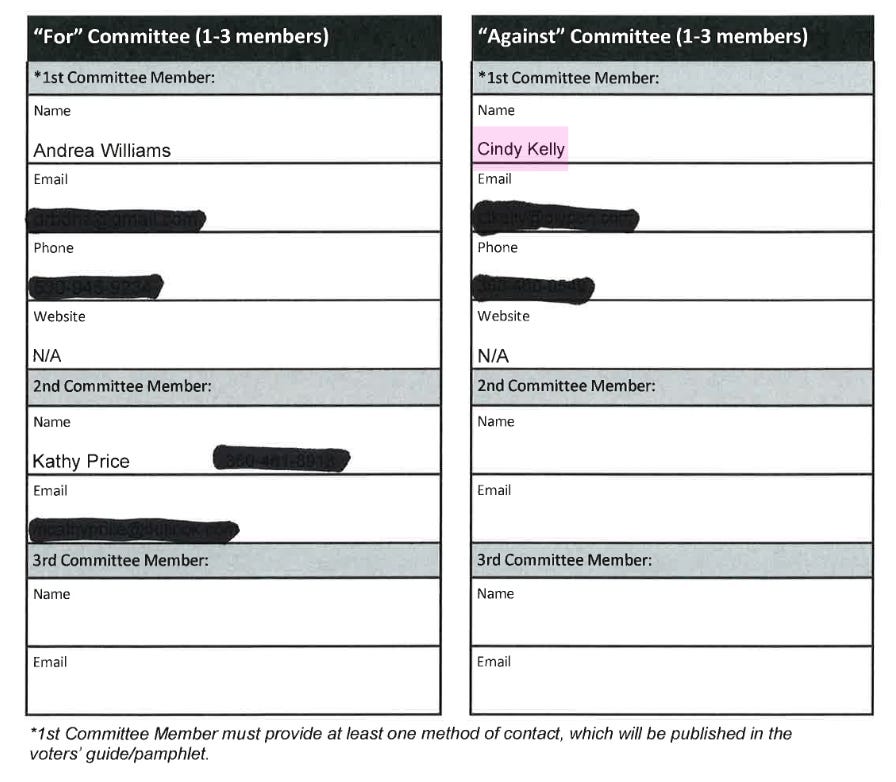
Kelly serves as a tribal ambassador for the Elwha Tribe. During the Charter Review process, it was revealed that Commissioner Jim Stoffer improperly shared confidential, attorney-client privileged documents with her—documents that were never meant to leave the Commission. That same Commission later voted to send the ethics measure to voters.
Even setting that aside, Kelly’s proximity to past ethical controversies has not gone unnoticed. A 2012 State Auditor’s report found that her husband, a former PUD employee, improperly received $24,726 in residency stipends over several years. While subsequent arbitration returned him to work, the Auditor’s findings were blunt: internal controls failed, public money was lost, and the district “allowed” it to happen.
Cindy Kelly then ran unsuccessfully in 2012 for a PUD commissioner position.
Voters can decide the initiative on its merits—but they are also entitled to scrutinize who is chosen to argue against it, and why.
Sequim’s New Library: Built Without Raising Property Taxes
Amid constant claims that new public infrastructure requires higher taxes, KONP Radio offered a useful reminder: the new Sequim Library was built without using local property taxes.

Instead, the project relied primarily on timber revenue from state trust lands, combined with grants, donations, and a low-interest state loan. When a 2018 bond measure failed by just 1%, that non-tax revenue made a scaled-down—but still modern—library possible.
Timber revenue is projected to cover more than $9 million of the $10.7 million project, with future harvests designated to repay the loan.
It’s worth remembering the next time an eco-activist chains themselves to a tree in the Elwha watershed or vandalizes DNR land: those harvests fund libraries, schools, and hospitals—not abstract line items.


People Aren’t Cycling In and Out of Jail—Except When They Are
At this week’s Commissioner Forum, a public commenter described county policy as a “perpetual loop”: harm-reduction spending on the front end, indigent defense on the back end, and taxpayers funding both.
County Administrator Todd Mielke responded by describing a clinical services model in the jail meant to stabilize individuals and connect them to services so they can focus on recovery rather than cycling through incarceration.
But the jail roster tells a different story.
Sergey Anatolevech Kubai—recently arrived from Montana—has now been arrested three times this month in Clallam County on multiple drug-related charges, including possession of stolen firearms and dangerous weapons. The previous two times, he was released within days.
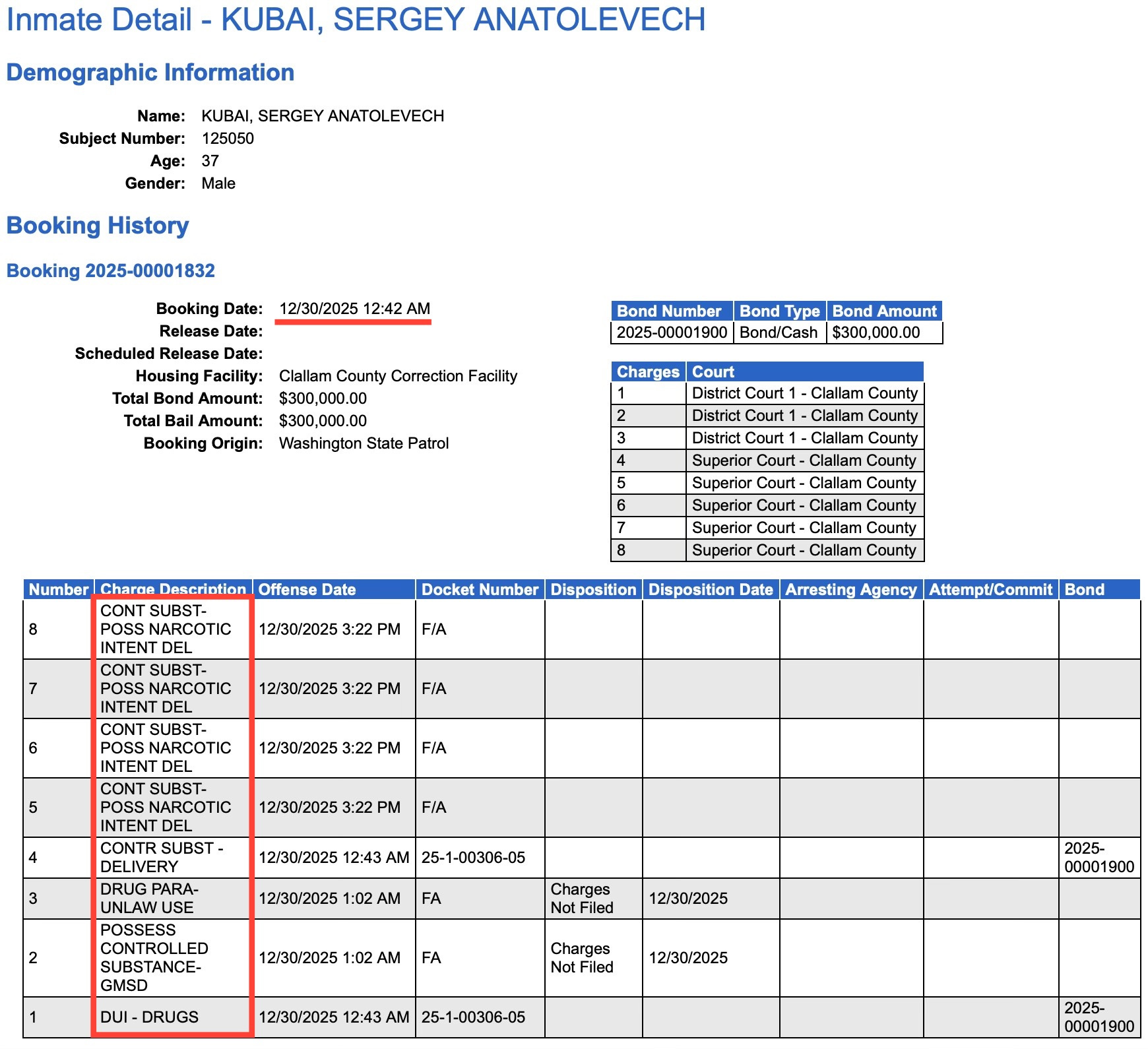

This is precisely the scenario residents worry about—and exactly what they’re told is not happening.
Food Bank Numbers—and the Question Nobody Asks
Some readers have questioned claims that the Sequim Food Bank serves 35% of local residents annually. Comments on CC Watchdog may explain why.
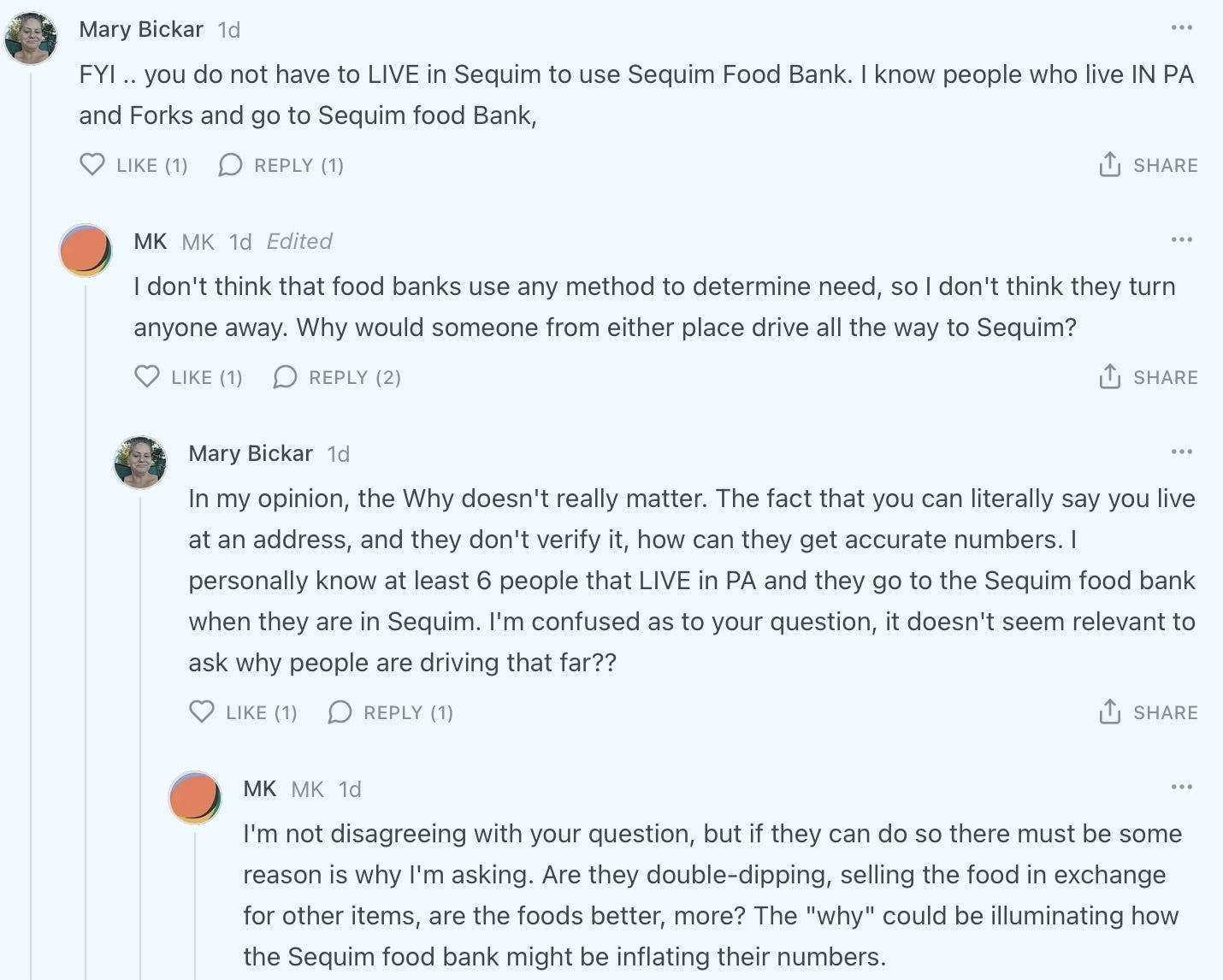
Commenters noted that residency is not verified and proof of income is not required, meaning residents from Port Angeles or Forks can—and do—use the Sequim Food Bank regularly.
Between the three communities, it’s theoretically possible to access food banks six days a week without spending a dime on groceries.
This isn’t an argument against food banks. It’s a question about metrics.
If a gas station gave away free fuel and 35% of locals filled their tanks, would that prove 35% couldn’t afford gas—or simply that free resources attract demand?
Want Transparency? Here’s Your Chance
The county is now seeking volunteers for For and Against committees to write voter pamphlet arguments on a proposed charter amendment requiring the full text of charter amendments to be printed in the local voters’ pamphlet.
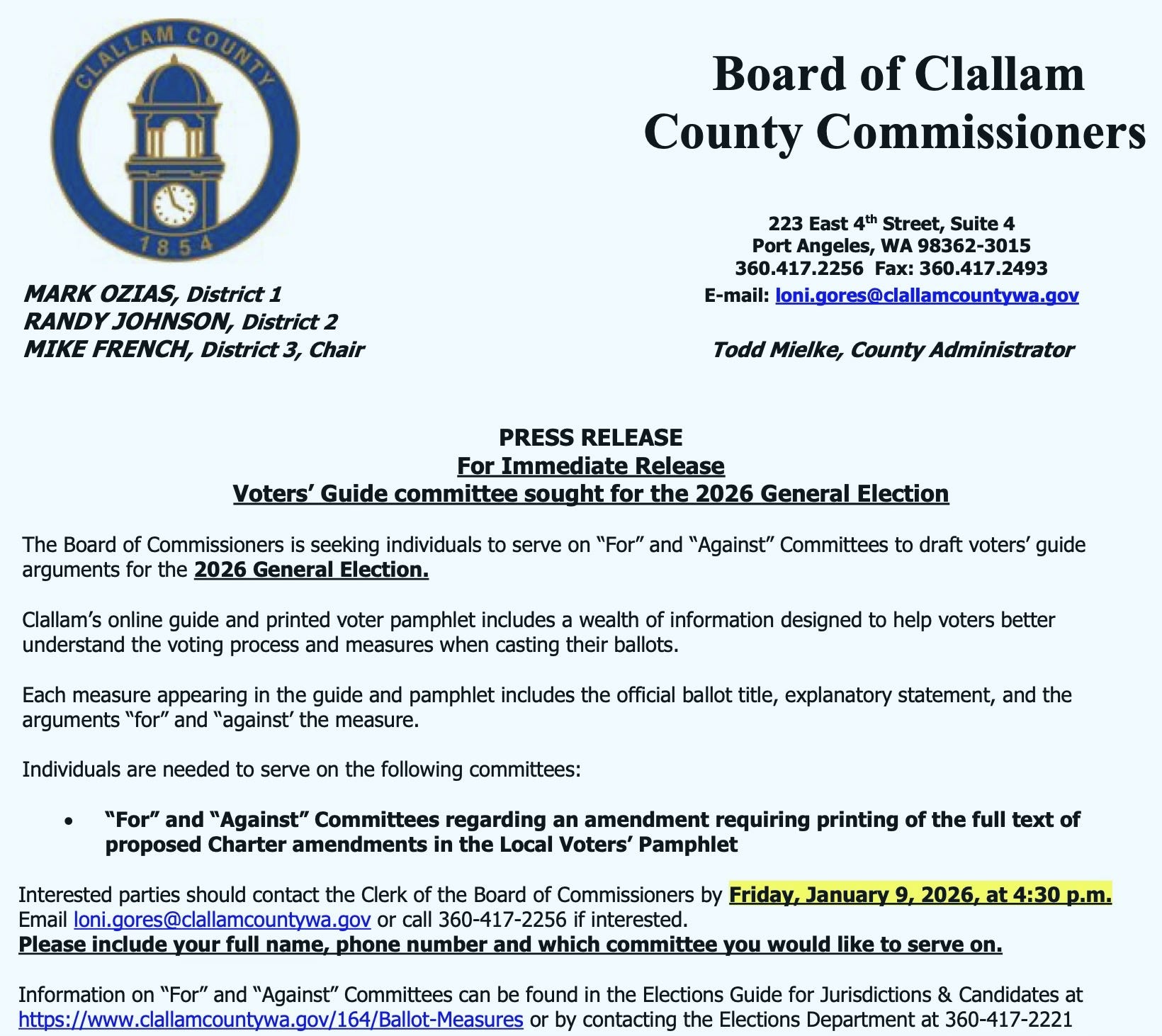
The amendment originated with Charter Review Commissioner Ron Richards and received broad support.
If you care about transparency, this is a concrete way to participate.
Public Safety Alerts—for Branches, Not Needles
The City of Port Angeles issues public advisories when falling limbs pose a safety risk in parks. But residents hear nothing when needles are found near playgrounds, tents occupy family spaces, or registered sex offenders fail to report while living in encampments in public spaces.
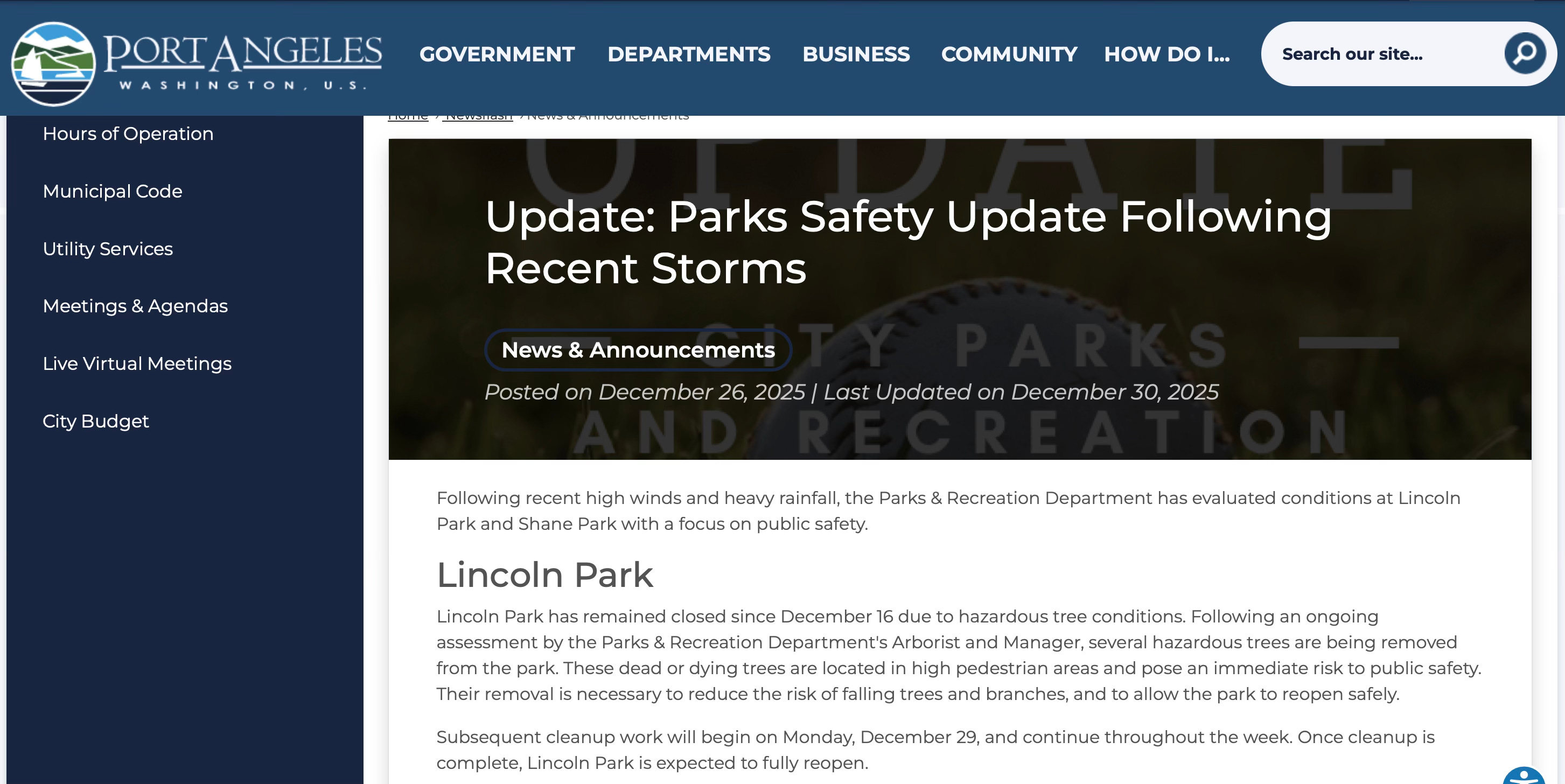
Falling branches may be a hazard, but they are not the most pressing one.


What Counts as “News” Anymore?
The Peninsula Daily News recently gave prominent coverage to racial disparities in Washington State Patrol traffic stops.
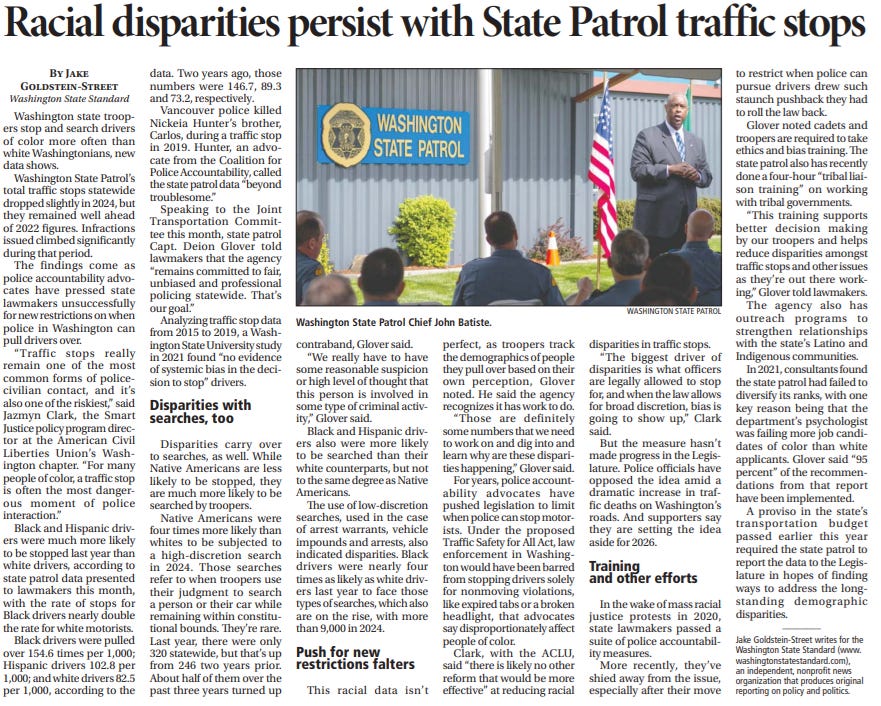
What drew attention was what received far less emphasis.
A violent assault on a Clallam Transit driver—an incident involving physical harm and passengers stepping in to restrain the attacker—was downplayed and folded into administrative coverage about agency leadership, rather than treated as a major local public-safety story.
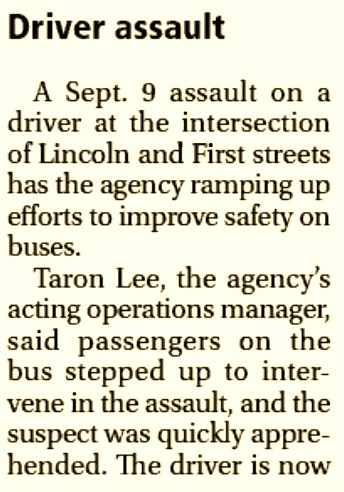
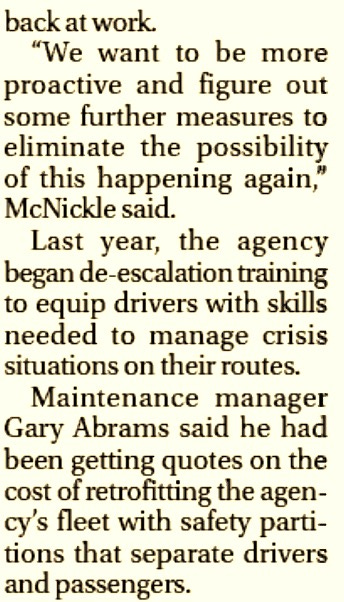
Editorial judgment isn’t just about what gets covered; it’s about placement and emphasis. When abstract, statewide narratives are elevated while immediate local violence is minimized, readers notice the disconnect.
A Preview of Coming Attractions
By now, you’ve seen the video: a Washington State Patrol lieutenant on I-5 in Seattle is pulled from her vehicle and carjacked in broad daylight. KOMO News reports the suspect later told officers he had smoked meth before the incident.
Here’s why it matters locally: in a county where taxpayer-funded meth pipes are distributed for free, the public is being asked to accept a new normal—visible addiction, public impairment, and the cascading crime that often follows. Even when officials insist this is about compassion, residents are right to worry about downstream consequences.
If meth-fueled violence can escalate to a trooper being yanked from her patrol vehicle on a major freeway on Christmas Day, it is not “fearmongering” to ask how long it will be before Clallam County experiences its own version of that story—on a highway near you.
An Example Worth Following
The Washington State Coalition for Open Government recently highlighted civic engagement across the state. On the Olympic Peninsula, Dr. Sarah Huling stood out.

Through public records requests, she sought evidence that county substance-abuse programs were achieving real outcomes—not just activity.
That work led directly to an article she authored for CC Watchdog. Dr. Huling is a medical technologist, an elected hospital commissioner—and now, proudly, CC Watchdog’s West End Correspondent.
Her example is simple and powerful: you don’t need permission to ask questions. You just need persistence.
And sometimes, that’s where accountability begins.


