


In this week’s Sundays with Seegers, County Commissioner candidate Jake Seegers describes how a gated, posted property he co-owns was entered by a county appraiser, sparking a constitutional challenge. After raising concerns under the Fourth Amendment and Washington’s Article I, Section 7, the Grays Harbor Assessor reviewed the issue and implemented corrective action. Seegers argues that this level of humility should be standard — particularly as counties expand aerial surveillance tools like EagleView — and questions whether Clallam County leadership will show the same respect for constitutional limits.
The Exceptional Exception
“I was wrong. Thank you for bringing this to my attention. I am taking immediate corrective action.”
Statements like this are rare in everyday life — and nearly unheard of from elected officials. Yet the most effective leaders embrace humility as a core discipline. They base decisions not on ego, tradition, or ideology, but on facts, data, and outcomes.
Recently, that kind of leadership came from an unexpected source: Grays Harbor County Assessor Dan Lindgren.
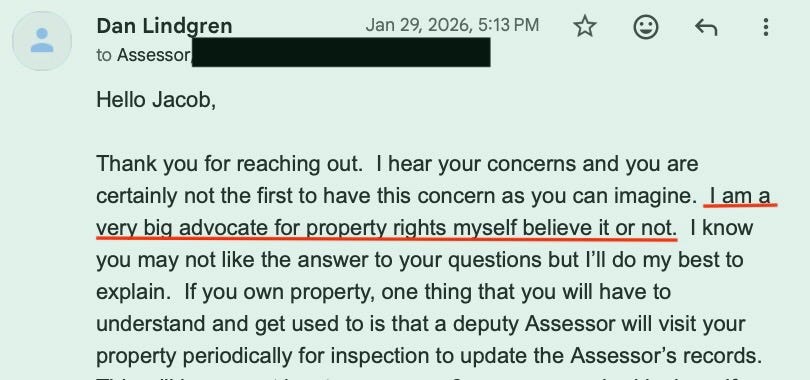
After two weeks of correspondence regarding constitutional property rights, I received the email below:
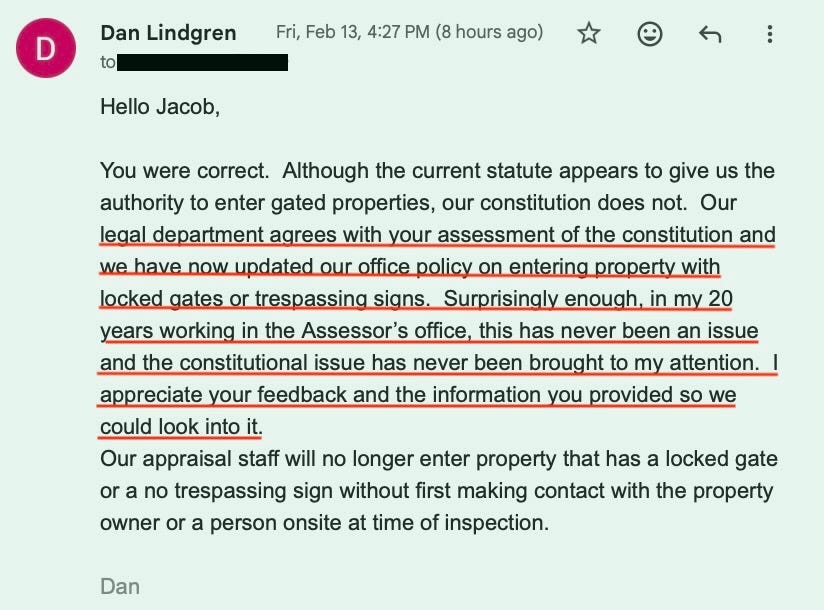
Although I was confident in my legal assertions — which I’ll outline below — I did not expect that level of humility, responsiveness, and course correction from a county official.
And that’s the problem.
We should expect it.
Mr. Lindgren’s response should be the standard — not the exception.
Returning to the Standard
Often, I’m asked why I decided to run for county commissioner.
I never aspired to be a politician. Like many Clallam County citizens, I simply saw changes in governance and outcomes that concerned me. I spoke up — repeatedly.
Unlike Assessor Lindgren, however, my county commissioners seemed more focused on defending their positions than solving the issues raised. If they responded at all, it followed a familiar pattern:
• Acknowledge and refute citizen concerns in a single email
• Radio silence to follow-up questions
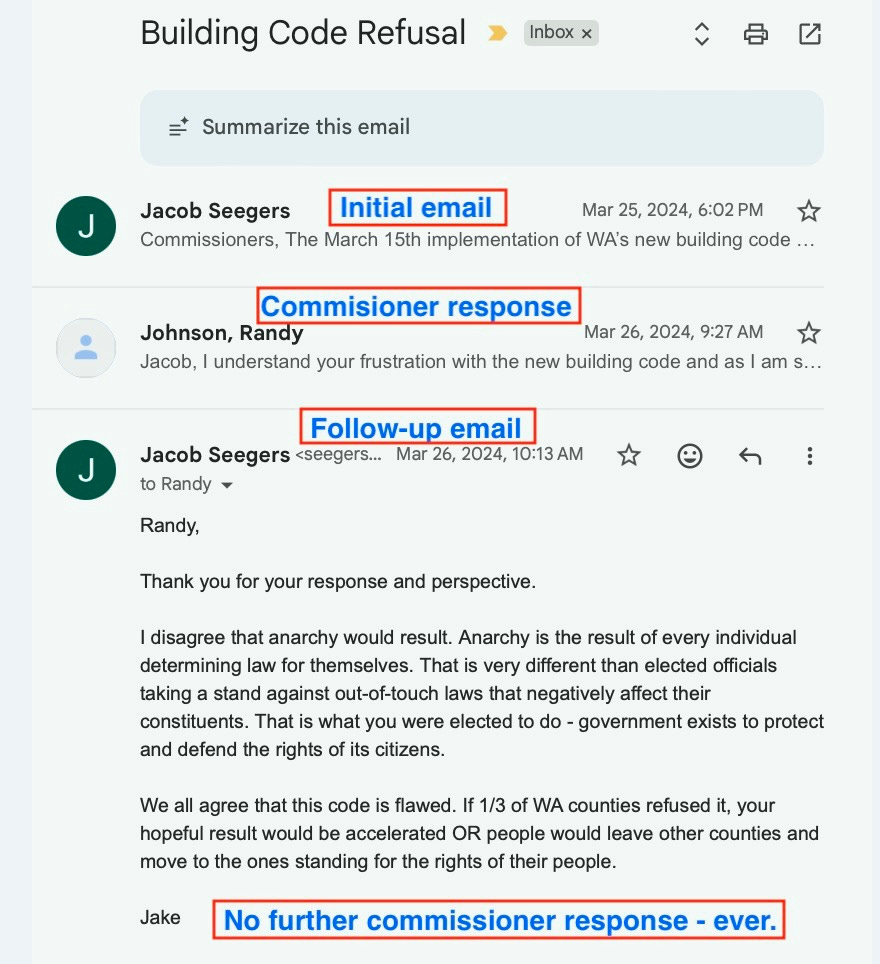
Over and over, I felt unheard, unseen, and unrepresented. As I engaged with my neighbors, I realized I wasn’t alone.
That realization left me with a choice: continue enjoying a comfortable life with my family in paradise and hope for the best — or step up and fight for Clallam County’s future so that our friends, neighbors, kids, and grandkids can thrive here too.
Some of the threats to our way of life come from policy choices rooted in ideology. Others come from something more subtle — improper interpretation or overextension of the law.
It is essential to question our leaders, know our rights, and defend them when they are misapplied or ignored.
Government officials are human. They can misinterpret statutes. They can rely on incomplete information and on training or advice that may not align with lawful practice. They often default to black-and-white answers for complex legal questions. And sometimes, they overstate and overstep their authority.
We hear it constantly:
This is allowed. That is not.
This is enforceable. That is not.
The code means this.
The assessor has the right to…
The citizens must…
Case closed.
But the law is rarely that simple. Definitions have context. Constitutional rights provide limits.
A few weeks ago, that reality hit close to home again.
Overstepping the Right to Privacy
My family and some close friends own a small camping parcel in Grays Harbor County. It’s remote. The area struggles with trespassers, theft, and illegal dumping. So, we installed a locked gate, posted “No Trespassing” signs, and set up cameras. We coordinate with neighbors to protect one another’s property.
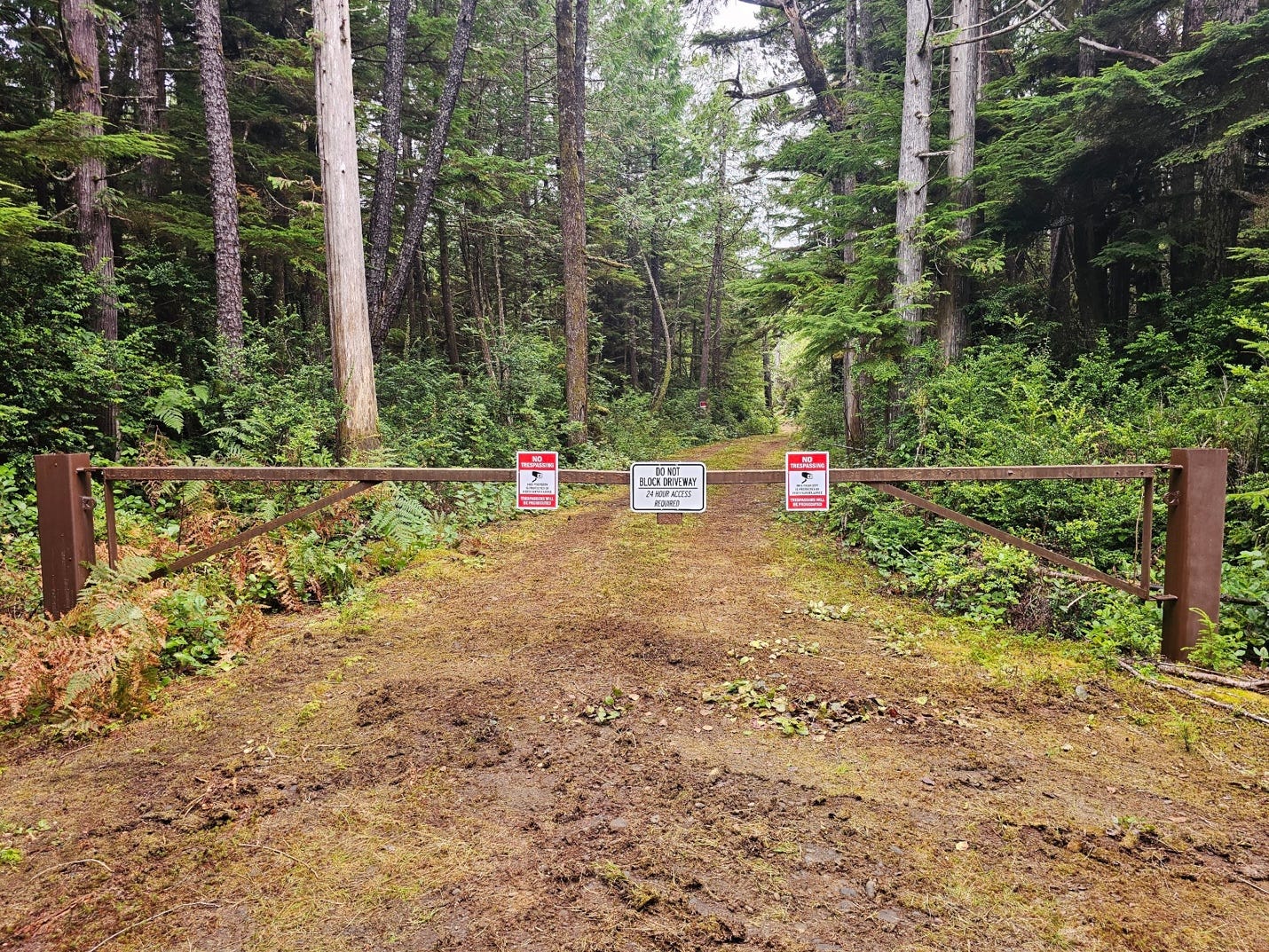
Recently, our camera captured a county appraiser ignoring the gate and signage and entering the property without notice or permission.
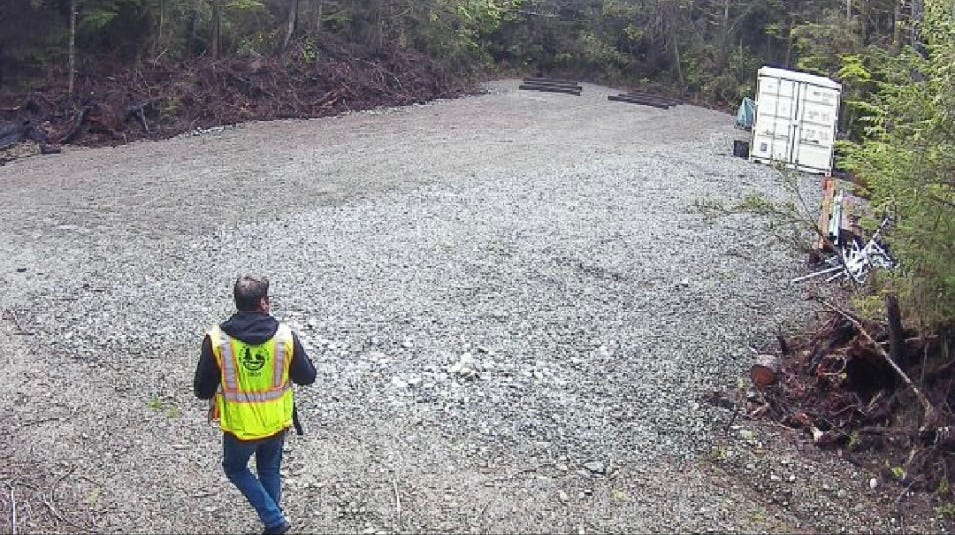
Not a criminal. A government official – paid by our property taxes to protect our property rights.
I was stunned — and frankly furious.
I felt something similar last year when I learned that the Clallam County commissioners had approved funding for EagleView’s high-definition aerial photography and 3-dimensional property surveillance software to inspect private property countywide — with virtually no public discussion of the privacy implications. Read more about it here.
These systems use low-flying aircraft equipped with high-resolution cameras capable of sub-inch accuracy from multiple angles.

EagleView advertises the ability to read text on road signs and manhole covers.
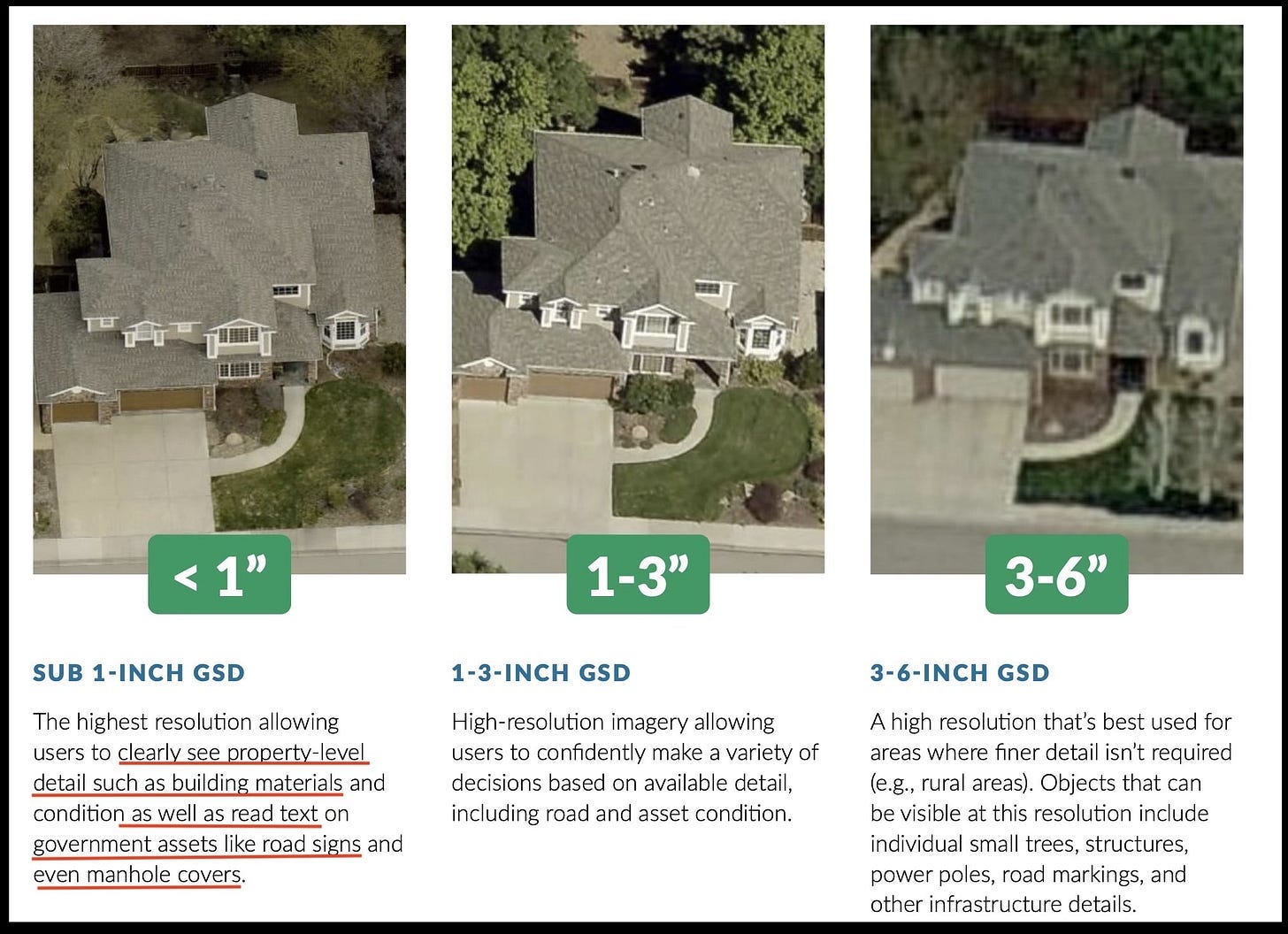
The company demonstrates the resolution of its imagery down to the size of a golf ball in the following video:
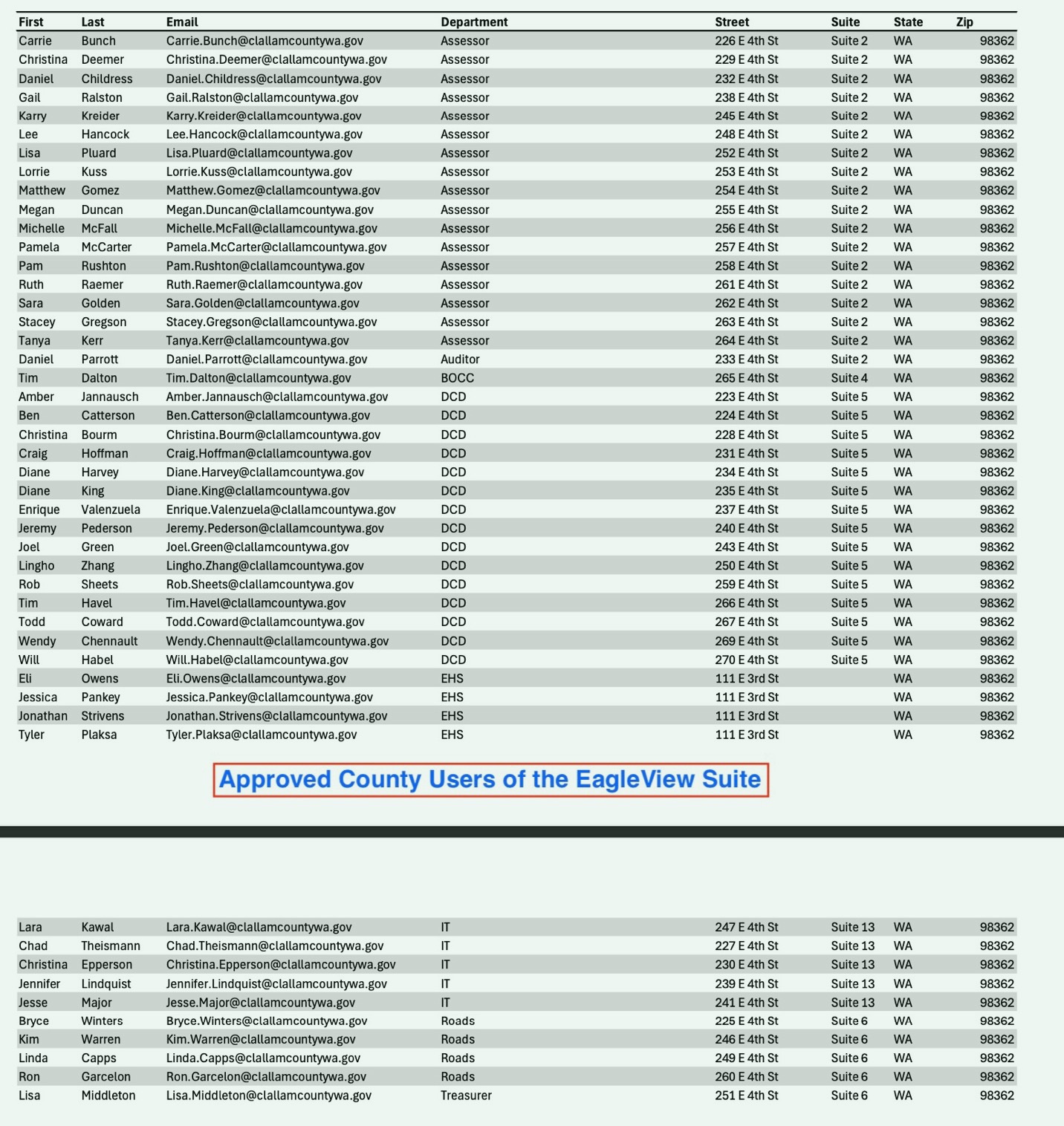
Even more concerning, this technology has expanded well beyond the Assessor’s Office, with nearly 50 user accounts now spread across multiple Clallam County departments and functions.
Grays Harbor – The Exchange
On January 29th, I emailed the Grays Harbor Assessor, Dan Lindgren, and expressed my concerns.
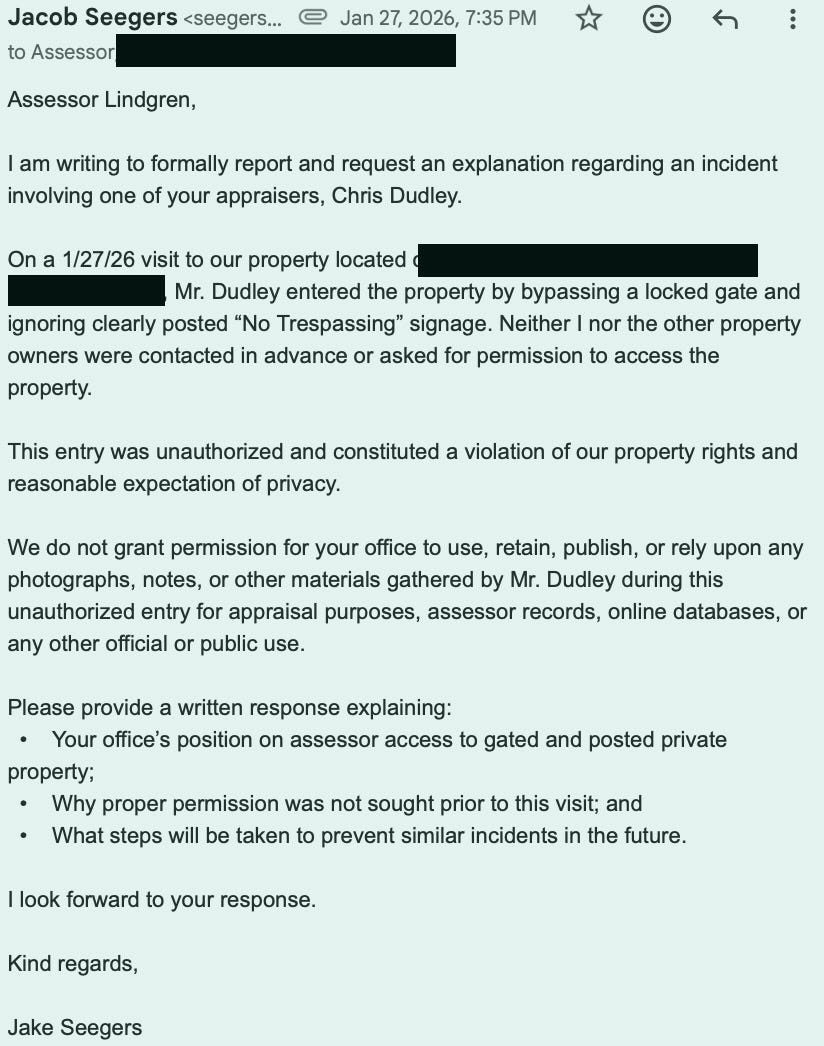
The assessor responded promptly and professionally, stating:
“I am a very big advocate of property rights myself, believe it or not.”
He went on to cite RCW 84.40.025 and WAC 458-07-015 as authority to enter posted and gated property.
His position was clear: assessors have lawful authority to bypass trespass law.
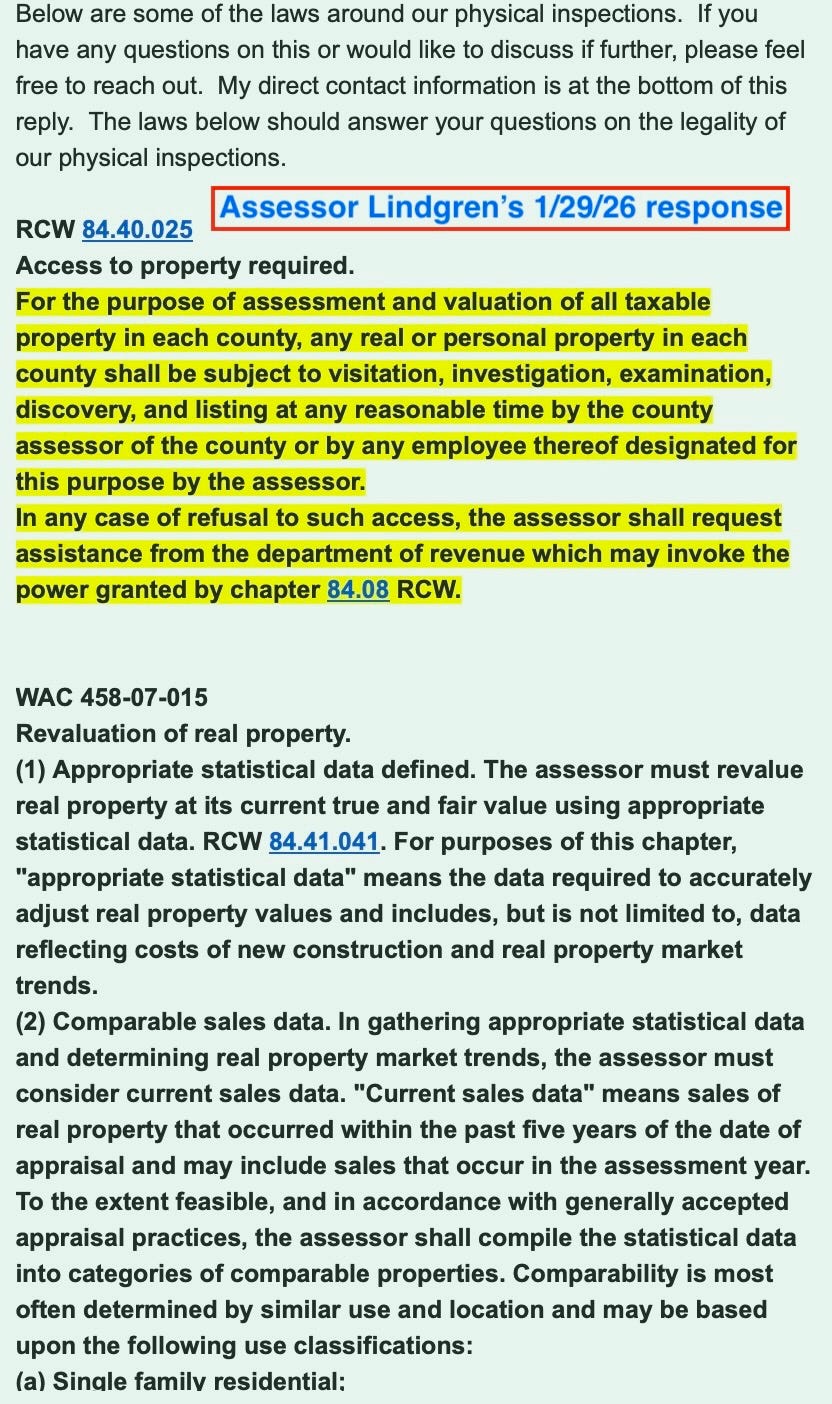
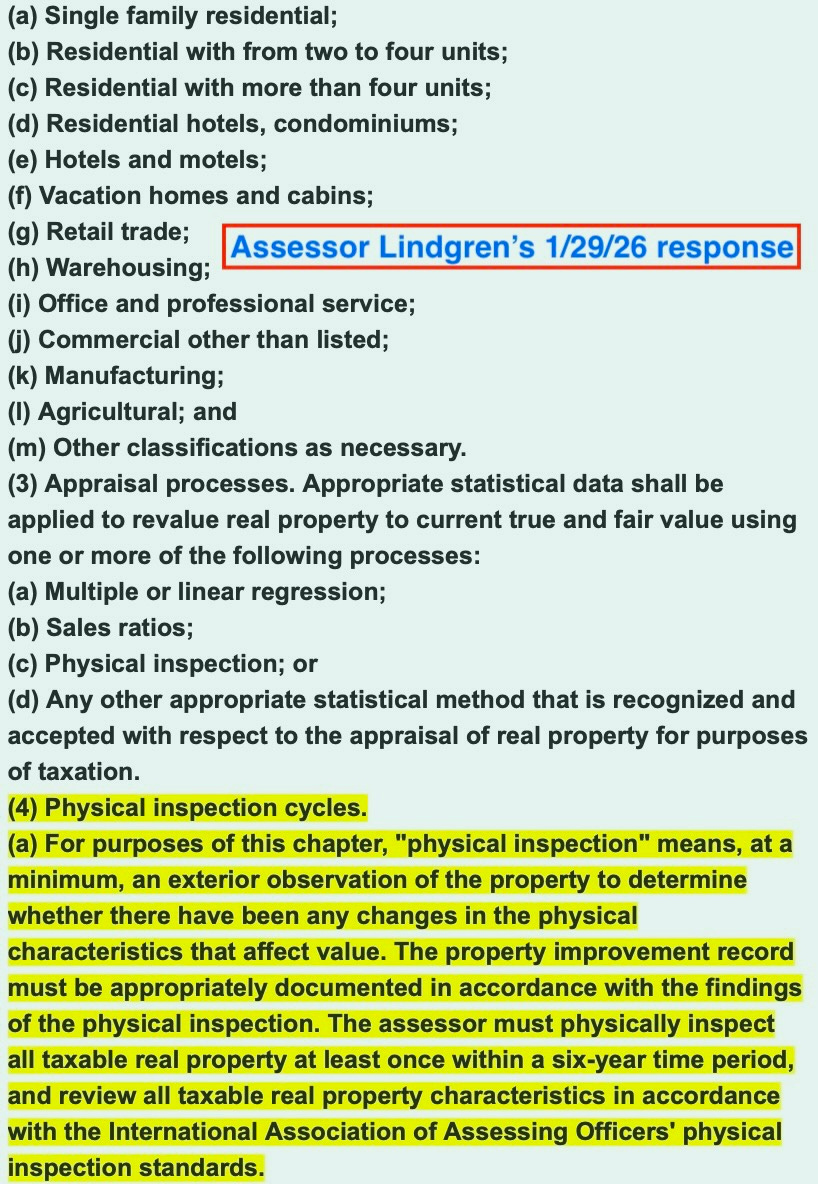
The response was clear and absolute: the assessor has the lawful right to bypass trespass law and inspect property at any time.
But constitutional rights limit these stated authorities.
RCW and WAC do not override constitutional protections — including the Fourth Amendment and Article I, Section 7 of the Washington Constitution.
In Camara v. Municipal Court (1967), the U.S. Supreme Court held that administrative inspections are searches under the Fourth Amendment and generally require consent or a warrant. In See v. City of Seattle (1967), the Court extended that protection to commercial property.
Washington goes even further.
Article I, Section 7 protects “private affairs,” not merely “reasonable expectations of privacy.” Washington courts have repeatedly interpreted this language to provide broader protections than those afforded by the federal Constitution.
Former Washington Assistant Attorney General Phyllis Barney outlined these rights in a public presentation on access laws.
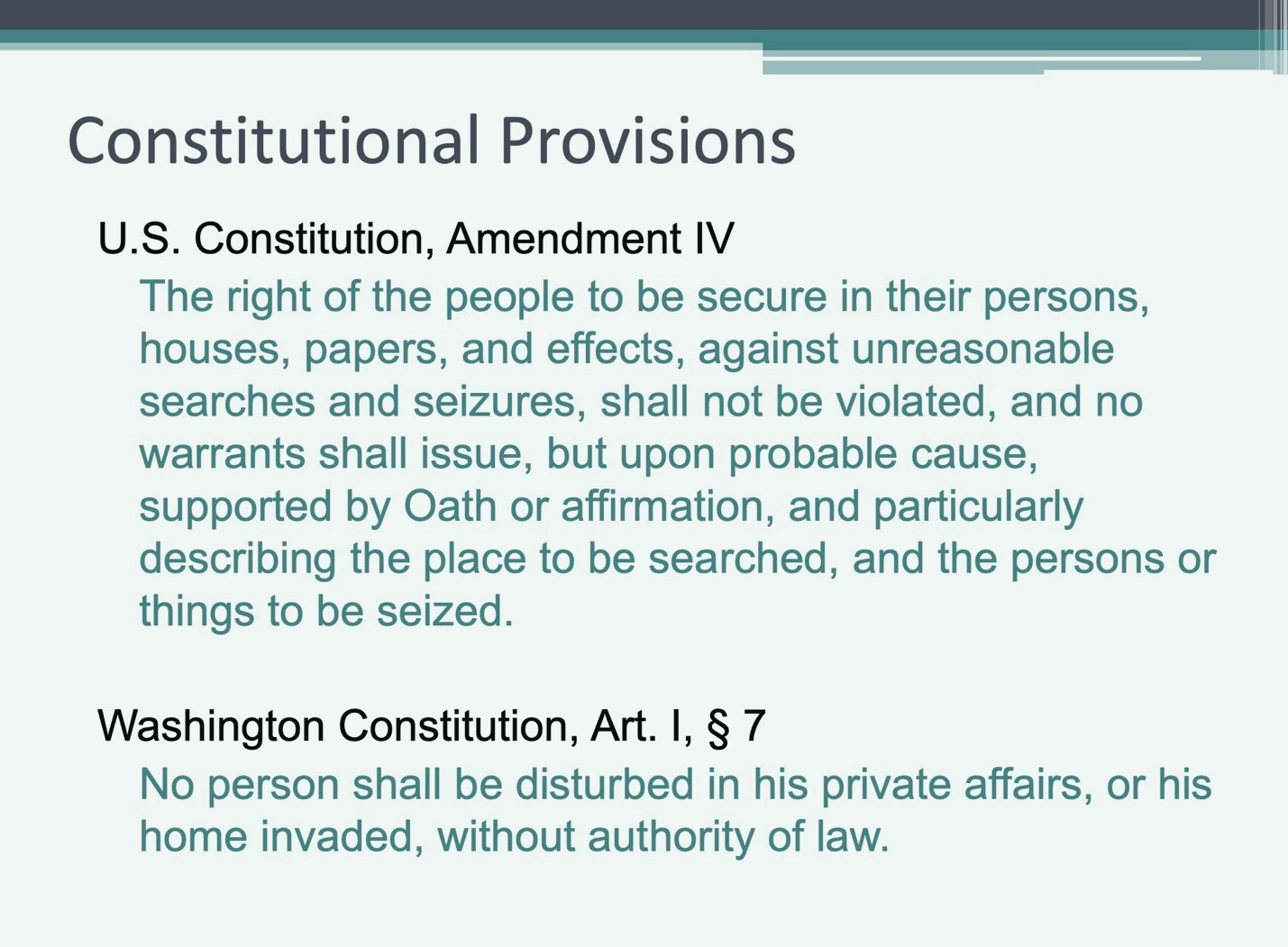
She explained that state actors — including assessors — may enter without consent only under narrow exceptions:
A valid warrant
A pervasively regulated business
Open view from public access
Certain routine health and safety inspections
Exigent circumstances involving immediate public safety
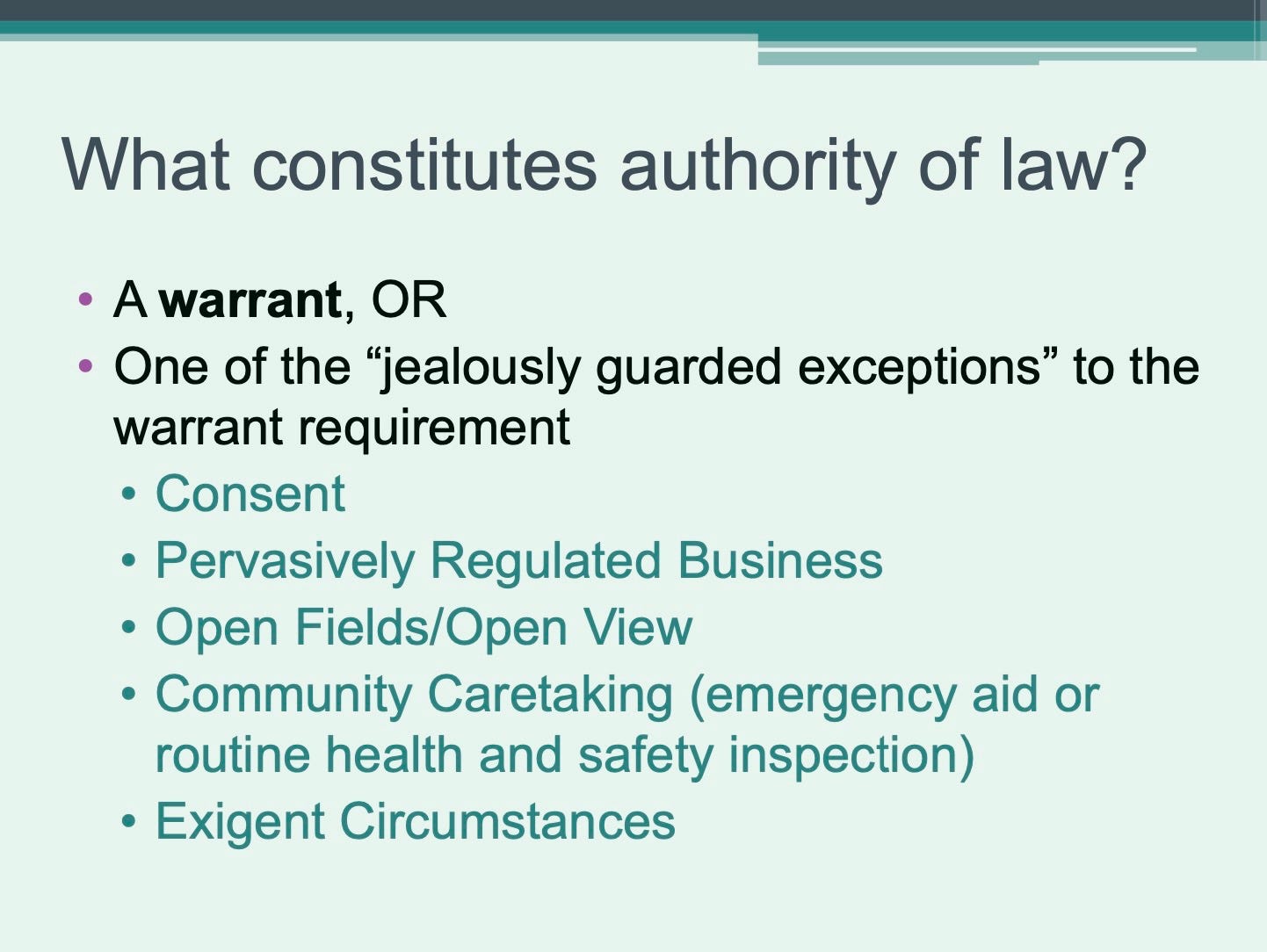
Outside those exceptions, constitutional protections remain intact.
I shared these authorities and limits with the assessor.
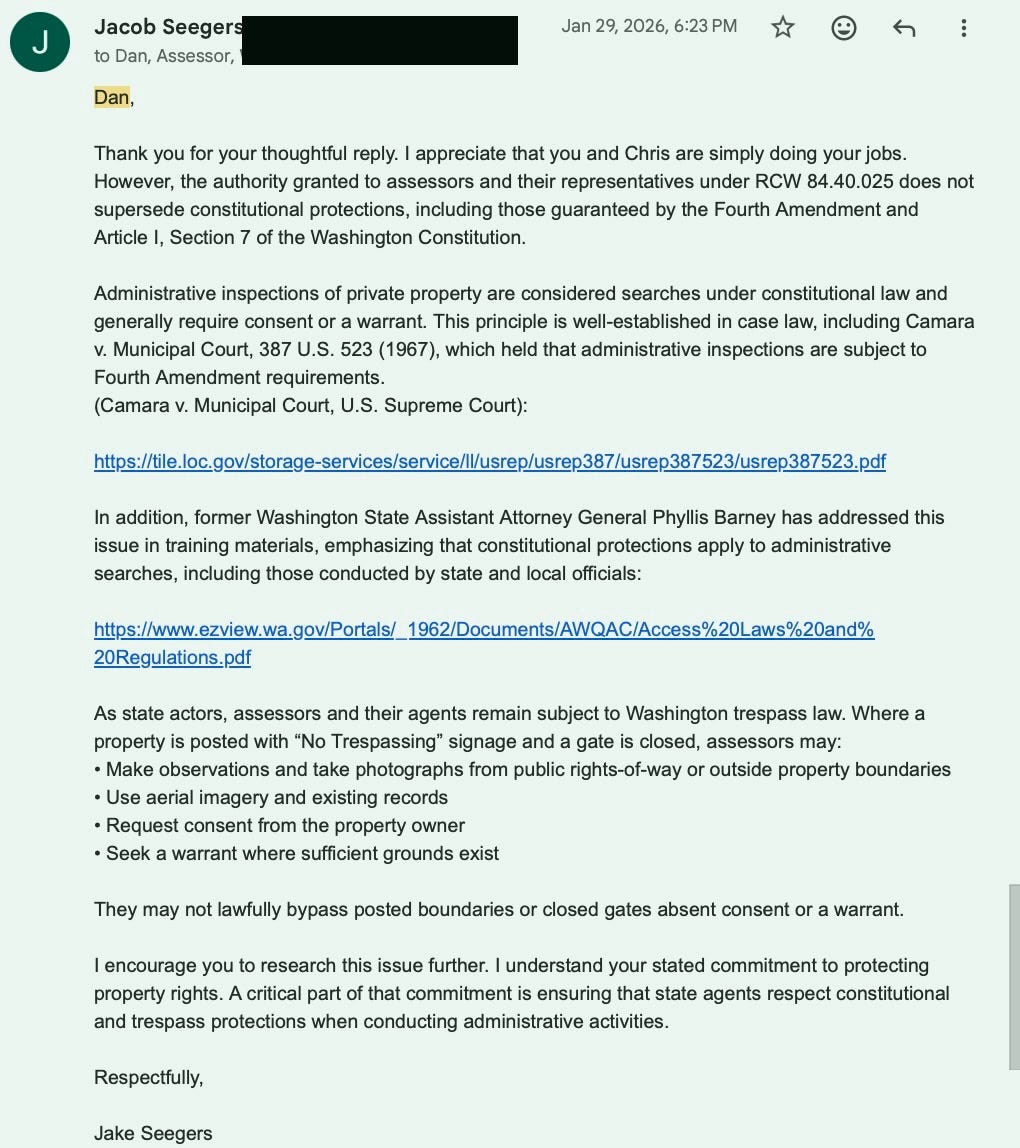
In his follow-up response, Assessor Lindgren’s position appeared to shift.
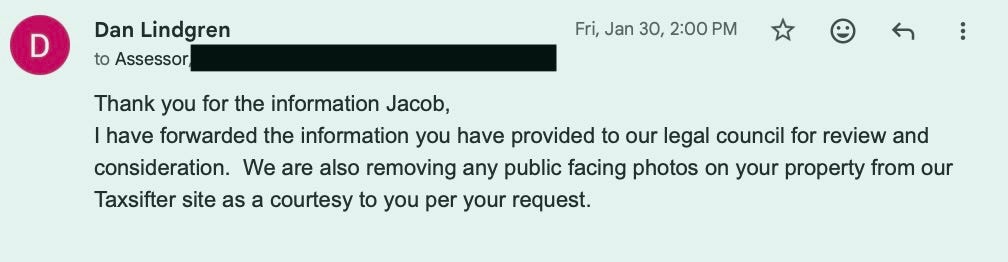
He offered to provide me with an update when he heard back from the county’s legal counsel.
Two weeks later, he sent the email at the beginning of this article — and had already implemented corrective action within his department to address what he described as a long-standing misinterpretation of the law, restoring important privacy protections for Grays Harbor citizens.
That is leadership. That is representation.
He could have dismissed my concerns. He didn’t. He evaluated the facts and adjusted.
Why This Matters
When citizens engage respectfully and knowledgeably, officials have an opportunity to reconsider.
Oversight does not belong solely to boards, staff, or agencies. It belongs to informed citizens willing to stand up for their rights.
If we do not question authority, authority expands.
If we do not defend our rights, they erode.
If we do not engage, we surrender representation.
That is why I am running.
Because this paradise is worth protecting — and so are the rights, safety, and quality of life of the people who call it home — both now and in the future.
What You Should Know
You have privacy protections under the Fourth Amendment and Article I, Section 7 of the Washington Constitution.
You may refuse entry to posted and gated private property absent a warrant, or narrow exceptions.
Assessors may inspect from public roads or seek consent or a warrant for on-site entry.
What Can You Do?
1. Clearly post signage and secure your property.
2. Contact Clallam County Assessor Pam Rushton and ask her if her office has adopted similar property rights protections as Grays Harbor.
Express privacy concerns related to EagleView’s imagery and software suite.
In my experience, Assessor Rushton has been responsive, courteous, and professional. That level of engagement is genuinely appreciated.
3. Contact the Board of Commissioners
The most effective way to reach all three commissioners is by emailing the Clerk of the Board at loni.gores@clallamcountywa.gov.
Consider asking:
• What safeguards exist to protect constitutional privacy rights?
• How is aerial imagery being used beyond assessment functions?
• What policies ensure constitutional compliance?
Last week, Jake Seegers asked readers what single change they would make to “Title 33,” the county’s zoning and land use framework. Of 95 votes:
47% said, “I disagree with all of the above”
28% said, “Allow more than one vacation rental”
14% said, “Allow two occupied RVs”
11% said, “Allow RVs as vacation rentals”
Editor’s Note: CC Watchdog editor Jeff Tozzer also serves as campaign manager for Jake Seegers during his run for Clallam County Commissioner, District 3. Learn more at www.JakeSeegers.com.


