


In this week’s Sundays With Seegers, county commissioner candidate Jake Seegers responds to claims that volunteer syringe cleanups amount to “theft” and offers a documented tour of encampments along Tumwater Creek. Contrasting government discussions with on-the-ground conditions, he questions whether current harm-reduction policies are delivering measurable results and calls for stronger accountability, enforcement, and a renewed focus on treatment and restoration.
The Syringe Heist
Just hours before Joe DeScala, founder and CEO of 4PA, presented a boots-on-the-ground perspective on homelessness to the City of Port Angeles City Council, Clallam County Health Officer Dr. Allison Berry was publicly criticizing his efforts during the February 17th Board of Health meeting.
While discussing syringe collection (approx. 1:00:30 mark), Dr. Berry expressed her irritation:
“I live here. Have kids in PA. I don’t want needles on the ground, so we work hard to get them back. I think it’s important to acknowledge that some of our supplies that are turned in by people who find them are folks who are cleaning up encampments that people still live in. So, that cleaning up is actually theft. It’s taking supplies that someone is still using.”
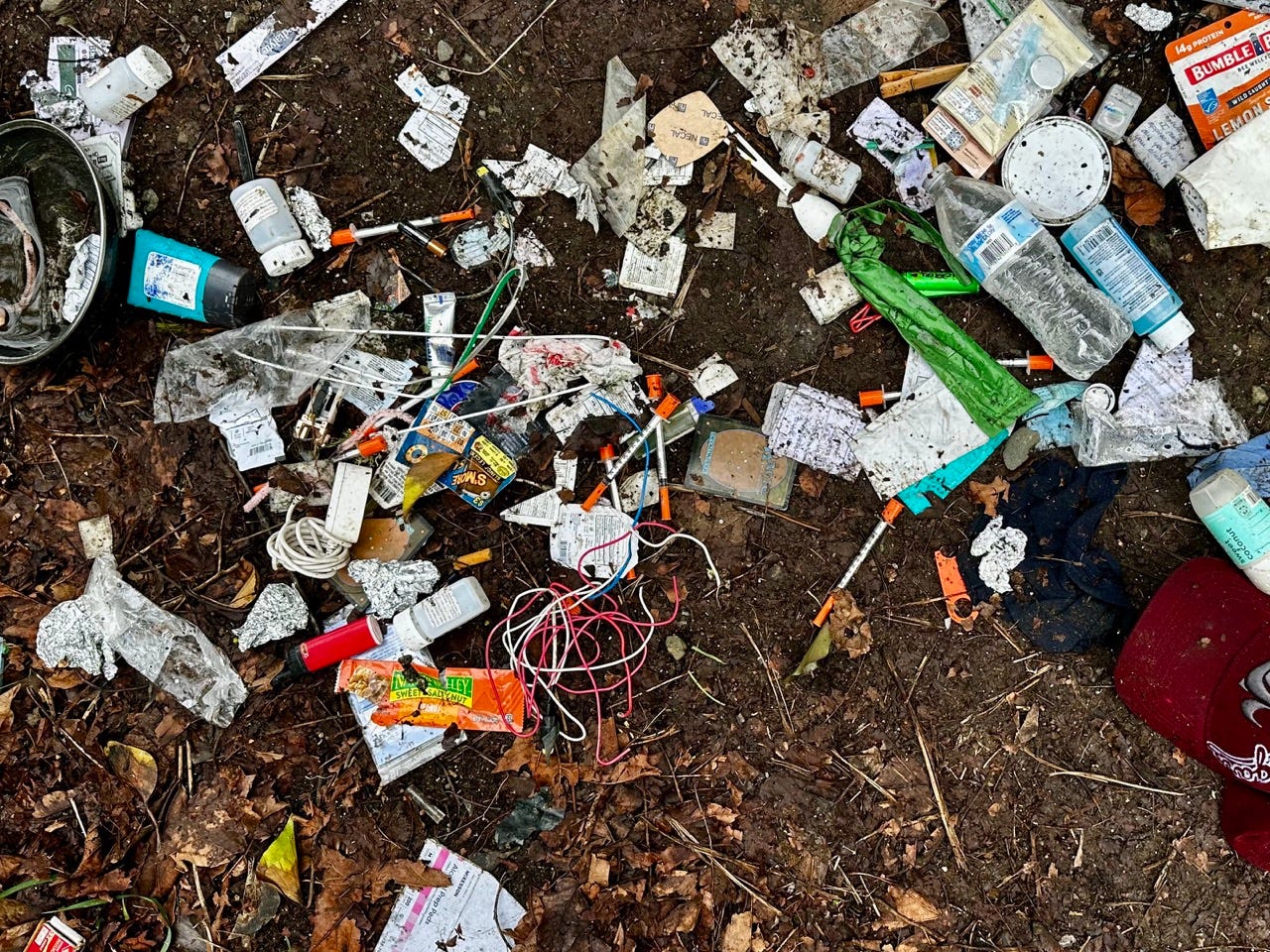
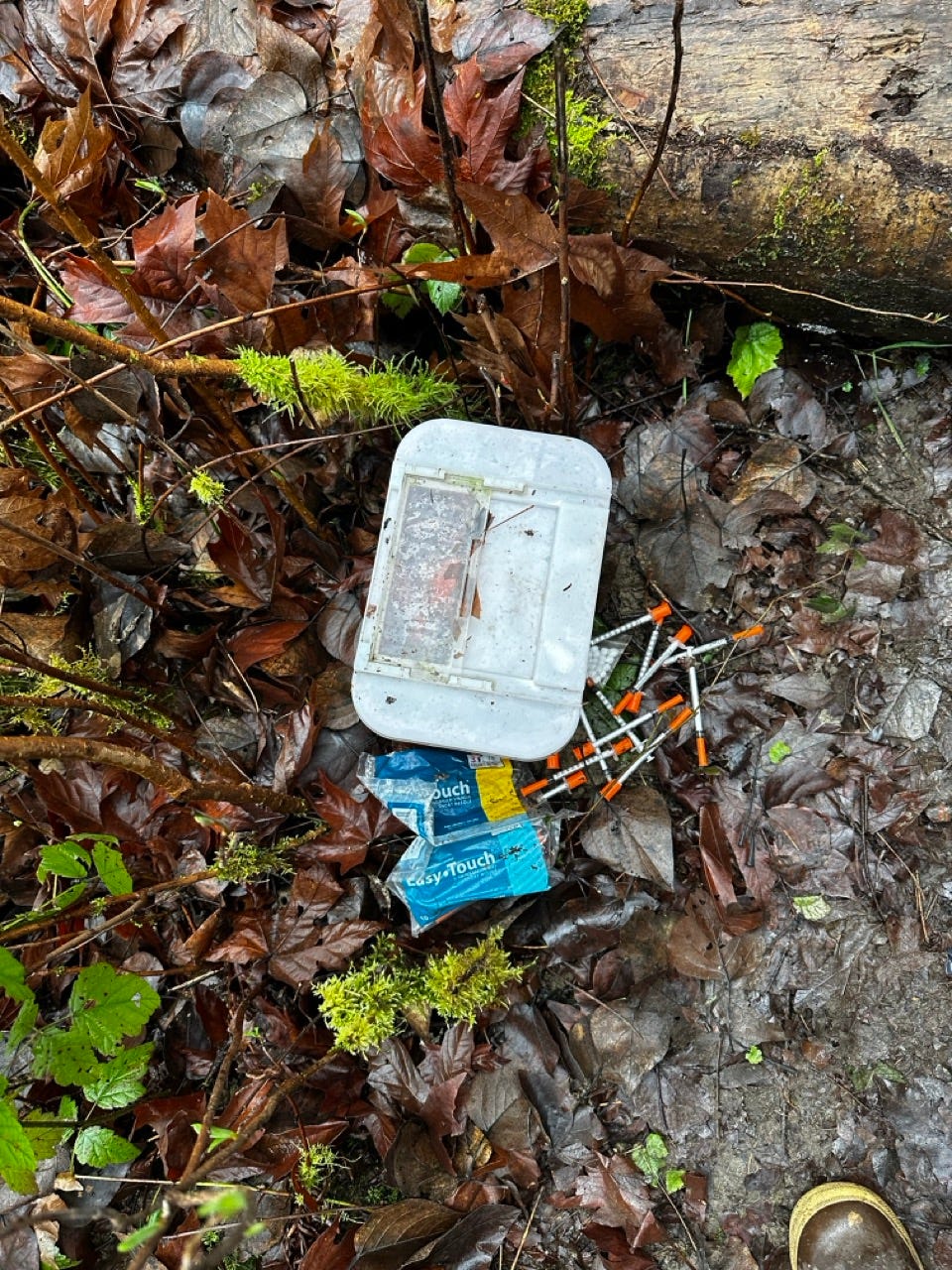
Syringes (above) near a currently occupied structure built into the 8th Street bridge (shown below).
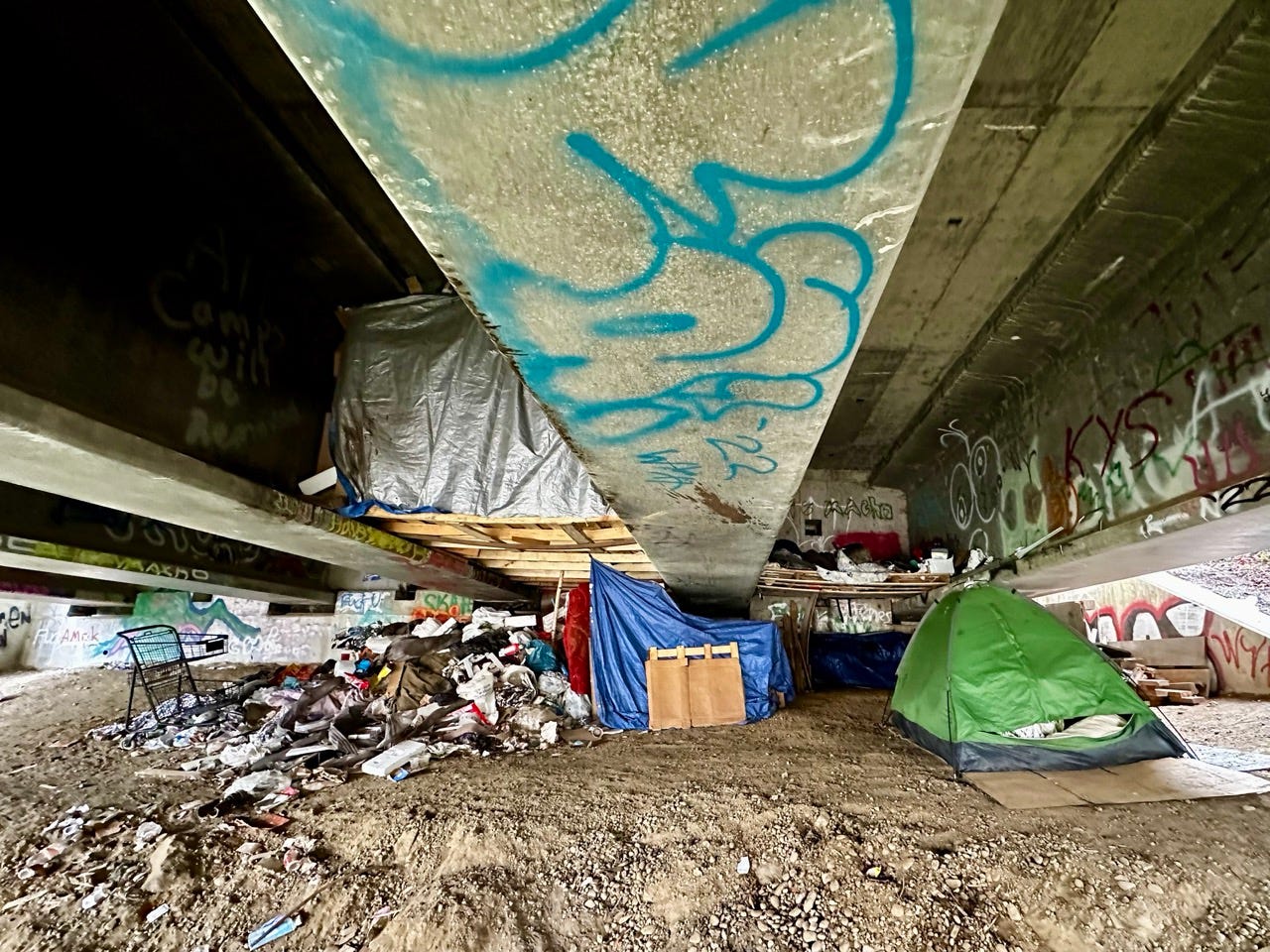
Ironically, the accusation — that people cleaning encampments are committing “theft” — came amid Dr. Berry’s presentation seeking to correct what she described as the public’s “fundamental misunderstanding” of harm reduction.
But had the Health Officer spent time working directly with 4PA, she would have understood that 4PA operates under strict internal safeguards before conducting any cleanup. Authorization from law enforcement, confirmation of abandonment, multiple site visits with no activity, and direct communication with prior occupants are all part of the process designed to avoid removing personal property.
Joe DeScala explained the process clearly to the City Council:
“If there’s any inkling that I’m not 100% sure [that the location is abandoned], we don’t do it. I make sure that I contact our partner agencies, we work with code enforcement. We often times work directly with the folks after they have left an encampment. I’ve got their phone numbers. We text back and forth. They’ll let me know when they’re done with a location.”
This is not vigilante cleanup. It is coordinated, documented, and deliberate.
The real theft is the appropriation of taxes to fund harm reduction that many residents never supported and believe is failing — a heist planned and executed by Health Officer Berry, the commissioners, and Health and Human Services.
“Let Them Live That Way”?
At the same council meeting, Port Angeles Councilmember LaTrisha Suggs suggested helping homeless individuals live the life they are “choosing to live” along Tumwater Creek by providing large trash receptacles so that camps don’t become uninhabitable.
On paper, that may sound compassionate.
On the ground, it is detached from reality.
When trespass and solid waste ordinances are not enforced on public land, there is little incentive to maintain or restore a site. Camps deteriorate. Trash accumulates. Fires occur. Environmental damage spreads. When conditions become unlivable, individuals move to a new location — often re-occupying a site that volunteers have just restored.
On December 9th, 2025, 4PA staff and volunteers cleaned underneath the west end of the 8th Street Bridge.
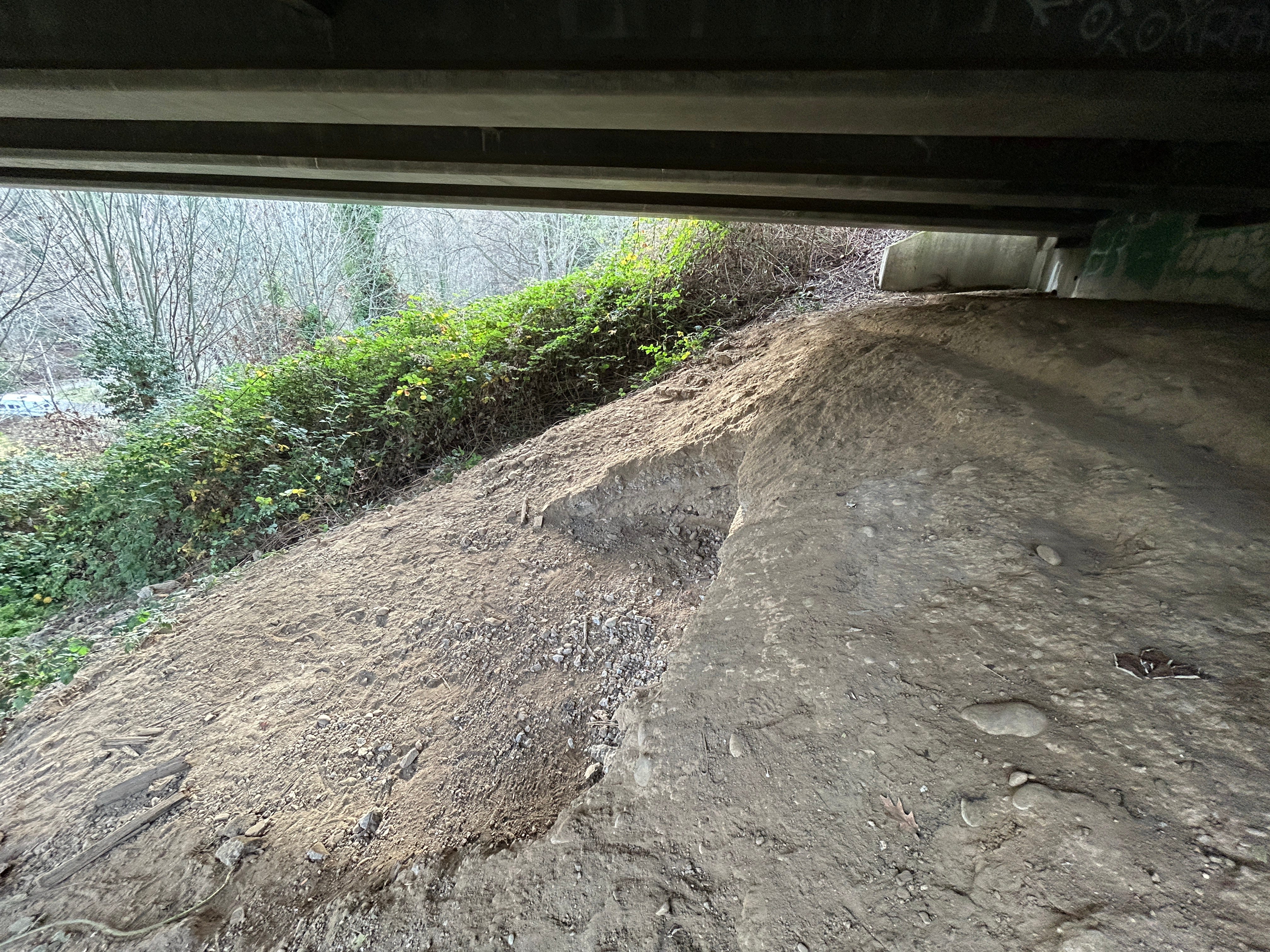
Two months later, the site was once again occupied and littered.
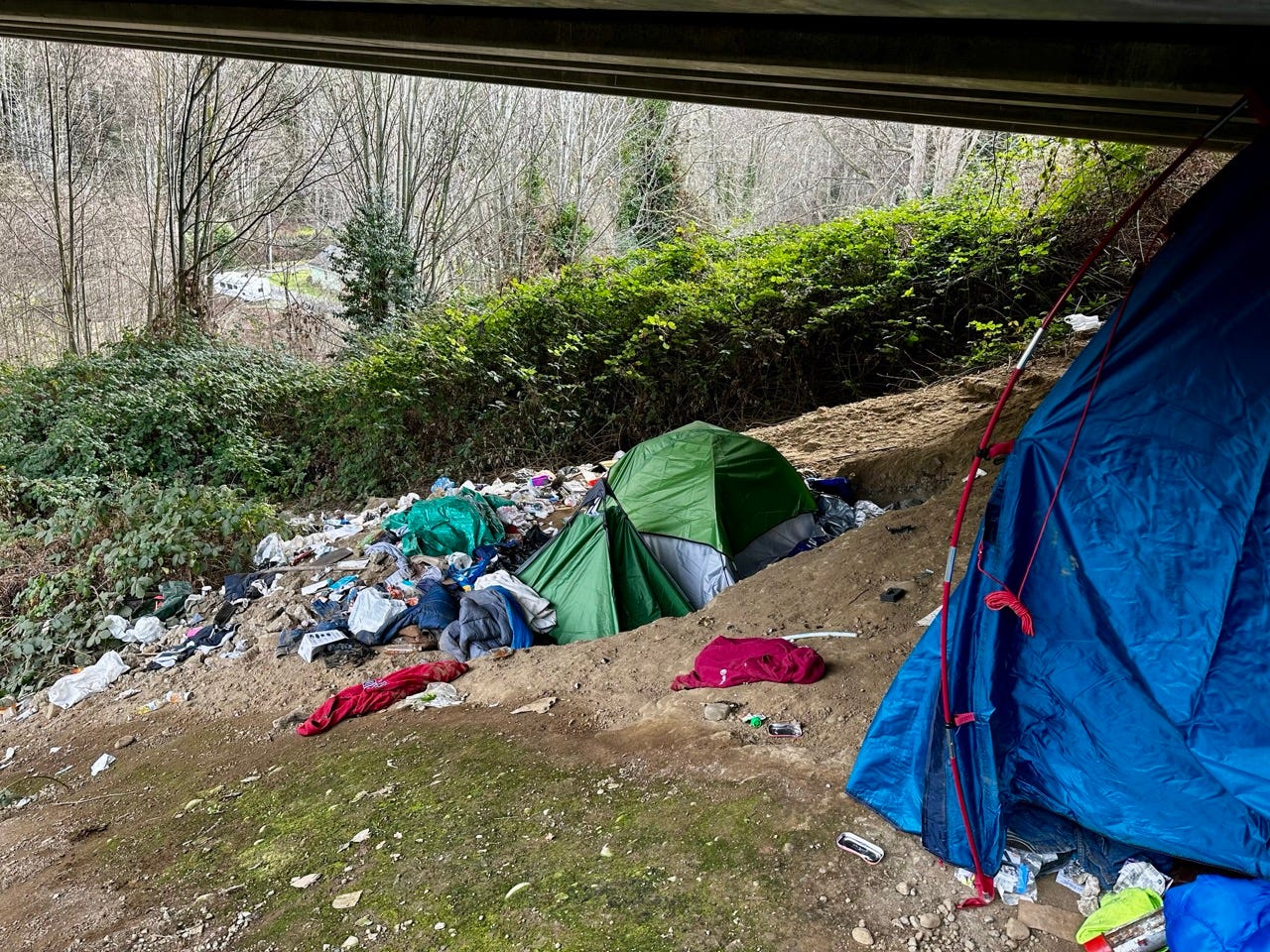
The pattern repeats.
If Ms. Suggs were to walk along Tumwater Creek from Marine Drive to Highway 101, she might find that on-the-ground conditions differ from how they’ve been characterized. To provide helpful context, this article includes a visual overview below so Ms. Suggs, Dr. Berry, and other local officials can review the current conditions without leaving their offices and take the images into account as they continue the conversation.
A Tour of Tumwater
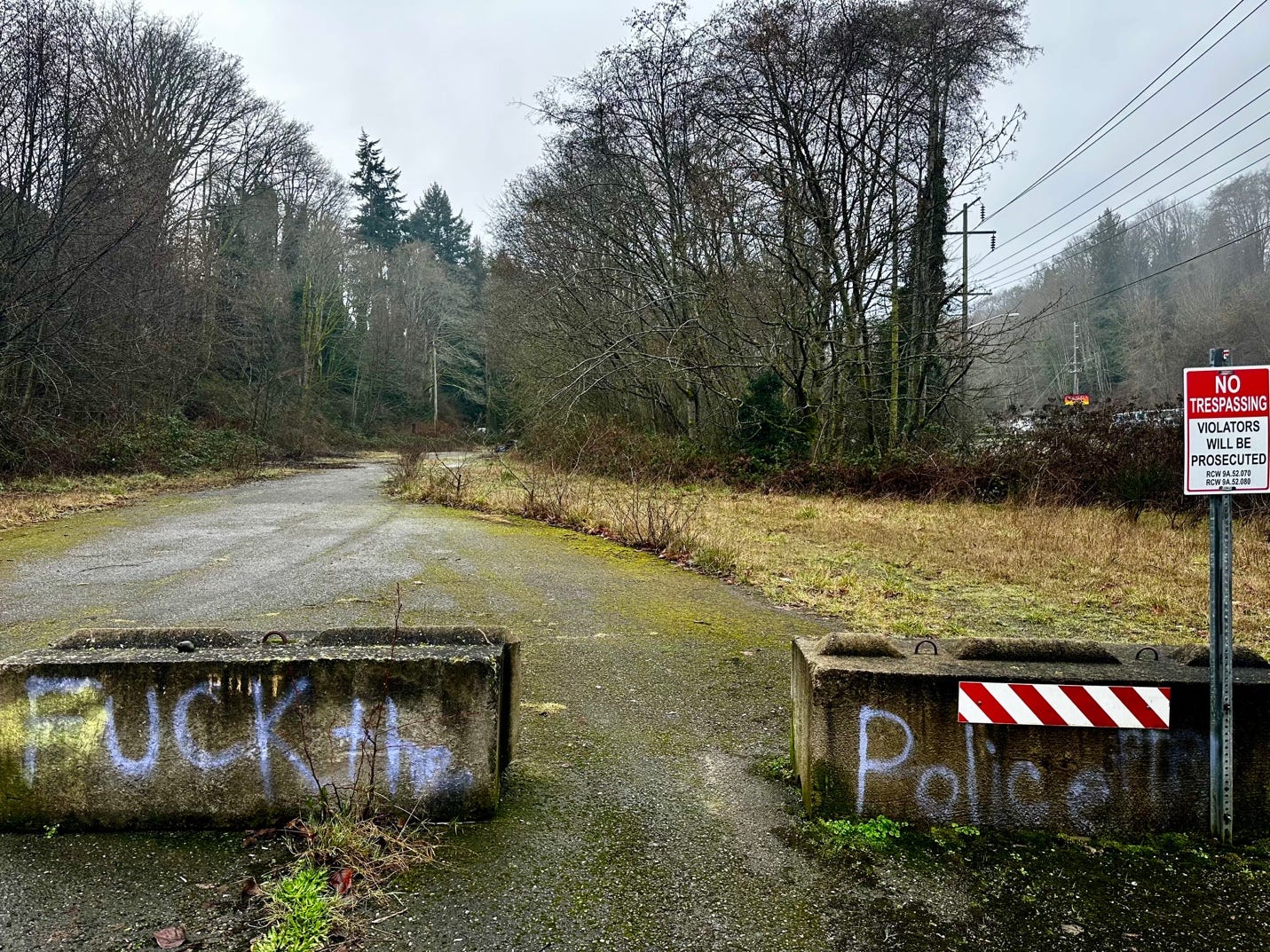
A walk along Tumwater Creek from Marine Drive to Highway 101 reveals the real-world consequences of policies shaped in board rooms and council chambers. While not exhaustive, this photo tour offers a representative snapshot of the Tumwater Creek corridor. The tour begins at the concrete barricades just south of W. Marine Drive and the Tumwater Truck Route.
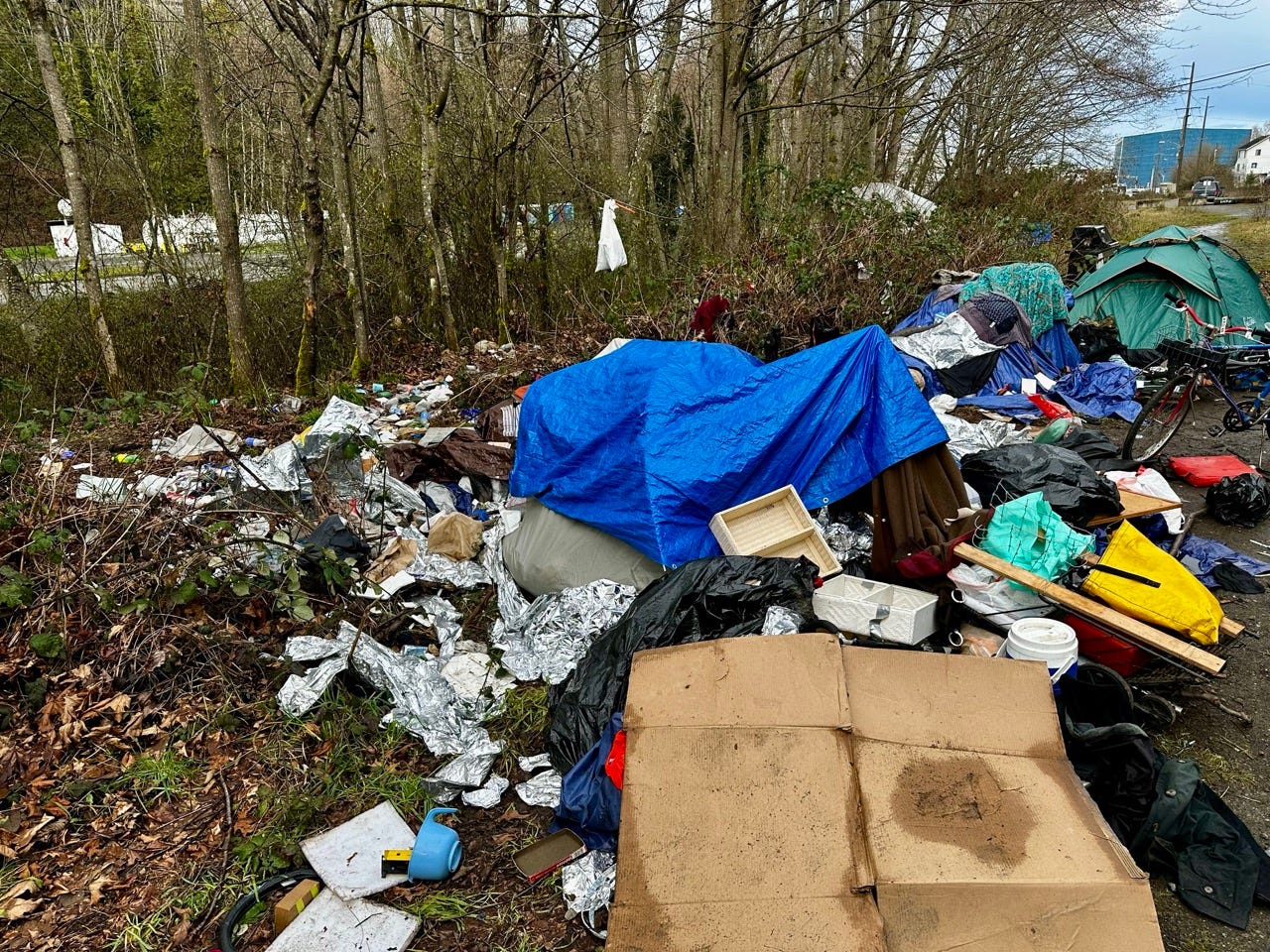
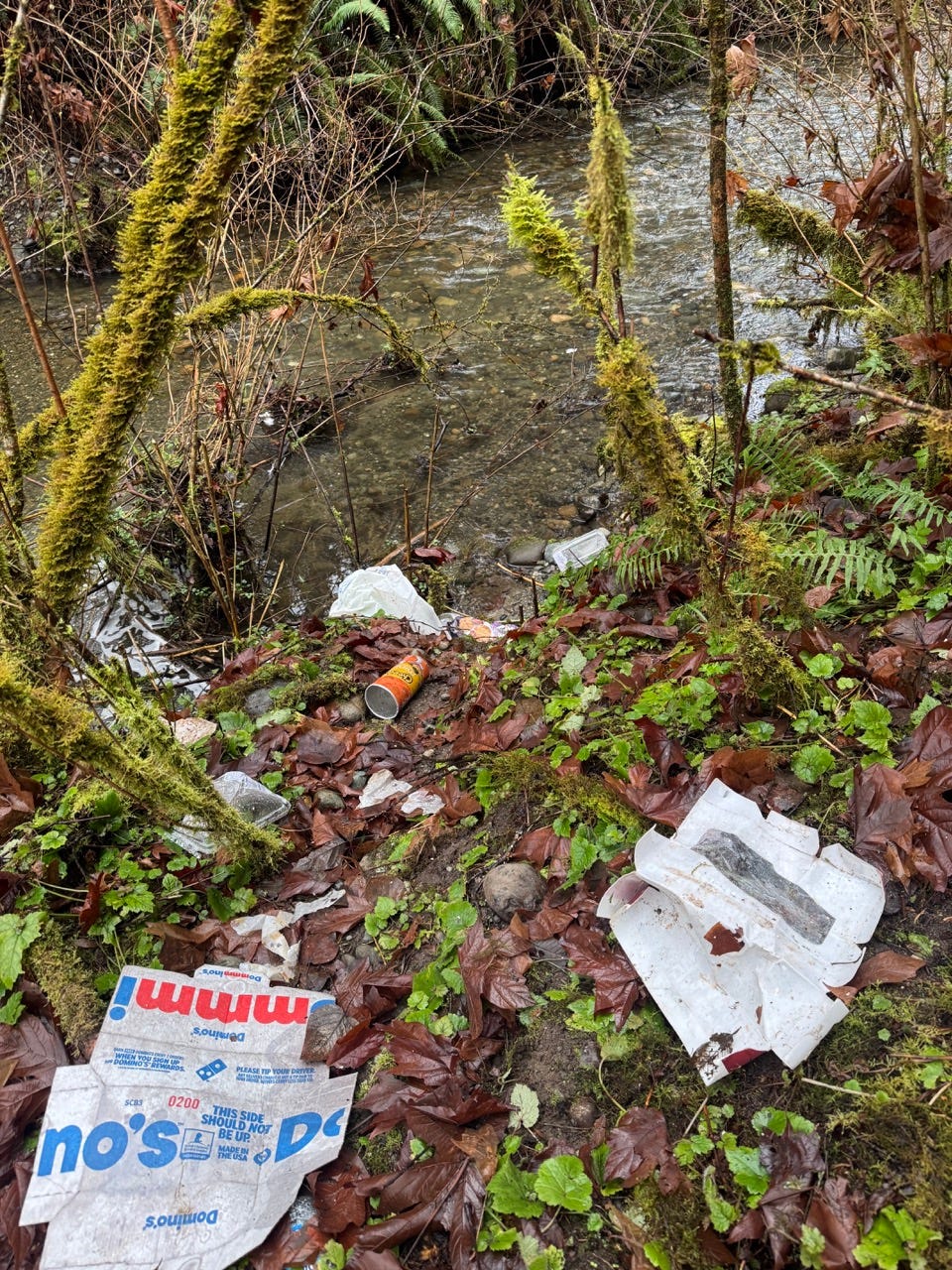
Just beyond the concrete barricade, trash lines the creek bed — scattered among it are the Harm Reduction Health Center’s (HRHC) distinctive silver space blankets made of Mylar.
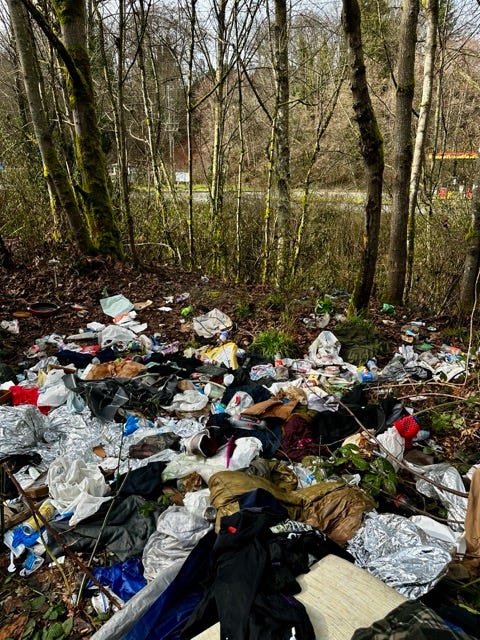
Multiple tents are occupied in this conspicuous location.
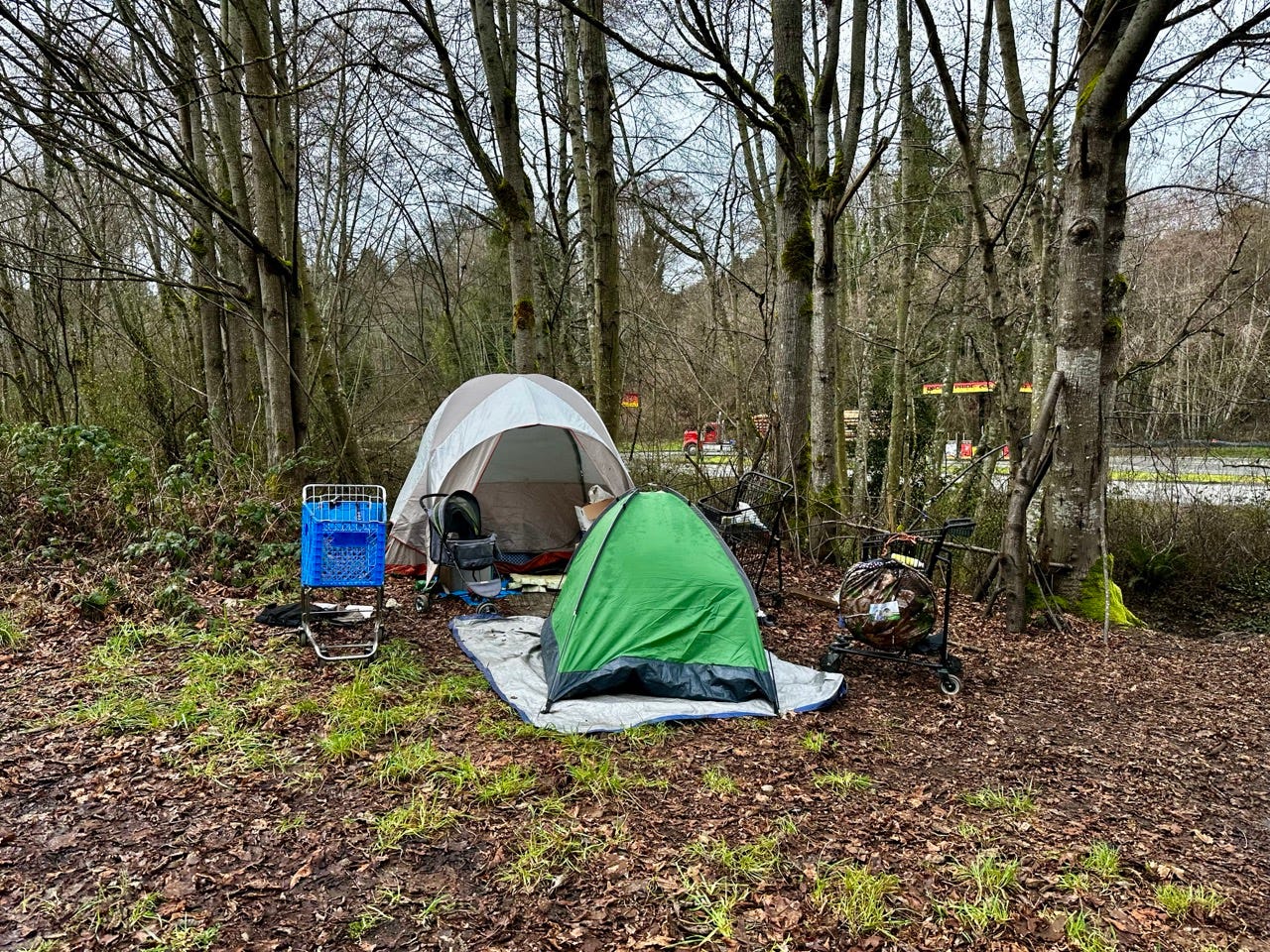
Continuing south, the trail splits.
To the west sits an active encampment — a site 4PA cleaned just months ago. The couple currently living there say they prefer Tumwater Creek to Serenity House, citing past conflicts with staff and claiming the showers are consistently ice cold.
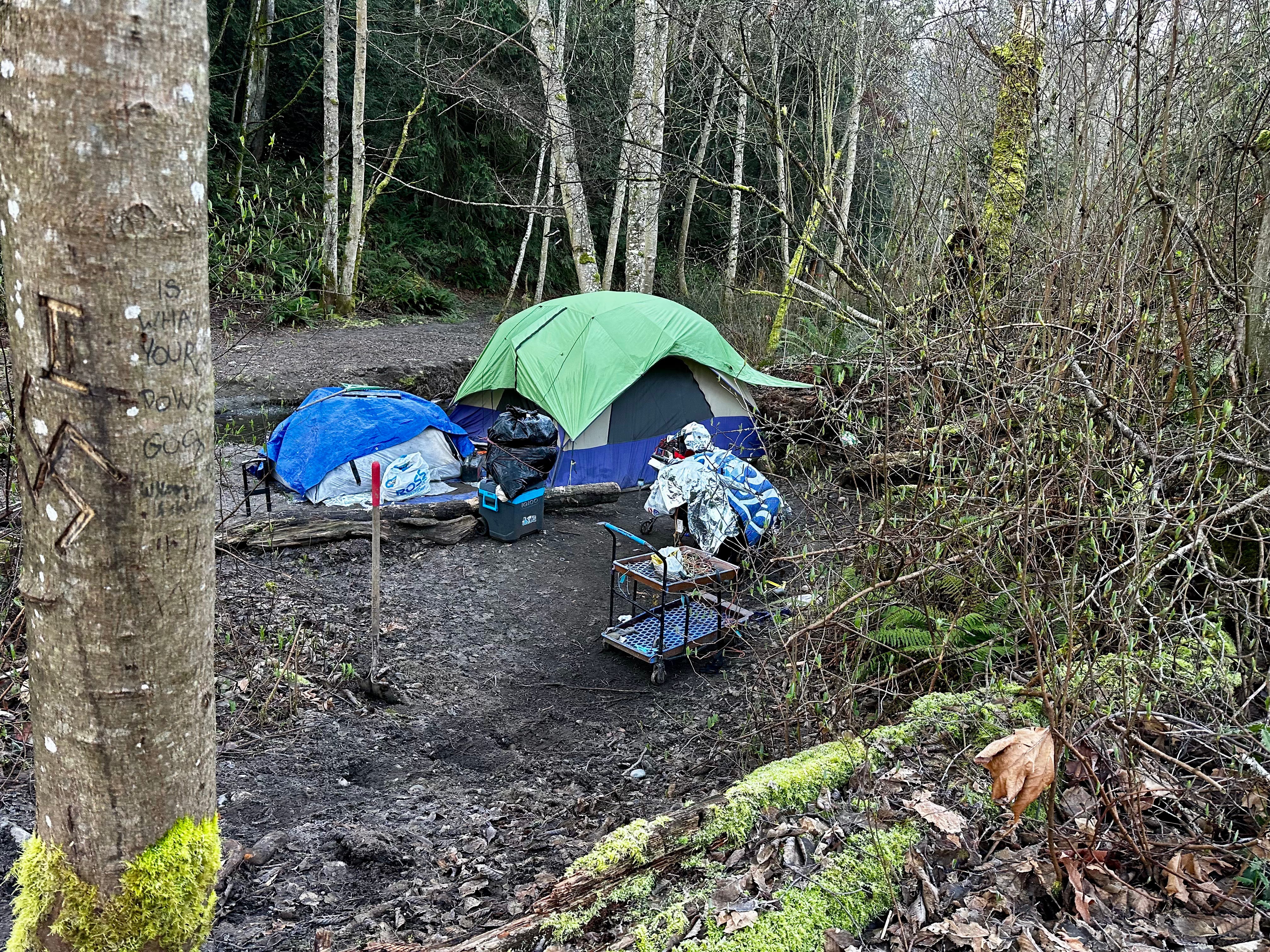
Along the eastern fork lies an abandoned campsite.
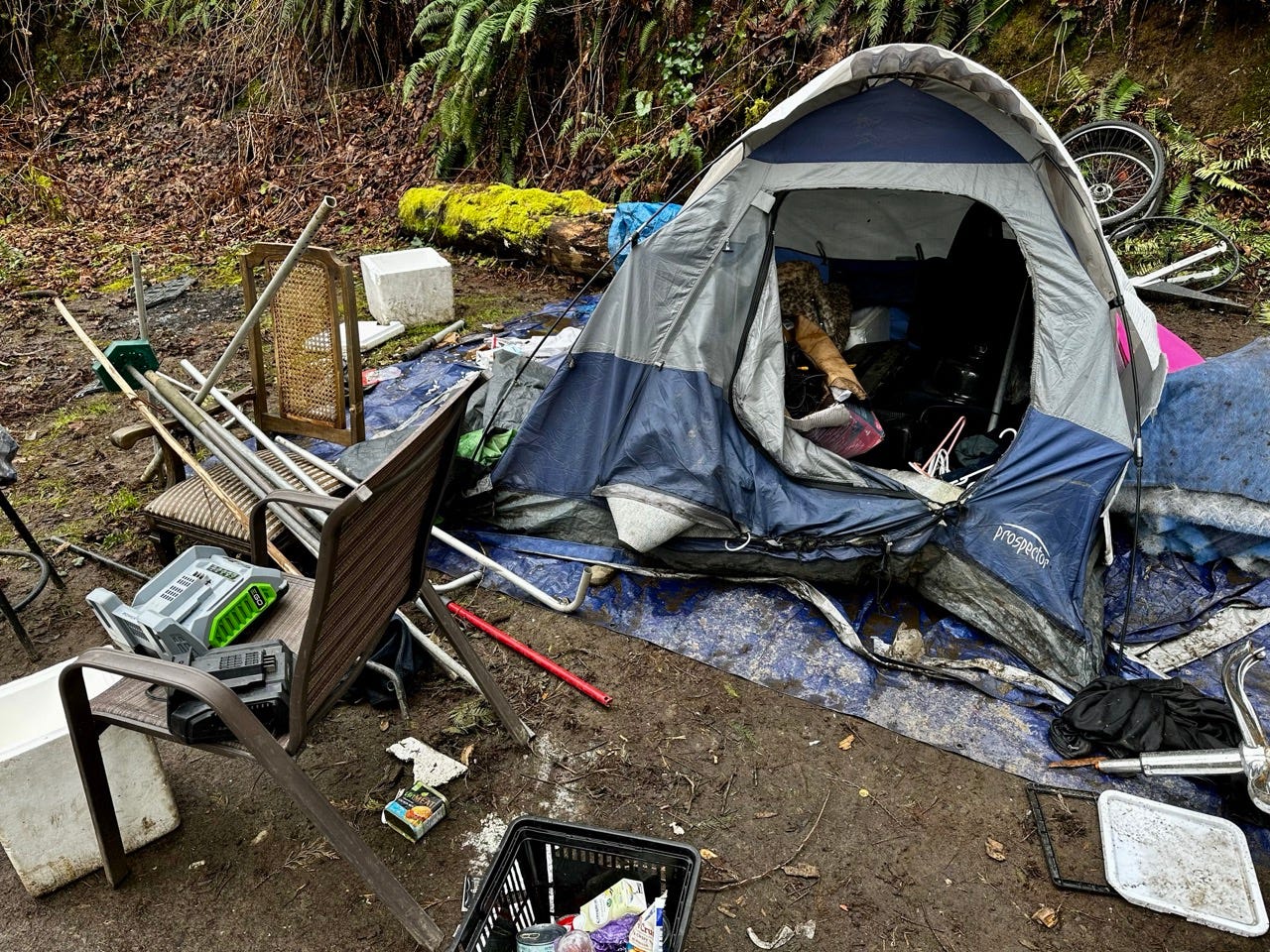
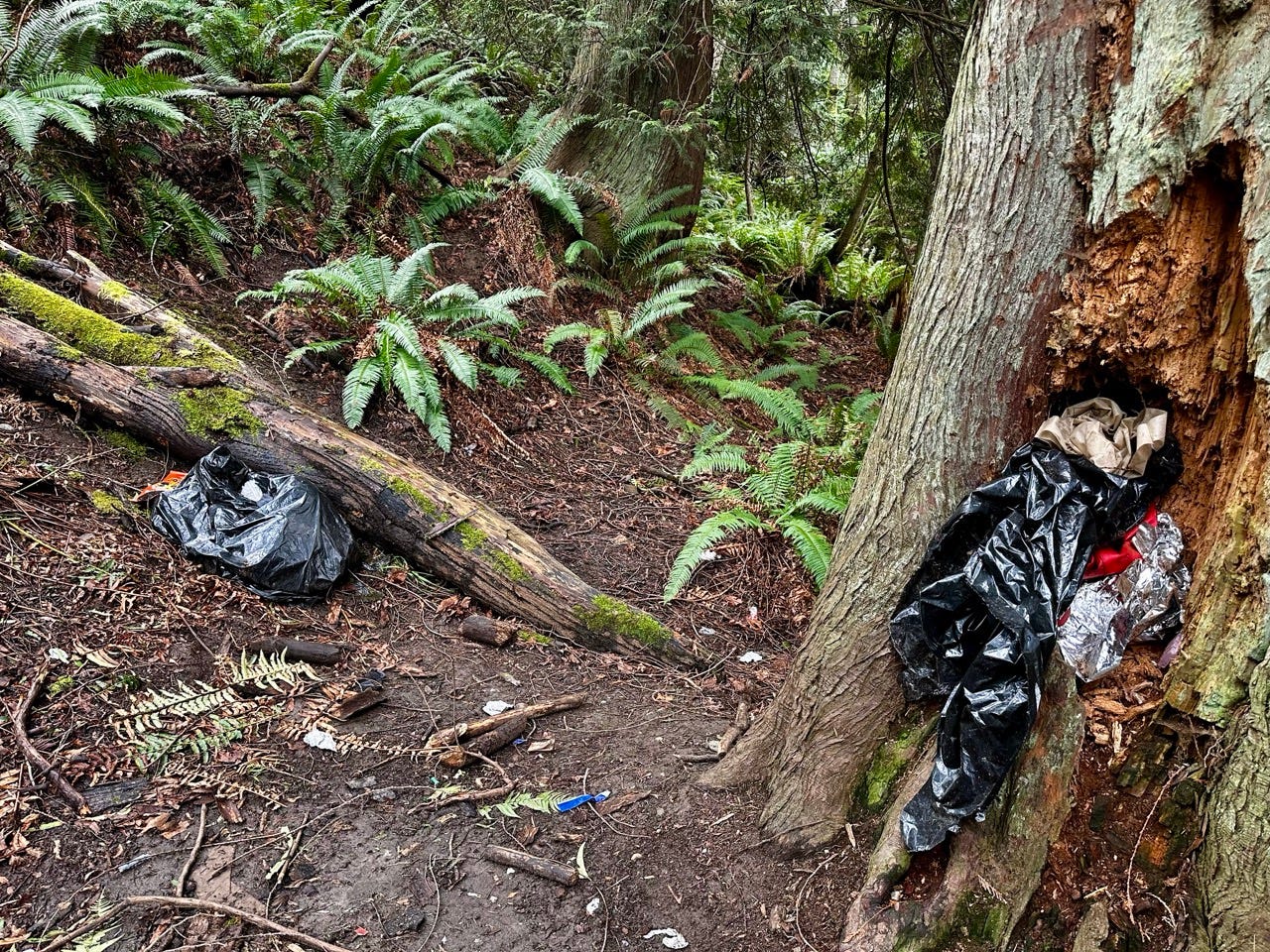
A living tree has been fashioned into a natural trash receptacle.
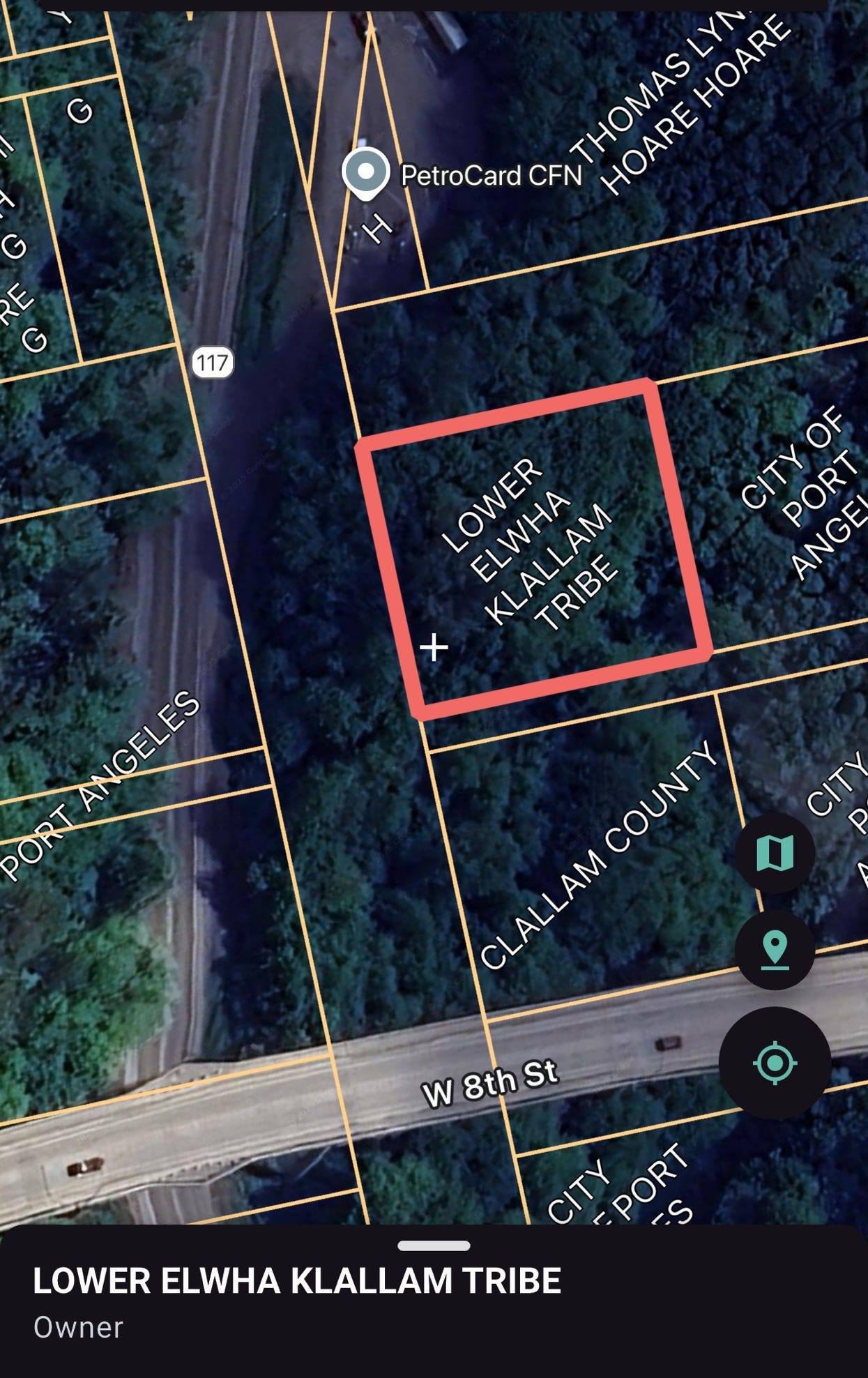
Crossing the creek, the tour reaches the charred remains of a 2024 encampment fire on property owned by the Lower Elwha Klallam Tribe — a stark reminder of the very real safety risks that accompany unmanaged camps.
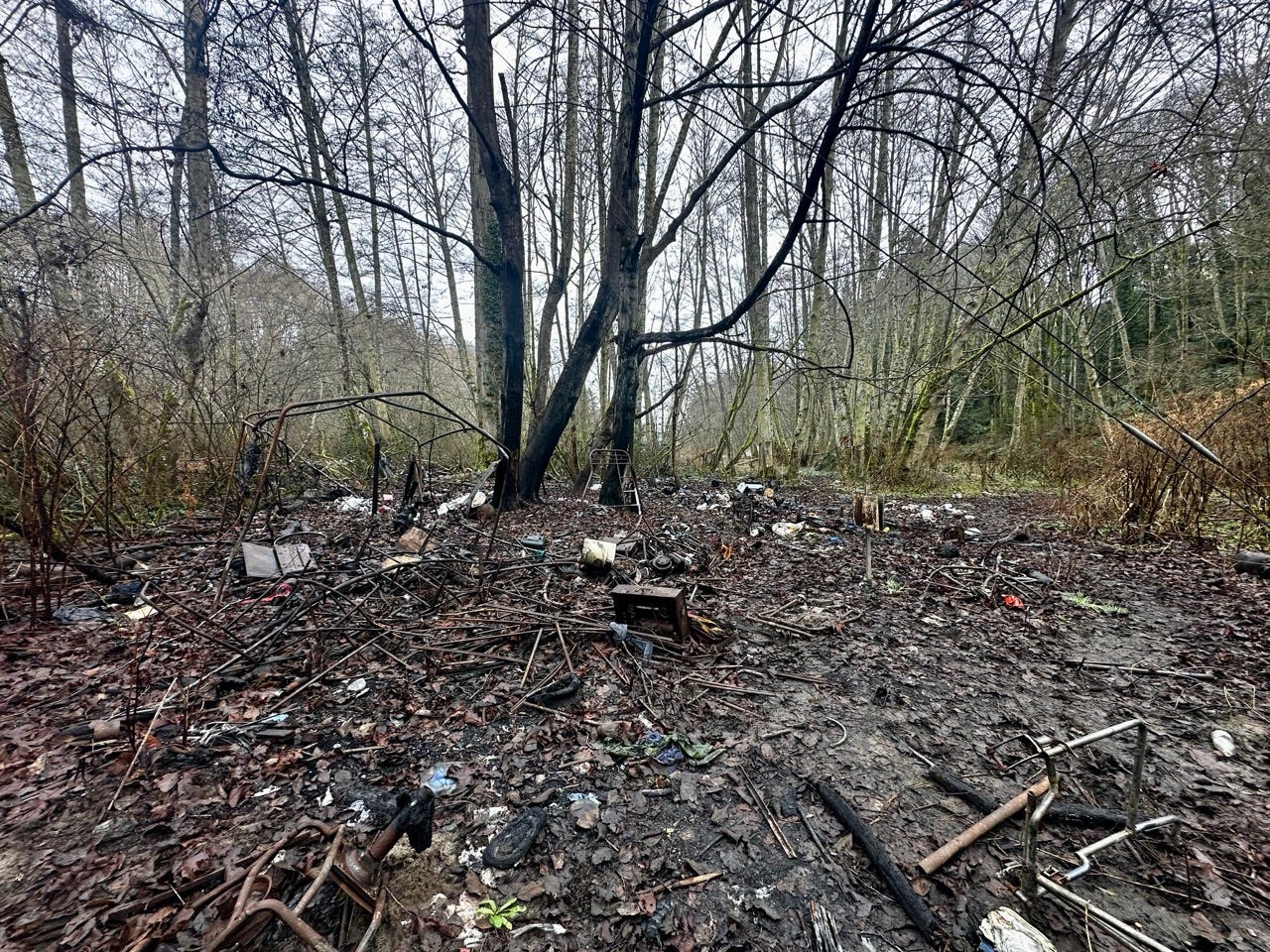
Just beyond newly posted signs on a parcel owned by Clallam County, surface trash remains scattered across the ground — a visible indication that signage alone does not solve the underlying problem.
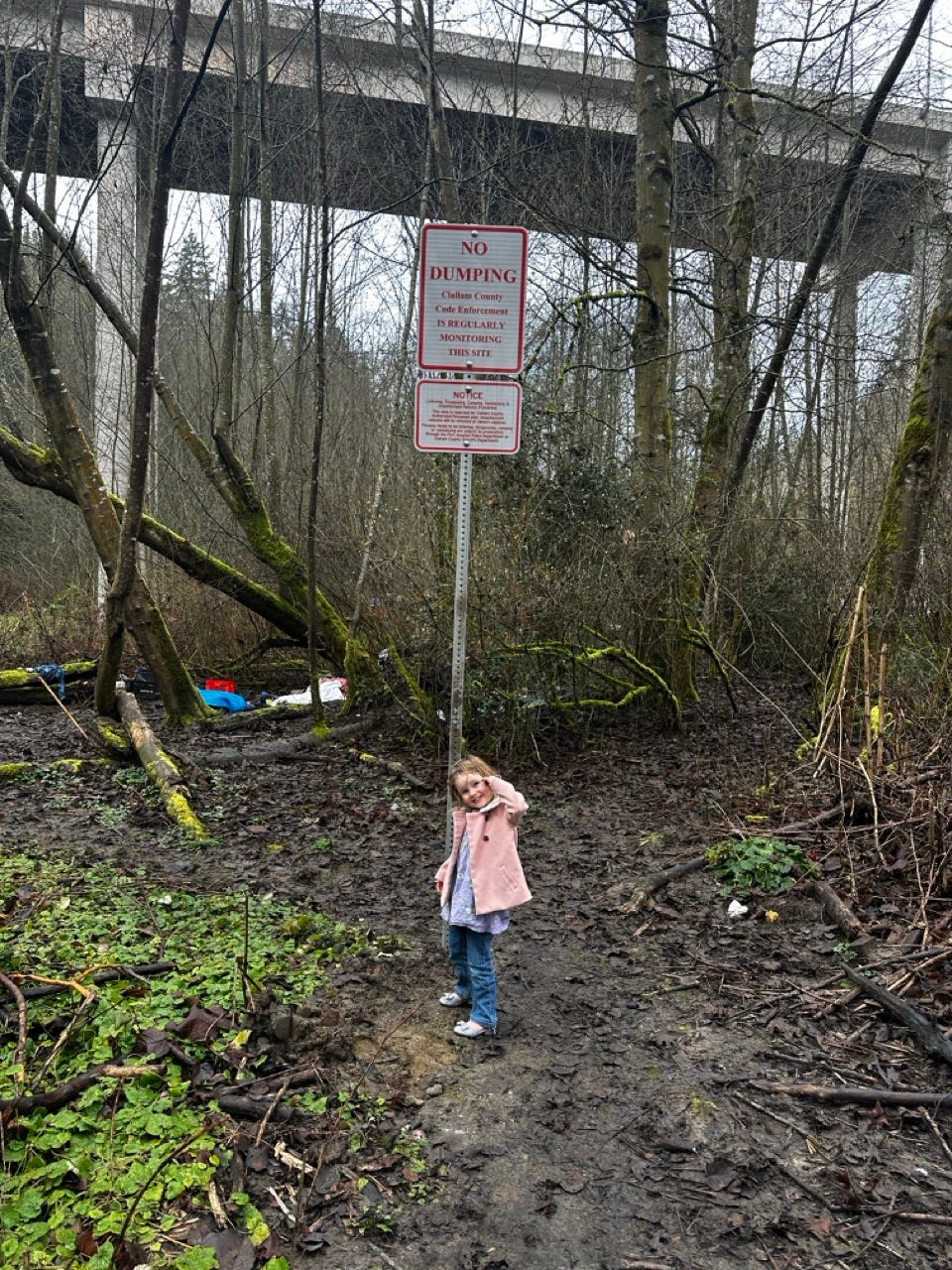
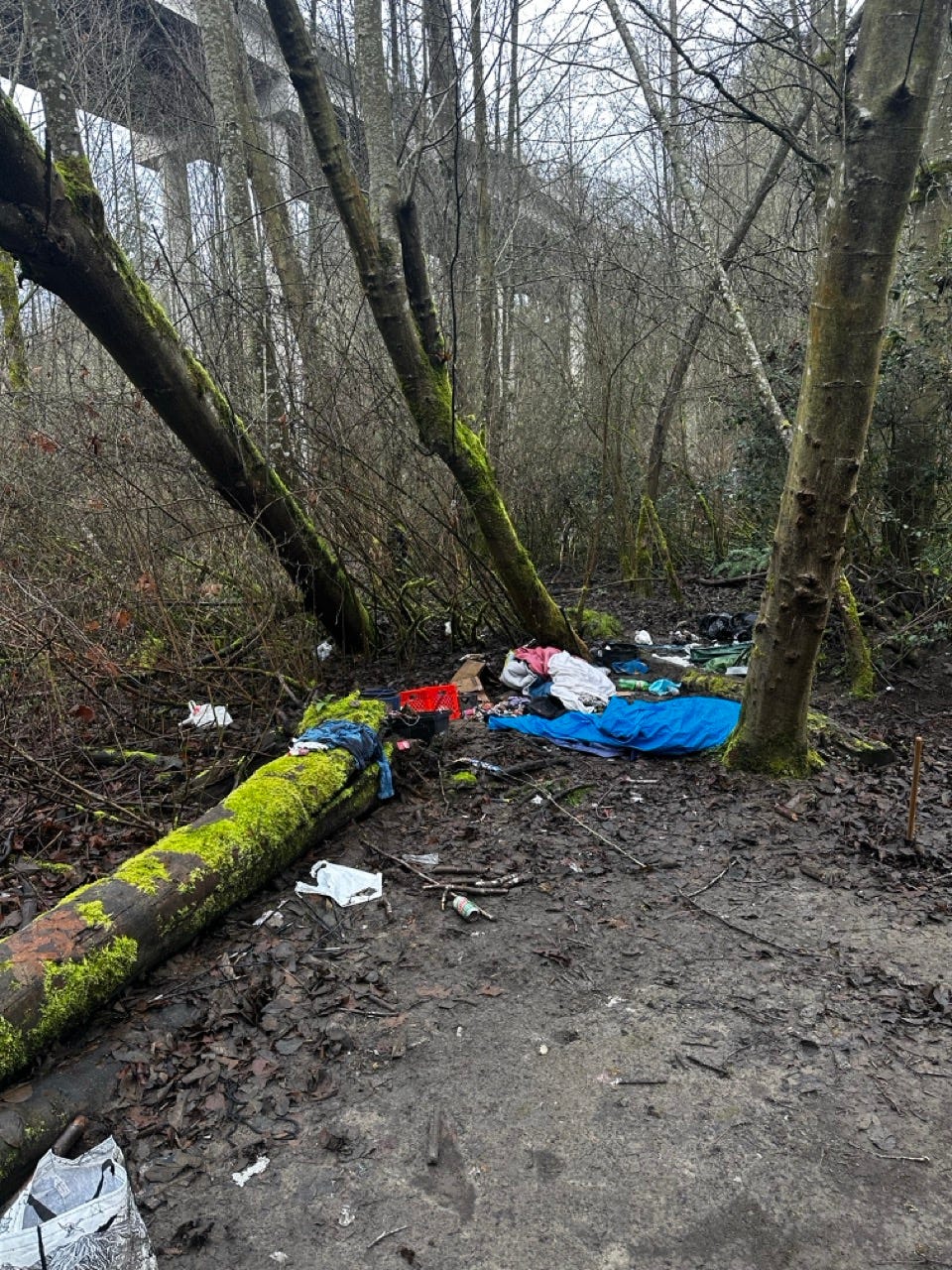
The trail then passes directly beneath the 8th Street Bridge, where a young man — who shared that his father introduced him to drugs at age 10 — now lives.
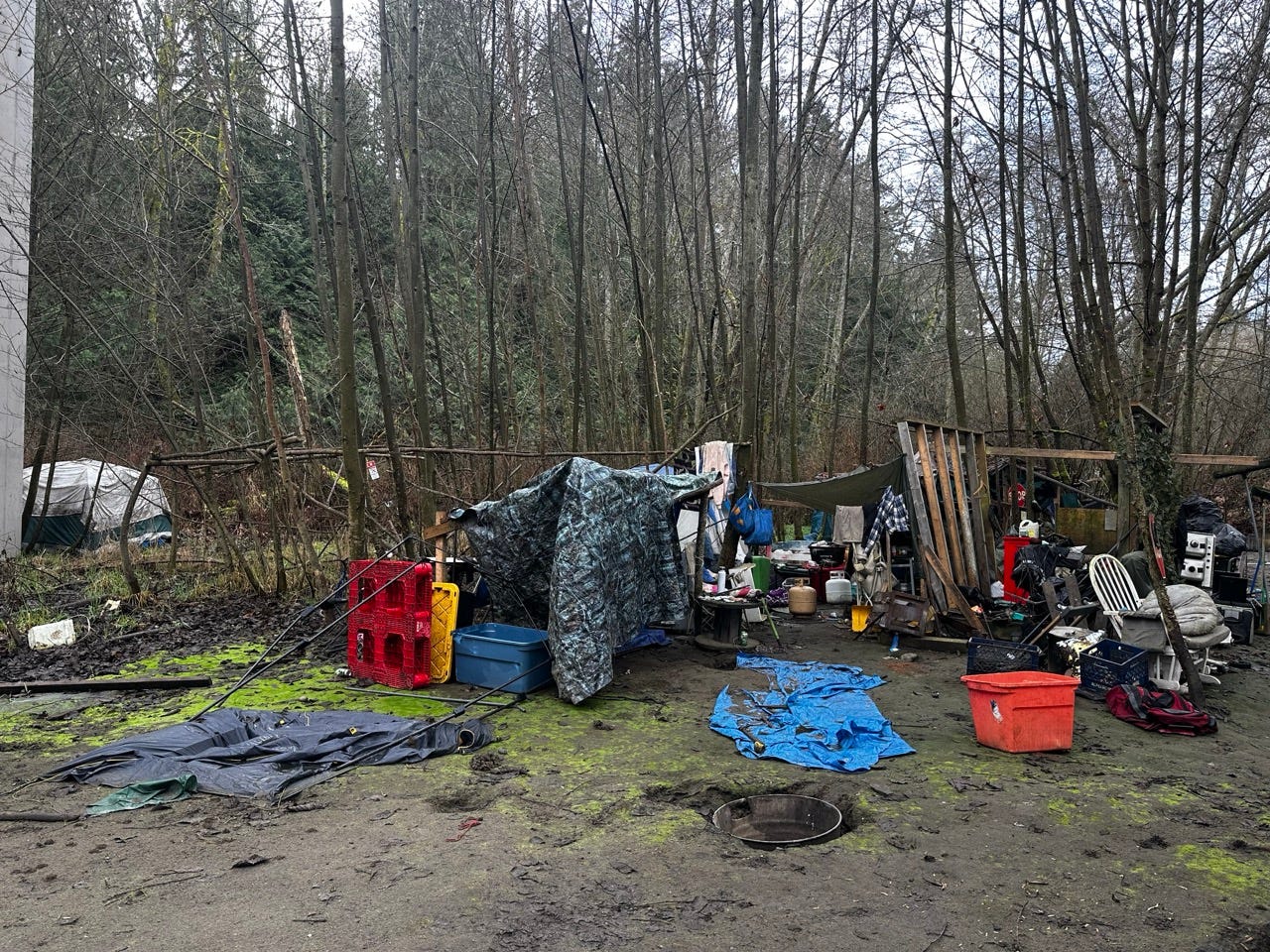
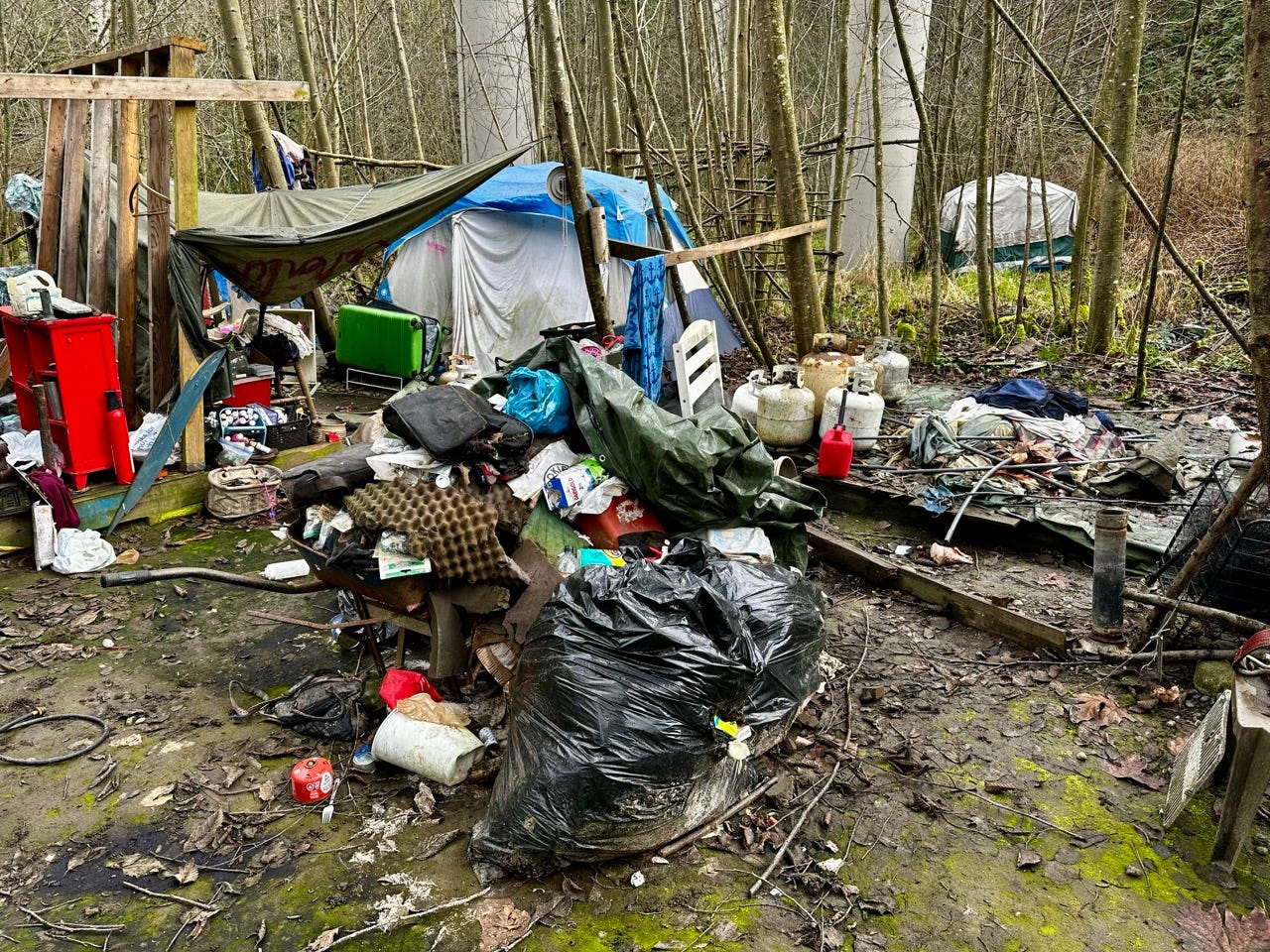
Crossing Tumwater Creek a second time brings readers to another active encampment — the site of a 4PA cleanup this week. Trash was removed at the direction of the current occupants.
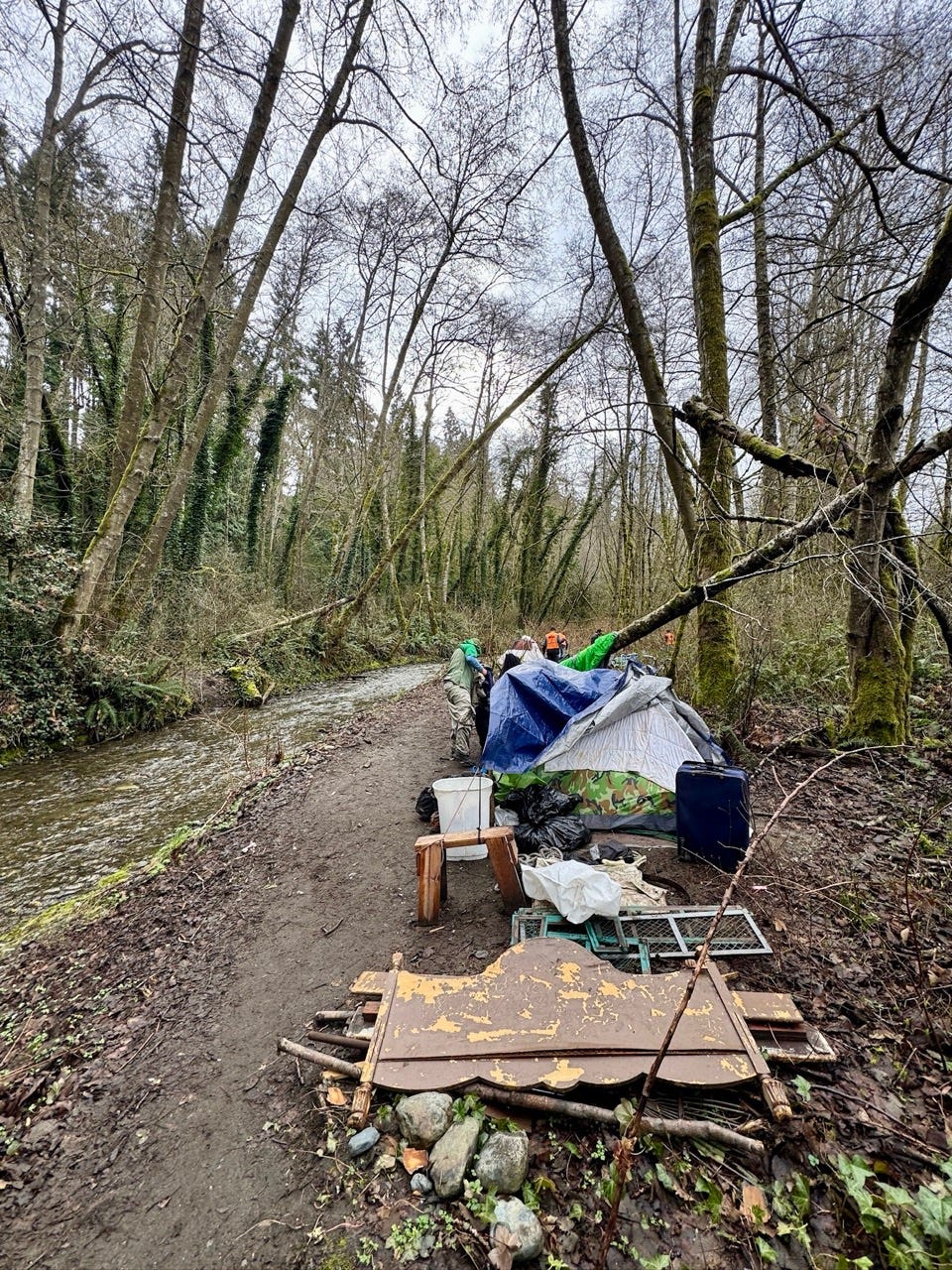
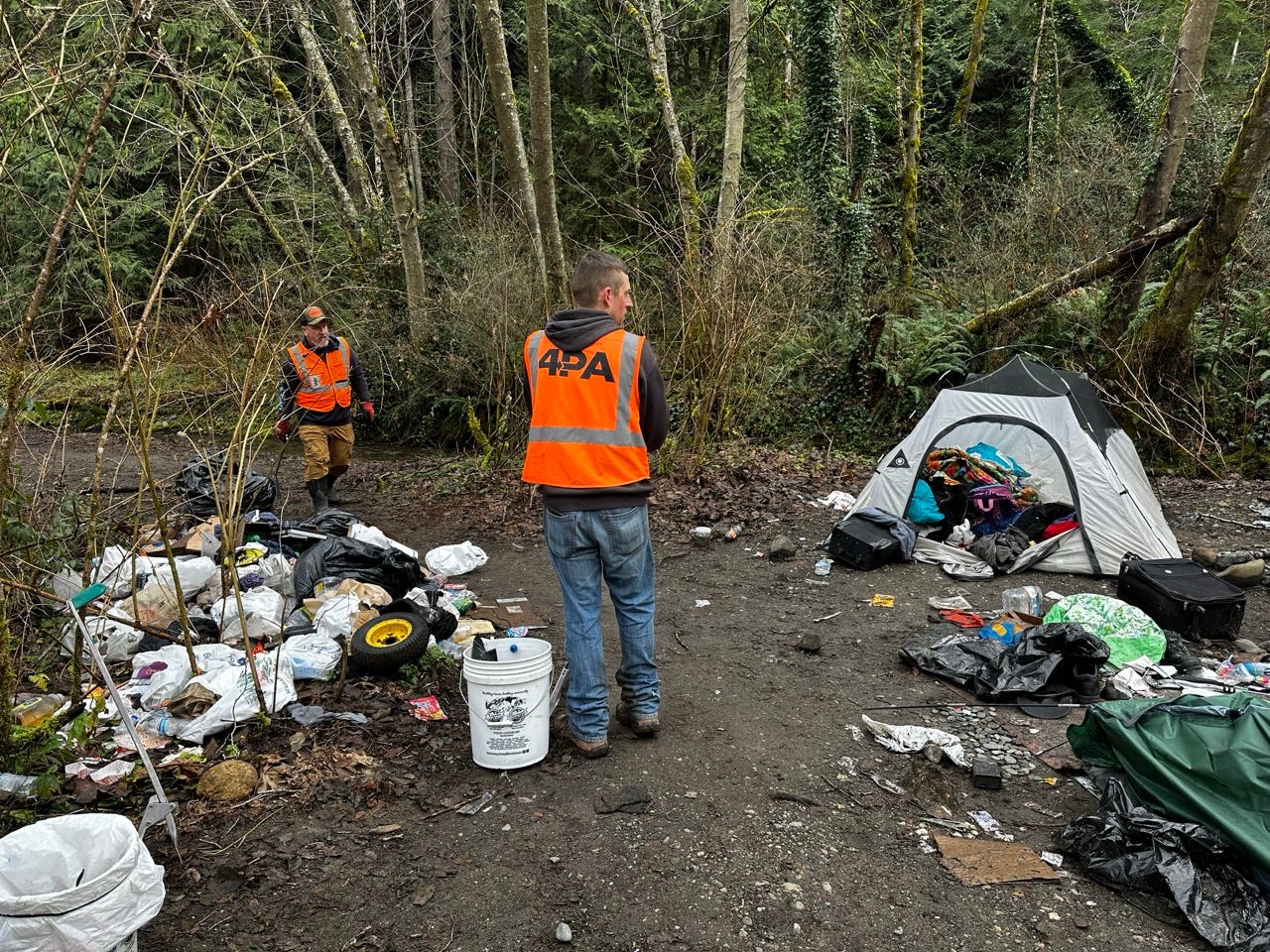
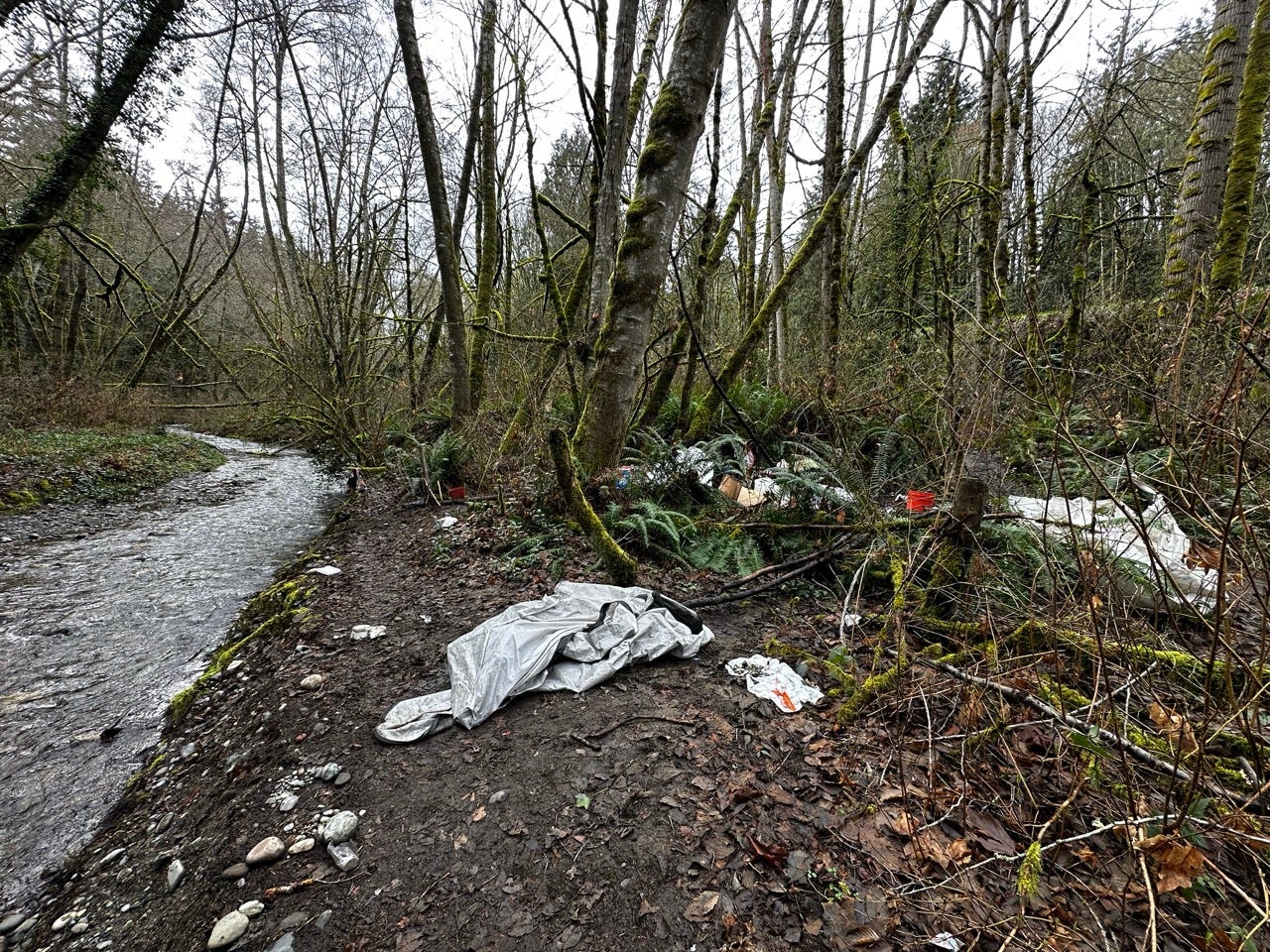
The first tent is occupied by an older man from Portland. The final photo shows where a young man from Idaho sleeps.
Just upstream is a newly erected cluster of shelters occupied by a young man from Scottsdale, Arizona, and a young woman from Port Angeles.
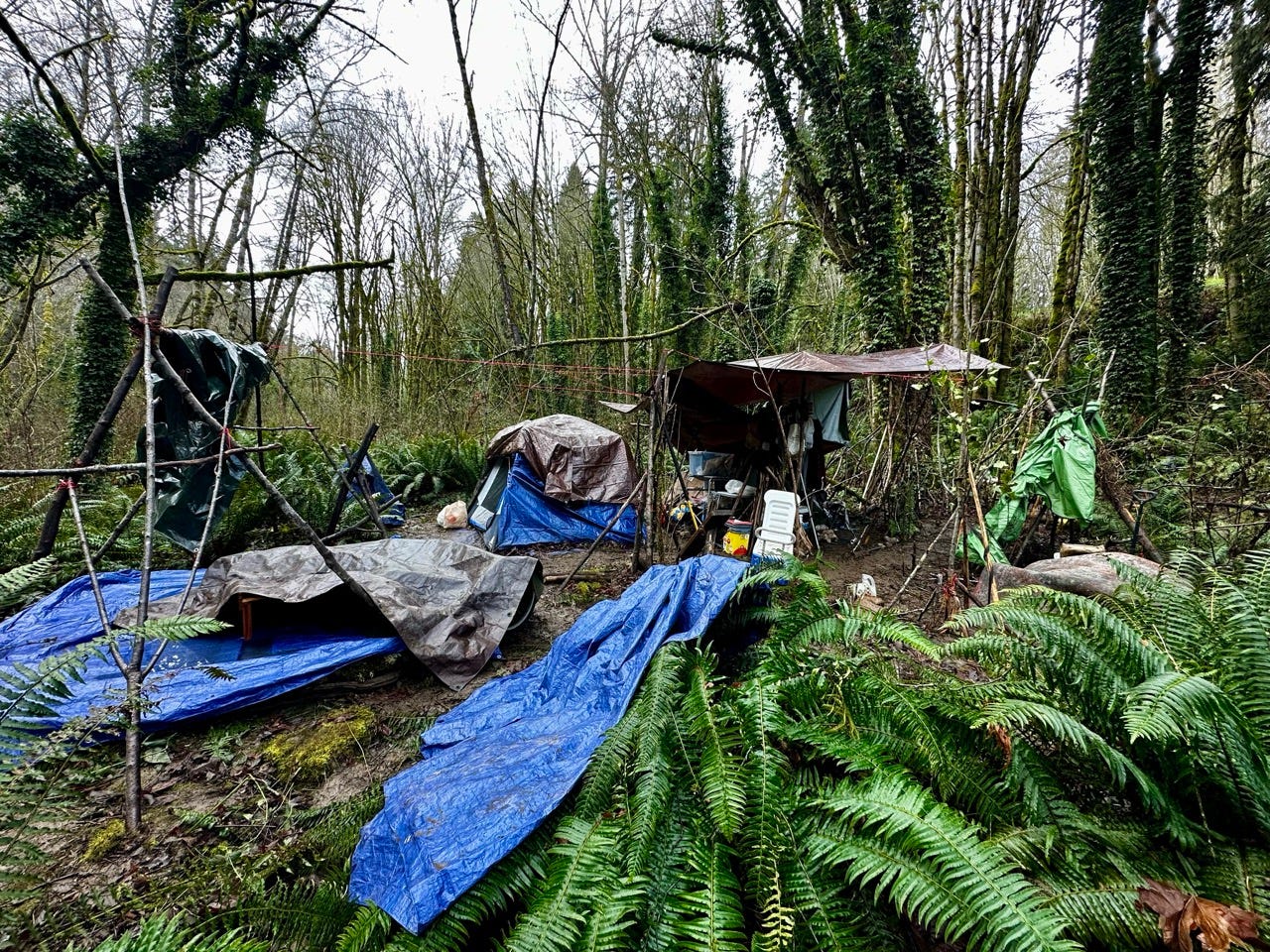
Just beyond that, discarded waste lines stream bank.
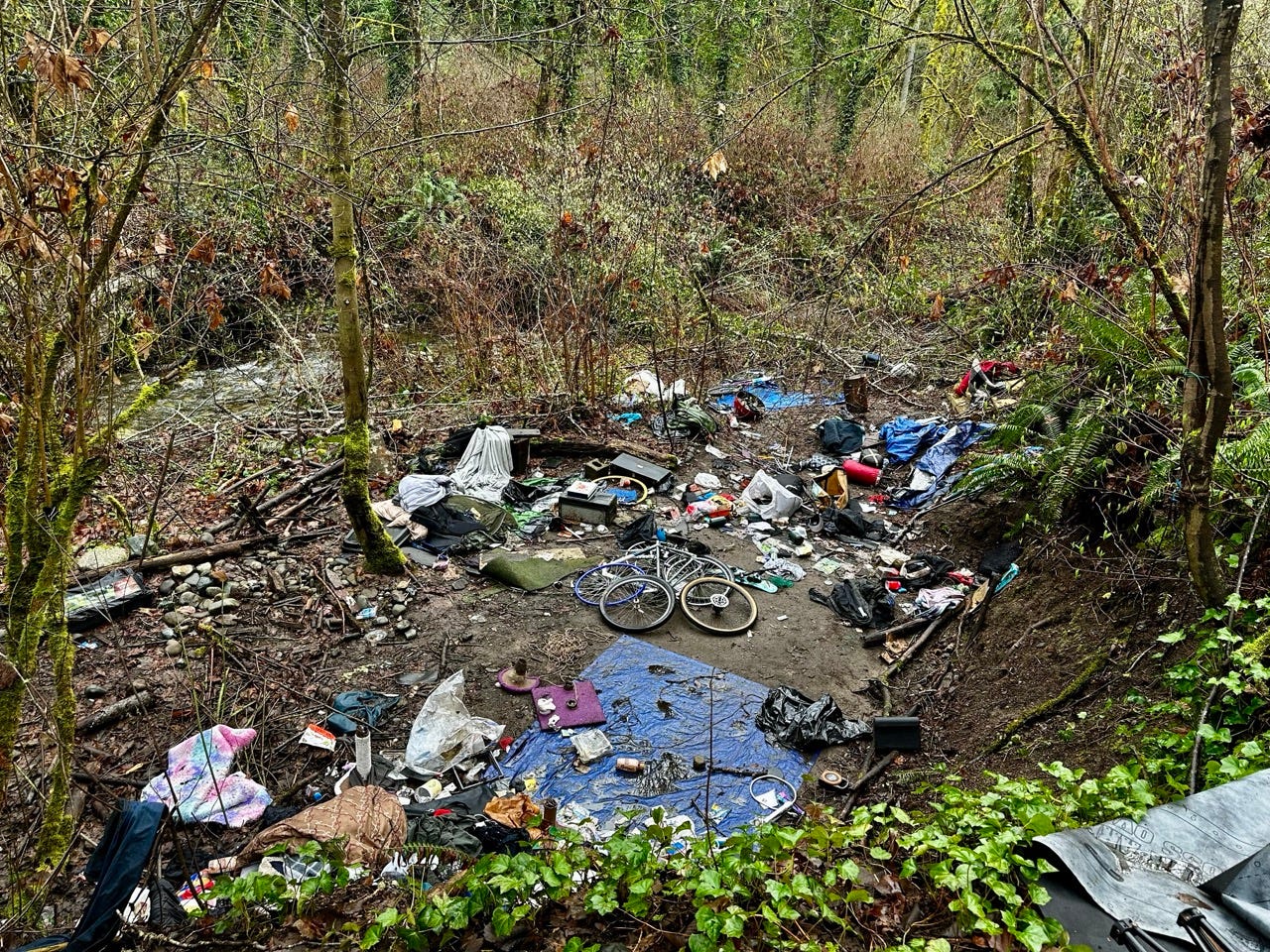
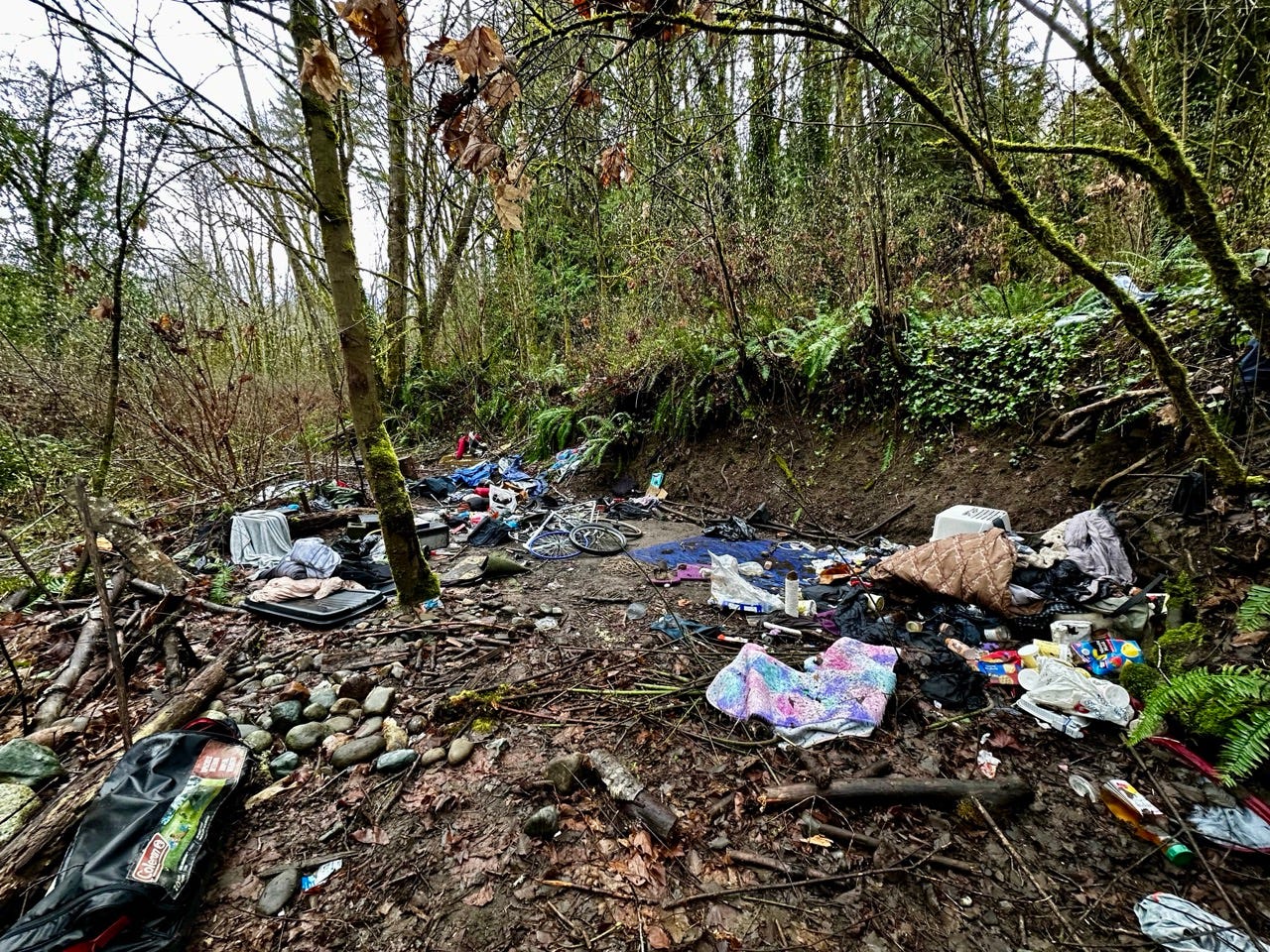
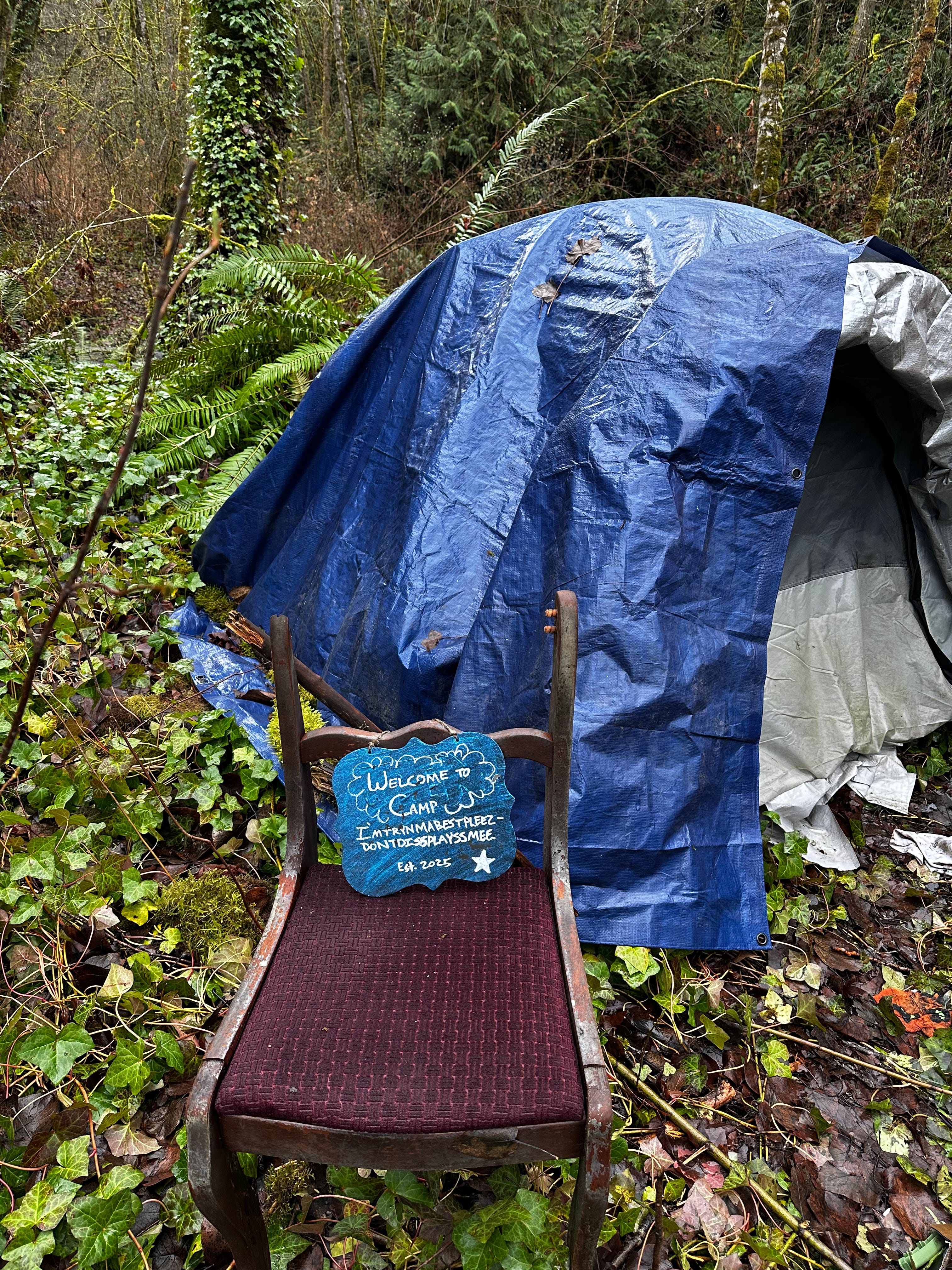
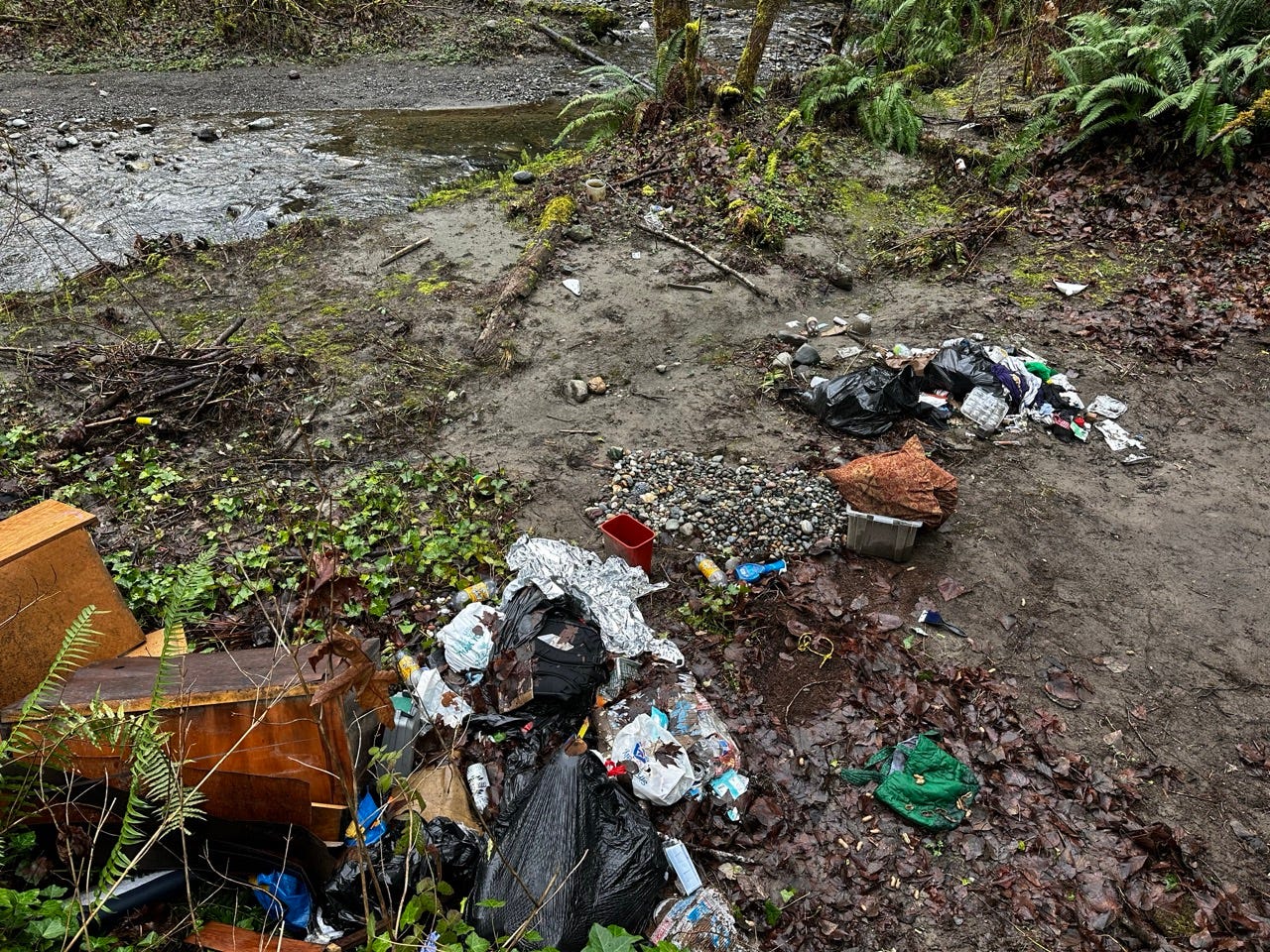
Followed by another occupied camp and a creek-side dump site.
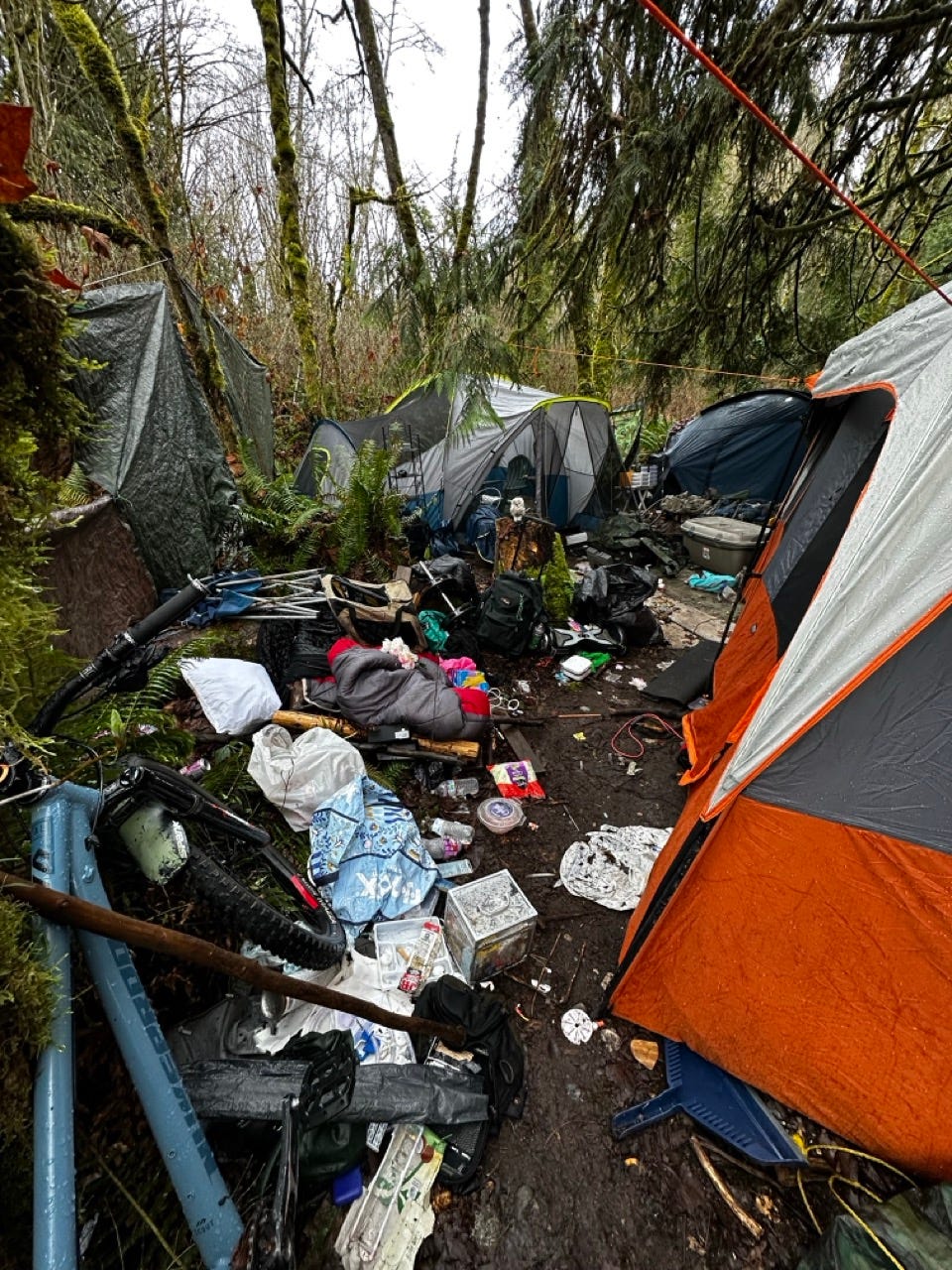
And another:
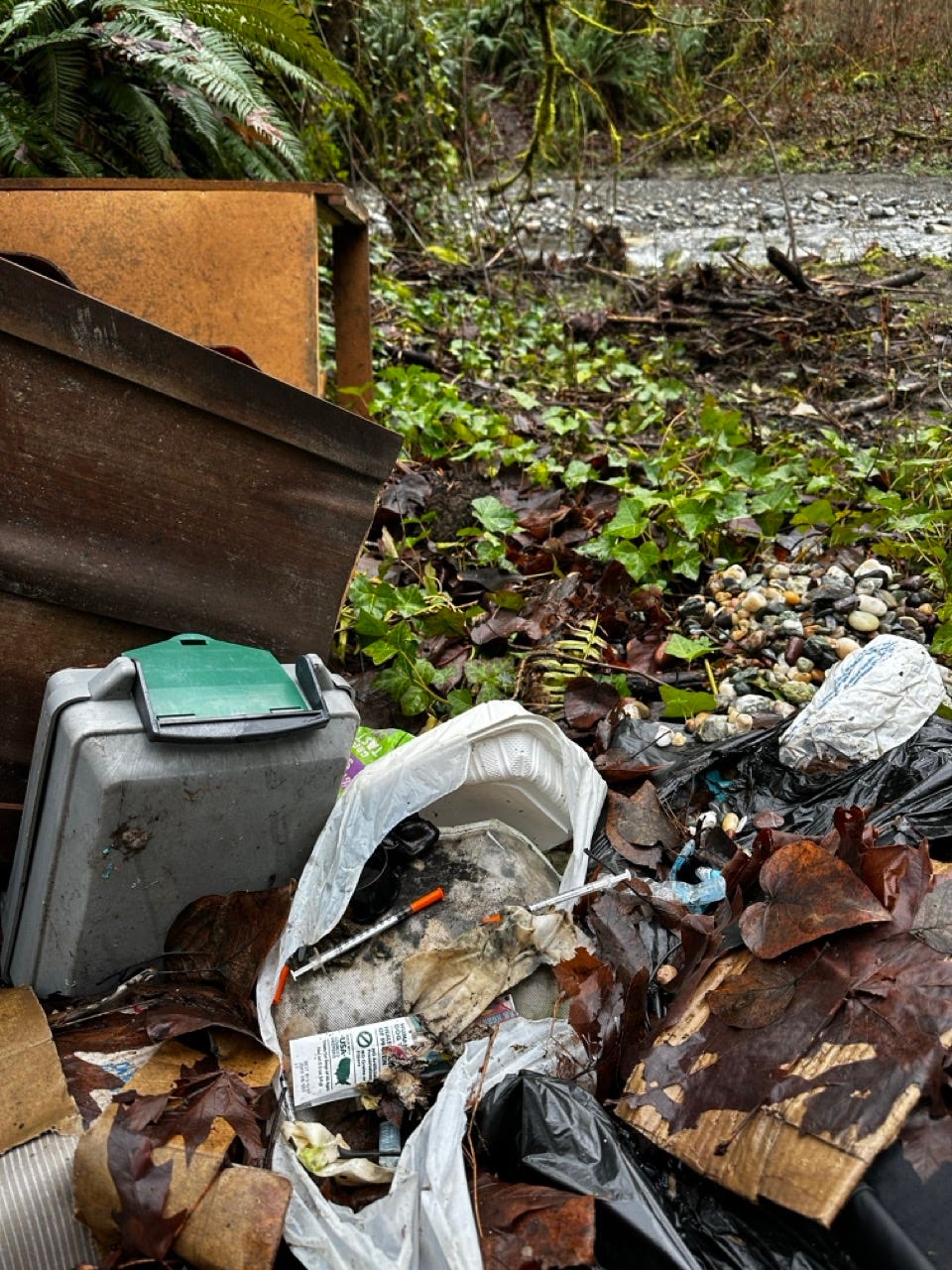
Across the creek to the south sits a tent overflowing with soggy garbage, spilling toward the water’s edge.
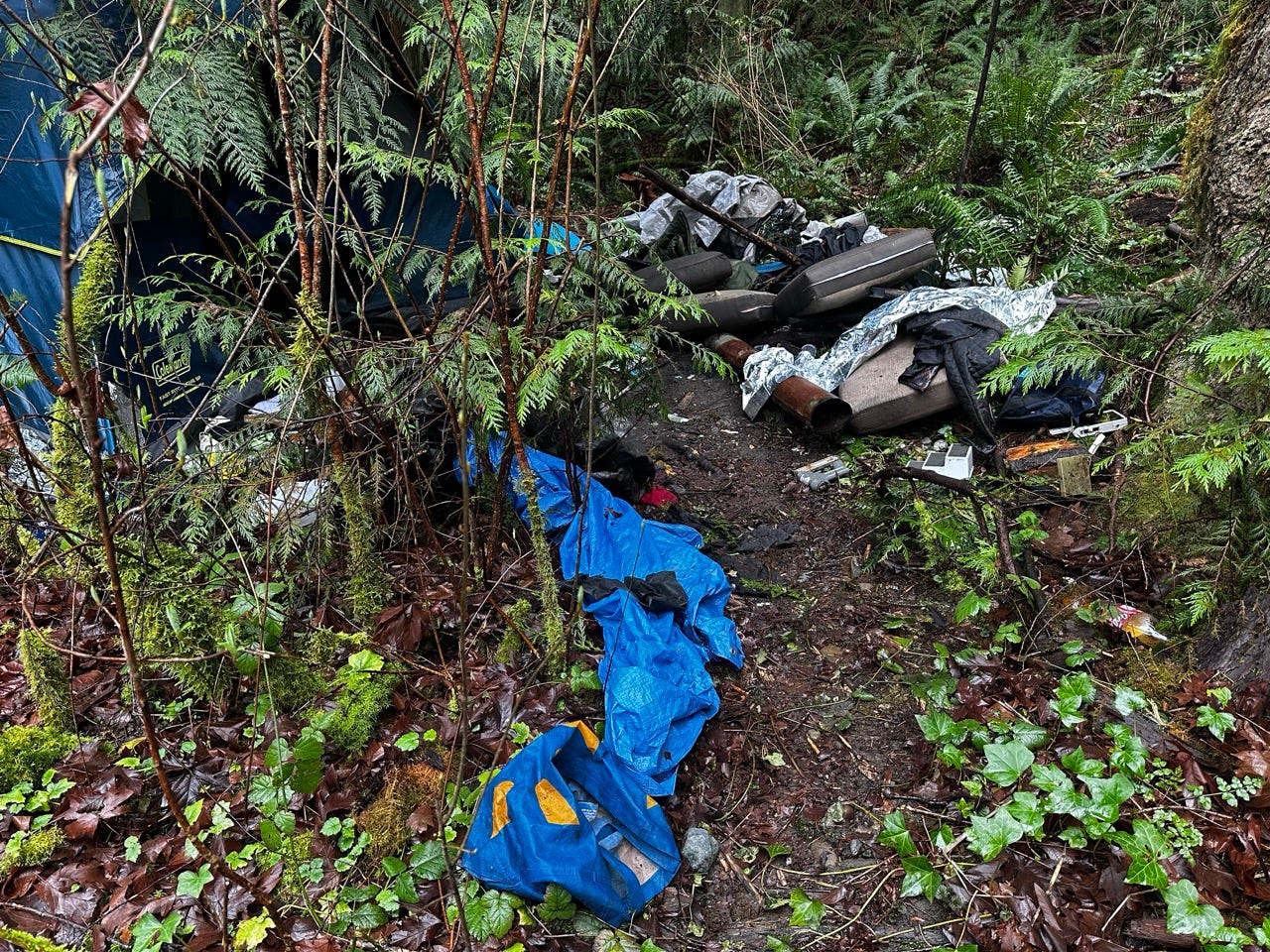
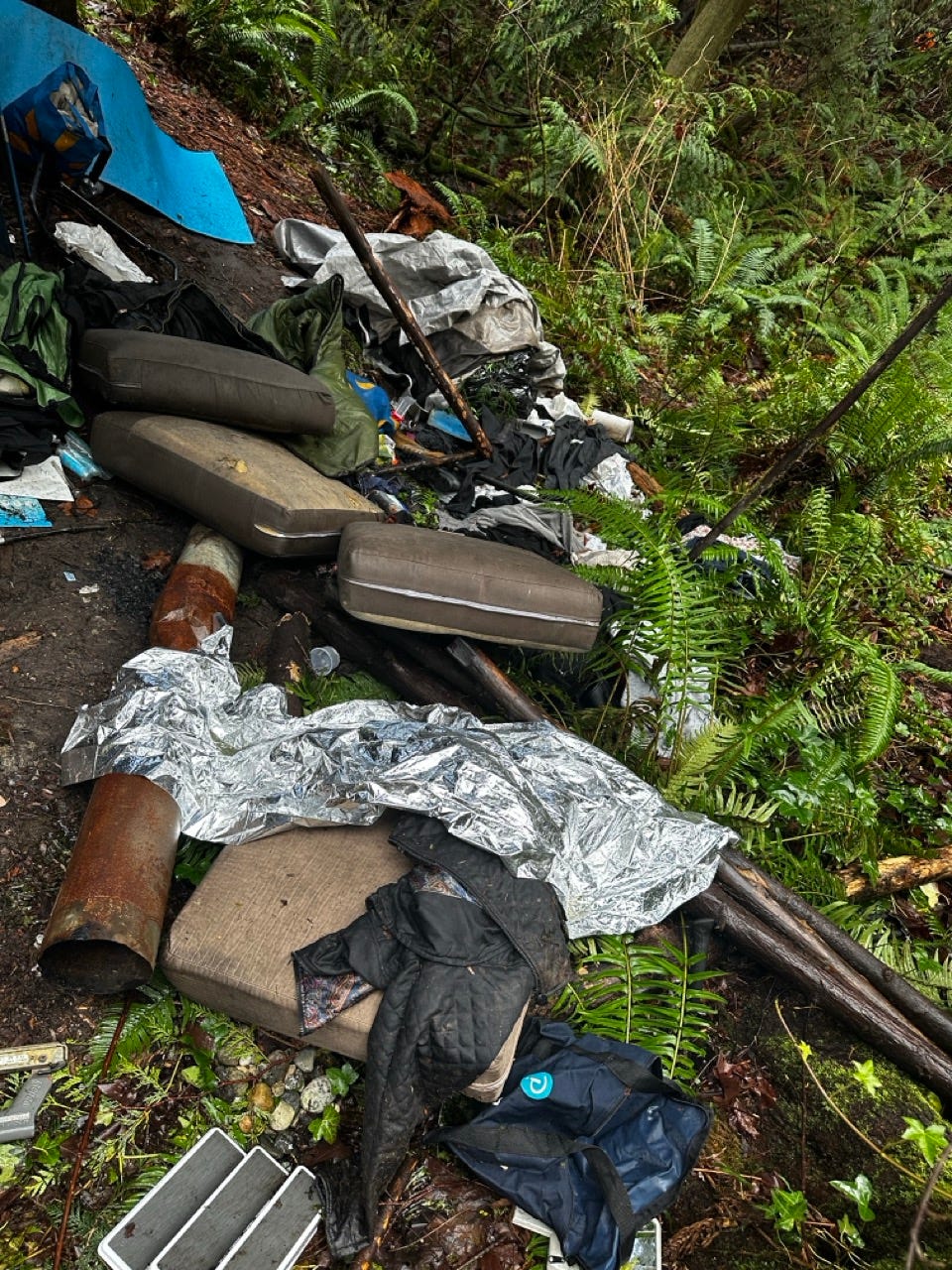
Up the hill lies a small commune.
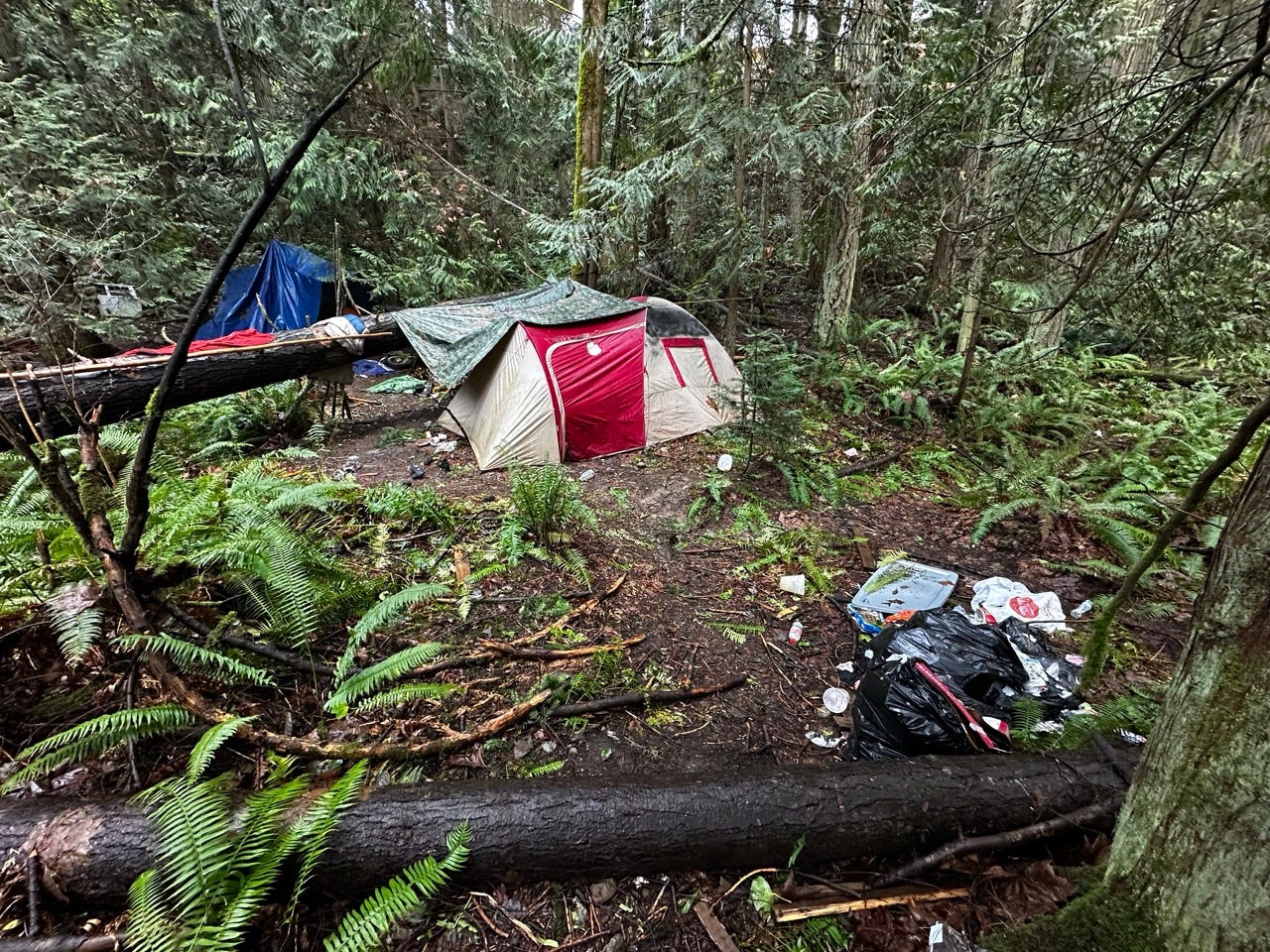
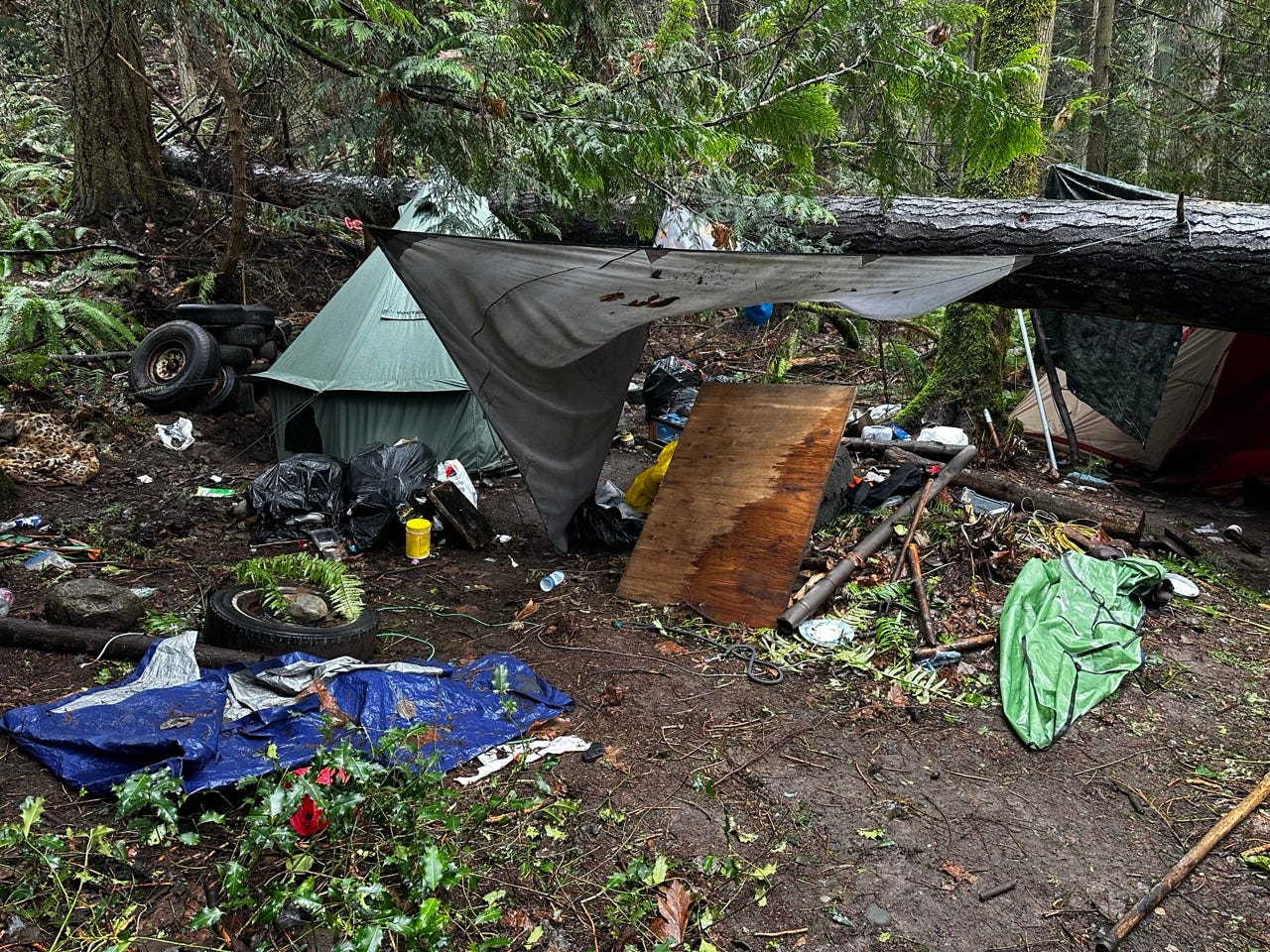
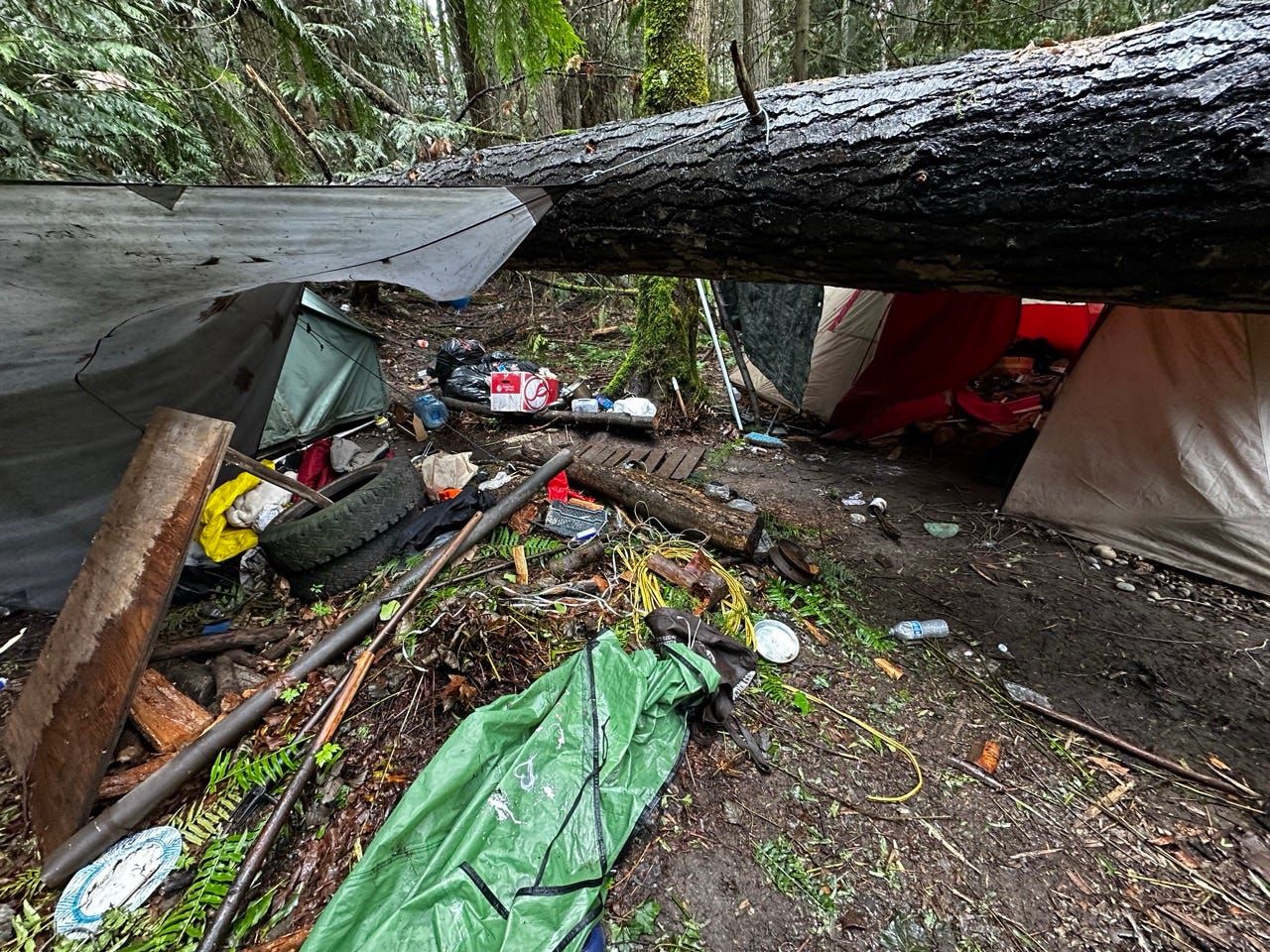
A single tent is just steps away.
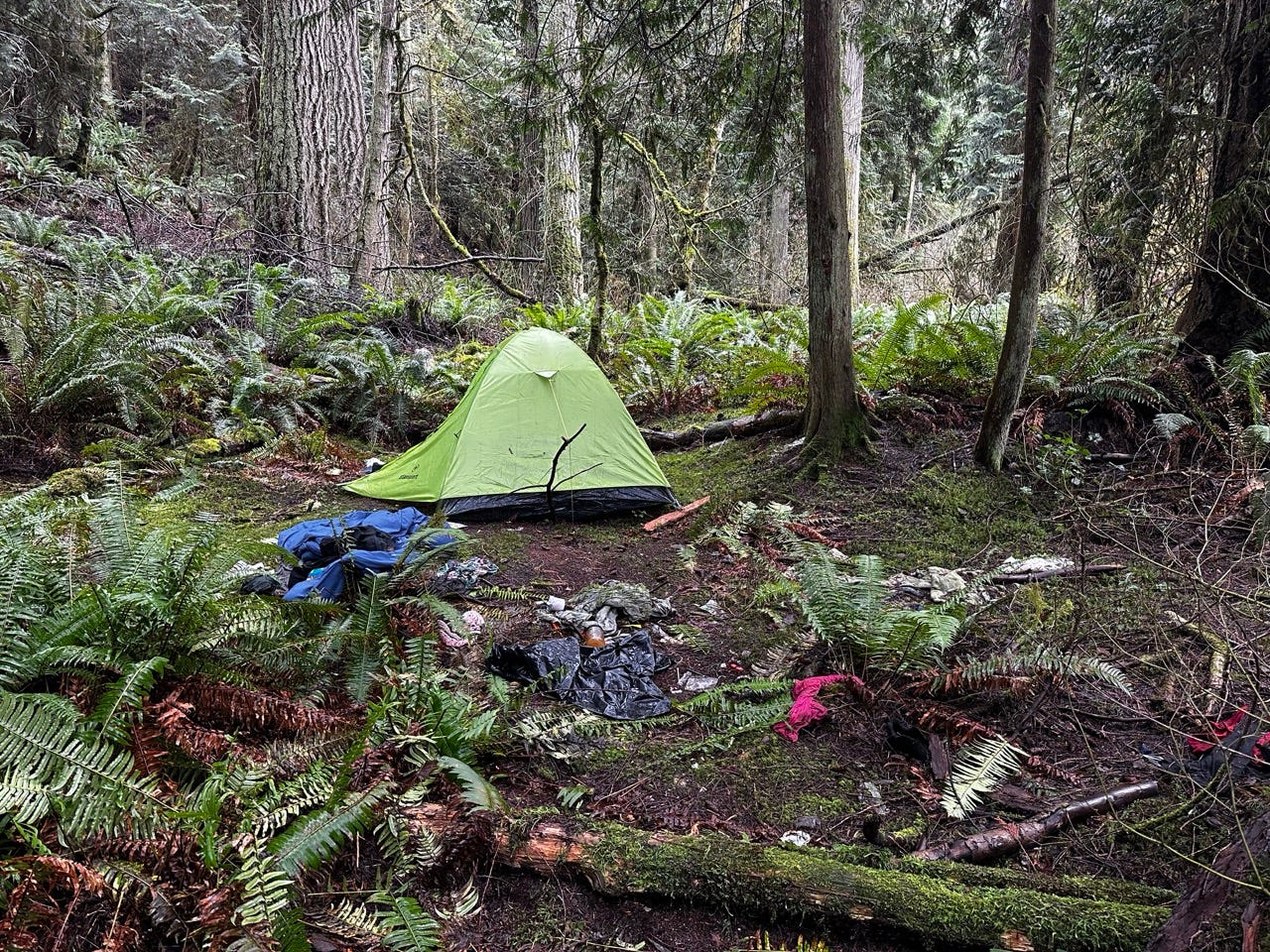
Upstream is another long-abandoned campsite.
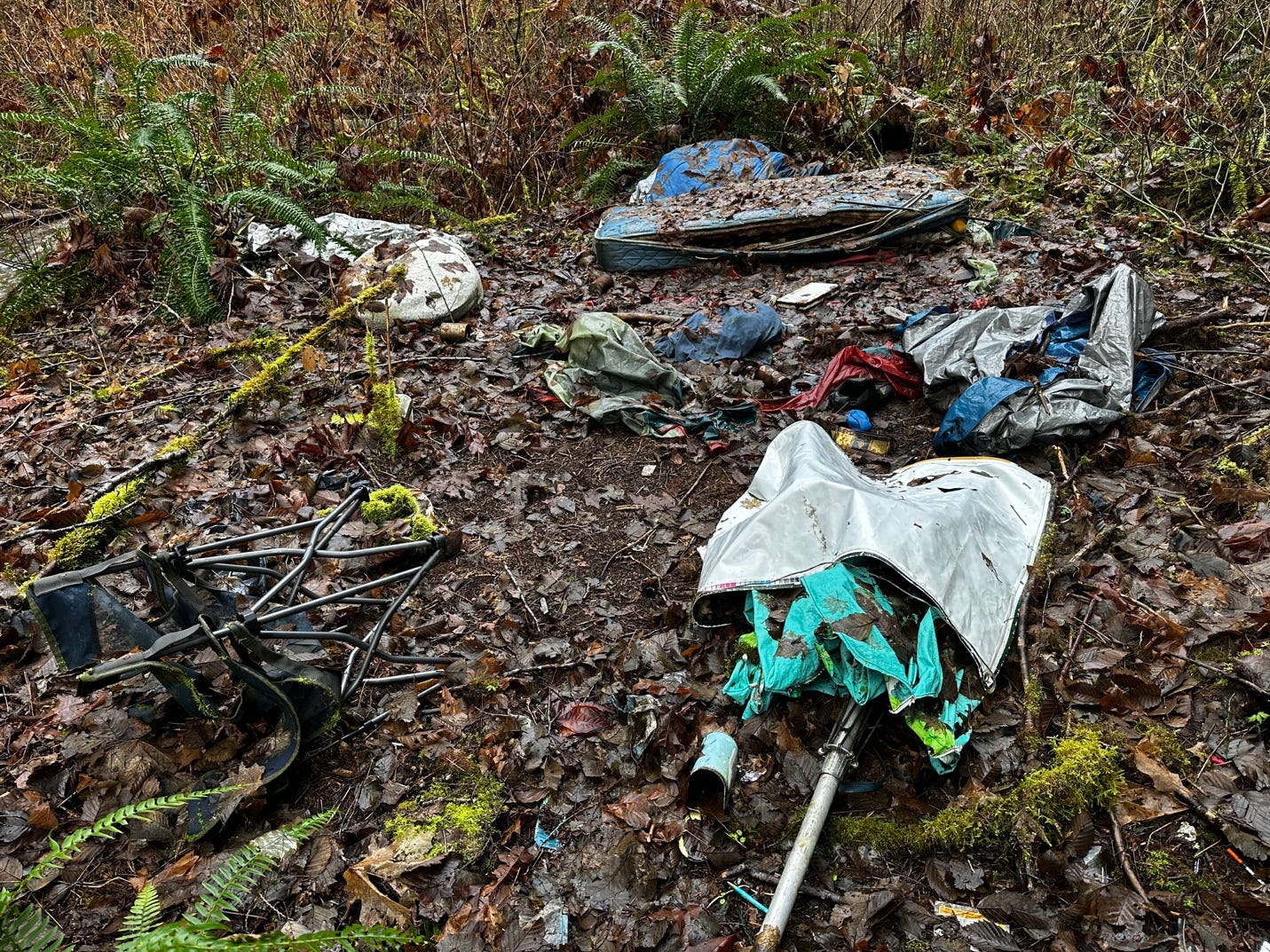
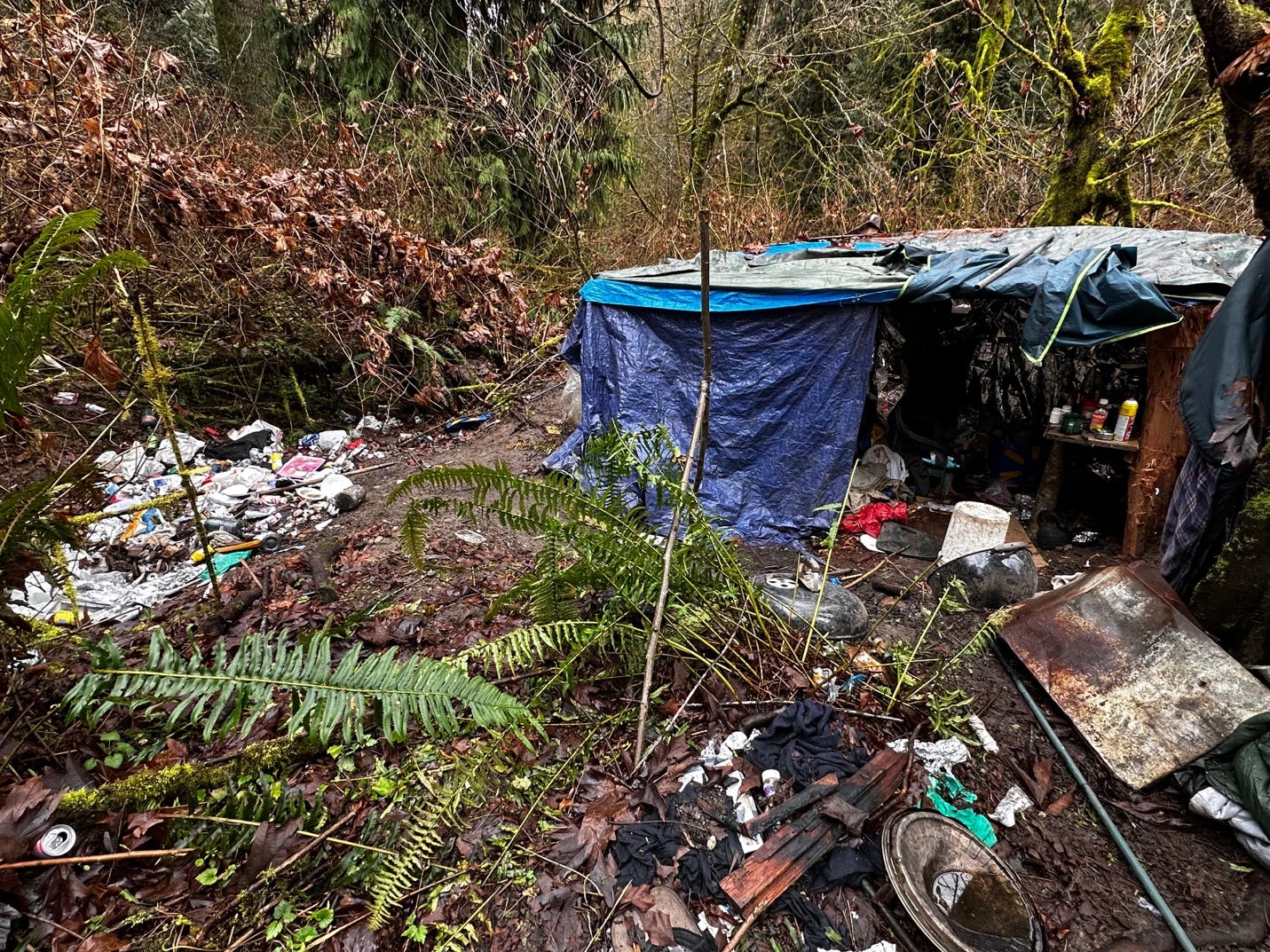
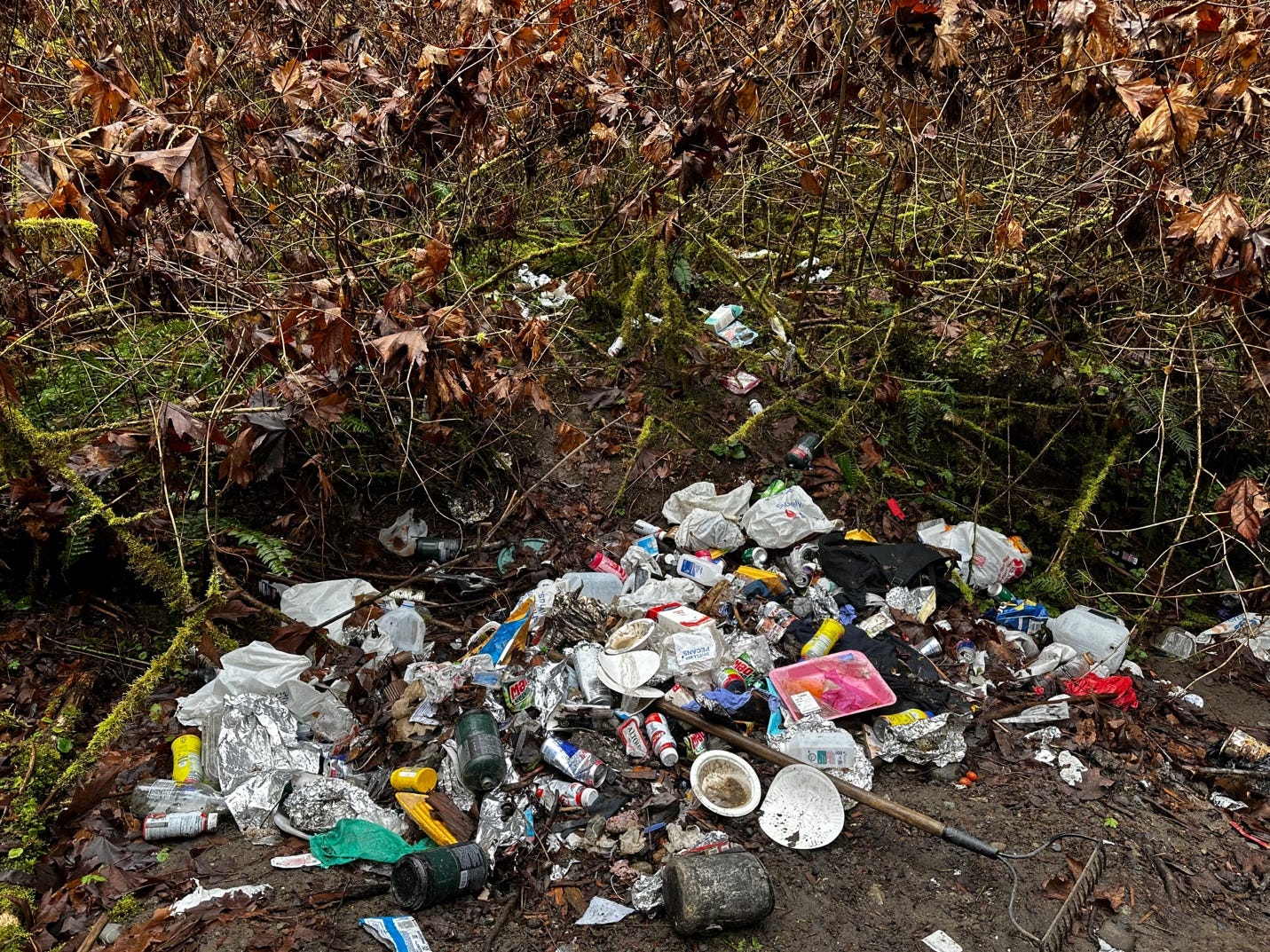
Beyond this point, the trail grows faint and the terrain more difficult — multiple creek crossings, thick undergrowth, and deep mud. Near a small tributary feeding into Tumwater Creek, an occupied structure is covered with tarps and ringed by scattered waste.
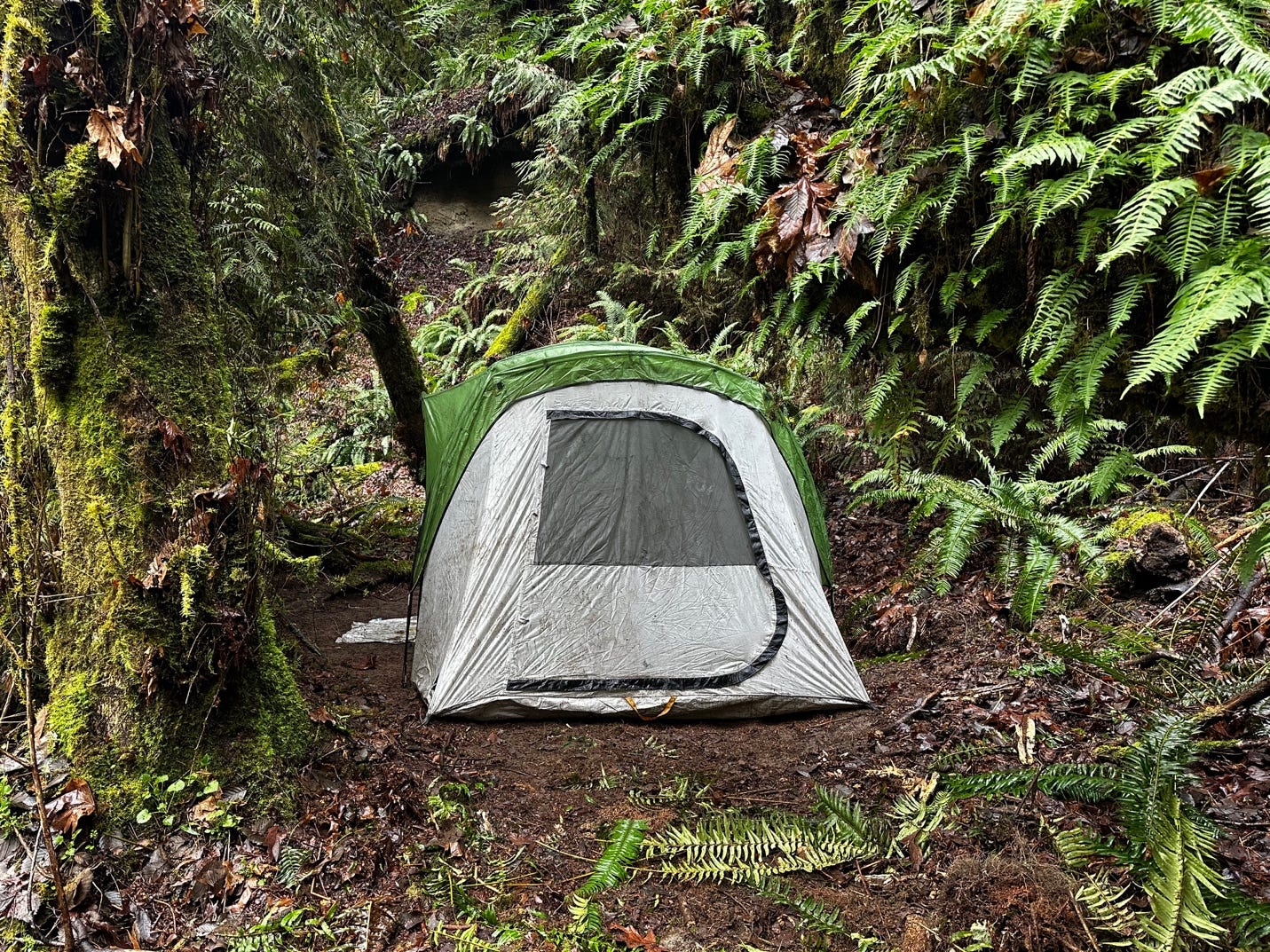
Farther south sits a comparatively tidy tent, occupied by an older man from Colorado who bikes into town for supplies.
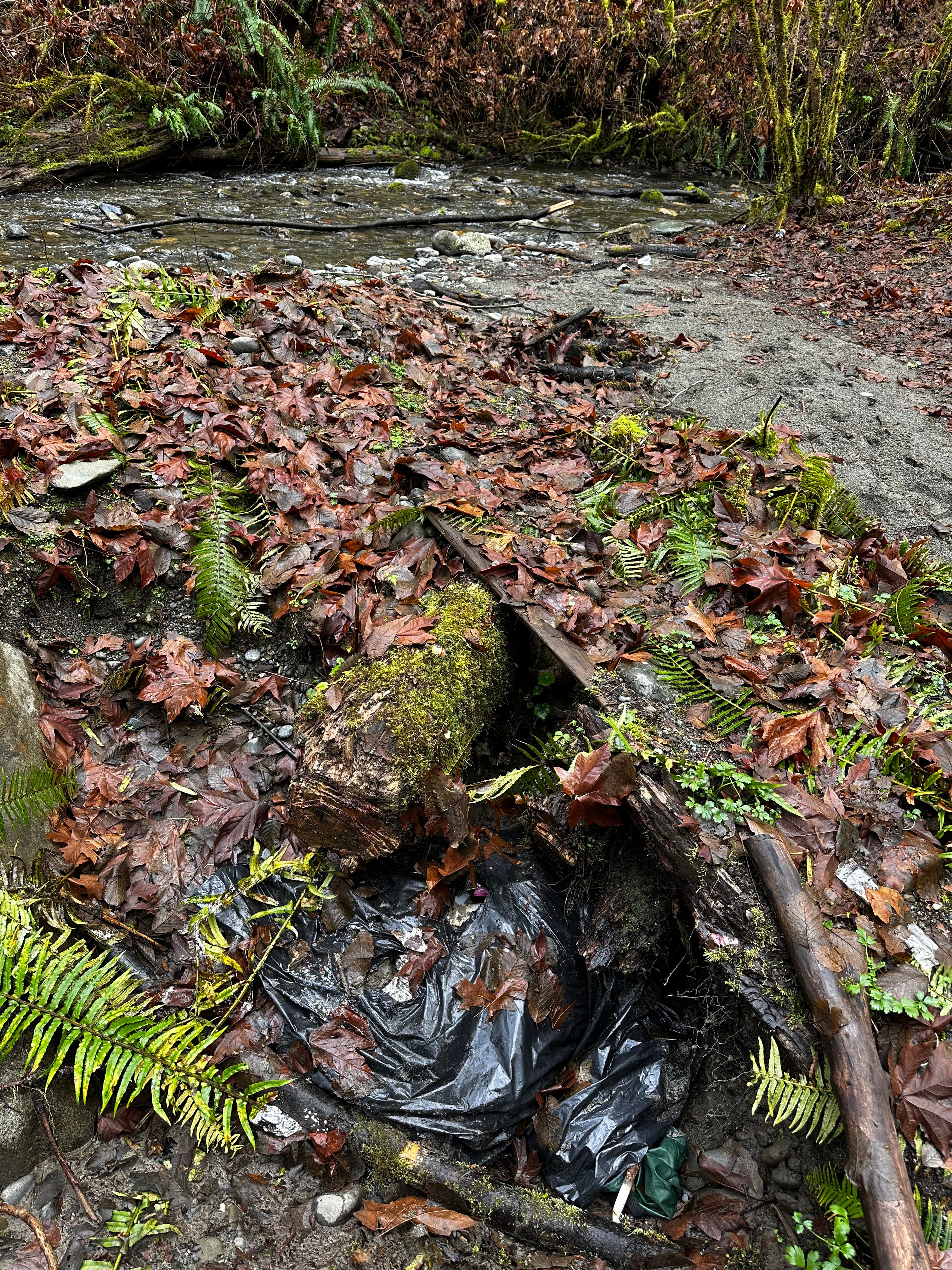
Nearby, along the water’s edge, an abandoned tent remains.
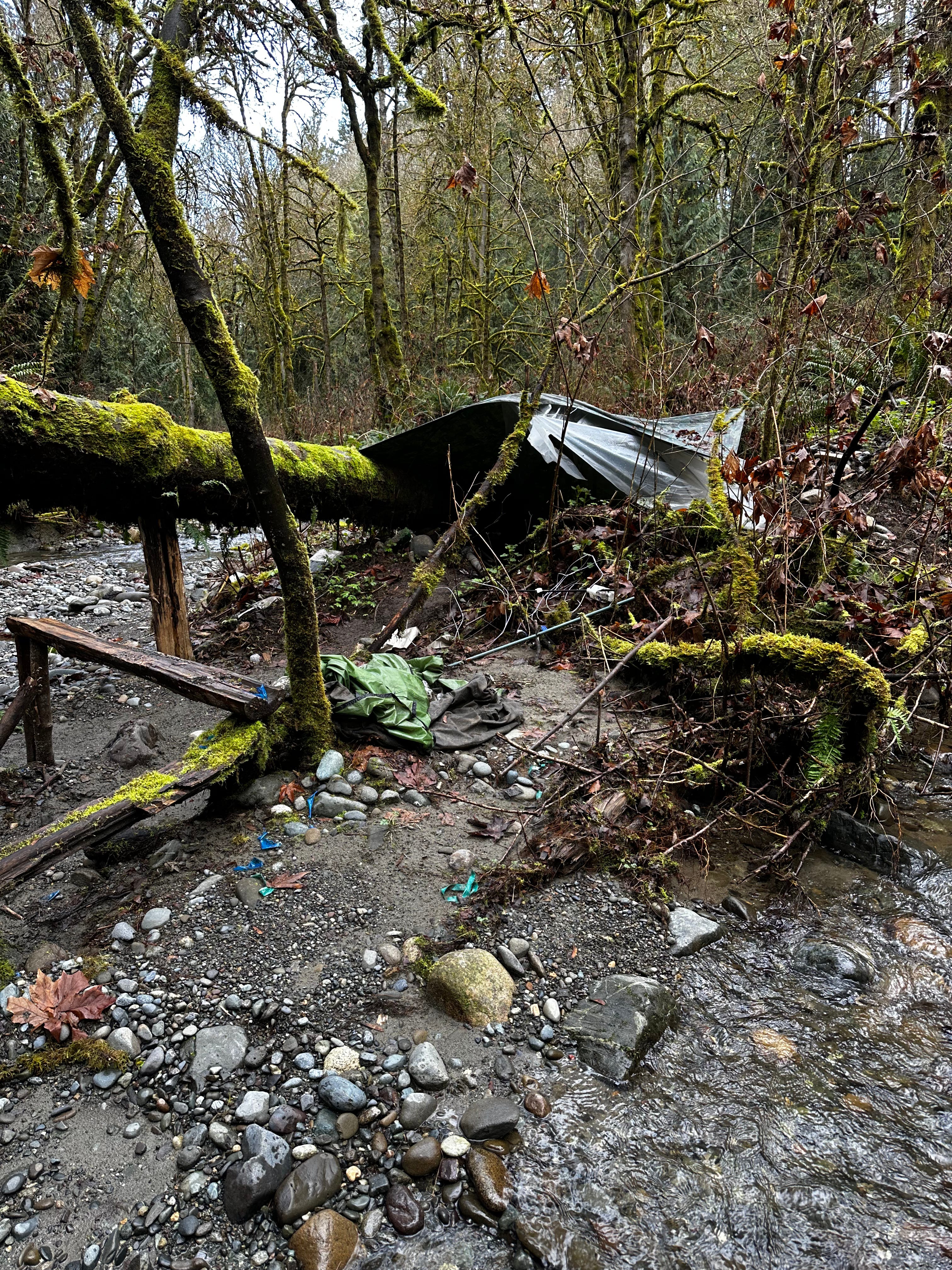
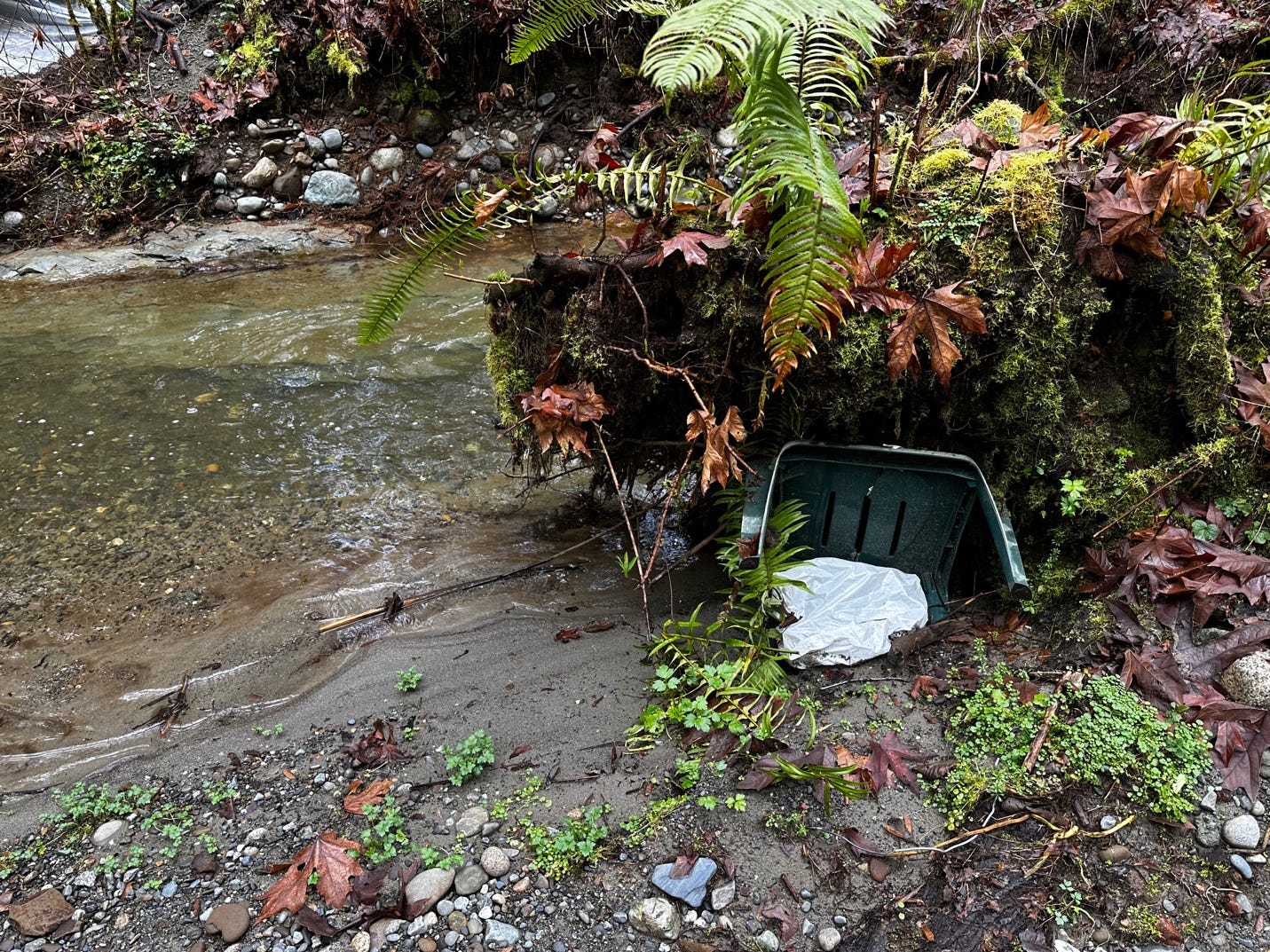
The former occupant buried their trash along the creek bank.
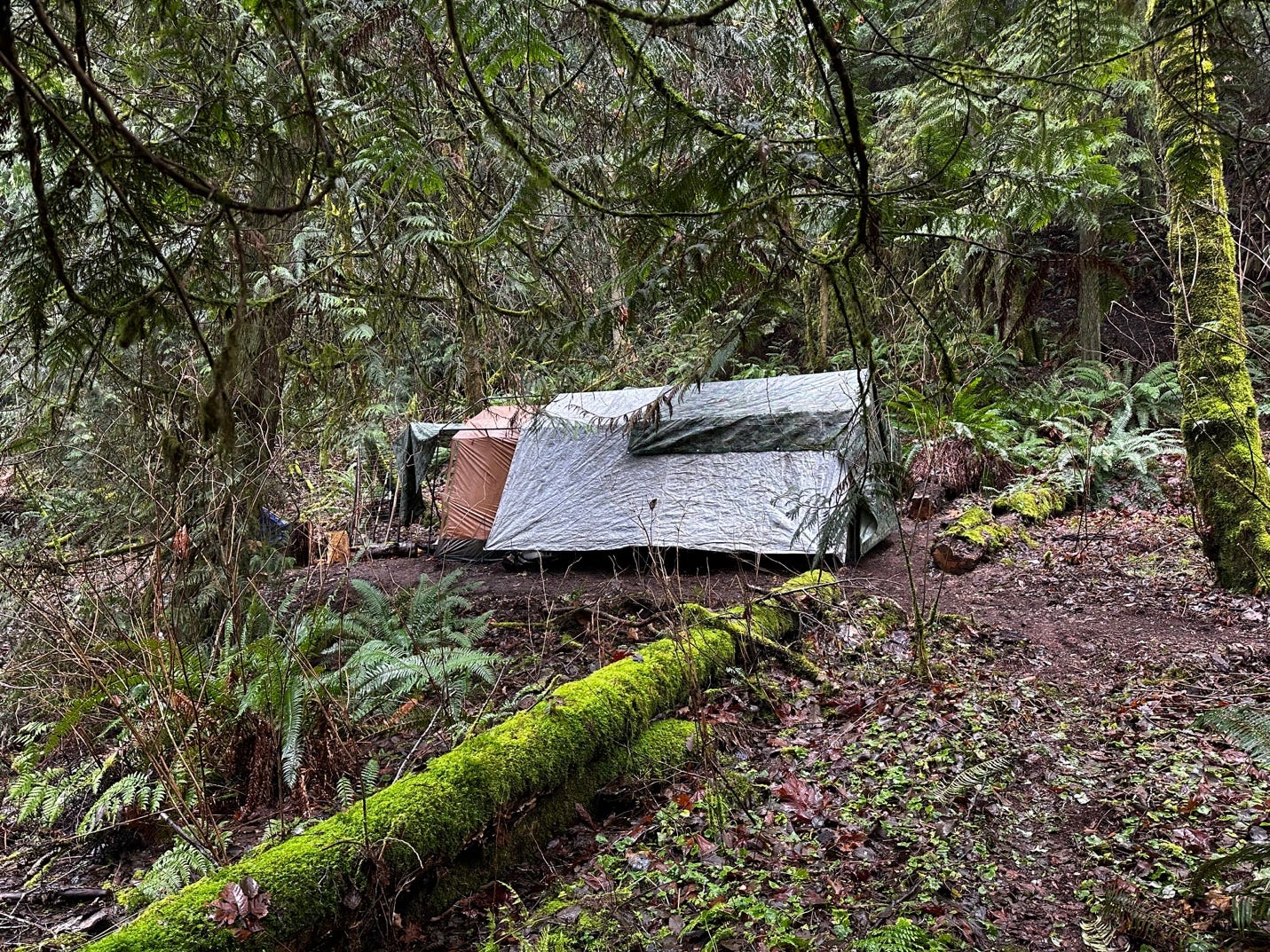
The northernmost tent is large enough to accommodate a family and is presently occupied, at minimum, by a young woman and her dog.
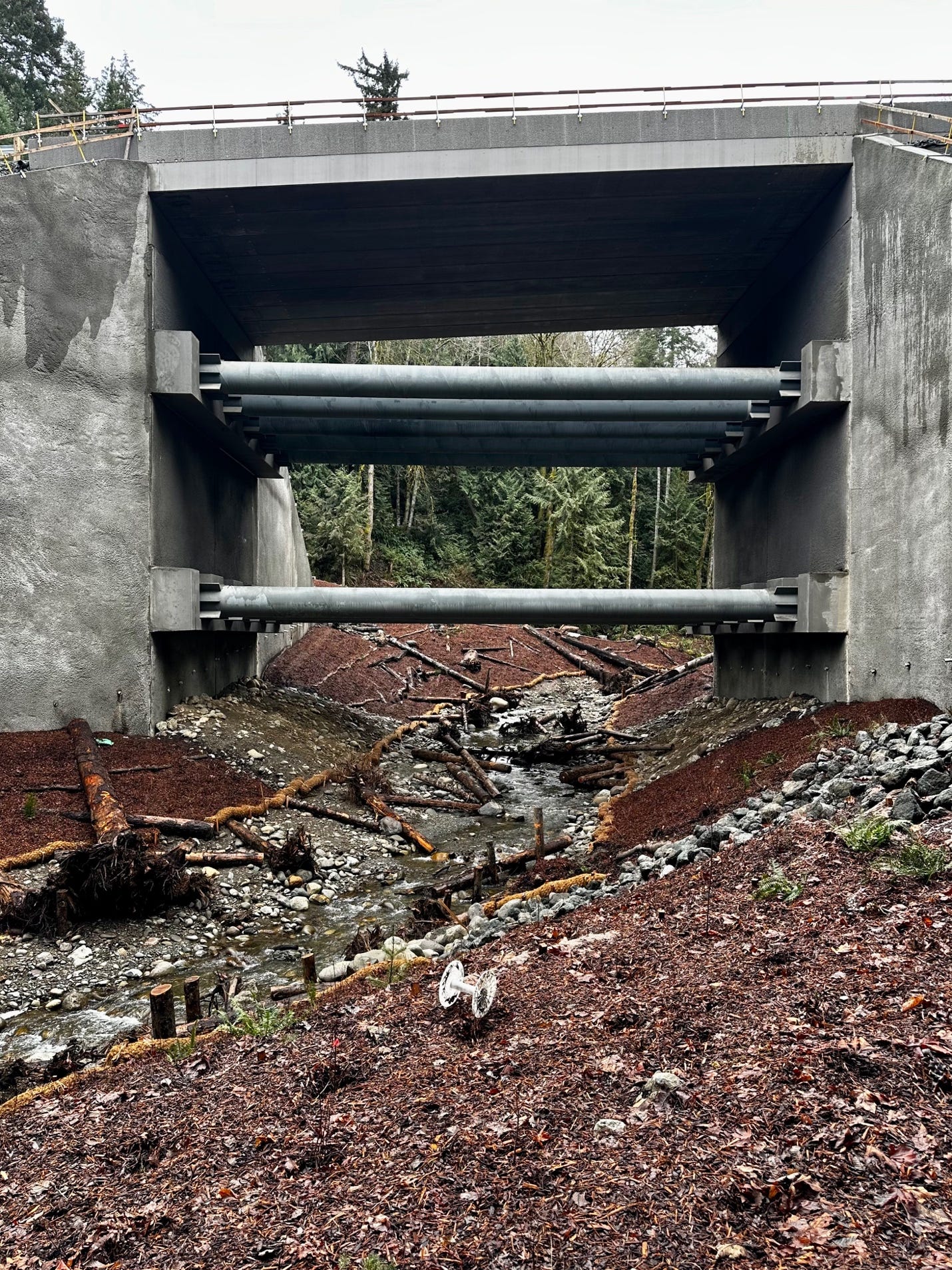
For the salmon that make it past everything shown on this tour, the reward is a state-of-the-art fish passage culvert beneath Highway 101 — thoughtfully engineered with strategically placed logs to make their upstream journey more interesting.
So far, the culvert has not become an encampment — though given the surrounding conditions, one might reasonably wonder how long that will remain the case.
Summing Up
This is not a single “problem spot.” It is a corridor.
It is also a salmon habitat.
Providing larger trash receptacles does not solve this. It institutionalizes it.
The fundamental issue is not compassion. It is accountability. Strong leaders set expectations and take ownership, but that is not happening.
If public lands are not enforced as public lands, they become unmanaged settlements.
If encampments are permitted to exist indefinitely, cleanup becomes cyclical.
If harm reduction focuses on supply distribution without a primary emphasis on transition and treatment, the visible footprint of addiction expands.
This is not about demonizing individuals who are struggling. It is about asking whether the current policy reduces harm or simply relocates it downstream.
When volunteers remove waste, they are not committing theft.
They are filling a vacuum.
And until enforcement, environmental stewardship, and treatment expectations are aligned, that vacuum will remain.
Strong Leadership for Effective Change
The personal, social, economic, safety, and environmental crises of homelessness and substance abuse can be addressed. Doing so will require leadership willing to align policy with measurable outcomes and community standards. Here are practical steps that would reflect that leadership:
Eliminate the option of long-term outdoor living on public land by revising ordinances where necessary and consistently enforcing existing laws.
Prioritize local housing resources for current Clallam County residents, ensuring limited beds and services first serve those who already call this community home.
Expand temporary shelter capacity, actively gather feedback from users and neighbors, and implement improvements that make shelters safe, clean, and functional.
Reduce the cash flow that fuels addiction through clear anti-panhandling signage and public education campaigns that direct generosity toward structured services instead of street transactions.
Redirect funding from drug-use supplies toward treatment programs that emphasize recovery and produce measurable, long-term results.
Measure outcomes — not inputs. Instead of counting encounters, supplies distributed, or service interactions, ask the harder questions:
How many people graduate from addiction into sustained sobriety?
How many transition from homelessness and dependency into stable housing and self-sufficiency?
Strong leadership does not merely manage symptoms. It sets expectations, establishes accountability, and measures success by restored lives and restored public spaces.
What Can You Do?
Ask the Port Angeles City Council to stand up and lead in defense of our citizens, our economy, and our homeless population. Demand strong leadership, not tone-deaf ideology. All councilmembers can be reached by emailing council@cityofpa.us
Remind Health Officer Berry that cleaning up her harm reduction trash is not theft at allison.berry@clallamcountywa.gov
Ask the county commissioners to lead by example. Strong leadership is contagious. Ask them to set the standard for the city council and encourage cooperative change. All three commissioners can be reached by emailing the Clerk of the Board at loni.gores@clallamcountywa.gov.
Last week, Jake Seegers asked readers what matters most in local leadership. Out of 78 votes:
86% said, “A willingness to correct mistakes”
9% said, “Policy outcomes over process”
4% said, “Strict enforcement of authority”
1% said, “Alignment with my personal values”
Editor’s Note: CC Watchdog editor Jeff Tozzer also serves as campaign manager for Jake Seegers during his run for Clallam County Commissioner, District 3. Learn more at www.JakeSeegers.com.


