


A seemingly minor issue—commissioners placing stickers on taxpayer-funded laptops—opens a window into a broader culture of inconsistency, dismissiveness, and unequal treatment inside Clallam County government. What may look trivial at first glance points to something more serious: a growing divide between those who make the rules and those expected to follow them.
In the podcast: Highlights from last week’s Commissioners’ Forum.
“I think it was just a fun thing that I did.”
That was Commissioner Mike French’s response to a constituent during last Tuesday’s “Commissioner Forum.”
The question itself was straightforward:
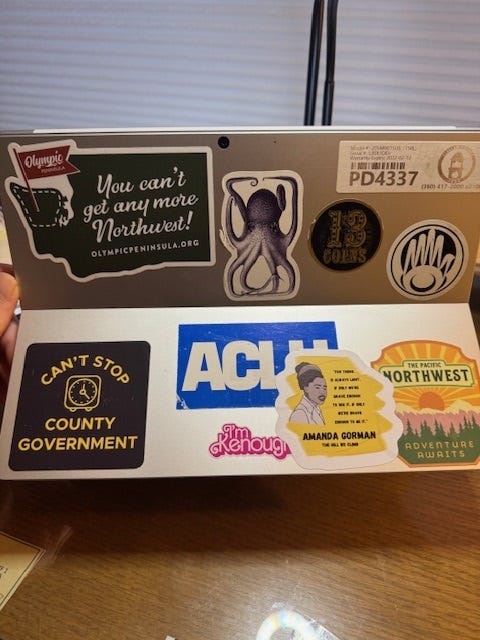
The laptops used by commissioners are county property, purchased with taxpayer funds for official business. Some commissioners have placed stickers on these laptops, including political ones, while keeping their own personal items—like coffee mugs—plain. Can you explain why you believe it is appropriate for elected officials to place personal or political stickers on county-owned property that does not belong to them?
Instead of engaging seriously, the response reduced the issue to “fun.”
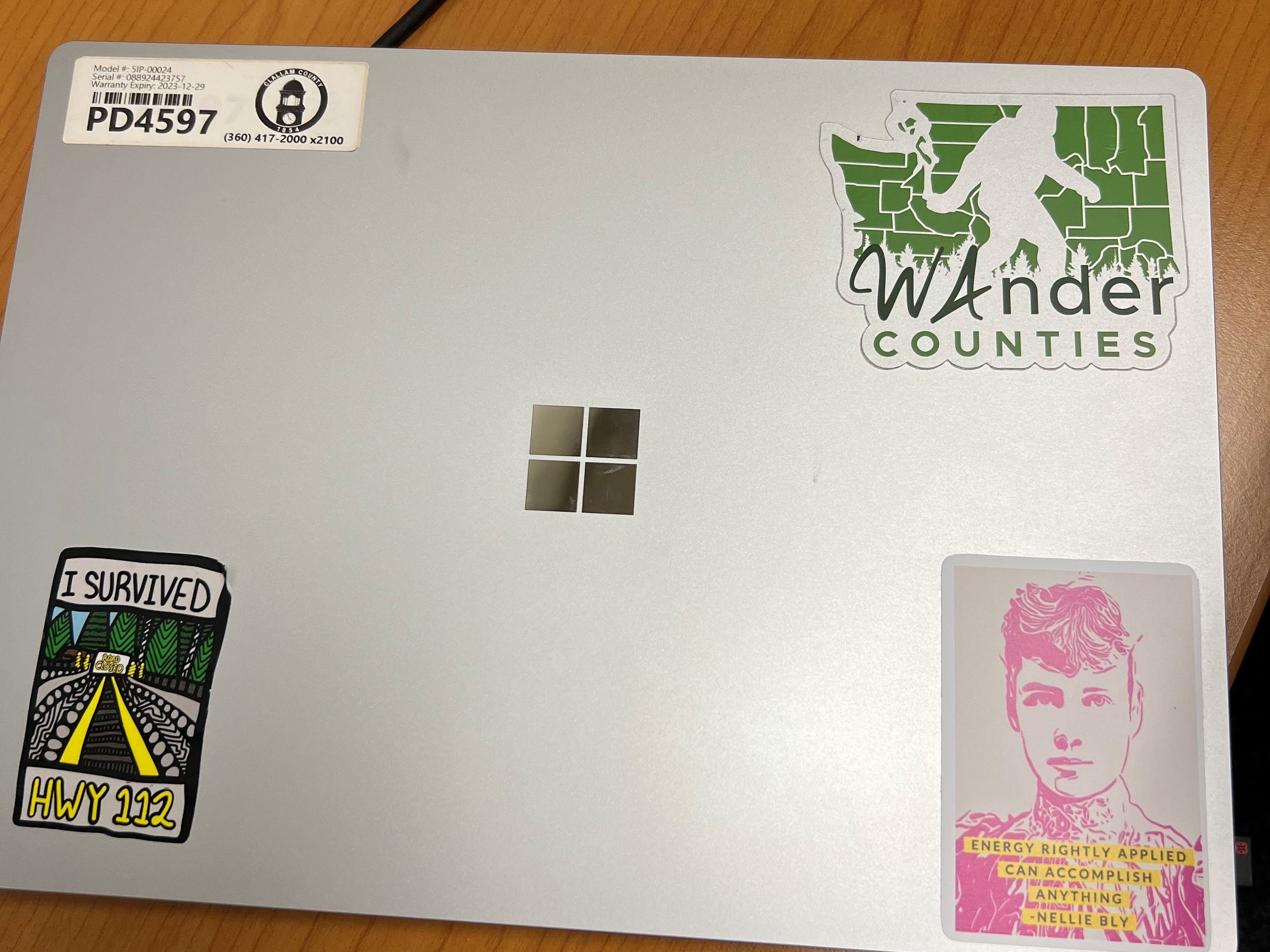
Commissioner Mark Ozias offered a similar dismissal:
“One thing I can say about stickers is that they’re removable… Elected officials do not give up their freedom of speech… it’s been a common expression of fun.”
When asked whether that same “fun” could extend to a public commenter placing removable stickers on the podium or dais, Commissioner Ozias replied:
“I think that’s a ridiculous question.”
This, notably, from a commissioner who once publicly encouraged citizens to ask questions and insisted, “There is no such thing as a stupid question.”
This Isn’t About Stickers
On its face, this may seem trivial. It’s not.
It’s about standards, consistency, and respect for public property.
The laptops in question are not personal belongings—they are county-issued equipment paid for by taxpayers. Under Clallam County Policy 420, technology resources are intended for official use. Personal use is limited. Political use is prohibited.
And while the policy may not explicitly say “no stickers,” it does establish a clear expectation: Public resources are not for personal expression.
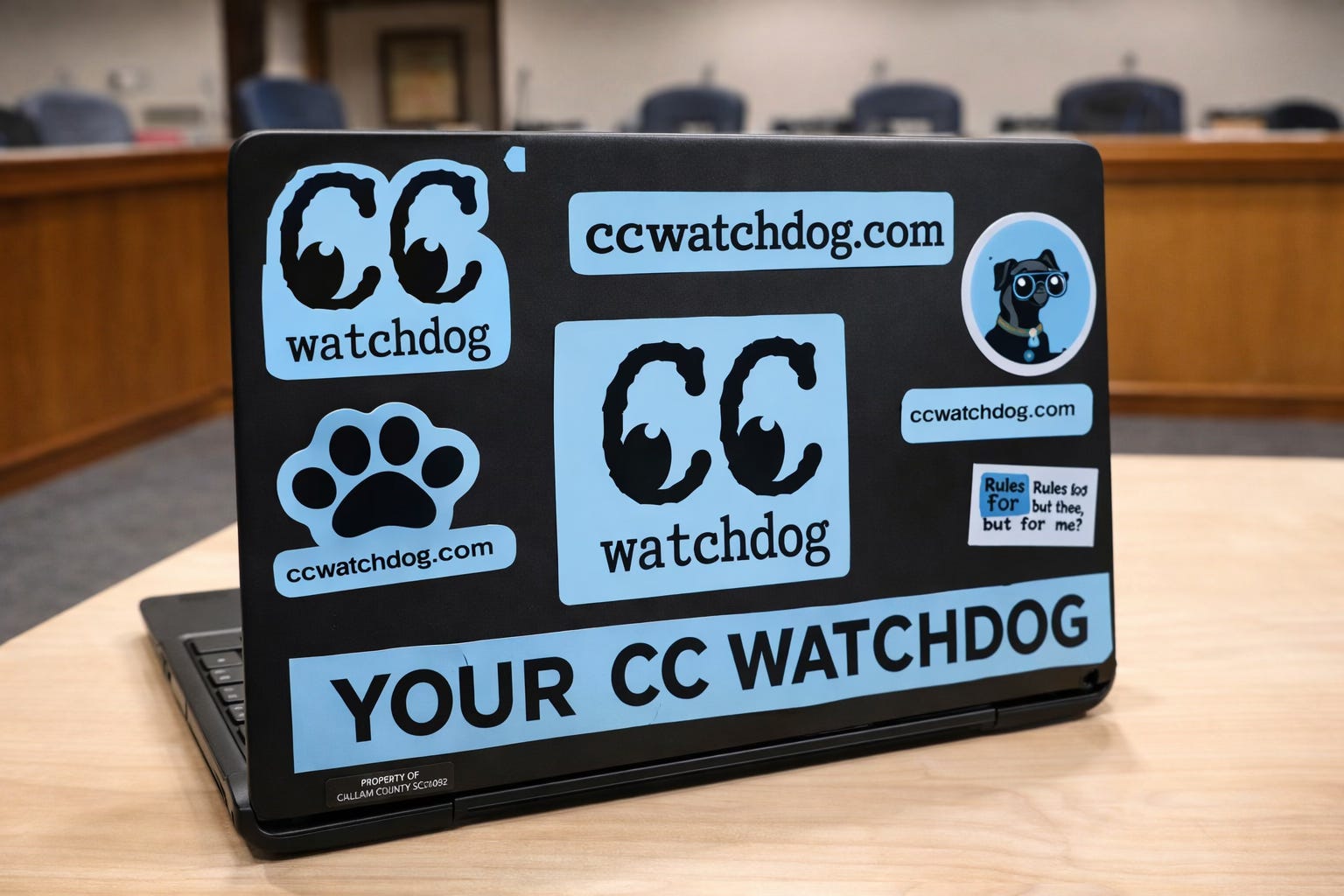
The First Amendment Doesn’t Apply the Way They Think It Does
The justification offered by Commissioner Ozias—“free speech”—is a fundamental misunderstanding.
The First Amendment protects citizens from government restriction of speech.
It does not grant government officials the right to use public property as a personal billboard.
There’s a difference between:
speaking as a private citizen
and using taxpayer-funded equipment to display ideological messaging
That distinction matters.
Even the Content Raises Questions
One of the stickers in question is tied to the American Civil Liberties Union.
From a legal standpoint, that matters—but only to a point.
An ACLU sticker is generally issue-based, not tied to a specific candidate or ballot measure. Because of that, it likely doesn’t violate Washington’s campaign finance law (RCW 29B.45.010).
But that’s not really the issue here.
The question isn’t whether it’s legal. It’s whether it’s appropriate.
The ACLU isn’t a neutral organization. Like the League of Women Voters, it’s an advocacy group that takes positions on some of the most debated and divisive issues in the country, including:
criminal justice and policing policies
homeless encampments and how public spaces are used
free speech disputes in schools and public institutions
challenges to government authority and law enforcement
and more recently, high-profile advocacy around transgender policies, including positions on gender identity in schools, healthcare, and public accommodations

People can—and do—strongly disagree with those positions. That’s exactly the point.
When an elected official puts the branding of an advocacy organization on taxpayer-funded equipment, it’s no longer just personal expression. It starts to look like something more by:
creating the appearance of government alignment with a particular viewpoint
raising questions about neutrality
and blurring the line between personal beliefs and official conduct
Public office comes with a higher standard. Not just in decisions, but in presentation.
Because even small, symbolic choices send a message.
And in this case, the message isn’t neutral.
A Pattern, Not an Isolated Incident
If this were a one-off, it might not matter.
But it’s not.
Two of three commissioners are doing it
The response to public concern was dismissive
And it fits a broader pattern of behavior that many constituents have noticed
Consider:
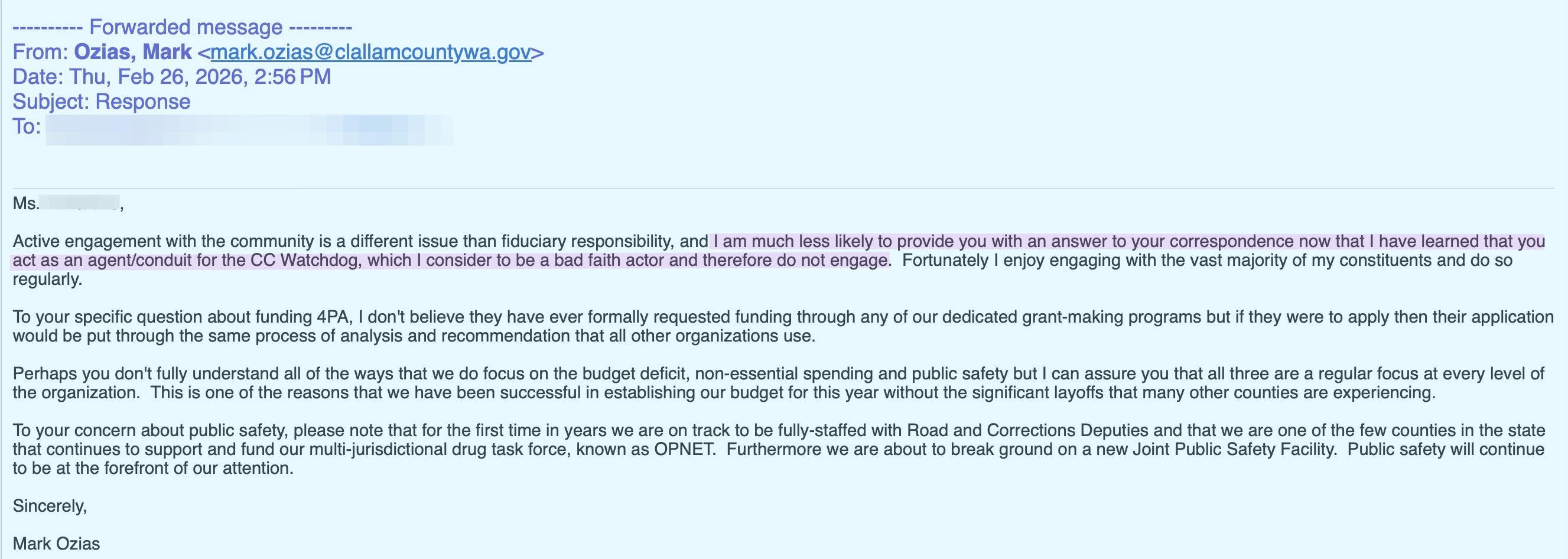
Commissioner Ozias has, at times, dismissed critics as “agents” or “conduits” for CC Watchdog rather than engaging their concerns.
Commissioner French has displayed a level of informality in meetings that many would consider unprofessional


Commissioner Randy Johnson has publicly indicated decisions before hearing public comment—undermining the purpose of participation altogether
Individually, these may seem small. Together, they point to something larger: A culture that is increasingly disconnected from the people it serves.
A Growing List of Double Standards
What makes this more than a cosmetic issue is the pattern it reflects.
Increasingly, residents are seeing two different sets of rules:
The public cannot place stickers on county property—but commissioners can
The public would face consequences for damaging public property—while politically aligned actors have engaged in destruction, filmed it, celebrated it publicly, and faced little visible accountability
Law enforcement resources are stretched thin for taxpayers—yet taxpayer-funded private security has been arranged for politically connected individuals
Homeless encampments are allowed to impact public spaces and waterways—conditions that would bring fines or enforcement if experienced elsewhere
Activists are given extended access and influence—while everyday citizens are limited to a few minutes at the podium
Many residents carry the tax burden—while some of the most politically influential entities operate tax-exempt
Each of these issues can be debated individually.
But taken together, they create a perception that is difficult to ignore: A two-tiered system—one for insiders, and one for everyone else.
And once that perception takes hold, trust erodes quickly.
Rules For Thee, But Not For Me
This isn’t about stickers.
It’s about whether the same standards apply to everyone.
When elected officials dismiss reasonable questions, blur the line between public and personal property, and operate under a different set of expectations than the people they represent, it sends a message.
Not about policy.
Not about law.
But about respect.
Public office is not personal property.
Taxpayer-funded equipment is not a canvas.
And accountability is not optional.
If small things are treated casually, it’s fair to ask:
Are the big things being treated the same way?
Today’s Tidbit
oAnother issue raised at the Commissioner Forum wasn’t really about any one topic—it was about capacity, attention, and priorities.
When resident Teresa Miller asked whether commissioners should take a more active role in engaging with local school districts, Commissioner Mike French gave a thoughtful and candid response. He acknowledged that serving effectively on a school board would require significant time and focus, and said plainly that he didn’t believe he could do both roles well at the same time.
That’s an honest answer—and a reasonable one.
But it also raises a bigger question.
If adding one more responsibility would stretch things too thin, what about the dozens already on the table?
In addition to serving as commissioner, French sits on an extensive list of boards and committees, including:
Board of Health
Canvassing Board
Clallam Bay/Sekiu Chamber of Commerce Liaison
Clallam Bay/Sekiu Community Action Team
Clallam Bay/Sekiu Sewer Advisory Council
Clallam County Finance Committee
Clallam Transit System
Crescent Community Advisory Council
Developmental Disability Advisory Council Liaison
Forks Chamber of Commerce Liaison
Housing Solutions Committee (Alternate)
Law Library Board of Trustees
Neah Bay Chamber of Commerce Liaison
Olympic Area Agency on Aging (Alternate)
Olympic Community Action Programs (OlyCAP)
Olympic Region Clean Air Agency (ORCAA)
Peninsula Regional Transportation Planning Organization
Trails Advisory Committee
Tribal Liaison – Lower Elwha Klallam, Quileute, Makah
Veterans’ Affairs Liaison (Alternate)
Washington State Association of Counties – Legislative Steering Committee
William Shore Memorial Pool District
That’s not just a busy schedule—it’s a structural overload.
And it matters.
Because when attention is divided, oversight suffers. Not always in obvious ways—but in the kinds of failures that show up later, when it’s harder to fix.
The William Shore Memorial Pool District—where French also serves—was the subject of a State Auditor fraud investigation last year that found:
$67,000 in questionable spending
Weak or nonexistent financial controls
Personal expenses charged to public funds
In December, French was selected to serve as treasurer for the pool.
Which brings the conversation full circle.
If effective leadership requires focus—and even one additional role increases the burden—then it’s fair to ask:
How much is too much?


