


The Jamestown Corporation’s newsletters used to be publicly available online. Now they’re much harder to find. But when the county’s second-largest and fastest-growing employer quietly outlines its plans, projects, partnerships, political relationships, land ambitions, and economic advantages, the public should probably pay attention. This review of the Tribe’s May 2026 newsletter raises serious questions about who is shaping the future of Clallam County, who benefits, and whether the public’s interests are increasingly taking a back seat to tribal expansion and influence.
If you want to know where power is moving, don’t watch the speeches — watch the land, the money, and the partnerships.
The Jamestown Corporation’s May 2026 newsletter reads less like a community bulletin and more like a roadmap for expanding influence across the Olympic Peninsula.
And perhaps most importantly, much of it is happening with little public discussion.
The Wildlife Refuge Question Nobody Can Answer
The centerpiece of the newsletter is Chairman Ron Allen’s continued push for transferring the Dungeness and Protection Island National Wildlife Refuges into tribal trust ownership.
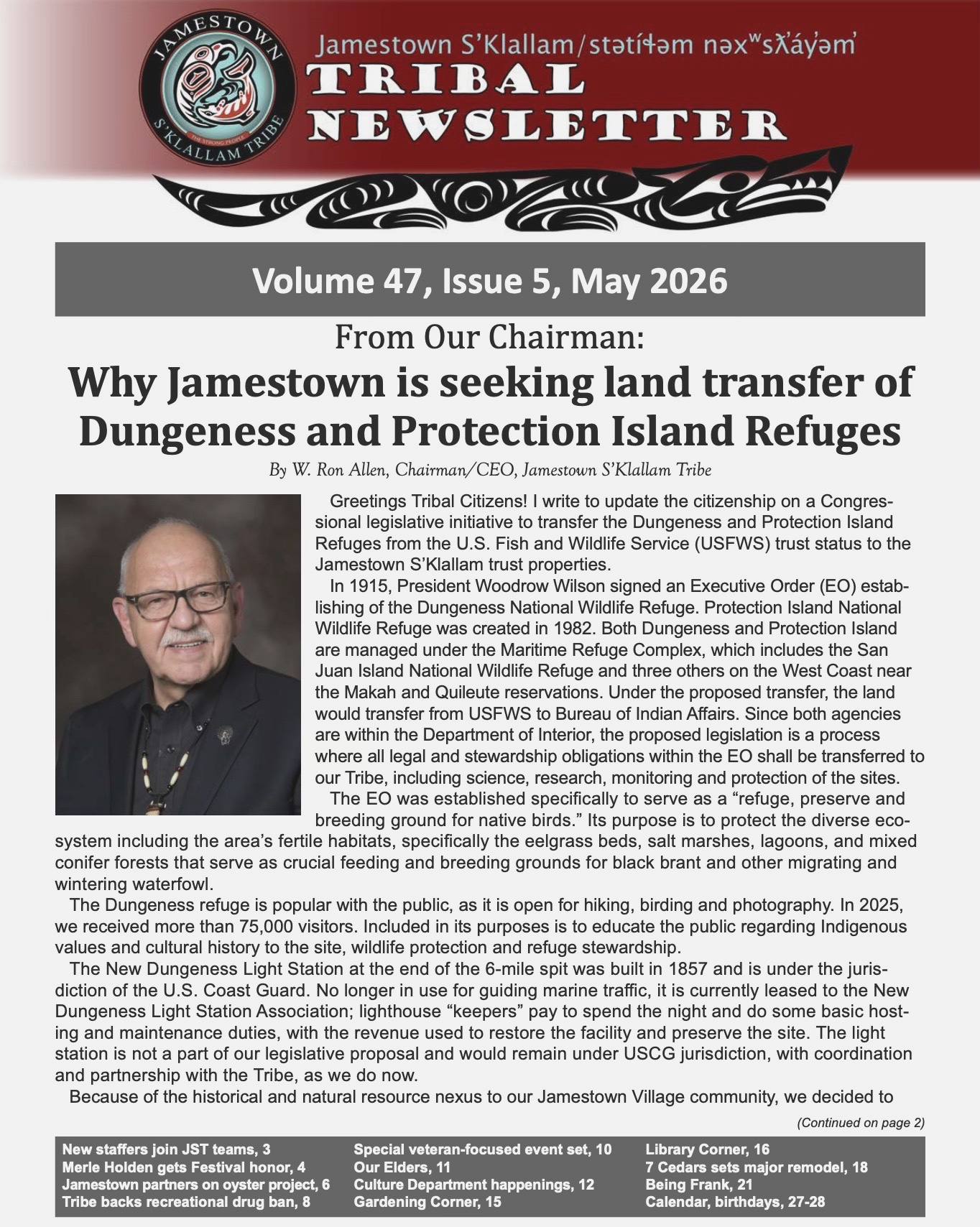
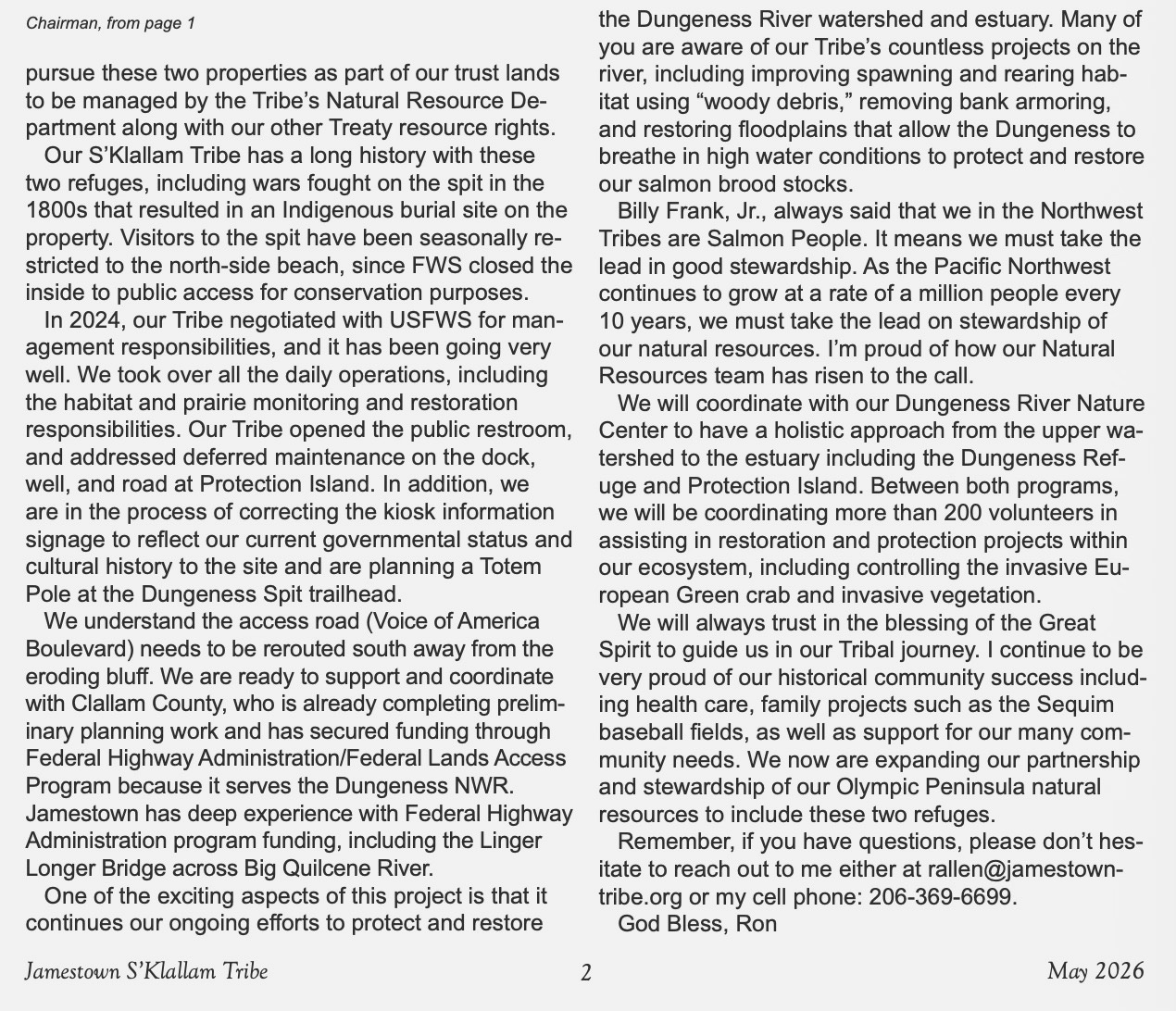
But here’s the question nobody seems willing to answer clearly:
Why?
Tribal members already have access to the National Wildlife Refuges because they are American citizens. The public already has access. The Tribe already co-manages and participates in stewardship activities.
So why pursue sole ownership and federal trust status?
The newsletter explains that the refuges attracted more than 75,000 visitors in 2025 and says one goal is to “educate the public regarding Indigenous values and cultural history.”
Clallam County has a population of roughly 78,000 people. The Tribe is openly discussing using these federal lands to educate a population roughly equivalent to the size of the county itself.
That’s not simply conservation language. That’s cultural and political influence language.
And once land enters trust status, local government loses authority over it permanently.
“Wars Fought on the Spit” — Or Something Else?
Allen’s article references “wars fought on the spit in the 1800s that resulted in an Indigenous burial site.”
But local historical accounts describe something far more specific and far less romanticized than “wars.”
In September 1868, a group of Jamestown raiders attacked a camp of Tsimshian Indians on Dungeness Spit before dawn. Historical accounts describe the attackers collapsing the victims’ shelter before killing 17 men, women, and children with clubs, knives, and firearms. Only one survivor—a wounded pregnant teenager—escaped to the lighthouse, where she was reportedly given protection by the white lighthouse keeper.
According to Dungeness Massacre and Other Regional Tales, published in 1961, the Jamestown tribal members involved in the massacre were arrested and given two days to dispose of the victims’ remains. The account states:
“Contrary to general belief, the Clallams did not bury the dead enemy on the beach. Instead the bodies of the Chimseans along with that of Lame Jack were placed in the largest of the canoes, in the bottom of which holes were bored, and set out to sea. A strong southeast wind carried the funeral barge filled with dead bodies to the deep water of the Strait of Juan de Fuca, where it sank, bringing an end to the tragic episode.”
If this historical account is accurate, the bodies were not buried on the spit itself. It is also important to acknowledge a detail often glossed over in modern retellings: those killed on Dungeness Spit were murdered at the hands of Jamestown tribal members.
That distinction matters.
Because when historical events are reduced to vague phrases like “wars fought on the spit,” the public loses critical context and nuance. A targeted massacre is not the same thing as a generalized battlefield conflict. And when these historical narratives are invoked today as part of arguments for transferring control of a national wildlife refuge, accuracy becomes even more important.
Fun Fact: Jamestown S’Klallam Chairman Ron Allen wrote that his great-grandfather was a British sailor — meaning by ancestry, he’s reportedly about 75% “colonizer.” History can get complicated fast.
Rebranding the Spit Has Already Begun
One of the more subtle entries in the newsletter may actually be one of the most revealing.
The Tribe proudly highlights “Poetry-Line Paths” signs now installed along the Dungeness refuge trails in partnership with the North Olympic Library System.
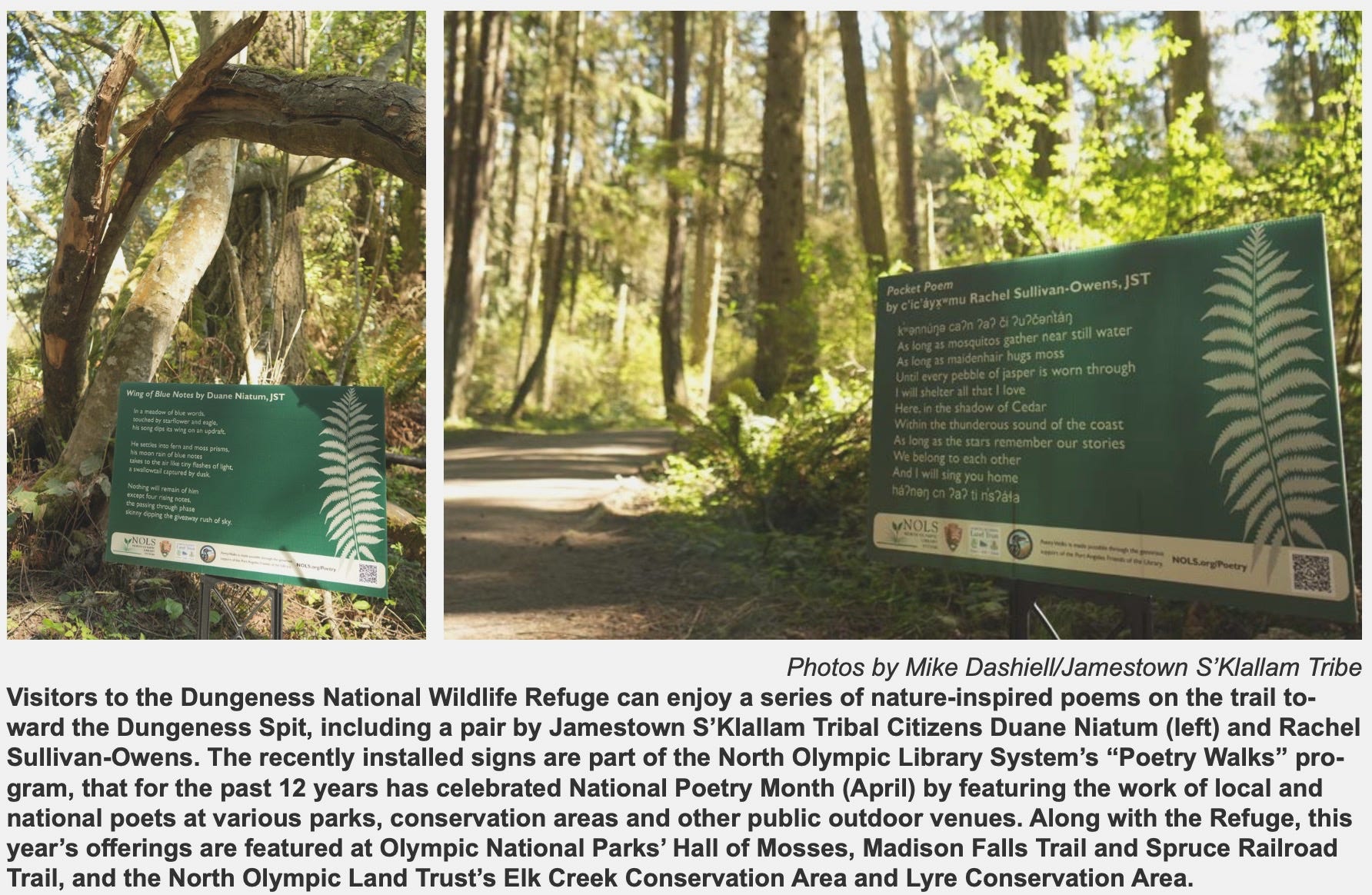
Culturally, symbolically, and institutionally, this is how landscapes slowly become redefined.
New signage.
New interpretive framing.
New historical narratives.
New cultural branding.
The newsletter openly celebrates the effort to “correct” kiosk signage and incorporate tribal governmental and cultural messaging into the refuge experience.
Again, the question isn’t whether tribal history deserves recognition.
Of course it does.
The question is whether the public fully understands that this is part of a much broader long-term effort to reshape ownership, management, branding, and authority over public lands.
Environmental Stewardship — For Everyone Else
Another recurring theme throughout the newsletter is environmental stewardship, salmon recovery, climate action, habitat restoration, buffers, and ecological protection.
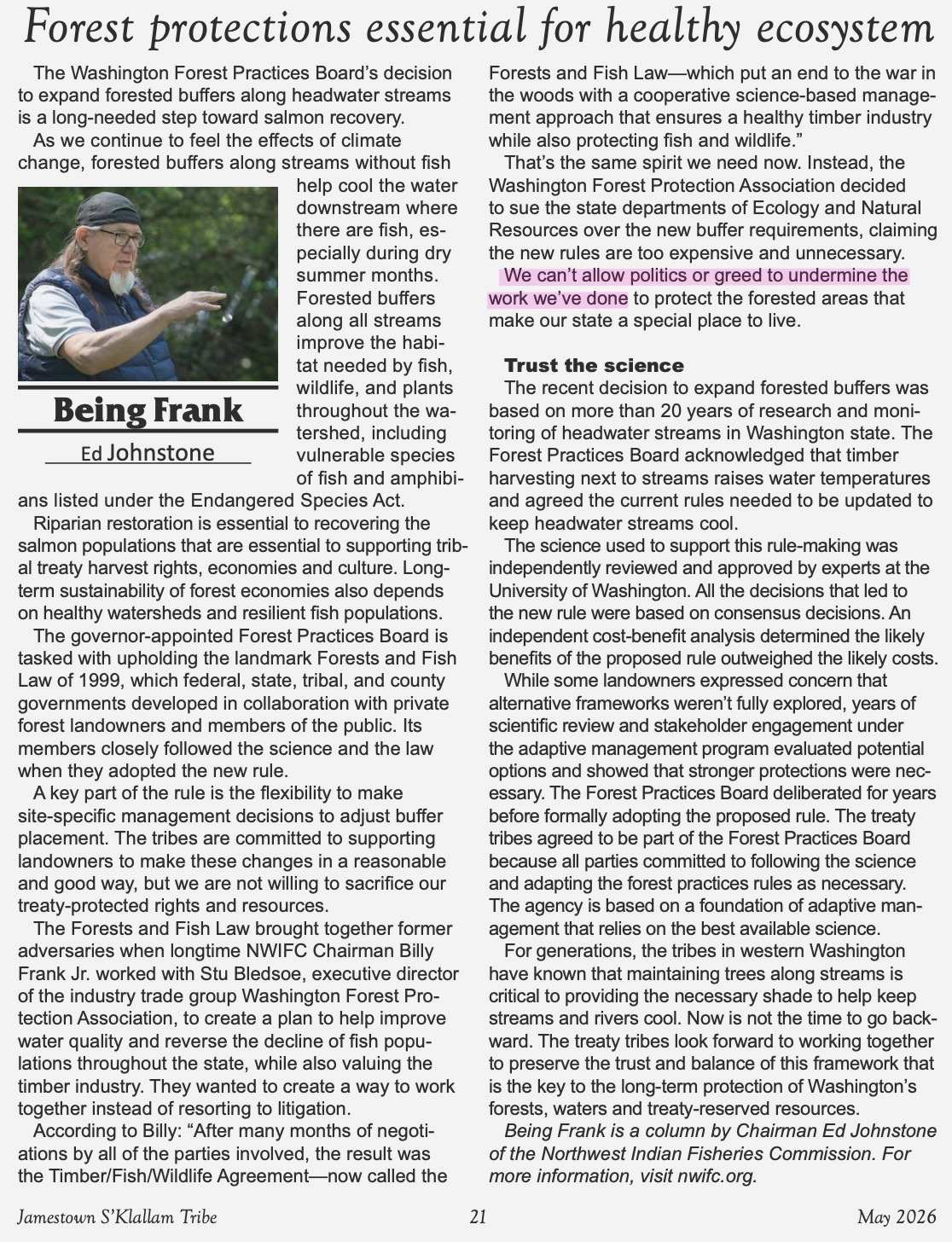
Yet many local residents have noticed what appears to be a very different set of standards when tribal economic projects are involved.
The Jamestown Corporation continues to push for commercial net pens. The Corporation was able to build a gas station adjacent to salmon-bearing Jimmycomelately Creek and is now planning another on Miller Peninsula. Meanwhile, geoduck and other shellfish harvested locally are flown overseas to Asian markets as part of large-scale commercial operations.
Wetlands were filled and altered during expansion projects at the Cedars at Dungeness Golf Course, and today, anyone driving Highway 101 can see massive earthmoving activity underway at the Salish Trails RV Resort site — on land that was formerly a wetland.
At the same time, ordinary property owners routinely face growing environmental restrictions, wider buffers, expensive permitting hurdles, and escalating compliance costs in the name of habitat protection and climate stewardship.
That’s where many residents see hypocrisy. Environmental standards often appear uncompromising when applied to homeowners, farmers, and small businesses, yet far more flexible when major tribal commercial projects are involved. For critics, it increasingly feels like environmental absolutism for the public — and economic flexibility for politically connected projects.
The Nitrous Oxide Crackdown — But Cannabis Is Fine?
The newsletter celebrates the Tribe’s support for banning retail nitrous oxide sales statewide.
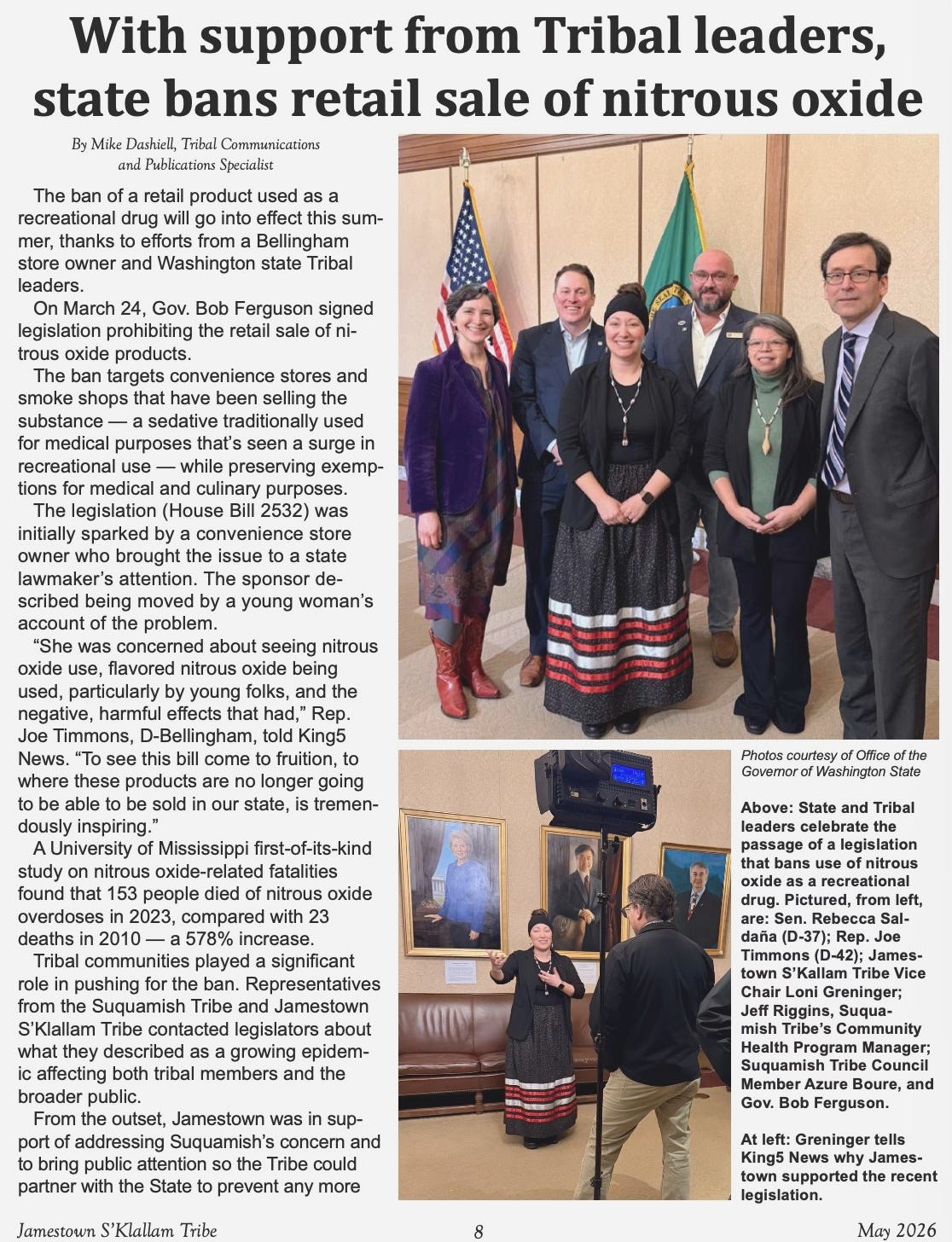
The article frames it as a public health victory.
But critics may reasonably ask another question:
Why is nitrous oxide treated as an intolerable threat while heavily taxed cannabis sales remain a major tribal business?
One obvious difference is taxation.
Cannabis generates enormous tax revenue. Nitrous oxide didn’t.
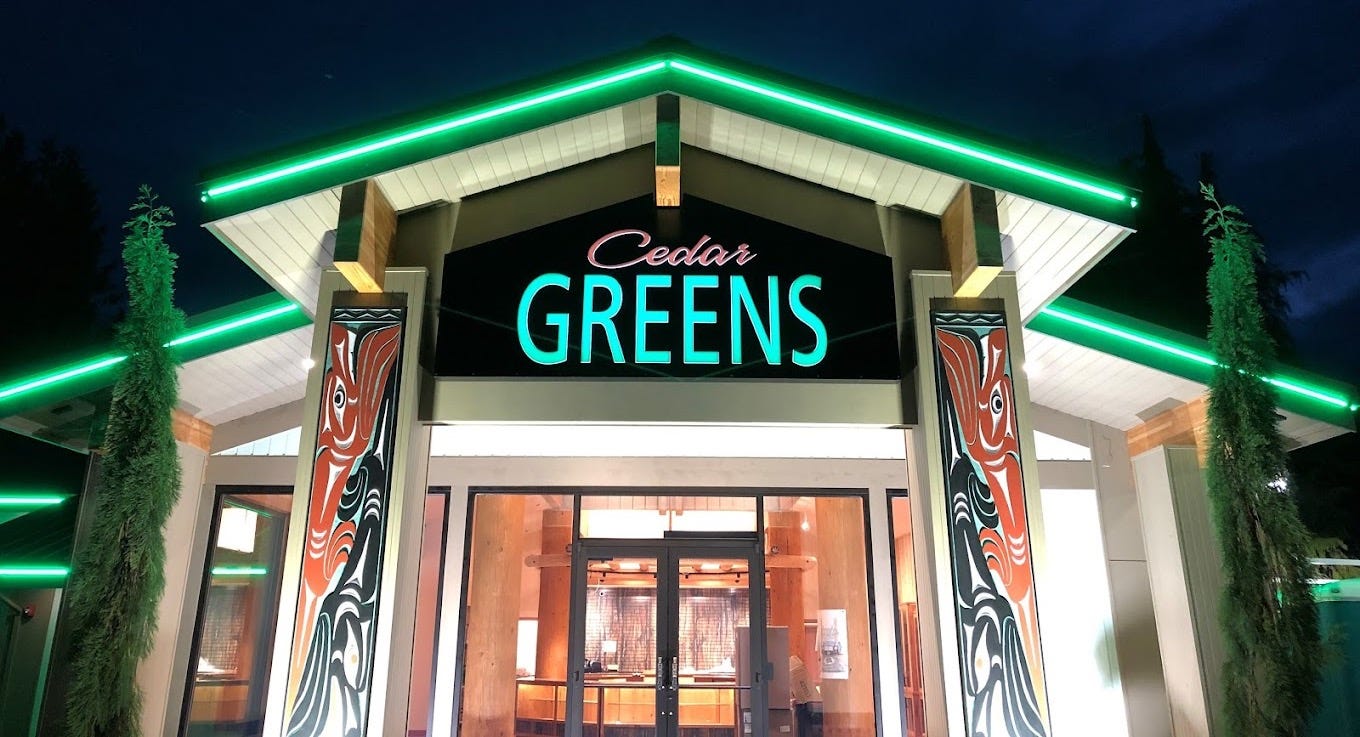
And unlike many non-tribal businesses, tribes operating under sovereign frameworks can retain significant financial advantages in how cannabis revenues and taxation structures operate.
So while the Tribe pushes aggressively to eliminate one intoxicating product from competitors’ shelves, it continues profiting from another highly regulated intoxicant market.
Whether people agree or disagree with cannabis legalization, the economic incentive here is difficult to ignore.
Political Relationships Continue to Blur
Buried in the Culture Department section is another noteworthy detail.
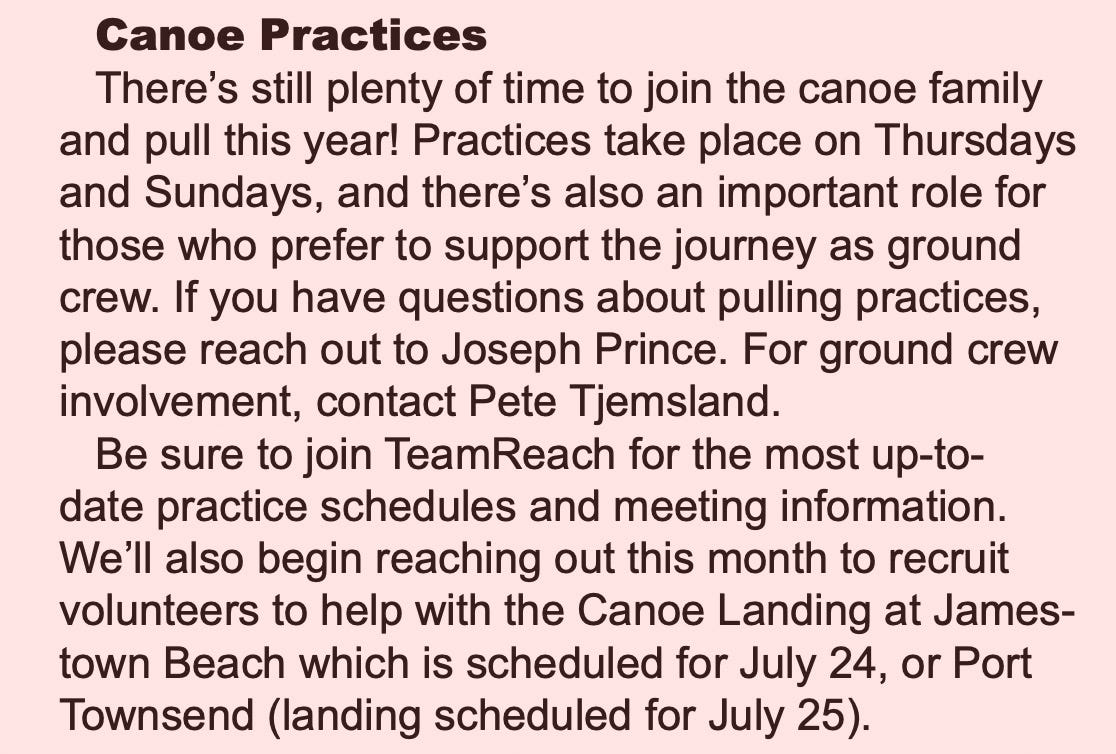
Pete Tjemsland — currently serving on the Sequim City Council — is identified as leading ground crew coordination for canoe journey practices.
Why does this matter?
Because Tjemsland recently voted in favor of Sequim sending a letter supporting transfer of the wildlife refuges to the Tribe.
Again, none of this is illegal.
But the overlap between tribal initiatives, local elected officials, nonprofit partnerships, cultural programming, and public institutions continues to grow deeper and more interconnected.
Food Distribution Based on Identity
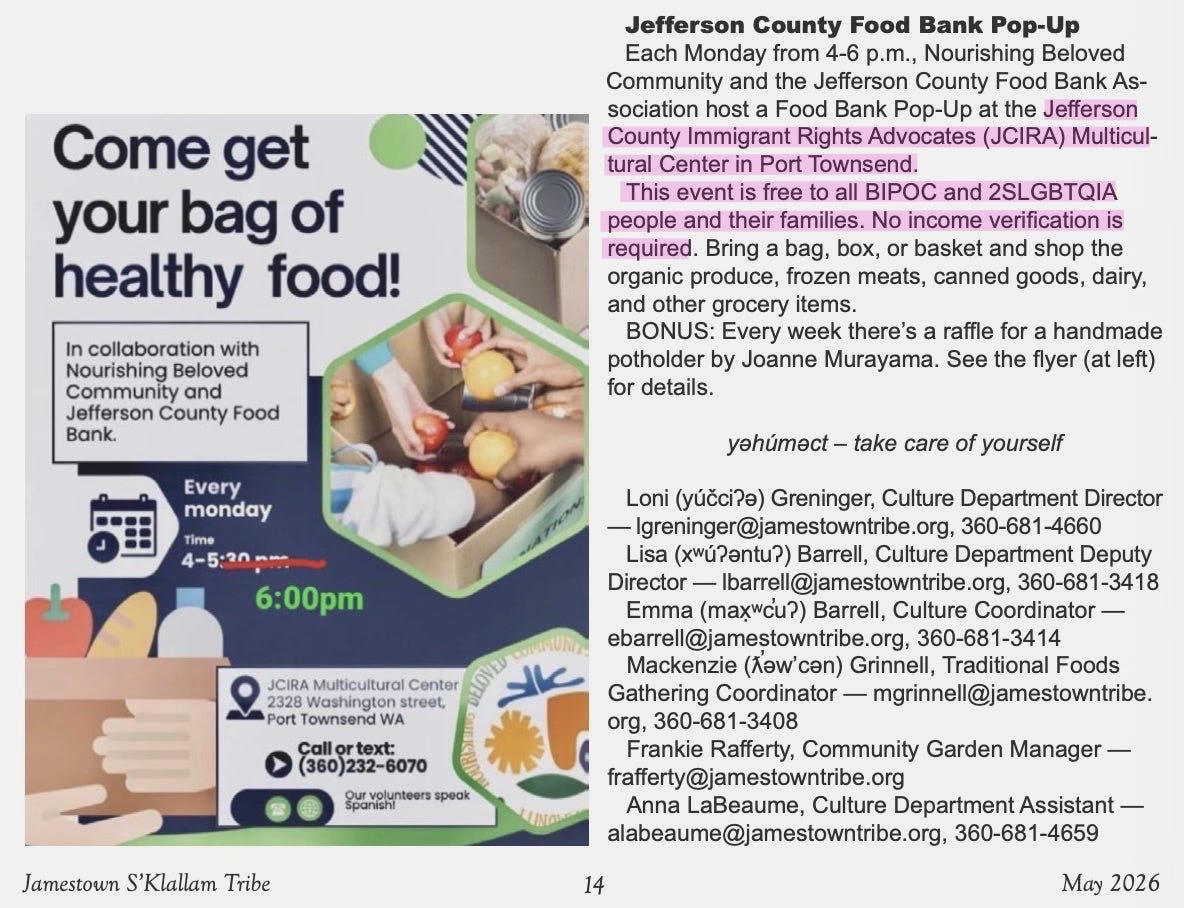
One section of the newsletter promotes a Jefferson County Food Bank Pop-Up event specifically for “BIPOC and 2SLGBTQIA people and their families,” with no income verification required.
The event is hosted through the Jefferson County Immigrant Rights Advocates Multicultural Center.
Many readers will likely ask:
Would a whites-only or heterosexual-only food distribution program ever be tolerated?
And why exactly is this being highlighted in a tribal newsletter? More importantly, why is a Tribe that generates over $100 million annually promoting a program encouraging roughly 200 local tribal members to access free food distributions intended for identity-based groups — without any income verification requirement?
The Visit That Never Made Headlines
The newsletter casually mentions that Washington Secretary of State Steve Hobbs visited the Jamestown Tribal Library and staff recently.
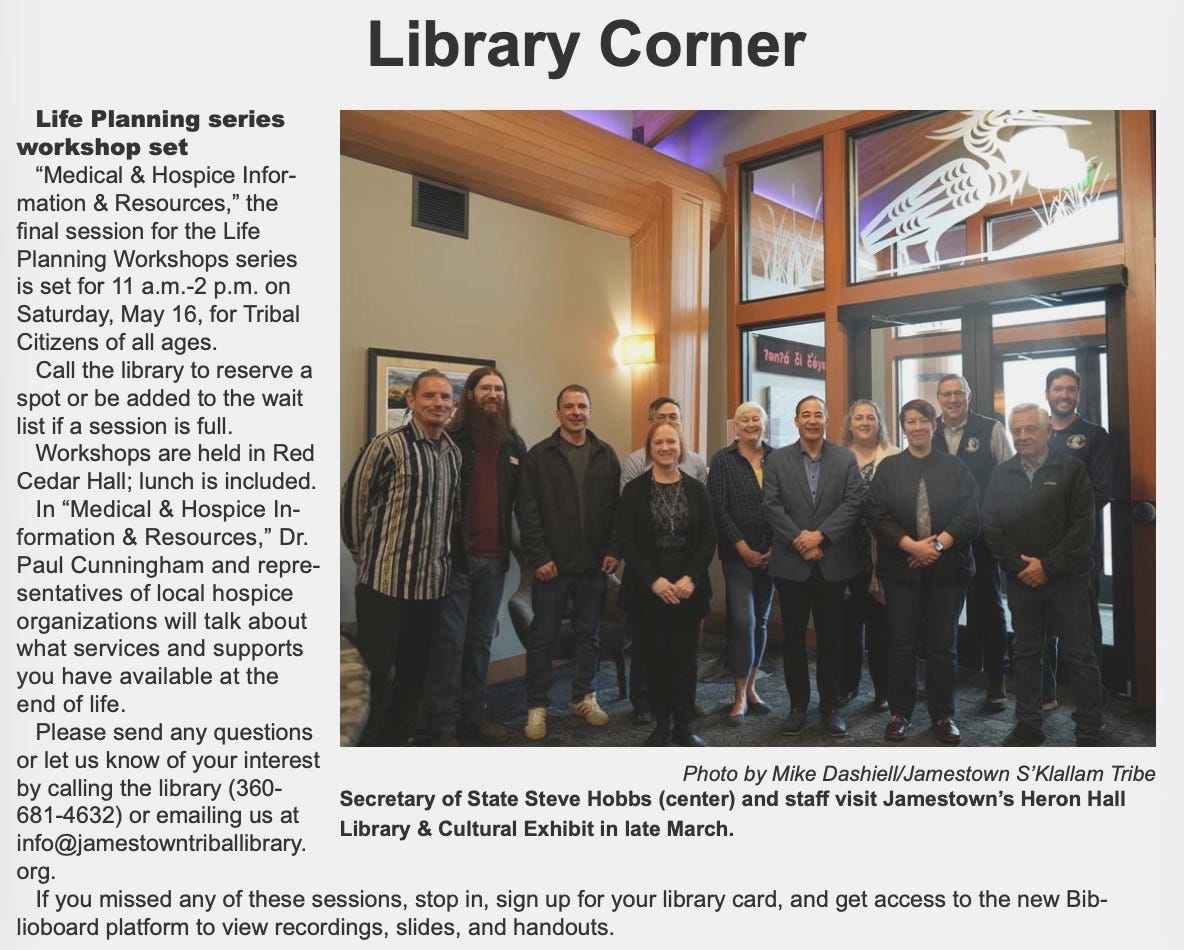
Most Clallam County residents probably never heard about it.
No major headlines.
Little public discussion.
No broad media attention.
Yet one of the state’s highest-ranking elected officials quietly visited tribal facilities.
That alone speaks volumes about where influence and political relationships increasingly flow.
Tax-Free Expansion and the 7 Cedars Empire
The newsletter also highlights major upgrades coming to 7 Cedars Resort, described as “The entertainment capital of the Olympic Peninsula.”
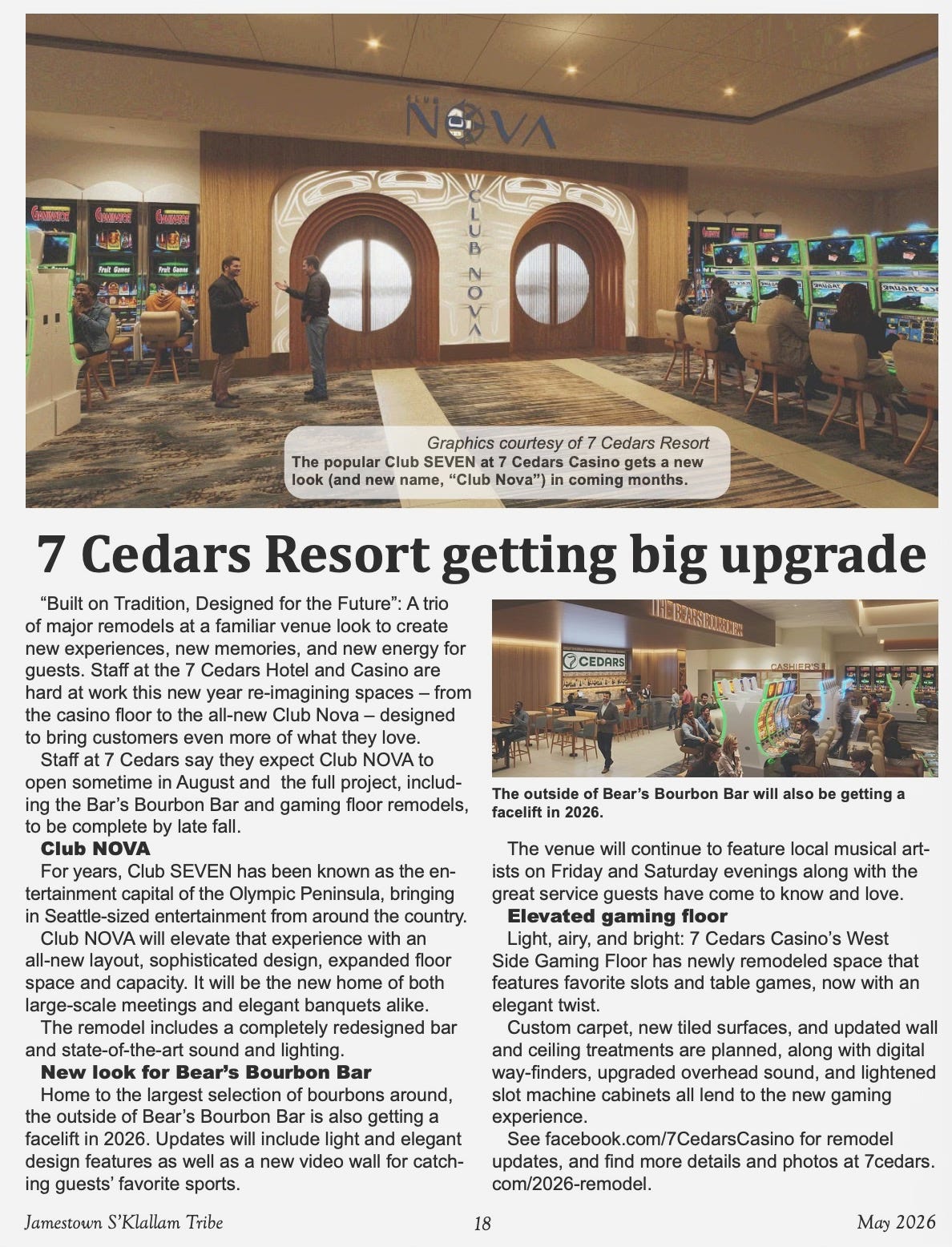
And to be fair — the Tribe has undeniably built a successful enterprise.
But it’s worth acknowledging the enormous structural advantages involved.
Imagine operating major commercial properties without the same property tax burdens, lodging taxes, or many of the regulatory burdens faced by competing businesses.
That advantage compounds year after year.
Meanwhile, surrounding governments increasingly ask ordinary taxpayers for levy lid lifts, fee increases, and higher taxes to maintain services.
Subsistence — Or Commercial Harvest?
The newsletter also discusses halibut harvest opportunities, noting:
“The fishery is currently open seven days a week and fishermen can harvest up to 5,000 pounds of halibut per day.”
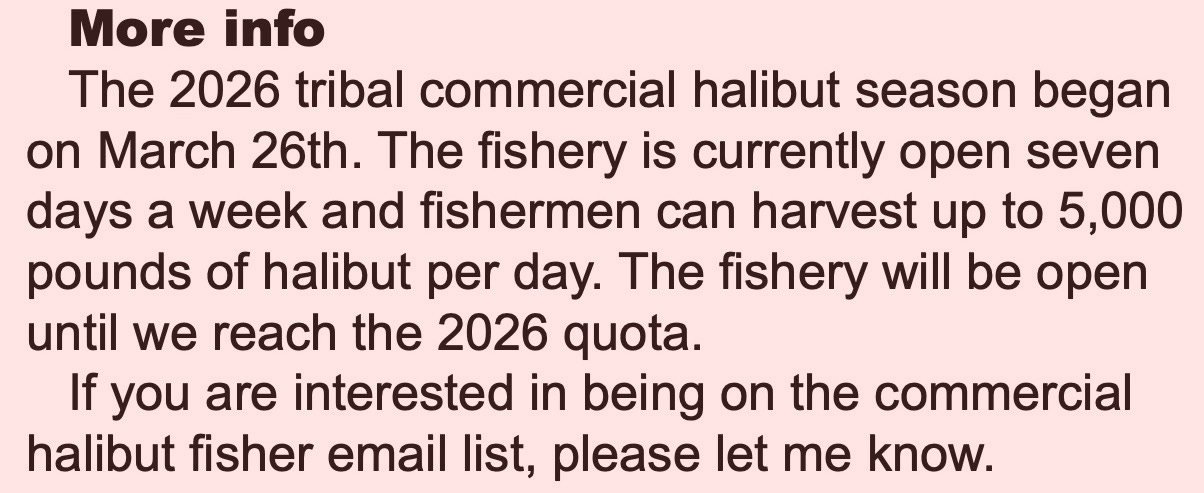
At some point, residents are fair to ask:
Is this subsistence fishing?
Or commercial-scale economic activity?
The Bigger Picture
None of this is an argument against tribal citizens, tribal culture, or tribal success.
But it is absolutely fair to ask whether the balance of power in Clallam County is shifting in ways the public barely understands.
The Jamestown Corporation is growing economically.
Expanding institutionally.
Acquiring influence culturally.
Building political partnerships.
Seeking additional land control.
Increasing its role in education, conservation, healthcare, tourism, and public policy.
And much of it is happening quietly, incrementally, and often with the enthusiastic support of local governments and institutions that rarely apply the same scrutiny they would to anyone else.
That’s exactly why these newsletters matter.
And exactly why the public should still be allowed to see them.

Today’s Tidbit
Clallam County is updating its Parks Comprehensive Plan — the document that will shape the future of county parks, trails, recreation areas, and public access for the next 10 years.
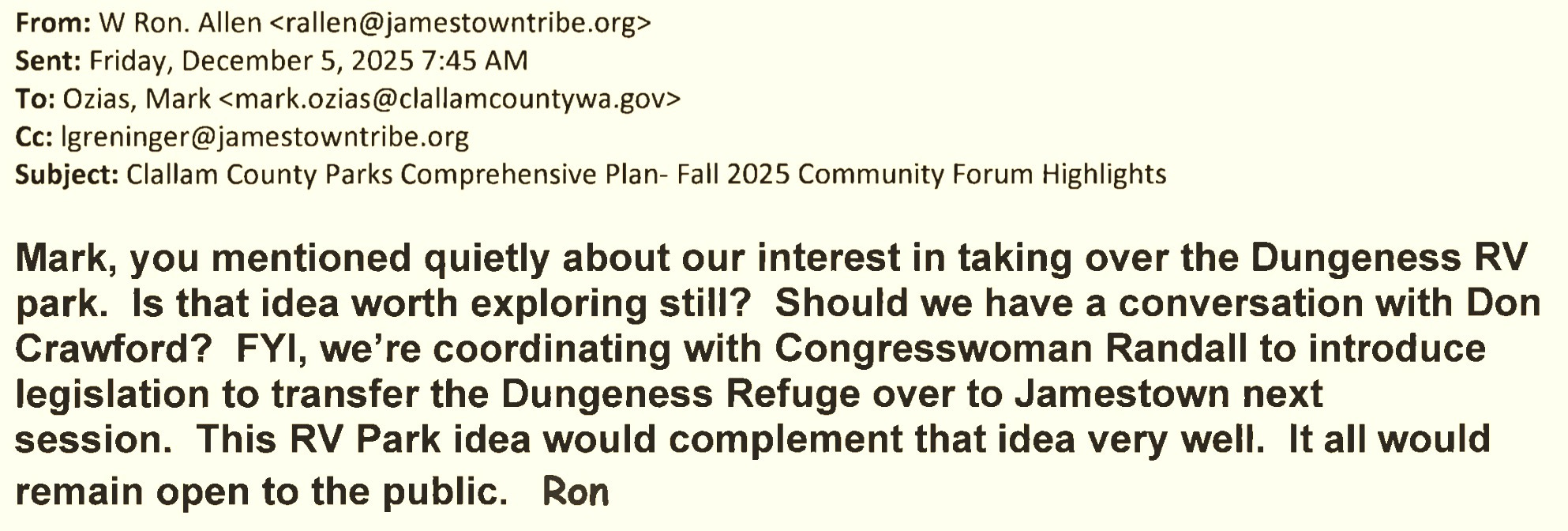
Why should people care? Because once these plans are adopted, they help determine where money goes, what projects get prioritized, and who helps shape the future of public land. And that’s especially important right now as Jamestown CEO Ron Allen has been working closely with Commissioner Mark Ozias on discussions about “taking over” the Dungeness Recreation Area.
📅 Upcoming Public Forums About Park Comp Plan
📍 Port Angeles — Thursday, May 7
🕐 1:00 PM – 2:30 PM
📚 Port Angeles Main Library
📍 Sequim — Thursday, May 7
🕕 6:00 PM – 8:30 PM
🎙️ KSQM Studios
📍 Forks — Monday, May 11
🕚 11:00 AM – 1:00 PM
📚 Forks Library
📍 Clallam Bay / Sekiu — Monday, May 11
🕕 6:00 PM – 8:00 PM
🏘️ Sekiu Community Center
💻 Can’t attend?
The County says an online version will remain open through May 24. Click here for details.
Sometimes the biggest long-term changes happen quietly through “planning processes” that few people pay attention to until after the decisions are already made.


