

A second deposition tied to the turmoil inside the Sequim School District has surfaced, and this time the picture is harder to dismiss. First obtained and reported by the Olympic Herald, the sworn testimony adds to a growing body of evidence suggesting that what happened inside the district was not isolated. Complaints appearing in sequence. Information circulating before it should. Individuals operating behind the scenes. With many of the same names still influencing the district today, the question is no longer what happened—but whether anything has changed.
A Second Deposition—and a Pattern Taking Shape
This is now the second deposition to emerge from the same period of conflict inside the Sequim School District.
At the time of this testimony, Superintendent Regan Nickels was already part of district leadership. Current board members like Eric Pickens, Maren Halversen and Patrice Johnston were serving. And former board member Jim Stoffer—who features prominently in the testimony—remains active today through the Olympic Educational Service District, continuing to influence education across the region.
That continuity matters.
Because the behavior described in the deposition does not read like a one-off conflict. It reads like a system.
Complaints That Were Anticipated—Not Discovered
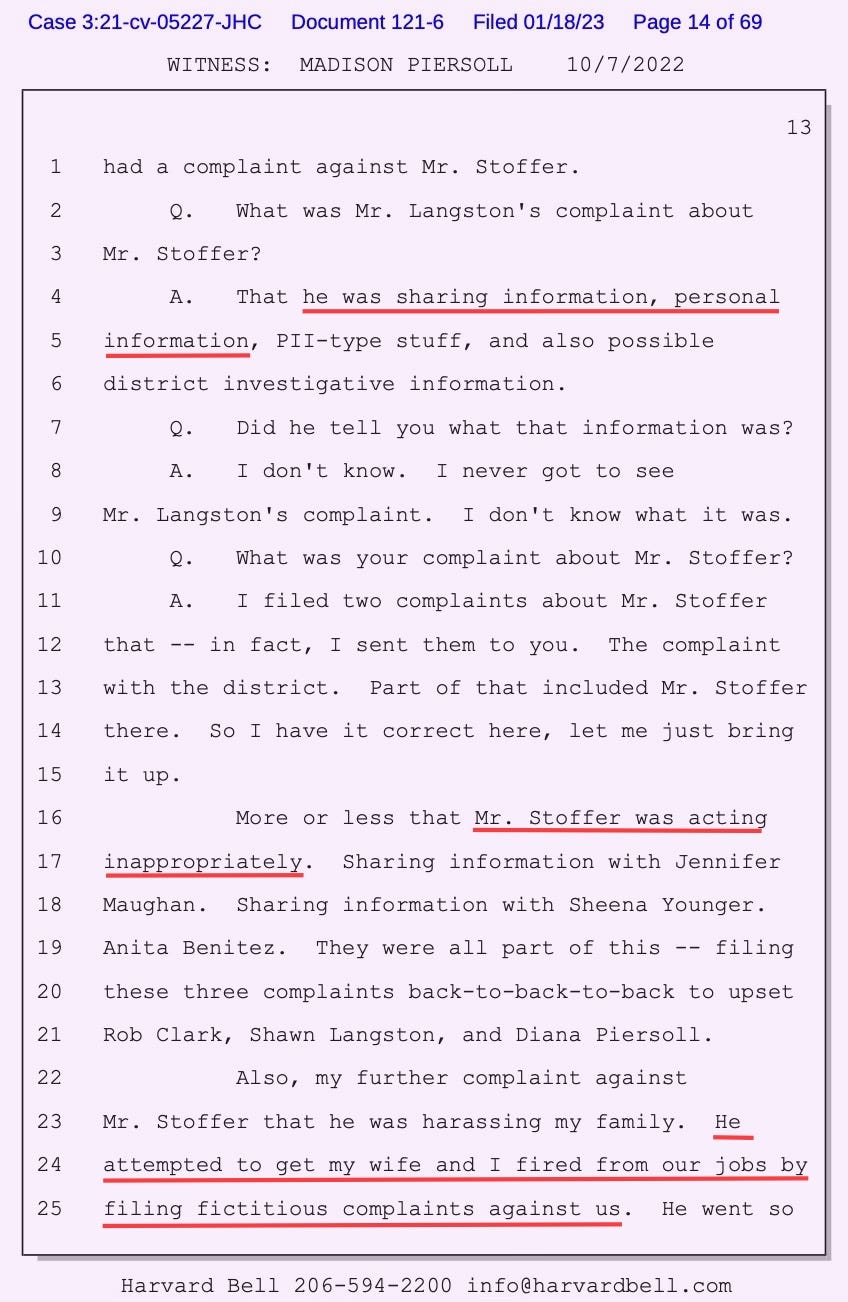
One of the most troubling elements of the testimony is the suggestion that multiple complaints against district personnel were not independent events, but part of a coordinated sequence.
“They were all part of this — filing these complaints back-to-back-to-back…”
But the deposition goes further than timing. It raises questions about how influence may have been used once those conflicts were underway.
The witness describes what he believed was a pattern of escalating, targeted actions directed at him and his family. According to his testimony:
“He [Stoffer] attempted to get my wife and I fired from our jobs by filing fictitious complaints against us.”
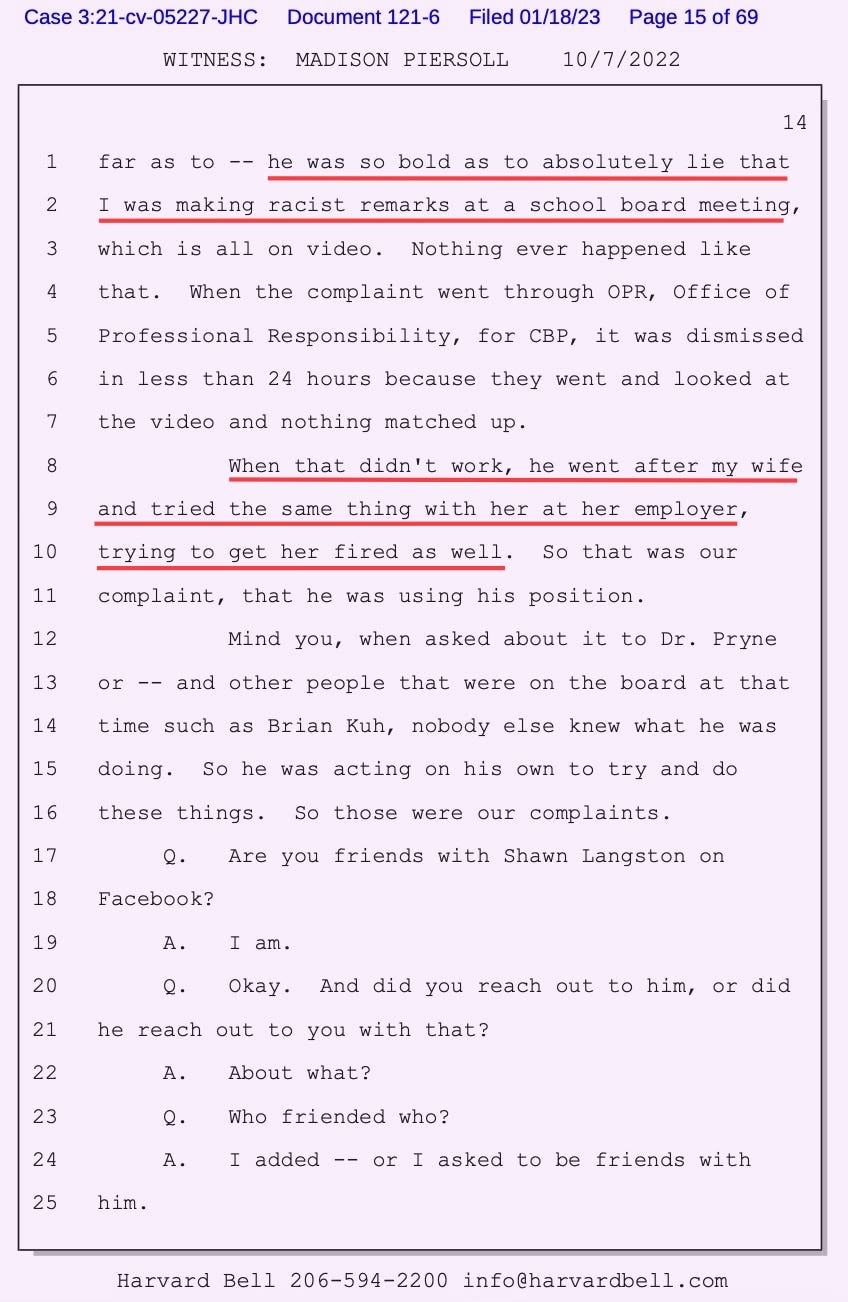
He goes on to describe a specific incident that, in his view, crossed a line:
“He was so bold as to absolutely lie that I was making racist remarks at a school board meeting, which is all on video. Nothing ever happened like that… When that didn’t work, he went after my wife and tried the same thing with her at her employer, trying to get her fired as well. So that was our complaint, that he was using his position.”
Taken together, the testimony does not describe a single disagreement. It outlines what the witness characterizes as a pattern—one in which complaints and allegations were not only filed but, in his view, weaponized to impact livelihoods.
A Climate Where Pressure Was Felt
The deposition also describes an environment where even minor actions could trigger a response.
In one example, a teacher who simply “liked” a social media post was allegedly contacted directly:
“Jim Stoffer proceeded to call her and leave her a very nasty message… ‘You have no business to do that.’”
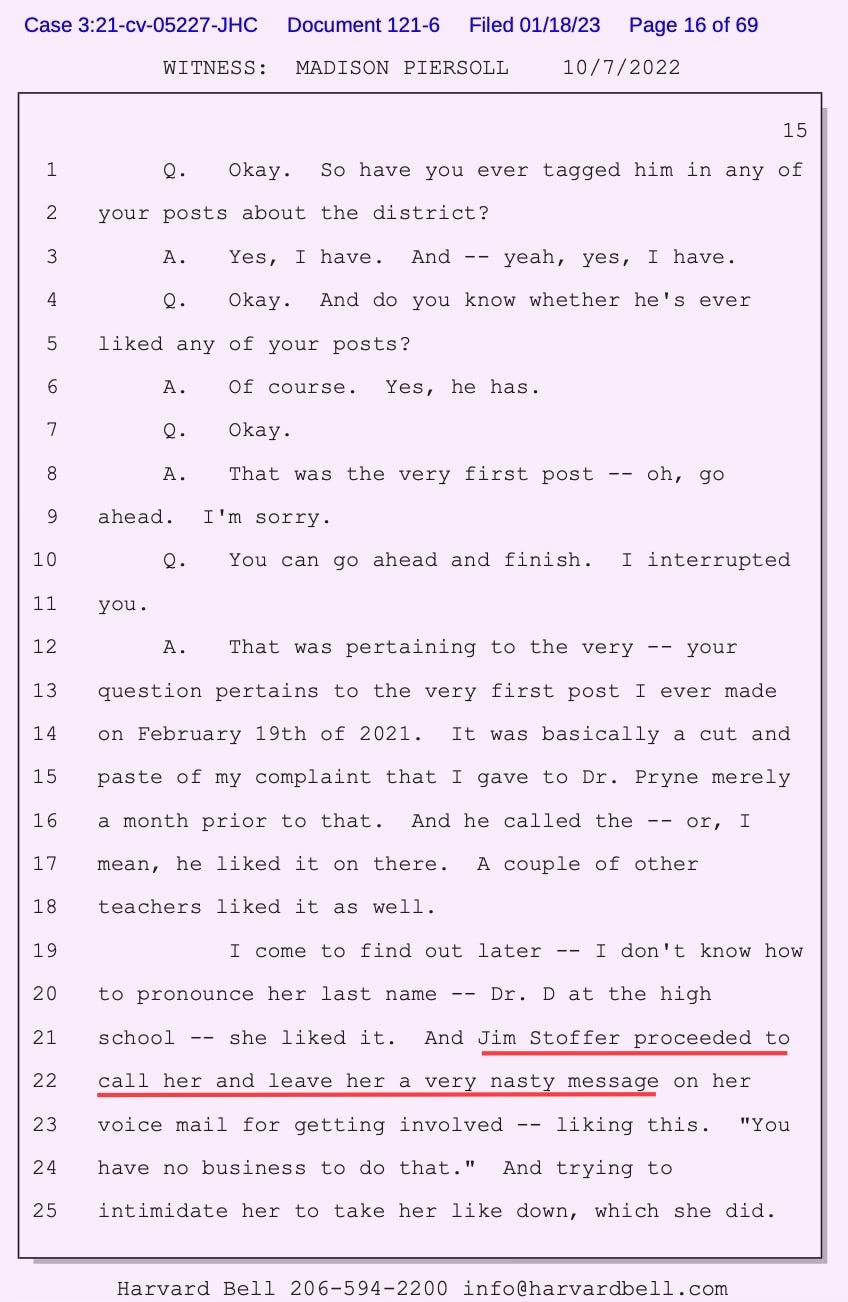
According to the testimony, the teacher removed the interaction afterward.
That moment—small as it may seem—speaks volumes about the broader environment.
Managing Optics Instead of Addressing Issues
Perhaps the most revealing portion of the deposition involves how complaints were handled internally.
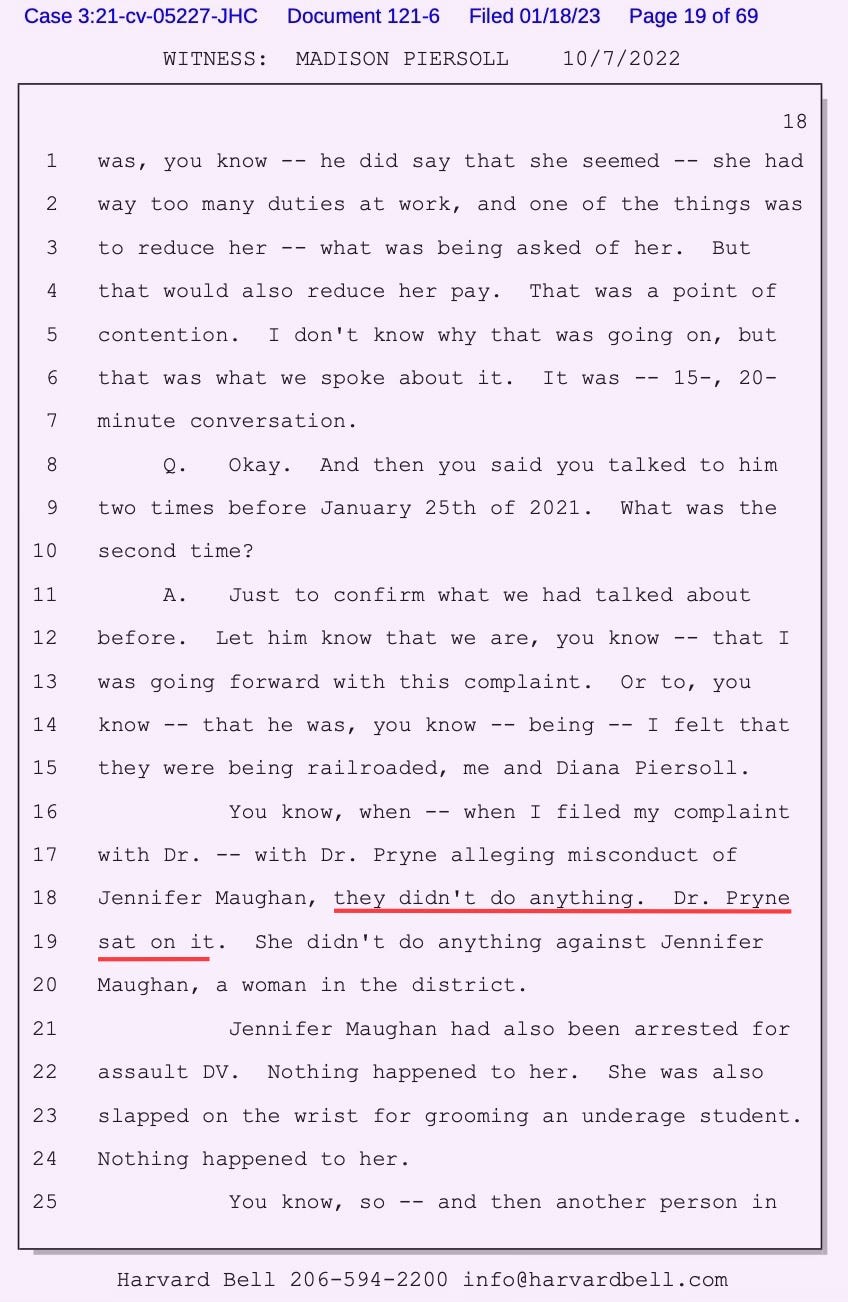
The witness testified that after bringing forward concerns:
“Dr. Pryne sat on it. She didn’t do anything…”
He then described being told:
“I don’t want this coming out before the levy.”
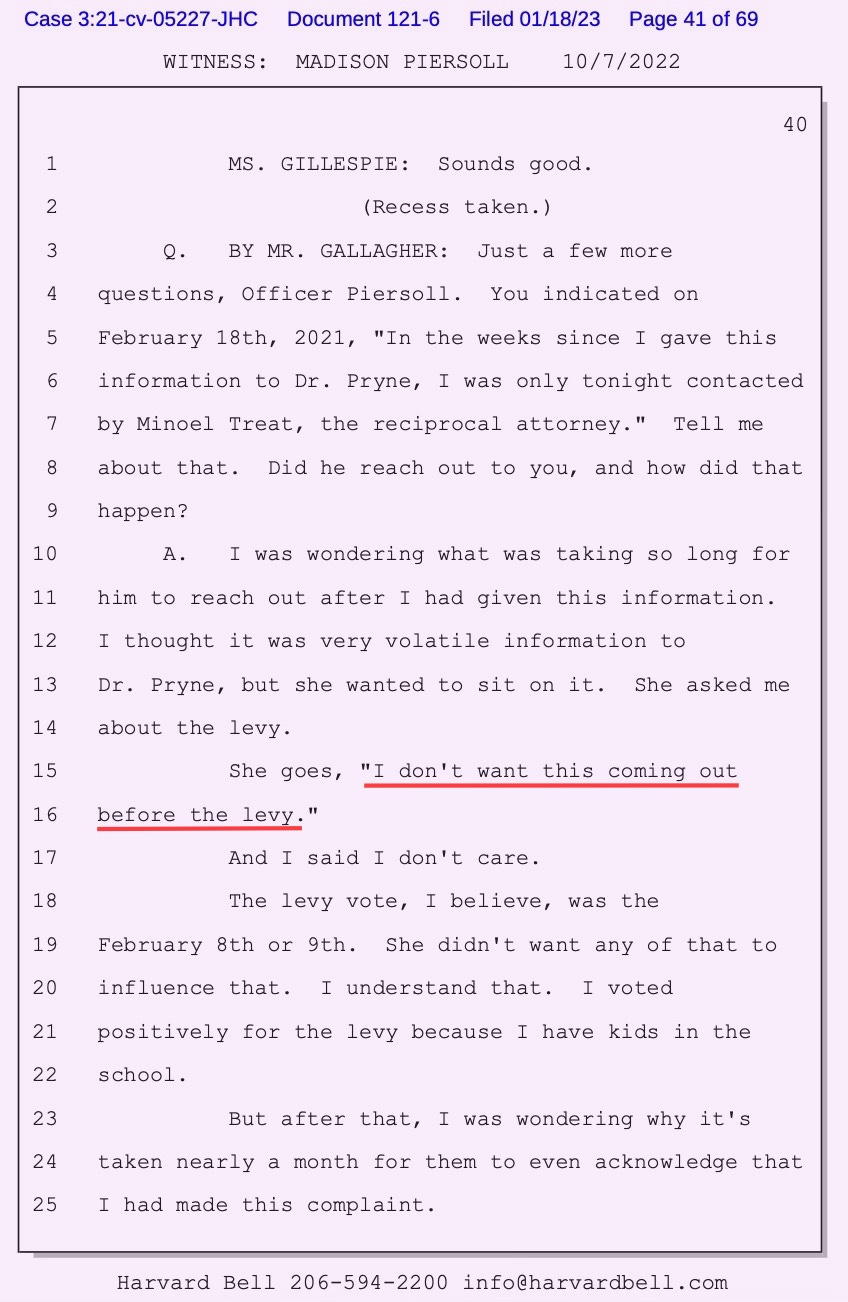
That statement stands out.
Not because it proves intent—but because it reveals priorities.
Even Public Statements Raise Questions
In a 2021 interview with KONP, Stoffer addressed controversy surrounding allegations that he had revealed privileged information.
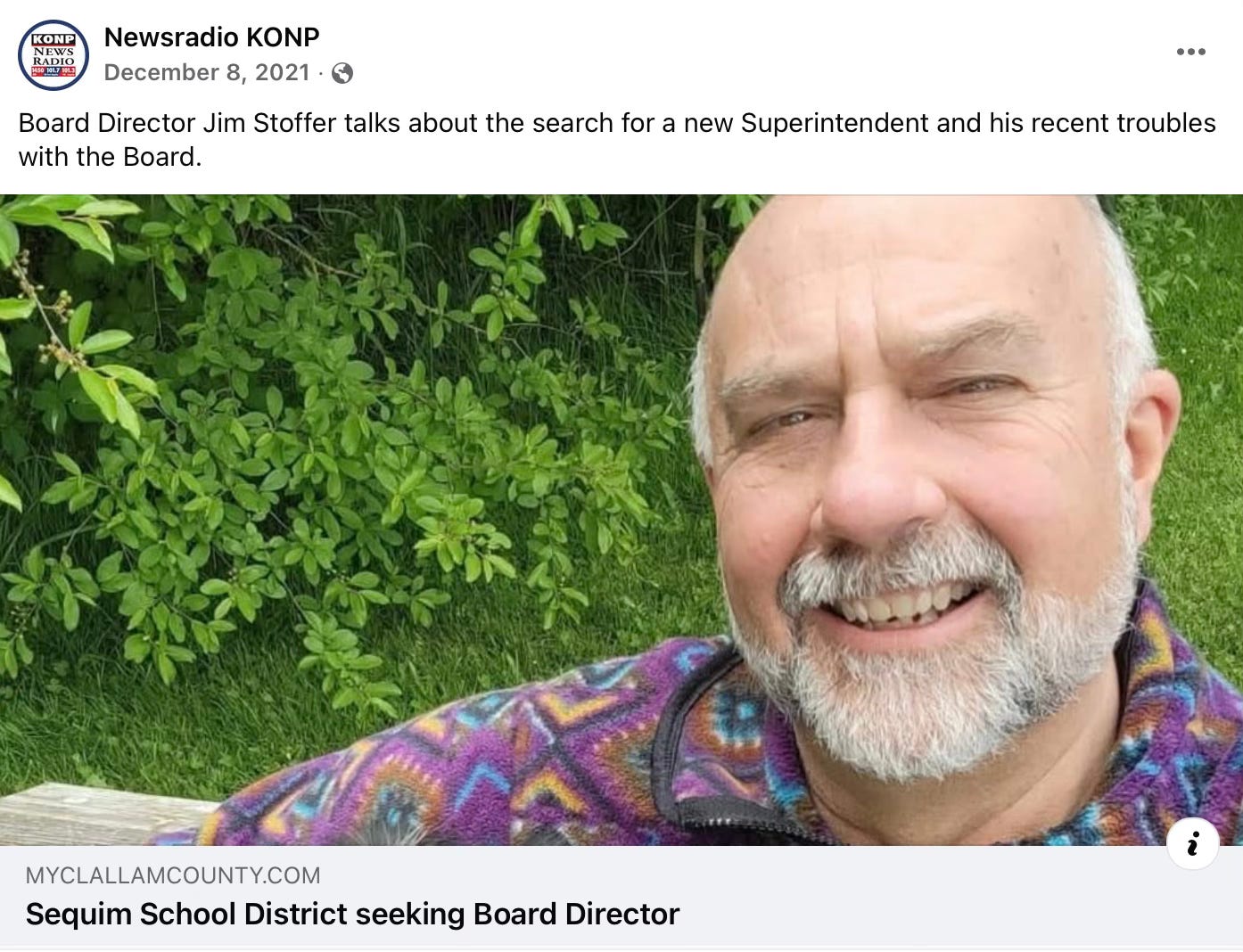
Specifically, he was asked about a resolution in which the Board called for his censure over those claims.
His response was unequivocal:
“That won’t transpire… we’re moving forward with a new board.”
When pressed whether he was confident the Board would drop the matter, his answer was just as direct:
“Yes.”
—signaling clear confidence that it would not move forward.
Taken alongside the deposition, those remarks are hard to reconcile: if concerns about sharing sensitive information were serious enough to warrant internal action, why were they so quickly dismissed in public?
In most parts of the country, a situation like this would draw immediate and sustained scrutiny. Allegations of personal retaliation, withholding information during an active investigation to protect a levy, and using the authority of an elected position for personal ends would ignite public outrage. Parents would demand answers. Meetings would be standing-room only. Accountability wouldn’t be optional—it would be unavoidable.
Here in Clallam County, the response is different. At times, the focus appears less on the substance of the allegations and more on managing perception and protecting reputations.
And that’s where the concern deepens.
Because if outcomes are being shaped before public processes have a chance to play out, it reinforces what the deposition suggests—questions about influence, coordination, and whether decisions are effectively made before the public is ever part of the conversation.
Praise at the Exit—and What It Says About the Culture
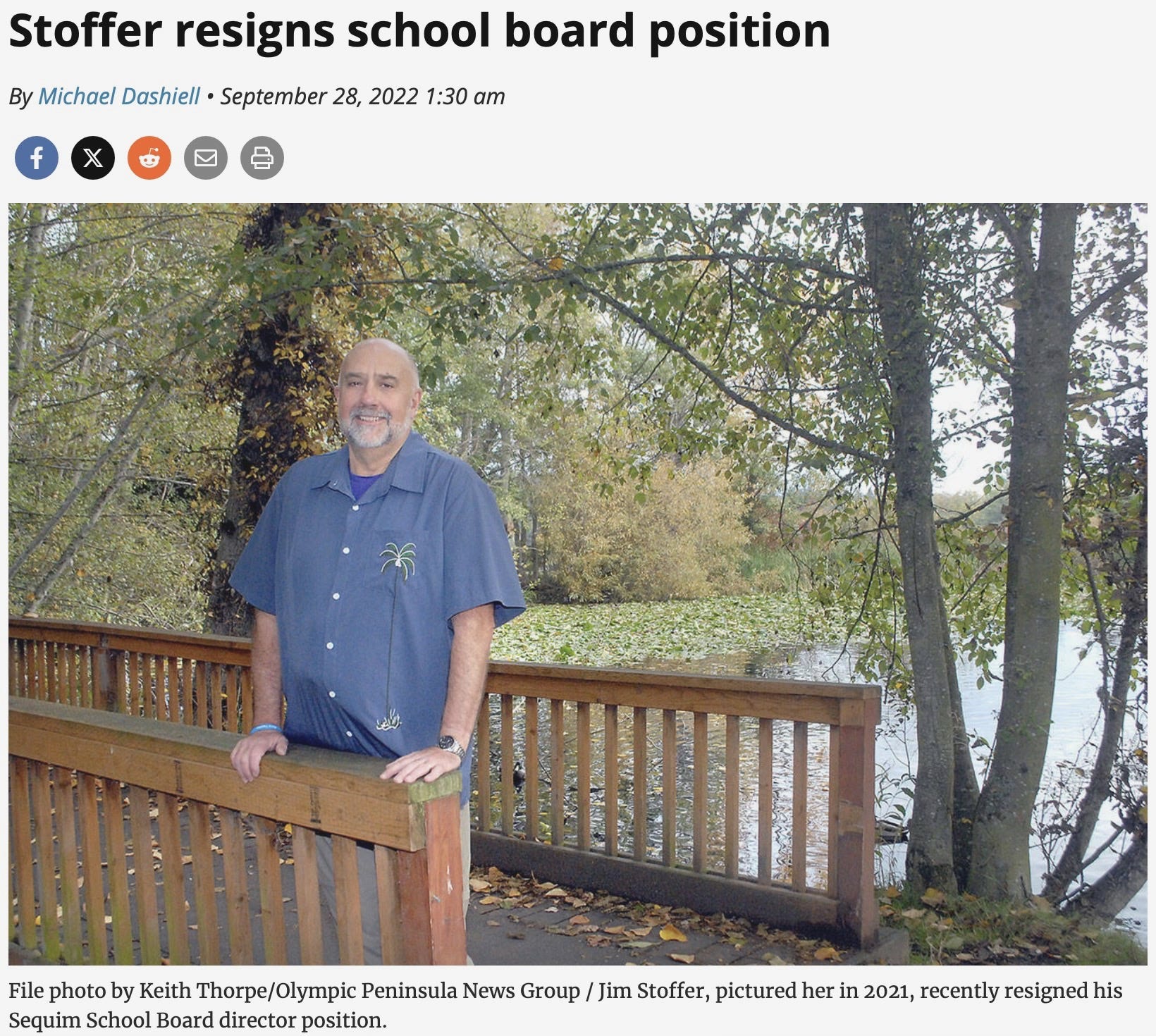
In September 2022, when Jim Stoffer resigned from the Sequim School Board, citing health issues, the response from his colleagues was overwhelmingly positive. There was no visible hesitation, no acknowledgment of the controversies that had surrounded his tenure—just praise.
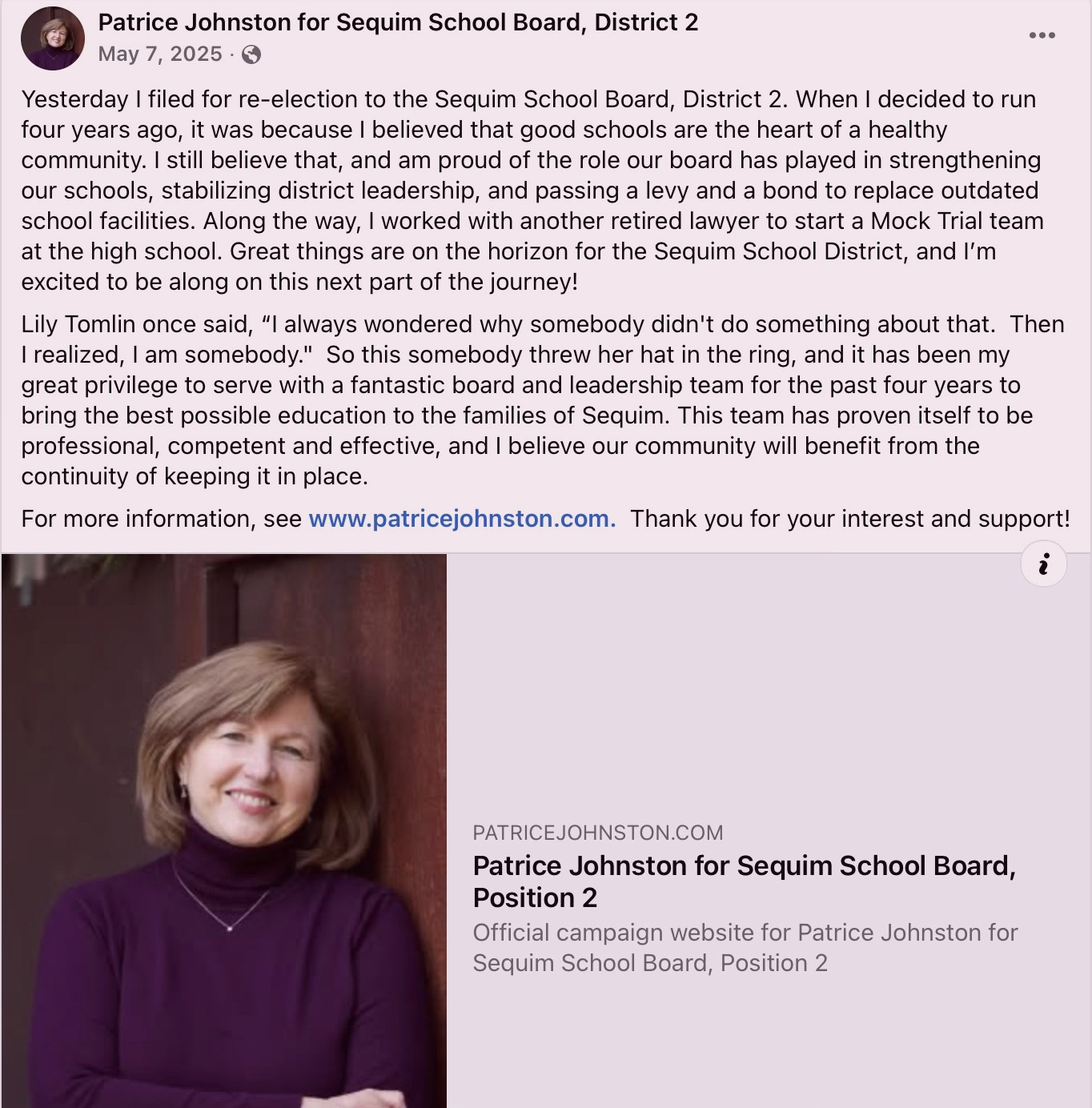
Board member Patrice Johnston spoke to his accomplishments, pointing to his work with the State School Directors’ Association, trust lands, and legislative efforts. She emphasized how difficult he would be to replace, noting that his contributions were made “willingly and eagerly.”
Maren Halvorsen followed in a similar vein, describing Stoffer’s passion for the schools as something that was always present, something that “exuded from him at all times.” She spoke about the void his departure would leave, calling it a “big gap” for the board.
Board President Eric Pickens offered his own remarks, saying Stoffer had “certainly done his part” and would “be missed.”
On its face, it sounded like the kind of sendoff you might expect for any long-serving board member. But context matters.
These comments came after months of controversy—after allegations that confidential information had been shared, after a formal move toward censure, and after the kinds of claims described in sworn testimony. Yet none of that appeared to factor into how his tenure was publicly framed by the very people who continue to lead the district today.
That contrast is hard to ignore.
Because Johnston, Halvorsen, and Pickens are still on the board. They are still helping shape policy, still influencing direction, still setting the tone for how issues are handled and how accountability is defined. When those same individuals look back on that period and present it in wholly positive terms, it raises a fair question about how those events are viewed internally—and whether they are viewed as concerns at all.
The Present-Day Reality
If this were just about the past, it might not matter.
But the same concerns are surfacing in different ways today.
Last year, during four days at the Clallam County Fair, conversations at the CC Watchdog booth revealed a consistent theme: dissatisfaction with the Sequim School District. Many parents described pulling their children out and turning to homeschooling—not out of convenience, but out of concern.
And just this week, the district itself acknowledged challenges. A school board meeting focused on declining enrollment and an increase in departing staff.
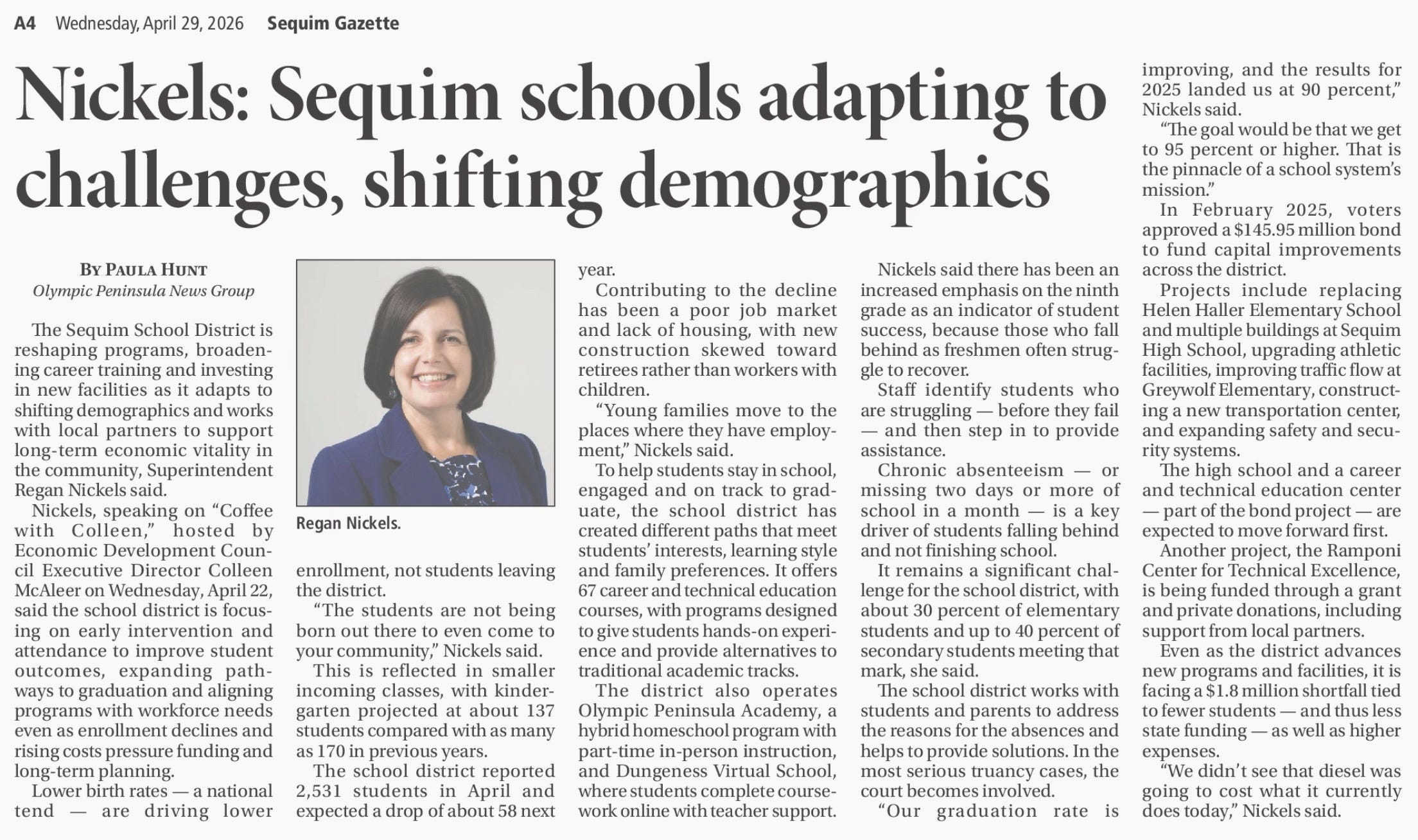
Those are not abstract trends.
They are measurable shifts in confidence.
Perception Is Becoming Reality
Among many parents, there is a growing perception that the district’s leadership is being shaped more by politics than by a focus on education. Names that frequently come up in those conversations include Jim Stoffer, often linked to groups like Indivisible, and Patrice Johnston, particularly in connection with the League of Women Voters.
Whether that perception is fully accurate or not, it is clearly taking hold.
And when families begin acting on that perception—by leaving—the consequences become real.
The Question That Won’t Go Away
The deposition does not provide final answers. It presents testimony—one perspective, under oath—about how events unfolded.
But now, with a second deposition surfacing, the consistency between them is becoming harder to ignore.
The same names.
The same dynamics.
The same concerns.
So the question isn’t just what happened then.
It’s whether the system that allowed it is still in place now.
Today’s Tidbit
🚨 New COMPLIANT campaign signs are here for Jake Seegers’ run for County Commissioner!
We now have pickup locations in each district—come grab yours and help show your support!
📍 Port Angeles Pickup
🏋️ Storm King Athletic Club
📍 224 E 1st St, Port Angeles
🗓 Wednesdays & Fridays
⏰ 4:30pm – 6:30pm
👉 Signs and stakes are just inside the door. Please be respectful—this is an active gym with classes in session, so let’s not disrupt members.
🎪 Sequim Pickup (This Weekend!)
🎉 FREE Sequim Logging Show
📍 Find us at the CC Watchdog booth
🗓 Friday – starting at 4:00pm
🗓 Saturday – starting at 11:00am
🌲 Forks / West End Pickup
🗣 “Community Conversation” with Jake
🗓 Next weekend, stay tuned for details
🔧 Already have a sign?
🟡 Hang onto it!
We’ve got compliance stickers in production that will bring your current signs up to code soon.
🙌 It’s been great seeing so many signs popping up across the county. This is shaping up to be an active next six months—and Jake truly appreciates the support!