


For years, the public has been told that tribal control automatically means better environmental stewardship. But court records, treaty disputes, commercial export operations, and decades of intertribal lawsuits tell a far more complicated story. From oyster farms inside wildlife refuges to fights over fishing territories, shellfish allocations, and commercial harvests headed overseas, the reality appears less spiritual and more economic. Now, as Protect the Peninsula’s Future continues its lawsuit over commercial oyster operations in the Dungeness National Wildlife Refuge, residents are asking a politically uncomfortable question: if everyone claims to be the “best steward,” why are they all suing each other over the resource?
The debate over tribal stewardship on the Olympic Peninsula just took another turn.
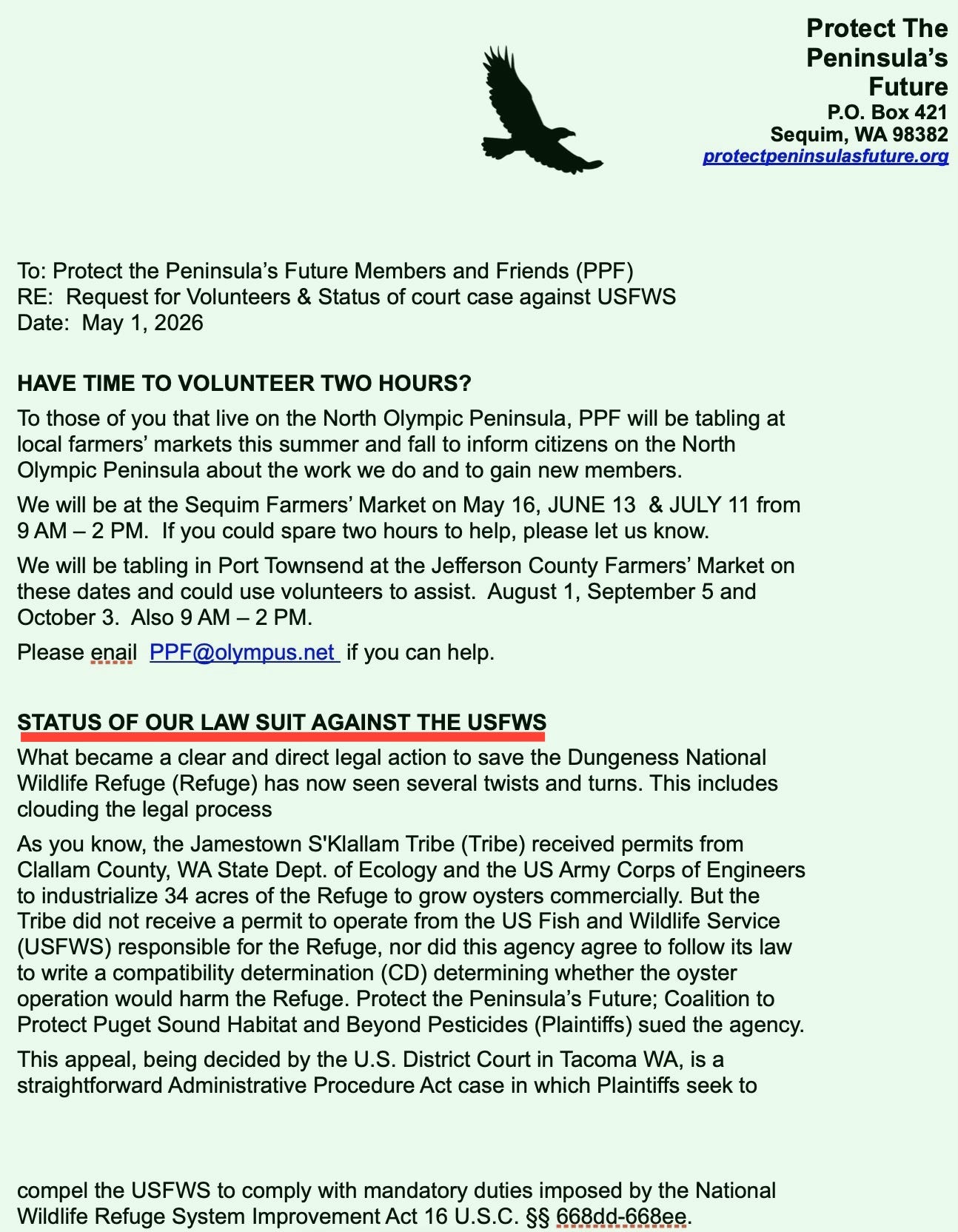
Protect the Peninsula’s Future (PPF) recently updated supporters on its ongoing federal lawsuit against the U.S. Fish & Wildlife Service over commercial oyster operations connected to the Jamestown S’Klallam Tribe inside the Dungeness National Wildlife Refuge.
According to PPF, the core issue is simple: the Tribe allegedly received permits from Clallam County, the Washington Department of Ecology, and the U.S. Army Corps of Engineers to commercially grow oysters on 34 acres inside the refuge — but the U.S. Fish & Wildlife Service never completed a required “compatibility determination” analyzing whether the operation would harm refuge wildlife.
PPF argues federal law is clear that wildlife conservation must remain the priority on refuge lands. The organization says the Refuge System Improvement Act requires federal managers to ensure “biological integrity, diversity, and environmental health” are maintained before new uses are approved.
Then came another twist.
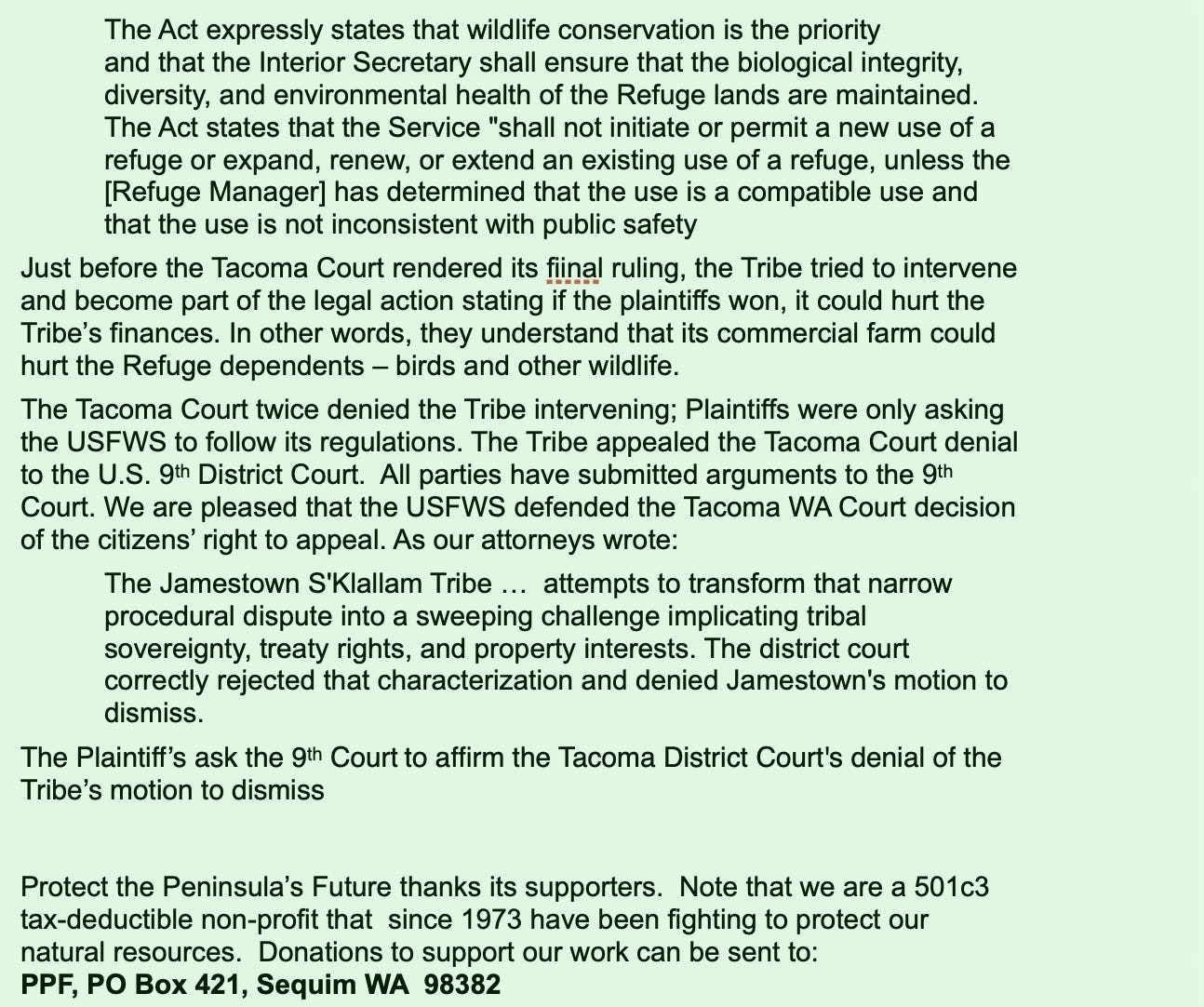
According to the update, the Jamestown S’Klallam Tribe attempted to intervene directly in the lawsuit, arguing that a ruling against the project could financially harm the Tribe. The federal court reportedly denied the request twice, leading to an appeal before the Ninth Circuit.
And that is where this story becomes much larger than one oyster farm.
Because the public is constantly told that tribal management is inherently superior stewardship — almost spiritual in nature — and that criticism of tribal resource control is somehow anti-environmental.
But history paints a more complicated picture.
The “Best Steward” Narrative Meets the Courtroom
If tribal stewardship were universally aligned and environmentally harmonious, why are tribes so frequently suing each other over fish, shellfish, and harvest territory?
The legal record is extensive.
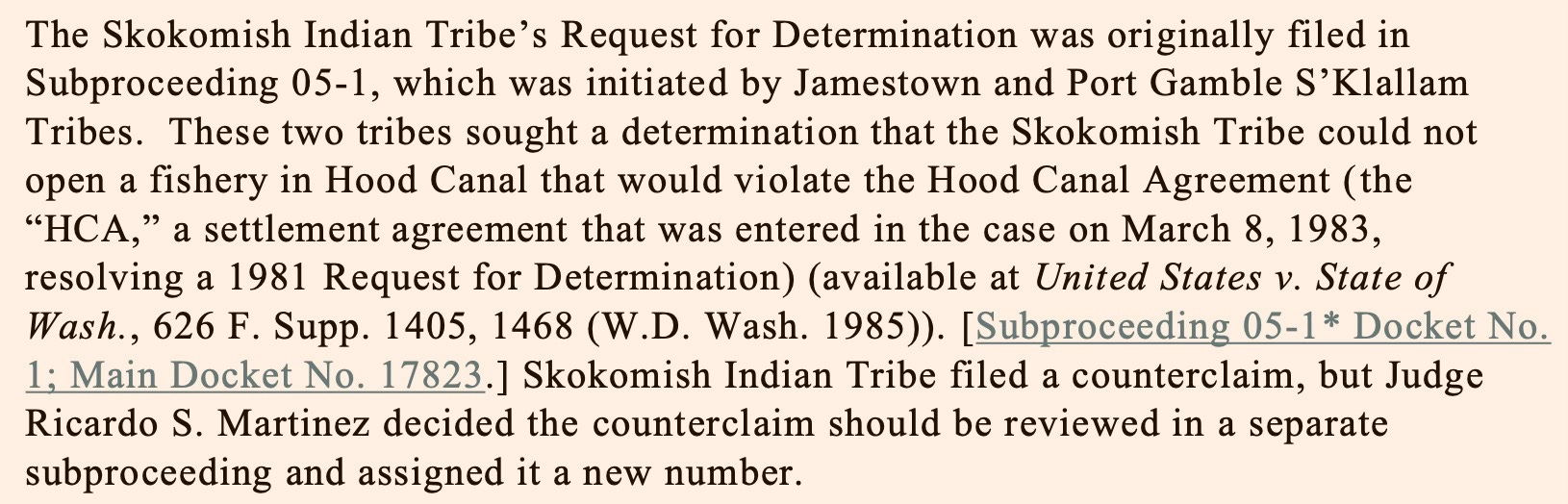
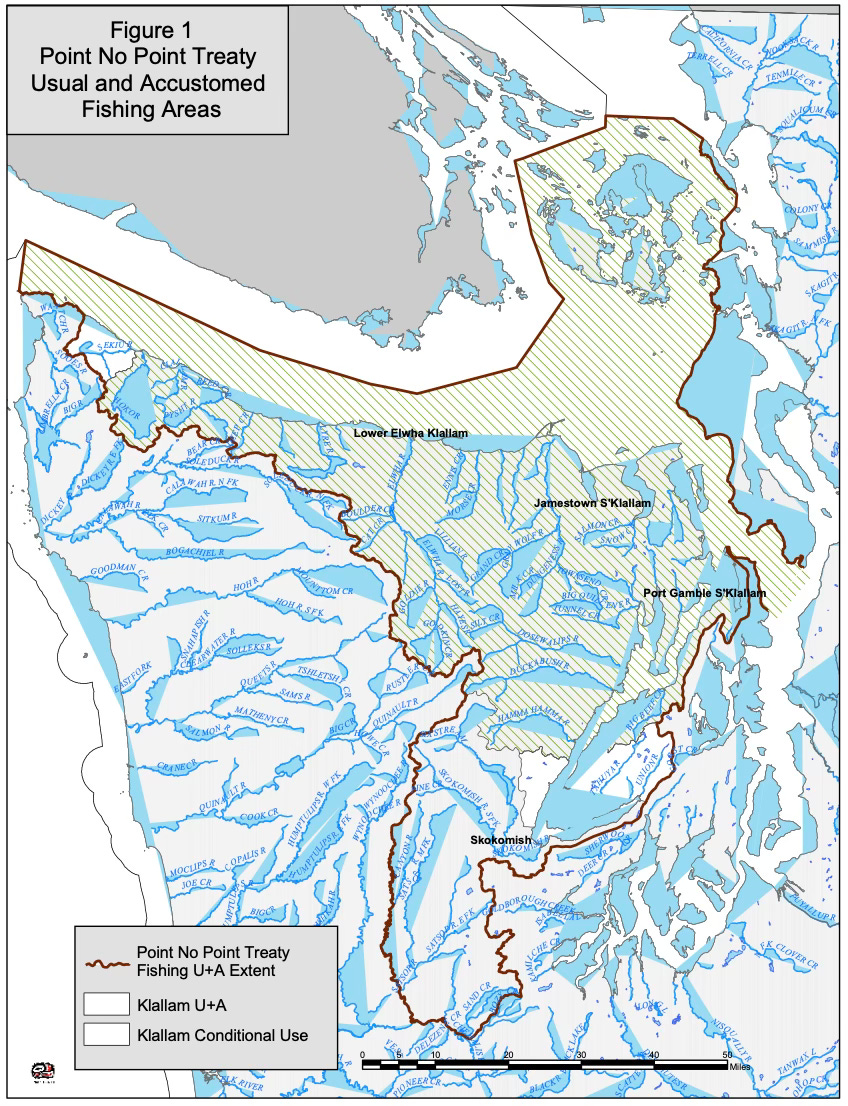
A 2005 federal subproceeding involving the Skokomish Tribe, Jamestown S’Klallam Tribe, and Port Gamble S’Klallam Tribe centered on disputes over Hood Canal fisheries and whether certain harvests violated prior agreements tied to the Boldt Decision framework. The litigation became so complicated that counterclaims were split into separate proceedings.
That wasn’t isolated.
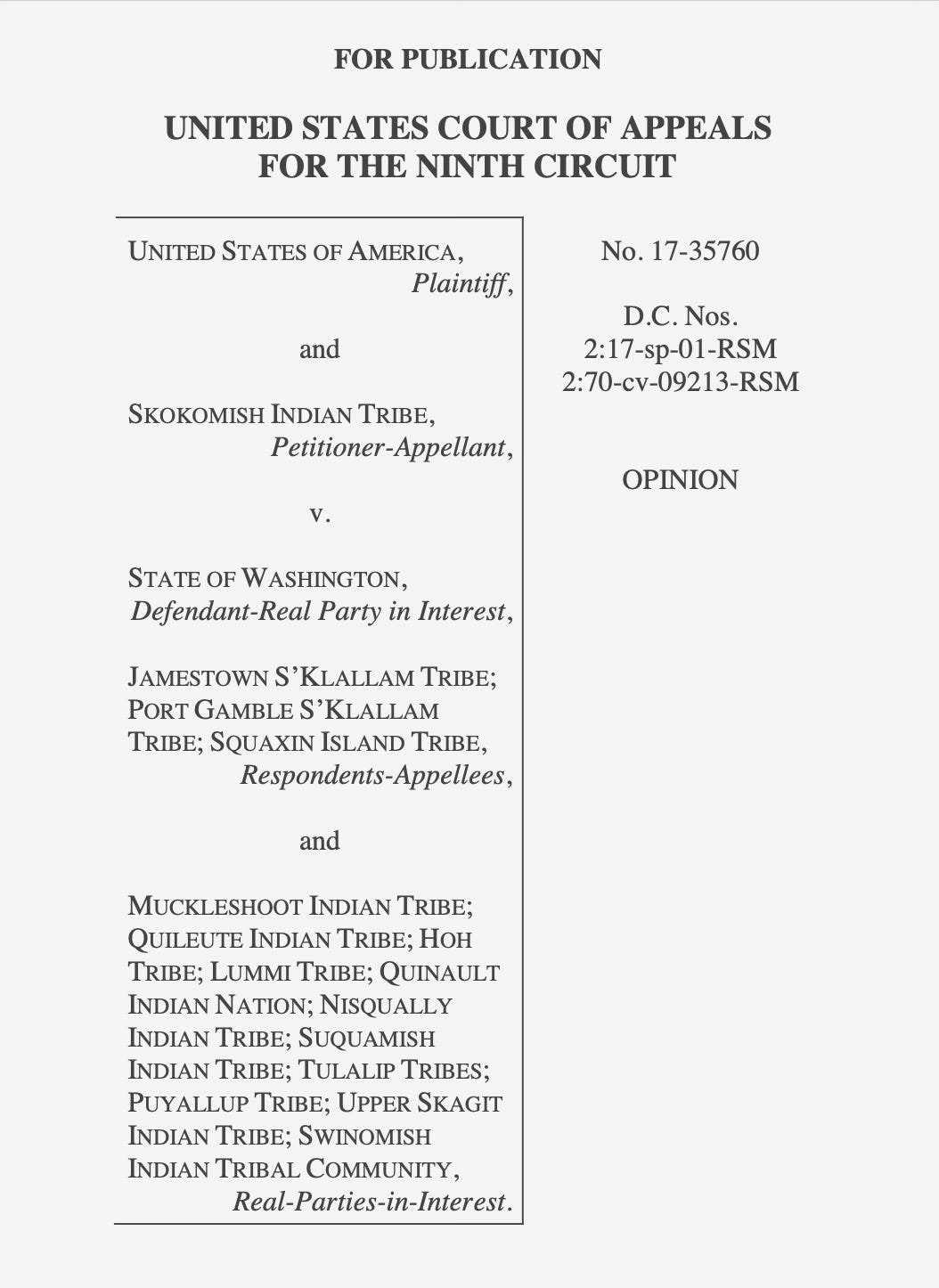
In 2019, another Ninth Circuit case revisited tribal fishing disputes rooted in the Boldt Decision — the landmark 1974 ruling that dramatically reshaped treaty fishing rights in Washington state.
There are also long-running territorial disputes involving the Lummi Nation and S’Klallam tribes over fishing areas and treaty interpretations stretching back decades.
In other words, this isn’t a simple story of “wise stewardship versus reckless outsiders.”
It is often competing governments fighting over highly valuable commercial resources.
And the stakes are enormous.
This Isn’t Just Subsistence Fishing
Another uncomfortable reality rarely discussed publicly is the scale and commercialization of many modern tribal fisheries.
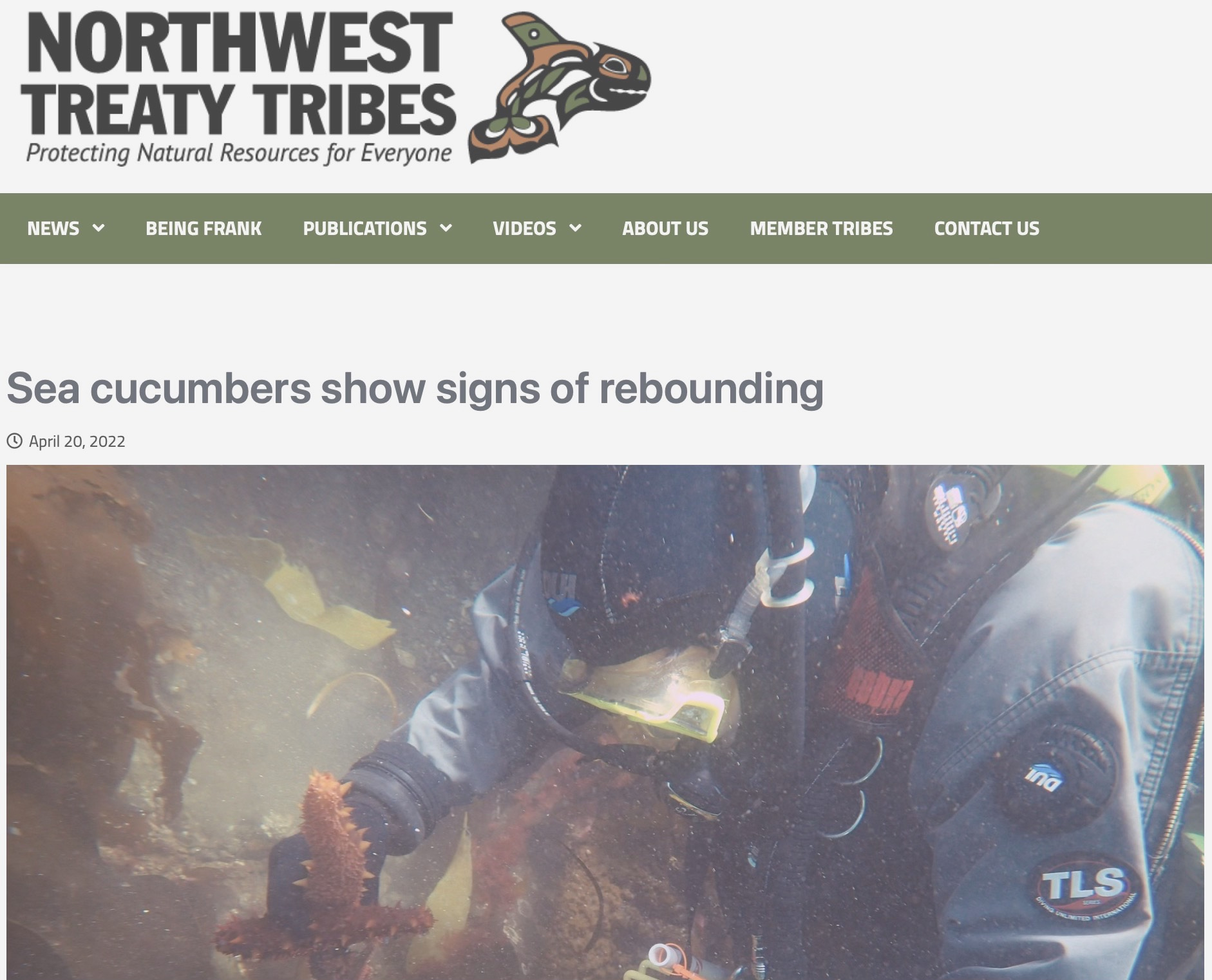
According to the Northwest Indian Fisheries Commission and related fisheries documents, treaty tribes participate in major commercial harvests involving Pacific whiting, sablefish (blackcod), shrimp, shellfish, geoduck, and sea cucumber fisheries.
One documented example states tribal divers harvested approximately 150,000 sea cucumbers in a single 2020 season.
These are not symbolic harvests intended merely to “feed the village.”
This is industrial-scale commerce.
Some of those products enter lucrative export markets in Asia, particularly China.
That matters because the public narrative often frames treaty harvests as purely local, sustainable, low-impact food gathering deeply connected to place and tradition.
But much of the seafood economy today operates like global capitalism because that’s exactly what it is.
Commercial buyers.
Export markets.
International pricing.
Competing allocations.
Territorial disputes.
Federal litigation.
That doesn’t automatically make it wrong.
But it does make the rhetoric surrounding it far less romanticized than what many residents are led to believe.
So Who Gets To Claim Moral Authority?
That may be the most politically sensitive question of all.
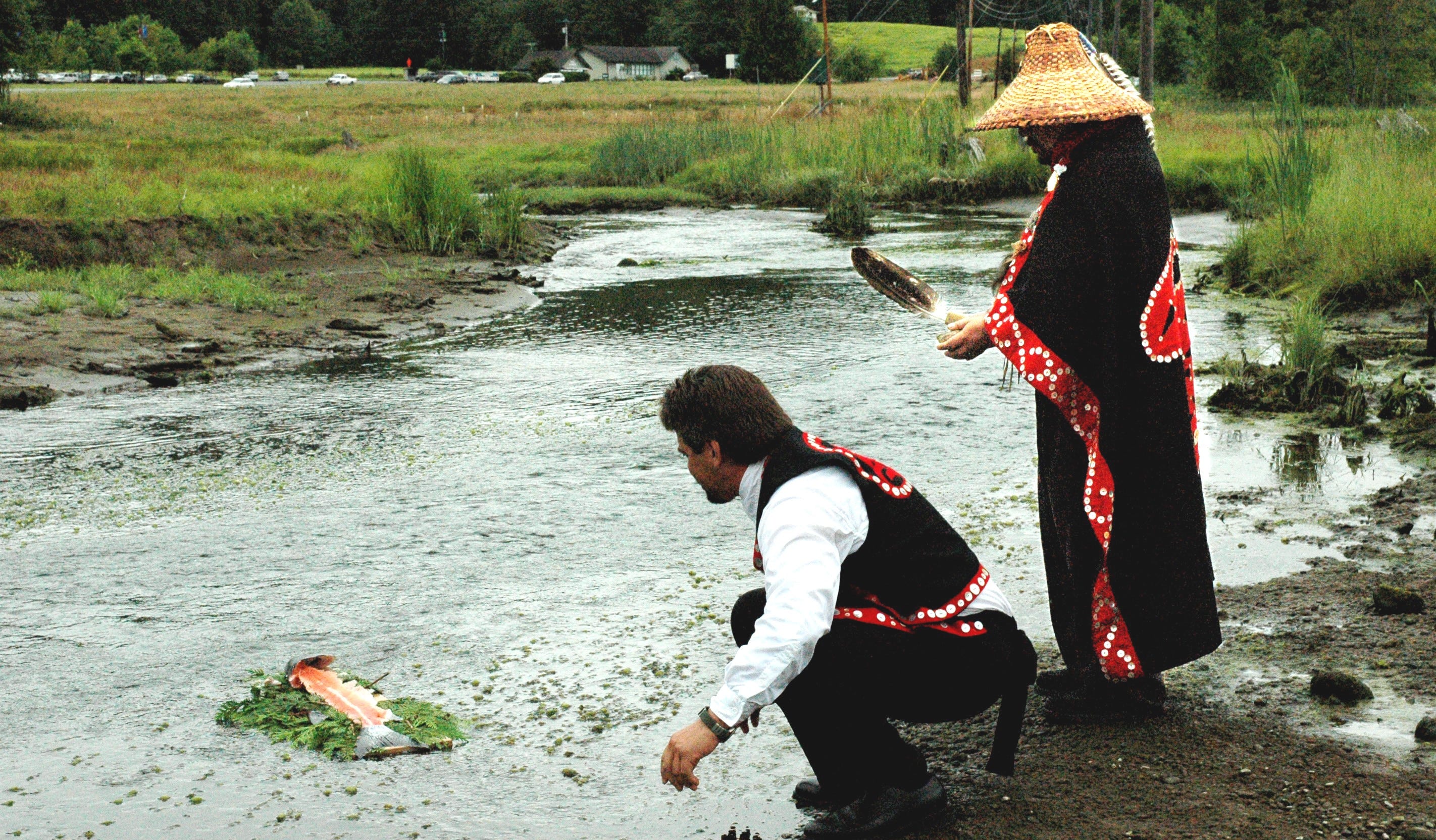
Because increasingly, residents are being told that tribes should exercise greater control over wildlife refuges, fisheries, tidelands, shoreline management, salmon restoration policy, and even broader land-use decisions because they are supposedly uniquely qualified stewards of the land.
But if stewardship is genetic, spiritual, or culturally automatic, why do tribes themselves frequently end up in adversarial court battles over harvest boundaries, allocations, shellfish beds, and commercial rights?
Who decides which tribe is the “better steward” when tribes disagree with each other?
The Skokomish?
The Squaxin?
The Lummi?
The Jamestown S’Klallam?
The Lower Elwha Klallam?
The Makah?
The Quileute?
The Puyallup?
The Port Gamble S’Klallam?
And if the answer ultimately becomes “whoever wins in federal court,” then perhaps this debate has far less to do with sacred stewardship and far more to do with power, economics, and control of valuable natural resources.
That may not fit neatly on a bumper sticker.
But it is increasingly difficult to ignore.
Today’s Tidbit: The Front-Page Push for Volunteer Labor
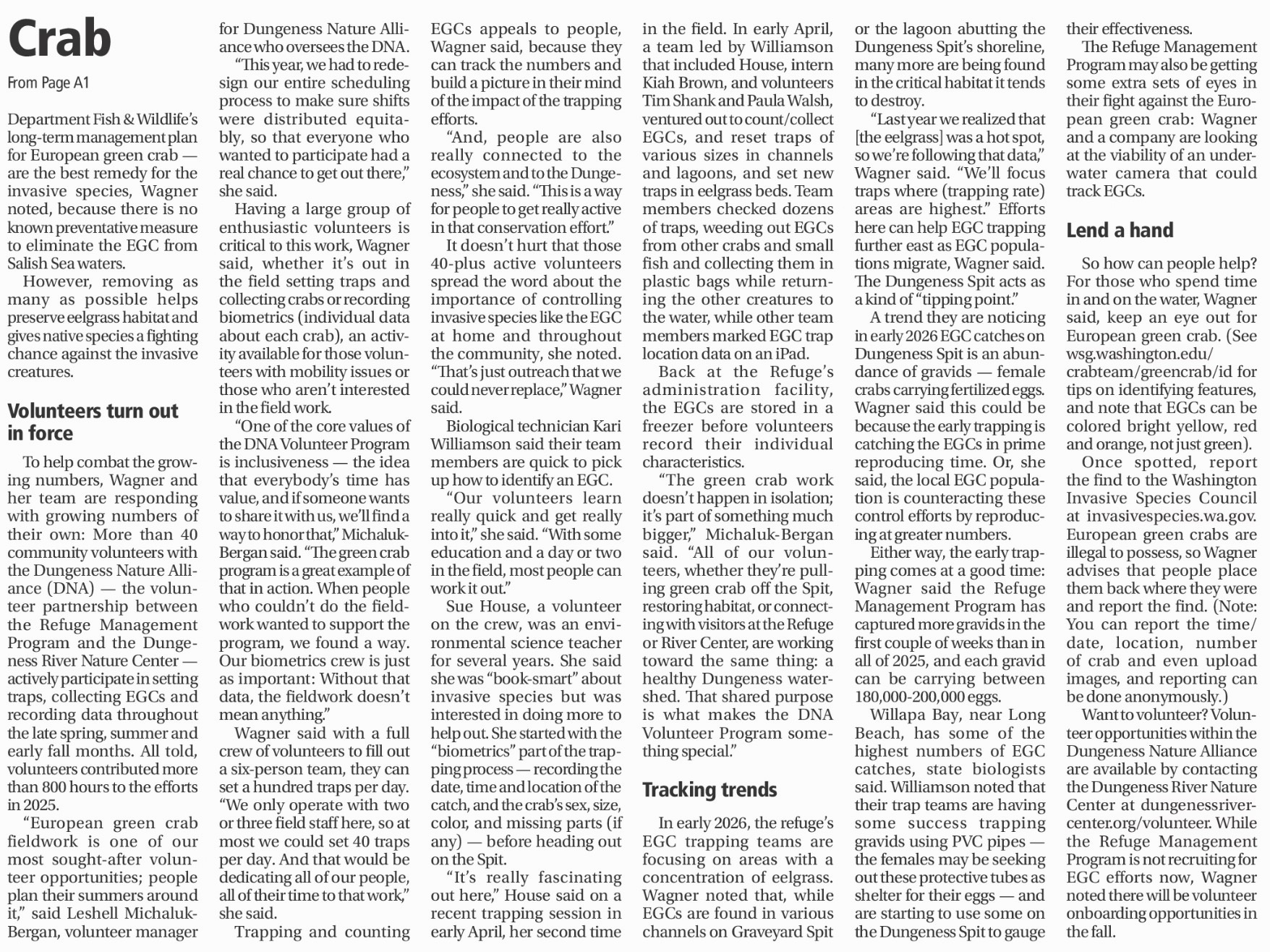
It made the front page.
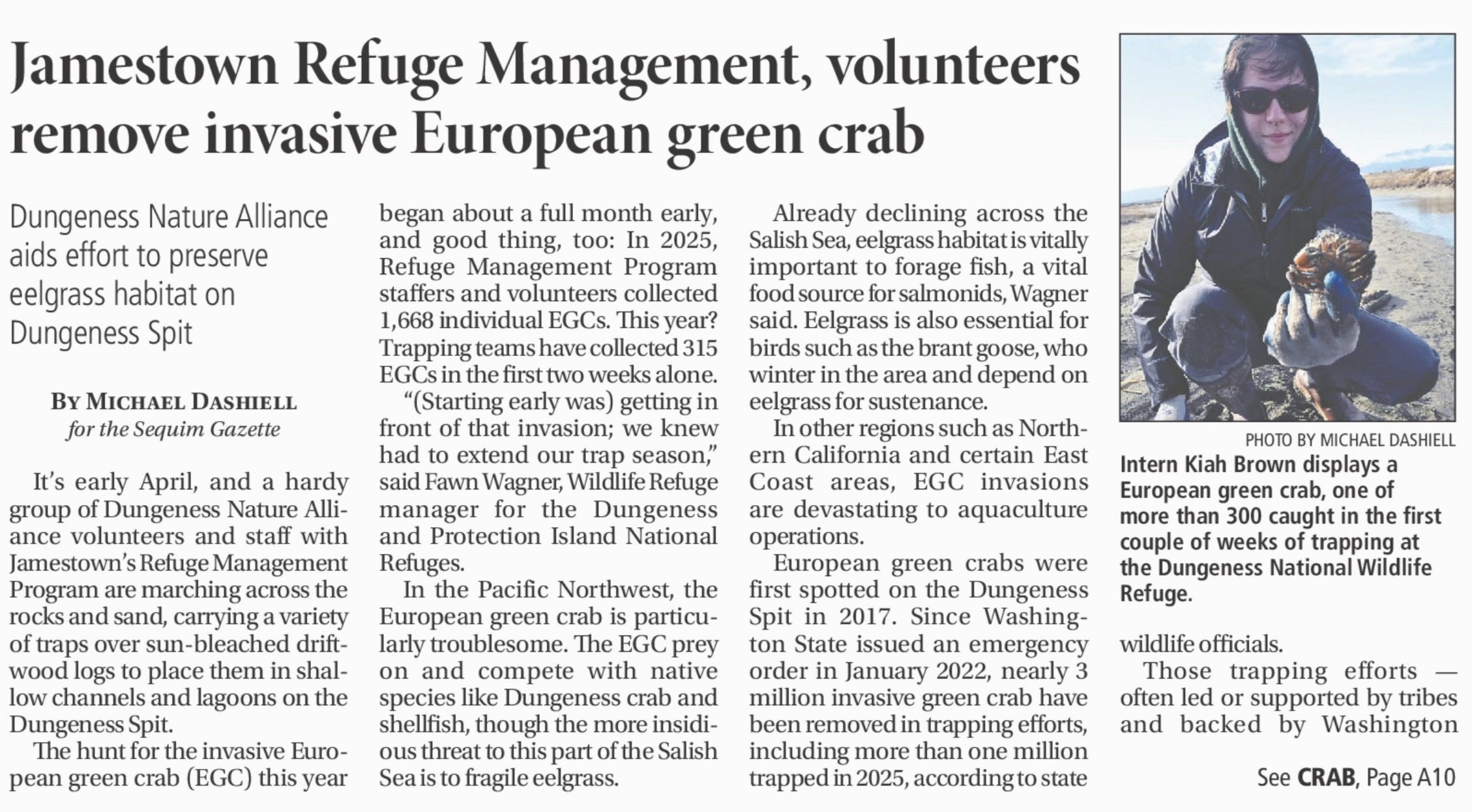
And notably, it was not written by Sequim Gazette newsroom staff. The article was authored by the Tribe’s communications and publications specialist. In other words, the Tribe effectively received front-page space in the local paper to promote its own messaging and programs in what reads more like institutional public relations than independent reporting.
Not a story about a struggling nonprofit.
Not a tiny grassroots conservation club operating on bake sales and spare change.
A front-page story about the Jamestown Corporation’s Refuge Management Program and its partnership with the Dungeness Nature Alliance recruiting volunteers to help trap invasive European green crabs on the Dungeness Spit.
According to the article, more than 40 community volunteers are already participating in the effort through the Dungeness Nature Alliance (DNA), a volunteer partnership involving the Refuge Management Program and the Dungeness River Nature Center.
The article describes volunteers spending hundreds of hours trapping crabs, recording biometrics, entering data, and supporting field operations throughout the season.
That raises an interesting question.
Why is an organization tied to a tribal corporation reportedly generating well over $100 million annually relying so heavily on unpaid community labor?
Especially when that corporation ultimately benefits from the same marine ecosystems being protected.
The volunteer handbook gets even more interesting.
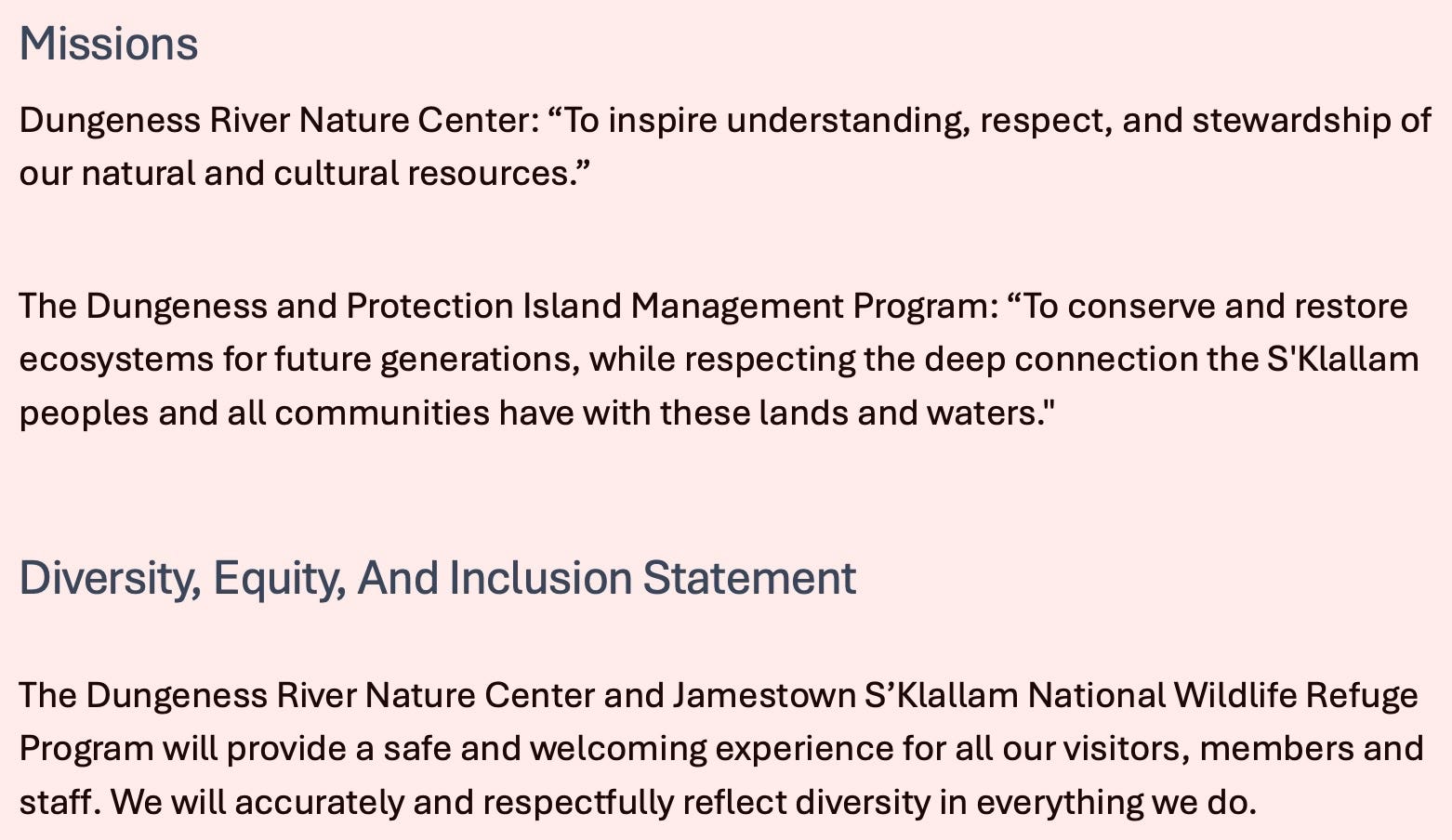
Volunteers are thanked for “donating” their time not only to the Dungeness Nature Alliance, but also to the Jamestown S’Klallam Tribe itself. The handbook says volunteers will receive training on Jamestown S’Klallam tribal history and culture, refuge program goals, and organizational values. It also emphasizes that volunteers should “accurately and respectfully reflect diversity in everything we do.”
In other words, this isn’t simply “show up and trap crabs.”
It appears to function partly as environmental volunteerism, partly as public outreach, and partly as institutional brand-building tied to tribal management of refuge lands and marine ecosystems.
And again — this is occurring while ongoing litigation continues over commercial oyster operations within the Dungeness National Wildlife Refuge itself.
So residents may reasonably wonder:
If the operation is large enough to support industrial aquaculture, extensive fisheries interests, land acquisitions, hospitality ventures, medical enterprises, and major development projects… why is the public still being asked to provide free labor to manage the environmental consequences surrounding those same protected ecosystems?


