


A single image—one child, one beach, one bottle filled with used needles—cuts through the policy debates and forces a simple question: after years of harm reduction policy in Clallam County, where are the measurable results? As officials point to compassion and isolated success stories, residents are left confronting a very different reality—one that can’t be explained away with anecdotes.
This Image Hits Hard
Not a report. Not a policy memo. Just a moment frozen in time.
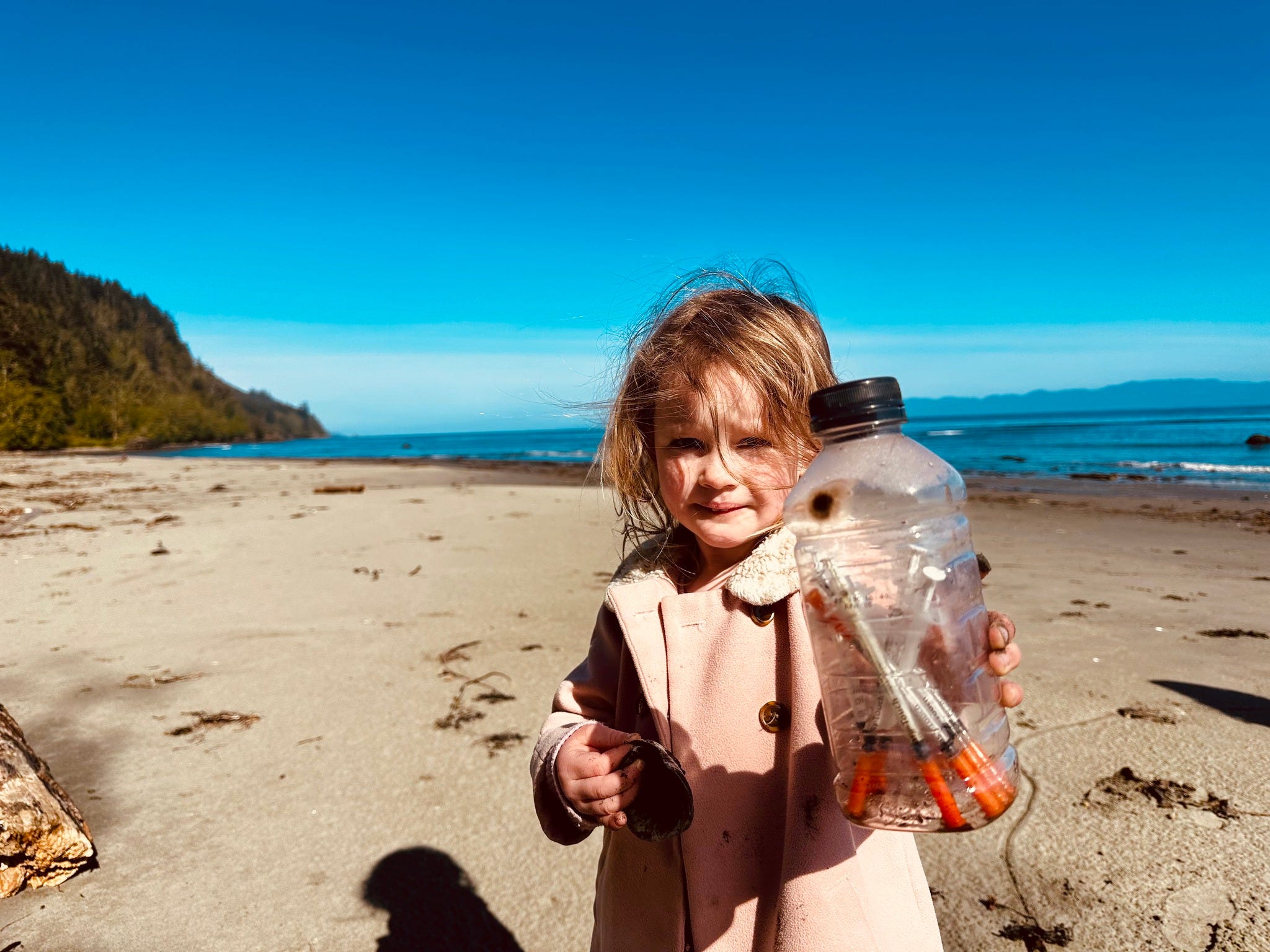
A four-year-old girl stands on a beach in Clallam County, holding a Gatorade bottle—inside it, used hypodermic needles.
It’s like a gut punch.
Minutes earlier, she had been running barefoot along the shoreline, doing what kids are supposed to do in places like this. Now she’s holding something no child should ever have to make sense of.
Look at her expression. It isn’t curiosity. It’s uncertainty. Maybe even fear.
That’s the part that lingers—the collision between innocence and something entirely out of place.
You can have endless debates about policy approaches, intent, and long-term outcomes. But moments like this cut through all of it and force a simpler question:
What are we allowing into the shared spaces that families trust to be safe?
Beaches—especially ones as remote and beautiful as this—should never become informal dumping grounds for drug paraphernalia.
Whatever someone’s position is on harm reduction, there’s a line where the consequences spill outward—onto families, onto children, onto communities that had no say in carrying that burden.
And that’s why this image matters.
Because it communicates, instantly and unmistakably, what pages of data and reports often fail to capture.
What Jake Seegers Saw
This wasn’t theoretical. It wasn’t secondhand.
It happened here.
County Commissioner candidate Jake Seegers posted this after the incident involving his daughter:
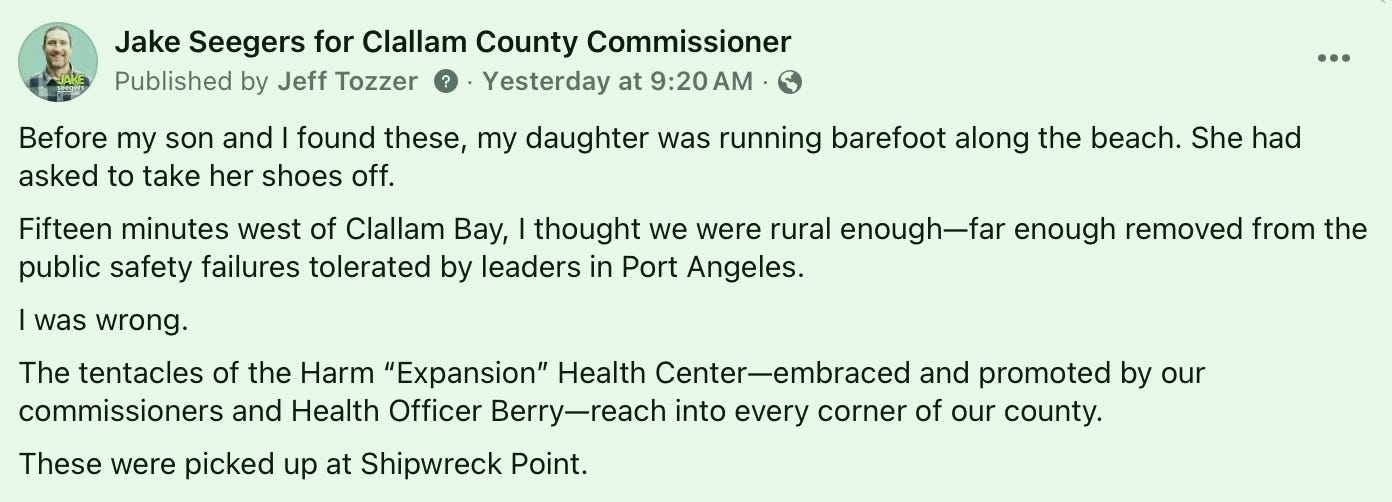
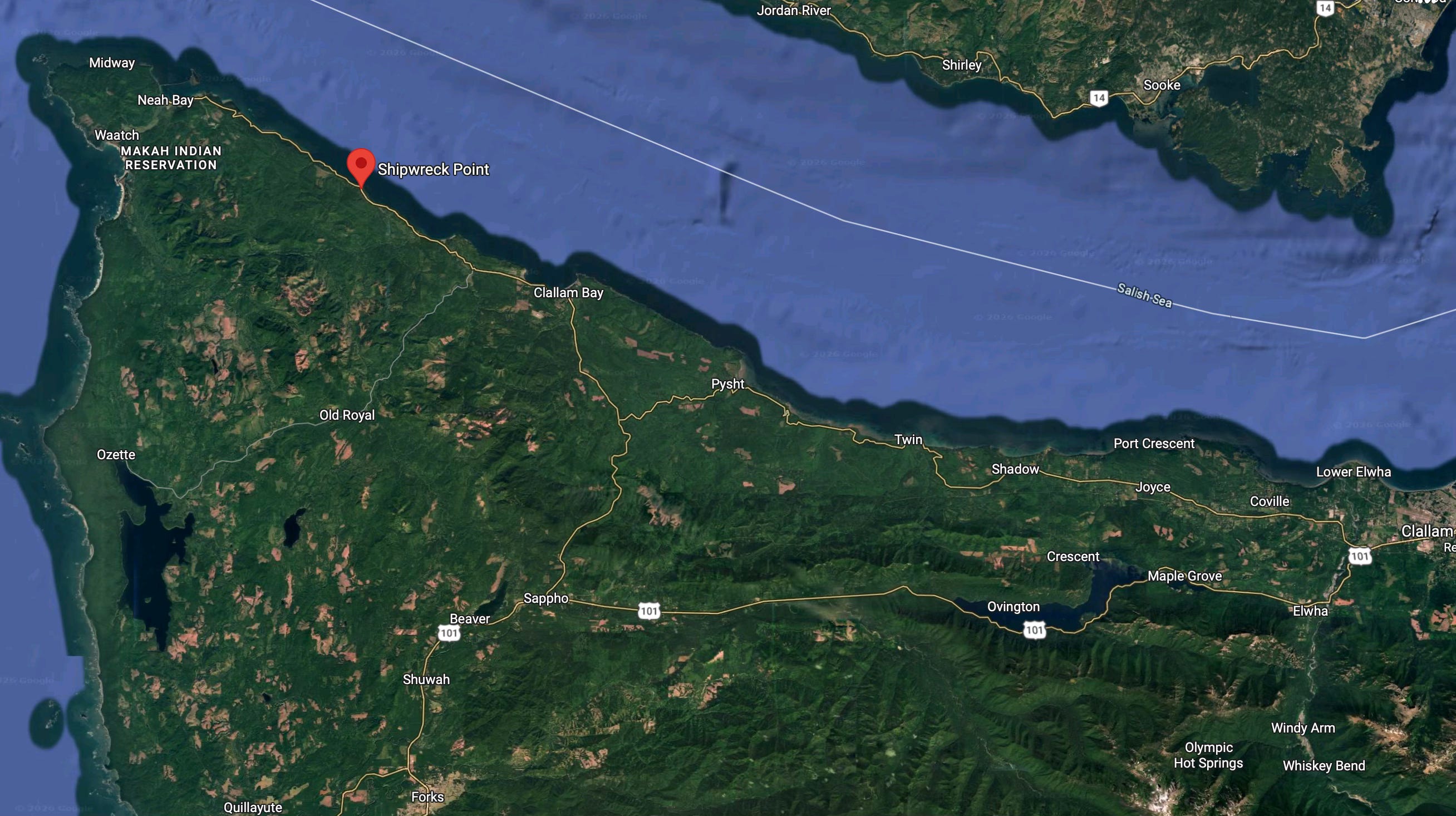
That location matters.
Shipwreck Point isn’t an urban corridor. It isn’t a dense encampment zone.
It’s exactly the kind of place people assume is still untouched.
The Official Narrative
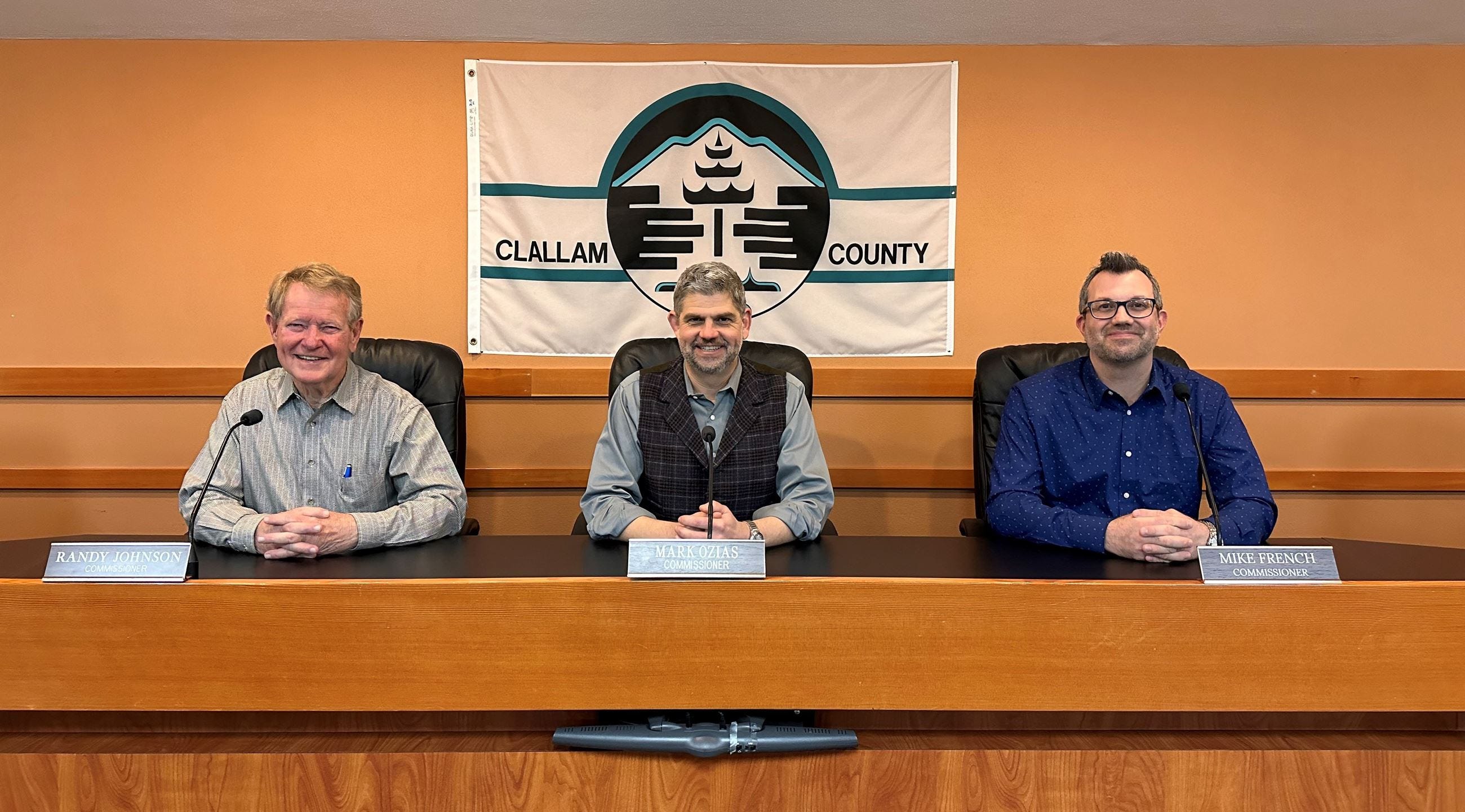
Put the image aside for a moment and look at the argument County Commissioner Mark Ozias is making.
His column isn’t just a defense of harm reduction. It’s a framework for how the public is supposed to understand what’s happening in Clallam County.
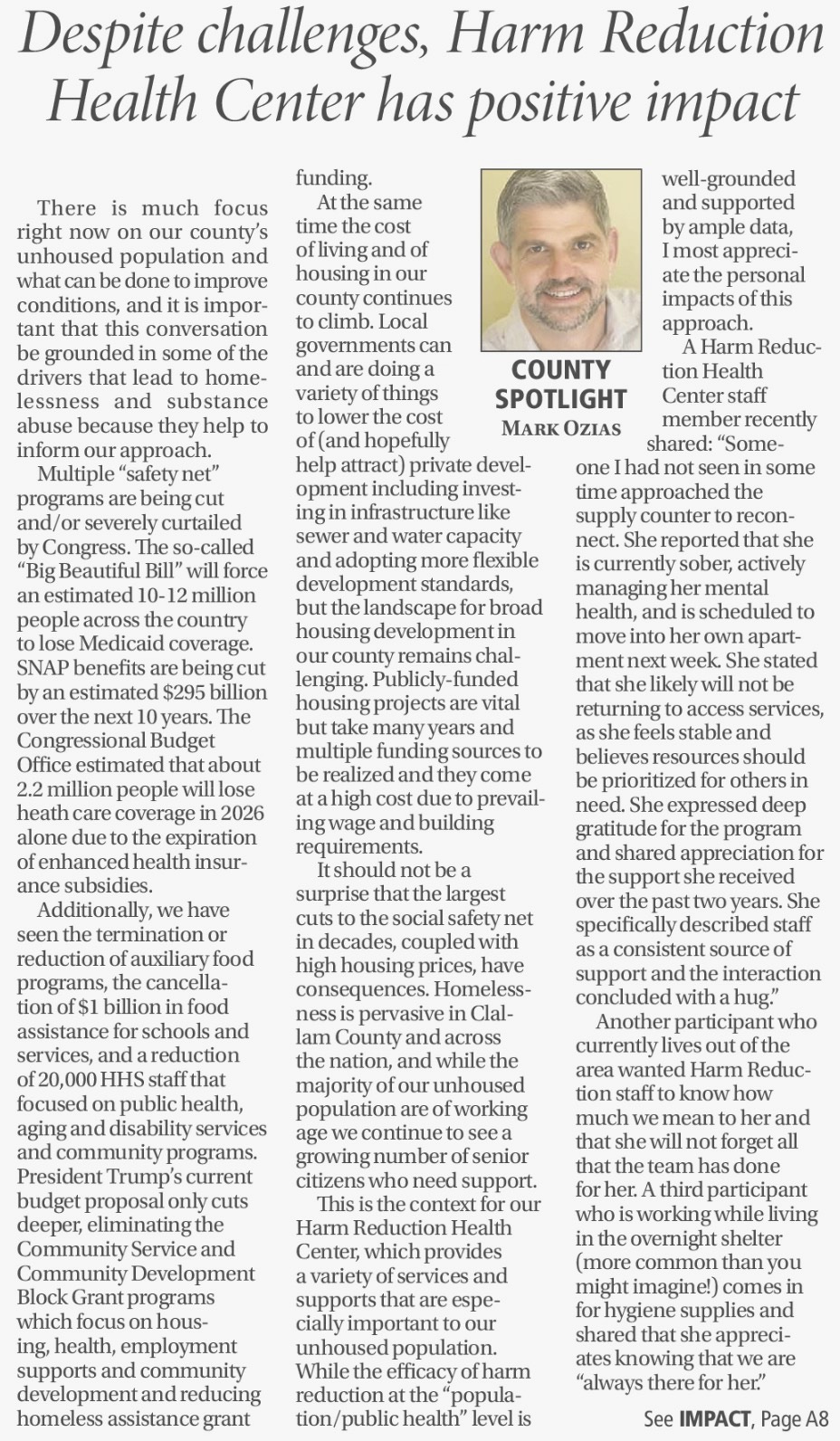
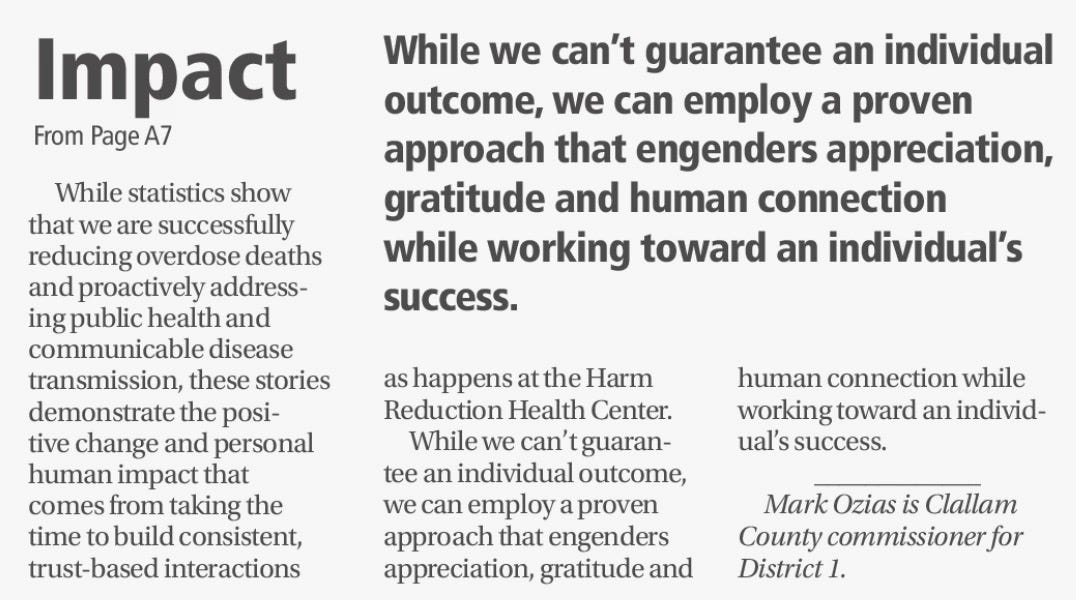
He starts by looking outward—toward Congress, toward federal funding cuts, toward national housing pressures. The message is clear: the root causes of what we’re seeing locally are largely beyond local control. If things feel worse, it’s because the system above us is breaking down.
From there, he turns to the County’s response. Harm reduction, he argues, is not just a choice—it’s the right choice. It’s grounded in data. It’s proven. It works.
And then, instead of showing that through local results, he shows it through stories.
People who got help. People who stabilized. People who are grateful.
That combination—external blame, moral framing, and anecdotal success—is powerful. It reassures. It explains. It defends.
But it also does something else.
It insulates the policy from being measured in a straightforward way.
The Claim: “Ample Data”—But Not Here
Commissioner Ozias leans on the idea that harm reduction is supported by “ample data.”
But none of that data is presented in a way that tells Clallam County residents what they actually want to know:
Is it working here?
There are no local performance metrics in the column. No trendlines tied to the program. No baseline comparisons. No measurable outcomes tied to cost, participation, or long-term success.
That absence matters.
Because if a policy is working, especially one that has been in place for years, there should be clear, local evidence of that success.
Instead, what the public sees is something harder to reconcile:
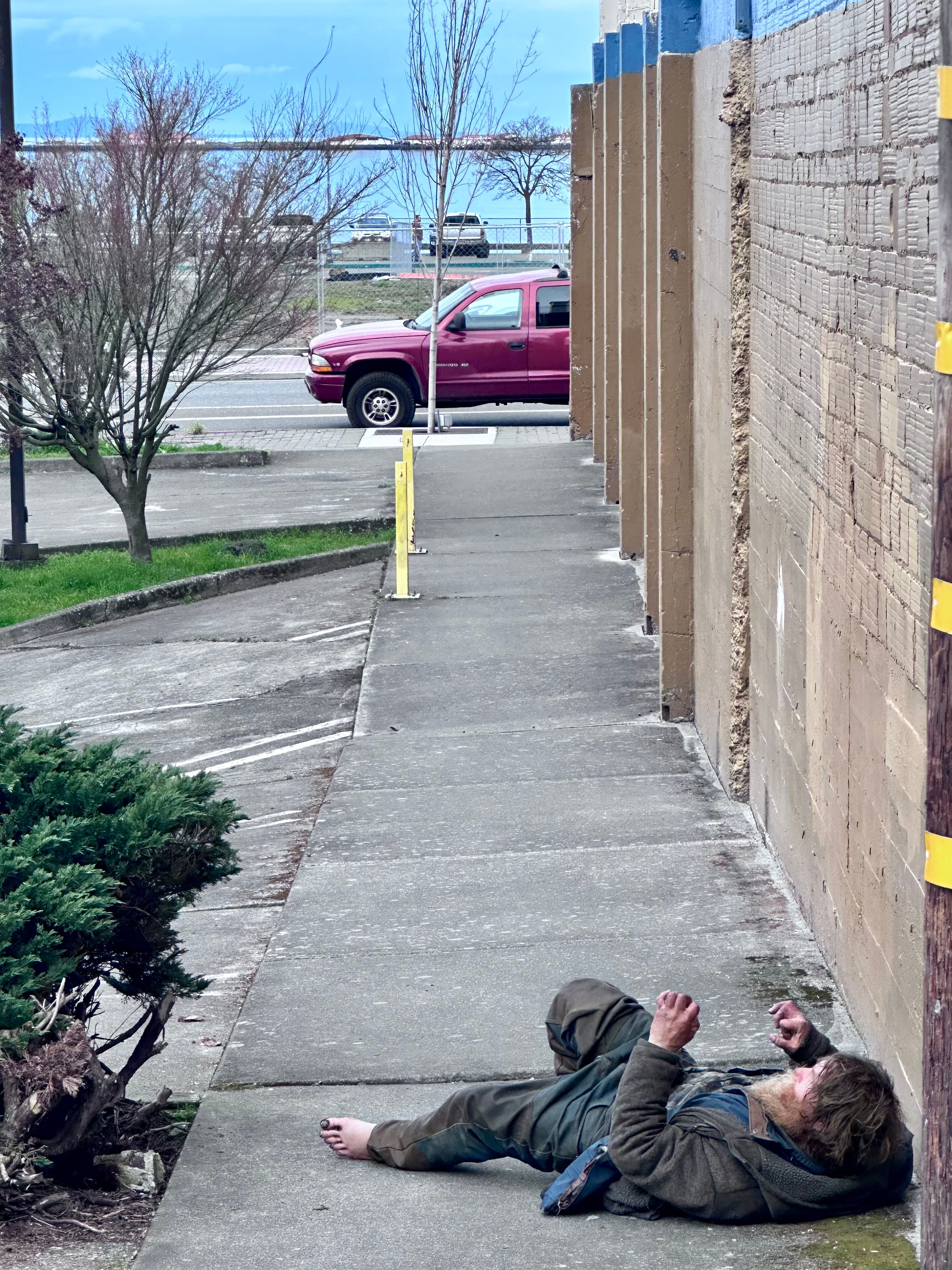
Overdose deaths that rose dramatically over the past decade. Public disorder that remains visible. Environmental impacts—like discarded needles—showing up in places that were once considered removed from all of this.
The question isn’t whether harm reduction can work in theory.
It’s whether it is producing measurable results here.
And that question goes unanswered.
Anecdotes as a Substitute for Accountability
The most compelling part of Ozias’ column is also its weakest from a policy standpoint.
The stories.
They’re real. They matter. But they are not a substitute for data.
Because without context, they don’t tell you how often those outcomes happen—or how many people never reach them.
One example describes someone who stabilized after two years of support. That may be a success. But it also raises questions the column doesn’t address:
How many people enter the system each year?
How many achieve that outcome?
How many cycle back through?
What does it cost to get one person there?
Those are not hostile questions. They are basic governance questions.
And they’re missing.
The Timeline: When Does “Proven” Mean Proven?
Harm reduction isn’t new in Clallam County.
It’s part of a broader approach that has been evolving for well over a decade—alongside earlier commitments, including what was framed as a 10-year plan to end homelessness.
That was sixteen years ago.
At some point, a strategy described as “proven” has to demonstrate that proof locally, not just philosophically.
If years of implementation don’t produce clear, measurable improvements in outcomes, then the question isn’t whether the idea is sound.
It’s whether the execution is working.
Or whether something needs to change.
The Missing Link: Homelessness and Addiction
There’s another gap in the County’s approach that Ozias’ column reflects rather than resolves.
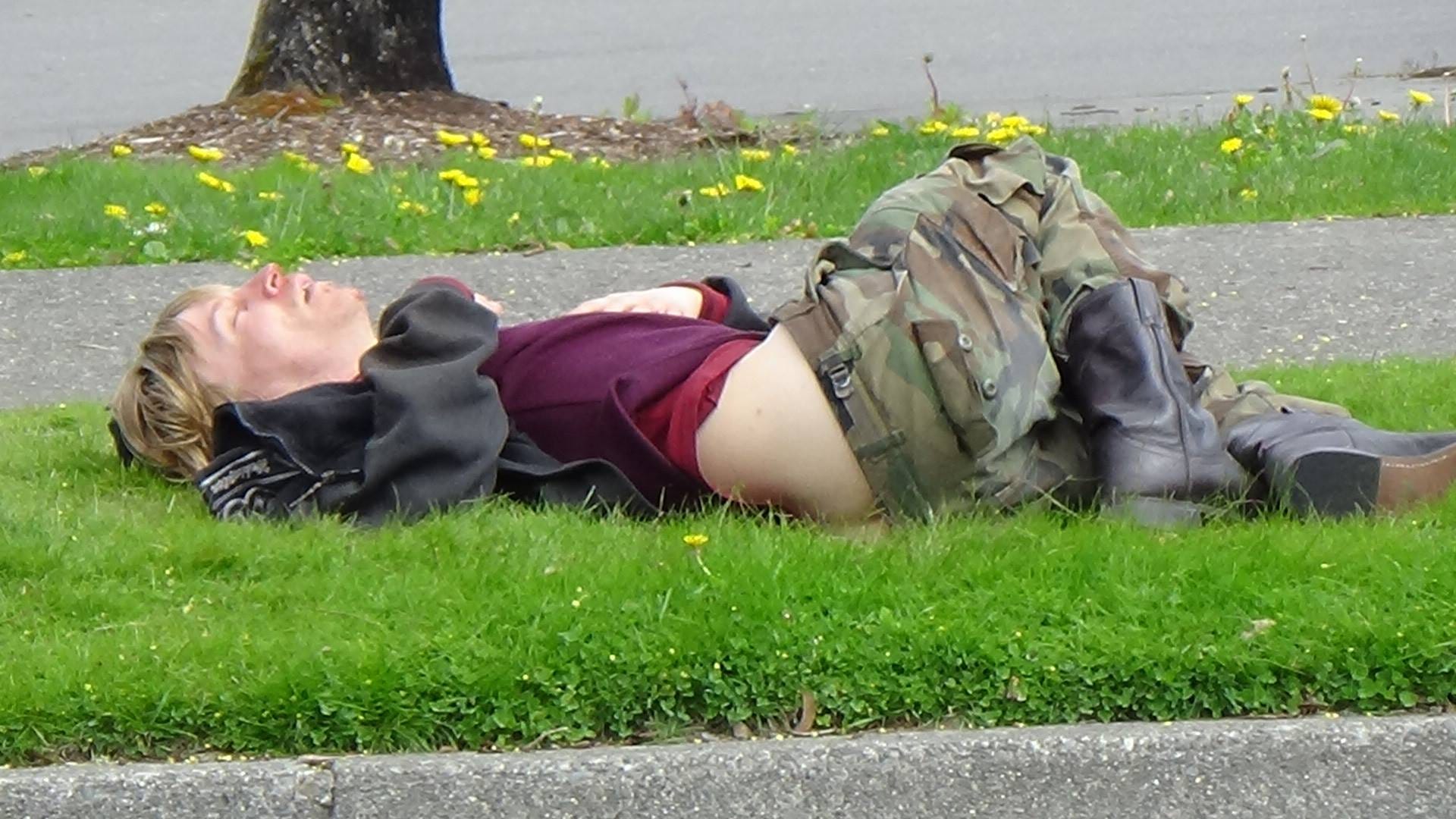
Clallam County has consistently avoided drawing a clear connection between homelessness and addiction.
They are discussed as overlapping issues, but rarely treated as directly linked drivers of one another.
That separation shapes policy.
It allows strategies to focus on housing in one lane and substance use in another, without fully addressing how intertwined they are on the ground.
And when that connection isn’t clearly acknowledged, it becomes easier to define success in narrower terms—program engagement, service delivery, individual stories—without confronting whether the overall system is reducing addiction or stabilizing the population experiencing it.
Redefining Success
Read closely, and you can see how success is being reframed.
Not as fewer overdoses.
Not as fewer people living unsheltered.
Not as measurable reductions in addiction.
Instead, success is described in terms of connection, trust, and gratitude.
Those things are meaningful. They matter in human terms.
But they are not outcome metrics.
And when process replaces outcome, it becomes difficult to determine whether a policy is actually solving the problem it was designed to address.

What Residents Measure
While the County talks about philosophy, residents measure something else.
They measure what they see.
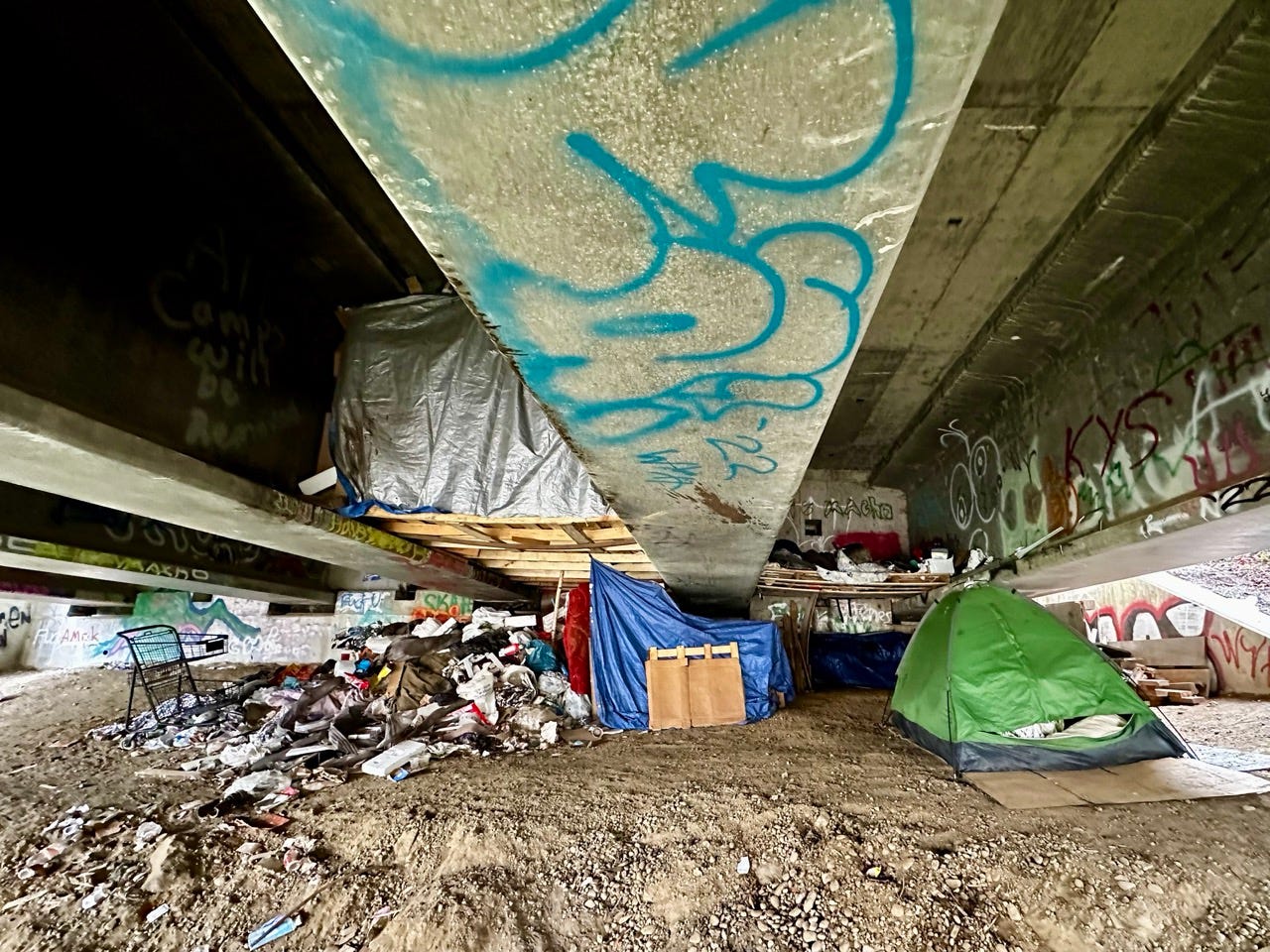
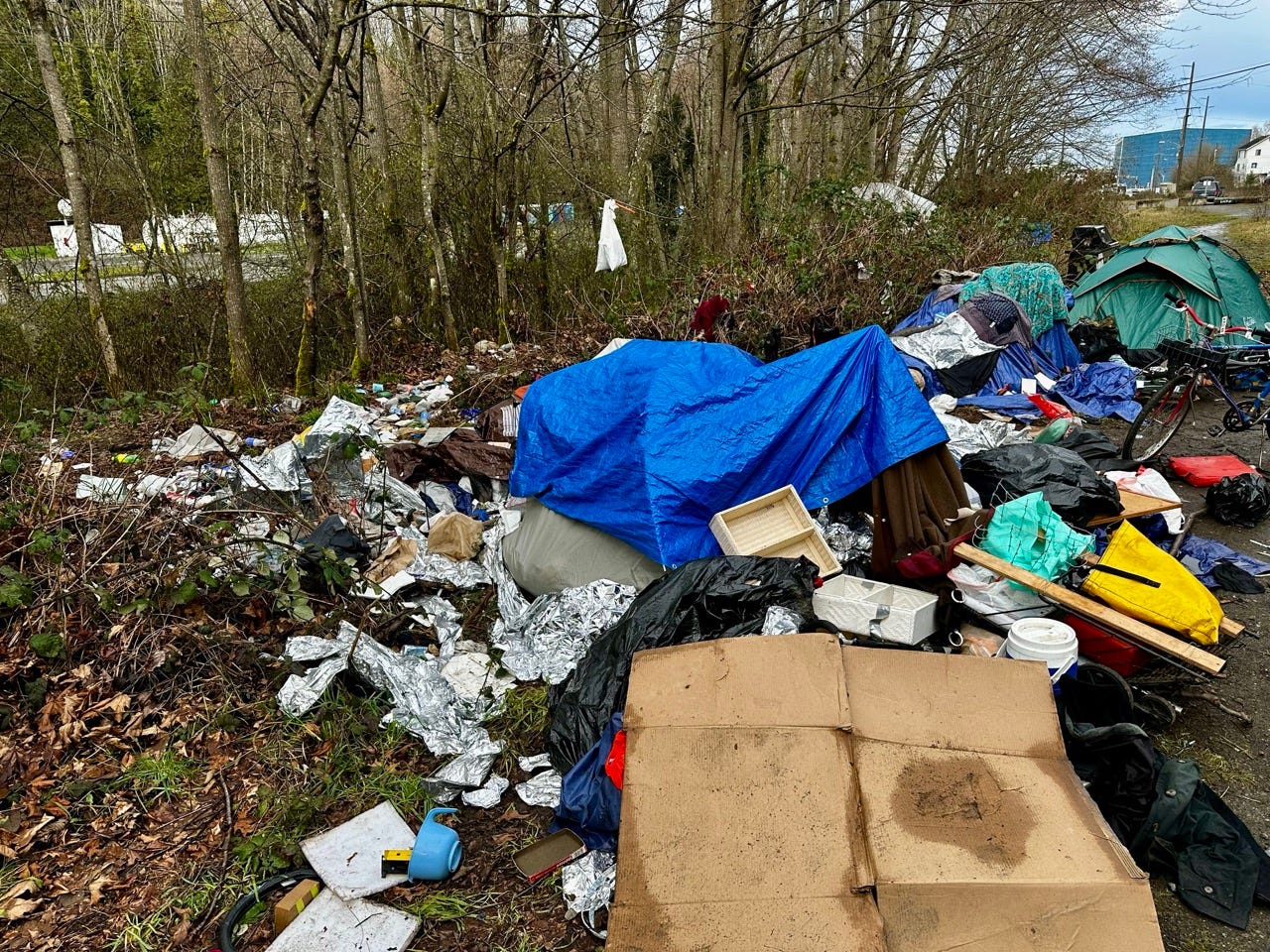
They see needles in public places. They see encampments in sensitive areas. They see environmental degradation where restoration money has already been spent.
And now, they see those impacts reaching even further—into places that were once assumed to be untouched.
That gap—between what is being described and what is being experienced—is where trust starts to erode.
Why the County Isn’t Pivoting
At some point, every policy approach faces a test.
Not whether it was well-intentioned. Not whether it aligns with a broader philosophy.
But whether it is producing results.
So why isn’t there a shift?
Because the current framework makes a pivot difficult.
Responsibility is pushed upward, toward federal policy. The local response is framed as both compassionate and evidence-based. And criticism is often met not with counter-data, but with stories that reinforce the moral case for continuing as-is.
That combination creates stability—not necessarily in outcomes, but in the narrative itself.
And when the narrative is stable, even in the face of mixed or unclear results, change becomes less likely.
The Core Question
Strip everything else away, and the issue becomes simple.
You have a long-running strategy. You have leadership saying it works. And you have a public that is still seeing visible, unresolved problems.
So the question isn’t ideological.
It’s operational.
What are the measurable outcomes of Clallam County’s harm reduction strategy—and why aren’t they being clearly presented?
Until that question is answered with data—not anecdotes—it’s going to keep coming back.
Because the public doesn’t just want to understand the policy.
They want to know if it’s working.
And that brings it full circle.
Back to a beach that should have been one of the safest places in the county. Back to a moment that didn’t require explanation or interpretation.
A young girl, holding a bottle filled with used needles.
That’s not a statistic. It’s not a case study. It’s not an anecdote offered to support a policy.
It’s a result.
And if the County wants to make the case that its approach is working, it has to be able to explain moments like that—not with philosophy, not with stories from somewhere else, but with clear, measurable answers.
Because until then, that image isn’t just powerful.
It’s a question that hasn’t been answered.
Reminder: Meet Marcia Tonight
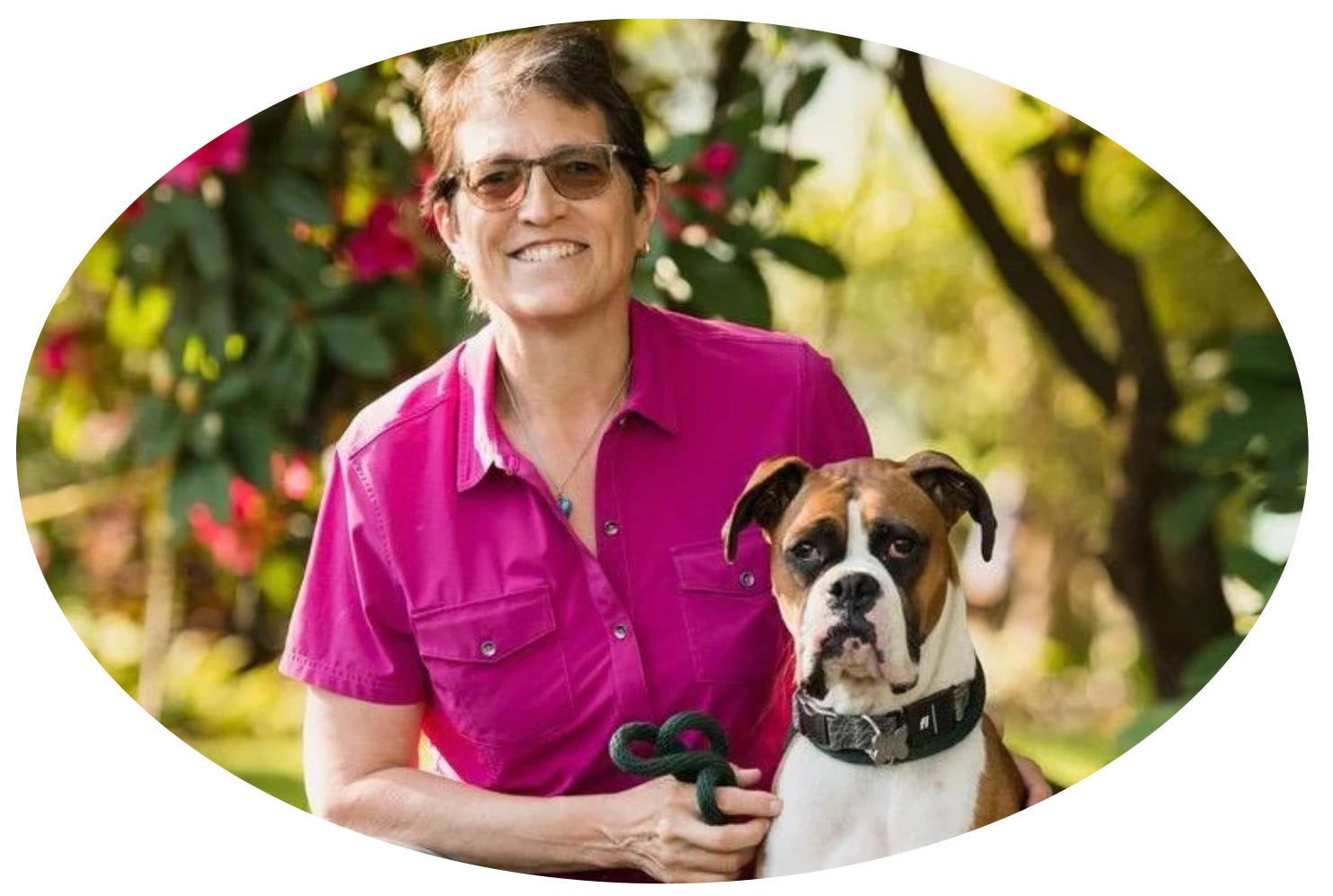
Tonight is your chance to meet an Independent running to represent our 24th Legislative District.
Meet Marcia Kelbon at an informal meet-and-greet this evening—no speeches, no pressure, just a chance to connect and ask questions.
📍 Event Details
📅 Tonight
⏰ 5:00 PM
📍 Barhop Brewing & Artisan Pizza
🍺 Grab a beer
🍕 Enjoy a slice of pizza
🤝 Casual conversation & Q&A
Today’s Tidbit
In a move that’s becoming all too familiar, the Port Townsend Leader reports that Jefferson County Commissioners signed off on a letter supporting the transfer of Protection Island to the Jamestown S’Klallam Tribe—calling it a “powerful step toward land justice.” That sounds nice. Until you read the rest.
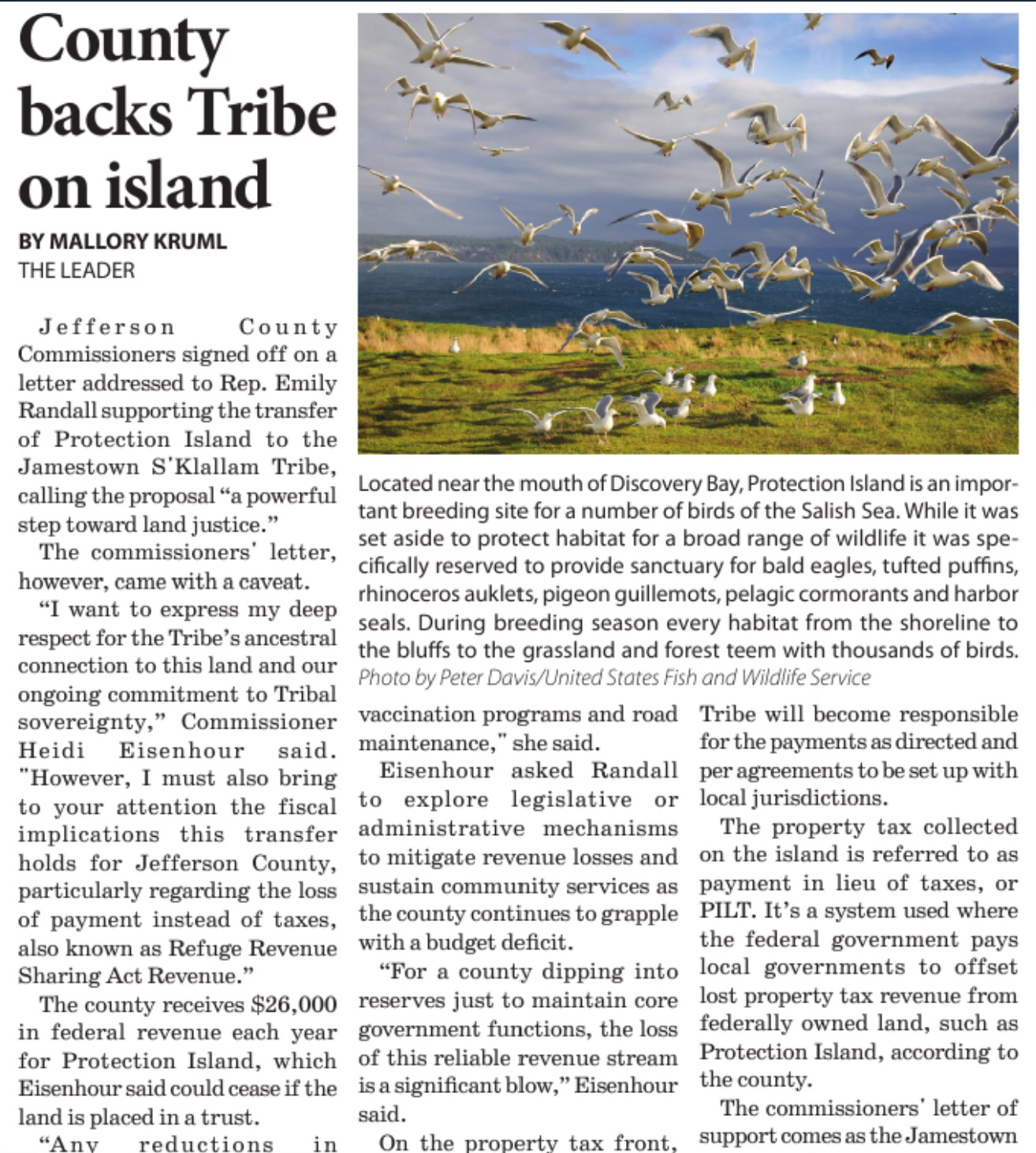
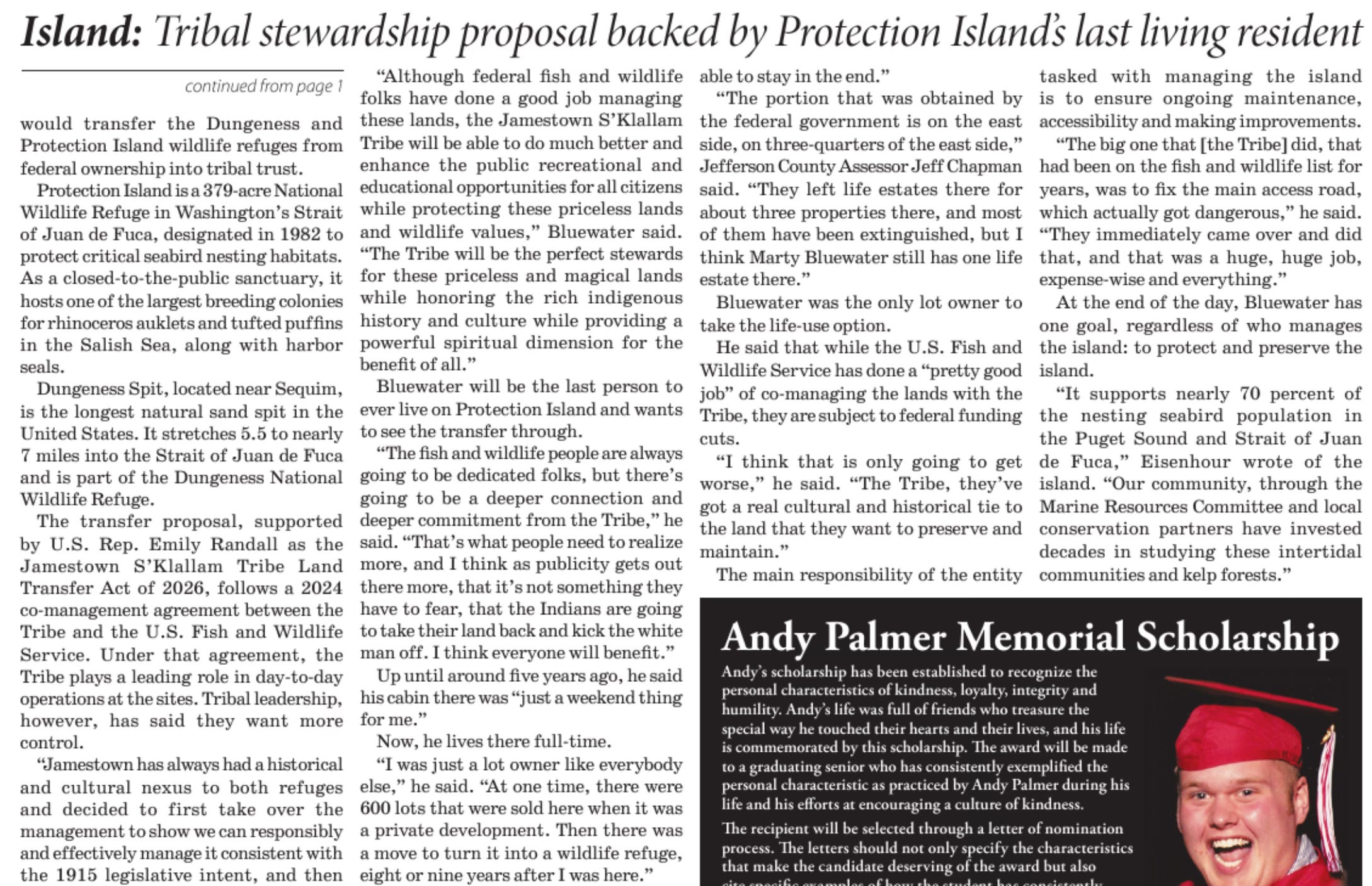
Because buried in the same letter is concern about losing revenue, with Commissioner Heidi Eisenhour warning the county could take a “significant blow” from the loss of payments tied to federally owned land. In other words: we support giving it away… but we’d also like to be reimbursed.
The article highlights that the county currently receives about $26,000 annually tied to the island—money that could disappear if the land goes into tribal trust. So while commissioners publicly champion the transfer, they’re simultaneously asking lawmakers to figure out how to backfill the budget hole it creates.
There’s also the broader framing: this is being sold as better stewardship, with claims the Tribe can “do much better” than federal management, even though federal wildlife officials are already described as doing a “pretty good job.” That’s a curious argument—replace a system that works, hope it works better, and ask taxpayers to cover the difference.
At the end of the day, the message feels mixed. It’s land justice on paper, fiscal concern in the fine print, and a growing pattern of local governments supporting decisions that reduce public control—while quietly acknowledging the costs that come with it.


