


In this week’s Sundays With Seegers, County Commissioner candidate Jake Seegers examines a brutal 30-minute assault on the Laurel Street stairs—an incident that unfolded in the downtown core without intervention. Jake connects the violence to a broader pattern: policies that tolerate instability, avoid enforcement, and increasingly normalize outdoor living. The question is no longer whether it’s working—but whether anyone will change course.
Assault on a Landing
At 5:02 a.m., February 22, on the stairway behind the downtown Port Angeles fountain, a homeless man—Jake Veach—sat beside his camp, recently established on the first landing from the top.
What followed was not a brief altercation or a momentary loss of control. According to the police report, the violence stretched over roughly thirty minutes—an extended, escalating assault carried out in plain view on public property, just below a neighborhood of families.
During that time, according to the police report, Mr. Veach was repeatedly kicked, stomped on, and struck by the suspect, Isoble Snow.
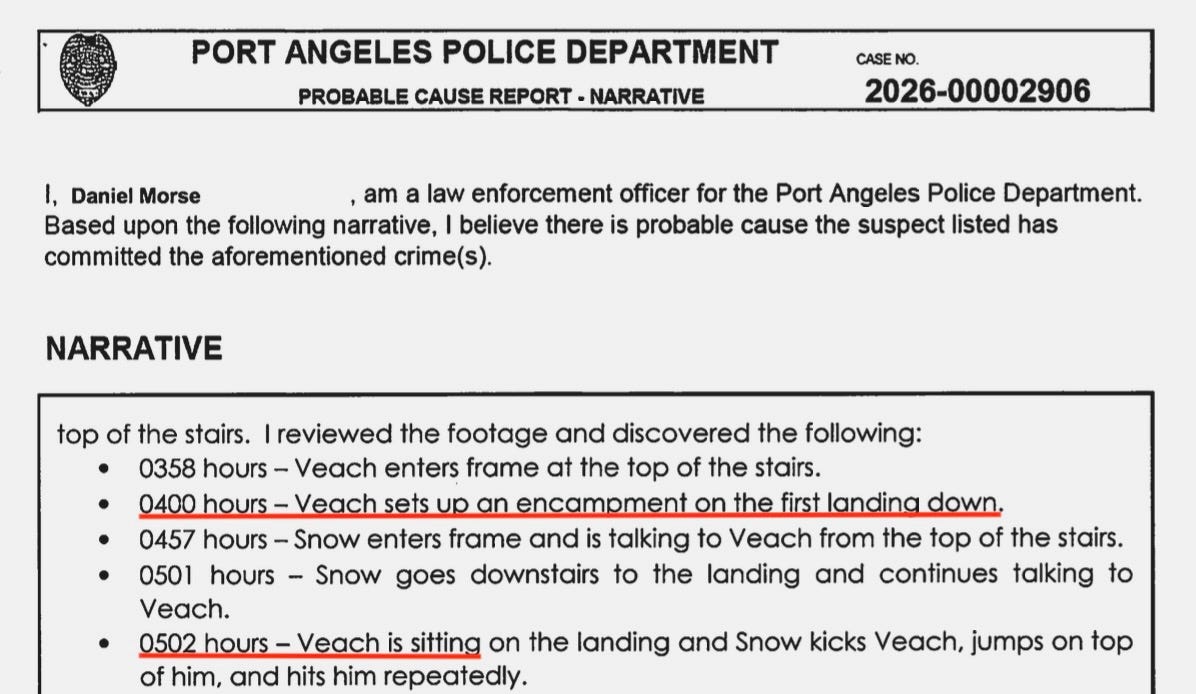
The report makes clear that he attempted to disengage, at times sitting back down and trying to avoid further conflict with Snow. But the assaults continued—again and again—over a sustained period that should give anyone pause.

Thirty minutes.
That detail matters. It speaks not only to the brutality of the attack, but to the absence of interruption—no effective intervention, no meaningful disruption, no system stepping in before things escalated further. All of it captured on camera. All of it unfolding on a public pedestrian connection between a residential neighborhood and the downtown core.
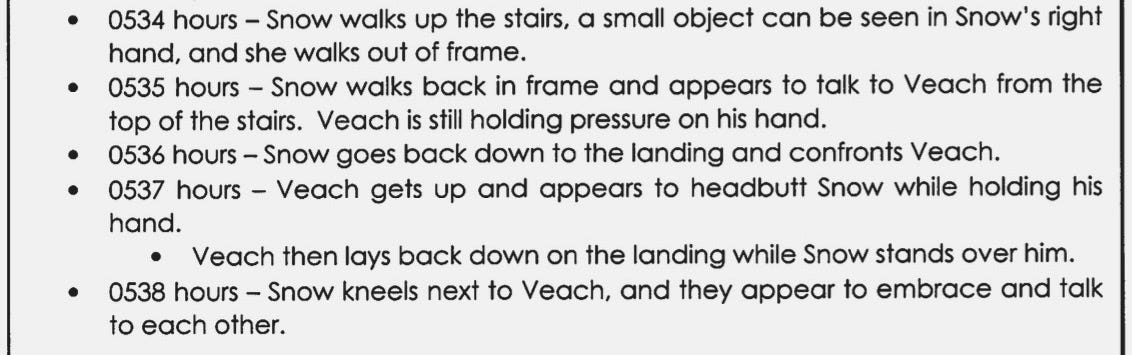
At approximately 5:33 AM, the violence intensified. The report indicates that the suspect, Isobel Snow, stabbed Mr. Veach in the left tricep multiple times. When he attempted to grab her hand—possibly to disarm her—his right hand was lacerated.

Even after the stabbing, the incident did not immediately end. Mr. Veach collapsed, clutching his arm. The suspect moved away, then re-engaged. The confrontation continued before eventually de-escalating into conversation—and even an embrace.
At 5:51 AM, the incident was reported. Responding officers arrived to find both individuals next to a large pool of blood on the stair landing.
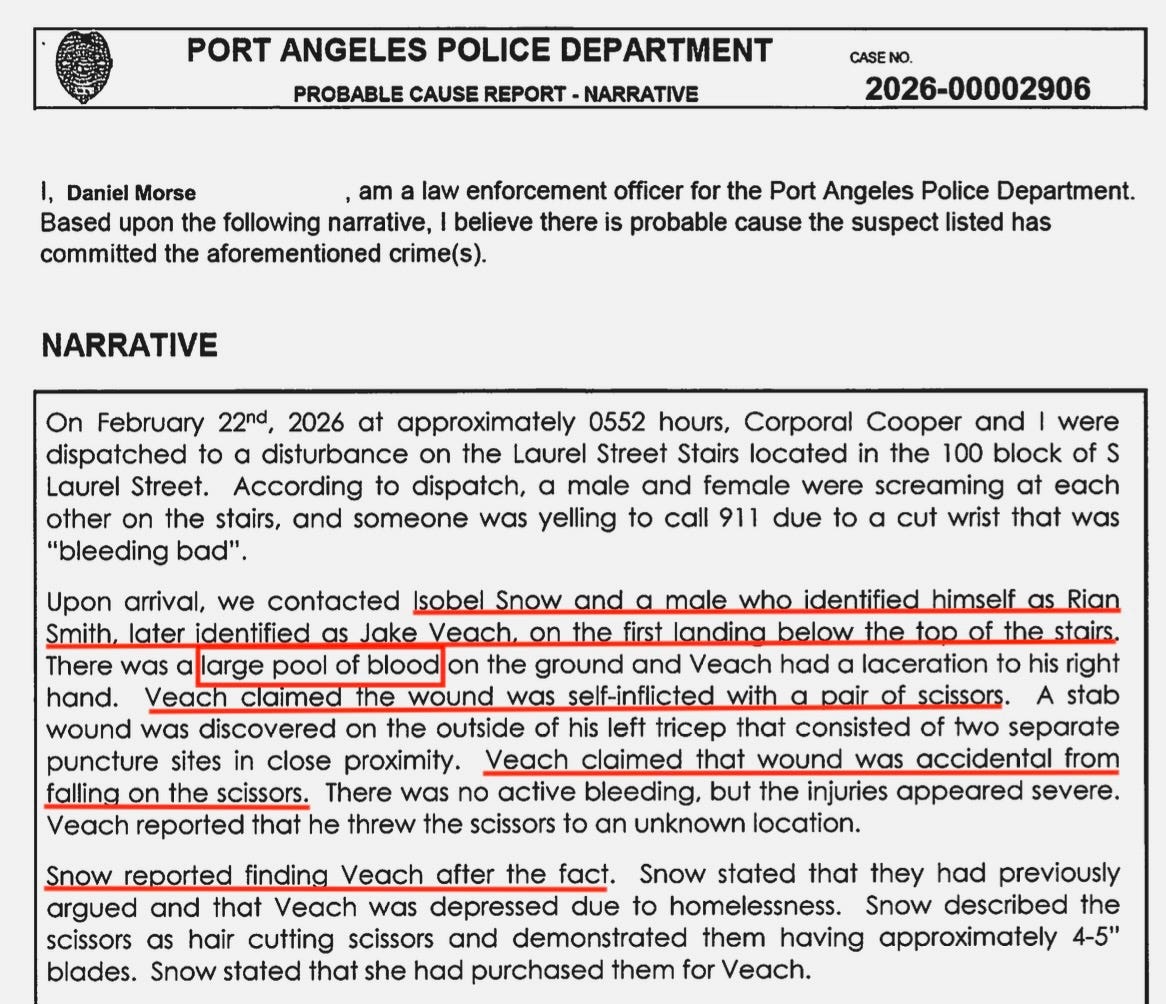
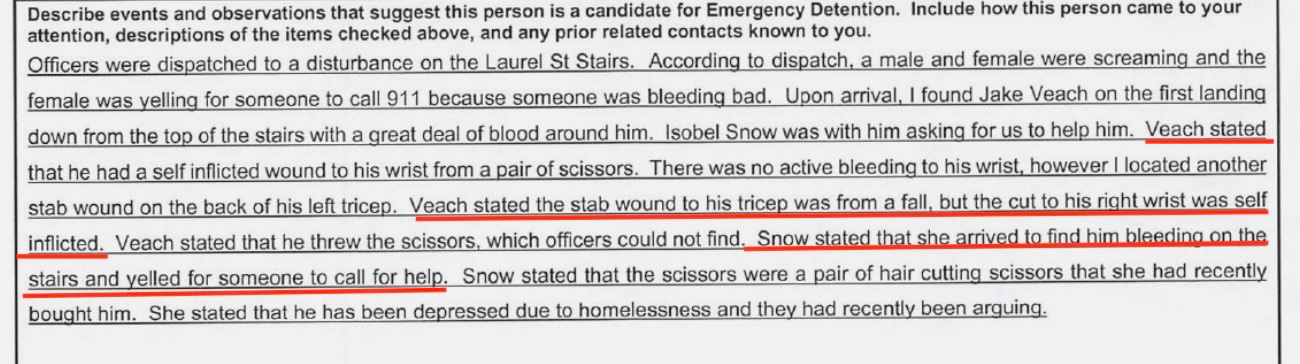
According to officers, Mr. Veach claimed his injuries were self-inflicted or the result of “falling on scissors.” Ms. Snow stated she arrived to find him bleeding and called for help.
Historical Context
Disclaimer: The following section reflects personal observations and conversations, as well as accounts from individuals living in the area. It is not part of the official police report and has not been independently verified.
I met Jake in mid-February. His camp, at the time, was feet from Tumwater Creek.
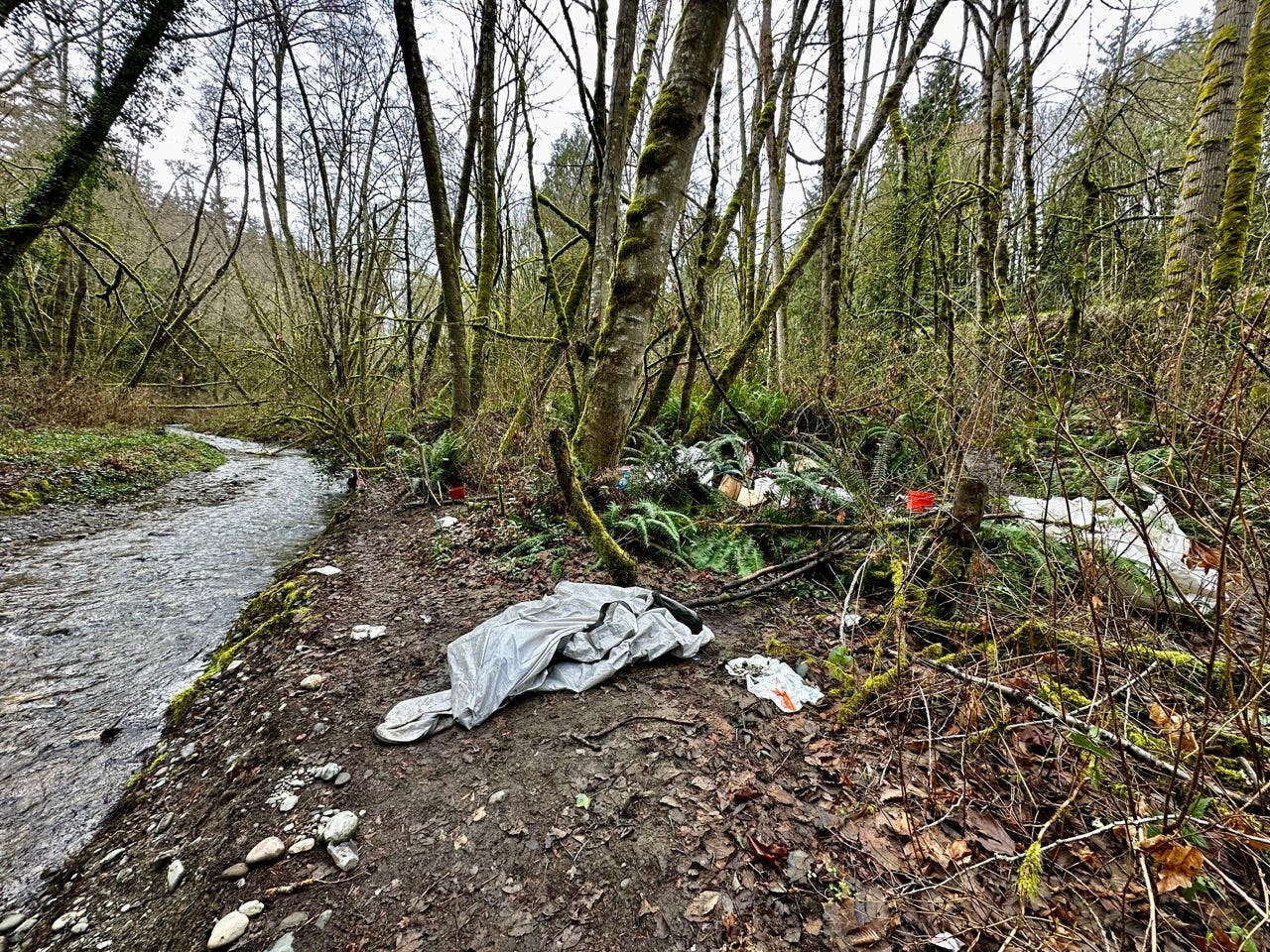
He collected rocks. I happened to have a small stone in my pocket from the beach and offered it to him. He accepted it with appreciation. We talked for about fifteen minutes.
Jake told me he came from Idaho, in part because Washington offers more services—specifically, clean drug use supplies. He said he had been living along Tumwater Creek for two to three years.
He was candid about his drug use:
“Everybody has to use out here. If you’re homeless, you have to.”
He appreciated the food, clothing, and supplies available through local programs, including the County’s Harm Reduction Health Clinic. But he also expressed frustration—suggesting, for example, that syringe distribution should require exchanges.
More importantly, he expressed a desire to get out.
He wanted inpatient treatment. Stability. A way forward.
When asked what would happen if enforcement made outdoor living no longer an option, he said he would go to Serenity House temporarily—and then he would “leave town.”
A Bit Downstream
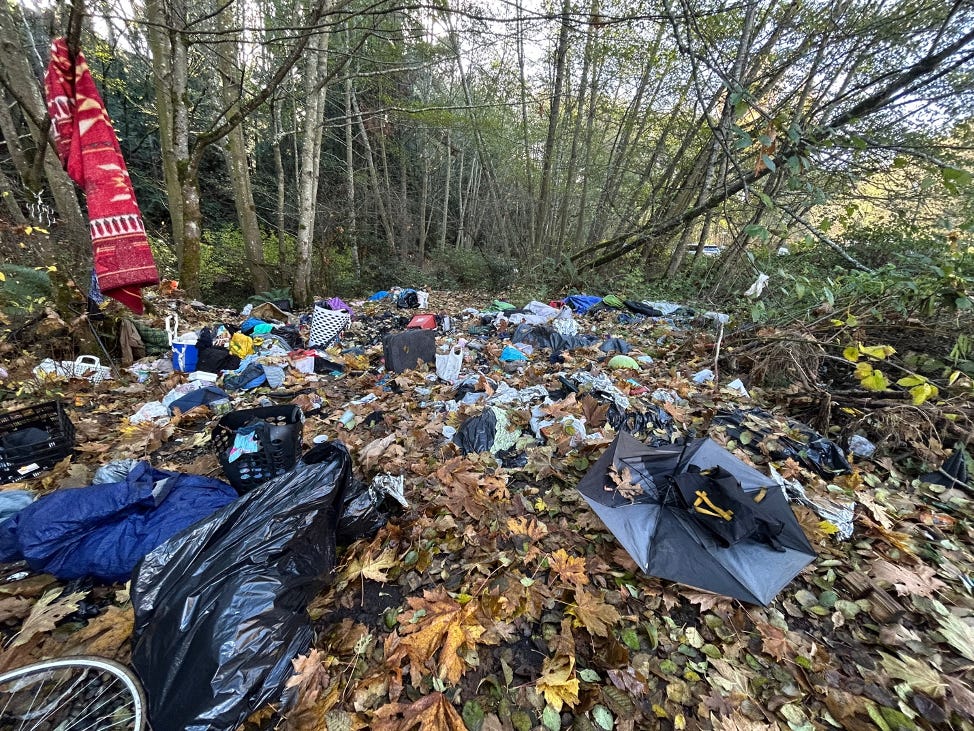
Later that month, the contents of an abandoned camp spilled down the bank of Tumwater Creek—scattering solid waste across Port of Port Angeles–owned property just north of Jake’s camp.
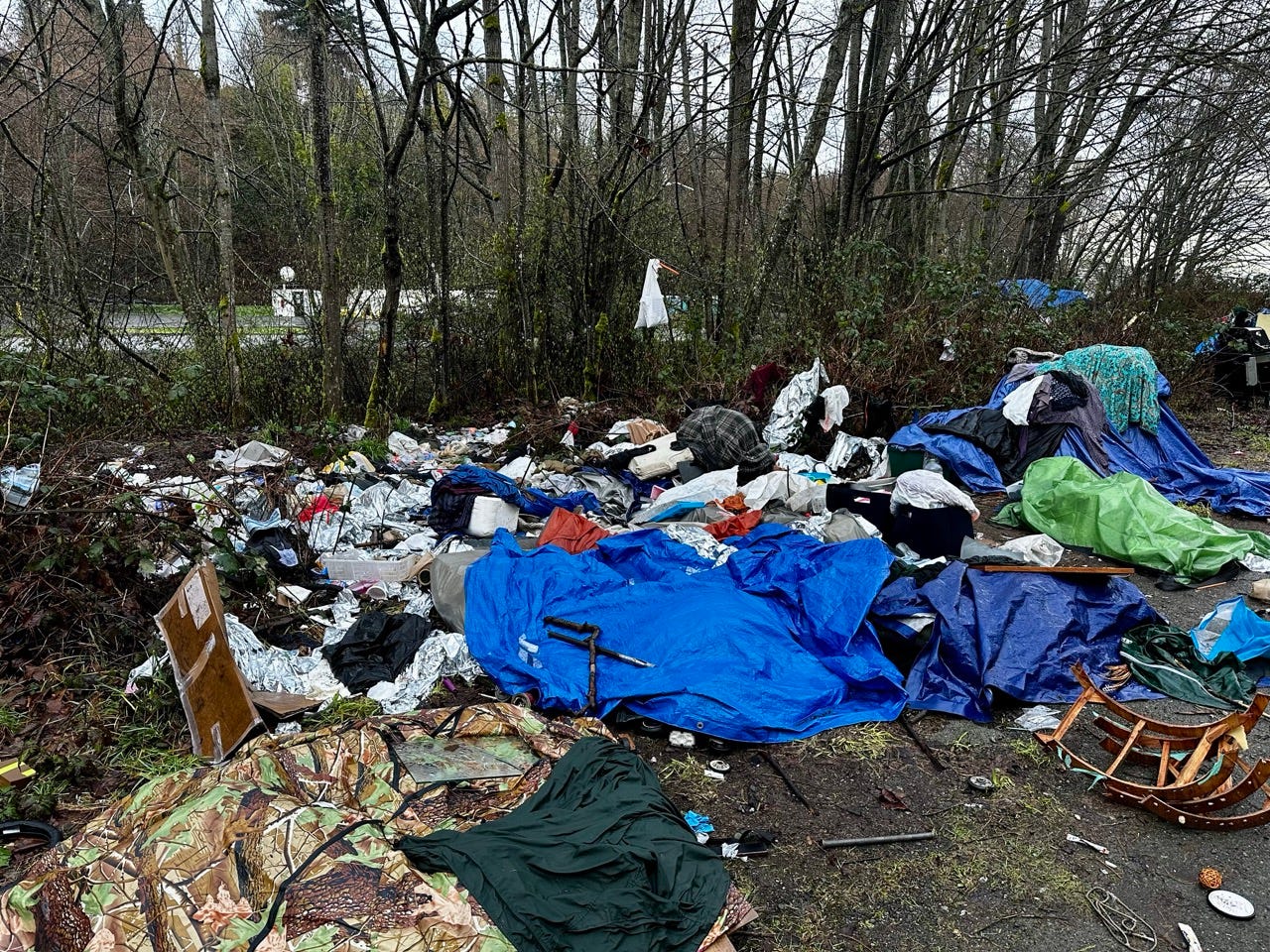
According to a reliable eyewitness, the camp had previously been occupied by Isobel Snow.
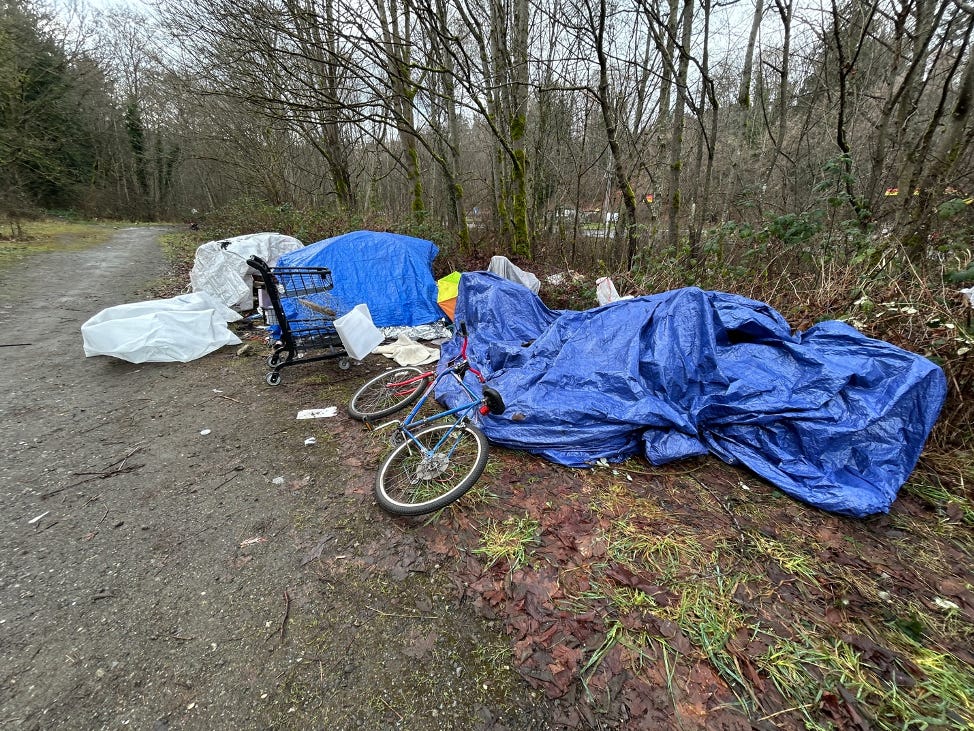
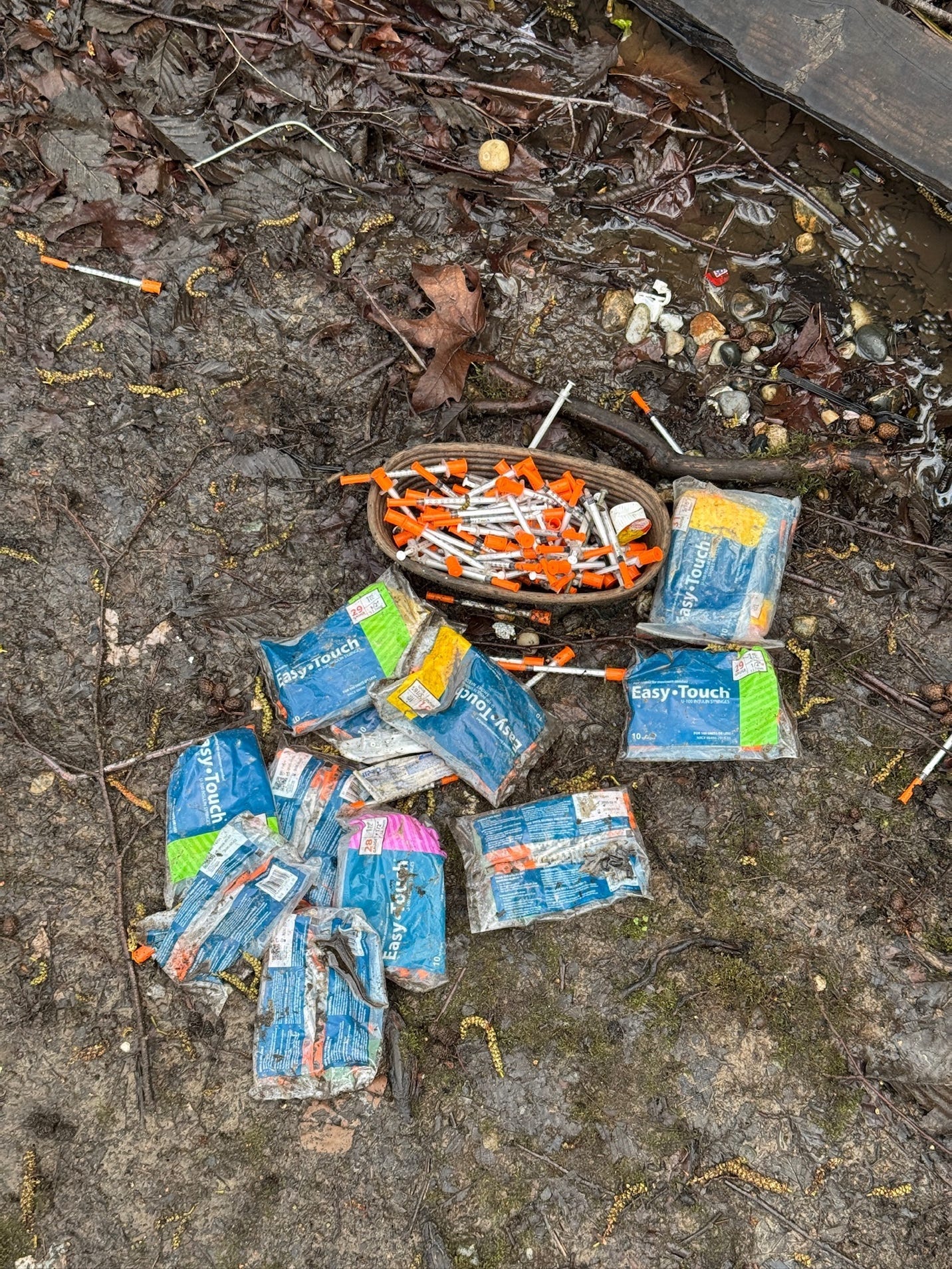
Signs of drug use were just steps away.
The same source also identified Snow’s previous encampment, which had burned to the ground.
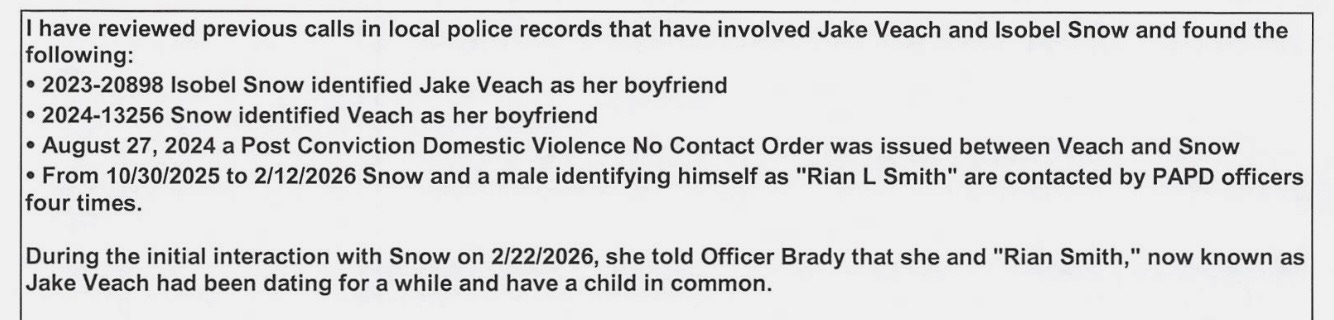
Prior to the incident on the stairs, Mr. Veach and Ms. Snow reportedly had a history that included a domestic violence no-contact order.
The assault on the Laurel Street stairs was captured on camera. But it raises a larger question: how much violence and instability goes unseen—hidden by dense brush, distance, and the constant rush of Tumwater Creek?
If this is what unfolds in a visible, monitored location, what is happening in the places we don’t see?
When Advocacy Becomes Enablement
At the March 17th meeting of the City of Port Angeles City Council, nearly an hour of public comment was delivered. A clear pattern emerged.
Speaker after speaker urged the city to allow outdoor camping to continue—many calling for fewer restrictions, or a hands-off approach so long as camps appeared orderly.
It did not feel spontaneous. The repetition in language and framing suggested coordination, with many speakers advancing nearly identical ideas.
One commenter urged the city to establish areas where unhoused individuals could “exist safely… with sanitation… and protection from harassment.” Another warned that “attempts to prohibit camping and encampments are a clear attack on homeless populations.”
Others advocated for designated outdoor communities “where these people can reside in safe, secure… communities,” while one speaker cautioned that banning camping “would be devastating… there’s nowhere else to go.”
Perhaps most telling was the suggestion that, “If a campsite is clean and the people aren’t harassing anyone, leave it.”
Taken together, the message was consistent: outdoor living should be preserved and protected.
But what happened on the Laurel Street stairs raises a difficult question—what does that look like in practice?
When Leaders Can’t Say “No”
Maybe the stabbing at Laurel Street could have been avoided.
Instead, individuals with known instability—living outside despite available shelter capacity—are enabled by a system that provides resources, access, and freedom without consistent expectations or enforcement.
This is not an isolated incident—it is a glimpse into a lawless society encouraged to grow at the expense of the lawful.
The City of Port Angeles has repeatedly failed to enforce existing trespass laws or meaningfully address unauthorized encampments.
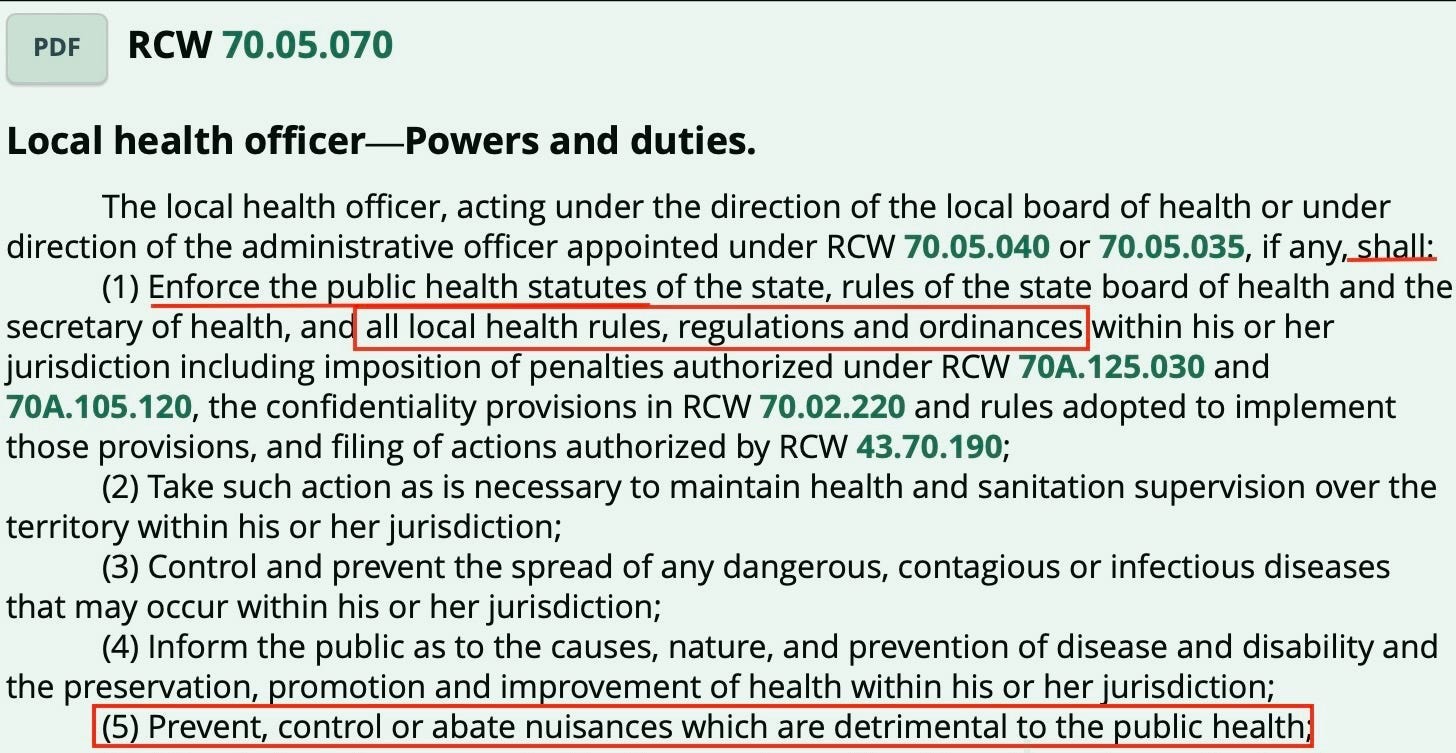
The Clallam County Board of Health and Health Officer Allison Berry have refused to comply with their lawful duty to “prevent, control or abate nuisances which are detrimental to public health,” when conditions deteriorate on public or private land.
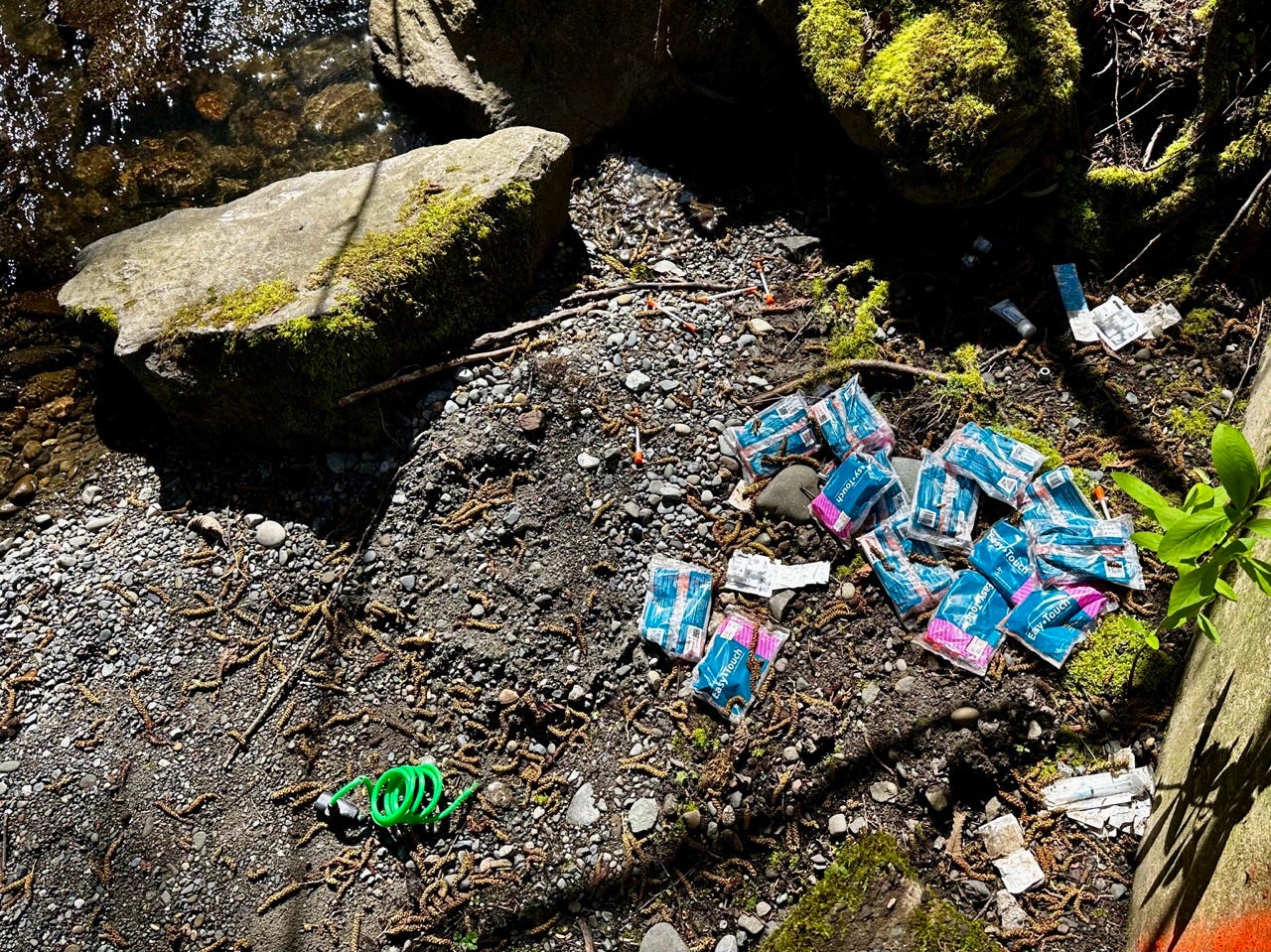
Meanwhile, harm reduction efforts have expanded without sufficient accountability for outcomes. Supplies are distributed widely, and in many cases, are discarded unused, contributing to growing waste in public spaces and sensitive environments.
Residents have taken notice. The Lincoln Street Safeway is now commonly referred to by some as the “UnSafeway,” reflecting concerns about open drug use and dealing.
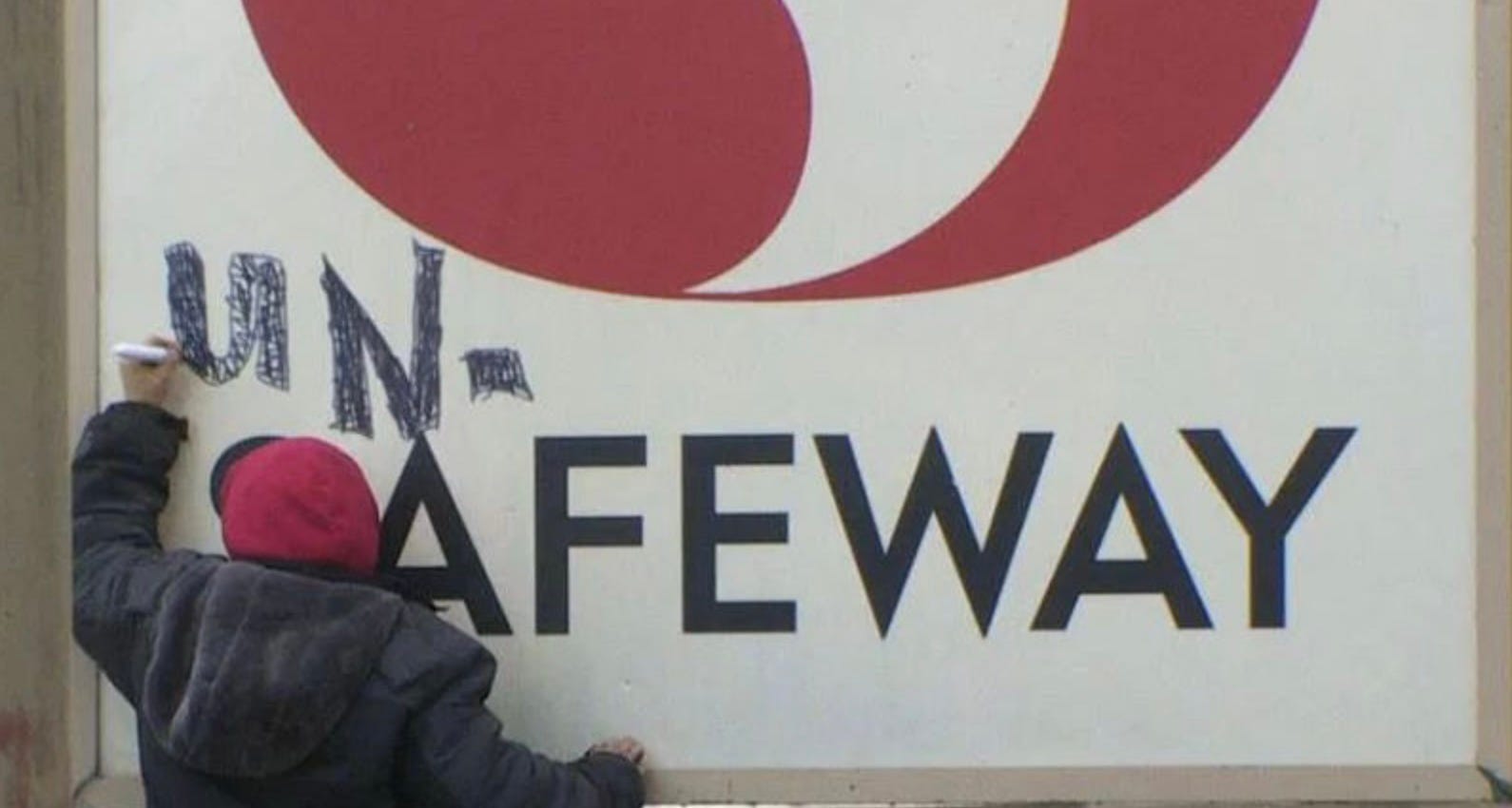
Panhandling continues, often unaddressed, contributing to a steady flow of cash into the drug trade.
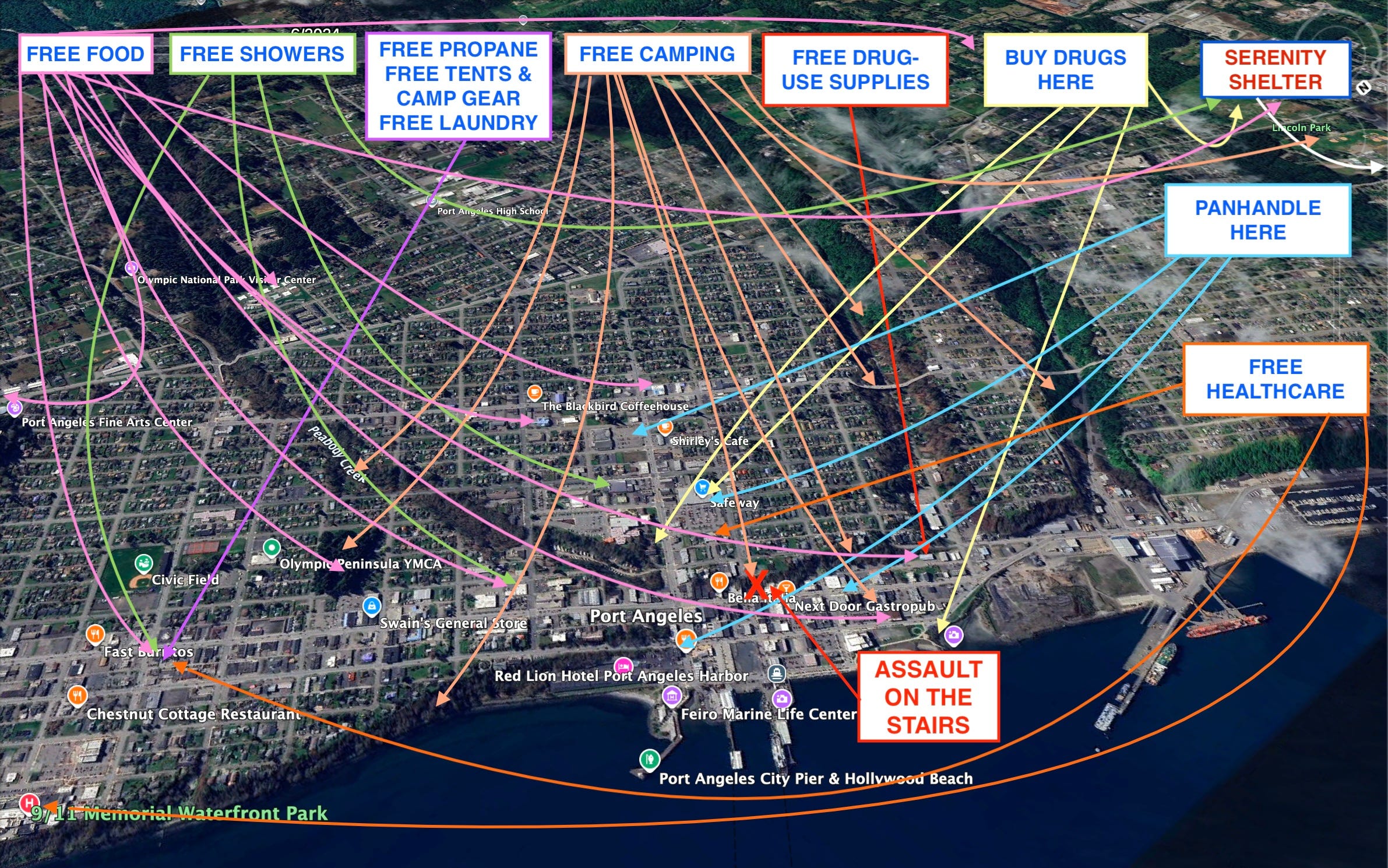
Basic services are widely available—but many are concentrated in the same areas where drug activity is prevalent.
Free food is abundant. WSU Extension keeps an active document of local food resources here.
Showers are available at Serenity House, Salvation Army, The Answer for Youth (TAFY), and now in the same locker rooms utilized by children and families at the taxpayer-funded William Shore Memorial Pool. Transients are invited to shower Monday through Friday between 5:30 am and 10:30 am.

TAFY provides free tents and camping gear and pays for propane tank refills at a nearby gas station—fuel that is often used for unventilated heating sources inside tents.
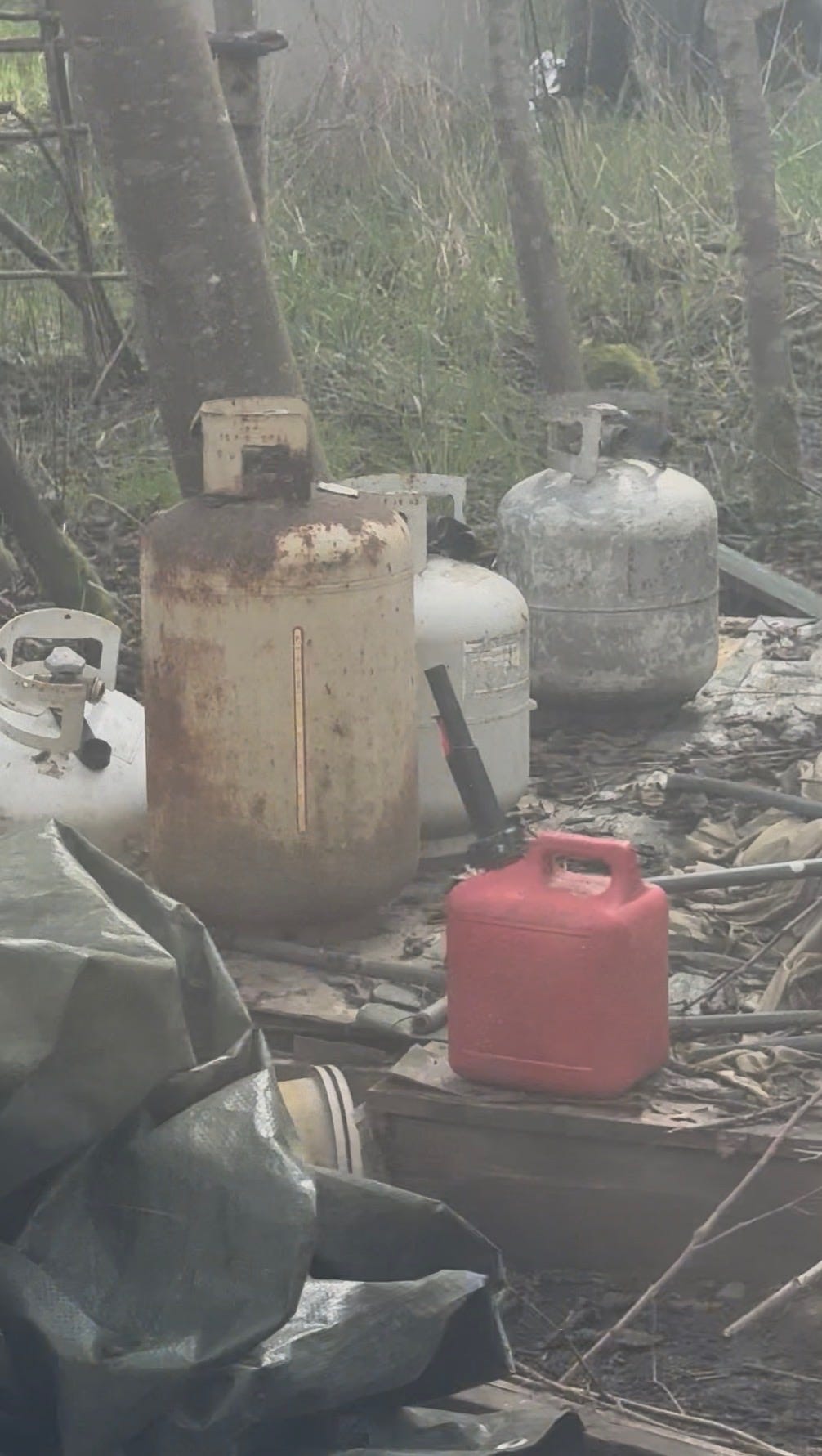
City, Port, and County-owned property has effectively become a largely unregulated option for outdoor camping, substance abuse, and illegal dumping.
Clallam Transit connects all of these services with convenience, free of charge.
The map below is not exhaustive, but it illustrates the network of services, resources, and lack of enforcement that made the Laurel Street Stairs a prime location for this incident.
The Officer Who Said “No”
In contrast, one moment in the report stands out.
When Ms. Snow asked to smoke a used cigarette from an ashtray while in custody, the arresting officer refused.

He followed protocol. He held the line.
It’s a small detail—but a telling one.
Because, in a system where nearly every request is accommodated, the first “no” can trigger instability. According to the report, Ms. Snow reacted by repeatedly striking her head against the divider in the patrol car.
Like a spoiled child who is granted their every request, when finally told “no,” Ms. Snow melted down into a tantrum.

That reaction is not random. It reflects a broader pattern—one shaped by a system that too often avoids setting limits.
Private Landowners Caught in the Middle
Not all stakeholders have accepted this trajectory.
The Port of Port Angeles has taken active steps to address trespassing, waste, and environmental damage on its property.
During a February 24, 2026 Port Commission meeting, Port Security Lead Jack Lowell outlined efforts to address these issues, including active vegetation management to improve visibility and deter camping, the placement of “No Trespassing” signage across Port property, increased security patrols, and a $70,000 fence installation along 18th Street near the airport, across from Serenity House.
Security staff also make near-nightly contact with campers, asking them to move along—some comply, while others stubbornly refuse.
Port staff praised collaborative efforts with local clean-up non-profit 4PA and said that:
“They, more often than not, come up with solutions for us for some of the individuals who do need to be housed.”
Port staff did not report the same level of success when working with the City of Port Angeles and Clallam County.
They cited nearly weekly complaints to the Port Angeles Police Department requesting enforcement, along with stalled coordination efforts involving the City Council, PAPD, the city attorney’s office, and code enforcement. Staff noted that enforcement is often deferred, with trespass notices rarely issued. Instead, complaints are typically routed to code enforcement the following day.
Port Commissioner Connie Beauvais described conditions along Tumwater Creek bluntly:
“It’s starting to look like its own urban area.”
Port Commissioner Colleen McAleer shared a personal experience that underscores growing safety concerns:
“There’s also the issue that sometimes these people are desperate and trying to obtain funds for their drug habits. I work downtown and I’ve been followed to my car at night. Someone tried to get into my car after I got in. They are scary situations. It’s all part of downtown Port Angeles, and I see and deal with it at least weekly.”
Port CEO Paul Jarkiewicz questioned whether the current location of the County’s Harm Reduction Health Center is appropriate:
“Maybe we take that offering of service that is centrally located in the central business district and move it to a location better suited to serving that need. The Harm Reduction Center is literally right behind the Port office, and what we see—from early morning to late evening—is constant movement of people coming to and from it. I’m not sure it’s properly located.”
Despite ongoing efforts by Port security staff, Port-owned land continues to experience persistent trespass, encampments, and drug use, along with the accumulation of solid and human waste and debris originating from nearby activity.
Fires and propane tank explosions have also occurred on Port property.
As Mr. Lowell summarized:
“Our hands are kind of tied until the city gets a little stricter on their enforcement.”
The result is predictable—continued encampments, ongoing environmental damage, and increasing safety concerns.
This week, during a forum hosted by the Port Angeles Business Association, City Council member Mark Hodgson described the Port of Port Angeles as a critical partner in the city’s economic future.
So why isn’t the City Council protecting that partner’s property rights?
A Symptom of Something Larger
The Laurel Street assault is not an isolated event. It is a signal.
For years, policy has focused on inputs—services delivered, supplies distributed, contacts made. But those metrics do not capture what people experience daily: whether conditions are improving, whether behavior is stabilizing, and whether public spaces are becoming safer.
In this case, the outcome was prolonged violence between two individuals in crisis, in a public place, with no effective intervention until after serious harm had occurred.
That is not harm reduction.
It is harm management.
And too often, it comes too late.
Both individuals needed more than tolerance. They needed structure, accountability, and a pathway to recovery. Without those guardrails, instability compounds—and incidents like this become more likely.
Policies that minimize friction can, over time, normalize dysfunction. And when that happens, the consequences extend beyond those directly involved.
They show up in our parks.
Along our waterways.
And on the stairways that connect our neighborhoods.
Leaders must begin to measure success not by activity, but by outcomes—by whether people are moving toward sobriety, stability, and self-sufficiency, and whether the broader community is safer as a result.
Because what happened on the Laurel Street stairs wasn’t just an incident.
It was a warning.
And it’s one we shouldn’t ignore.
Compassion should not come at the expense of public safety.
Editor’s Note: CC Watchdog editor Jeff Tozzer also serves as campaign manager for Jake Seegers during his run for Clallam County Commissioner, District 3. Learn more at www.JakeSeegers.com.


