
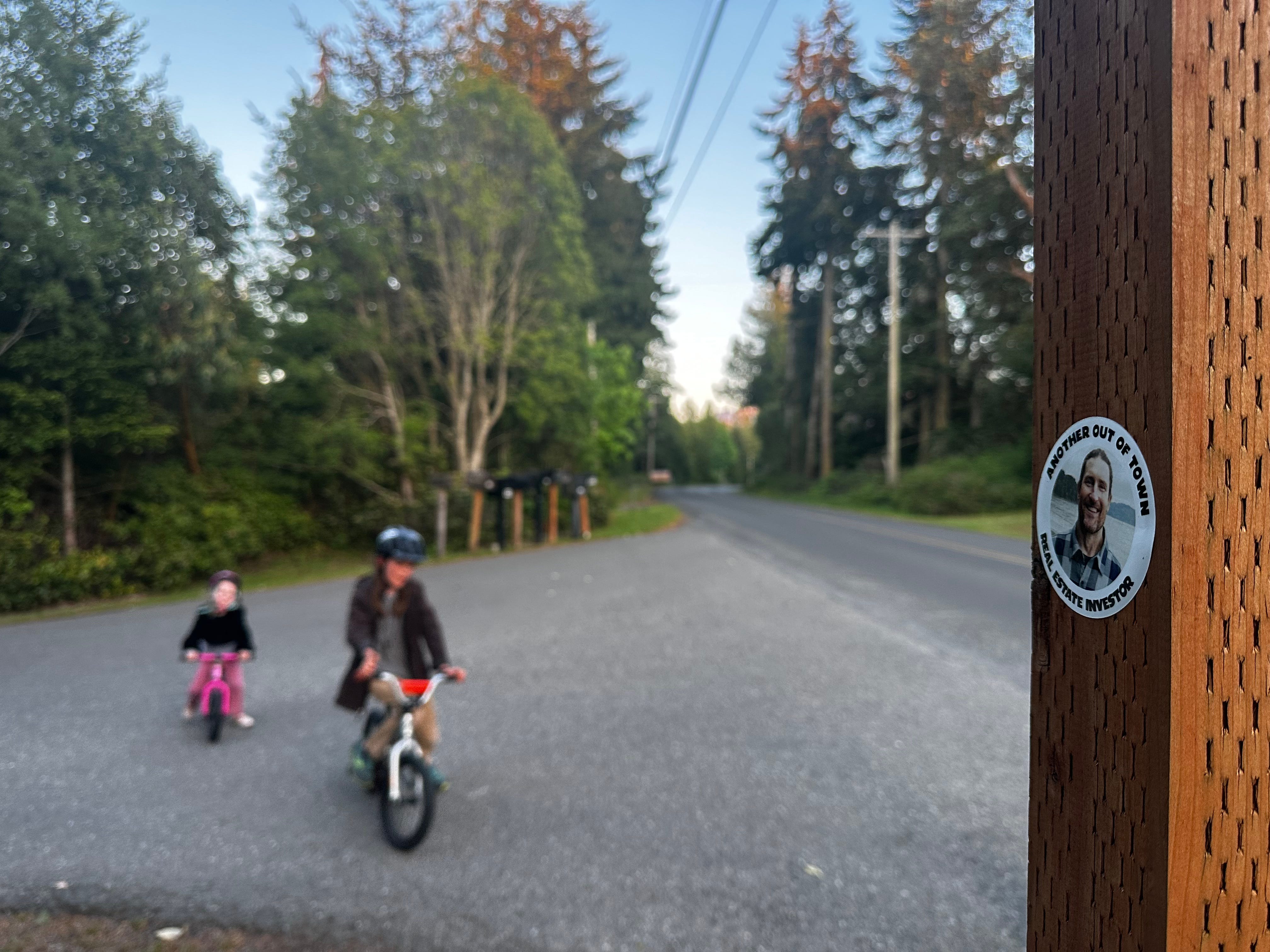
Anti-Jake Seegers activism is escalating beyond policy disagreements and campaign signs. After stickers labeling Seegers a “carpetbagger” and “out of town real estate investor” appeared at the end of his family’s private driveway — where his children discovered them during a bike ride — questions are now being raised about how far local political hostility is willing to go, and whether some activists are more interested in intimidation than honest debate.
Stickers calling county commissioner candidate Jake Seegers a “carpetbagger” and “out of town real estate investor” continue appearing, and not just in downtown Port Angeles.
Most recently, the stickers showed up roughly seven miles away from the downtown core — at the entrance to the Seegers family driveway itself.
The stickers were discovered by three children riding their bicycles to pick up the family’s mail. The children were Jake’s. The stickers had been placed on signs and posts at the entrance to the shared driveway used by several neighboring families.
The message was unmistakable.
This was no longer simply, “We disagree with Jake Seegers politically.”
The message had evolved into something much more personal:
“We know where you live.”
Jake’s middle child summed up the moment in a way only a child can:
“That’s scary… they know where we live.”
That sentence says more about the current state of local politics than perhaps anything else could.
A Campaign That Has Intensified
With just over five months remaining in the race, Seegers’ campaign has clearly entered a new phase.
Jake continues to spend long days meeting with residents, listening to concerns, touring local industries, conducting podcast interviews, writing articles for CC Watchdog, and engaging directly with community members. Jake is putting in 60-hour workweeks while balancing life as a husband, father, volunteer, and friend.


But now that the race has narrowed into a two-person contest, another shift has become apparent.
The attacks have become less about policy and increasingly about the man himself.
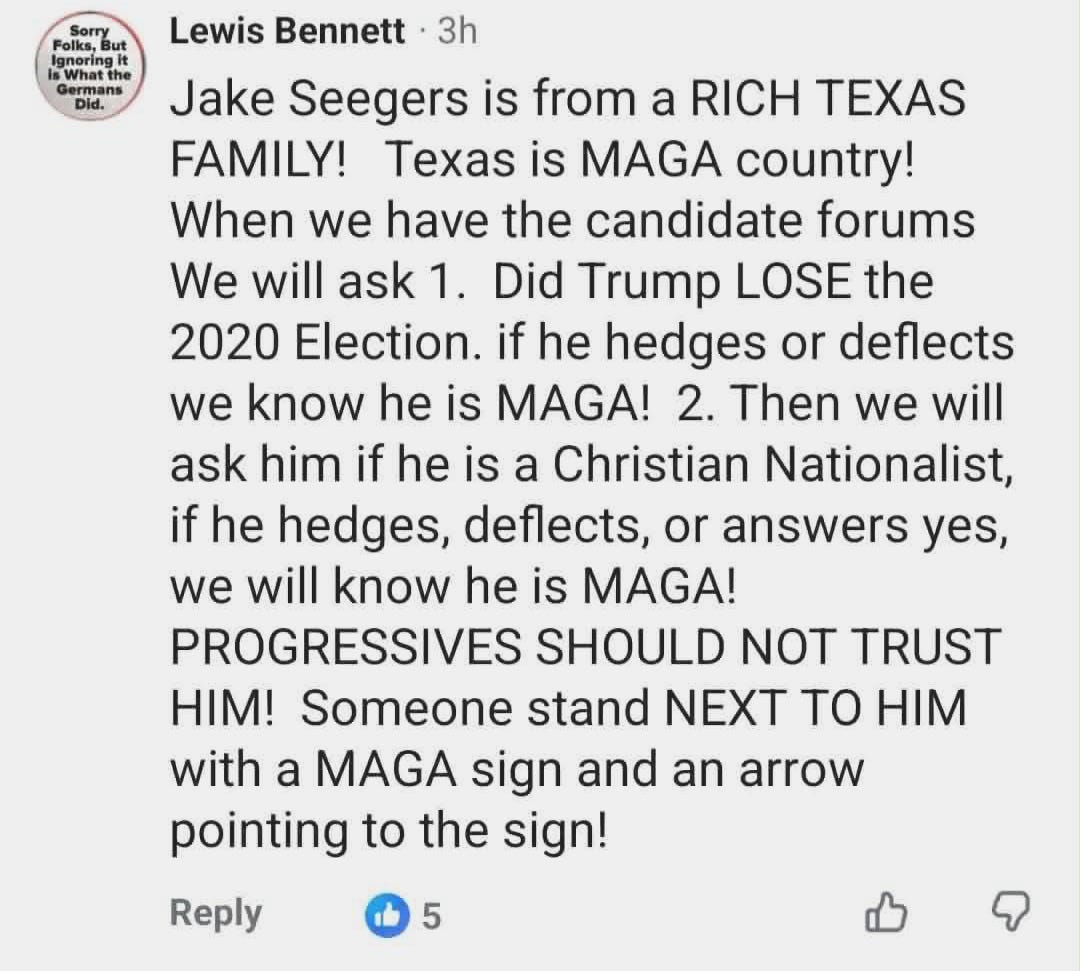
Rather than debating county spending, homelessness, public safety, roads, taxes, or economic development, much of the rhetoric online has turned toward labeling, personal associations, and attempts to portray Seegers as politically radioactive.
Reddit, Rumors, and Anonymous Politics
A lengthy Reddit discussion about Jake Seegers recently gained traction online after one user reposted what they described as “research” into Seegers’ background, finances, family foundation connections, business relationships, and property ownership.

The original post raised questions about transparency, campaign disclosures, out-of-state family associations, grants tied to the Seegers Foundation, Seegers’ involvement with local organizations, and whether certain property ownership interests should have been disclosed in connection with advocacy surrounding Olympic Hot Springs Road.
Some commenters described the research as “great work” and argued that Seegers was not being fully transparent. Others used the thread to speculate about broader political motives, national conservative ties, religion, Project 2025, and alleged “MAGA” associations. One commenter referred to Seegers as a “carpetbagger,” while others mocked his background, family wealth, and even his children.
The thread also highlighted something increasingly common in modern politics: anonymous online activism replacing direct public conversation.
Reddit allows users to operate under anonymous screen names, and discussions can quickly escalate in tone and speculation. In this case, accusations, assumptions, and political labeling rapidly overtook any substantive discussion about county government itself.
What makes the situation notable, however, is that Seegers did not avoid the thread.
Using his own account, Seegers directly responded publicly:
“Thank you for originally raising these legitimate concerns.”
He then expanded an open invitation to anyone involved in the discussion to join him for a recorded podcast interview where they could ask any questions they wanted, on the record, in long-form format, with the entire community able to hear both the questions and the answers in full context.
He wrote:
“Transparency is critical, and this is a way to provide it for everyone interested.”
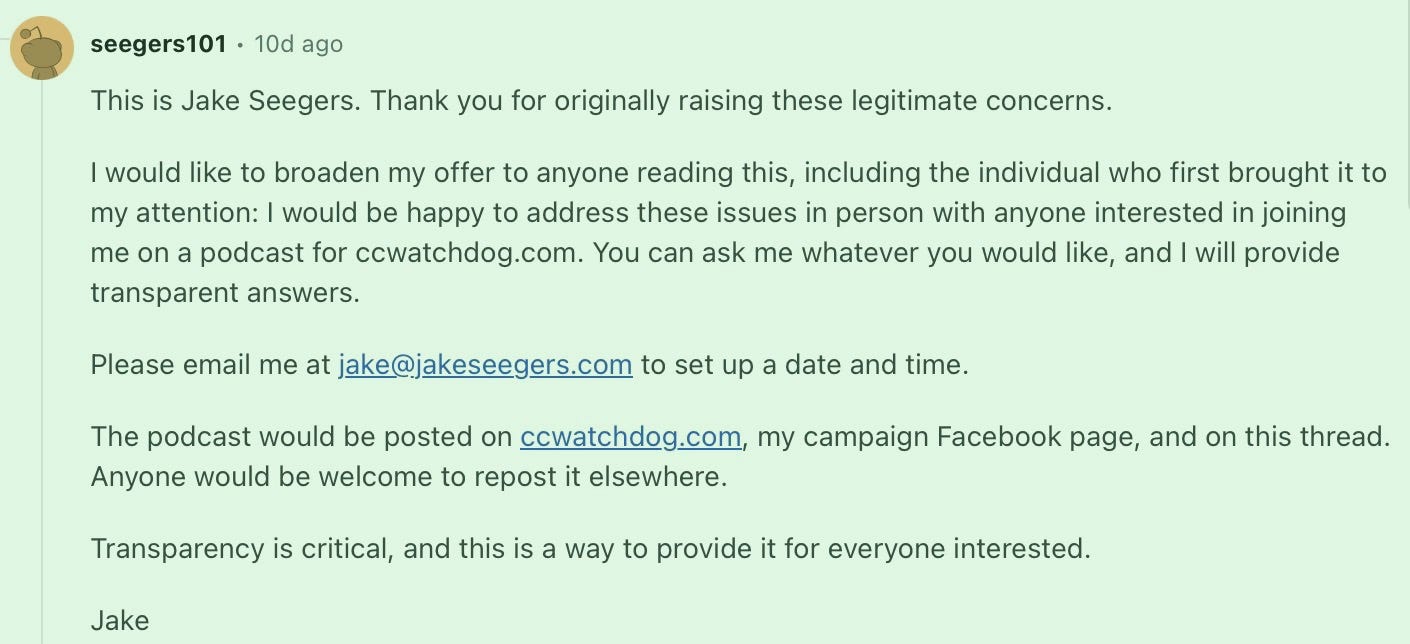

So far, despite the accusations and speculation, no one has accepted the offer.
“FTG”
One particularly telling comment circulating online suggested creating signs that say “FTG” with arrows pointing toward Seegers at public events.
For those unfamiliar with the slang, “FTG” is shorthand for the French phrase Ferme ta gueule, which roughly translates to “shut up” or more bluntly, “shut the f*** up.”
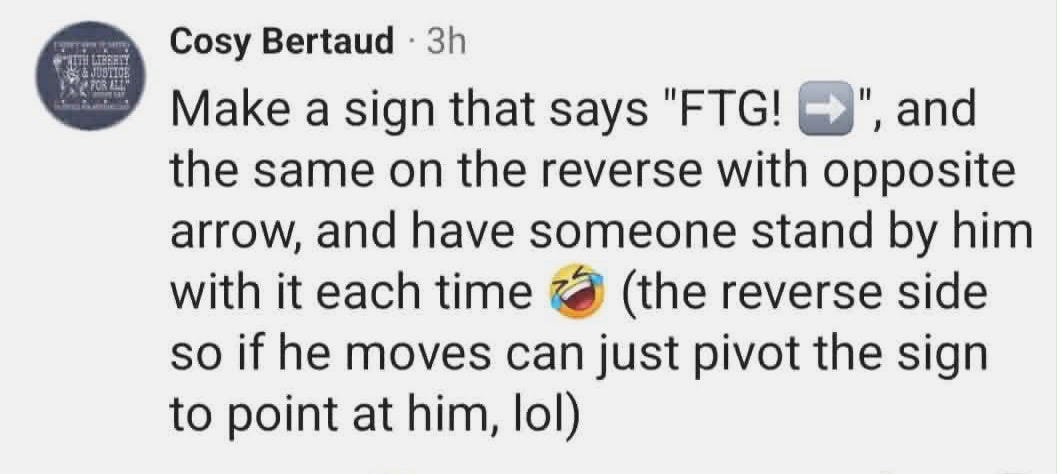
That is the level local political discourse is descending toward.
Not debate.
Not discussion.
Not competing visions for county government.
Just hostility.
From Protest to Intimidation?
There is an important distinction between criticizing a candidate’s policies and attempting to intimidate a candidate personally.
People absolutely have the right to oppose Jake Seegers politically. They have the right to question his ideas, challenge his proposals, disagree with his priorities, and support another candidate.
That is democracy.
But when activists begin placing targeted political messaging at the end of a candidate’s private driveway where his children will encounter it, reasonable people begin asking where the line is.
Especially when online discussions openly discuss following him to events, surrounding him with signs, and confronting him with nationally divisive ideological litmus tests that have little to do with county government.
A Different Response
Ironically, just last week, another incident tested the campaign.
A person was caught on camera removing and destroying one of Jake’s signs. It did not take long for members of the community to identify the individual involved through social media.
The individual later contacted Jake directly and apologized.
Rather than escalating the situation, Jake agreed to meet with the man personally to discuss his concerns and ideas about county government.
Law enforcement contacted Seegers and asked whether he wished to pursue charges related to the sign destruction. He declined.
According to Seegers:
“I asked the Sheriff’s Department not to pursue an investigation or press charges. This person appears to have made a poor decision out of frustration and then personally reached out to apologize. That humility is admirable.
Additionally, it did not seem like a good use of our limited and already strained law enforcement resources.
I look forward to a future conversation with this individual and believe that, like most community members, we can find common ground on local issues.”
That response reflects exactly who Jake Seegers is: approachable, willing to listen, calm under pressure, and genuinely interested in hearing from people even when they disagree with him.
People may disagree with his policies or question his solutions. That is fair game in politics.
But targeting a candidate’s family and sending the message that political opponents are comfortable showing up at the end of his driveway is something entirely different.
And many in the community are beginning to notice the difference.
Today’s Tidbit: A Historic Shift
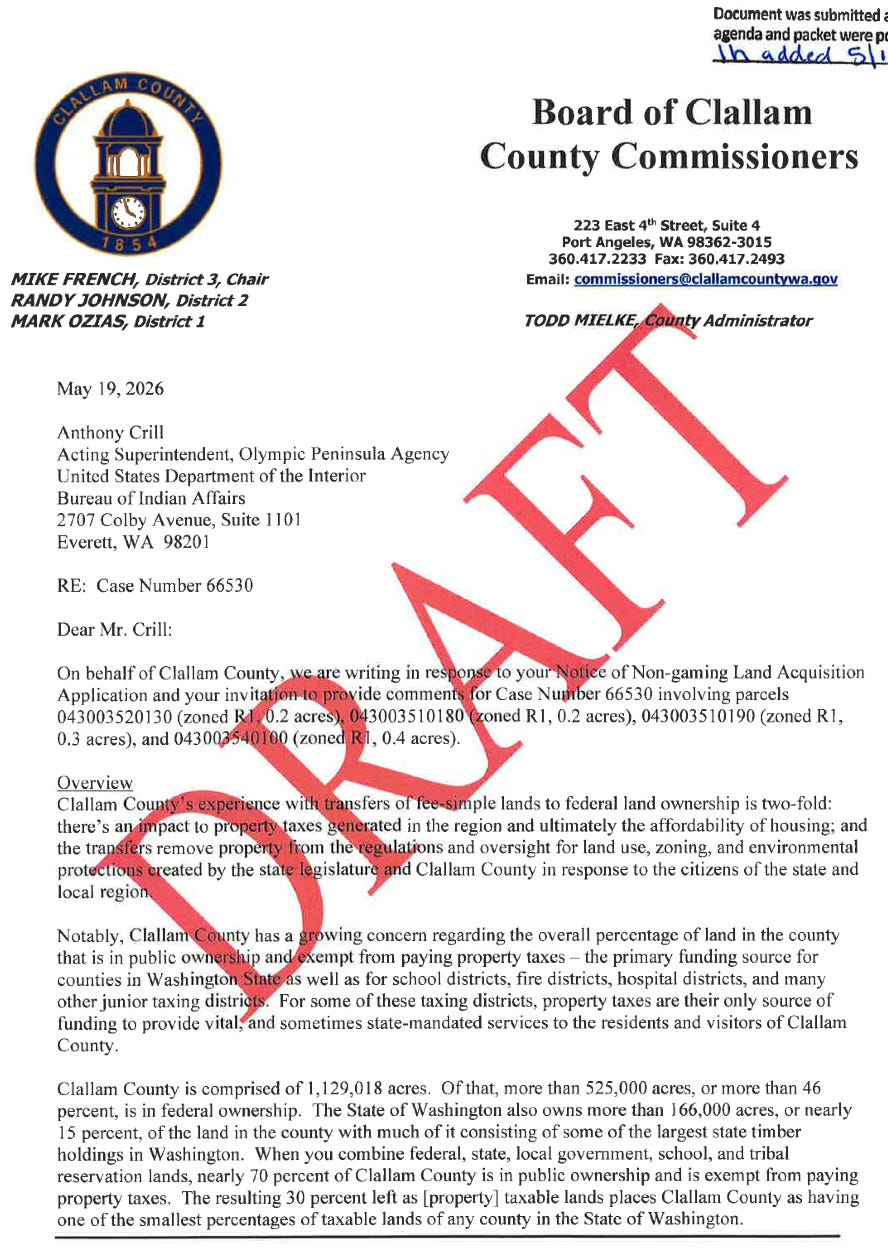
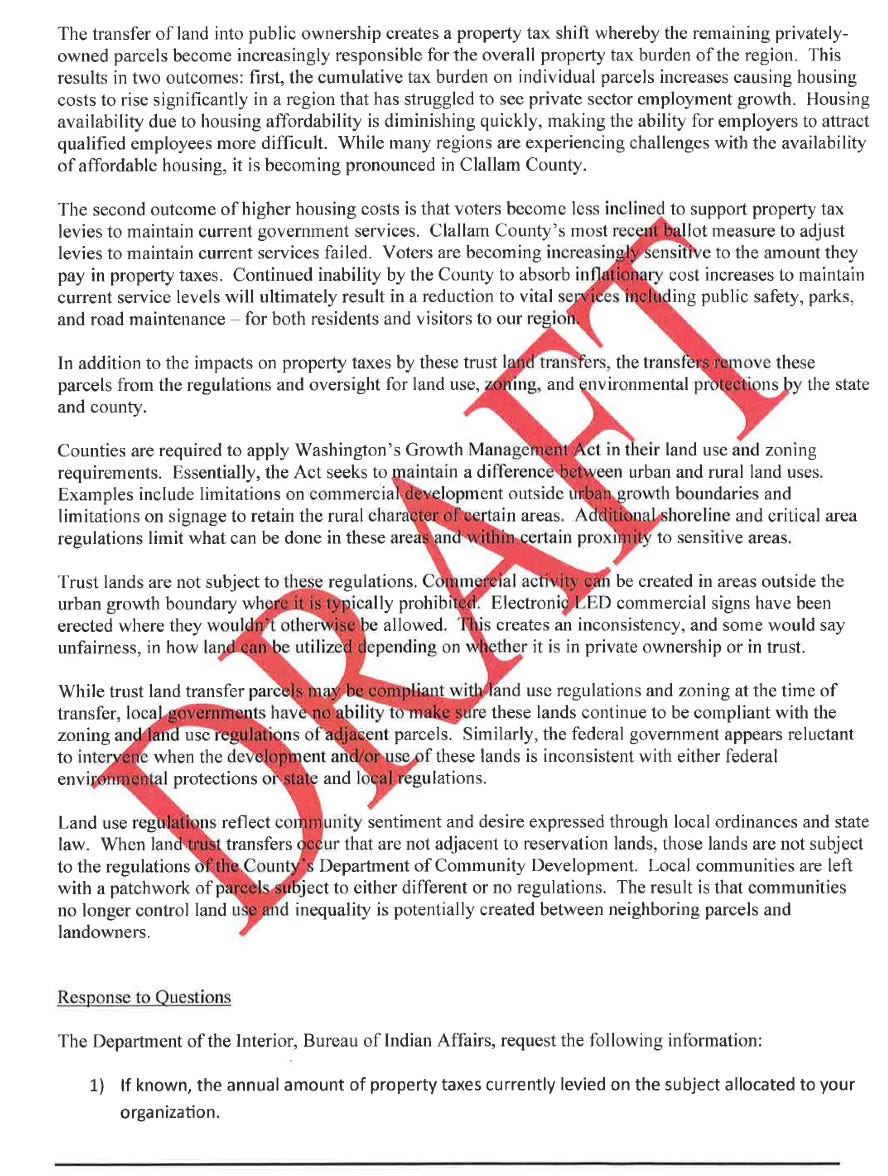
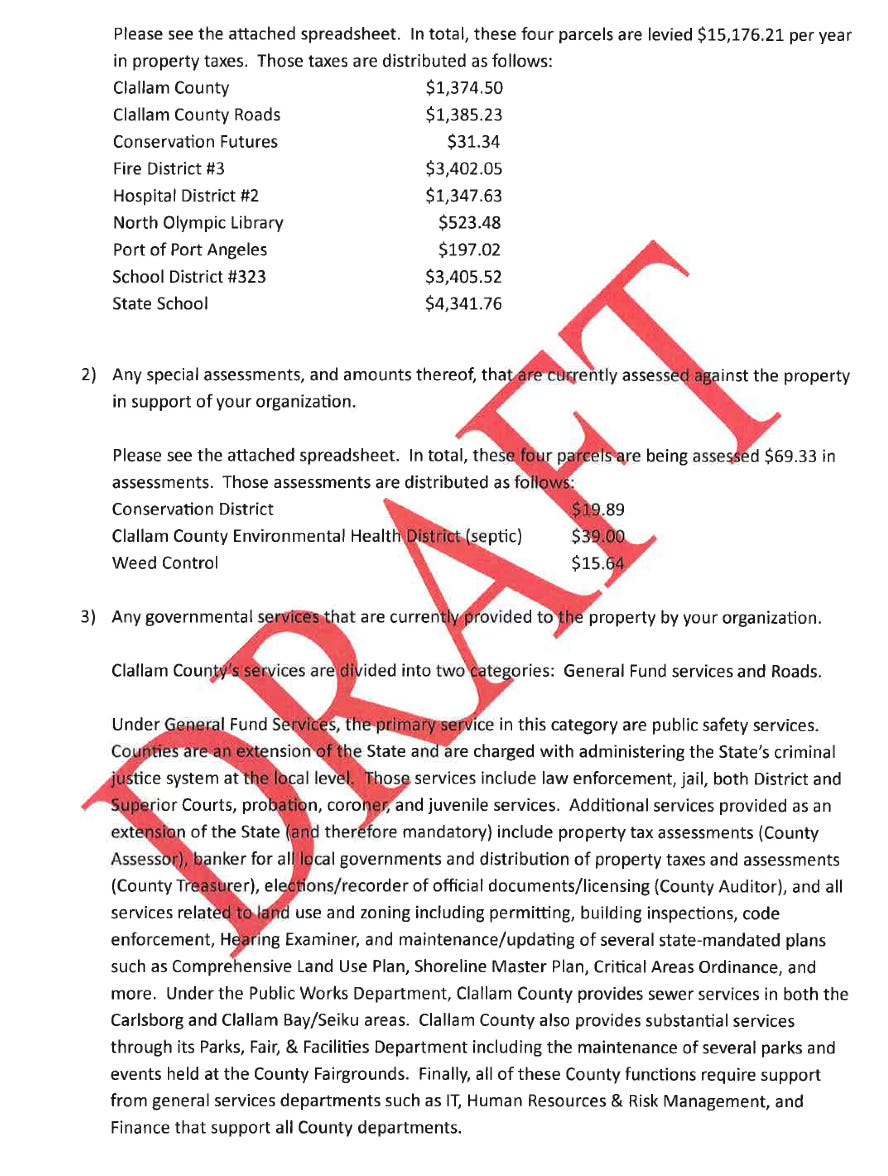
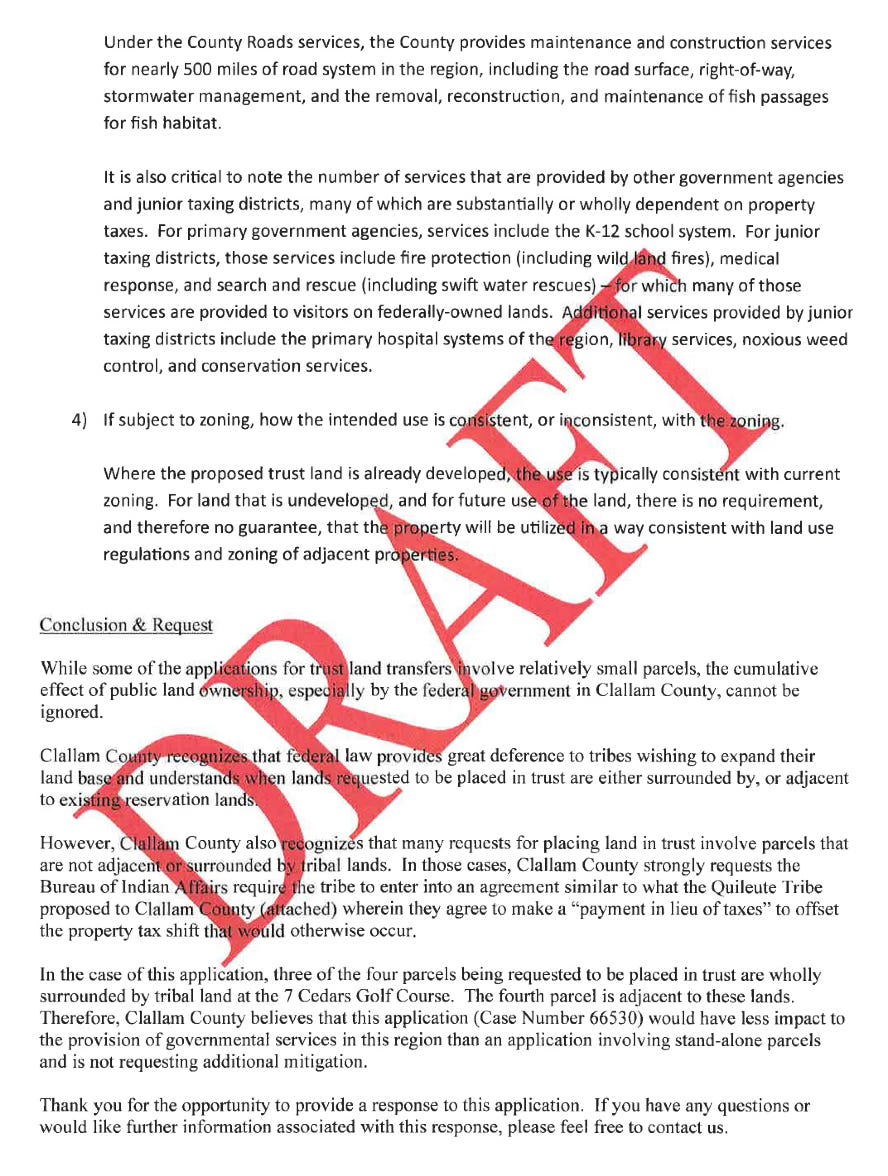
Yesterday, for the first time in more than a decade, the Clallam County Commissioners approved a formal response letter to the Bureau of Indian Affairs regarding a proposed transfer of land into federal tribal trust status.
That did not happen by accident.
It happened because members of the public pushed for it relentlessly for more than two years, refusing to let the issue disappear quietly into bureaucracy and backroom silence. Citizens attended meetings, submitted comments, wrote emails, researched federal processes, and repeatedly asked why Clallam County was not formally responding to trust land applications that directly impact taxation, zoning, land use, and local governance.
This is genuinely historic.
And whether people agree with every word of the letter or not, County Administrator Todd Mielke deserves substantial credit for helping move the county toward finally engaging the issue formally and professionally.
The letter itself is surprisingly direct.
It outlines concerns about the cumulative loss of taxable land in Clallam County, noting that roughly 70 percent of the county is already publicly owned and exempt from property taxes when federal, state, local, and tribal lands are combined. The county warns that continued transfers into trust status shift increasing tax burdens onto remaining private property owners while reducing the land base that funds schools, fire districts, hospitals, libraries, roads, and local government services.
The response also raises concerns about inconsistent zoning oversight once land enters trust status, particularly when parcels are not adjacent to existing reservation lands. The county notes that trust lands are no longer subject to many local land use regulations, potentially creating situations where neighboring properties operate under entirely different rules.
Most notably, the county formally requested that the BIA encourage tribes to enter into agreements similar to the “payment in lieu of taxes” arrangement associated with the Quileute Tribe, recognizing the growing strain placed on local taxpayers and taxing districts.
For years, many residents were told these conversations either could not happen, should not happen, or were inappropriate to discuss publicly.
Now, they are happening in official county correspondence.