


Clallam County property owners were told a new parcel fee was essential to protect clean air, water, and soil. Since then, the Clallam Conservation District has expanded staffing, secured county-approved contracts with premium hourly rates, and now finds itself at the center of a court decision voiding a supervisor election. With another election approaching, the moment has arrived to restore balance, transparency, and election integrity to an organization funded by the public—but increasingly insulated from it.
From volunteer district to taxpayer-funded authority
The Clallam Conservation District (CCD) now receives guaranteed funding through a parcel fee added to property tax statements—approved by the County Commissioners and projected to transfer roughly $2 million from taxpayers over the next decade. Land held in tribal trust is exempt, leaving non-tribal property owners to shoulder the full burden.
The fee was sold as necessary to protect air, water, and soil—essentials of life itself. Yet as the District’s funding has stabilized, its structure has changed rapidly. CCD has grown from an all-volunteer organization into a staffed agency of five paid employees.
That growth accelerated further when the County approved a grant paying CCD to assist the Environmental Health Department with outreach, education, and pollution correction under the Clean Water District’s Pollution Identification and Correction Program.
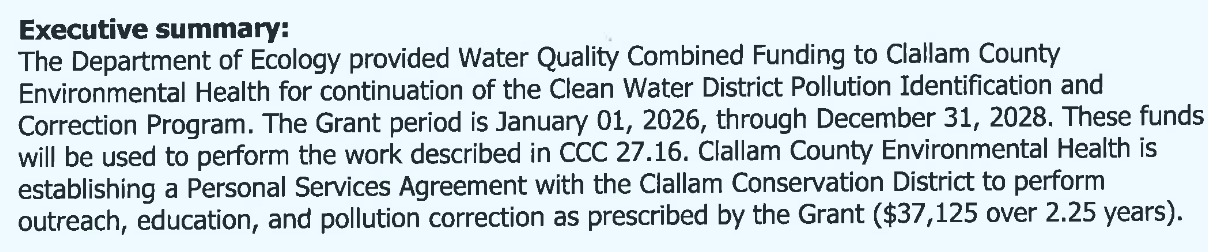
According to approved grant documents, hourly rates billed for this work range from $52.62 to $71.64 per hour—double and, in some cases, triple the average hourly wage in Clallam County. For an organization that recently cited financial strain, the turnaround has been swift and lucrative.
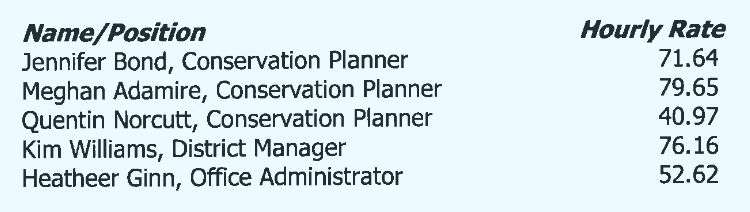
The public question is unavoidable: are taxpayers funding conservation outcomes—or underwriting an organization’s expansion and wage structure?
A court voids the Conservation District election
On December 12, 2025, Thurston County Superior Court Judge Christine Schaller voided the results of the March 19, 2024 Clallam Conservation District supervisor election.
The ruling followed a final administrative review hearing in Shogren v. State Conservation Commission, brought by Clallam County elector Virginia Shogren, who represented herself. The State Conservation Commission was represented by the Attorney General’s Office.
The Court found that the election process violated administrative code and that the State Conservation Commission failed to follow its own procedures when reviewing Shogren’s election challenge.
Specifically, the election allowed approximately 17 days of in-person “walk-in” voting after the absentee ballot request deadline, followed by a seven-hour poll site on Election Day. That hybrid process was not authorized under the applicable rules.
The Court also rejected the Commission’s claim that Shogren lacked standing, affirming that electors have the right to challenge elections that are not administered fairly or lawfully. The Court emphasized that every election matters, and that voters are prejudiced when procedures deviate from the law.
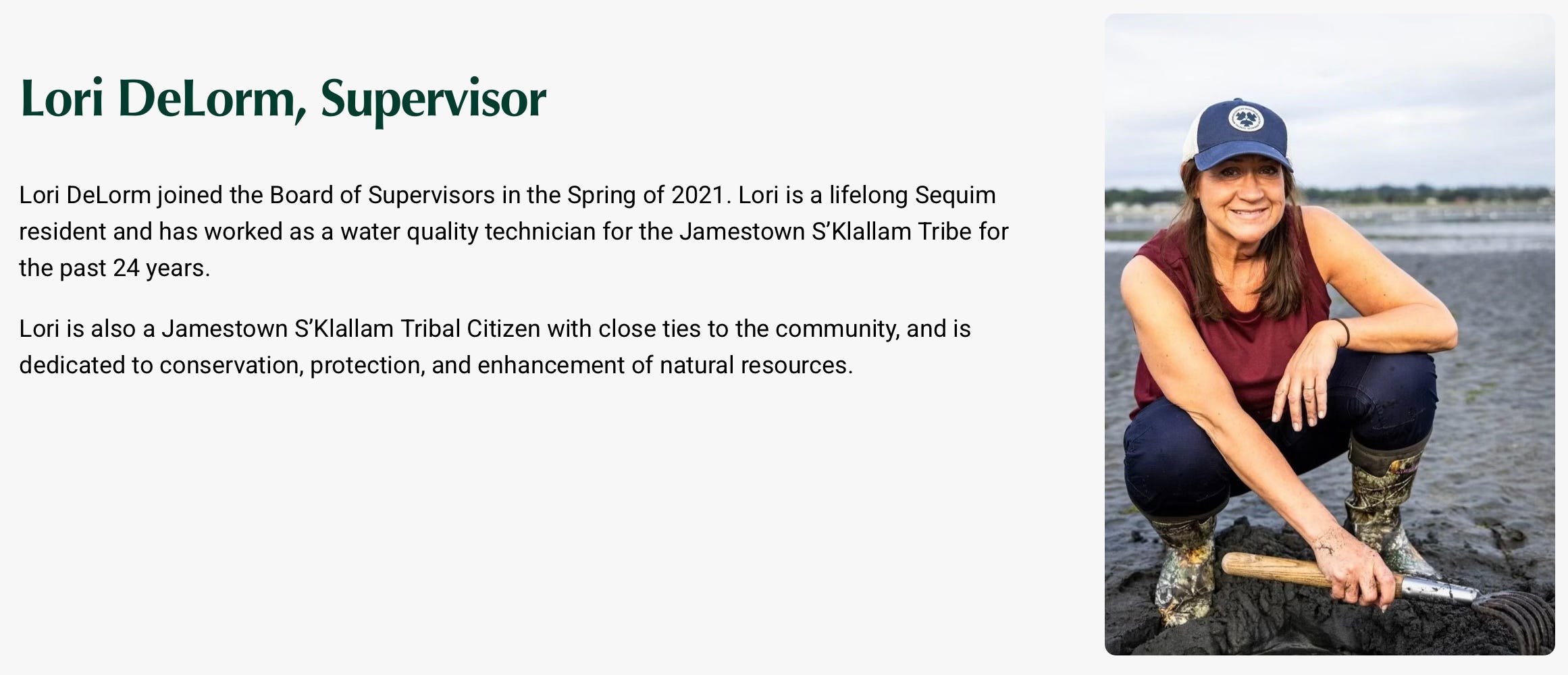
As a result of the ruling, the supervisor position held by Lori DeLorme is now vacant.
The problem isn’t participation—it’s preference
During the disputed election period, the CCD district manager publicly stated, “We want conservation-minded folks to vote.”
Every registered voter in Clallam County was eligible to vote in the election. Government election administrators are expected to encourage broad participation, not imply that certain viewpoints are more welcome than others.
That concern deepened when CCD Supervisor Ben Smith, who also serves on the Dungeness River Management Team, encouraged participation while explicitly promoting Lori DeLorm’s stance on irrigation-ditch piping projects—projects strongly supported by the Jamestown S’Klallam Tribe.
“I would encourage folks to participate in the Conservation District elections and Lori DeLorme is the only candidate who is in support of piping projects, so I think that’s a very critical point, and I think that your participation would be appreciated and it’s important to keep these piping projects going.” — CCD Supervisor Ben Smith at a public DRMT meeting
That same piping approach has drawn warnings from the U.S. Geological Survey, which cautioned that piping historic irrigation ditches could place hundreds of wells at risk of going dry.
When elected officials sitting on multiple boards promote candidates based on alignment with contested policies—while running elections internally—the line between governance and advocacy blurs.
Accountability matters more when tax authority exists
The Conservation District now operates with:
Guaranteed parcel-fee revenue
County-funded contracts
Premium hourly billing rates
Internal control over its own elections
Hybrid meetings, but they are unrecorded
With that power comes responsibility. Public agencies that demand compliance from taxpayers must hold themselves to higher, not lower, standards of transparency, neutrality, and procedural rigor.
When election procedures are improvised, records are incomplete, and advocacy appears to outweigh neutrality, public trust erodes—regardless of how worthy the mission may be.
A chance to restore balance: the March 17 election
The Clallam Conservation District Board of Supervisors will hold a mail-in election on March 17 to fill a supervisor position currently held by Wendy Rae Johnson, whose seat opens in May.
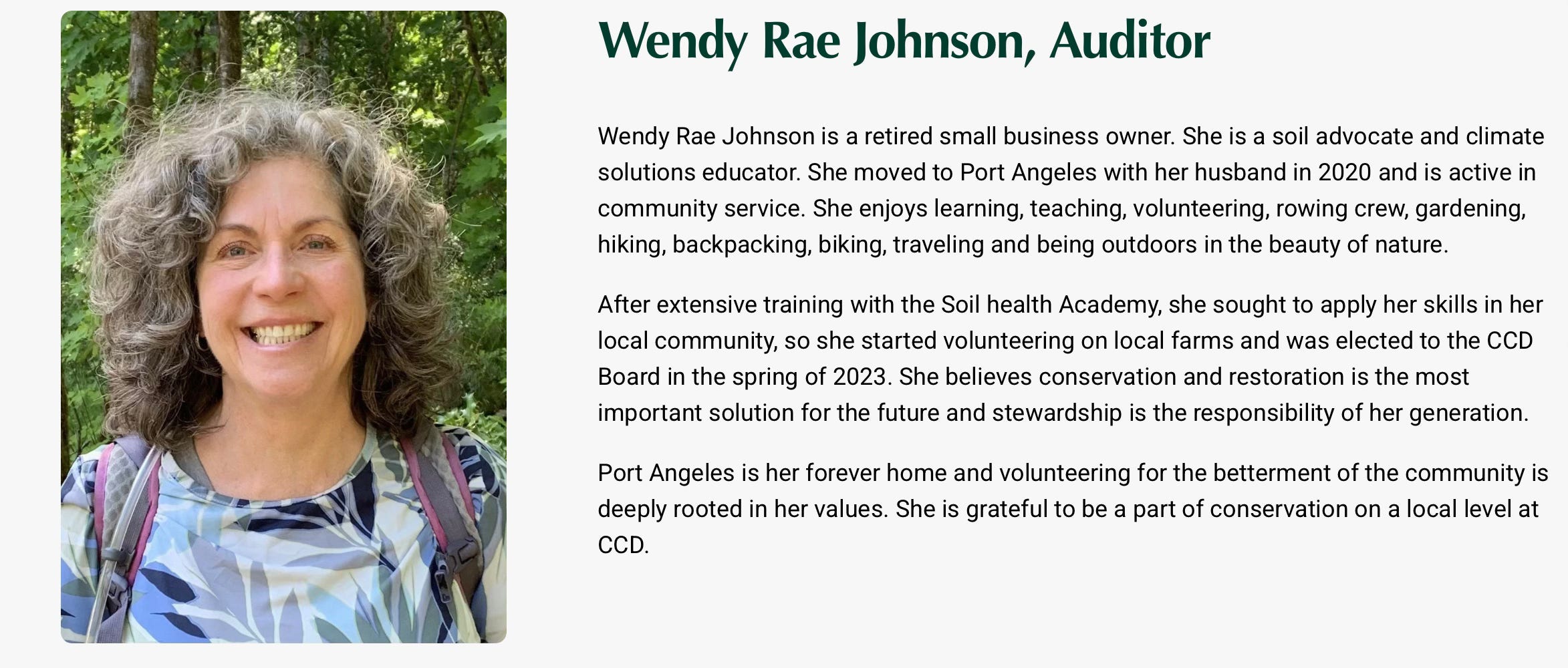
Johnson, who describes herself as a “soil advocate” and has participated in activist protests, has publicly expressed concern that “Mr. Tozzer will get this out to his angry mob,” citing that claim as justification for pushing for a formal code of conduct at meetings. Notably, CC Watchdog editor Jeff Tozzer has never met Wendy Rae Johnson.
Supervisors serve three-year terms without compensation and set policy and direction for the District.
Key details:
Candidate filing deadline: 4 p.m., February 9
Eligible voters: registered Clallam County voters
Ballots must be requested from the District (not the County Auditor)
Election supervised by District Manager Kim Williams
Ballot request deadline: February 13
Ballots due by 4 p.m., March 17
This election is more than a formality. It is an opportunity to correct course.
Solutions
If the Conservation District and County Commissioners want public confidence—not just continued funding—several reforms are essential:
Independent election oversight
Elections should be administered or monitored by a neutral third party to eliminate conflicts of interest.Strict adherence to noticed procedures
No ad-hoc voting methods. No informal extensions. If changes are needed, re-notice the election.Public ballot accounting and chain-of-custody reporting
Publish ballots issued, received, counted, and rejected—with explanations.Clear neutrality rules for staff and supervisors
Election administrators and sitting supervisors should not advocate for candidates or outcomes.Performance-based funding transparency
If CCD is billing premium rates, taxpayers deserve clear metrics tying dollars spent to outcomes achieved.
Call to action
Clallam County residents who want conservation guided by science, law, and public accountability—not politics or special interests—should act now.
Write the Clallam Conservation District Board of Supervisors
Ask how election integrity will be ensured in March and what safeguards are now in place. Board members may be contacted via email at info@clallamcd.org.Write the Clallam County Board of Commissioners
Request a public review of CCD funding, wage structures, election oversight, and measurable performance outcomes. All three commissioners can be reached by emailing the Clerk of the Board at loni.gores@clallamcountywa.gov.
An organization with taxing power must earn legitimacy every day—not assume it. The March 17 election is a test of whether the Clallam Conservation District is willing to do exactly that.
Download court documents below.


