
From a Montana offender now cycling through Clallam County’s public systems, to repeated “catch and release” jail bookings, to major policy discussions on homelessness, race-based enrollment rules, and decisions affecting land use, education, and public access to elected officials—this week’s developments raise one fundamental question: Are public interests being placed second to politics, ideology, or convenience?
Sergey Kubai and the incentives that bring offenders here
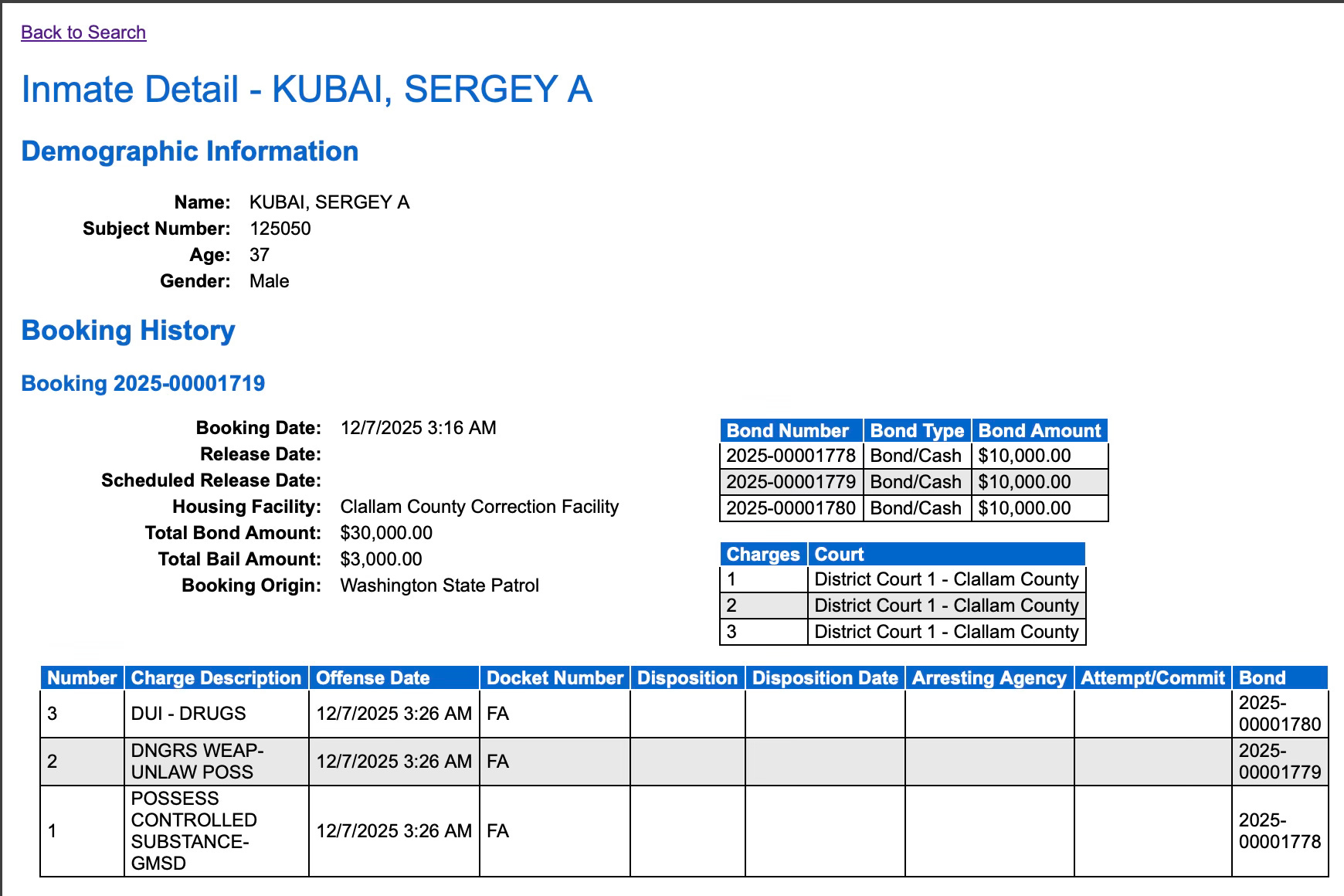
On Sunday, 37-year-old Sergey A. Kubai was booked into Clallam County Jail for DUI-drugs, unlawful possession of a dangerous weapon, and possession of a controlled substance. His name may be new to Clallam County, but his history is not new to law enforcement—particularly in Montana.
In 2010, a Daily Inter Lake article reported that Kalispell officers responded to a disturbance where several individuals were holding Kubai down as he screamed and threatened to kill them. After being handcuffed, he allegedly head-butted a police officer. The incident began with an argument with his girlfriend; when his brother tried to intervene, Kubai reportedly brandished a knife and threatened to stab him. During transport, he repeatedly slammed his head into the divider and threatened to kill officers and their families. He was charged with felony assault on a peace officer and assault with a weapon, with potential sentences totaling 30 years.
By 2017, Kubai was back in the system—this time pleading guilty to two felony counts of distributing dangerous drugs after selling heroin to a confidential informant. Additional charges were dropped as part of a plea deal.
The Montana Parole Board’s public records further document repeated supervision concerns. Conditions included strict bans on drugs and alcohol, mandatory mental health and chemical dependency aftercare, employment restrictions, and the highest level of supervision. In one case, parole “commencement was denied” altogether.



Given that record, it is not difficult to understand why Kubai might have drifted toward Clallam County, where—compared to other jurisdictions—the barriers to entry are low, the enforcement is inconsistent, and the services are generous. Free transportation, free food, permissive public camping, and publicly funded harm-reduction supplies create an environment where high-needs individuals can survive with minimal accountability.
No community can prevent every arrival. But a county’s policies shape its reputation. And right now, Clallam County’s permissive conditions send a message—intended or not—that this is a place where repeat offenders can get by with fewer consequences and more subsidies than almost anywhere else in the region.
The cycle continues: Labaran Kourtney Mohammed in jail again
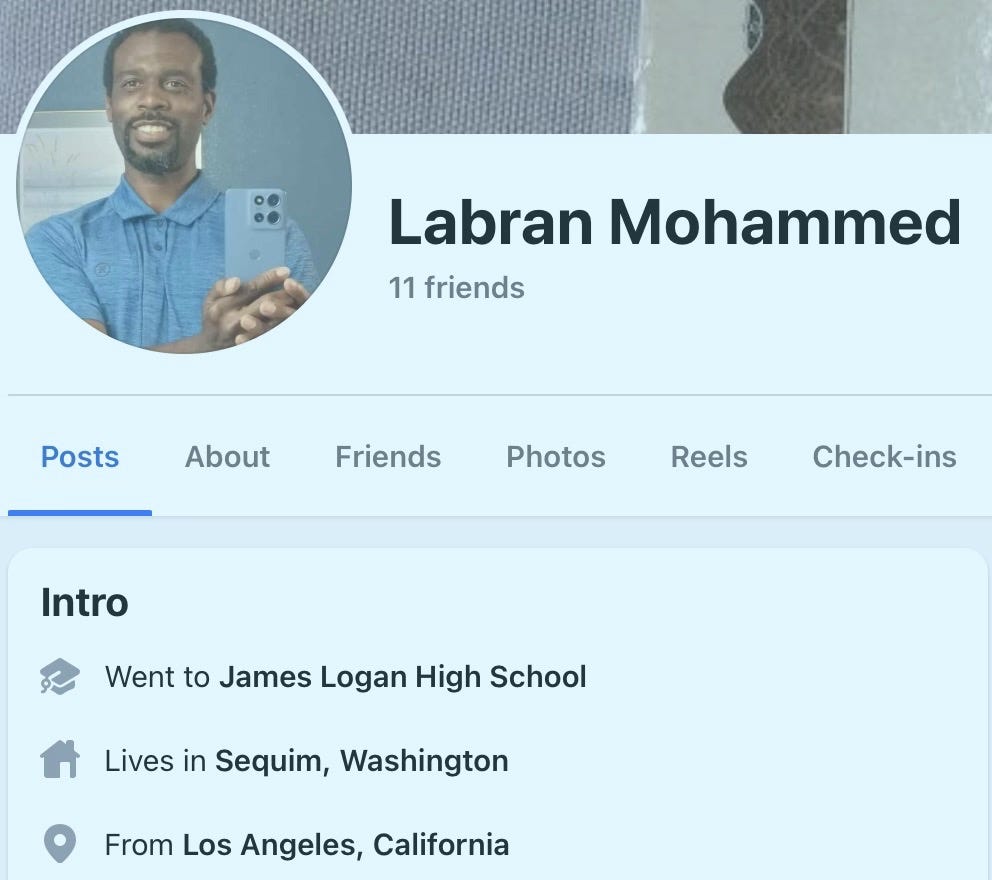
Labaran Kourtney Mohammed—previously covered by CC Watchdog for arriving from the Los Angeles area and repeatedly cycling in and out of Clallam County Jail on drug-related charges—is once again in custody. This time, it’s DUI-drugs.
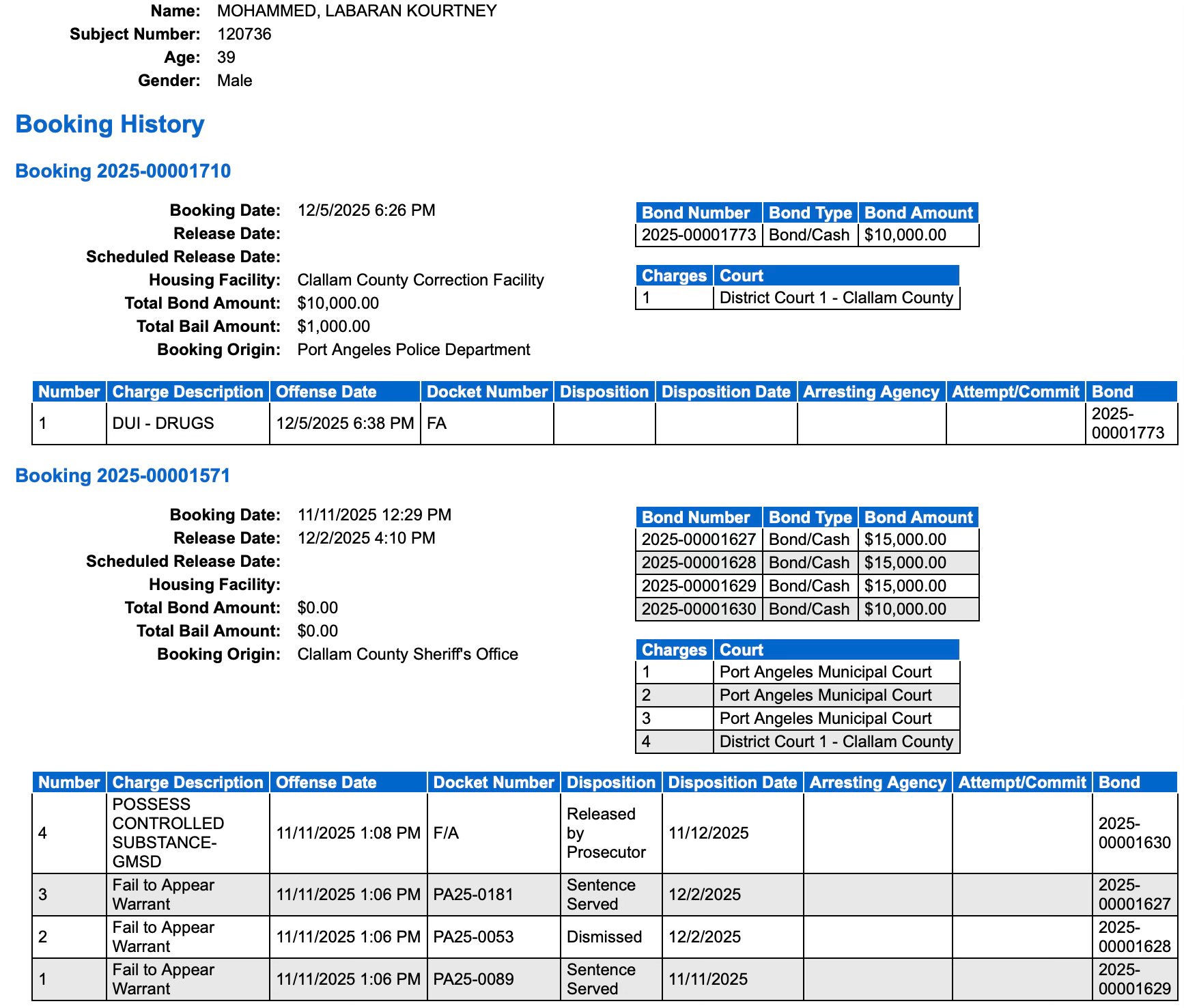
His booking record since November paints a clear picture: arrested November 11th for possession of a controlled substance and a warrant-based failure to appear; released December 2nd; re-booked just three days later on the DUI.
Each arrest requires medical evaluations, court time, transport, screening, and staffing. And each release places him right back into the environment that produced the arrest in the first place.
Residents are regularly told that our county struggles to attract professionals due to aging schools or an overburdened hospital. But business owners and families also consider public safety, and many hesitate to invest or relocate to areas where visibly impaired individuals are cycling between the streets and the jail more quickly than motel check-ins.
This is not about being punitive. It’s about recognizing the cost of a system that protects neither the public nor the individuals stuck in an endless loop of untreated addiction.
Homelessness, drug use, and a public health narrative at odds with reality
Dr. Allison Berry, Public Health Officer for Clallam and Jefferson Counties, recently addressed “misunderstandings” about homelessness in an interview with the Peninsula Daily News.

She stated that only one in five unhoused residents has a substance-use disorder, and that drug use is more often a result of homelessness than a cause. She added that homeless youth frequently turn to meth because it keeps them warm and awake—needs she believes should be met by bringing them indoors.
But residents observing the streets of Port Angeles and Sequim see something very different. The county-operated harm-reduction program—distributing needles, pipes, and “boofing kits”—has reported a 450% increase in utilization within two years. Public spaces include individuals shouting at the sky, responding to imaginary threats, or visibly in psychosis. Calling this “20% of the homeless population” strains credibility.
Drug use fundamentally alters brain chemistry and worsens underlying mental health conditions, including schizophrenia. And many families—including those in Clallam County—have watched addiction lead directly to homelessness, job loss, and child removal. A stable housing situation does not immunize someone from drug-driven collapse.
Dr. Berry’s salary—estimated at $171,000, one of the highest in county government—comes with great responsibility. And residents are not wrong to question whether a narrative that minimizes addiction’s role in homelessness may be contributing to policies that fail to address root causes.

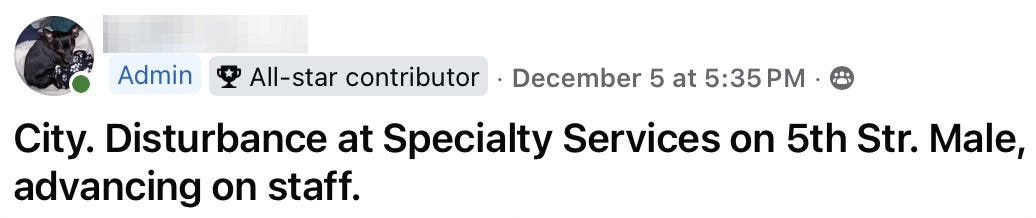
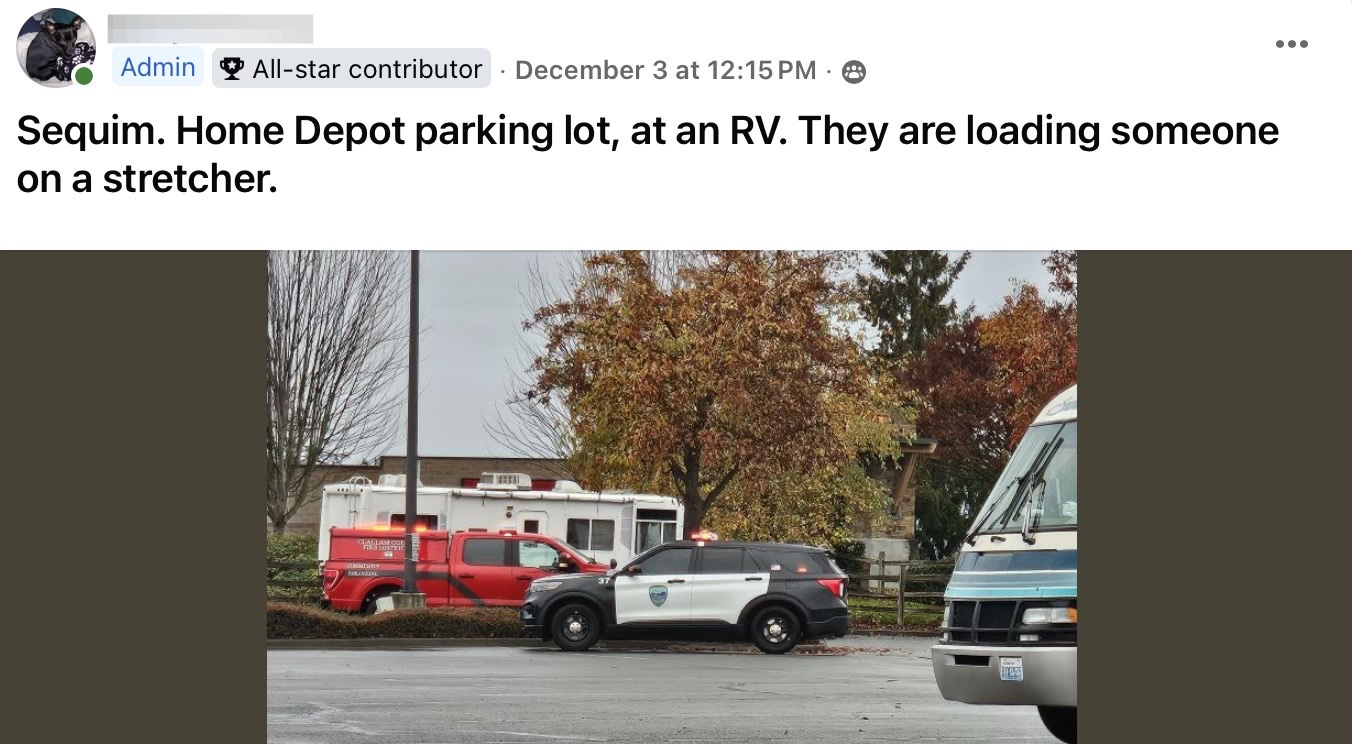
Are we really seeing only “1 in 5”?
A sampling of the Clallam County Scanner Report Facebook page over one week.







Crow Nation and a warning about race-based enrollment rules
A recent Associated Press story highlights the Crow Tribe’s proposal to “reset the clock” on blood quantum—a federally imposed system that measures tribal membership by fractional ancestry. Crow leadership is considering reclassifying all current members as having 100% Crow blood, dramatically expanding future eligibility.
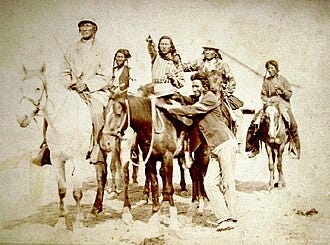
Blood quantum rules remain controversial nationwide. They determine access to health care, scholarships, voting rights, and land inheritance. But they also create a race-based membership threshold that excludes descendants who fall below an arbitrary line.
As tribes—including those in Clallam County—continue to intermarry with non-tribal residents (sometimes referred to as “Colonizers”), blood quantum numbers naturally decline. The Crow Tribe’s debate raises questions that may arrive in our region too: who is considered a tribal member, who receives benefits, and whether policies that sort people by ancestry can remain sustainable—or equitable—in an increasingly blended community.
The issue is deeply sensitive. But it is also important. When government benefits and political authority hinge on ancestry fractions, the line between cultural preservation and racial exclusion becomes thin—and deserves careful public discussion.
“I’m a Communist” and why Conservation Futures matters
At a recent Conservation Futures Program Advisory Board meeting, County Commissioner Randy Johnson made a remark that caught attention: “I’m a communist, so you have to start with that part.”

He later clarified he was referencing an insult someone else had directed at him, and that neither “communist” nor “fascist” is accurate.
The explanation makes sense — But the board he addressed handles serious responsibilities. Conservation Futures uses property taxes to acquire and preserve land, often transferring parcels into nonprofit stewardship and off the tax rolls. These decisions can improve habitat and public access, but they also shift the tax burden onto fewer remaining payers.
The board will be taking new member applications next year. For residents concerned about taxation, land use, or accountability, participation is one of the most effective ways to influence policy directly. The county has made the application publicly available and encourages civic involvement. Click here and lead your county.
A fresh voice on Nextdoor—and why it matters
Nextdoor.com is not known for gentle debate, and one resident—Stacey—walked directly into its ideological crossfire by asking if anyone reads Clallam County Watchdog. The response was harsh enough that she did her own research and concluded that the blog presents factual information, regardless of political leanings. She described herself as someone who tends to be left but values transparency and direct information.
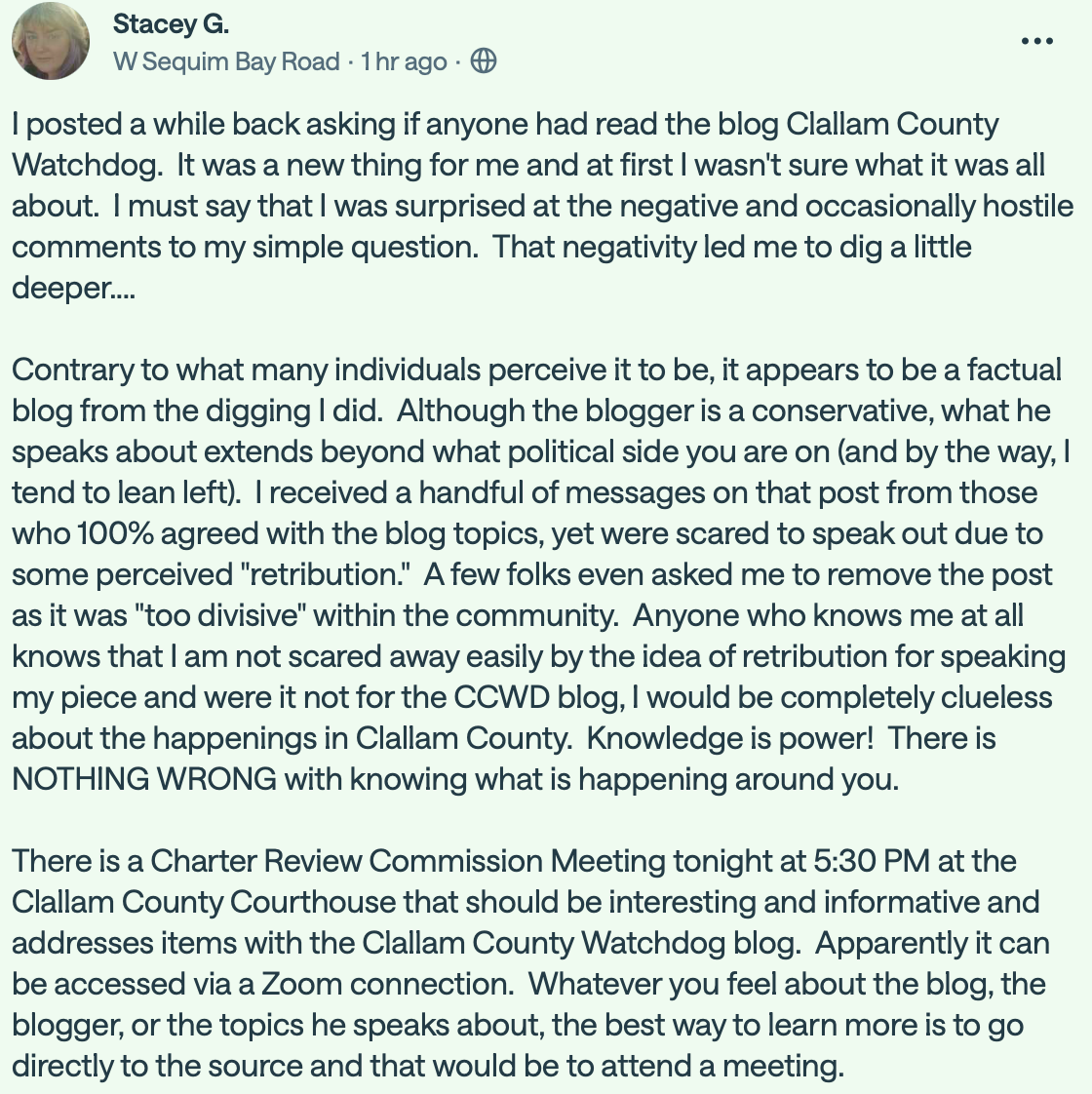
Her post went viral, and several residents privately agreed with her but said they feared social retaliation for saying so publicly. Stacey refused to remove her post, stating, “Knowledge is power.” She even encouraged others to attend public meetings, including the Charter Review Commission.
Her message is simple: residents shouldn’t be afraid to discuss local government. In a climate where disagreement is treated as extremism, her willingness to speak openly—and her refusal to back down—is a reminder that civic engagement requires courage, not conformity.
Magic School AI and who is teaching the teachers
The Olympic Educational Service District (OESD) provides regional support to school districts and tribal compact schools. Its mission is to advance student achievement. Recently, OESD began promoting a course on Magic School AI, marketed as a tool to streamline lesson planning, feedback, rubrics, assessments, and even classroom humor.

Washington already pays some of the highest educator salaries in the country, while academic outcomes remain middling. The growing reliance on AI to generate curriculum raises concerns about quality, educational tools, and whether automation is replacing professional expertise rather than enhancing it.
Also notable is that Jim Stoffer—the only Charter Review Commissioner to request and receive private taxpayer-funded security, and a former Sequim School Board director who resigned amid controversy—sits on OESD’s Board of Directors.
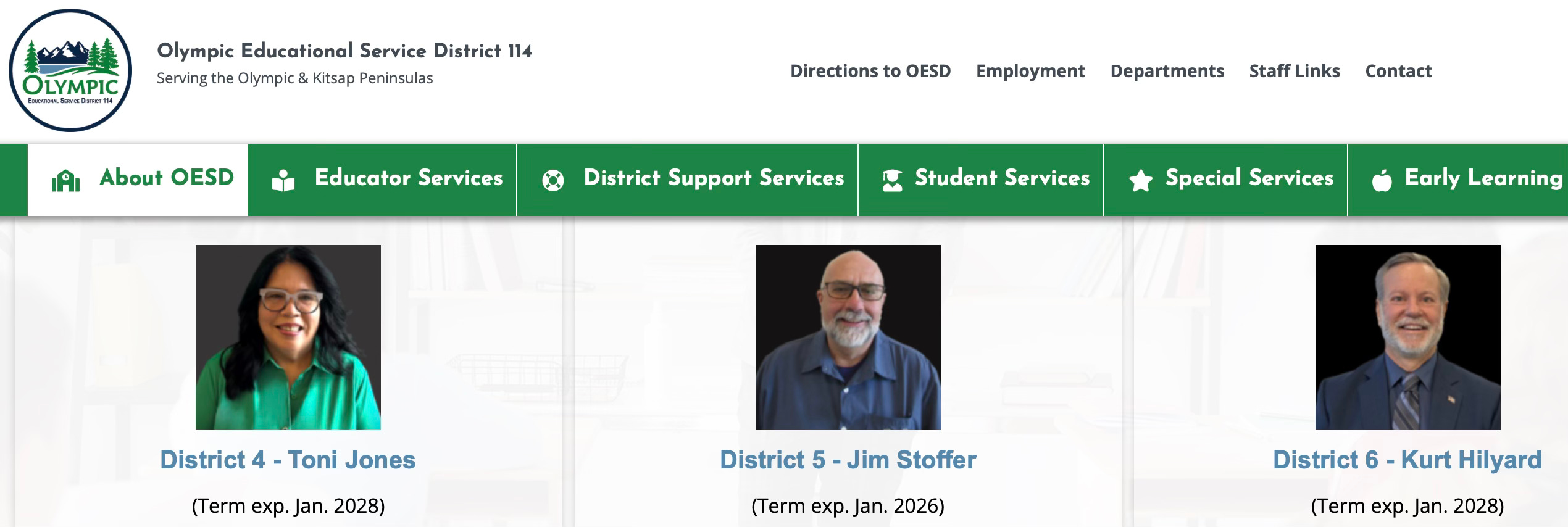
Given his documented history of sharing confidential information, his role in shaping regional education policy understandably draws scrutiny.
Sequim’s latest proclamation and some important context
The Sequim City Council issued a proclamation honoring Councilor Vicki Lowe, praising her advocacy for inclusivity, marginalized communities, tribal partnerships, and human services. The proclamation highlights integrity, compassion, and bridge-building.
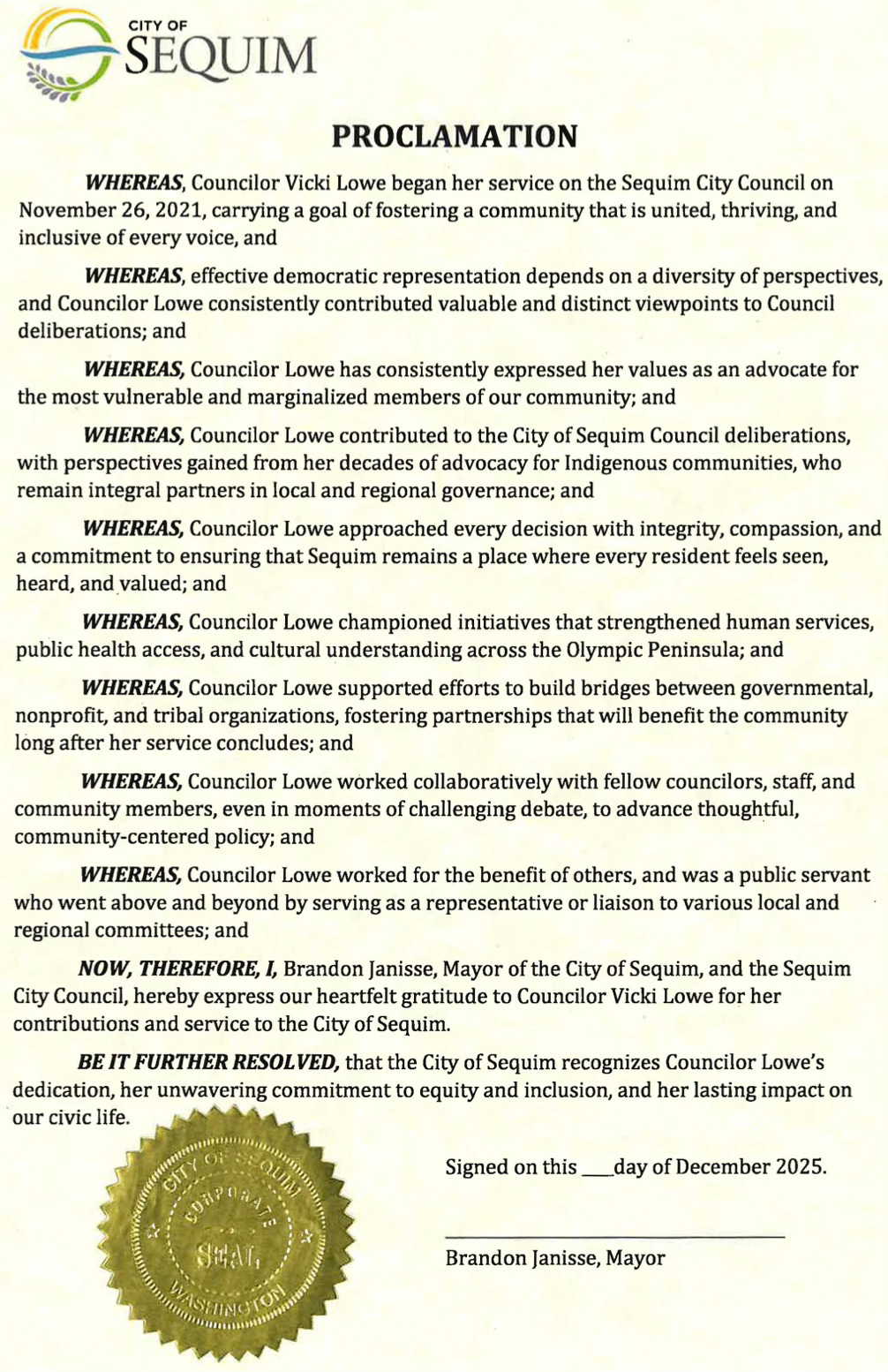
But context matters. Lowe previously stated that the phrase “high quality” is a “dog whistle for white people”—a comment widely criticized as being blatantly racist. She also maintained close communication with community activist Dale Jarvis, founder of the Sequim Good Governance League, who attempted to influence Sequim City Council decision-making through a process that wasn’t exactly “democratic representation.”
None of this negates Lowe’s positive contributions. But when a proclamation omits entire chapters of a public official’s record, the public receives a story that is incomplete—and less useful for evaluating leadership.
Commissioner Forums: Available when they want you, canceled when you want them
The County Commissioners launched monthly “Commissioner Forums” as the public’s only opportunity to ask questions directly and receive answers. The timing coincided with their push to have voters voluntarily raise property taxes.
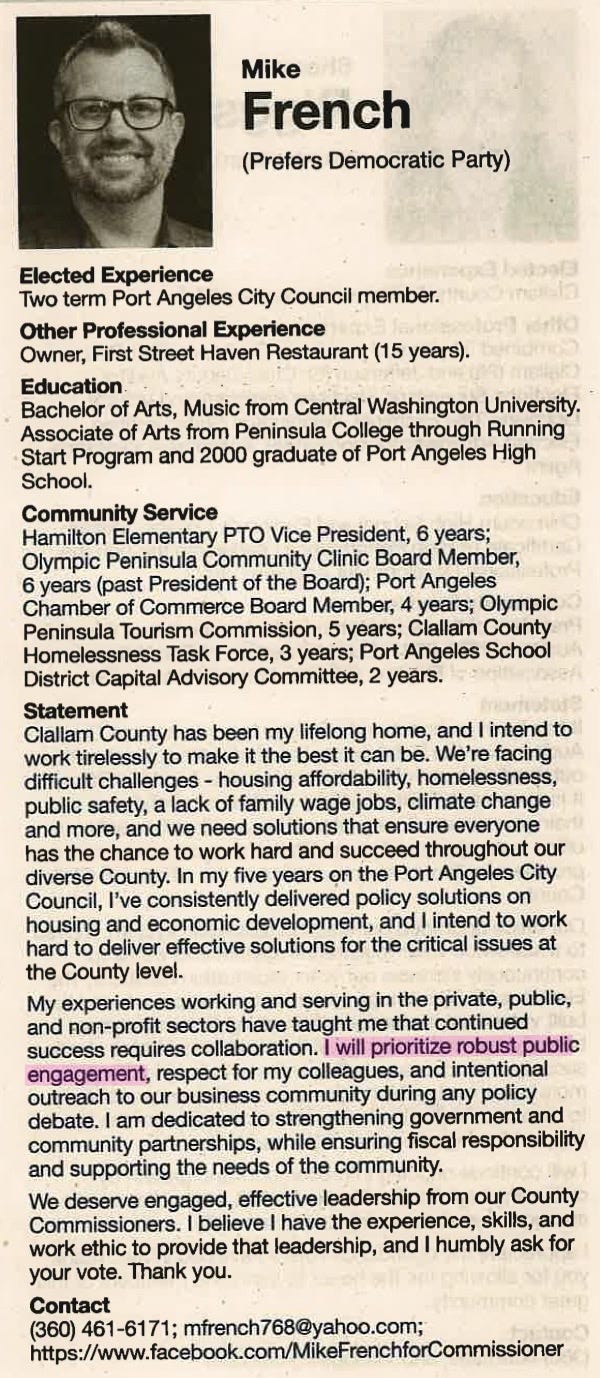
After the levy failed, November’s forum was canceled. The official explanation: too many hearings on the schedule. When residents who attended specifically to engage asked whether a makeup session would be offered, Board Chair Mike French said no.
The contrast is clear. When commissioners want public support, there is always time for a forum. When the public wants answers, there isn’t. Access to elected officials should not depend on whether the public is being asked for money.