
Indivisible invited Jake Seegers to complete their questionnaire and explicitly promised to publish his responses to help voters decide. Seegers submitted thoughtful answers before the deadline and received confirmation that they were received. Instead, the group published glowing coverage and answers for Mike French while attacking Seegers — and never posted his responses. By breaking their own commitment, Indivisible has sabotaged itself and forfeited any claim to fairness in future election cycles.
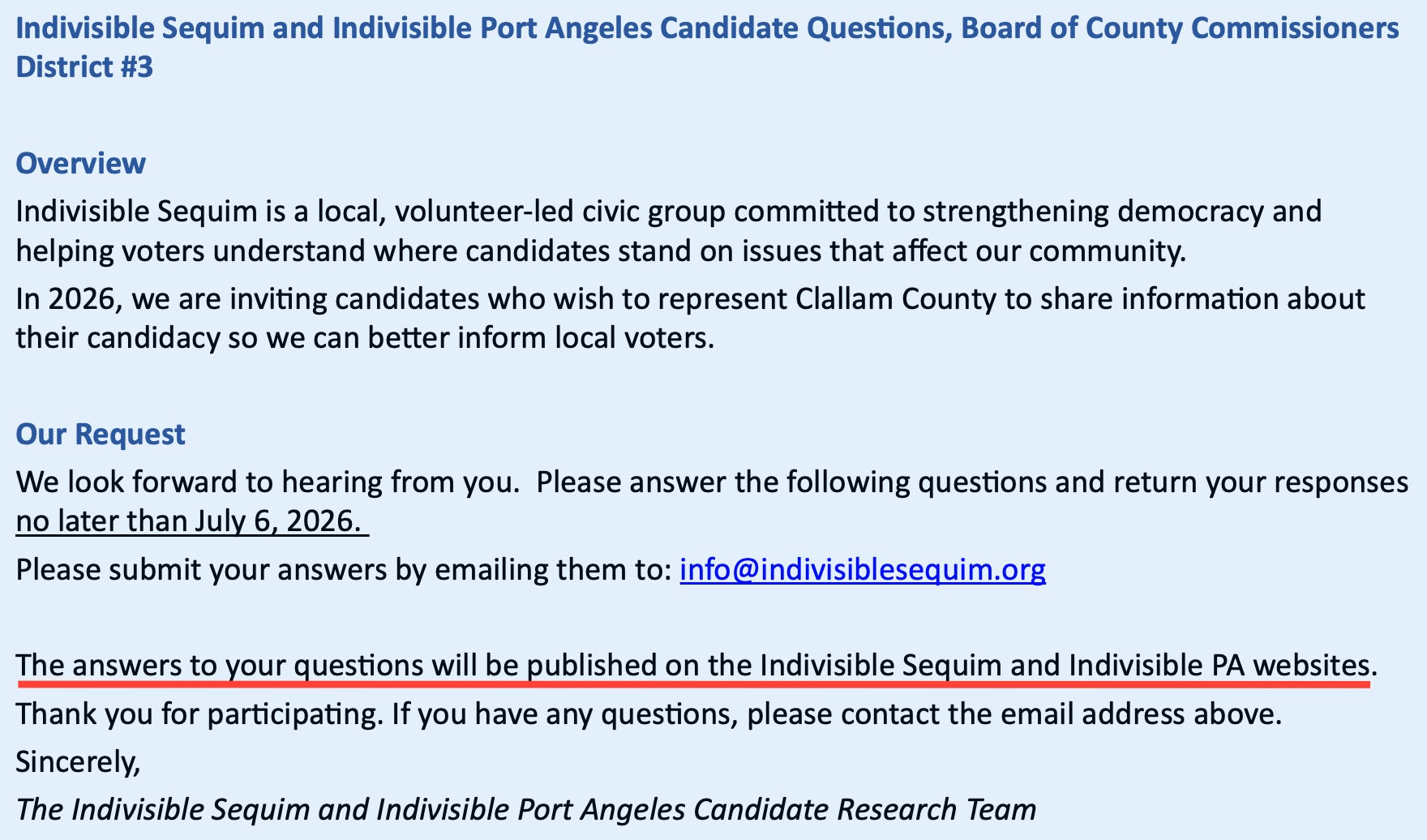
In their questionnaire invitation, Indivisible Sequim and Indivisible Port Angeles told candidates: “The answers to your questions will be published on the Indivisible Sequim and Indivisible PA websites.”
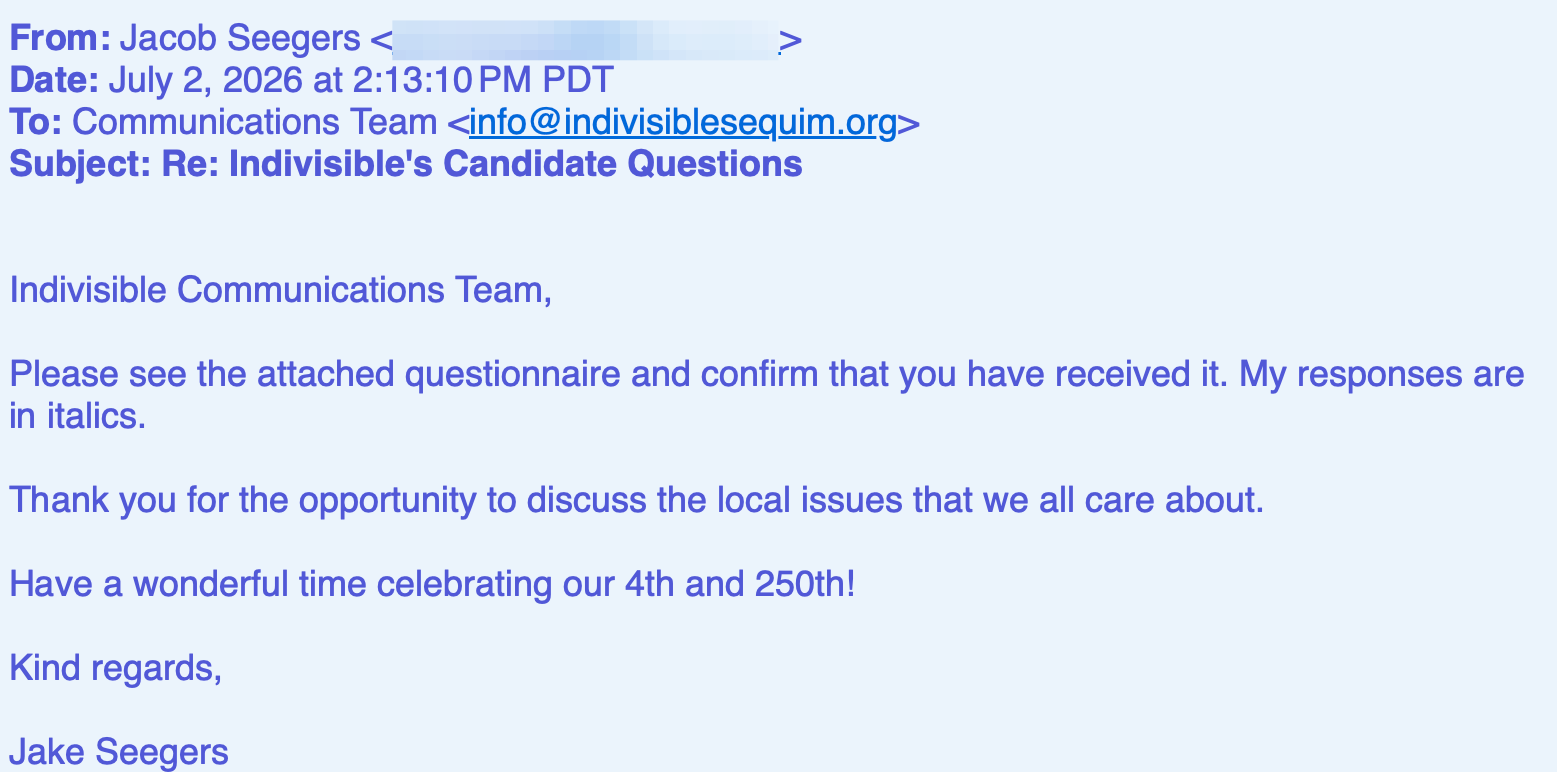
Jake Seegers took them at their word. He completed the form, returned it on July 2 with clear, substantive responses on housing, homelessness, economic development, property rights, and more, and received confirmation of receipt.

Those answers never saw the light of day on Indivisible’s site.
What voters got instead was a lengthy, negative profile of Seegers that omitted his actual positions while mischaracterizing them.
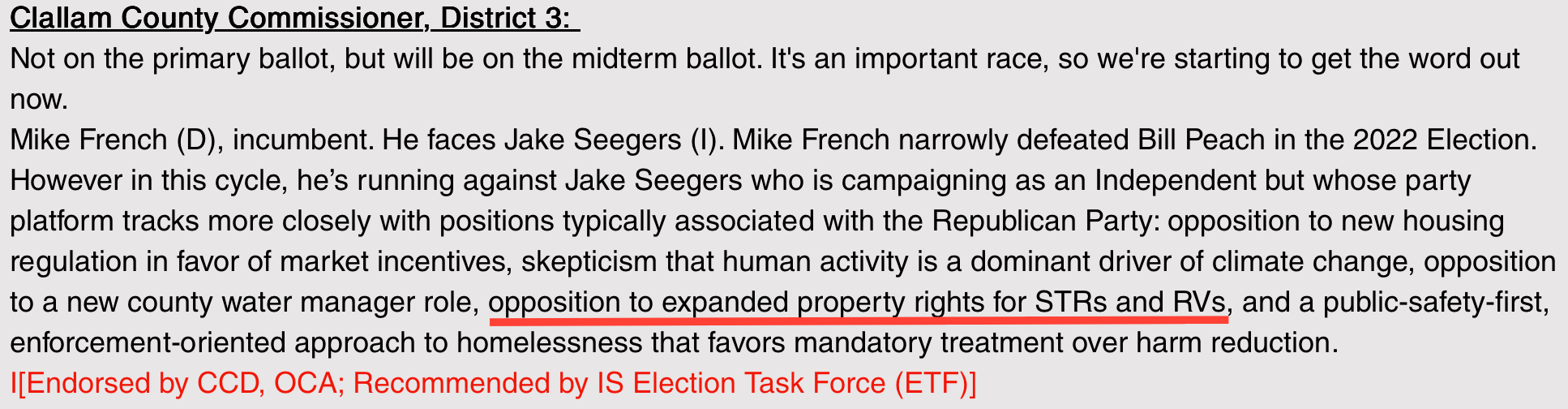
For example, Indivisible claimed Seegers holds “opposition to expanded property rights for STRs and RVs.”
His actual questionnaire response says the exact opposite: he supports expanding property rights by allowing up to two vacation rentals and two RVs per parcel and permitting RVs to be used as short-term vacation rentals.
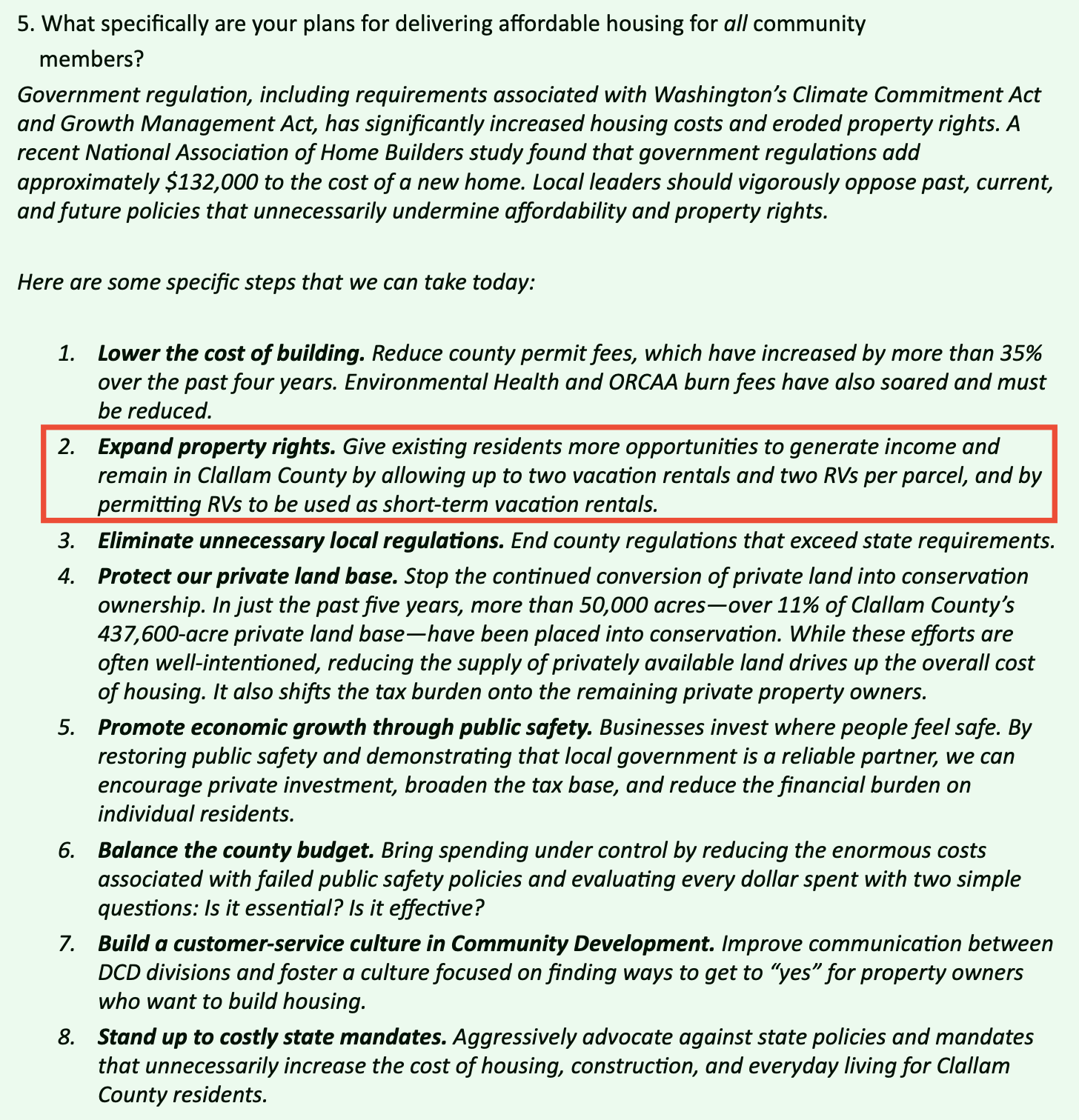
This is the direct opposite of Jake’s stated position. Seegers’ full responses reveal a pragmatic, solution-oriented approach grounded in local realities.
On homelessness, he advocates moving beyond failed “housing first” and harm-reduction models toward accountability, transitional housing paired with treatment and work requirements, and enforcement of existing laws against outdoor living on public land.
On housing affordability for the working poor, he emphasizes incentives over mandates, leveraging existing housing stock, reducing regulations and permit fees, and protecting private property rights rather than further restricting them.
Jake consistently stresses practical local action over ideological debates. Yet none of this was shared with voters. In its place, Indivisible published attacks on Seegers’ family rental home, real-estate holdings (many held as trustee or through LLCs and not subject to full PDC disclosure), foundation donations, and even the placement of his campaign signs in a Republican Party window.
They criticized his decision to source 1,400 yard signs from an out-of-state, non-union printer in Massachusetts to control costs while facing massive potential PDC fines. Meanwhile, they ignored incumbent Mike French’s own expenditures — including payments to a middleman branding company for stickers and $108.39 in shipping charges.

This isn’t voter education. It’s a partisan ambush. Indivisible Sequim reached out under the banner of civic engagement, received substantive answers they promised to publish, then chose to suppress them and run opposition research instead. The group has now ensured that no serious candidate will trust their process again. Why participate if your responses will be buried the moment they don’t align with the predetermined narrative?
The damage extends further. Indivisible is regularly platformed by the “nonpartisan” League of Women Voters, which lends its century-old reputation to the group’s events and activities. By remaining silent on this clear breach of promised transparency, the League risks complicity in undermining the very democratic values both organizations claim to defend.
Indivisible Sequim had Jake Seegers’ answers in hand and chose not to publish them — even while misrepresenting his positions to the public. That decision reveals everything voters need to know about the group’s commitment to fairness. For the remainder of this cycle and future elections, their claim to be a neutral source of information should be viewed with deep skepticism by candidates and voters alike.
Read Indivisible’s endorsements here.
Read Commissioner French’s responses here.
Today’s Tidbit: The Real Reason Indivisible Buried Jake Seegers’ Answers
Why would Indivisible solicit questionnaire responses from both candidates but publish only one? The answer is obvious.
After reading both sets of answers, they realized Jake Seegers’ pragmatic, solutions-focused responses made their preferred candidate, Mike French, look like the weaker choice. Rather than let voters see the contrast, Indivisible made a deliberate decision: suppress Seegers’ thoughtful answers, run a lengthy character assassination against him, and publish a glowing endorsement of French complete with his status quo responses.
They had a chance to strengthen democracy by providing voters with honest information. Instead, they chose censorship and partisan protection.
Below are Jake Seegers’ complete, unedited answers to the Indivisible questionnaire — exactly as submitted.
1. Please share the personal and public office experiences that best prepare you for serving as a Clallam County Commissioner.
Most of my preteen and teenage years were spent in Creel, Chihuahua, Mexico, where my parents, both medical professionals, provided healthcare to the Tarahumara people through mobile clinics serving remote mountain communities. I helped by taking vital signs and preparing prescriptions and instructions in Spanish.
My parents gave me the gifts of a strong work ethic, perseverance in the face of adversity, and the conviction to serve others with kindness - even when the work was difficult, I was exhausted, or the effort went unnoticed.
Both in Mexico and back in the United States, I have faced experiences that seemed impossible to overcome. Those experiences taught me that there is always a solution. More often than not, finding it requires the humility to listen to the experience and ideas of others, the courage to challenge assumptions, and the willingness to embrace unfamiliar approaches.
These experiences shaped a lifelong commitment to serving others and community problem-solving. I don’t take “no” for an answer. I believe that when people work together with humility, persistence, and creativity, effective outcomes are always possible.
2. Commissioner French is running as a Democrat. Mr. Seegers is running as an Independent. Including specific examples, please explain how you are different than a Republican.
As an Independent, I find this question divisive. I am a centrist, aligned with many values of both Democrats and Republicans. I have voted for Democrats, Republicans and Independents. As a local leader, driven to serve all residents of our county, my focus is our common ground, not our differences.
3. Considering the number of unhoused persons currently in treatment for substance abuse disorder and/or other behavioral health issues, what is your long term housing strategy?
I spend a lot of time talking to individuals who are living outside and struggling with substance abuse or mental health issues. Most of them yearn for recovery and self-sufficiency.
Housing first and harm reduction approaches may seem compassionate, but without accountability or set expectations, these have failed the unhoused over the last decade. Our leaders must have the humility to recognize this and pivot to solutions that have worked elsewhere.
Homelessness is a complex issue, and there is no one-size-fits-all solution. A drug-free single mother who has fallen on hard times needs a place to live until she can get on her feet.
For someone trapped in addiction, the solution is different. They need shelter, treatment community and a job. They require transitional housing, paired with accountability and expectation with a clear path to the workforce.
For individuals struggling with serious mental health challenges, they need transitional housing connected to treatment, medication compliance, social engagement, and opportunities to build independence and purpose.
We need a balance of services that can adapt based on individual needs.
Here are the first steps that I would take to address the housing needs for these vulnerable members of our community.
End outdoor living on public land by consistently enforcing existing laws.
Prioritize local housing resources for individuals currently residing in Clallam County.
Strengthen shelter policies so services are supportive, accountable, and attractive for those leaving outdoor living and pursuing recovery.
Expand transitional housing rather than focusing primarily on costly permanent supportive housing
Reduce the cash flow that fuels addiction through clear anti-panhandling signage and public education.
Redirect funding from drug-use supplies to treatment programs with measurable outcomes.
Expand OPNET, co-responder and programs like the community paramedics of Operation Shielding Hope.
Measure success by outcomes, not inputs—tracking how many individuals move from addiction to sobriety and from homelessness to self-sufficiency.
Living outside and using drugs in public spaces can no longer be treated as an acceptable option.
For those willing to participate, we should offer transitional housing with both support and accountability. To receive shelter, participants should commit to treatment, demonstrate progress toward sobriety, and engage in work training.
Clallam County has workforce gaps that many people could fill with minimal training, including hospitality, retail, food service, construction, forestry, and related trades. Many of these jobs provide a pathway to financial independence, yet people with criminal records often struggle to get hired. We should partner with local employers to create apprenticeship opportunities that can grow into full-time careers as skills develop and trust is earned.
Recovery requires repetition, persistence, and purpose. We all grow by doing difficult things over and over again. We do it with the support of our community. That is how we discover what we are capable of.
4. Given the cost of housing, transportation, food, and other basic human needs, what is your housing solution for the working poor? In addition to financial barriers (e.g. required first and last month rent and deposit), many of the unhoused working poor have bad credit due to life circumstances (e.g. divorce, medical bills, bankruptcy, etc.) and don’t or may not qualify for traditional rentals. What solutions to these issues do you propose?
In the tumultuous wake of the Climate Commitment Act, the Growth Management Act and the current energy code and building requirements mandated by the state, the only truly affordable housing remaining in our county is existing housing stock. One way to provide affordable housing for the working poor is to harness existing inventory that is currently vacant or dedicated to short-term-rentals (STRs) and vacation homes and bring them to the market as long-term rentals.
This can be done through incentives, not mandates.
Most property owners purchased these homes because they love Clallam County and their community. They understand the struggle faced by affordable housing. But, up to this point, local and state government have provided obstacles to property owners and landlords. Unfavorable landlord-tenant laws, property-right-restricting ordinances, soaring property taxes, punitive approaches to STRs and public safety failures have led to a significant deficit in long-term rentals.
It’s time for local government to be a partner with property owners and landlords.
County government should focus on empowering local solutions through incentives rather than compromising property rights through penalties, regulation and mandates.
I discuss several creative approaches that communities around the country are using to successfully increase long-term rental housing in this article.
Additionally, to help offset unfavorable landlord-tenant laws and encourage participation in voluntary long-term rental programs, the county could provide an insurance or risk-sharing program that protects participating property owners from certain financial losses.
Communities function best when citizens band together to solve local problems. Government should facilitate that effort, not attempt to replace it through mandate.
5. What specifically are your plans for delivering affordable housing for all community members?
Government regulation, including requirements associated with Washington’s Climate Commitment Act and Growth Management Act, has significantly increased housing costs and eroded property rights. A recent National Association of Home Builders study found that government regulations add approximately $132,000 to the cost of a new home. Local leaders should vigorously oppose past, current, and future policies that unnecessarily undermine affordability and property rights.
Here are some specific steps that we can take today:
Lower the cost of building. Reduce county permit fees, which have increased by more than 35% over the past four years. Environmental Health and ORCAA burn fees have also soared and must be reduced.
Expand property rights. Give existing residents more opportunities to generate income and remain in Clallam County by allowing up to two vacation rentals and two RVs per parcel, and by permitting RVs to be used as short-term vacation rentals.
Eliminate unnecessary local regulations. End county regulations that exceed state requirements.
Protect our private land base. Stop the continued conversion of private land into conservation ownership. In just the past five years, more than 50,000 acres—over 11% of Clallam County’s 437,600-acre private land base—have been placed into conservation. While these efforts are often well-intentioned, reducing the supply of privately available land drives up the overall cost of housing. It also shifts the tax burden onto the remaining private property owners.
Promote economic growth through public safety. Businesses invest where people feel safe. By restoring public safety and demonstrating that local government is a reliable partner, we can encourage private investment, broaden the tax base, and reduce the financial burden on individual residents.
Balance the county budget. Bring spending under control by reducing the enormous costs associated with failed public safety policies and evaluating every dollar spent with two simple questions: Is it essential? Is it effective?
Build a customer-service culture in Community Development. Improve communication between DCD divisions and foster a culture focused on finding ways to get to “yes” for property owners who want to build housing.
Stand up to costly state mandates. Aggressively advocate against state policies and mandates that unnecessarily increase the cost of housing, construction, and everyday living for Clallam County residents.
6. How can we strengthen economic development in Clallam County while simultaneously protecting our environment and rural lifestyle?
Public safety is the foundation of both economic prosperity and environmental stewardship.
If we want a stronger economy, we must first restore public safety. Businesses need to know that their investments will be protected. And I’m not just talking about attracting companies from outside the county.
Clallam County is already home to talented, hardworking people with the skills, ideas, and capital to build businesses right here. Yet many are waiting on the sidelines. How can we expect organic economic growth when local government fails to provide the most basic conditions for success: clean, safe, and welcoming business districts?
The same principle applies to environmental protection. We cannot claim to be good stewards of our natural resources while allowing illegal dumping, unmanaged encampments, and environmental degradation to continue on public and private property. Protecting our environment requires enforcing the laws that protect it.
When the City of Port Angeles fails to address environmental hazards on its own property, as it has along Tumwater Creek, or when complicated ownership issues delay county code enforcement, as at 6992 Old Olympic Highway, the county’s Board of Health has both the authority and the responsibility to act. Under RCW 70.05.060 and RCW 70.05.070, the Board of Health is empowered to abate public health nuisances and environmental emergencies that threaten our community.
Public safety is not separate from economic development or environmental protection. It is the prerequisite for both.
7. (a) How do you plan to balance economic development with conservation of National, State, and privately owned forests and timber that protect our watersheds and contribute to carbon sequestration?
Washington has some of the most rigorous forestry and environmental regulations anywhere in the world. Our Forest Practices Act, Forests and Fish Law, and the Department of Natural Resources’ science-based oversight require protections for streams, fish habitat, unstable slopes, road construction, reforestation, and water quality while allowing a sustainable timber industry to remain viable.
Because those protections are already in place, I do not believe we should allow fear-based rhetoric to undermine one of Clallam County’s most important economic resources. Timber has sustained families here for generations, supports family-wage jobs, funds local services, and provides the wood products our society depends on.
Balancing economic development and conservation begins with recognizing that these goals are not mutually exclusive. Clallam County’s forests are remarkably productive. Trees naturally regenerate and grow rapidly in our climate, and Washington law requires harvested areas to be replanted. Sustainable forestry allows us to continuously grow, harvest, and regrow forests while protecting watersheds, fish habitat, wildlife, and recreational opportunities through strict state oversight.
As County Commissioner, I will defend Clallam County’s working forests, support responsible stewardship on public and private lands, and advocate for policies that recognize conservation and sustainable timber production as complementary - not competing - objectives.
(b) What is your position on the preservation of Legacy Forests? Please explain.
DNR already adheres to strict protocols to protect structurally complex old-growth forests.
8. What is your opinion on the role of human contribution to climate change, especially considering the low snowpack and water supply?
Climate change is a complex issue, and the evidence suggests that human activity plays a role alongside natural climate cycles. Regardless of the cause, lower snowpack and changing water conditions require us to be responsible stewards of our natural resources and to plan for long-term resilience. As an independent, I am less interested in political debates and more interested in practical solutions that protect our environment, water supply, economy, and quality of life.
9. Do you support the water manager position for the county? Why or why not?
Not at this time. Clallam Conservation District has been allocated $200,000 annually via the recently commissioner-approved $5 parcel fee. With a tight county budget, some of this funding should be allocated toward voluntary well data collection to determine local aquifer capacity.
10. Where do you stand on supporting public education in our communities?
Effective and efficient public education is critical. We are raising the future of our county’s public safety, economic growth, financial opportunity and environmental stewardship.
11. How would you describe your communication and problem-solving skills and styles when confronted with divisive issues?
There is always a solution. Listening to those closest to the problem is often the best place to start.
I will listen to all points of view and examine the data for myself. I will pursue common-sense solutions, measure results, and hold programs accountable for delivering the outcomes they promise.
Meeting face-to-face, rather than relying solely on Zoom, email, or text, is essential to effective communication - especially when addressing difficult or potentially divisive issues.
12. Yes or no. Do you think the 2020 Presidential election was stolen?
What does this question have to do with the functions of a county commissioner?
Six years later, it is time to move beyond 2020 and focus on the local issues we all care about. Candidates who answer this question with a simple “yes or no” risk alienating half of Clallam County at a time when unity is essential to achieving the outcomes we all desire.