
In a front-row seat at Olympic Theatre Arts’ 2026 Lavender Melodrama, I watched a thinly veiled caricature of myself — dressed as a floppy-eared dog — devour a bag of human excrement, sob about his lineage, and conspire with “Pioneer Pete,” a stand-in for old Sequim families who dare resist change. What began as local satire revealed itself as a deliberate character assassination, complete with direct references to my reporting on a proposed cultural access tax. The experience stung, but it also prompted deeper reflection on heritage, accountability, and what truly matters as life’s clock ticks for all of us.
The Performance That Hit Home
Before I ever bought a ticket, CCWD subscriber Jim Randall sent me an email.
“I just got home from a performance at OTA. I was disappointed to see the character assassination on display.”
Jim described a character called “The Watchdog”—a floppy-eared dog who spread rumors disguised as facts, eagerly accepted a paper bag of human excrement as a treat, and spent much of the play crying whenever anyone challenged him. Alongside him was “Pioneer Pete,” a stubborn descendant of one of Sequim’s pioneer families who feared change, wanted to preserve the past at all costs, and dreamed up increasingly absurd schemes to save the town from modern ideas.
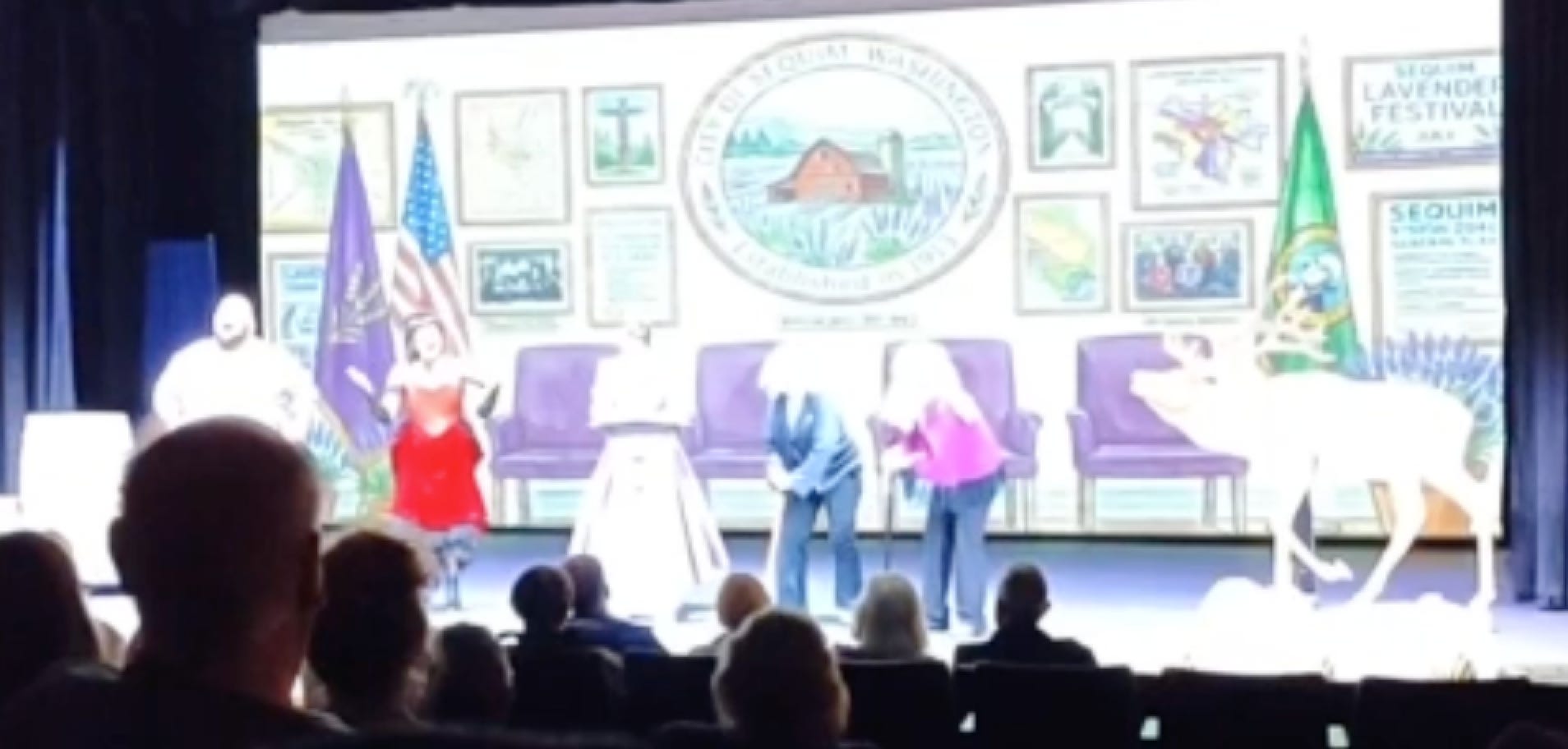
Jim thought the characters were obvious stand-ins for Clallam County Watchdog and me.
I was skeptical.
Satire often borrows familiar archetypes, and it would have been easy to dismiss the similarities as coincidence. Rather than speculate, I texted local blogger Clallamity Jen and asked if she’d like to join me.
Read Clallamity Jen’s synopsis on the Lavender Melodrama here.
We picked a night, bought tickets, and went to see the Lavender Melodrama for ourselves.
By intermission, I wasn’t wondering anymore.
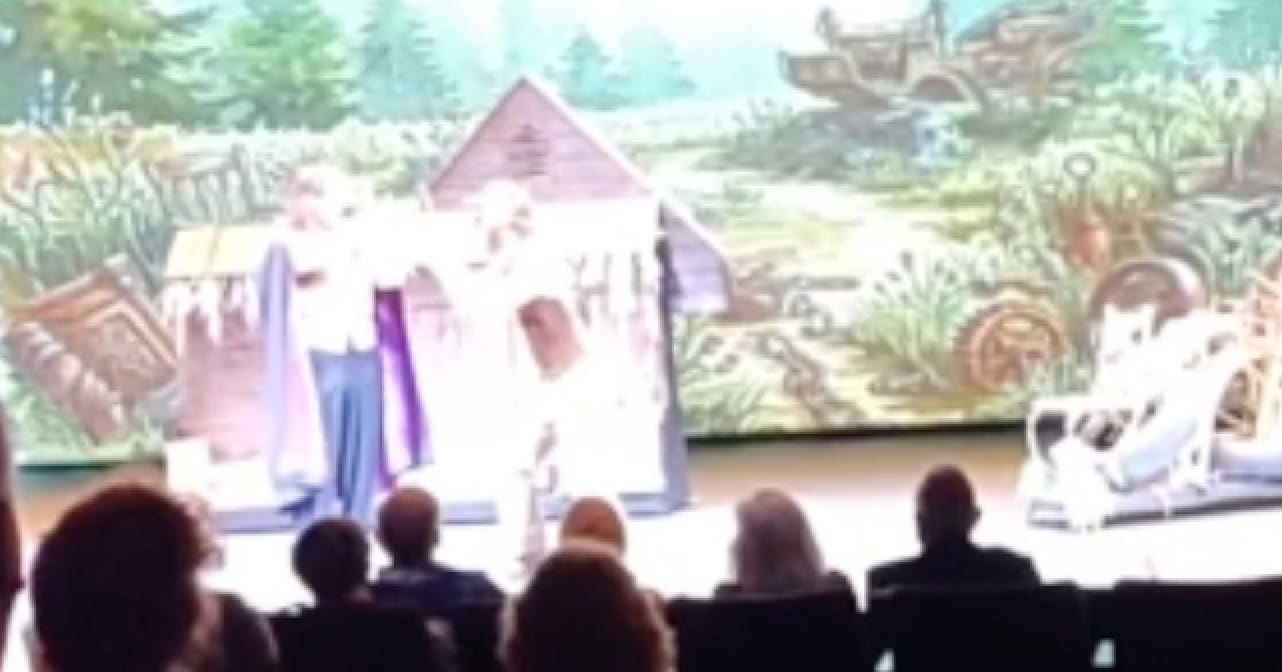
The opening scene featured the Mayor of Sequim attempting to read a letter from someone identifying themselves only as “Watchdog.” She quickly stopped because the letter contained statements that were illegal, inappropriate, and “questionably racist.” During the first scene change, the audience learned that Watchdog had been secretly listening to everything happening around town.
“I finally have everything I need to write my news pamphlets!” the character announced.
Later, Watchdog excitedly approached Pioneer Pete.
“I have some tidbits of news for you,” he said, before eagerly submitting to a belly rub from his owner.
As the play continued, the parallels kept coming.
Watchdog warned about government overreach, accused officials of secret meetings after witnessing nothing more than a handshake, barked endlessly about taxes, and proudly collected gossip before publishing it. Other characters mocked him for seeing conspiracies everywhere.
At one point, Pioneer Pete handed Watchdog a paper bag.
“Your lunch arrived.”
Inside was human excrement.
Watchdog happily carried it offstage to eat.
It was impossible to miss the message.
Acting Out Headlines
The play wasn’t simply poking fun at watchdog journalism. It was portraying the Watchdog as dishonest, paranoid, easily manipulated, and worthy of ridicule.
Pioneer Pete seemed equally familiar.
He repeatedly reminded audiences that his pioneer family had been in Sequim for generations. He insisted newcomers were ruining the community. He opposed affordable housing, mocked free public transit, and declared that “returning our precious peninsula to the prosperous pioneers” justified almost anything.
One line caught my attention immediately. Pioneer Pete boasted that his family had once owned 160 acres. That wasn’t just a generic pioneer reference.
In March 2025, I published an article about the 100th anniversary of the Clallam Relief Act and described the very farm where I still live. My great-great-grandparents once owned 160 acres on the Sequim Prairie. Today, three acres remain.
Then another scene referenced an obscure proposal to create a new cultural access sales tax to fund arts organizations.
That wasn’t a well-known issue. It was the subject of an investigation CC Watchdog published in 2024 after Commissioner Mike French proposed a one-tenth of one percent sales tax to support cultural organizations—including Olympic Theatre Arts. The proposal quietly disappeared after public criticism, only to resurface months later through leaked emails showing efforts to build support for passing the tax without asking voters.
By the end of the performance, I had stopped counting the references. Could every one of them be a coincidence? Perhaps. But taken together, the similarities were difficult to ignore.
Rather than jump to conclusions, I contacted Olympic Theatre Arts after the performance.
I wanted to ask a simple question. Was the Watchdog based on me?
[Below is an eight-minute compilation of Lavender Melodrama highlights.]
A Theater My Family Helped Build
I sent Olympic Theatre Arts an email the following day.
Hello,
I attended last night’s performance at Olympic Theatre Arts and had a question about one of the characters.
The play included a character portrayed as a “Watchdog.” I was curious whether this character was based on a real person or was entirely fictional.
If the character was inspired by an actual person or organization, would you be willing to share who? I would also appreciate the opportunity to review a copy of the manuscript or script, if that is possible.
I’m gathering information for a potential article related to the production and wanted to give Olympic Theatre Arts an opportunity to provide context before I write anything.
Thank you for your time.
Operations Manager Deanna Eickhoff replied a few days later.
“As you may be aware the playwright, David Herbelin, passed away earlier this month so to guess at his intentions regarding characters and plot line would be conjecture on all of our parts. As the character is not named specifically I would guess that the character is purely fictional, but we will never know.”
She also offered to let me read the script and meet with OTA representatives to discuss the production.
It was a gracious response. And it forced me to think about something I hadn’t expected to write. Because my relationship with Olympic Theatre Arts didn’t begin with this play. It began when I was four.
My great-grandmother passed away before I had the chance to know her, but my great-grandfather married Lorna—a tiny woman with an enormous personality whom we called “Grandma Lorna.”
I adored her — she was almost my size.
Lorna was business partners with her son, Howard Wood, and Howard’s partner, Chuck Southern. Together they operated Southwoods Department Store in downtown Sequim, combining their last names into the store’s name. Today, A-1 Auto Parts occupies the building, but for years Southwoods was a fixture in downtown Sequim.
After Howard died, Lorna and Chuck opened the Howard Wood Memorial Theatre upstairs in that same building, where Calvary Chapel now meets.
That theater eventually evolved into what we know today as Olympic Theatre Arts. In a very real sense, my family helped build it. Some of my earliest memories involve that theater. As a kid, I remember carefully painting part of a banner advertising an upcoming production. Once it was finished, the banner stretched across Washington Street between Southwoods and the Sequim Gazette building.
Back then, I never imagined I’d someday be writing about the organization. In my family, supporting Olympic Theatre Arts wasn’t political. It was simply what we did.
We bought tickets.
We donated.
We volunteered.
Part of it was supporting local actors and musicians. And part of it was honoring Lorna, Howard, and Chuck, whose fingerprints remain on Sequim’s cultural history.
That’s why attending the Lavender Melodrama felt different than simply watching a community theater poke fun at public figures. This wasn’t just any stage. It was a place my family had invested in for generations.
That history also made something else feel strangely unfinished.
What Really Matters
I’ll admit it. Watching the Lavender Melodrama stung. Not because I expect everyone to agree with me. Anyone who writes about local politics long enough is going to make enemies. That’s part of the job.
What caught me off guard was seeing what felt like my hometown laughing at a version of me that was dishonest, paranoid, gullible, and deserving of humiliation. But there was another part that bothered me — something bigger than myself. When did it become acceptable to mock Sequim’s pioneer families simply because they were pioneer families?
Every community has parts of its history it should examine honestly, but history is not a competition where recognizing one group’s contributions requires diminishing another’s. Sequim exists today because many people built it.
The original tribes that settled the Sequim Prairie.
The Jamestown S’Klallam people.
The pioneer families.
The immigrants who arrived later.
The loggers, farmers, fishermen, teachers, shopkeepers, artists, volunteers, and entrepreneurs who all left something behind.
The people who moved here this year.
Their stories do not cancel one another out. They are all part of Sequim’s story.
That is what made the experience difficult. It wasn’t just about being the target of a joke. It was about wondering whether we have lost sight of the idea that a community’s history doesn’t have to be a reason to tear people down.
Then I learned something that changed how I viewed the entire experience.
David Herbelin had been diagnosed with cancer in 2022 and lived well beyond his original prognosis. He was still able to participate in the table reads for this year’s Lavender Melodrama. This was one of the last creative works he would leave behind.
Knowing that changed the way I looked at everything. I found myself thinking less about the jokes and more about the man who wrote them.
David devoted the last years of his life to Olympic Theatre Arts, helping build a place where thousands of people have laughed, cried, applauded, and discovered a love for theater.
I’m one of those people. The last show I attended was Steel Magnolias, and I left amazed by the talent on stage. The actors had the rare ability to take an audience from roaring laughter to quiet tears within minutes. I remember thinking: Why would anyone travel to Seattle for theater when we have this kind of talent right here in our own community?
I credit David with helping cultivate and nurture that talent. His greatest contribution was not any single production. It was the countless people he encouraged, mentored, and inspired along the way. Long after this year’s melodrama is forgotten, that will be his true legacy.
Learning a Lesson
A theater is more than a building. It is a place where people come together. Where strangers become neighbors. Where stories are shared. Where a community sees itself reflected on stage. That is what David helped create. And perhaps that is the lesson I needed to take away from this.
Life is astonishingly short.
Shorter than we imagine.
David knew his time was limited.
Most of us don’t.
That’s a gift, in a way. We wake up assuming we’ll have tomorrow. We put off difficult conversations. We postpone reconciliation. We tell ourselves there will always be another opportunity to meet for coffee, another chance to clear the air, another day to say what needs to be said.
Sometimes there isn’t.
A year and a half ago, OTA Executive Director David Herbelin sent me an email asking if we could meet for coffee or ice cream. I replied and asked what time would work best for him, but I didn’t hear back. I still think about the email David sent me. I don’t know why he didn’t reply. Maybe life got busy. Maybe his health changed. Maybe it simply slipped through the cracks. Now I’ll never know.
And that bothers me far more than anything that happened on stage. Because the truth is, the arguments that consume us today rarely matter in the end.
Commissioners come and go.
Elections come and go.
Editorials are published, shared, debated, and eventually forgotten.
The controversies that seem so important in the moment become footnotes with time.
What remains is what we build.
What remains is how we treat people.
What remains is whether we leave our corner of the world better than we found it.
That is something I believe David understood.
Leaving a Legacy
My own family’s connection to Olympic Theatre Arts is part of why this matters so much to me. Howard Wood, Chuck Southern, and my Grandma Lorna believed culture should bring people together. They helped create a place where neighbors could laugh together, tell stories together, and celebrate this community together.
I hope that is what Olympic Theatre Arts continues to be. As for me, I’ll keep doing what I’ve always done.
I’ll continue asking questions.
I’ll continue attending public meetings.
I’ll continue writing articles that some people appreciate, and others dislike.
That’s the role I’ve chosen.
Others are free to criticize my reporting, disagree with my conclusions, or even satirize me on stage. But if there is one thing I took home from the Lavender Melodrama, it has very little to do with politics.
It is this: Life is short. When we are gone, no one will care who won an argument over a county tax proposal or who got the last word in a newspaper or on social media.
People will remember whether we loved our families.
Whether we served our neighbors.
Whether we created something that outlived us.
Whether we made our community a little better than we found it.
David Herbelin did that.
He gave Sequim a place to gather.
He gave actors a place to grow.
He gave audiences a place to laugh, cry, and share an experience together.
He helped build something that will continue long after he is gone.
For all our differences, I believe David and I shared that same hope — that Sequim would be a stronger, richer, more connected community because of the things we choose to create.
Perhaps, in the end, we had more in common than either of us realized.
Today’s Tidbit: Where is Commissioner Ozias?
Commissioner Ozias was absent from this week’s work session and regular meeting. For the previous two weeks, he has either been absent or attended remotely.
During Tuesday’s meeting, Commissioners French and Johnson, along with County Administrator Todd Mielke, were asked several times where Commissioner Ozias has been. They declined to answer.
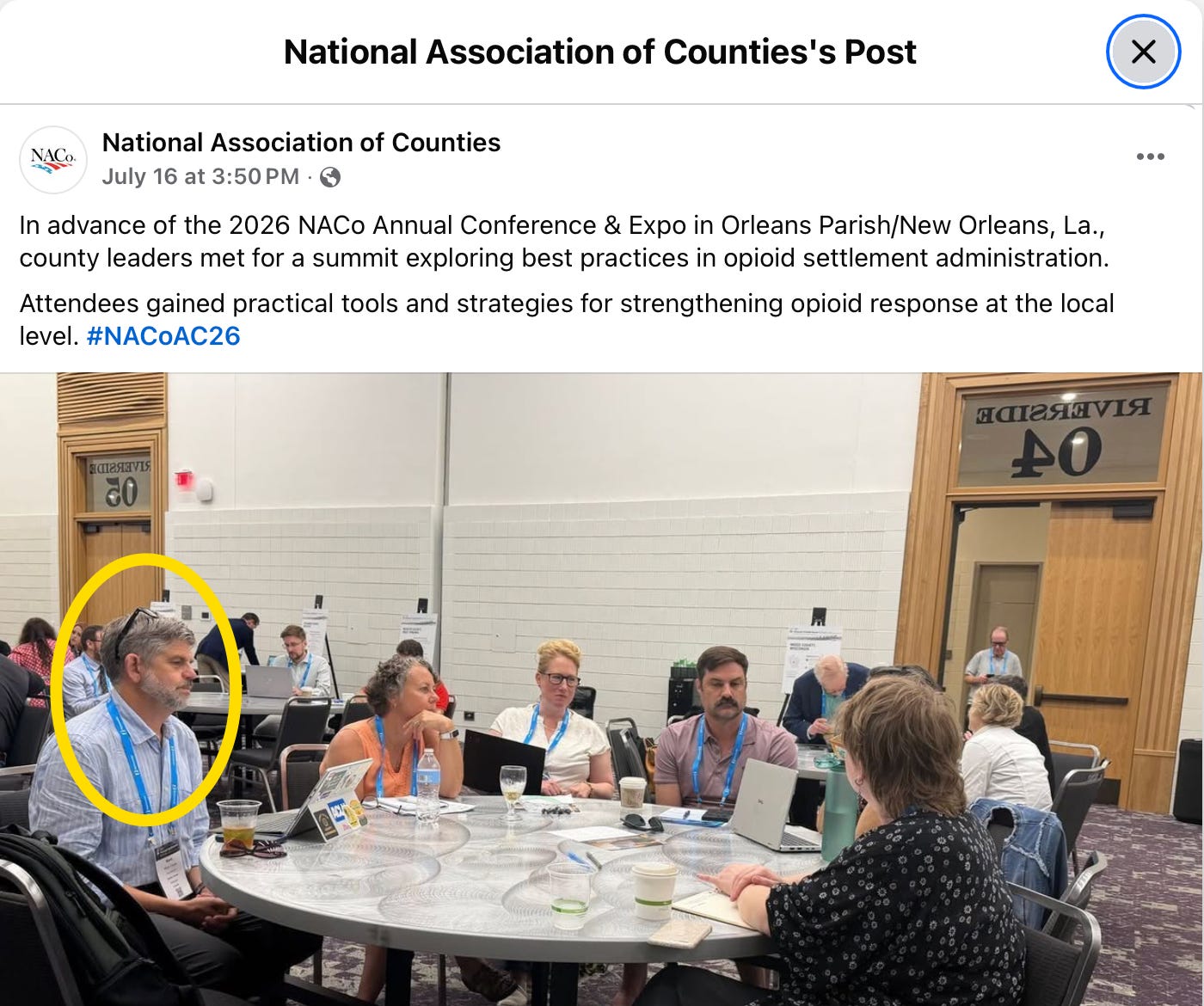
A public records request for Commissioner Mark Ozias’ calendar shows he was listed as “out of office” from July 1 through July 21. Beginning July 16, his calendar shows: “Mark Ozias — 2026 NACo Annual Conference & Expo.”

The conference is being held this year in New Orleans.
The New Orleans conference follows two earlier trips to Washington, D.C., and a conference in Maui this year. The National Association of Counties (NACo) receives funding from the Washington State Association of Counties (WSAC), an Olympia-based NGO that advocates on behalf of counties and of which Ozias serves as president.
WSAC is funded through voluntary membership dues paid by counties. Clallam County pays approximately $40,000 annually to maintain its membership.