
A new $37 million bridge in Jefferson County is being celebrated as a triumph of climate resilience, salmon restoration, and tribal leadership. But behind the ribbon cuttings and ceremonial blessings are larger questions taxpayers should be asking. Why was a Clallam County tribe leading a major infrastructure project in another county? Why is a bridge paid for with public funds decorated with the symbols of a sovereign nation? And why are many of the same organizations involved in regional flood-control projects continuing to receive public trust despite the unresolved questions surrounding the Towne Road debacle?
When most people think about major transportation projects, they assume local governments are in charge.
Jefferson County roads are managed by Jefferson County. State highways are managed by WSDOT. Federal highways are managed by federal agencies.
Yet when the ribbon was cut on the new Twana Bridge in Quilcene last month, the organization front and center was not Jefferson County. It was the Jamestown S’Klallam Tribe.
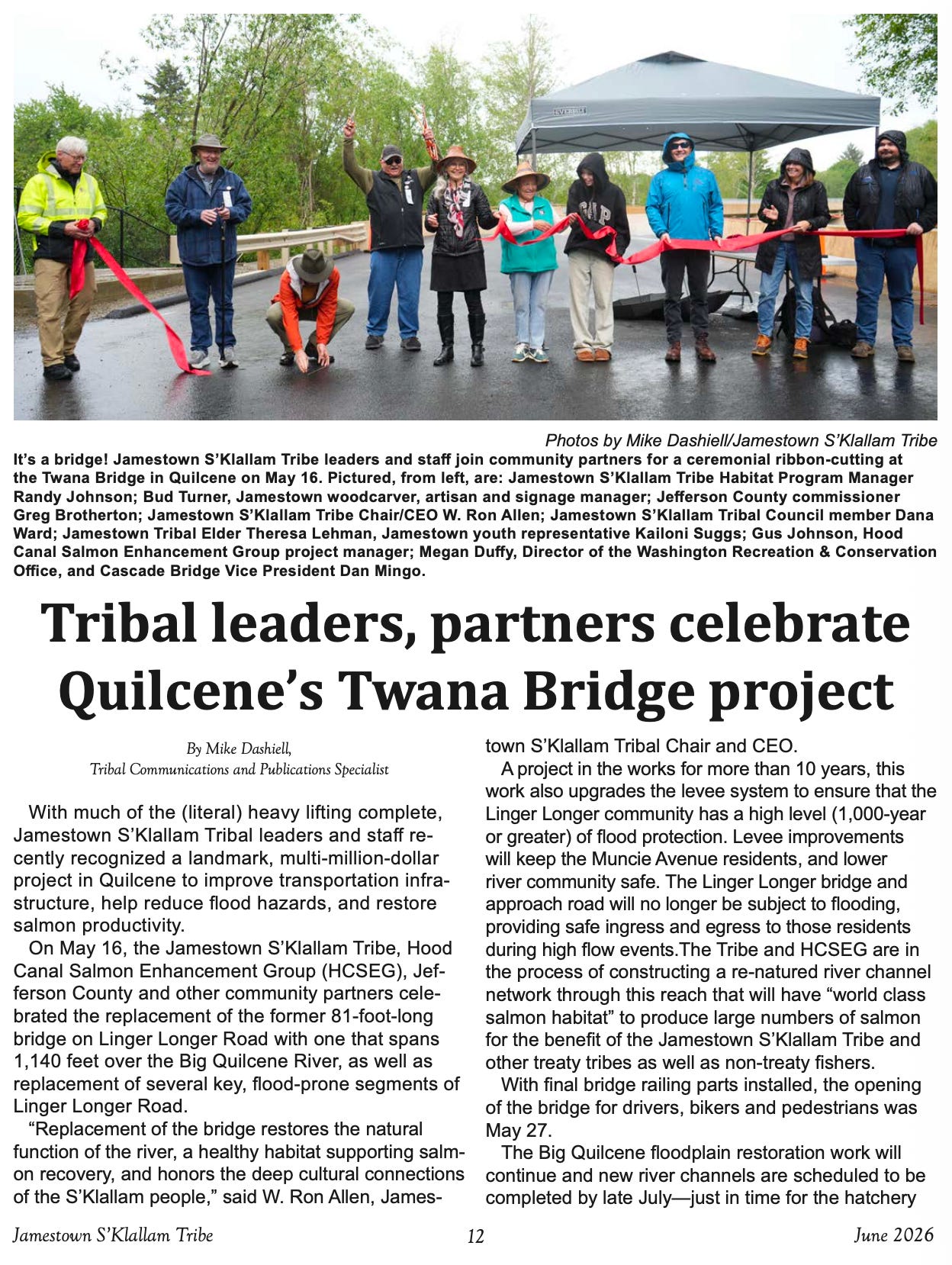
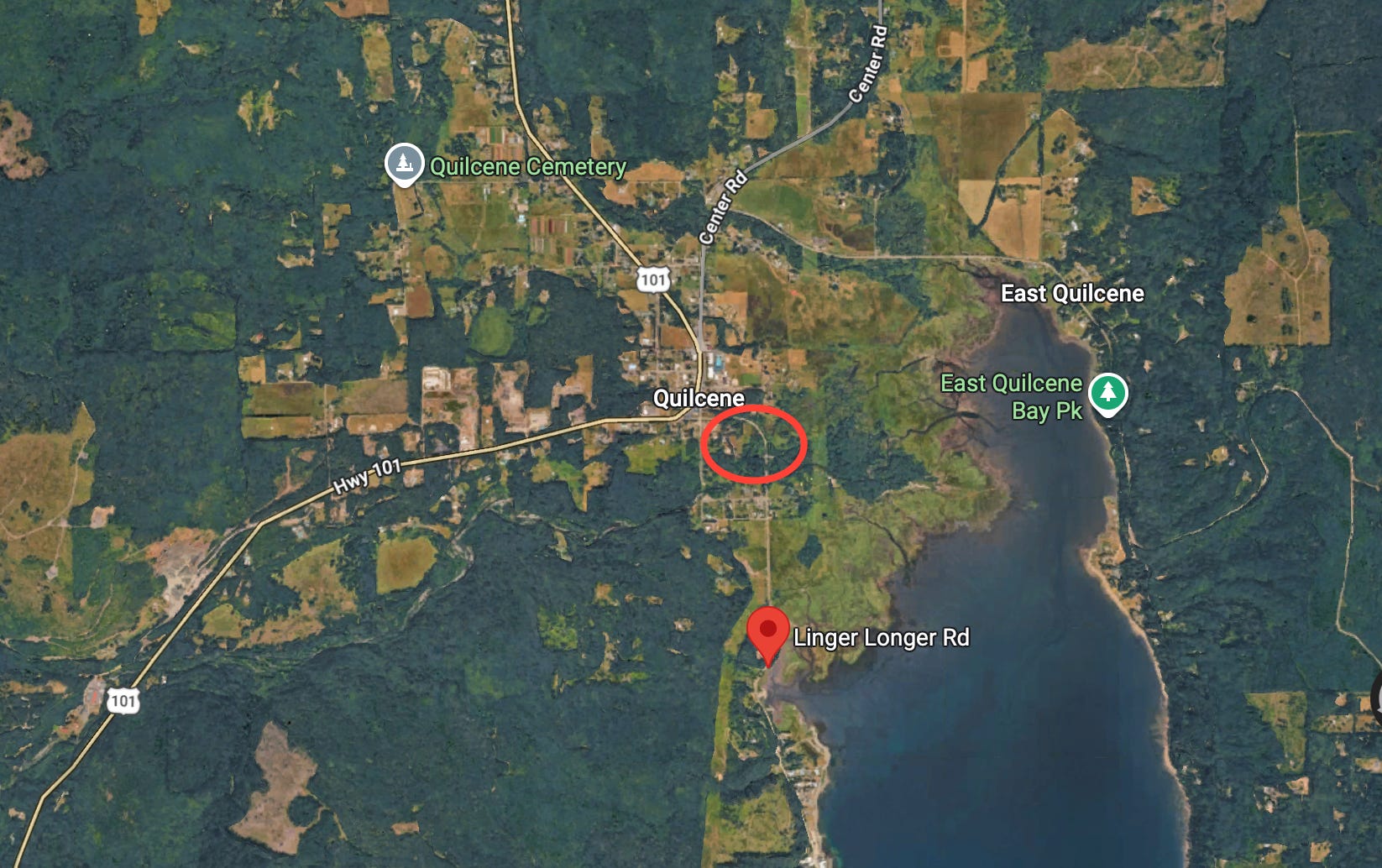
According to the Tribe’s June 2026 newsletter, the project has been more than a decade in the making and includes replacement of the old 81-foot bridge on Linger Longer Road with a new 1,140-foot structure spanning the Big Quilcene River. The overall construction effort is expected to cost approximately $37 million. The project was funded through a combination of state and federal sources secured by the Tribe and project partners. The actual construction work was performed by outside contractors, including Cascade Bridge and Bruch & Bruch Construction.
The newsletter portrays the bridge as much more than a transportation project.
It is repeatedly described as a climate-resilience project, a flood-reduction project, and a salmon-restoration project.
Jamestown Chairman and CEO Ron Allen stated:
“Replacement of the bridge restores the natural function of the river, a healthy habitat supporting salmon recovery, and honors the deep cultural connections of the S’Klallam people.”
The newsletter further explains that restoration work will create what it calls “world class salmon habitat” that will produce large numbers of salmon “for the benefit of the Jamestown S’Klallam Tribe and other treaty tribes as well as non-treaty fishers.”
It also states that restoration of the floodplain will provide major benefits for shellfish habitat in Quilcene Bay and further the Tribe’s goal of enhancing treaty resources.
Those statements deserve attention.
Treaty resources are not simply an environmental concept. They are economic resources. Salmon, shellfish, and other marine species support tribal fisheries and harvest opportunities. The newsletter openly acknowledges that habitat restoration associated with this bridge project is expected to increase those resources.
None of that is hidden. The Tribe proudly says so.
But it raises an obvious question.
If the bridge serves transportation needs for the public, flood-control objectives for the community, and resource enhancement objectives for the Tribe, how much of the project was driven by public infrastructure needs versus resource-management goals? Taxpayers deserve to understand the answer.
Another question involves symbolism.
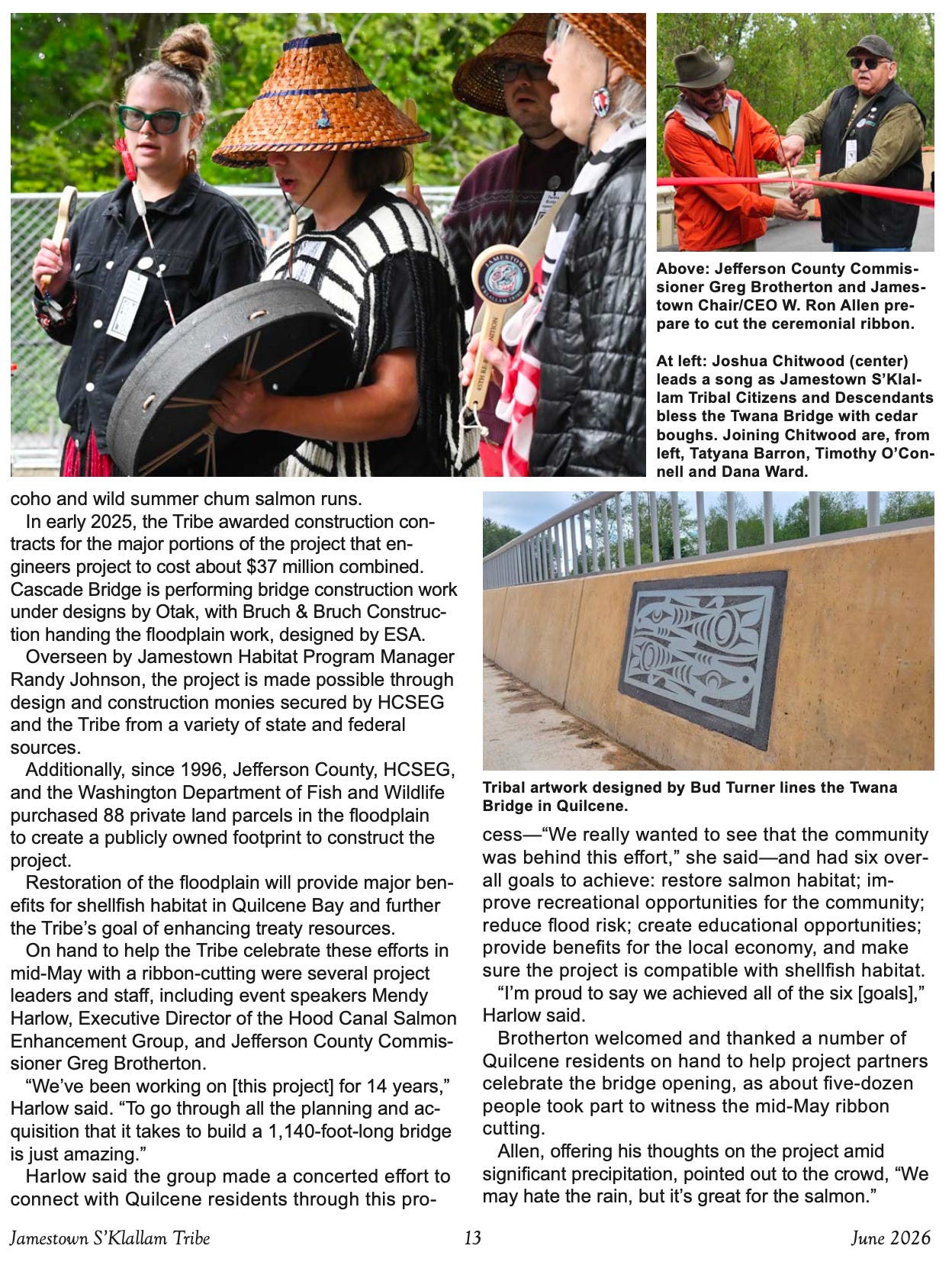
Photos from the dedication ceremony show the bridge adorned with Jamestown S’Klallam artwork and tribal design elements. The newsletter celebrates the bridge with tribal songs, blessings, cedar brushing ceremonies, and extensive tribal branding.
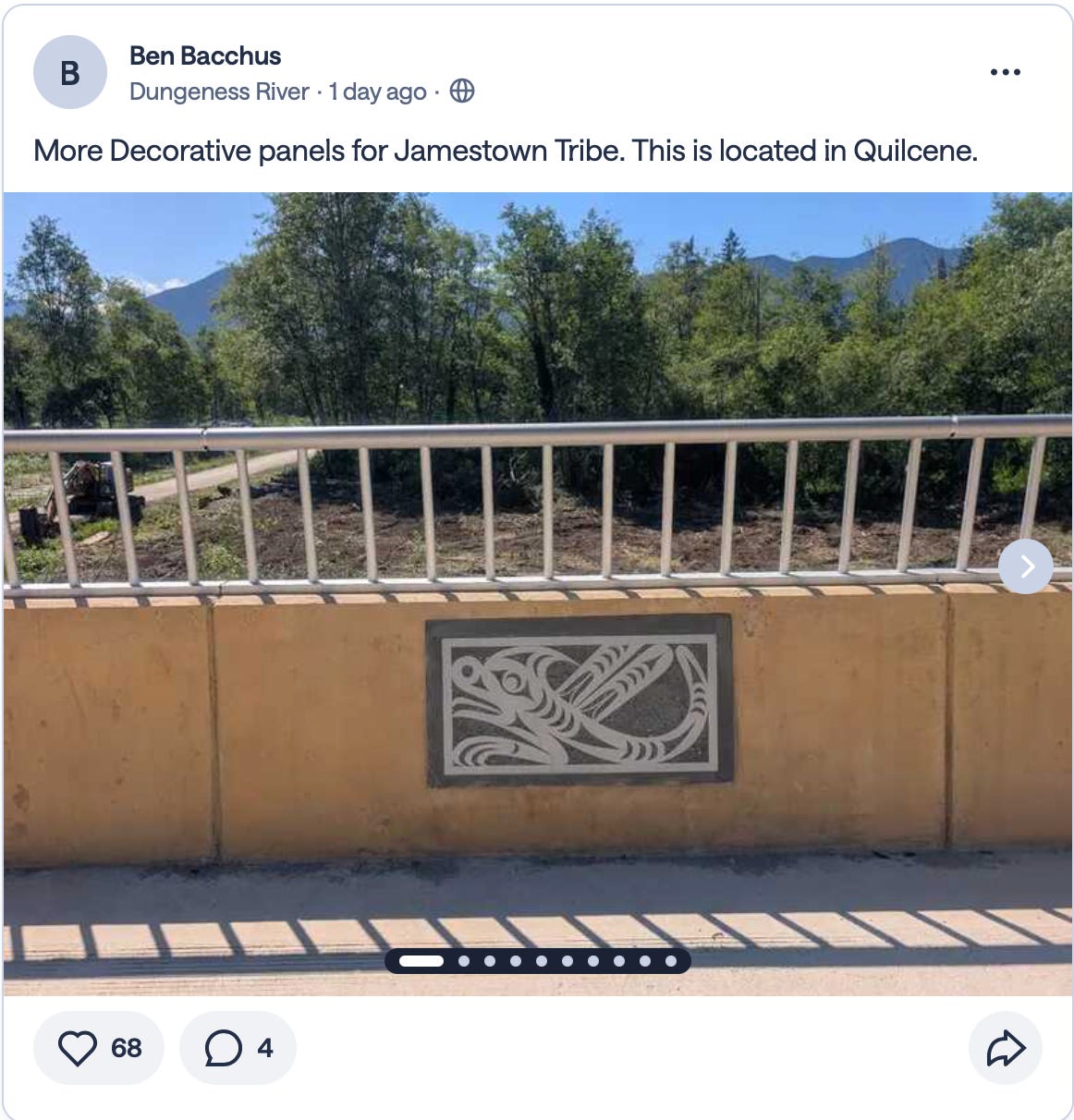
There is nothing inherently wrong with recognizing the cultural history of a region.
But this is not a bridge on tribal land. It is not a private facility. It is a public bridge funded through public dollars and intended for use by everyone.
Some residents may reasonably ask whether infrastructure funded by all taxpayers should be presented primarily through the lens of a single government or cultural group, regardless of who led the project.
The newsletter also repeatedly emphasizes flood protection.
According to project descriptions, the new bridge and levee improvements are intended to provide protection exceeding a 1,000-year flood standard and improve safety for downstream residents.
That sounds reassuring.
Yet many residents of Clallam County may remember another flood-related project involving the Jamestown Tribe: Towne Road.
During that project, the Jamestown Corporation deliberately removed a dike before replacement protections were fully in place, exposing hundreds of downstream residents to substantial flood risk. Internal communications released during subsequent investigations described scenarios so severe that one tribal communication referenced helicopters circling a disaster area and speculating about the number of fatalities.
“The water will drop about 10 vertical feet in a distance of about 100’ into Meadowbrook Creek. The erosive action of this flow could quickly head cut through the road, causing a blowout. Then the 50-acre lake suddenly drains. If it drains in 4 minutes, the flow raging through Dungeness and hitting 3 Crabs Road would be approximately 18,000 cfs. A Dungeness River 1,000-year flood is 13,528 cfs. News helicopters would circle the devastation and speculate on the number of dead. The County, Tribe, and the Corps would be embroiled in wrongful death suits for years or decades.” — Jamestown Corporation’s Habitat Program Manager
Years later, residents are still asking for a full accounting of what happened, who made critical decisions, how much it cost, and what lessons were learned.
Those questions remain largely unanswered.
That history makes the Twana Bridge project impossible to evaluate in isolation.
If organizations seek public trust as leaders in regional flood-control and restoration projects, they should also be willing to address concerns surrounding previous projects where things did not go according to plan.

To be clear, the Twana Bridge appears to be a remarkable engineering achievement. Replacing a flood-prone bridge with a modern structure that improves access and reduces flood exposure is a worthwhile accomplishment.
But public infrastructure should always come with public accountability.
The newsletter celebrates the bridge as a victory for climate resilience, salmon restoration, treaty resources, transportation infrastructure, and community partnerships.
What it does not fully address are the broader questions many taxpayers are asking:
Why was a Clallam County tribe the lead force behind a major Jefferson County transportation project?
How much influence do tribal priorities have in determining which regional infrastructure projects move forward?
What public oversight exists when projects are funded through a complex web of federal grants, state agencies, nonprofits, counties, and tribal governments?
And why, after the controversies surrounding Towne Road, has there never been a complete public reckoning with what happened there?
Those are questions worth asking.
One final note: the Jamestown newsletter itself is worth reading.

For years, these publications provided a fascinating look inside one of the North Olympic Peninsula’s largest employers, most influential institutions, and most politically connected organizations. The newsletters contain information on economic development, natural resources, healthcare, cultural programs, government affairs, and major regional projects that affect the entire community.
Today, those newsletters are no longer readily available to the general public.
That is unfortunate.
Whether residents agree with the Tribe’s priorities or not, understanding the activities of one of the most powerful organizations on the Olympic Peninsula is important for anyone trying to understand how the region is changing.
Today’s Tidbit
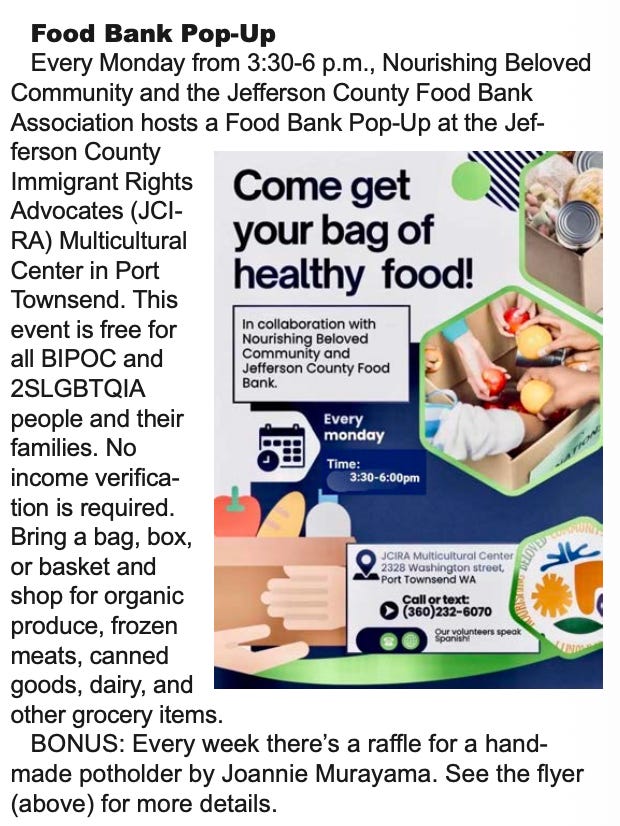
The Jamestown newsletter contained several other noteworthy items. Among them was the Tribe’s continued promotion of a weekly food bank pop-up event held at the Jefferson County Immigrant Rights Advocates Multicultural Center in Port Townsend. According to the announcement, no income verification is required to receive food assistance. However, participation is limited to individuals who identify as Black, Indigenous, or other people of color, as well as members of the 2SLGBTQIA+ community.
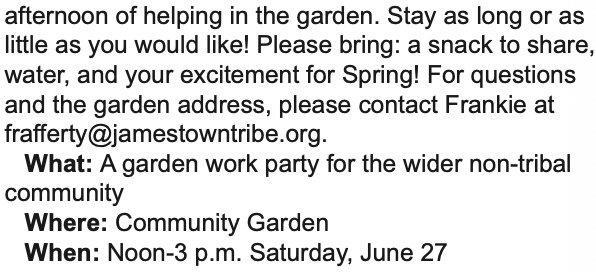
The newsletter also highlights opportunities for non-tribal community members to volunteer in the Jamestown community garden. Participants are invited to help maintain the garden while bringing their own beverages and a food item to share. The invitation presents an interesting dynamic: members of the public donating their time and labor to support a community garden operated by one of the most financially successful and influential organizations on the North Olympic Peninsula.