


Last week, Clallam County Auditor candidate Virginia Shogren argued that the Clallam Conservation District changed its election procedures after the official ballot request deadline, expanding the voting pool in an election decided by just 37 votes. Since then, additional public records—including political articles published during the campaign and the district’s replacement ballot log—have added new pieces to the timeline. While none of the records alone proves wrongdoing, together they raise legitimate questions about whether every voter was operating under the same rules and whether the election was administered as the district publicly promised.
Last week, CC Watchdog published Virginia Shogren’s investigation into the 2026 Clallam Conservation District election. Her article alleged that district officials departed from their own election resolution by expanding the pool of eligible voters after the published ballot request deadline, despite the district’s rules stating that requests made after February 18, 2026, at 4:00 p.m. “will not be fulfilled.”
Since that story was published, additional records obtained by CC Watchdog paint a fuller picture of how the election was presented to the public—and how it may have been administered behind the scenes.
Individually, each record may have an innocent explanation. Together, however, they raise additional questions that deserve answers.
Everyone Appeared to Be Told the Same Thing
The election resolution adopted on January 13, 2026, was unambiguous.
The district chose to conduct a mail-in-only election and required voters to request a ballot before February 18 at 4:00 p.m. The resolution states plainly:
“The last day to request a ballot is Wednesday February 18, 2026 by 4:00 PM. Requests made after the deadline will not be fulfilled.”
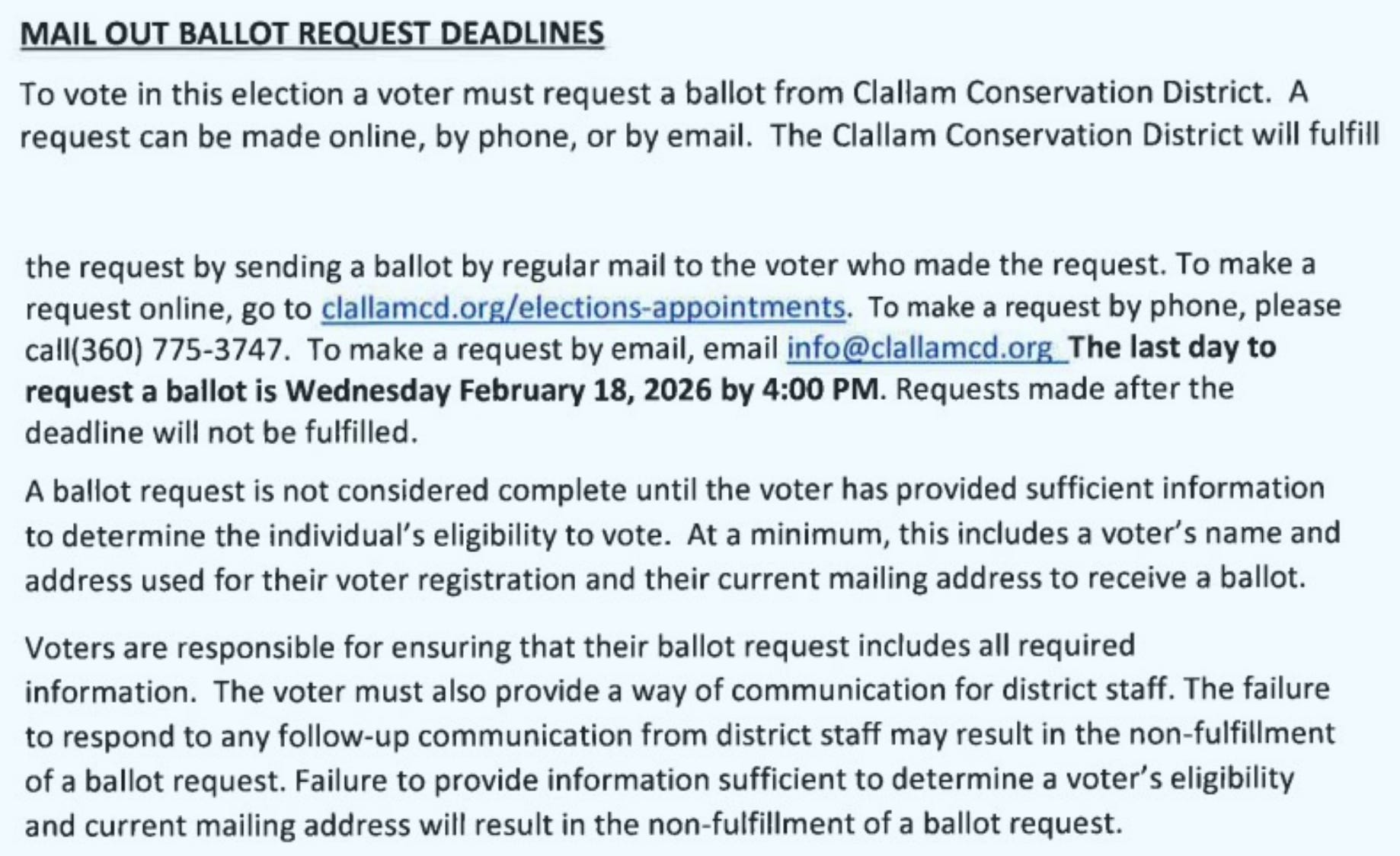
The district reinforced that message by mailing more than 1,200 notices to previous Conservation District voters explaining that ballots would only be mailed to individuals who submitted a request before the deadline. Shogren’s investigation also documented those notices.
That same message continued throughout the campaign.
The Public Messaging Never Changed
On February 27, longtime political activist Tim Wheeler published an article in Clallam Democrats Rising describing his efforts to encourage Sequim Indivisible members to request ballots before the deadline.
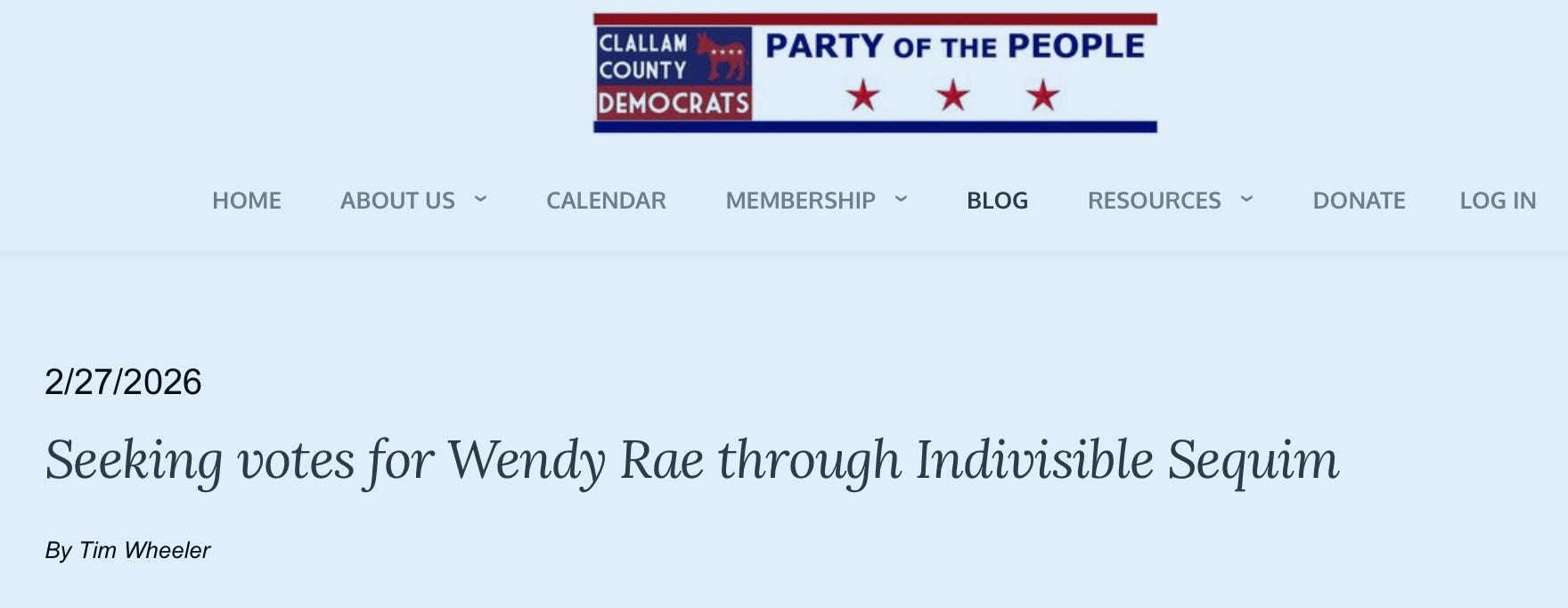
According to Wheeler, he attended the February 16 Indivisible meeting carrying campaign literature for incumbent Supervisor Wendy Rae Johnson. Because the deadline was approaching, he urged attendees to photograph the QR code and immediately request ballots before time expired.
Nothing about that effort is inherently unusual. Political campaigns routinely encourage supporters to vote.

What is noteworthy is that Wheeler’s article repeatedly reinforces the understanding that requesting a ballot before February 18 was required.
One day later, another Clallam Democrats Rising article by Tina Tyler delivered the same message while profiling Johnson’s campaign.
The article explained why the Conservation District used requested mail ballots rather than automatically mailing ballots to every registered voter.
Johnson was quoted explaining that the district could not afford to mail ballots to all 62,000 registered voters in Clallam County.
The article then told readers:
“To vote in this year’s election, you would have had to request a ballot by Feb. 18.”

At this point, the public message appeared remarkably consistent. The official election resolution said ballots had to be requested by February 18. The district’s mailers said the same thing.
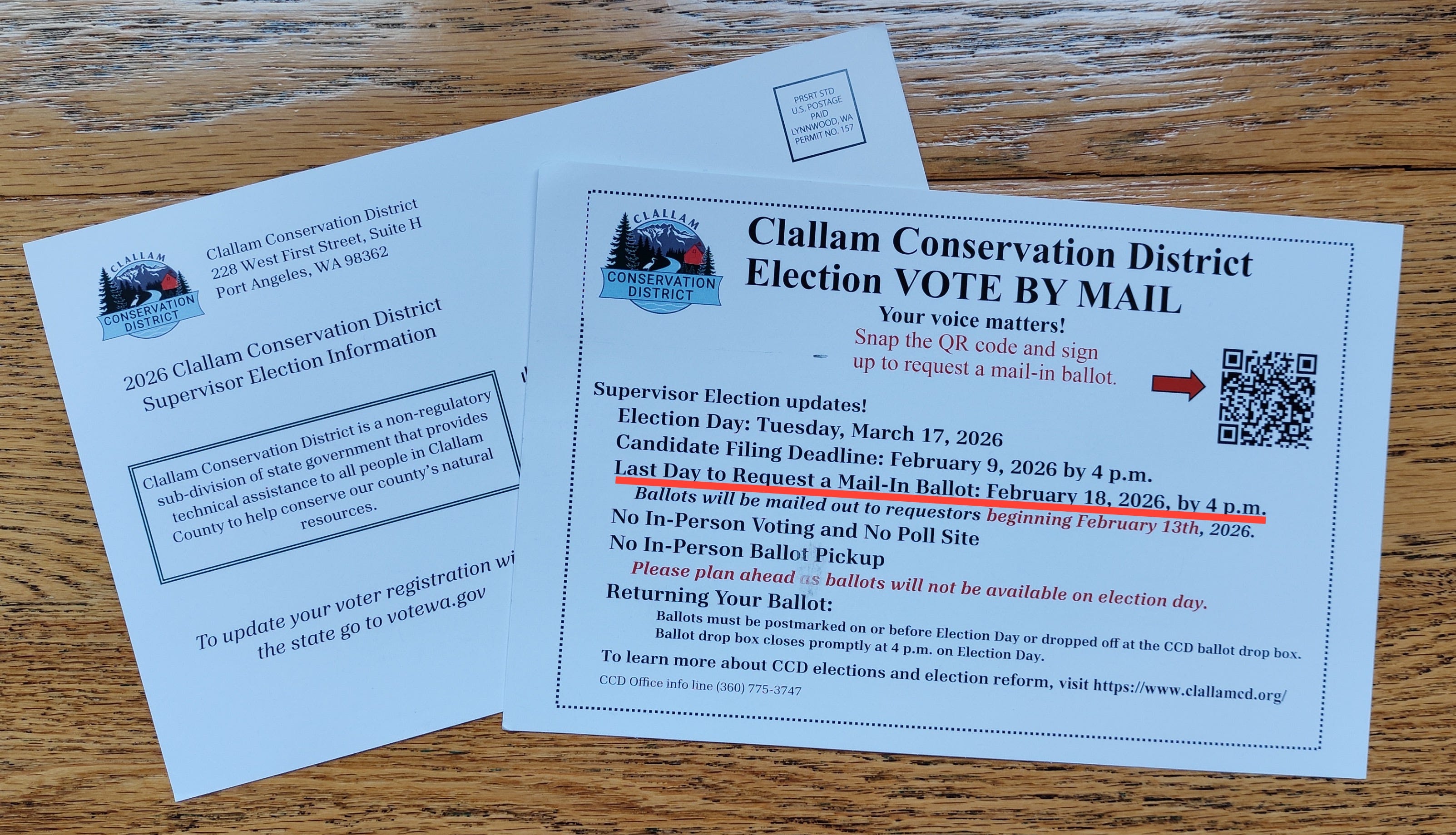
A campaign supporter writing in Clallam Democrats Rising emphasized the same deadline.
The following day, another article supporting Johnson’s candidacy repeated that voters needed to have requested their ballots before February 18.
Nothing in those public communications suggested the voting pool would later be expanded.
Then the Story Changed
According to Shogren’s investigation, that changed on March 10 during a public Conservation District board meeting.
There, candidate Wendy Rae Johnson reportedly disclosed that election officials had merged the official ballot request list with another internal list, resulting in additional ballots being mailed to people who had never requested one for the 2026 election.
Election records cited by Shogren show 2,238 ballots were ultimately mailed, despite only 1,921 ballot requests being received—a difference of at least 317 ballots in an election decided by just 37 votes.
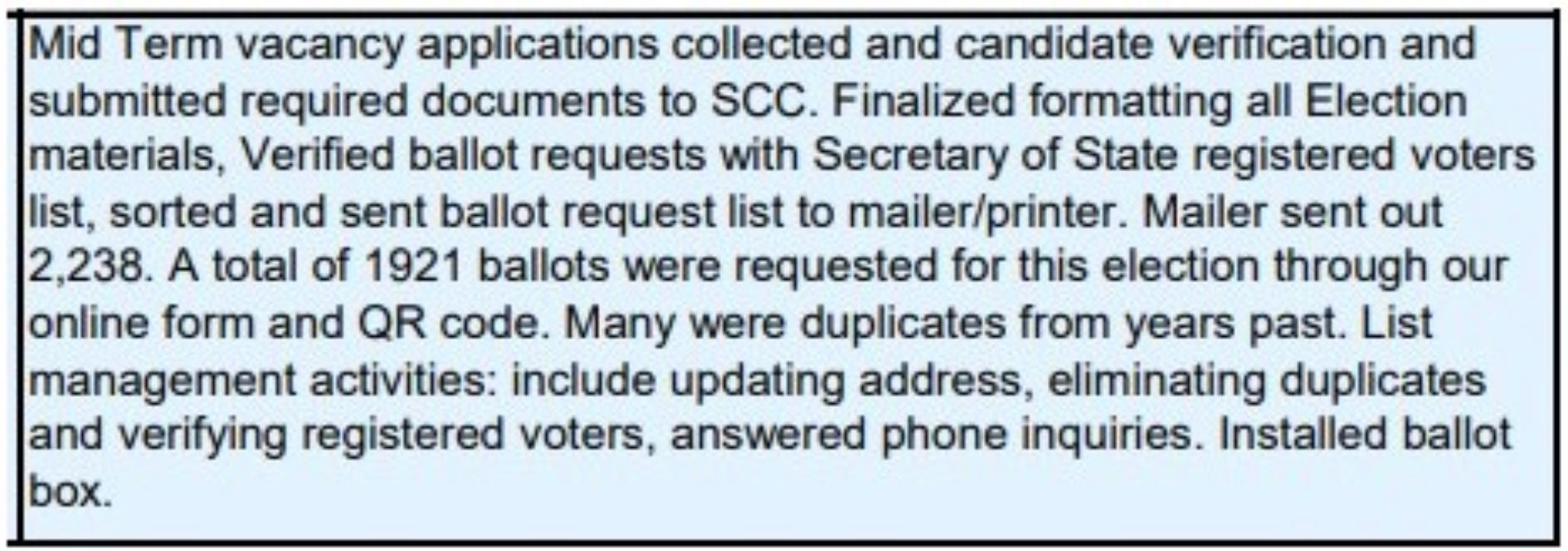
If those figures are accurate, they raise an obvious question.
Why was the public repeatedly told that requesting a ballot by February 18 was mandatory, even though additional ballots were later mailed to individuals who had never submitted a request?
That is precisely what the ongoing complaint before the Washington State Conservation Commission seeks to determine.
A Curious Statement
One passage in Wheeler’s article also stands out. After describing the Indivisible meeting, Wheeler wrote:
“Wendy Rae told us later that hundreds of ballot requests came in after that meeting! To say the least, she was very pleased.”

Candidates naturally celebrate successful voter outreach efforts. At the same time, the statement suggests Johnson was receiving updates about the volume of ballot requests during the election. Was her opponent receiving the same updates?
The article does not explain how she obtained that information or from whom. It may have come from campaign volunteers, public information, election administrators, or another source entirely.
Standing alone, the statement proves nothing.
Nevertheless, in light of the broader questions surrounding the administration of the election, it is another detail that merits clarification.
Replacement Ballots Raise Still More Questions
CC Watchdog also reviewed the Conservation District’s replacement ballot log.
Providing replacement ballots is a normal part of many elections. Voters sometimes lose or damage their ballots and request another.
However, the district’s election resolution describes only one method for receiving an original ballot: submitting a ballot request before the February 18 deadline. The resolution does not expressly describe a replacement ballot process.
Cross-referencing the replacement ballot spreadsheet with the district’s ballot request list revealed another apparent discrepancy.
At least six individuals who received replacement ballots do not appear on the ballot request list provided by the district.
Those names include:
Elizabeth Batson
Fred Kaiser
Sheila Kaiser
Roberta Andison
Walter Boyes
Erik Brihagen
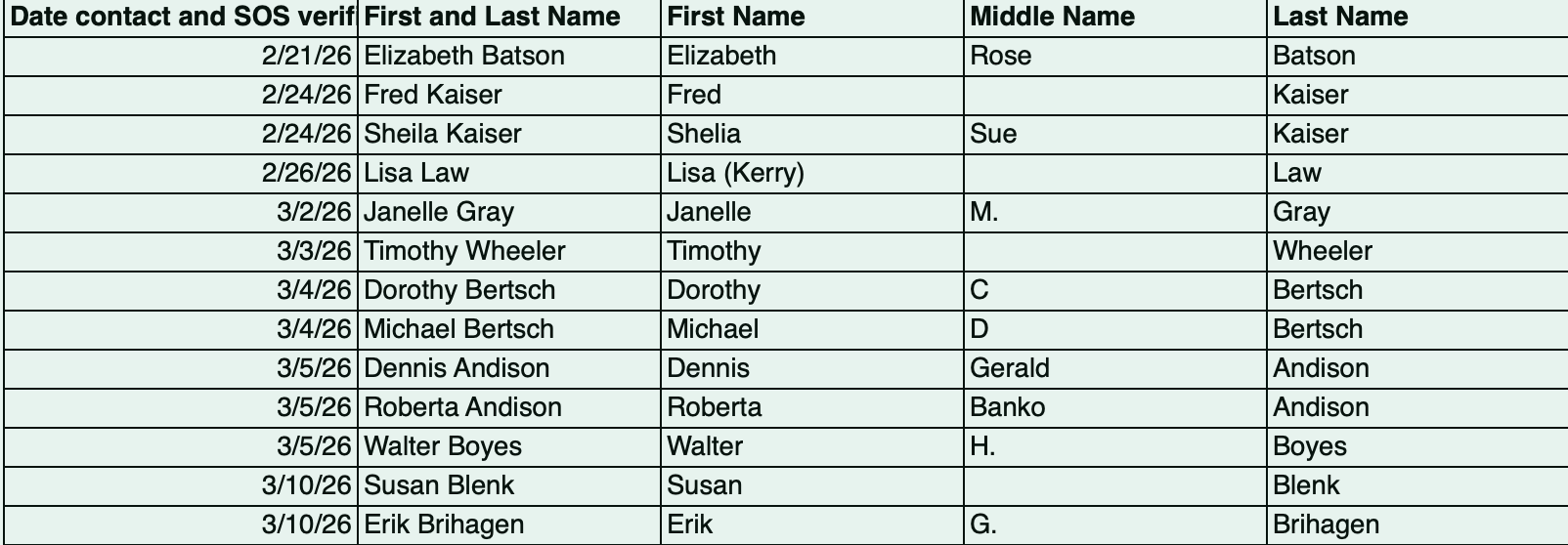
This observation should be interpreted cautiously.
It does not necessarily mean these individuals voted improperly or that the ballots should not have been issued. Administrative corrections, separate request records, clerical errors, or other explanations may exist that are not reflected in the documents.
Even so, the discrepancies underscore why complete transparency is necessary.
The Pattern
None of these facts, standing alone, proves election misconduct. But viewed together, they present a series of legitimate questions.
The district adopted a resolution establishing a firm ballot request deadline.
The public was repeatedly told that requesting a ballot by February 18 was required.
Political supporters encouraged voters to meet that deadline.
A campaign article published after the deadline still told readers they had needed to request a ballot before February 18.
Yet according to Shogren’s investigation, the voting pool was later expanded beyond those who complied with those published rules.
Replacement ballot records also appear to include recipients who cannot be located on the district’s ballot request list.
Perhaps every one of these questions has a perfectly reasonable explanation.
If so, the records should demonstrate it.
If not, Clallam County voters deserve to know why the rules described in the official election resolution—and repeated in public communications throughout the campaign—appear to differ from the procedures ultimately used to conduct the election.
That is precisely why independent investigations exist: not to assume wrongdoing, but to determine whether public confidence in an election has been earned.
NOTE: The League of Women Voters of Clallam County, which oversaw the CCD election, did not respond to multiple requests for comment.
Today’s Tidbit: Who Is the Conservation District Really Working For?
Every property owner in Clallam County is now required to pay the Conservation District’s $5 annual parcel assessment following a decision by the County Commissioners. That naturally raises a simple question: Who is the district working for?
Earlier this year, the Conservation District discussed three separate letters of support for grant applications submitted by the Washington Water Trust, including projects involving long-term drought response, wetlands restoration, and a deeper well for Jamestown’s Cedars at Dungeness Golf Course.
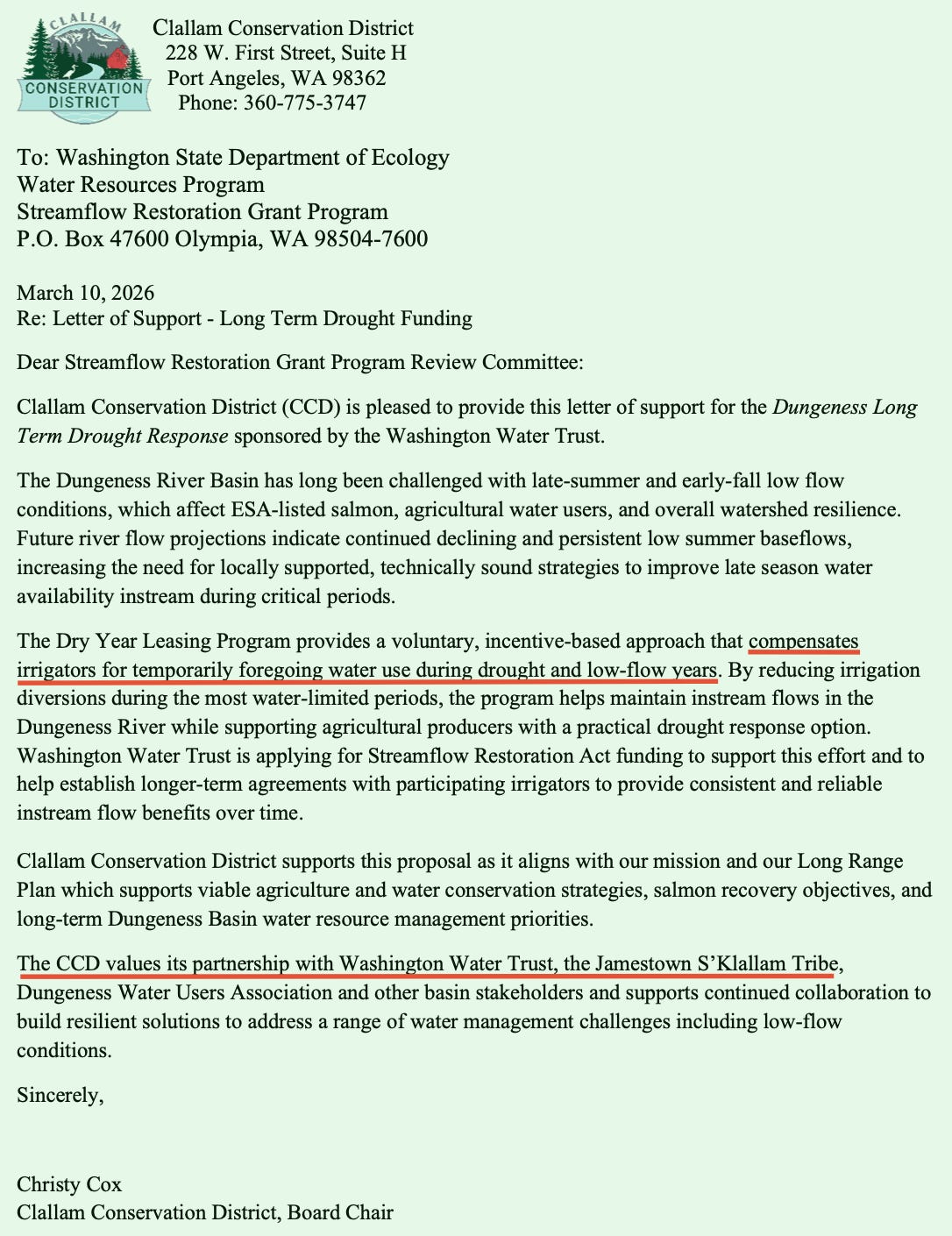
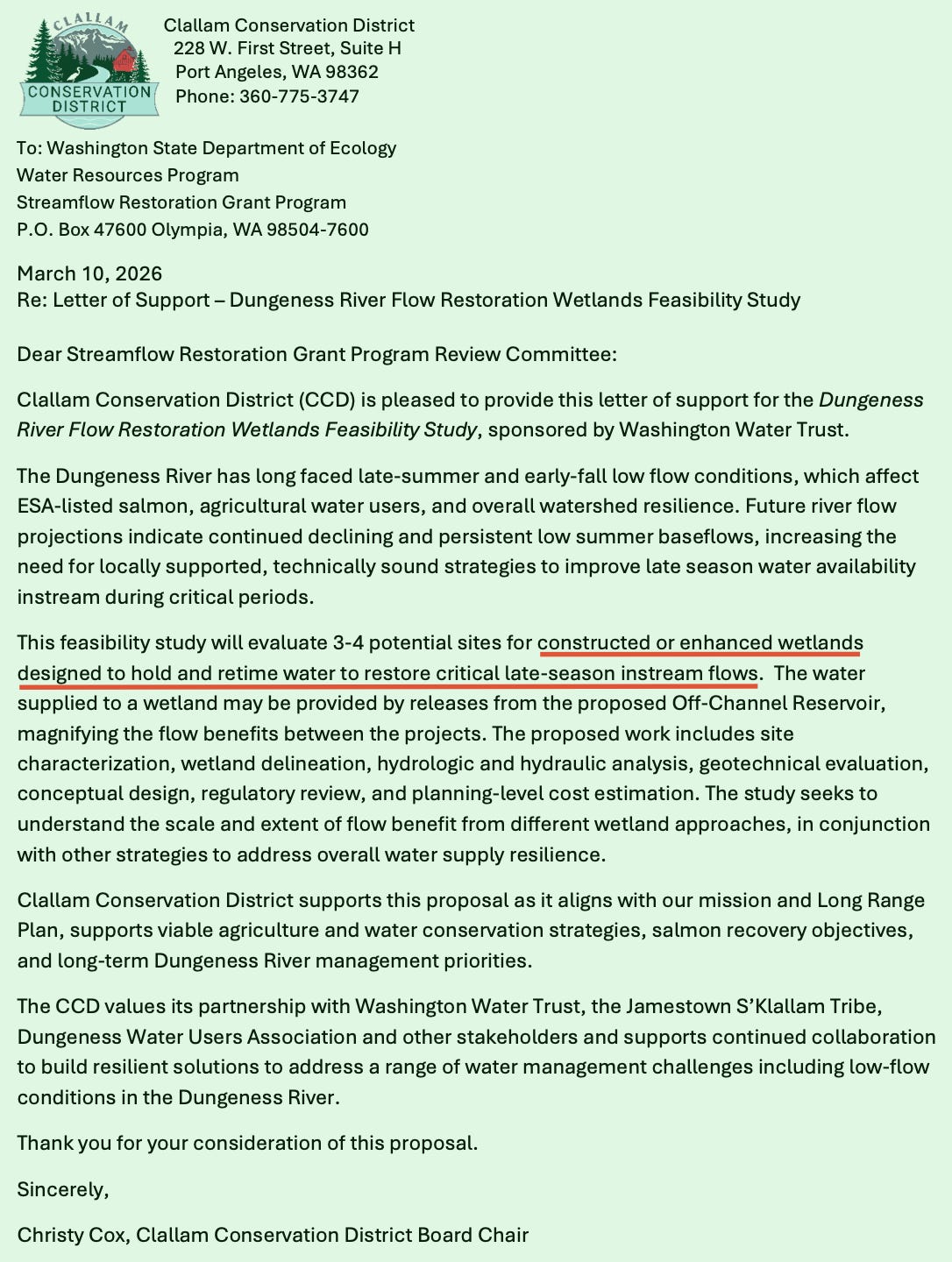
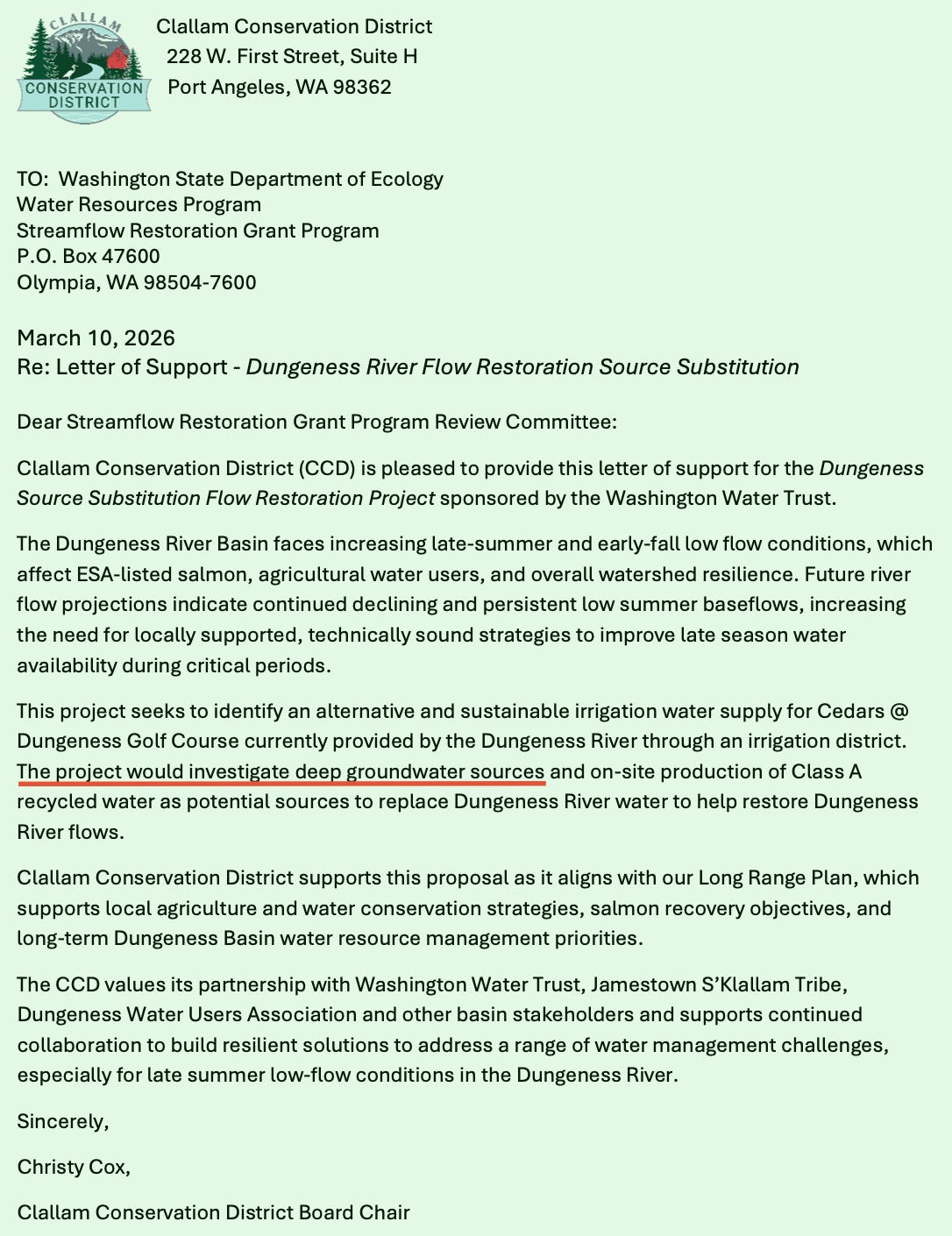
Each letter emphasizes the district’s partnership with the Washington Water Trust, the Jamestown S’Klallam Tribe, and the Dungeness Water Users Association.
The Washington Water Trust is no stranger to the Dungeness Basin. It has long been involved in water management and streamflow restoration efforts connected to the Dungeness Water Rule. Its leadership is also notable. According to his published biography, Washington Water Trust principal William Stelle spent three decades in federal government, serving as a political appointee under both the Clinton and Obama administrations before leading NOAA Fisheries on the West Coast.
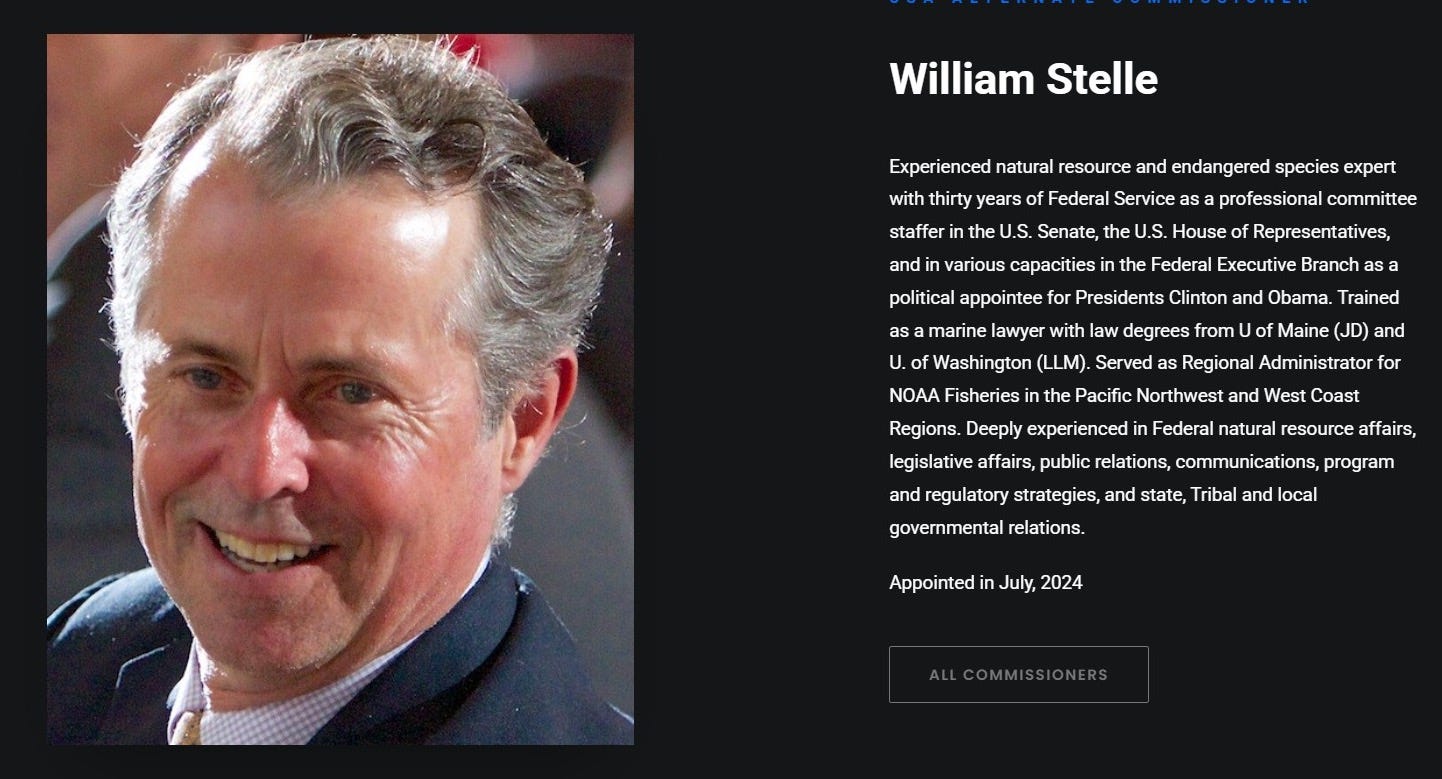
Meanwhile, Port Angeles City Councilmember LaTrisha Suggs serves on the Washington Water Trust’s Board of Directors.
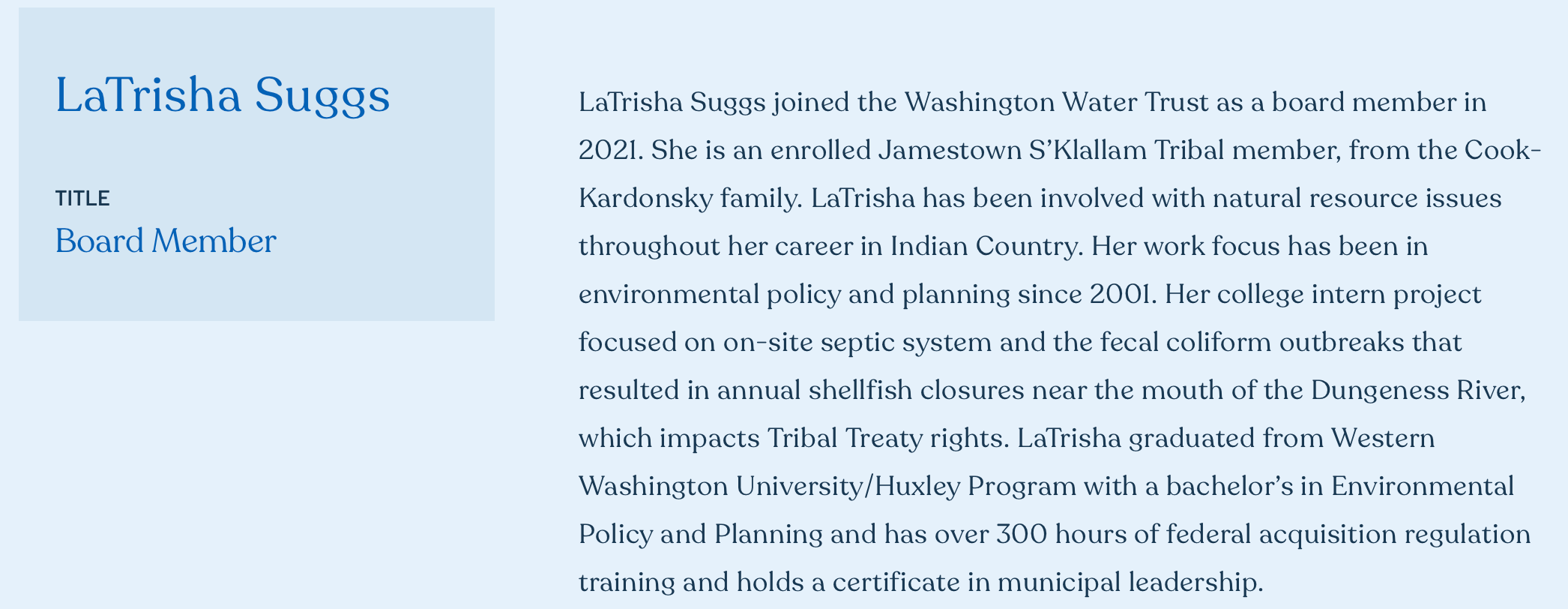
None of this is improper by itself. Partnerships are part of what conservation districts do.
But with every property owner now helping fund the Conservation District through a mandatory parcel assessment, residents may reasonably ask whether the district is spending enough time representing all taxpayers—or whether too much of its energy is being devoted to advancing the priorities of a relatively small circle of agencies, advocacy organizations, and stakeholder groups already deeply involved in Dungeness water policy.
That’s a fair question for the board—and one worth asking before it approves another round of support letters.


