
As Clallam County taxpayers pick up the tab for land moving into trust, a powerful narrative of “homeland restoration” is being used—while a buried history of displacement, violence, and a people nearly wiped out is largely ignored.
Seven properties. Thousands in lost tax revenue. And a decade of silence.
That’s where things stand in Clallam County today.
Recently, seven parcels in Blyn and one near the Cedars at Dungeness Golf Course were transferred into federal trust for the Jamestown corporate entity:
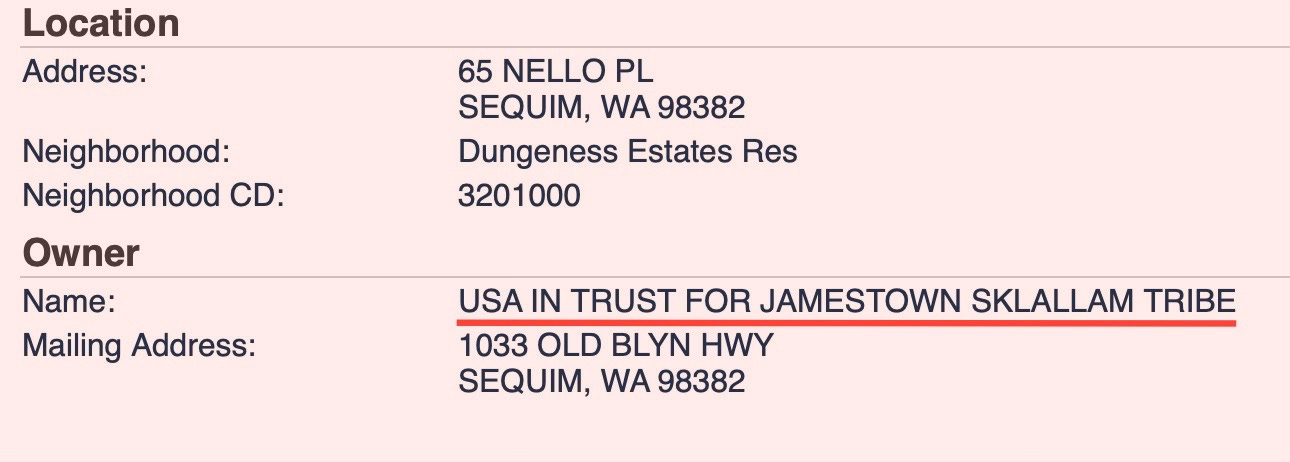
With those transfers, approximately $25,000 in annual property taxes disappears from the local tax base—funding that would otherwise support schools, fire districts, hospitals, veterans services, and essential government operations.
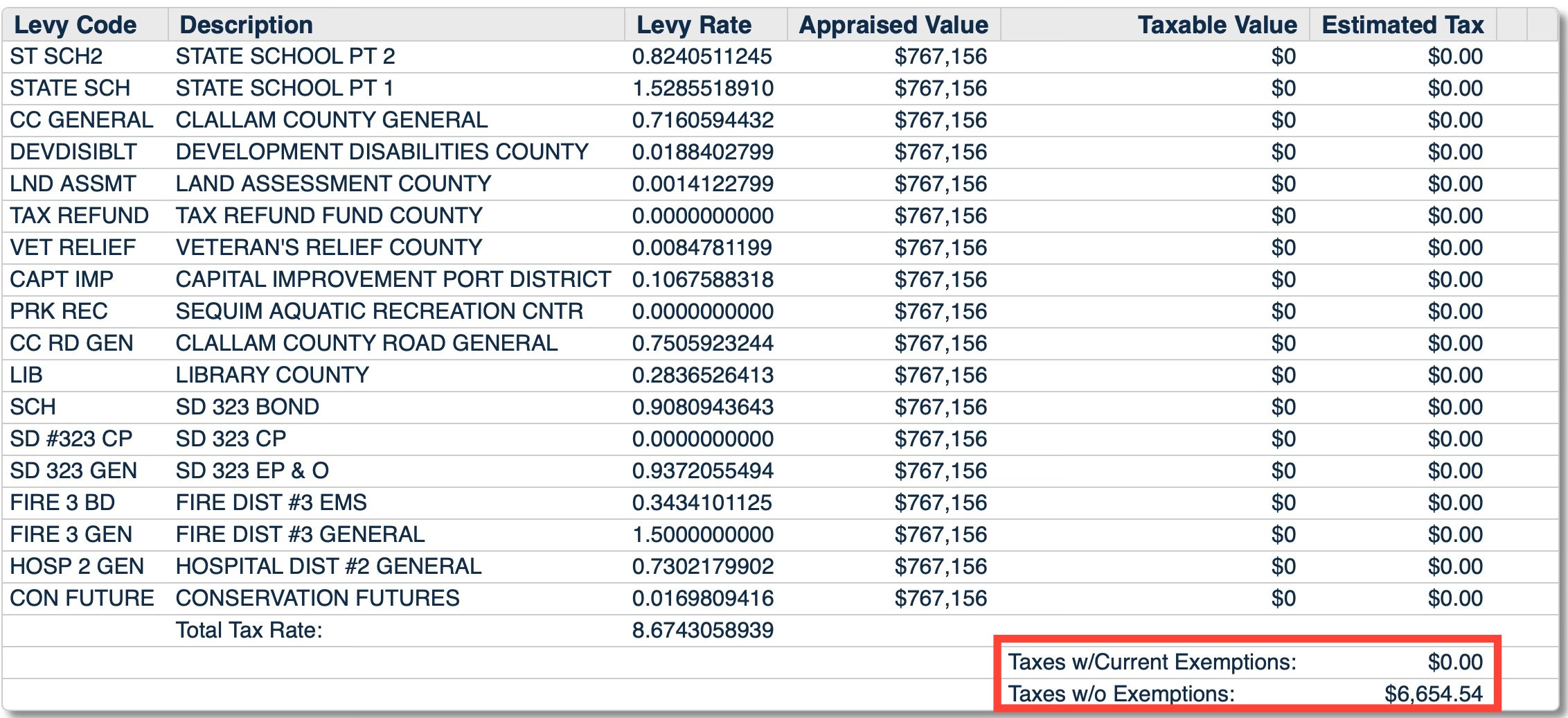
That burden doesn’t vanish.
It shifts.
The Next Transfer—and the Same Silence
Last week, the Bureau of Indian Affairs notified Clallam County that 9.22 acres off Silberhorn Road in Sequim had been approved for land-into-trust acquisition.
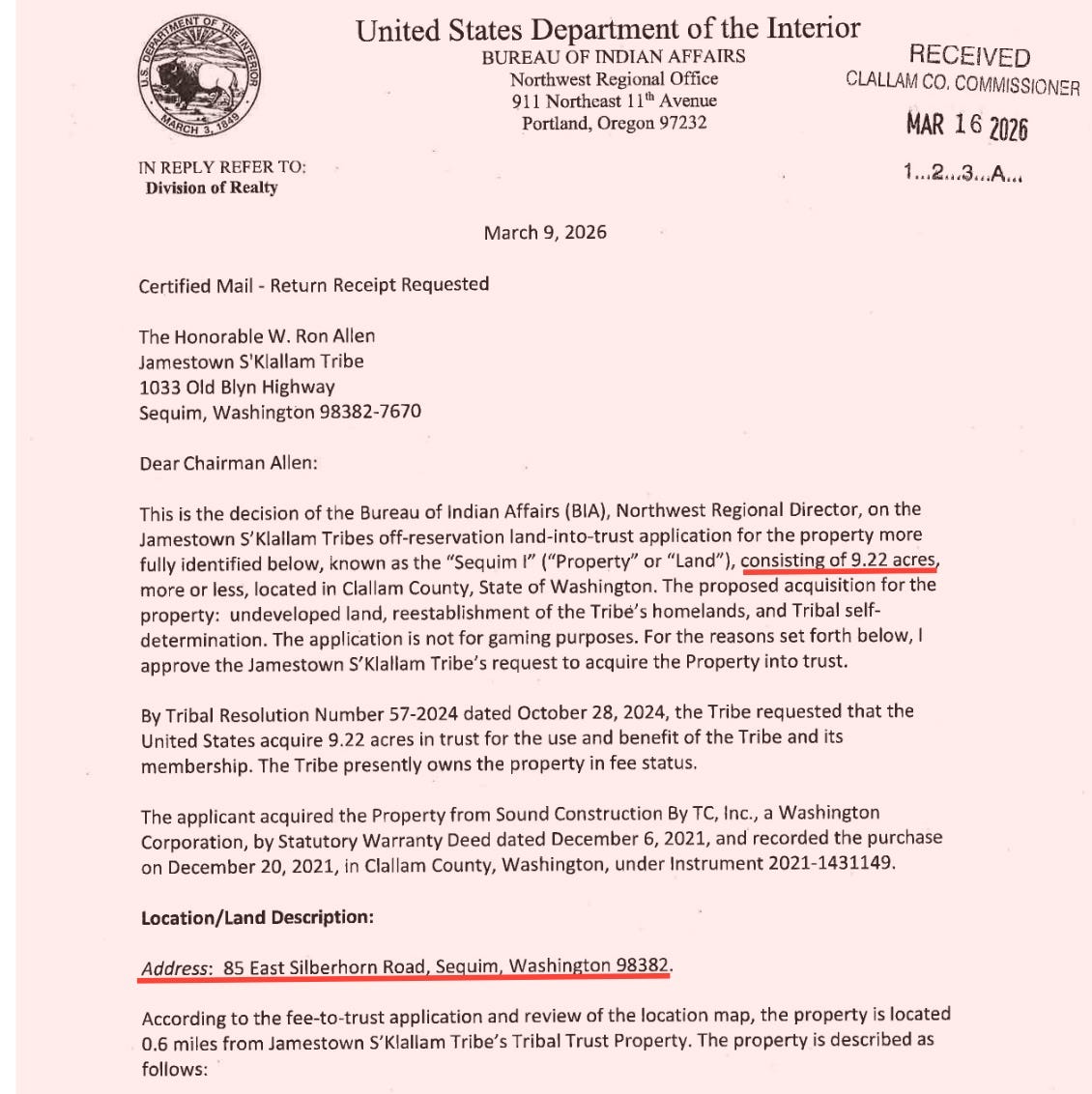
The justification:
“The acquisition furthers tribal interests by facilitating Tribal self-determination and reestablishment of the Tribe’s homelands.”
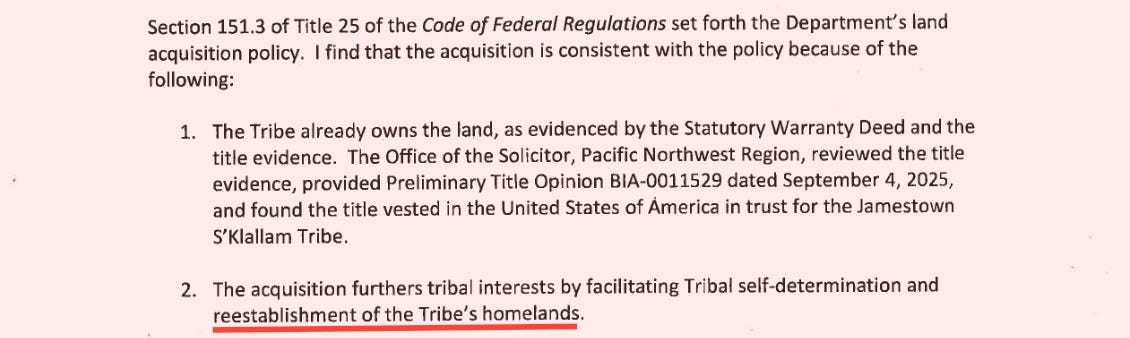
But buried in that same notice is something just as important:
The county was notified of the application nearly a year ago
The county’s response was recorded as “absent”
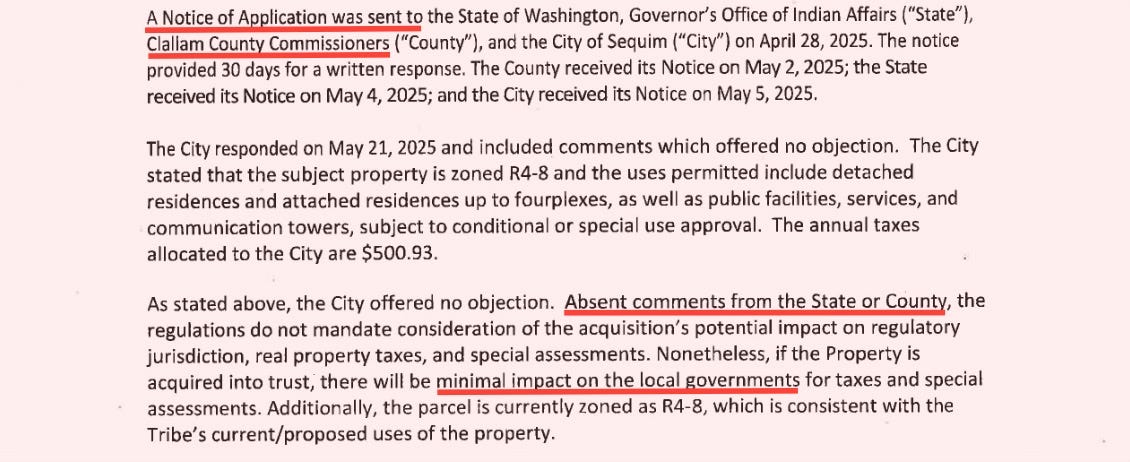
Not opposed.
Not supportive.
Not even neutral.
Absent.
For over a decade, federal agencies have asked Clallam County to comment on these transfers—on tax impacts, land use, and long-term consequences. And for over ten years, the county has refused to respond.
In practice, silence becomes consent.
“We Do Not Have a Role?”
A week ago, Commissioner Mike French offered two explanations that deserve closer scrutiny.
First, he suggested that concerns raised about land transfers do not reflect the broader public. He stated that the opinions expressed at public meetings requesting that the commissioners respond to the BIA “do not align” with what he hears from a majority of his constituents regarding how he should interact with tribes.
Second, he made a more sweeping claim about the county’s responsibility:
“We do not have a role,” he said, arguing that because the federal government enters into treaties with tribes, counties have no authority in these matters and that this is “very clear” in the Constitution.
That would be a convenient explanation—if it were true.
It isn’t.
Because the federal government itself tells a different story.
The Bureau of Indian Affairs doesn’t send letters for show. Those notices are part of the official process and are specifically intended to gather local government input on taxation, land use, and community impacts.
If counties truly had no role, those letters would not exist.
But they do.
Which brings this back to the real issue:
Not whether the county has a role — but whether county leadership is choosing not to use it.
The Math Is Not Debatable
At a recent presentation to the Clallam County Democrats, County Administrator Todd Mielke explained it clearly:
“If anyone is exempt from paying taxes, that doesn’t mean the amount collected is less… that amount gets shifted to others.”
This is not political opinion. It is how property tax systems function.
When land moves into trust:
It no longer pays property tax
The levy remains
The remaining taxpayers make up the difference
Fewer contributors. Higher burden.
In a county already struggling with affordability, that matters.
The Narrative Driving These Transfers
Every one of these transfers is justified with the same language:
“ancestral lands”
“traditional territory”
“time immemorial”
“restoring homelands”
The Jamestown S’Klallam Tribe’s history is described as being “faced with the threat of forced relocation by European colonizers” and speaks of returning to its ancestral lands.
It is a powerful narrative.
But it is not the whole story.
What the Map Doesn’t Show
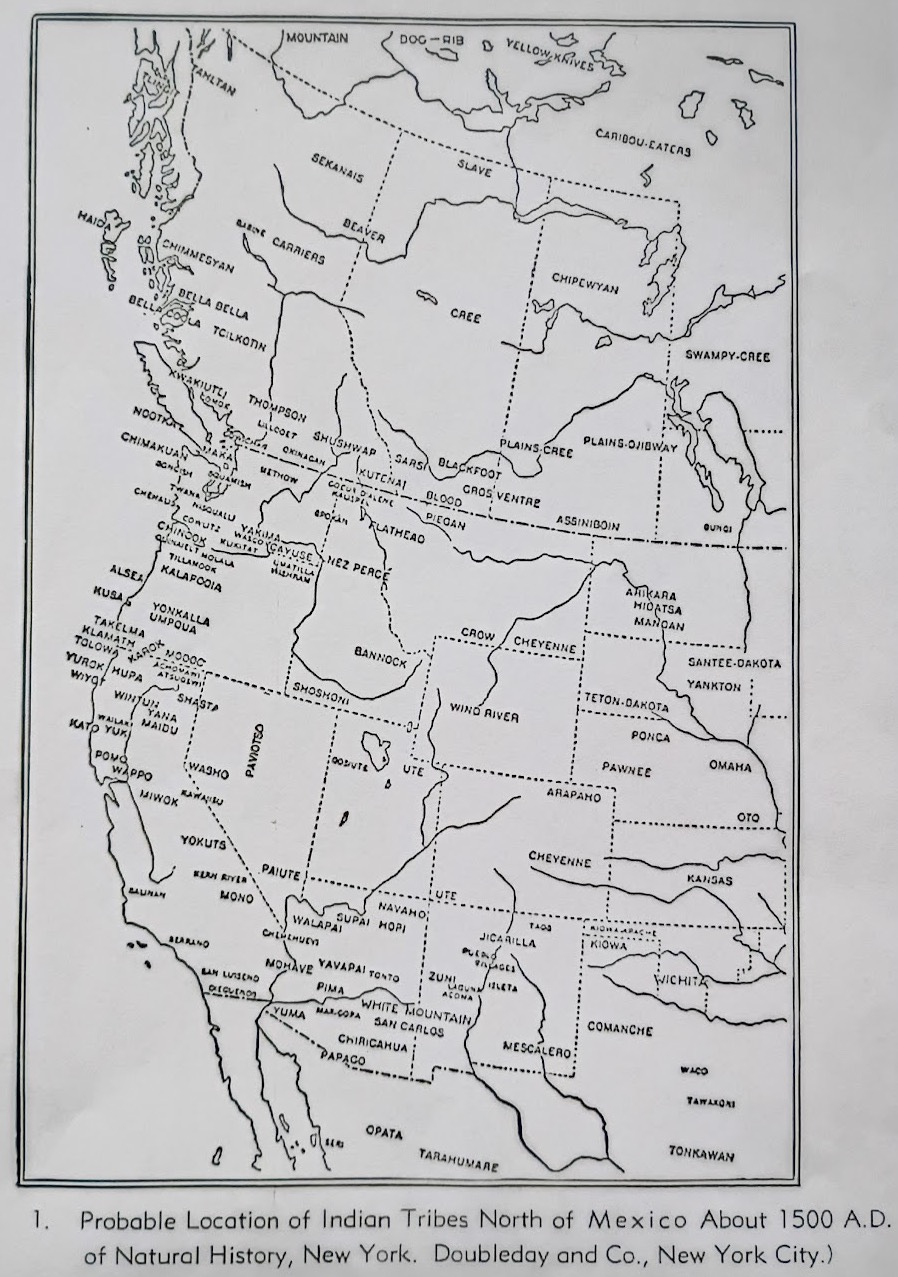
A Natural History map, published by Doubleday, shows “probable locations of Indian tribes north of Mexico around 1500 A.D.”
That map is important.
Because what it doesn’t show is just as telling as what it does.
It identifies groups like:
Makah
Chimakuan
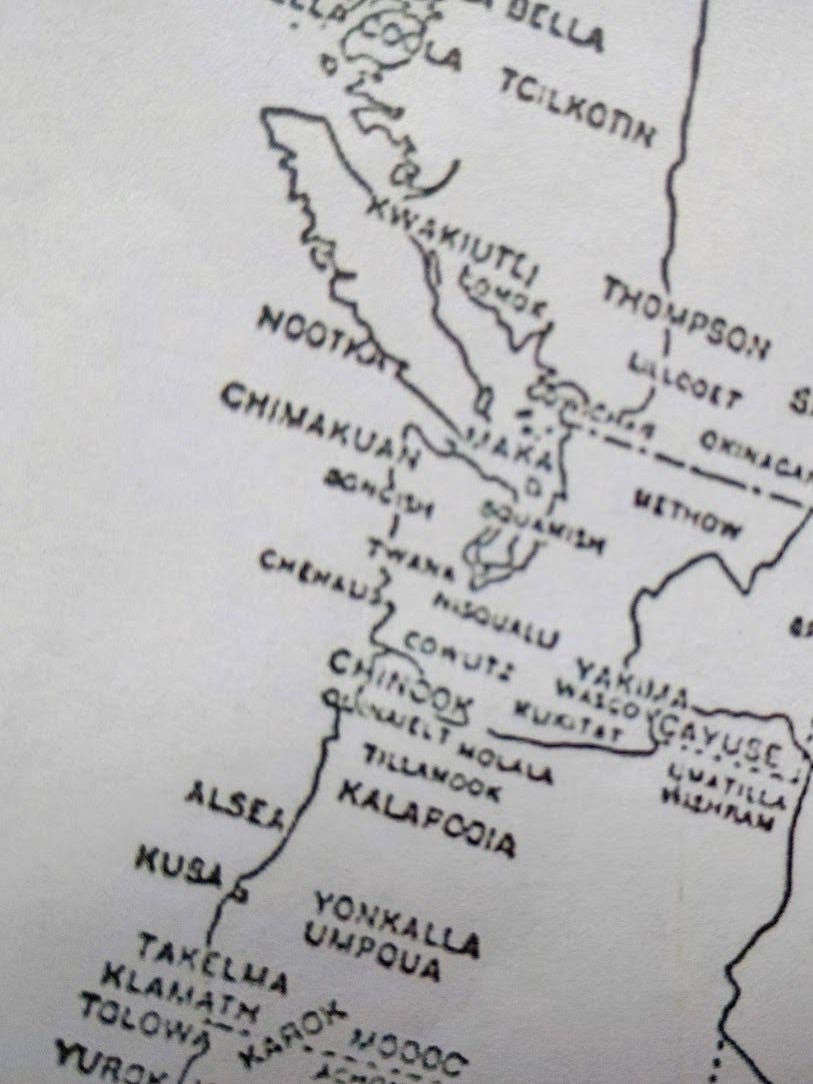
But it does not clearly identify the modern S’Klallam tribes or bands—Elwha, Jamestown, or Port Gamble—as distinct entities in the way they are framed today.
That alone should raise a question:
If modern claims rely on “time immemorial” presence in specific locations, why do historical and anthropological records show a far more fluid and shifting reality?
The Chemakum: A People Nearly Wiped Out
According to the Chemakum’s own history—and supported by Quileute accounts—the north Olympic Peninsula was once occupied by Chimakuan-speaking peoples, including both the Chemakum and Quileute.
They were not newcomers.
They were not temporary.
They were there.
Their own account states that the Makah moved down from Vancouver Island and the S’Klallam moved into the region from the north, gradually pushing Chimakuan peoples eastward into the Port Townsend and Chimacum areas.
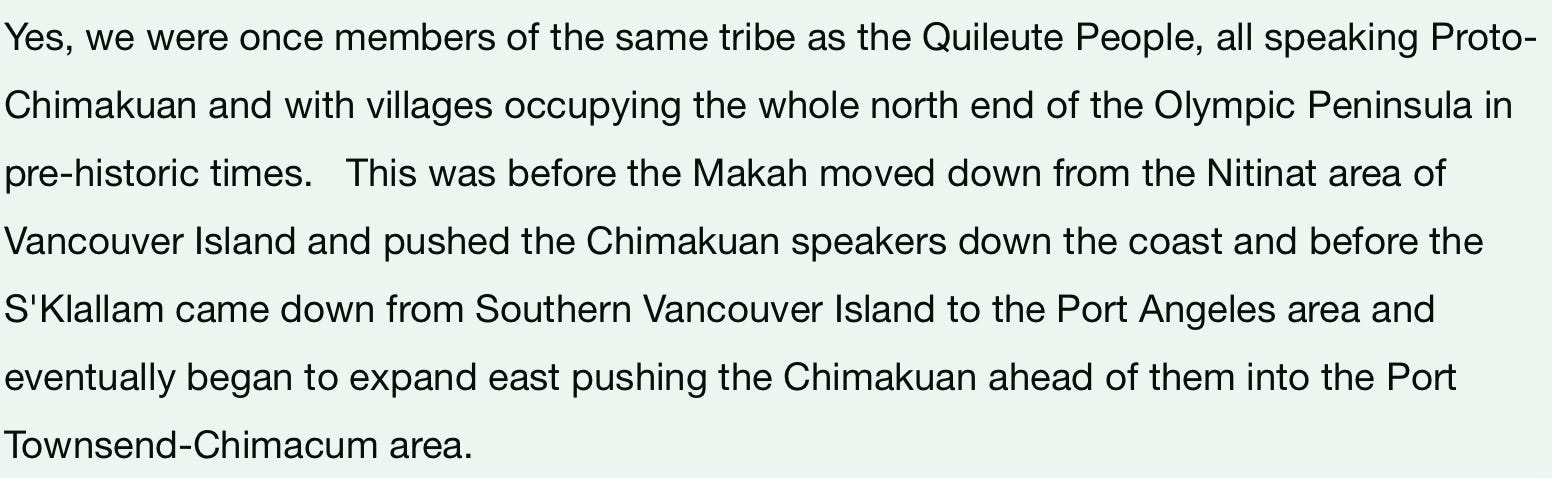
That is not coexistence.
That is displacement.
And it did not end there.
The Attack That Ended a People
One of the most documented events in this history is the 1847 coordinated attack on the Chemakum.
Historian David Buerge describes how S’Klallam and Suquamish forces joined together with a specific goal: to destroy the Chemakum.
The account is direct:
Raiders arrived under cover of darkness
They hid and waited
When families emerged, they were shot
The village rushed to defend itself
The attackers entered
Then came the end:
Chemakum men were killed
Women and children were taken as slaves
The village was burned
What remained was described as the smoking ruins of the last Chemakum stronghold.
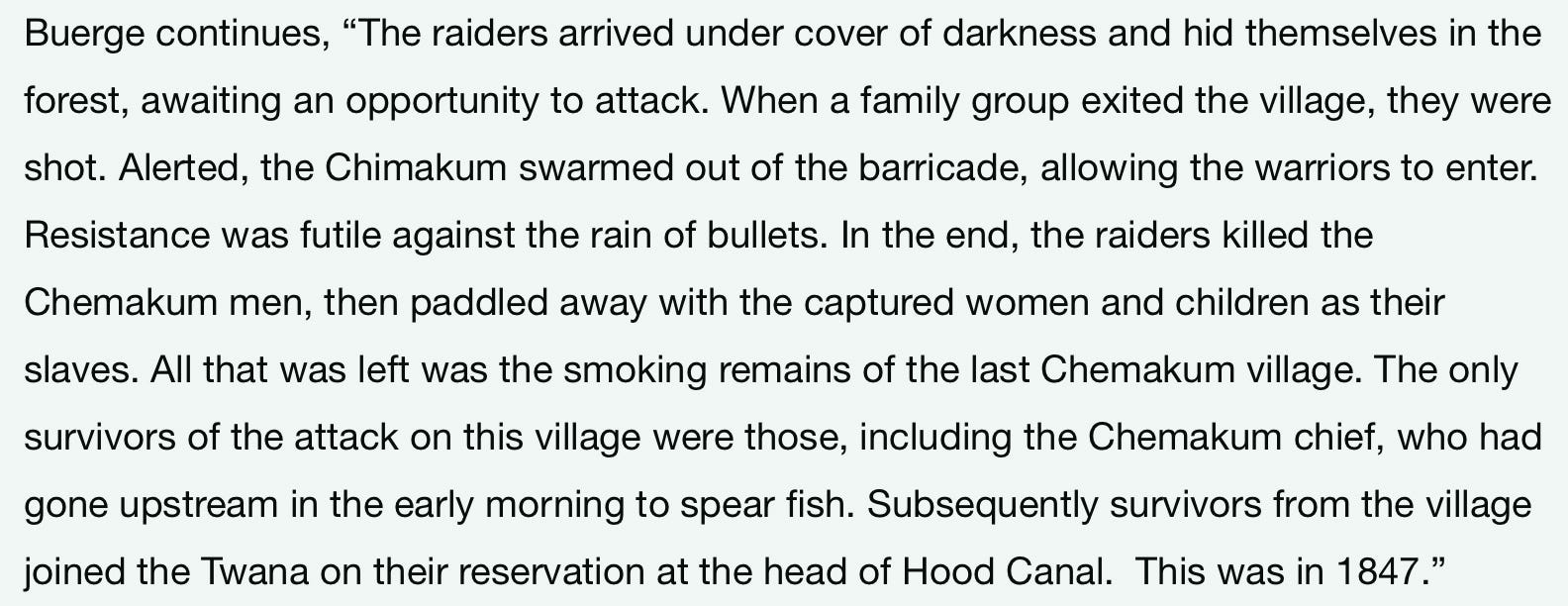
The only survivors were those who happened to be away at the time.
That is not a minor historical footnote.
That is the destruction of a people.
Genocide—A Word That Fits the Record
This is what followed.
Survivors were scattered
Many were enslaved
Others were absorbed into neighboring tribes
Federal agents later reclassified remaining Chemakum as S’Klallam
Their identity as a distinct people effectively disappeared
Their territory?
Awarded decades later to the S’Klallam by the Indian Claims Commission—on the basis that the Chemakum had “abandoned” it.
Abandoned?
After being attacked, enslaved, and erased?
If genocide includes:
killing
forced dispersal
enslavement
cultural erasure
Then the Chemakum story fits that definition far more closely than most are willing to acknowledge.
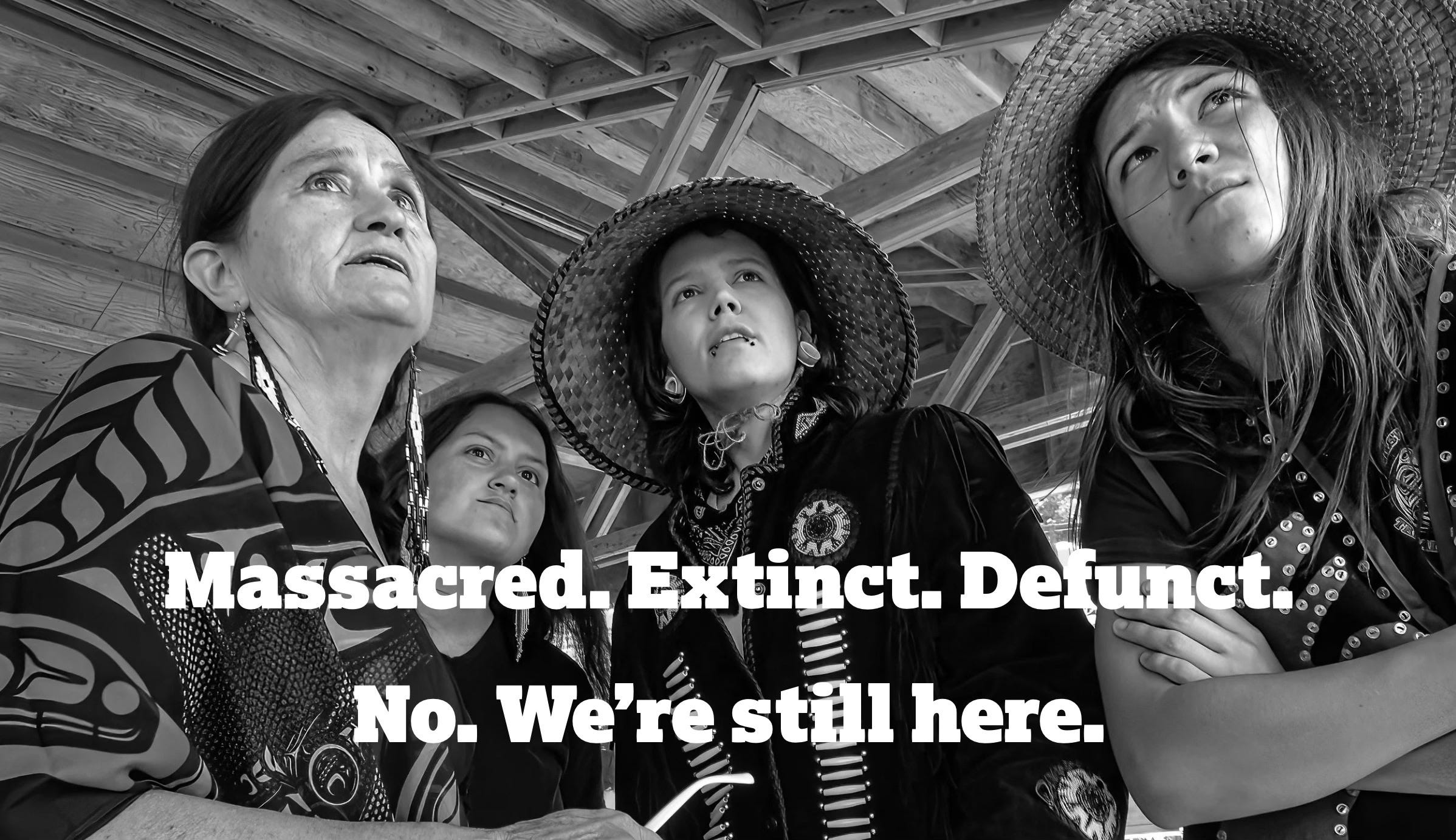
And yet, in modern conversations about “historical injustice,” the Chemakum are almost never mentioned.
The Quileute Connection
The Quileute Tribe—the closest linguistic and cultural relatives of the Chemakum—preserve a parallel account.
Their history describes the Chimakuan people as kin, separated long ago, and recounts that the Chemakum were ultimately wiped out, leaving the Quileute without their closest relatives.
This is not an outsider’s claim.
It is part of the historical memory of a living tribe.

Selective History, Real Consequences
Today, land transfers are justified using simplified language:
“restoration”
“homelands”
“ancestral territory”
But those terms omit key realities:
Tribal territories shifted over time
Migration occurred
Warfare reshaped the region
Entire groups were destroyed
Ignoring that history does not make it irrelevant.
It makes the public conversation incomplete.
Meanwhile, Back in the Present
While this narrative is being used to justify land transfers:
Property is leaving the tax rolls
The burden on remaining taxpayers increases
Local governments lose revenue
And elected officials remain silent
For more than two years, residents have asked commissioners to do something simple:
Respond to the BIA. Document the impact. Represent the public.
Instead, the record shows:
Nothing.
The Real Question
This is not about denying tribal history.
It is about acknowledging all of it.
It is not about opposing sovereignty.
It is about demanding accountability from local leadership.
And it is not about rewriting the past.
It is about refusing to accept a version of history that is selectively told to justify present-day decisions with real financial consequences.
The Bottom Line
The story of this land is not simple.
It is not clean.
And it is not one-sided.
Before federal policies, before treaties, before modern politics—this land was shaped by conflict, displacement, and, in the case of the Chemakum, the near destruction of an entire people.
Today, land is being transferred in the name of justice.
But justice requires honesty.
And right now, Clallam County is getting only part of the story.
While land changes hands…
while taxes shift…
while history is simplified…
Your elected officials remain exactly where the federal record says they are:
Absent.
Today’s Tidbit
What important work is the Clallam Conservation District doing to represent the public interest—especially now that county commissioners have agreed to direct $2 million in taxpayer funding to the CCD over the next decade through the $5 parcel fee (a fee not paid on parcels held in tribal trust)?
So far, one example stands out.
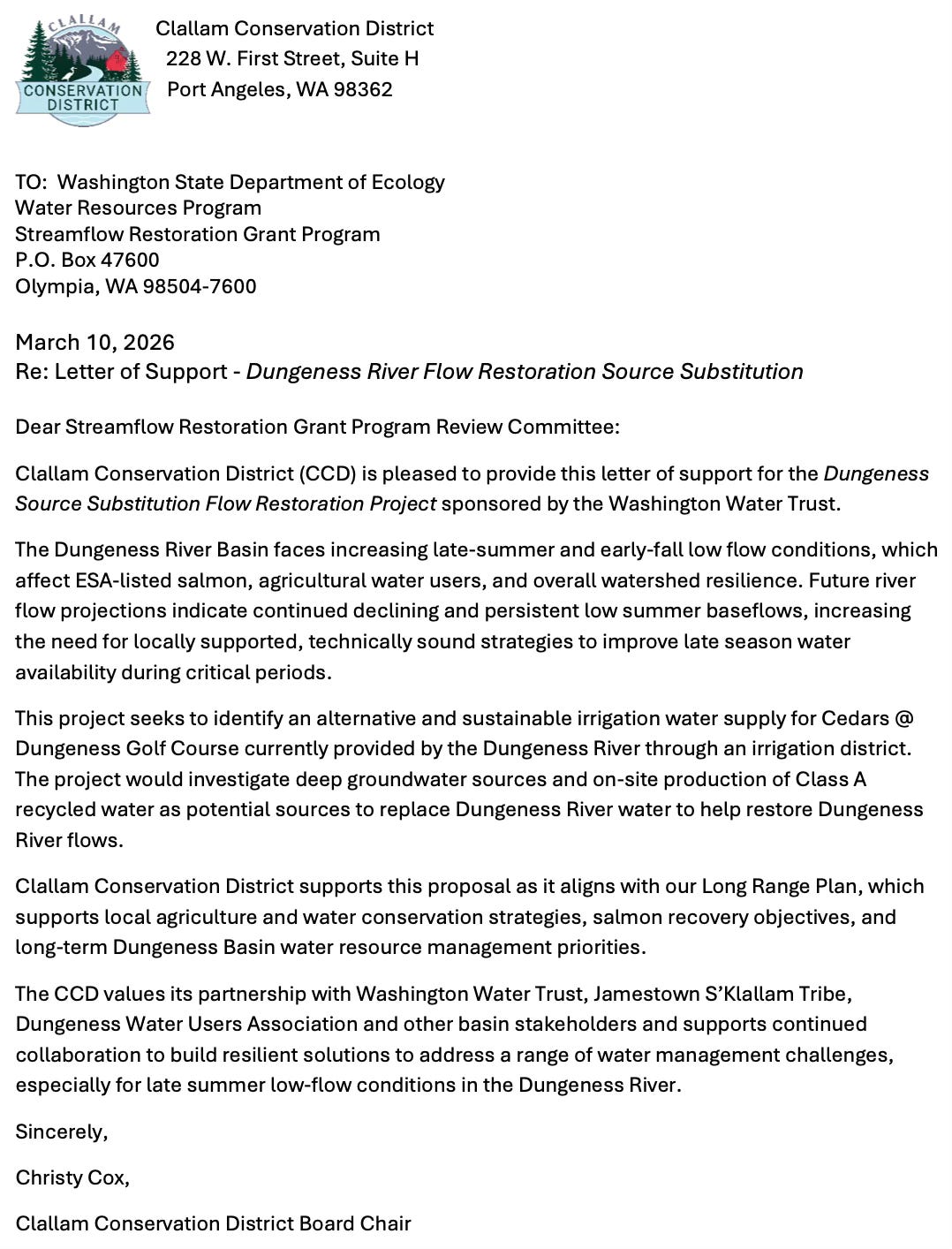
The CCD has submitted a letter of support to the Washington State Department of Ecology backing a project to “identify an alternative and sustainable irrigation water supply for Cedars @ Dungeness Golf Course” owned by the Jamestown Corporation.
According to the letter, that includes investigating deep groundwater sources and recycled water options.
Translation: the CCD is supporting a proposal for the Jamestown Corporation to drill a deep well to irrigate its award-winning golf course—located within the Dungeness Water Rule area, where water access and usage are already tightly constrained for others.
At a minimum, that raises a fair question:
Is this what taxpayers were told they were funding?