


A letter obtained through a public records request highlights a growing gap between what residents are experiencing and how county leadership is responding. After years of reporting crime and watching conditions deteriorate, a Port Angeles resident wrote directly to county commissioners asking for accountability and a change in direction. Commissioner Mike French’s reply is sympathetic in tone, but it largely falls back on the same explanations and approaches residents say have failed—while glossing over clear contradictions in policy around sobriety, public safety, and the use of taxpayer dollars. Once again, the message to residents is to “stay engaged,” even as the same strategies continue unchanged.
A Resident’s Reality, Put on the Record
In a letter sent to the Clallam County Board of Commissioners and later obtained through a public records request, a local resident described a sharp contrast between past and present life in Port Angeles.
After decades living in Chicago and then in Freshwater Bay without incident, she now reports repeated break-ins, encampments, public drug use, and violent behavior near her current home above Country Aire. Police have been called numerous times. Incidents have been documented. Security cameras have captured attempted break-ins. And yet, she writes, many neighbors have stopped reporting problems altogether—because nothing seems to change.
Her concerns were not theoretical. They were specific, detailed, and rooted in years of lived experience. She asked county leaders to acknowledge that the current approach is not working and to move toward policies that put safety, accountability, and measurable results first.


The Commissioner’s Response—and the Problem With It
Commissioner Mike French was the only commissioner to respond. He did so personally. His tone was polite. His suggestions were familiar.
First: keep filing police reports.
But this is exactly what the resident said she has been doing for years, without improvement. More reports have not translated into visible enforcement, deterrence, or relief. Telling residents to keep doing what has already failed is not a solution—it’s a stall.
Second: promote the Downtown Resource Officer.
Commissioner French pointed to the co-funding of a Port Angeles Downtown Resource Officer as evidence of investment in public safety. But a widely circulated video of a violent assault on a Clallam Transit operator raises serious questions about how effective that investment actually is.
In the video, a passenger punches the driver, struggles over a knife, is dragged off the bus by other riders, continues grabbing at them, calmly unloads his bike from the front rack, and rides away. Throughout the incident, the operator is calling for help by phone and radio. No officer arrives during the entire encounter.
The Downtown Resource Officer works out of an office at the Gateway Transit Center—roughly one block from where the assault occurred.
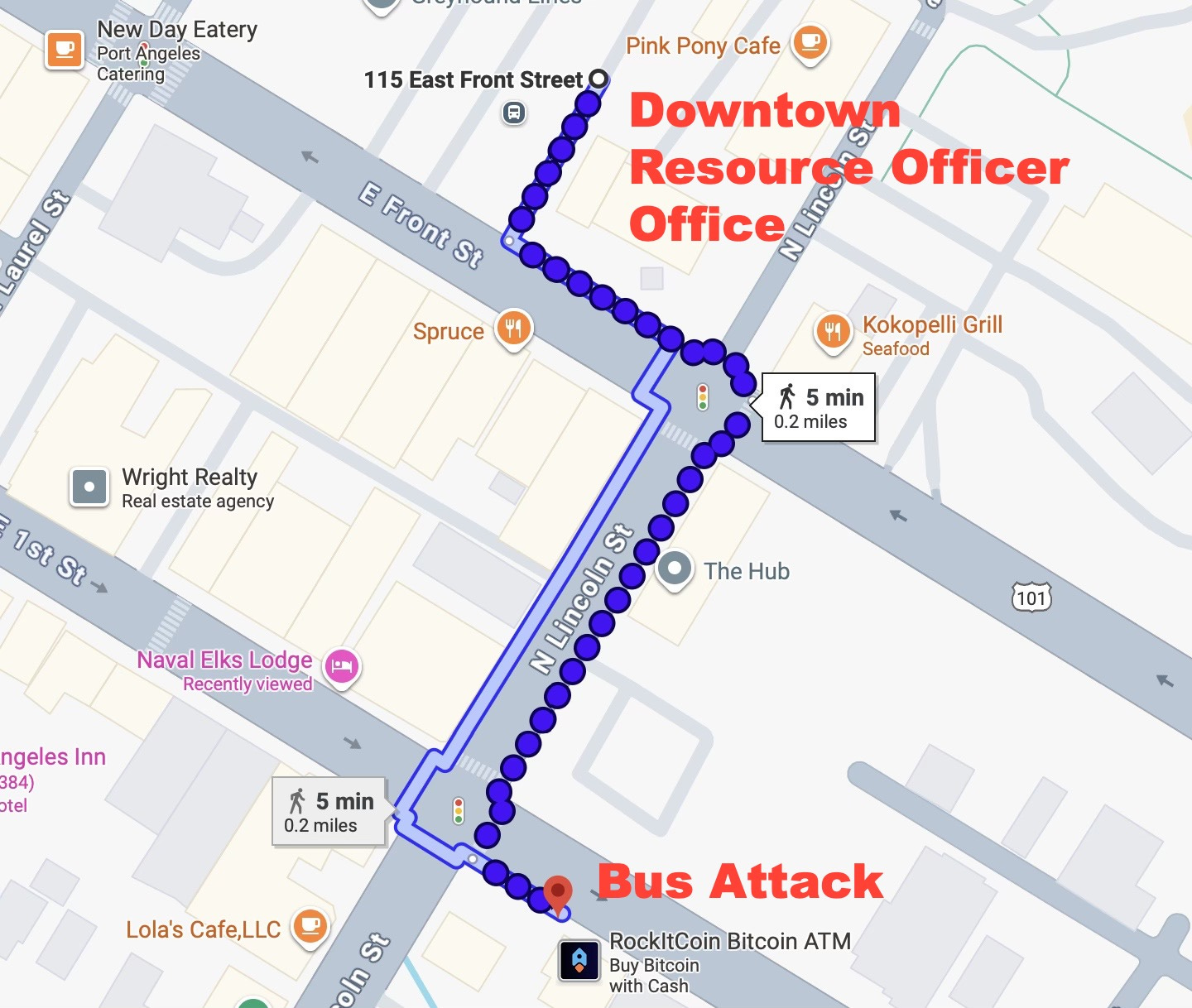
If this is what “investment in public safety” looks like in practice, residents are justified in asking what they are actually getting for their money.
Third: join a Facebook group.
Commissioner French also suggested participating in a Neighborhood Watch Facebook group. Social media engagement is not enforcement, deterrence, or policy. If Facebook groups were the answer, this problem would have been solved years ago.
Public Safety—Now, but Not Then
Commissioner French now presents himself as a proponent of increased public safety investment, urging residents to trust enforcement-based approaches and policing. That stance is difficult to reconcile with his own public statements from just a few years ago, when he wrote on Facebook: “My position is, property destruction is not only fine, it’s usually the only way we’ve seen actual change happen, accompanied by strikes.”
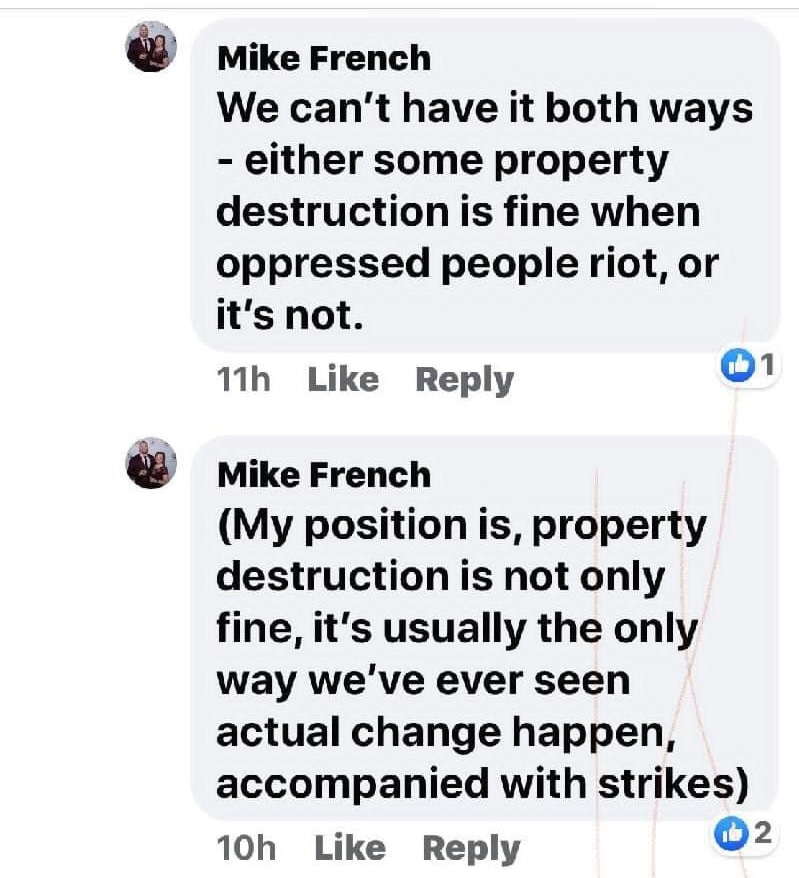
For residents dealing with repeated break-ins, vandalism, and growing disorder, that history matters. When an elected official once minimized—or even justified—property damage as a tool for change, it raises reasonable questions about how seriously those harms are taken today, and whether the shift in rhetoric reflects a real change in priorities or political convenience.
Harm Reduction: Course Correction or More of the Same?
Commissioner French wrote that he is “working with” substance-use organizations and hopes to “course correct” harm-reduction efforts. His recent votes suggest otherwise.
He supported:
An additional $100,000 for harm-reduction programs, and
A $25,000 study allowing Health and Human Services to review its own harm reduction data.
At the same time, Commissioner Mark Ozias has publicly stated there is already “ample evidence” that harm reduction is working.
There is no timeline for change, no definition of failure, and no acknowledgment that existing policies may be contributing to the problems residents are describing. Meetings have been canceled. Attendance has been inconsistent. And the public continues to hear reassurances—never admissions.
The Sobriety Question—and a Clear Policy Divide
Commissioner French asserted that Peninsula Behavioral Health’s new North View housing is intended for residents “not actively using substances.” Publicly available information and on-the-record statements suggest otherwise.
PBH’s own materials describe supportive housing models that do not require sobriety as a condition of entry or continued residency, and the organization’s treatment philosophy explicitly embraces harm reduction. In a public meeting, PBH’s CEO stated plainly that housing at North View is not exclusively dry.
There is no gray area here. Either sobriety is required, or it is not.
By contrast, another local nonprofit, 4PA, has adopted a clear high-barrier policy—no drugs, no alcohol, no ambiguity.
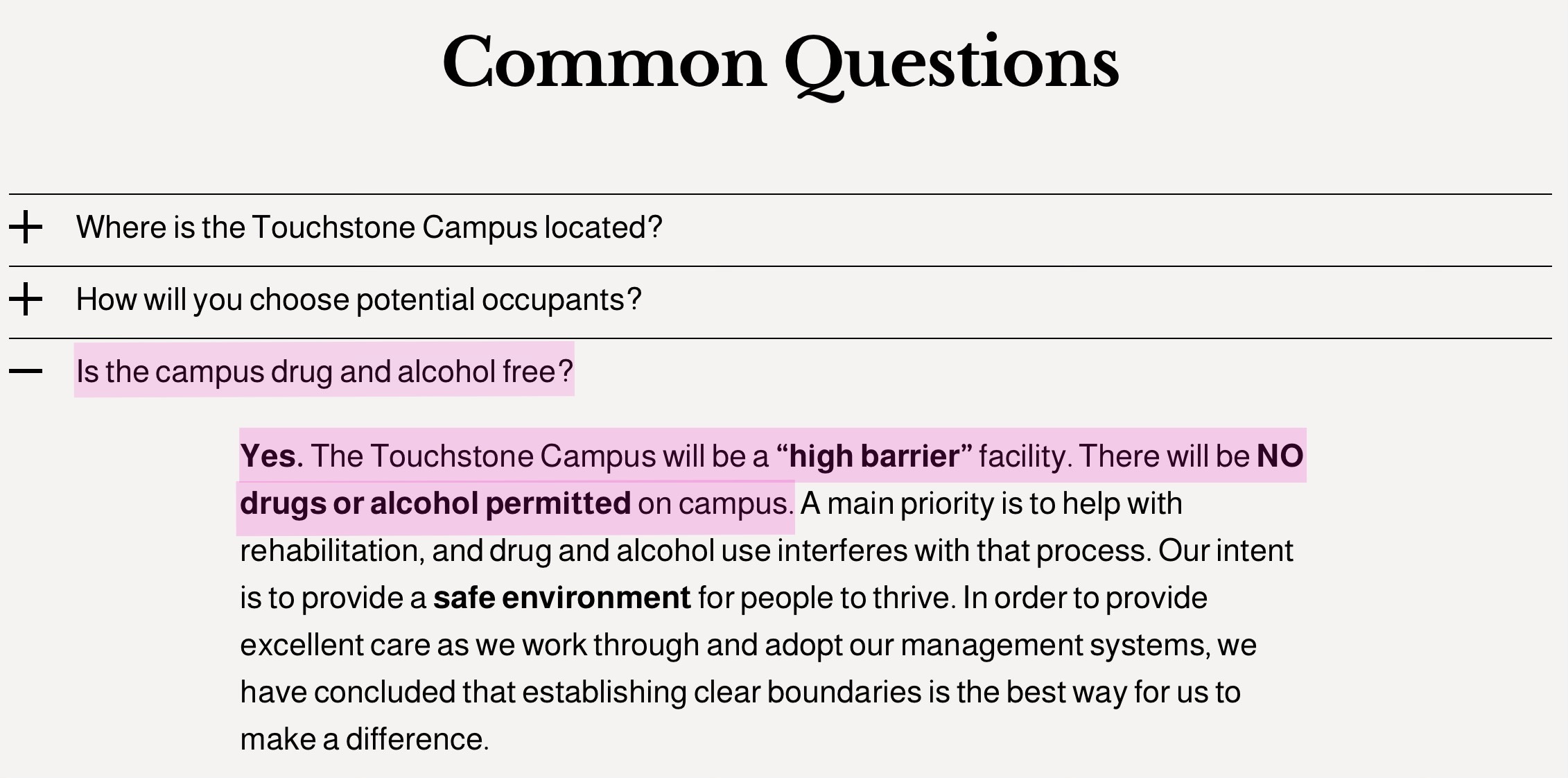
The reasoning is straightforward: rehabilitation requires firm boundaries, and safety depends on them. That approach also delivers housing at roughly 92% less per unit than Peninsula Behavioral Health’s model.
This is not a misunderstanding or a matter of nuance. It is a deliberate policy choice, and rebranding it does not change the underlying reality.
Deflection to NGOs—and the Accountability Gap
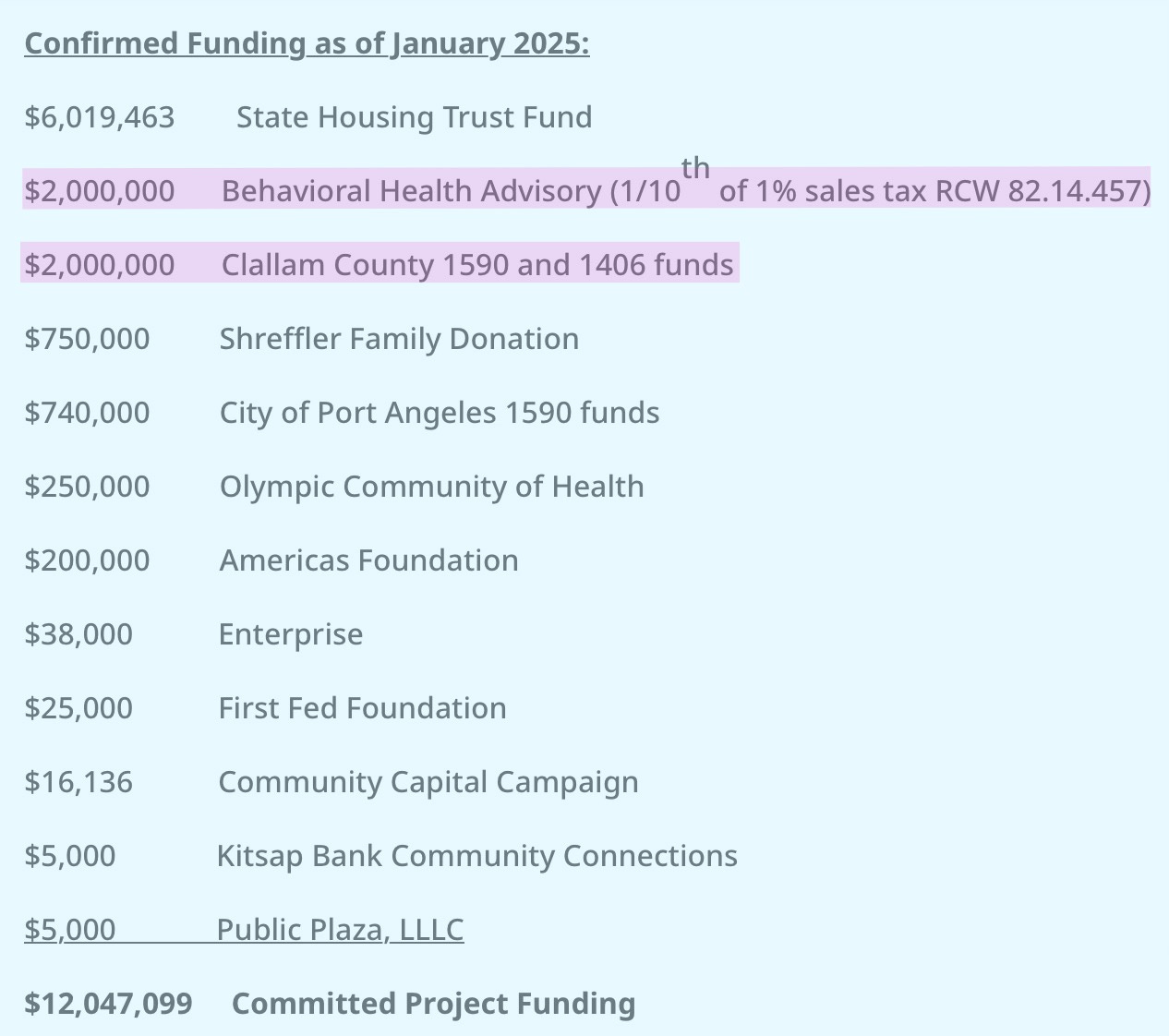
Commissioner French advised the resident to contact PBH’s CEO directly with concerns. PBH is not a government agency. It has no obligation to respond to residents, release records, or operate transparently—despite receiving millions in public funding approved by the commissioners.
When PBH previously provided false information about building requirements, it was the public—not county leadership—that corrected the record. When asked about accountability, Commissioner French dismissed further follow-up as “micromanaging,” stating that pursuing the issue did not interest him because it was not his “issue.” Today, PBH does not respond to CC Watchdog inquiries at all.
“I would also say, I am not interested in micromanaging a developer, I want it to be easy to build. I want everyone to be able to build housing units. I want public agencies to do less in the way of permitting and requirements. I want us to remove our regulations and restrictions so that it’s easy to build.
You seem to be interested in micromanaging the developer. In this case, I am not. So, again, that is not my issue, that’s your issue. So that’s what I would say about that. So, I’m not intending to reply to your email because I’m not interested in the subject matter. I’m not interested in micromanaging it.” — Commissioner Mike French
Directing residents to nonprofits for answers about publicly funded policy is not engagement. It is abdication.
“Stay Engaged” Is Not Leadership
Commissioner French closed his email by encouraging continued engagement, saying he cannot do his job without public input.
Yet residents describe unanswered emails, canceled meetings, missed attendance, and public comments dismissing scrutiny of spending and policy choices as unimportant.
The pattern is familiar:
File a report.
Call another agency.
Join another Facebook group.
Fund another study.
Wait.
What residents never hear is this:
We could have done better.
We need to change course.
This policy isn’t delivering what we promised.
Until that changes, the gap between rhetoric and reality will continue to grow—and public trust will continue to erode.
The Emails
Dear Commissioners,
I am writing in response to today’s Clallam County Watchdog: Sunday with Seegars article, which confirmed what I have long suspected: our county’s current approach is not working, and it is time to pivot.
My own experience illustrates the growing problem.
When I lived in downtown Chicago from 1995 to 2005, I only had to call the police once.
From 2005 to 2019, while living in the Freshwater Bay area of Port Angeles, I never had to call the police.
Since moving into town above County Aire, however, my condo neighbors and I have had to call the police multiple times.
I have personally endured three attempted break-ins while I was home (all caught on camera and reported), and I am aware of multiple car break-ins and at least one storage unit break-in among my condo neighbors. I also had to call the police when a man camped out on my elderly neighbor’s deck claiming to be our “security.” That same individual is now regularly cycling in and out of jail, as I discovered when his mug shot was published. Encampments have repeatedly formed between our condo building and Country Aire, and another one exists there today (see attached photos). Another time, I was in my car and unable to turn onto the street due to traffic, I witnessed a man clearly under the influence kicking out lights at Safeway before turning his aggression toward my vehicle by kicking the passenger door with me in the car. At this point, my neighbors and I don’t always report incidents or call the police anymore, because nothing ever seems to change.
We live in what feels like a vortex of agencies that unintentionally attract crime—the harm reduction center, the Health and Human Services building, and Safeway. I am deeply concerned that the new Peninsula Behavioral Health North View complex will not succeed if it does not enforce a strict no-drugs, no-alcohol policy. Its location, surrounded by ongoing issues, seems ill-suited for those striving to maintain sobriety.
Our community’s safety is at risk. We cannot continue pouring money into agencies and programs that are demonstrably failing and, in many cases, making the situation worse. I urge you to look to Jake Seegars’ article for solutions and to consider a new direction—one that prioritizes accountability, safety, and results over ineffective spending.
I know each of you personally, and I know how deeply you care about our county. My intent in writing is simply to share the perspective of someone living on the front lines of these challenges, in the hope that it helps inform your decisions moving forward.
Respectfully,
[name redacted]
Hi [name redacted],
Thanks for sending this email. I sympathize with your situation and am interested in solutions. Here’s a few things to think about:
The City of PA and Clallam Transit have co-funded a Downtown Resource Officer. It’s a good start, but it’s clearly not enough. At some point soon, there will probably be an opportunity to attempt to convince the City Council that it should enhance its investments in public safety (and specifically public safety in our central business district), and we will need affected residents to help make that case. I’ll try to keep you in the loop on this. Also, with this in mind - please continue to make police reports. Data helps inform decisions.
The PA Waterfront District is creating a Neighborhood Watch private Facebook group. If you’d like to participate, please reach out to Sam Grello at director@pawaterfront.org
I am currently working with some community substance use disorder treatment organizations capturing their feedback on the Harm Reduction Health Center. I hope to do some course correction with HHS based on that feedback - not eliminating harm reduction, but making sure that our activities aren’t counter-productive and that we’re actually motivating people to move toward better health outcomes and treatment.
PBH’s new building is intended for residents that are not actively using substances (including drugs and alcohol), and who are actively participating as a client of PBH. This is supported housing, which means ideally all the behavioral health supports are in place to help give their residents the best chance for success. The nuance is that our state’s landlord-tenant laws do not allow a landlord to evict solely because of substance use. This nuance has been explained to Mr. Tozzer and Mr. Seegers. I would strongly suggest you reach out to Wendy Sisk and speak to her directly, if you have concerns as a nearby property owner. Her email is wendys@peninsulabehavioral.org, and I’m sure she’d be interested in speaking with you.
Please stay engaged with me on this. I can’t do my job without input from affected folks. I appreciate you reaching out and I really do want to move us toward solutions on these complex issues.
Mike French


