

A simple email exchange between a Clallam County resident and Habitat for Humanity reflects a growing frustration across the county: taxpayers fund projects, commissioners celebrate the spending, and nonprofits ask for more money, but when citizens ask basic questions about results or accountability, the answers become vague. From stalled housing projects to nonprofit financial failures, the same pattern keeps repeating itself while residents asking questions are treated like the problem.
“The Project Is Not at the Stage to Share This Information Yet”
A short email exchange between a Clallam County resident and Habitat for Humanity of Clallam County may perfectly capture the culture that now defines local government.
The resident asked a simple question: What project was using the $800,000 the Clallam County Commissioners approved for Habitat through the county’s Opportunity Fund?
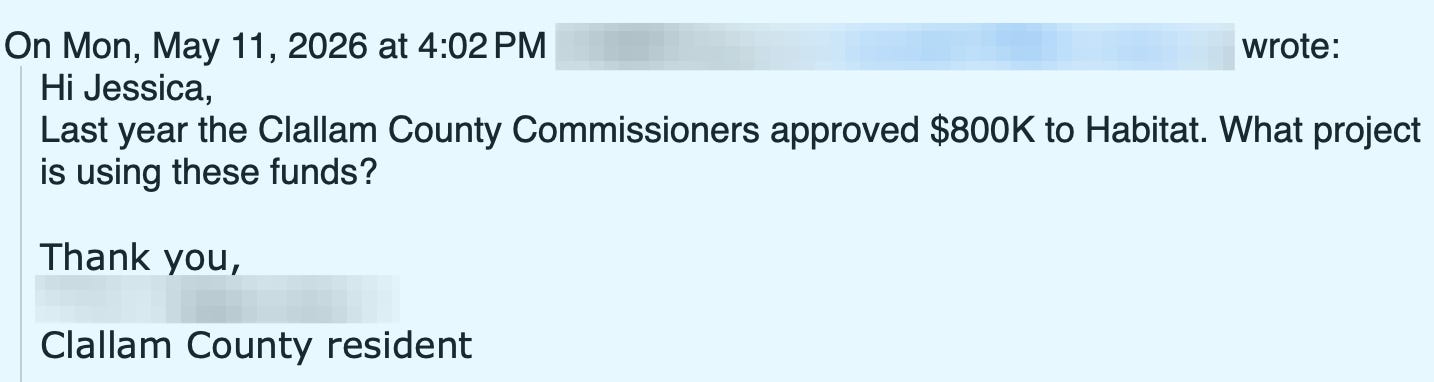
The money, Habitat explained, was going toward “Lyons Landing,” a proposed 45-home development in Carlsborg.
Then came the obvious follow-up question: Can taxpayers see the grant numbers, project numbers, and cost centers to understand how the money is being spent?
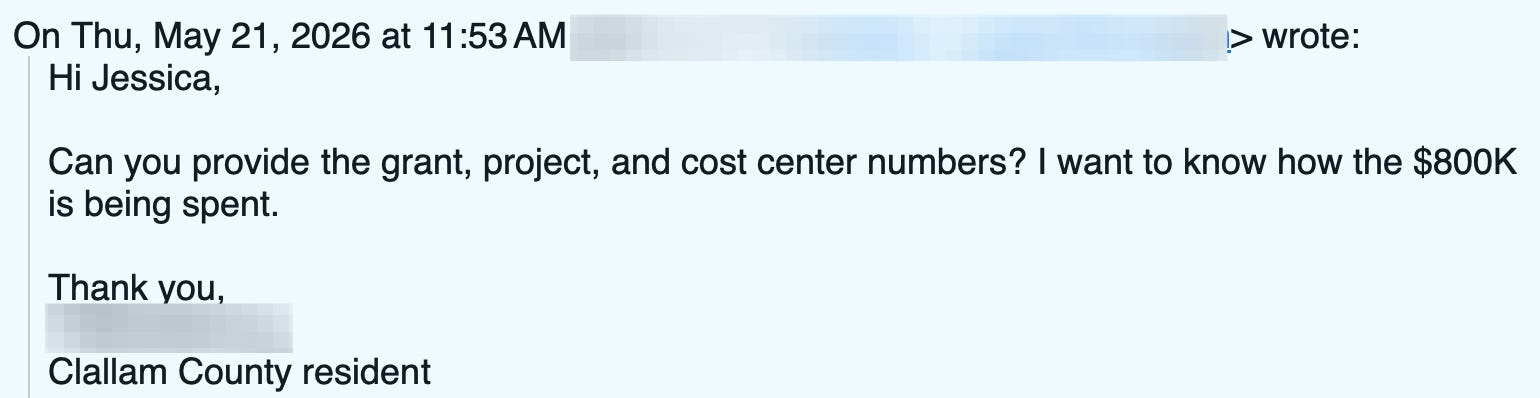
That answer was different.
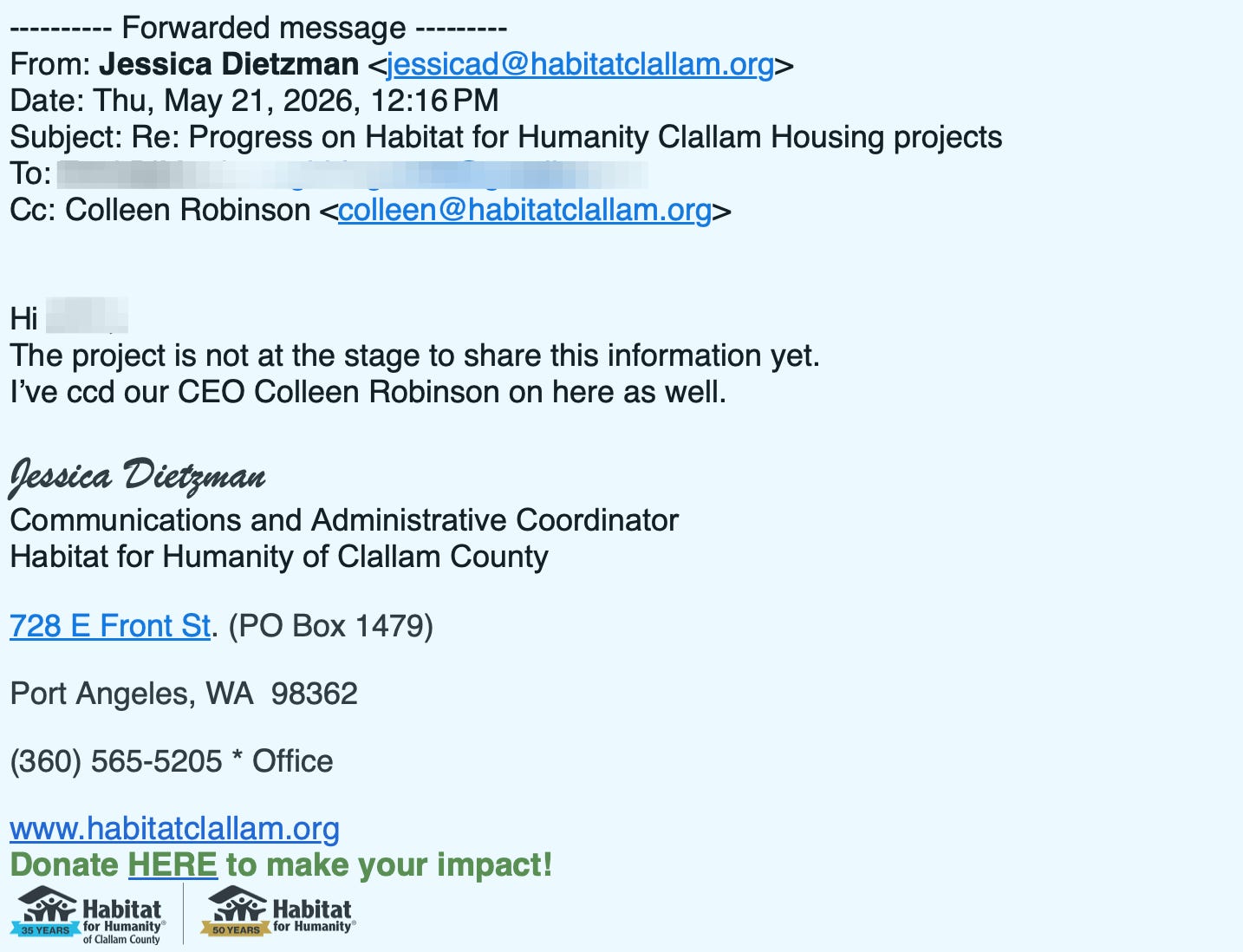
“The project is not at the stage to share this information yet.” Habitat’s CEO, Colleen Robinson, was copied on the exchange more a week ago and, as of publication, has not responded to the resident’s questions.
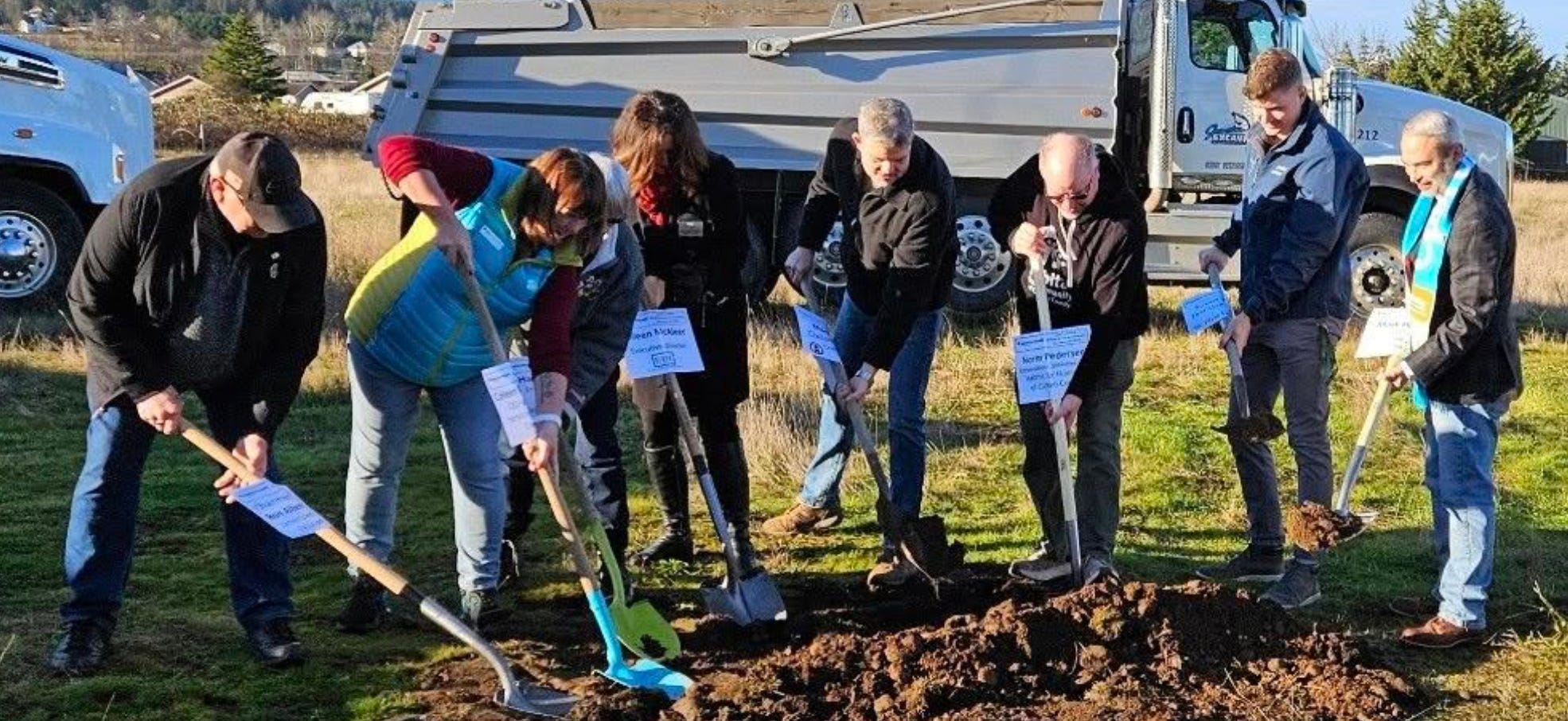
It has now been a year and a half since county commissioners approved the funding. Aside from a ceremonial groundbreaking photo opportunity featuring county officials, Habitat leadership, and tribal representatives standing together with shovels in a vacant lot, little work has occurred on the property north of Sunny Farms in Carlsborg.
And that response — “we’re not ready to share that information yet” — says a great deal about how Clallam County now operates.
Public Money, Private Transparency
To be fair, Habitat for Humanity is legally within its rights. It is a nonprofit organization, not a government agency. Once taxpayer money leaves county government and is handed to an NGO, much of the public transparency disappears with it.
Citizens cannot demand internal budgets the way they can from government departments. Public records laws no longer apply in the same way. The money may have originated from taxpayers, but once it changes hands, public visibility ends.
That is exactly why oversight before funding approvals matters so much.
The controversy surrounding Lyons Landing began in late 2024 when the Opportunity Fund Advisory Board recommended awarding Habitat $800,000 for the project. The Opportunity Fund collects a portion of local sales tax revenue and distributes it to economic development projects throughout the county.
Problems emerged after it became public that Habitat did not intend to competitively bid major portions of the development. Instead, significant excavation, surveying, and concrete work was expected to go to Jamestown Corporation businesses. The issue raised eyebrows because Jamestown Corporation had also donated $50,000 to Habitat for Humanity.
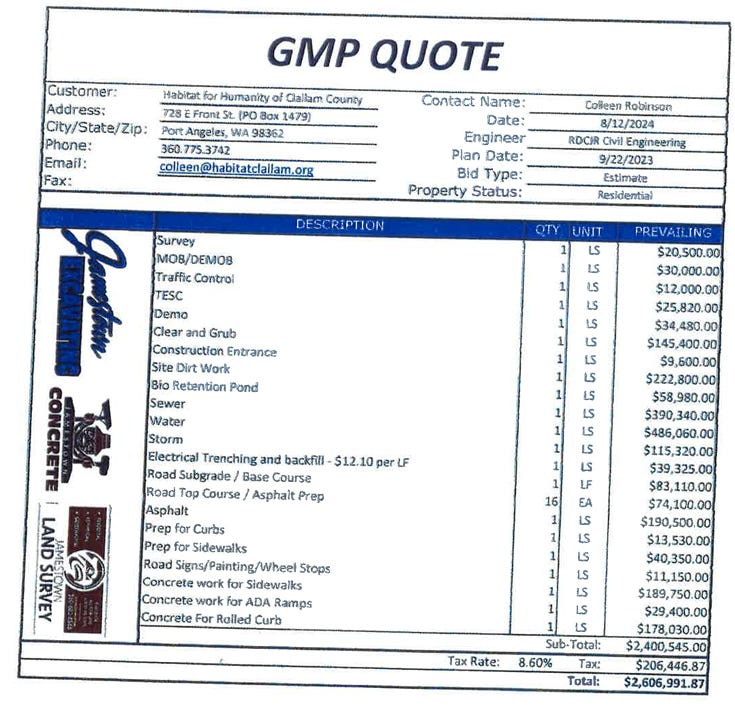
The county paused the award for months while legal review examined whether public funds could legally be used in a project structure that appeared to bypass traditional competitive bidding requirements intended to protect taxpayers and ensure fair pricing.
Eventually, the funding was approved.
Today, the property still sits vacant.
That makes the public’s questions entirely reasonable. What work has been completed? How much of the $800,000 has been spent? What exactly are taxpayers funding?
Instead of answers, the public is increasingly told to simply trust the process.
When Journalism Starts Reading Like Advertising
At the same time taxpayers are being denied answers, local newspapers continue publishing glowing nonprofit-written features celebrating community partnerships, fundraising dinners, wine tastings, and awareness campaigns.
One recent Habitat for Humanity article spent far more time discussing silent auctions, wine festivals, and “turning strangers into supporters” than it did discussing measurable housing production.
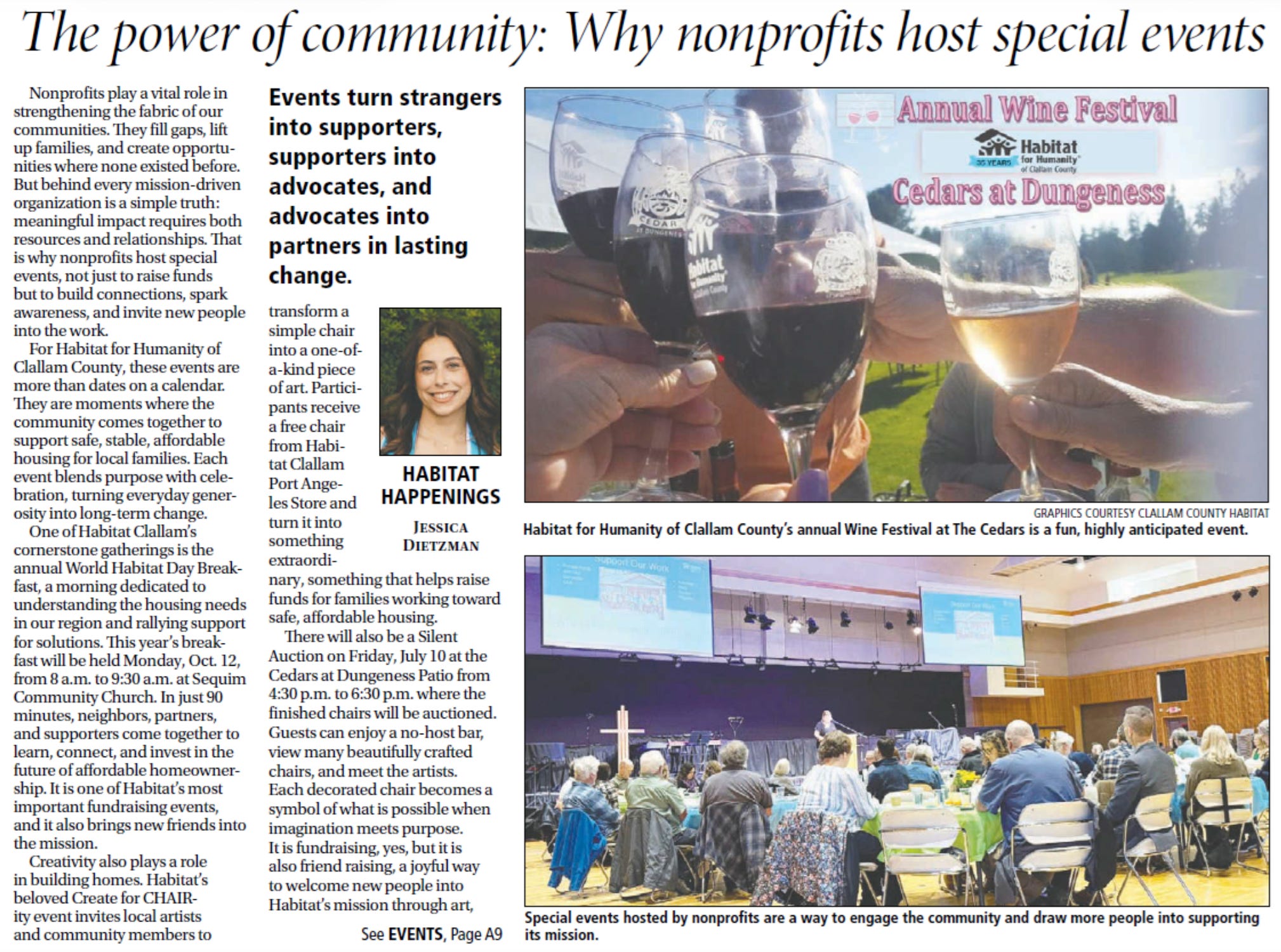

Readers were told repeatedly how important Habitat’s mission is and why the organization needs continued support. What readers were not told was how many homes Habitat is currently delivering annually, how much each completed housing unit costs, how long projects are taking, or how much taxpayer money is now flowing into the organization from local government sources.
Another detail stood out as well. Many of Habitat’s major fundraising events are hosted at Jamestown Corporation properties, including Cedars at Dungeness.

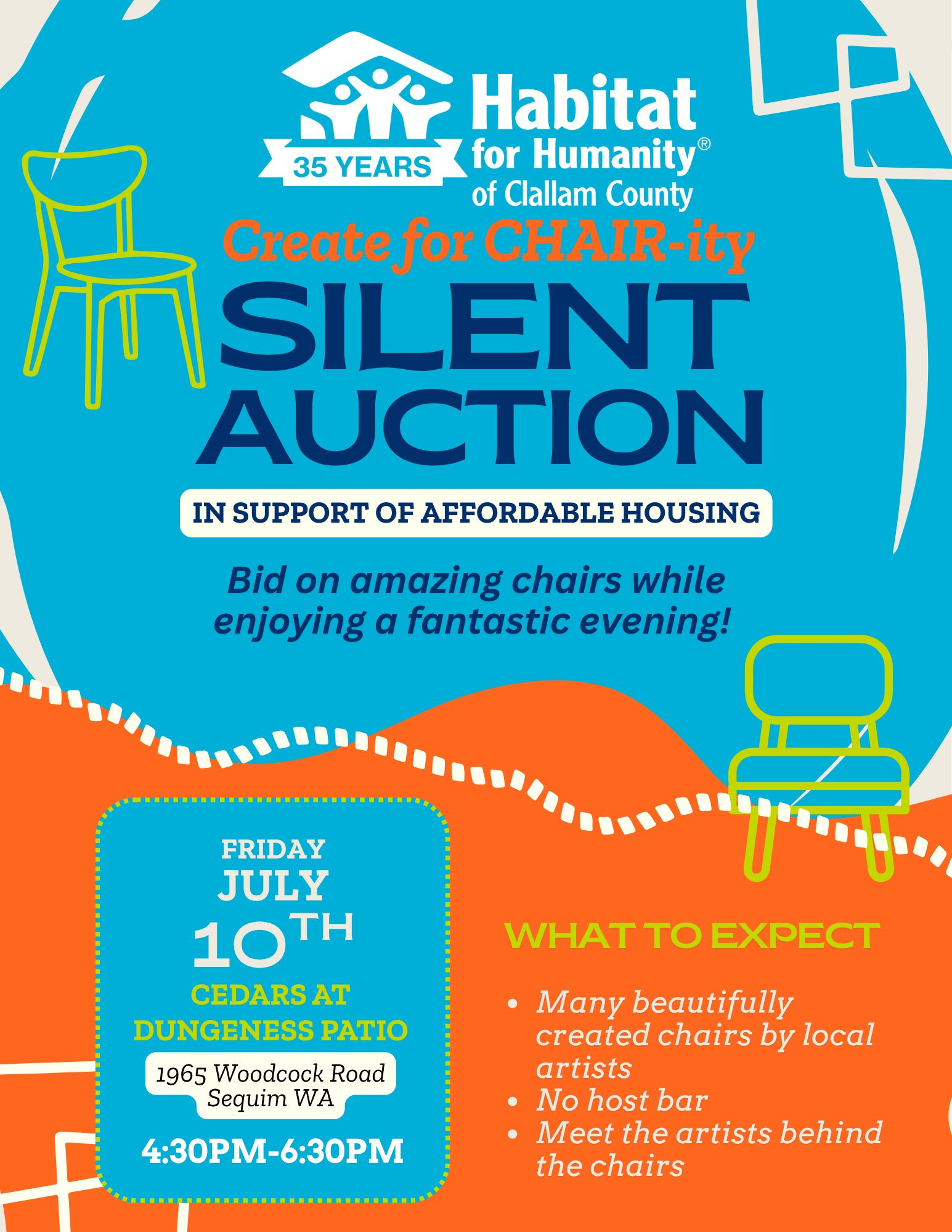
That raises a reasonable question: do other local venues ever have the opportunity to host these high-profile nonprofit events and receive the economic benefit and exposure that comes with them? Or are these relationships increasingly concentrated among politically connected organizations and tribal enterprises?
The question becomes even more relevant given Habitat’s emphasis on its Native American Housing Liaison program and its close partnerships with Jamestown entities.

These are not unreasonable questions. In a healthy civic environment, they would simply be part of public accountability.
Instead, people who ask them are often treated as troublemakers.
The Humane Society Warning Signs Everyone Ignored
This same pattern has repeated itself across Clallam County for years.
One of the clearest examples occurred during a December 2023 Clallam County Commissioner work session involving the Olympic Peninsula Humane Society. Executive Director Luanne Hinkle appeared before commissioners requesting an increase in county funding from $104,000 annually to $125,000 annually.
Hinkle opened the presentation by explaining that her goal was to show commissioners that county money was “very well spent.”
Commissioners asked one of the most basic financial questions imaginable: what is the cost per kennel?
Hinkle said it was difficult to calculate.
No estimate was provided.
No follow-up pressure came from the commissioners.
During the presentation, Hinkle acknowledged that animals were regularly transferred into the shelter system from outside Clallam County. The discussion relied heavily on emotional appeals about vulnerable animals, overcrowding, and community tensions, but offered little hard financial analysis.
The commissioners praised the organization anyway.
Then came perhaps the most revealing moment of the entire meeting. As the discussion wrapped up, Commissioner Randy Johnson’s final question was not about costs, operational efficiency, or financial sustainability.
“Are you and your husband planning a trip when you retire?” he asked.
Within months, the Humane Society suffered a financial collapse that shocked much of the community. The Bark House facility shut down. Dog intake operations effectively stopped. Reports surfaced alleging serious internal dysfunction, including claims involving employee treatment and controlled substances intended for animals.
Financial records showed that while revenue had significantly declined, salaries and compensation had surged. IRS Form 990 filings showed total revenue dropping from roughly $1.5 million to $1.18 million in a single year, while salaries, compensation, and benefits increased from approximately $758,000 to more than $1 million.
Luanne Hinkle’s compensation jumped nearly 50 percent in one year, rising from about $95,000 to nearly $142,000.
At the same time, tax documents showed that only 8% of total spending went directly toward animal care itself.
Yet despite all of this, the Humane Society had already received taxpayer support, public praise, and minimal scrutiny from county leadership.
The Weekly NGO Parade
And that is the broader story here.
Every week, nonprofits rotate through county commissioner meetings asking for taxpayer money. Housing nonprofits. Behavioral health nonprofits. Arts nonprofits. Food nonprofits. Animal nonprofits. Outreach nonprofits.
The presentations are almost always emotional. The scrutiny is almost always light.
The commissioners routinely thank the organizations for their work, praise their missions, and approve additional funding. Sometimes those same commissioners simultaneously sit on boards connected to the very nonprofits receiving public money.
One recent example is OlyCAP’s “safe parking” program in Sequim, where over $118,000 in taxpayer funding was approved for what amounts to three overnight parking spaces. Residents asking where the money is going and what measurable outcomes justify the expense have struggled to get clear answers from either OlyCAP or the county.
The silence is especially troubling because Commissioner Mike French not only voted on funding connected to OlyCAP, but he also sits on OlyCAP’s board. That dual role creates an obvious expectation for transparency and accountability, yet residents increasingly feel they are met with silence.
Questions about measurable outcomes, operational efficiency, and financial accountability are often secondary to narratives about compassion, partnerships, and community investment.
Meanwhile, taxpayers increasingly feel like the only people ever told “no” are the citizens asking for transparency.
The Disappearance of the Local Watchdog
The larger problem is cultural.
Local journalism once acted as a watchdog over government and public spending. Increasingly, many local publications now resemble public relations platforms for government agencies, nonprofits, and publicly funded initiatives.
Residents are constantly told how transformative programs are, how critical funding is, and why even more taxpayer support is necessary.
What is often missing are measurable outcomes and adversarial scrutiny.
How many homes were built?
How many people exited homelessness permanently?
How much did each project cost taxpayers?
What are the actual performance metrics?
What happens when organizations fail?
Those questions are becoming rarer and rarer.
Instead, the public is asked to trust institutions that increasingly resist transparency while continuing to demand larger amounts of taxpayer money.
This Is the Culture Now
This has become the norm in Clallam County.
Government praises nonprofits. Nonprofits praise government. Local media amplifies both. Taxpayers fund the entire system while struggling to obtain basic answers about where the money went and whether any of it is actually working.
Commissioners get to look compassionate and generous while handing out public money. NGOs receive funding, glowing media coverage, and reduced scrutiny. Meanwhile, residents asking hard questions are portrayed as cynical, divisive, or anti-community.
And while millions continue flowing into studies, outreach programs, partnerships, consultants, and nonprofit initiatives, many residents increasingly feel the county’s most basic responsibilities — public safety, infrastructure, accountability, and transparency — are slipping further out of reach.
This is not an isolated incident.
It is the culture.
And until voters demand something different, the revolving door will continue spinning exactly as it does now.
Today’s Tidbit: Jake in Joyce
Join County Commissioner candidate Jake Seegers this Saturday at the Joyce General Store for a casual Community Conversation focused on the future of Clallam County.
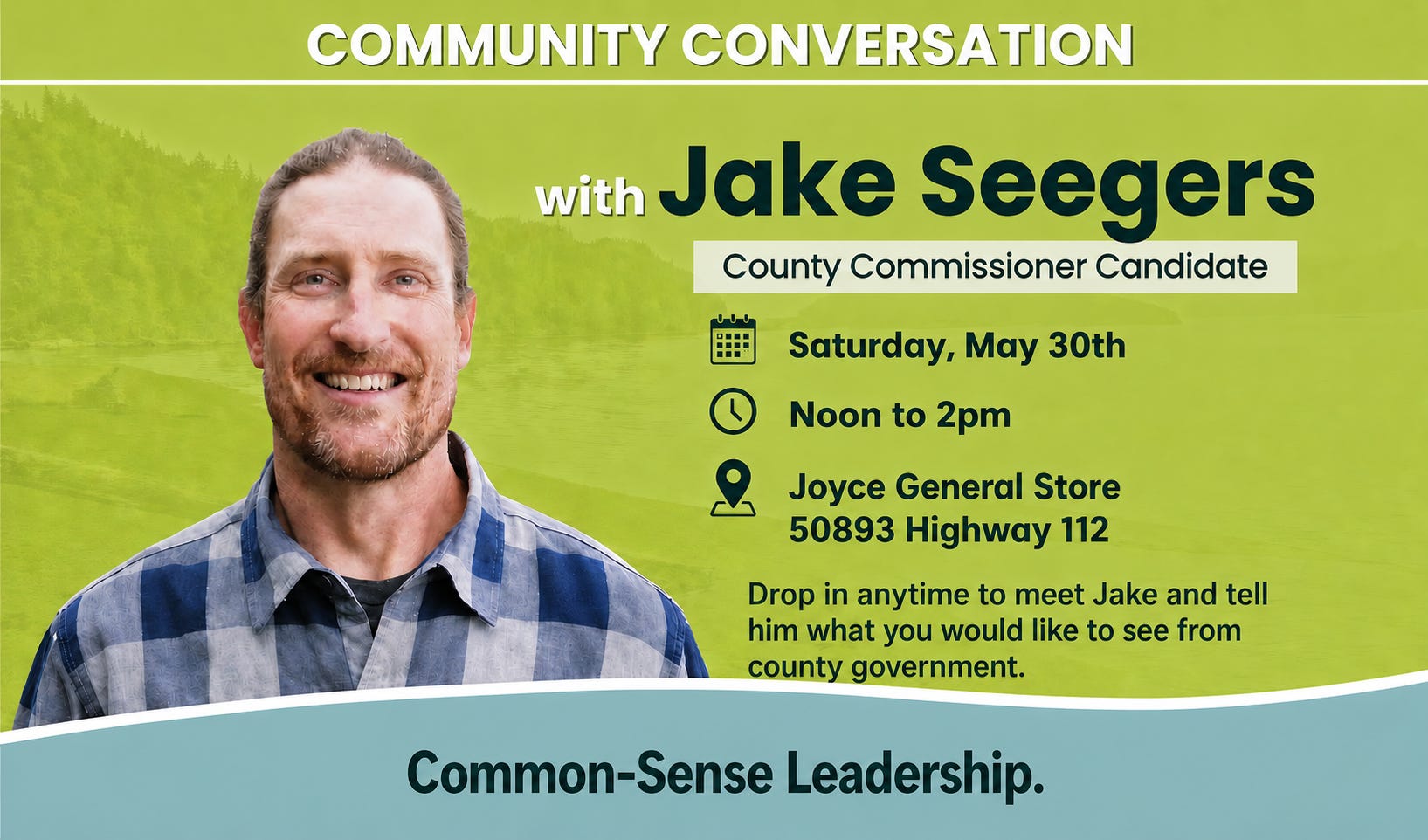
Stop by anytime between noon and 2pm to meet Jake, share your concerns, pick up a yard sign, and sign the growing petition to restore access to Olympic National Park by reopening Olympic Hot Springs Road into the Elwha Valley.
The petition effort is calling on state and federal leaders to prioritize restoring one of the county’s most important recreational and economic corridors. Reopening the road is about more than access — it’s about supporting local tourism, protecting gateway communities, and reconnecting families to one of the most iconic areas of the Olympic Peninsula.
Residents are encouraged to stop in, ask questions, and be part of the conversation about public safety, government accountability, economic priorities, and the future direction of Clallam County.


