


A letter supporting the transfer of federal refuge land wasn’t drafted by Sequim officials—it was handed to them. Emails show the Mayor moved quickly to put it on the agenda, unchanged, until public pushback forced a pause.
At Monday night’s Sequim City Council meeting, Mayor Rachel Anderson said she placed a proposed letter of support on the consent agenda because she “didn’t think that any council members would have any opposition.”
She acknowledged receiving several emails about the issue, but defended the move by saying “anyone can ask for a letter of support.”
“This is a letter of support—that is what it is,” Anderson said. “It is not the city gifting land to anybody—it’s not our land to give.” She added that it’s “not our jurisdiction, quite frankly,” but said she supported it because of the Tribe’s track record as a partner.
That raises a simple question: if it’s not the City’s jurisdiction, why was it moving forward at all—and why with so little scrutiny?
Now we know how it started.
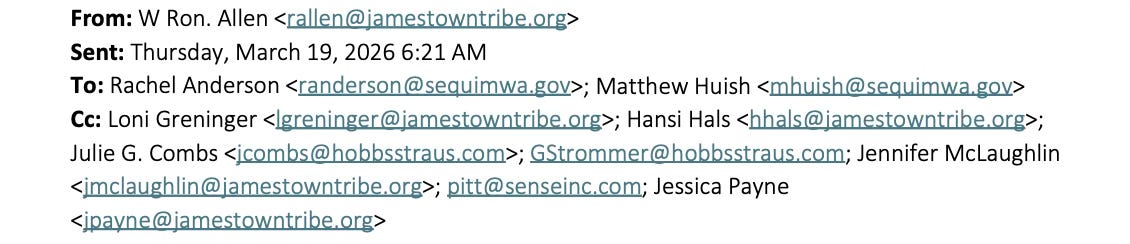
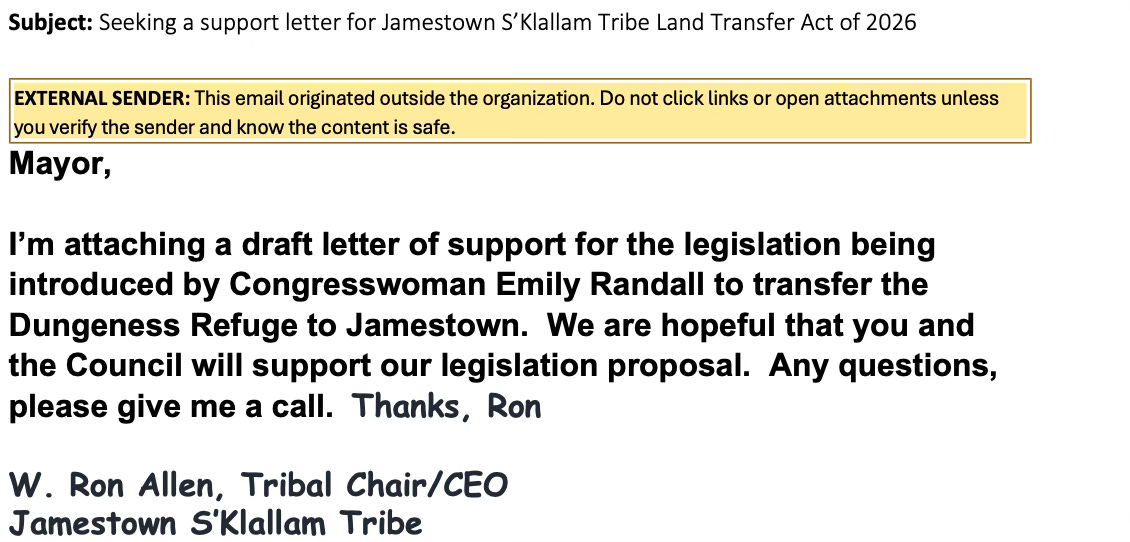
Public records show that on March 19, Jamestown S’Klallam Tribe Chairman/CEO Ron Allen emailed Mayor Anderson directly with a pre-written draft letter of support for federal legislation that would transfer the Dungeness and Protection Island National Wildlife Refuges into trust for the Tribe.
“Mayor,
I’m attaching a draft letter of support… We are hopeful that you and the Council will support our legislation proposal.”
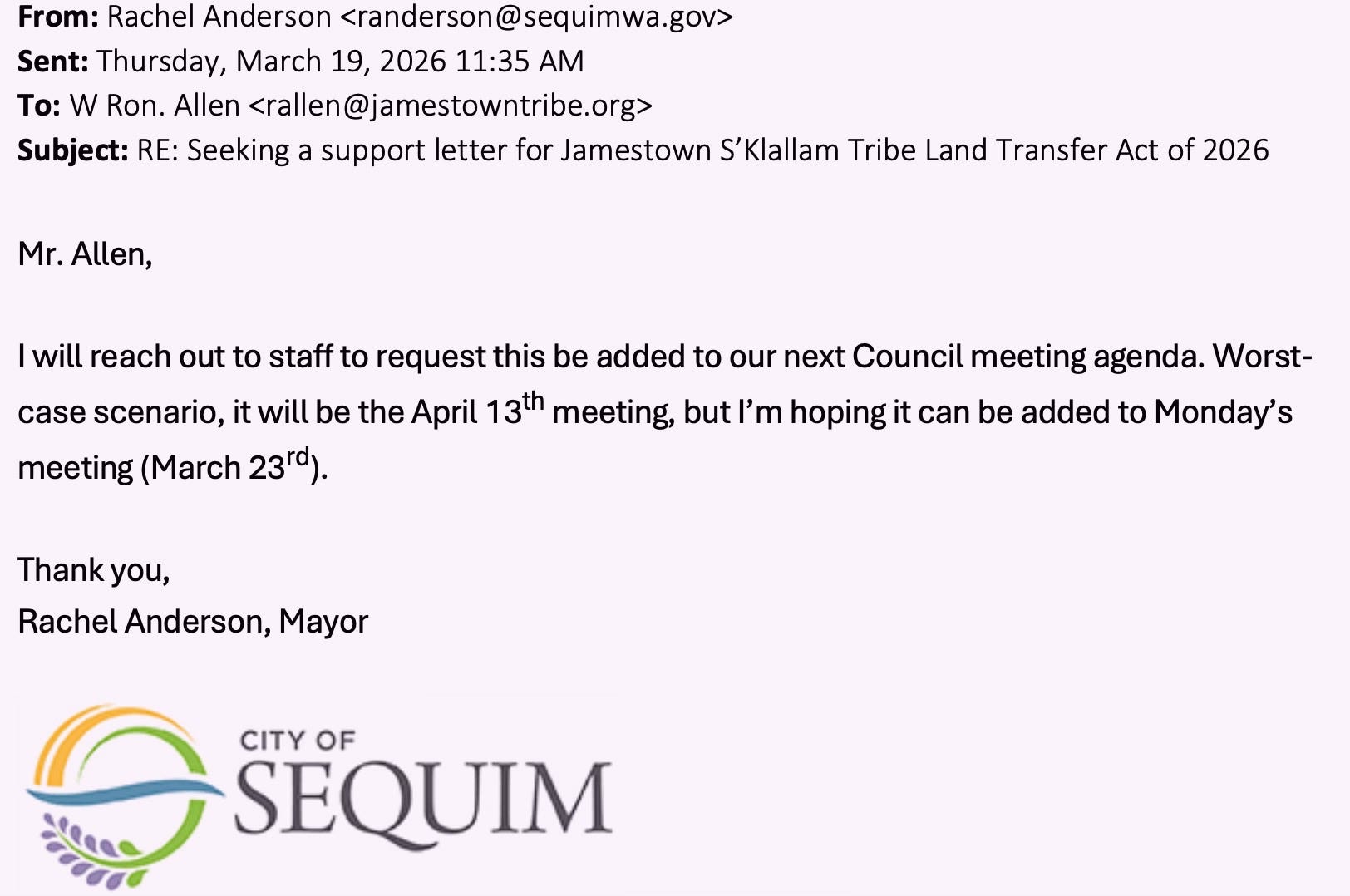
Later that same day, Anderson replied:
“I will reach out to staff to request this be added to our next Council meeting agenda… I’m hoping it can be added to Monday’s meeting.”
And it was.
Here’s the part that matters: the draft Allen sent is the exact letter the City prepared to send. Not similar. Not revised. Not adapted. Word-for-word identical.
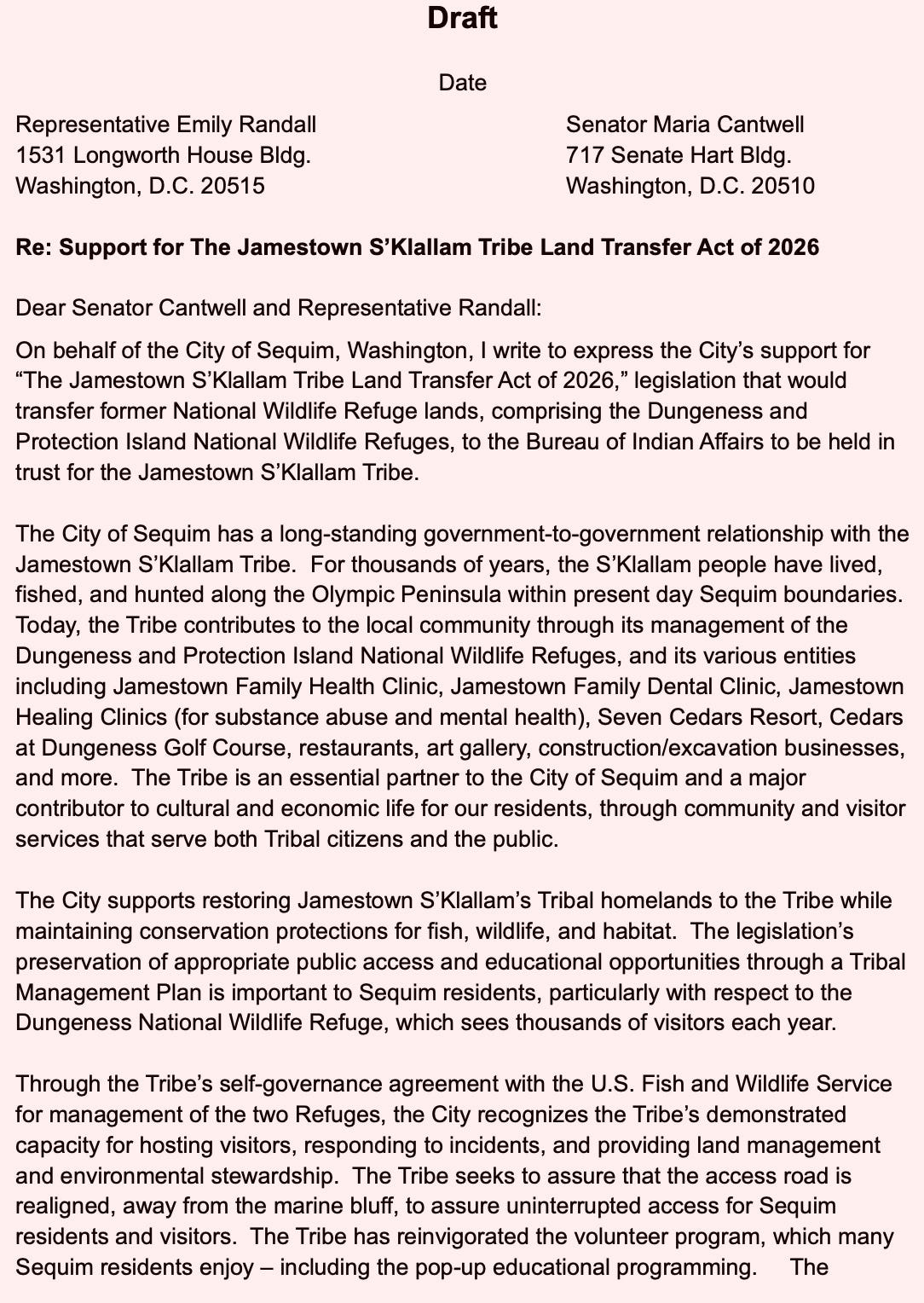
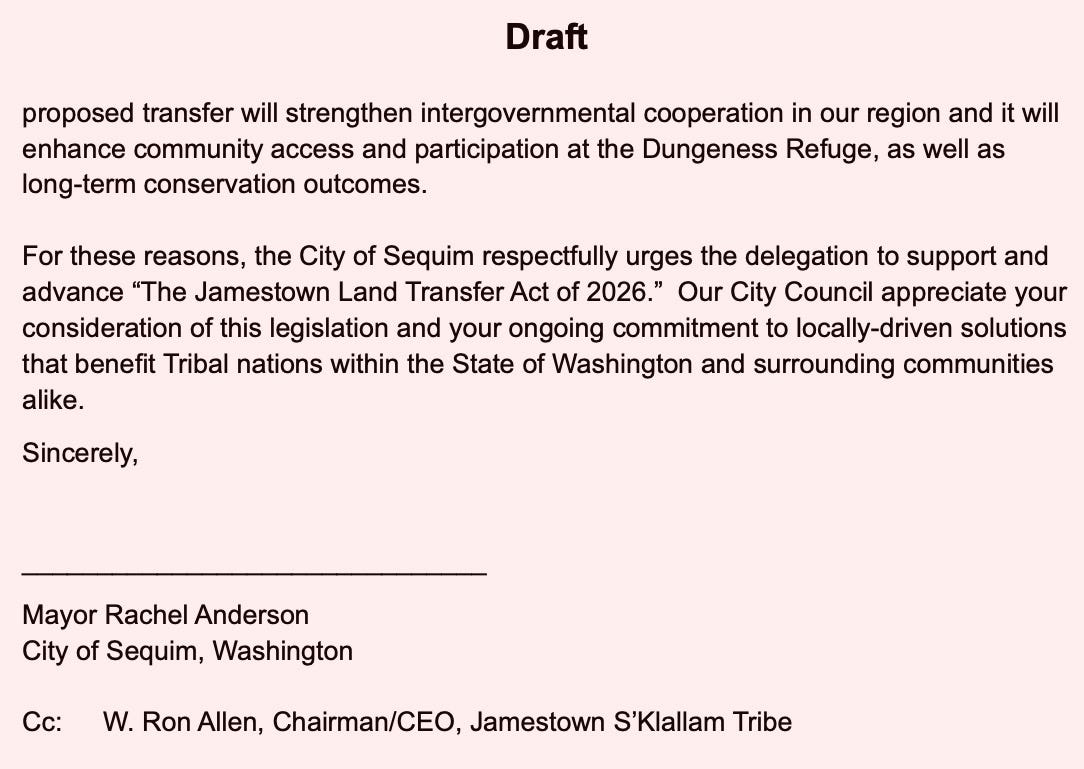
No edits. No independent analysis. No added perspective from the City of Sequim—just a direct pass-through.
The letter itself reads like a full endorsement, highlighting the Tribe’s economic contributions, stewardship, and community role in glowing terms. It credits the Tribe with everything from healthcare services to tourism, land management, and environmental protection—while urging federal lawmakers to advance the land transfer.
That may or may not reflect the views of Sequim residents. But it clearly reflects the views of the party requesting the land.
Public Pushback—and a Sudden Pause
During public comment, every speaker who addressed the issue opposed the letter.
The concerns weren’t vague. They were specific:
The issue is outside the City’s jurisdiction
Questions about the Tribe’s commercial oyster farming of a non-native species in a national refuge
Concerns about long-term public access
Whether fees—like the Makah Tribe’s $20 beach access permits—could eventually apply
Notably, the Tribe did not attend the meeting or comment.
After hearing the pushback, the Council shifted. What had been placed on the consent agenda—typically reserved for routine, non-controversial items—was pulled and delayed for further discussion.
Councilmember Dan Butler acknowledged the situation:
“It appears to be quite a divisive issue fundamentally and I’m not clear why that exists, but people have their issues.”
But by that point, the “issues” and reasons had already been clearly laid out by the public.
“It’s Not Our Gig”… But Still Our Letter
Mayor Anderson emphasized again:
“It’s not our gig, right? It was just a letter of support.”
She suggested that residents with questions should take them up with the Jamestown S’Klallam Tribe.
But that raises a practical problem: the Tribe is a sovereign nation and is under no obligation to answer to Sequim residents.
Councilmember Butler suggested directing concerns to federal representatives instead.
Councilmember Nicole Hartman recommended providing links so the public could “do their own reading.”
Fair enough—but shouldn’t that apply to the Council as well?
By their own discussion, it was clear several members were still learning basic details about the proposal after the letter had already been placed on the agenda.
Councilmember Harmony Rutter said:
“I have had nothing but positive experiences interacting with the tribe. From the way that they do so much outreach to the community during times of public health crisis, during times of when folks need to access resources and all of the ways that they work to steward the the lands that we all have that we all are enjoying at this time. I I look forward to learning more and being curious and learn and receiving more resources and input before making any kind of decisions and in the most respectful way possible with the Jamestown tribe.”
That’s a reasonable position. But it came after the City was already prepared to send a formal endorsement to Congress.
Good Governance—or Something Else?
There’s another layer here worth paying attention to.
Councilmembers Dan Butler, Nicole Hartman, Harmony Rutter, Brandon Janisse, and Mayor Rachel Anderson were all endorsed by the Sequim Good Governance League (SGGL).
That same group promotes transparency, accountability, and thoughtful decision-making.
SGGL itself emerged during a very public dispute over the Jamestown S’Klallam Tribe’s proposed Medication Assisted Treatment (MAT) clinic. In its own materials, SGGL described how a prior council had become controversial in part for opposing the Tribe’s MAT facility, and how the “Save Our Sequim” movement was spreading what supporters called misinformation about substance abuse treatment and the Tribe’s plans.
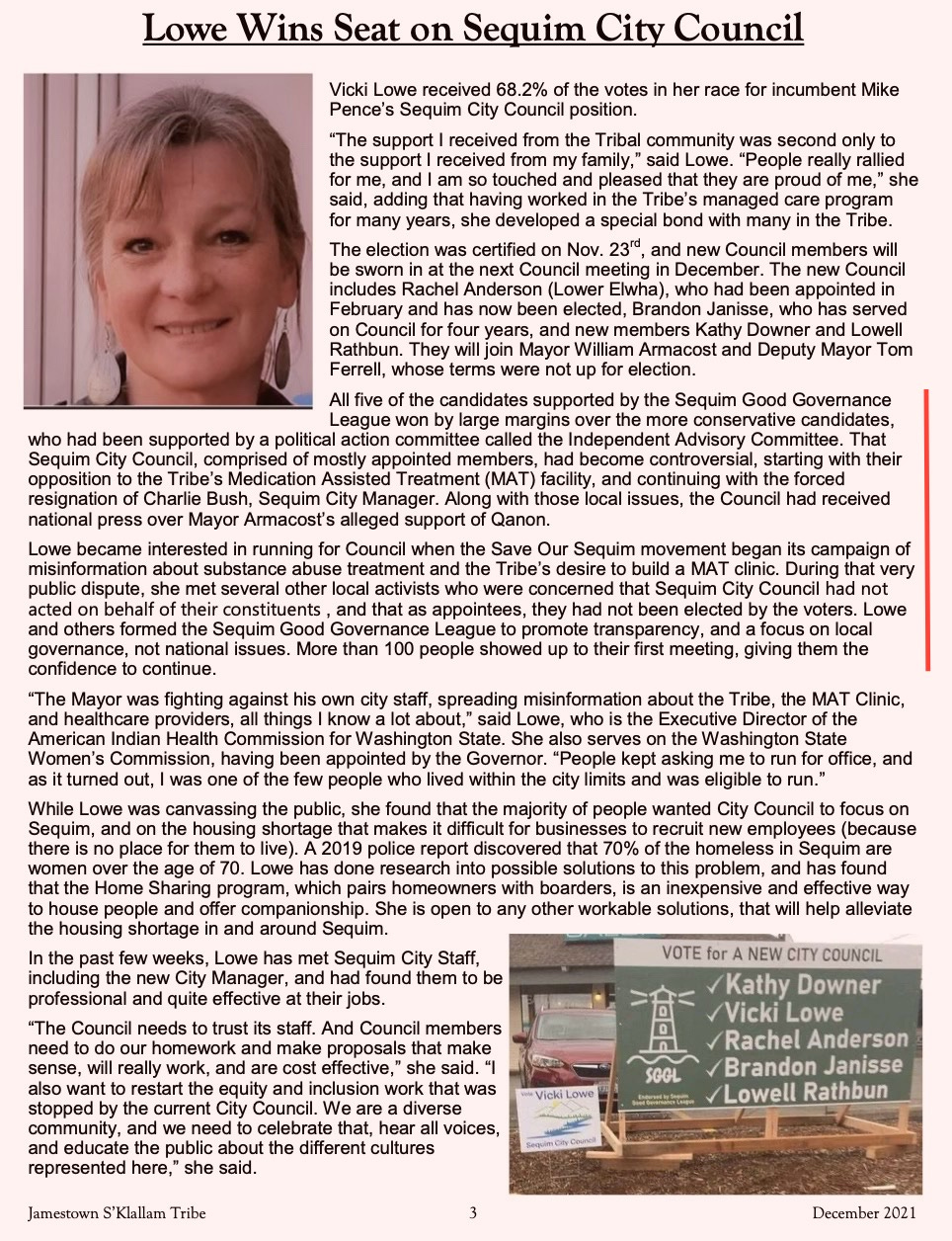
SGGL organizers positioned themselves as a response—arguing the council was not acting on behalf of constituents and needed to be replaced with leadership focused on “good governance.” All five SGGL-backed candidates went on to win.
In other words, the Tribe’s MAT clinic debate wasn’t just a background issue—it was a defining moment that helped shape the political coalition now holding a majority on the council.
So it’s fair to ask: is it “good governance” to take a letter written by an outside party—one with a direct interest in the outcome—and move it forward without changes, without independent analysis, and without meaningful discussion?
In local races that often see little to no financial activity, it’s also worth noting that the Jamestown Tribe contributed $1,200 each to both Dan Butler and Harmony Rutter.
None of that proves wrongdoing. But it does add context—especially when the City appears ready to support a major federal land transfer based on language it didn’t write.
A Pattern Worth Noting
There’s another piece of context that’s hard to ignore.
Last August, Clallam County Commissioners reached out to the Jamestown Tribe seeking a conversation about lodging and property taxes.
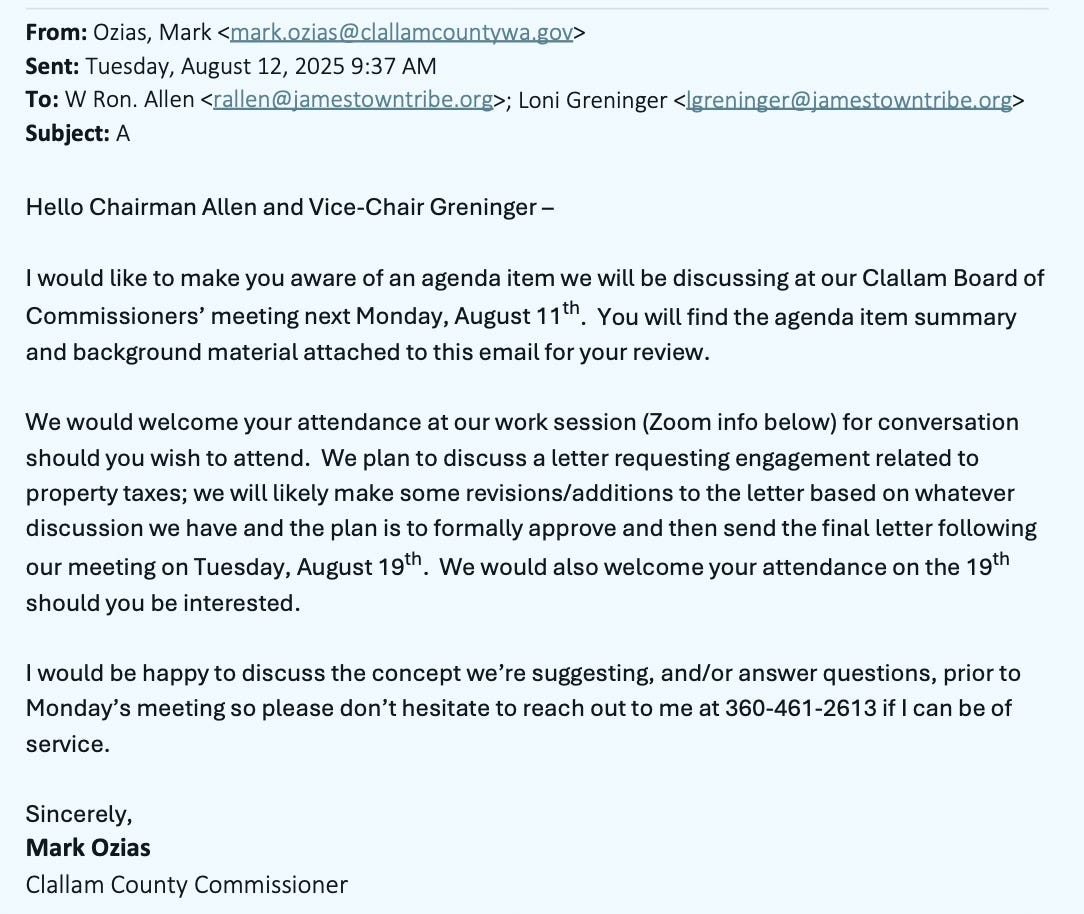
Commissioner Ozias received an acknowledgment:
“We will let you know if/when we need further conversations.”
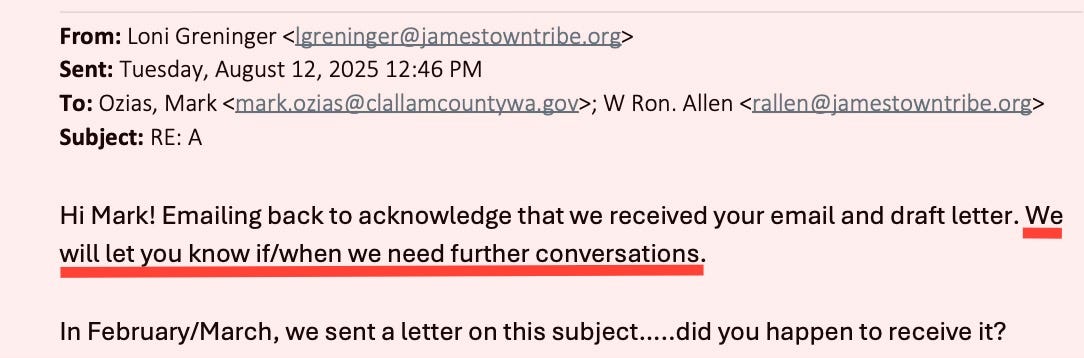

Seven months later, no reply.
So when local government asks the Tribe for engagement, the response is open-ended.
But when the Tribe asks for something—a letter supporting federal land transfer—Sequim leadership moves within hours to put it on the agenda.
The Question Going Forward
This issue isn’t settled.
The Sequim City Council will revisit the letter at its April 13th meeting.
Between now and then, residents have time to review the proposal, ask questions, and make their voices heard.
Because at the end of the day, this isn’t just about a letter.
It’s about who your elected officials are representing—and how decisions like this get made.
Call to Action
If you have concerns—or support—you should contact the Sequim City Council before the April 13th meeting.
Ask them:
Why the letter was introduced without independent review
Whether they fully understand the proposal they’re being asked to support
And whether they believe this process reflects the kind of governance Sequim residents expect
Email: clerk@sequimwa.gov
Public input made a difference once. It may again.


