

One of Clallam County’s most cherished public parks—owned, funded, and enjoyed by generations of taxpayers—is now the subject of behind-the-scenes discussions about a potential transfer of management to a sovereign corporation. The public was not informed. The discussion did not occur in an open meeting. And the key parties involved include a county commissioner and his top campaign donor. For many residents, this raises an uncomfortable question: when decisions involve public land of extraordinary value, why is the public hearing about it only after the fact?
In the podcast: Public comment highlights.
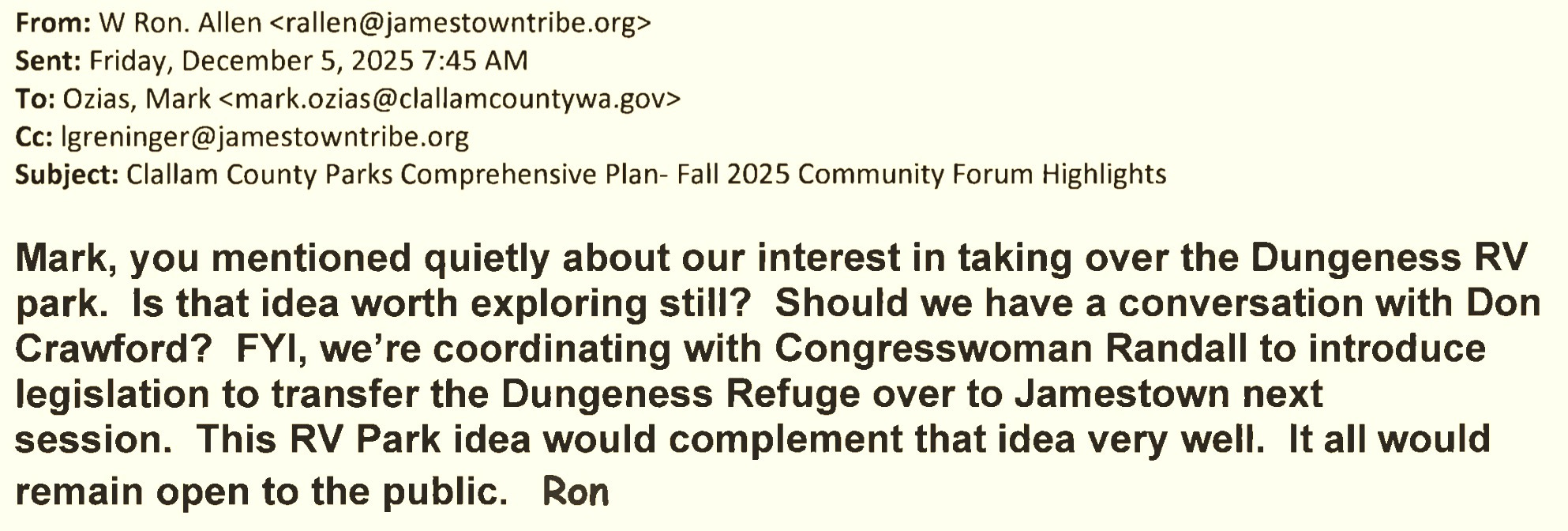
Last month, Clallam County Commissioner Mark Ozias received an email from Ron Allen, CEO of the Jamestown Corporation and Commissioner Ozias’ largest campaign donor. The email, dated December 5, referenced a prior quiet discussion between the two regarding Jamestown’s interest in “taking over” the Dungeness Recreation Area RV Park.
Allen wrote, in part:
“Mark, you mentioned quietly about our interest in taking over the Dungeness RV Park. Is that idea worth exploring still? Should we have a conversation with Don Crawford? … We’re coordinating with Congresswoman Randall to introduce legislation to transfer the Dungeness Refuge over to Jamestown next session. This RV Park idea would complement that idea very well. It all would remain open to the public.”
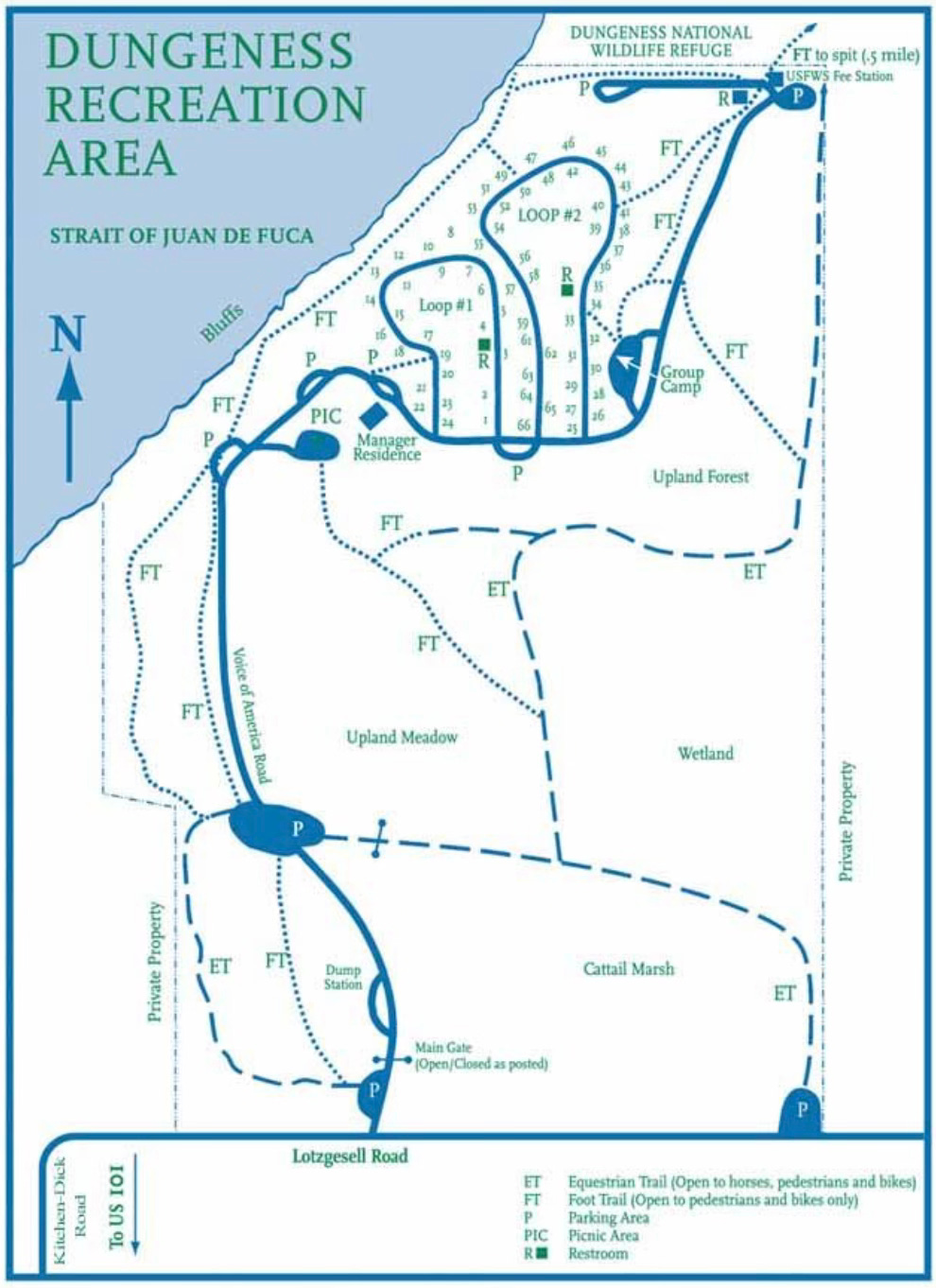
At the time this email was sent, no public disclosure was made. No agenda item appeared before the County Commission. No public discussion occurred about the future of one of the most heavily used and historically significant parks in Clallam County—a park that includes trails, RV camping, tent camping, and public shoreline access, and that has been owned and maintained by county taxpayers for generations.
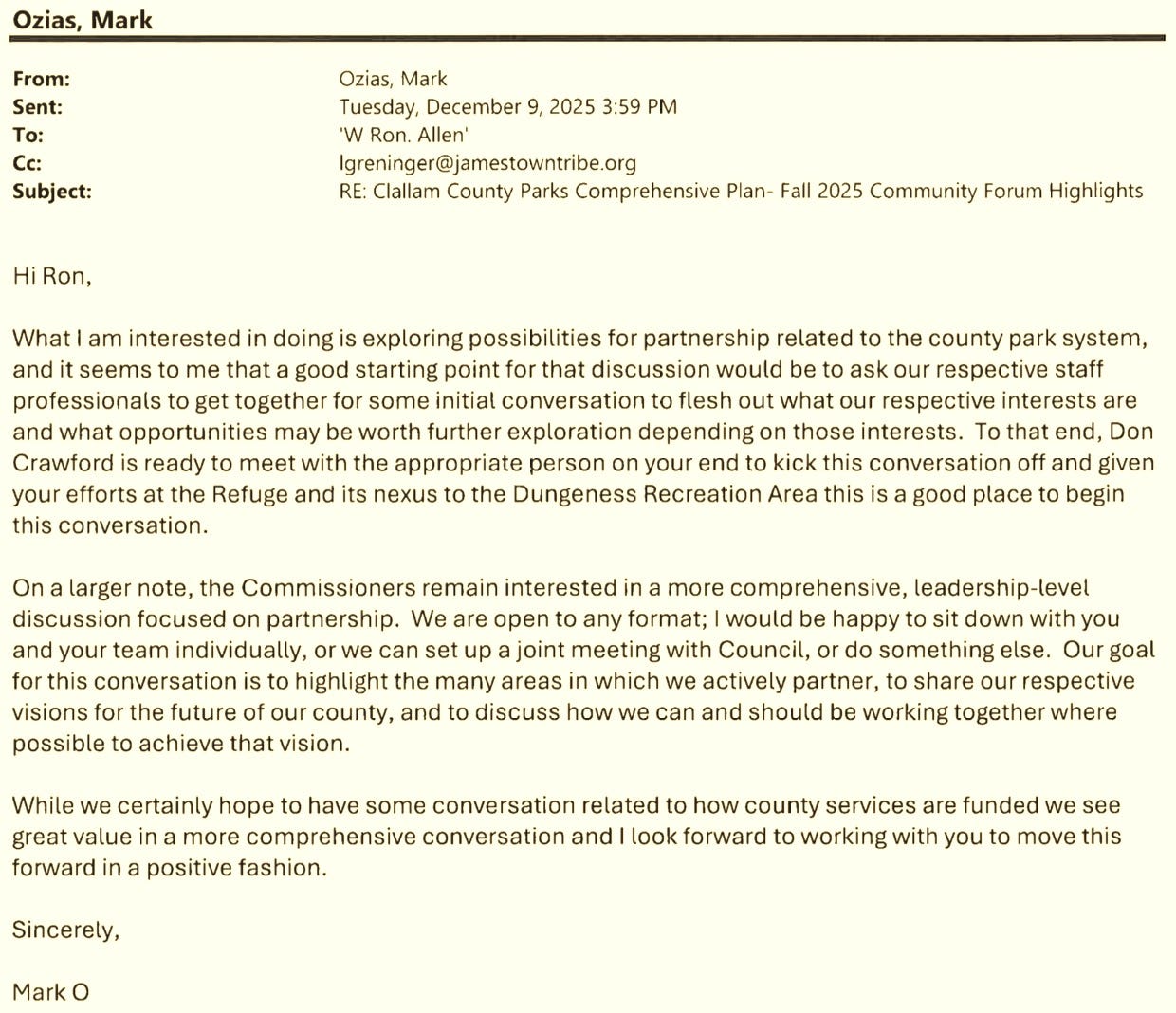
Commissioner Ozias’ response, dated December 9, confirmed his interest in exploring “partnership” opportunities related to the county park system and directed county staff to begin discussions with Jamestown representatives. He further expressed interest in broader, leadership-level conversations about future collaboration.
When asked about the email exchange during yesterday’s commissioners’ meeting, Commissioner Ozias stated that the public should not be surprised for two reasons.
First, he cited a single comment he made nearly a year ago—during a sparsely attended weekday meeting—about attending a Washington, D.C. seminar where tribal management of county parks was discussed. That brief mention, he suggested, should have prepared the public for what is now being explored.
Second, he pointed to the county’s ongoing financial challenges, arguing that commissioners must think creatively about reducing costs. County parks, he noted, are not legally mandated services. From that perspective, transferring management to a sovereign corporation is framed as a pragmatic solution.
Play the podcast above at 21:12 to hear Commissioner Ozias’ remarks.
What was not addressed is why such a consequential idea—affecting a crown jewel of the county park system—was discussed privately and quietly with a major political donor before being raised openly with the public.
This concern is heightened by recent developments involving the Jamestown Corporation’s role at the Dungeness National Wildlife Refuge. Jamestown currently manages the refuge and has proposed a 50-acre commercial, non-native oyster operation within its boundaries. At the same time, Jamestown is working with Representative Emily Randall on legislation that would transfer the refuge outright—not merely management, but ownership.
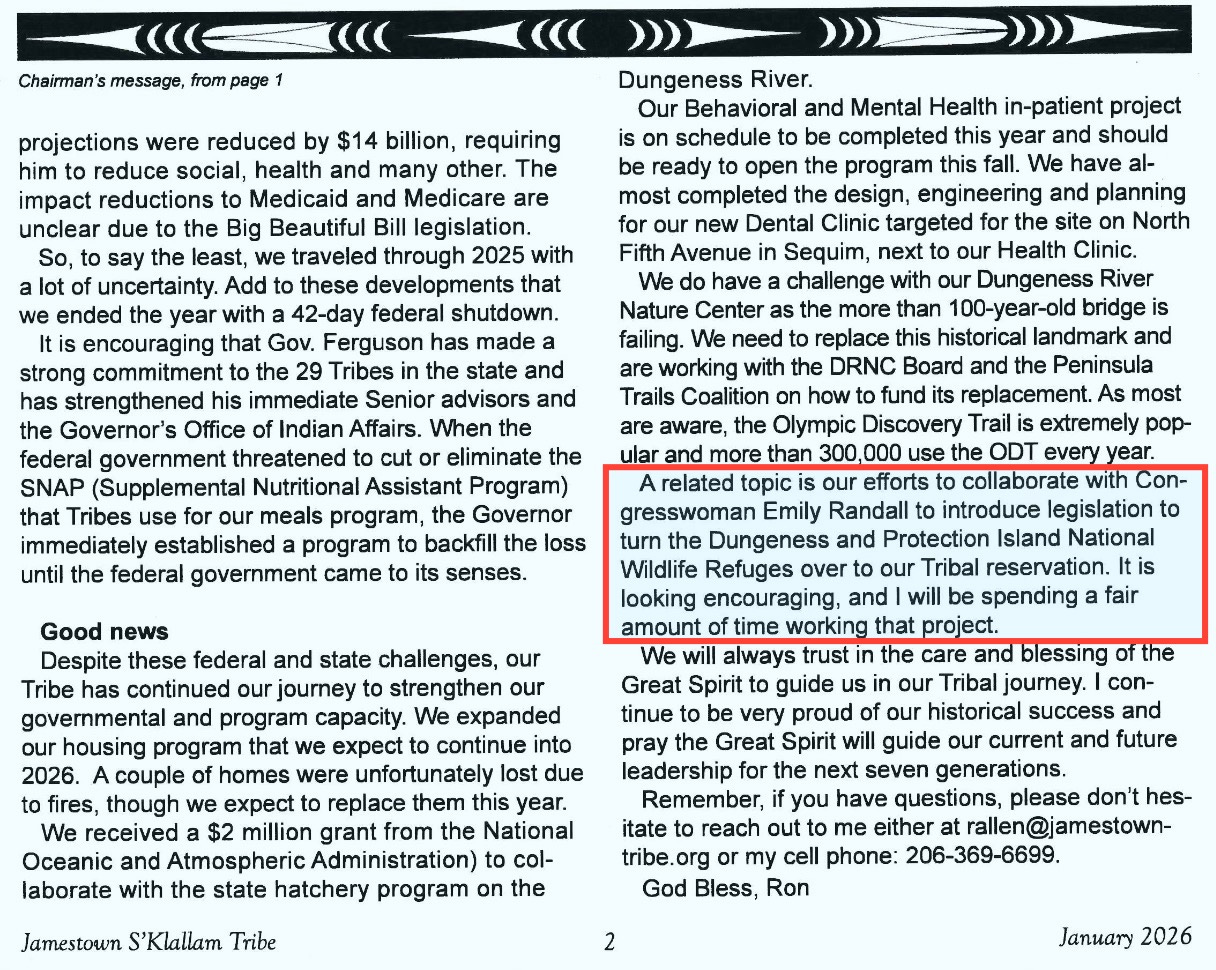
That sequence raises a reasonable question: Is management of the Dungeness Recreation Area being discussed as a first step toward a future transfer, following the same model?
Clallam County residents have seen this pattern before.
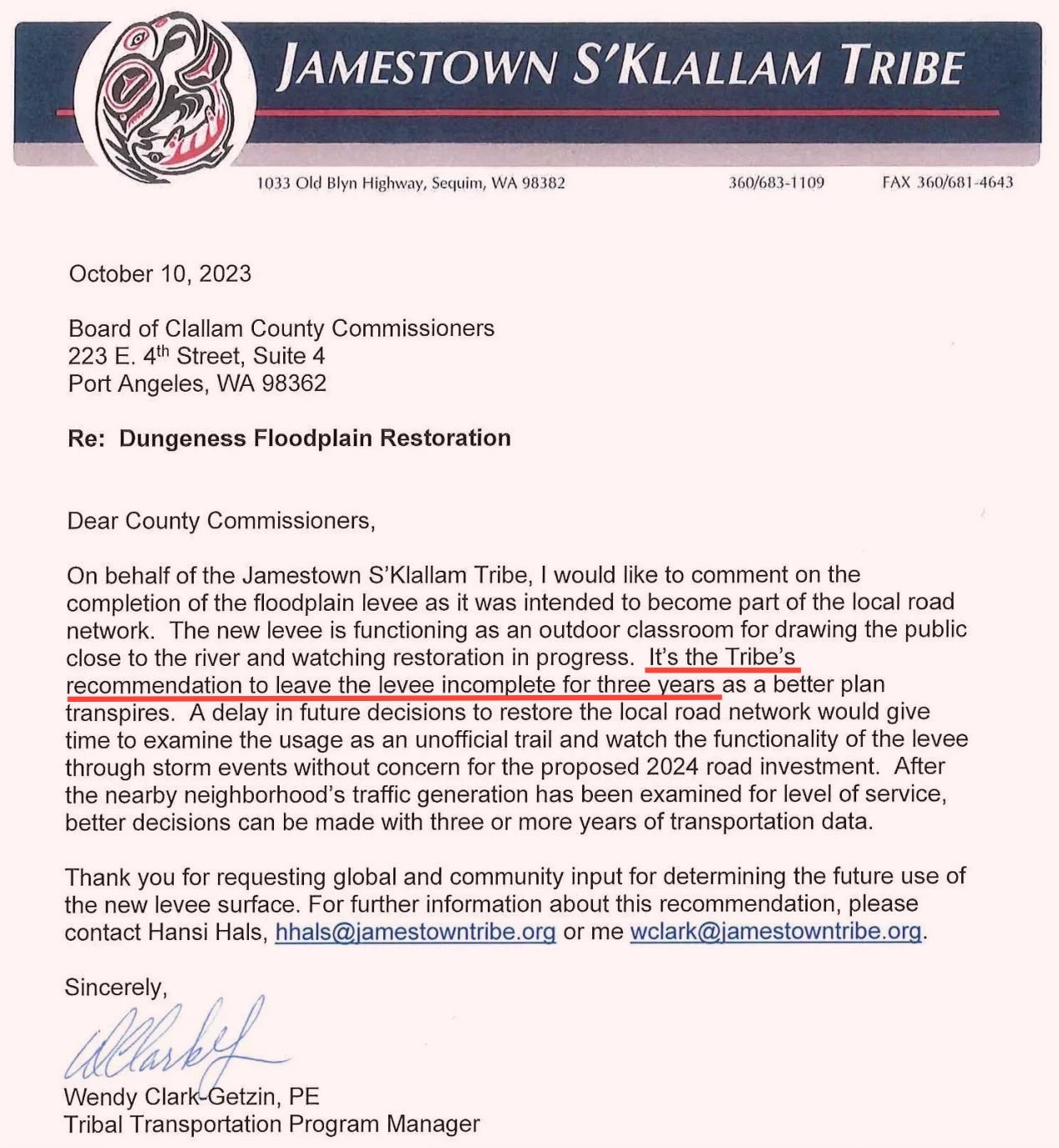
In 2023, Towne Road—a public road owned, paid for, and maintained by taxpayers for over a century—was nearly given away after the Jamestown Corporation first partnered in the project, and then expressed interest in its closure and conversion to a trail. Only sustained public opposition over two years halted that effort and reaffirmed a fundamental principle: public assets belong to the public, not to elected officials or politically connected interests.
The 218-acre Dungeness Recreation Area County Park—known locally as “the Spit” or “Voice of America”—is no different. County residents paid to build the access roads. They paid for the campsites. They paid for the trails. They continue to pay for maintenance, staffing, and stewardship. In return, residents receive discounted access to one of the most extraordinary public places in the county. This park is not surplus property. It is not expendable. And it is not the commissioners’ to give away.
The cumulative effect of these actions is a profound loss of public trust. Trust that decisions affecting public land will be made transparently. Trust that campaign donors will not receive preferential access. Trust that the commissioners understand the difference between managing public resources and disposing of them.
That trust has been badly damaged under the current board. After the actions of Commissioners Ozias, French, and Johnson, rebuilding trust will take years—if it can be rebuilt at all.
The solution is straightforward
If Clallam County faces financial pressure, the answer is not to quietly explore handing public parks to sovereign corporations. The answer is to prioritize. Trim discretionary programs. Reevaluate pet projects. Renegotiate revenue-sharing agreements with Port Angeles and Sequim before long-term contracts expire. Make hard choices—but do so openly, with the public involved from the beginning.
Residents should contact the county commissioners and make one thing unmistakably clear:
The Dungeness Recreation Area is not for sale.
Not for transfer.
Not for “management.”
Public land belongs to the public. And it is long past time the county’s leadership acted like it.
All three commissioners can be contacted by emailing the Clerk of the Board at loni.gores@clallamcountywa.gov.
“Many have expressed belief that this work has taken place in private, without informing the public. One core belief I have as an elected official is that local government only works when citizens participate. It troubles me greatly to think that so many feel they have been left out of the process.” — Commissioner Mark Ozias, Facebook, August 2019.


