


In a federal civil rights case, former Sequim School Board Director Jim Stoffer testified under oath about hiring decisions, internal conflicts, sexual harassment allegations, and closed-door governance. His own words reveal a pattern of deflection, reliance on rumor, and failure to act—raising urgent questions about the leadership still shaping local education and politics.
The Olympic Herald deserves real credit here. They didn’t summarize, spin, or selectively quote—they published the full, sworn deposition of Jim Stoffer, taken October 18, 2022, in a federal lawsuit against the Sequim School District.
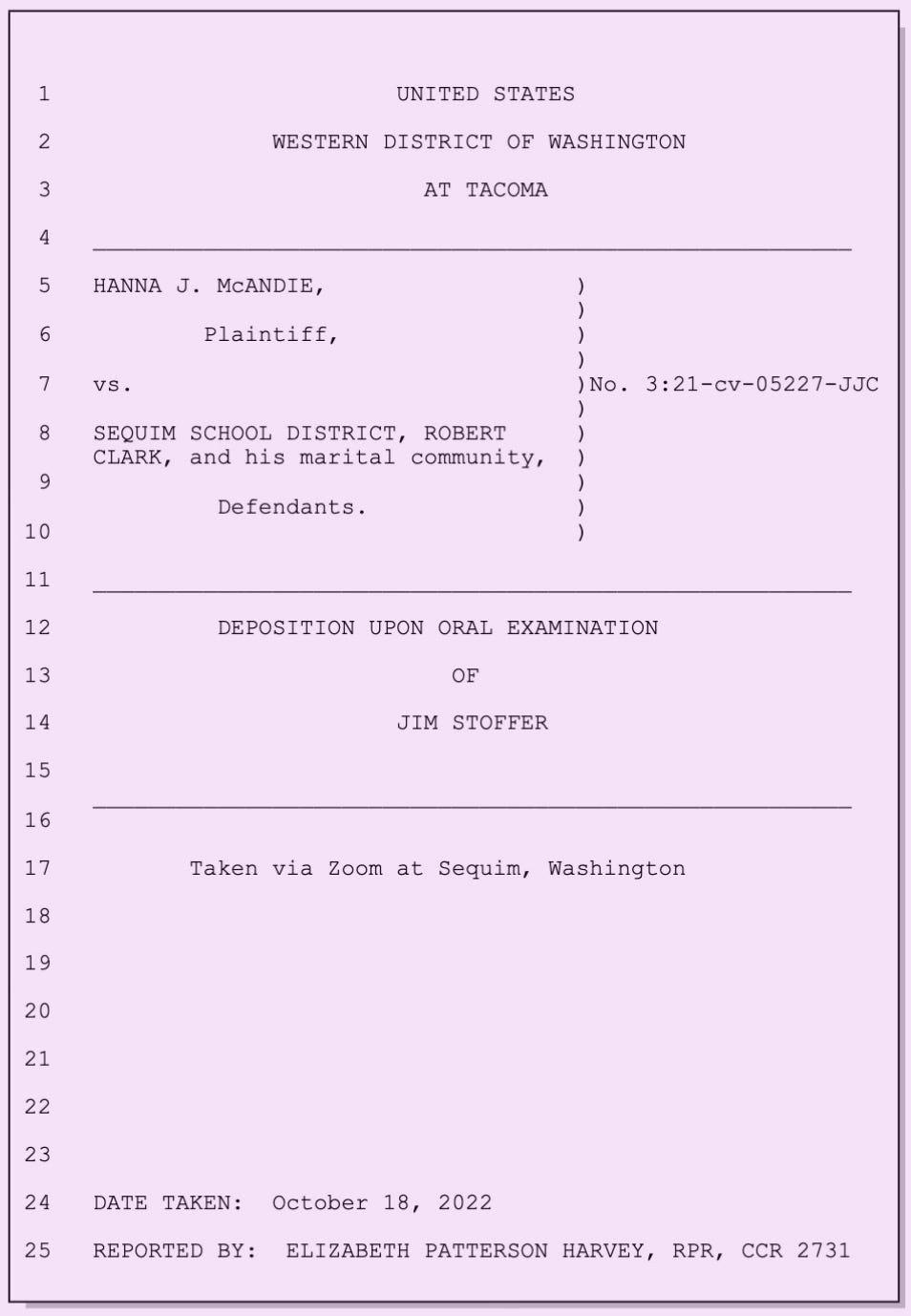
When you strip away press releases, talking points, and carefully crafted public statements, what remains is testimony under oath. And in that setting, Jim Stoffer didn’t just stumble—he exposed how decisions were actually made inside the Sequim School District.
You can read the full deposition here.
What you’ll find is not reassuring.
“Rumors in the Community”… and Still a Green Light
One of the most revealing portions of the deposition centers on the hiring of former Superintendent Rob Clark.
Stoffer acknowledges that before Clark was hired, he received warnings—unsolicited, informal, but unmistakable. A colleague told him there were “rumors in the community” and advised caution. Another suggested Clark might not be a good fit. These weren’t anonymous internet comments; these were professional contacts tied to the education system.
And what did Stoffer do with that information?
Nothing meaningful.
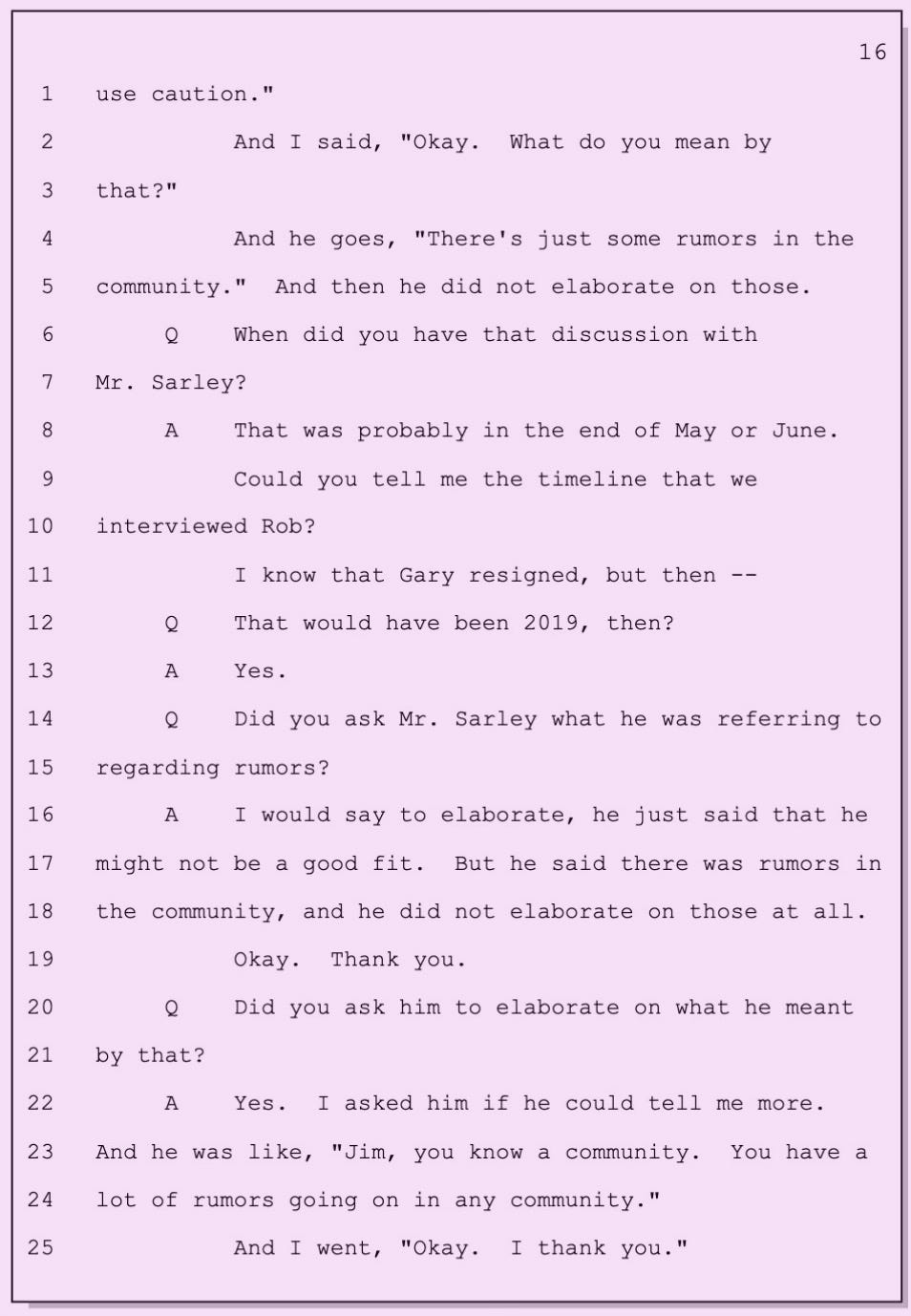
He didn’t press for details. He didn’t delay the process. He didn’t demand deeper vetting. He didn’t even treat it as a red flag worth resolving before handing over leadership of the district.
Instead, he rationalized it away. Small communities have rumors, he explained. People have agendas. You can’t chase everything down.
So the board moved forward.
That’s not just hindsight criticism. That’s Stoffer’s own explanation, under oath, for why warnings were ignored during one of the most consequential decisions a school board can make.
Mandatory Reporting—Known, Acknowledged, and Apparently Not Enforced
The deposition takes a more serious turn when the discussion shifts to allegations of sexual harassment within the district.
Stoffer is clear about one thing: he understands mandatory reporting requirements. He acknowledges that anyone in a leadership position—especially a superintendent—is trained on them and expected to act.
He even states plainly that Rob Clark should have reported certain allegations.
And yet, when pressed on whether those obligations were actually met, the answers become vague. Responsibility is diffused. Details are absent. The issue is framed as something handled through legal channels, executive sessions, or internal processes.
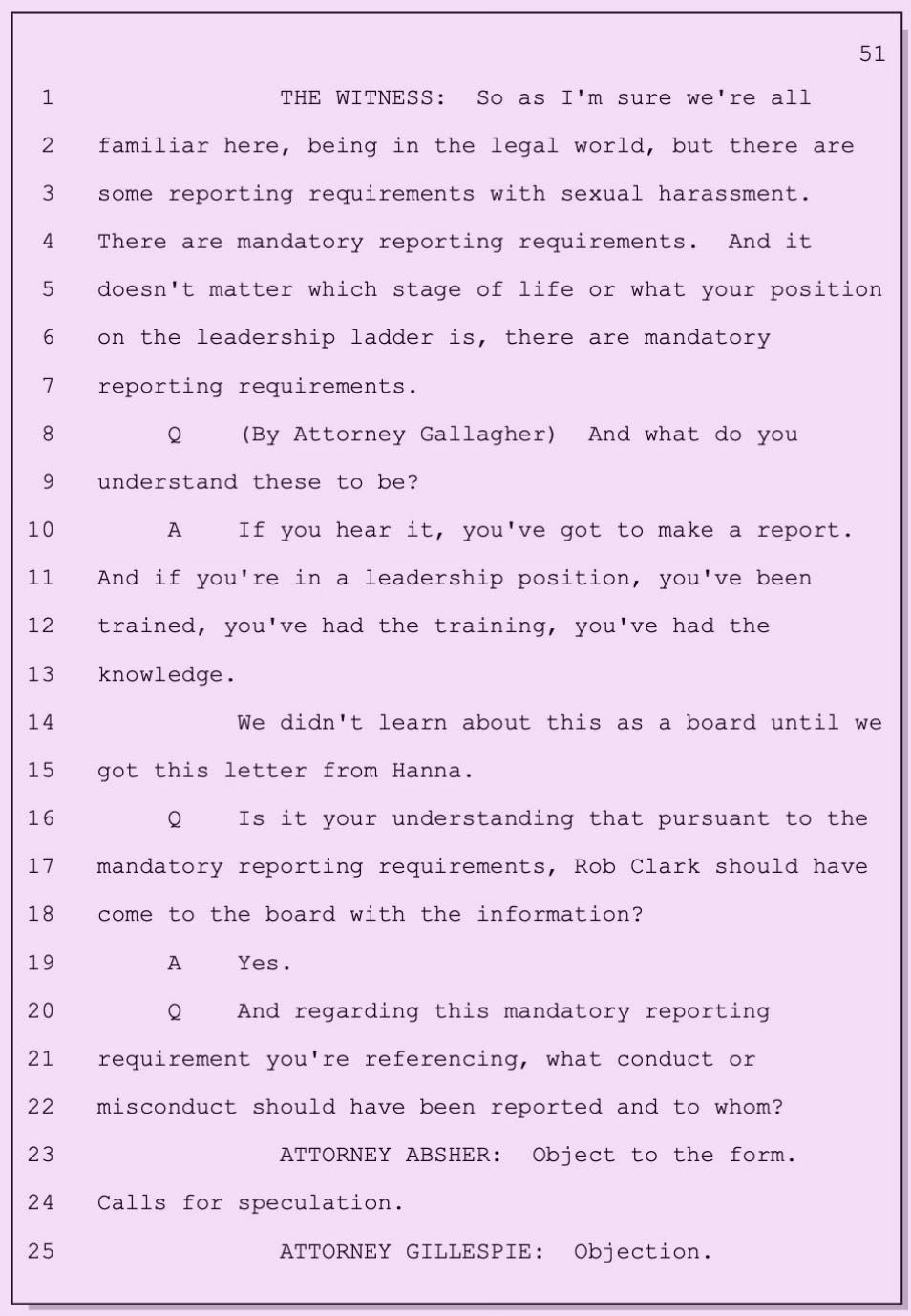
At one point, Stoffer admits the board relied heavily on legal counsel and executive session discussions—settings that are, by design, shielded from public scrutiny.
What’s left is a troubling gap: leadership that knows the rules, acknowledges the stakes, but cannot—or will not—clearly demonstrate that those rules were followed.
Executive Sessions: Where the Answers Go to Disappear
Throughout the deposition, Stoffer repeatedly retreats behind the same phrase: executive session.
Key decisions? Executive session.
Personnel issues? Executive session.
Investigations? Executive session.
He states outright that he cannot discuss what happened in those settings because it is “privileged.”
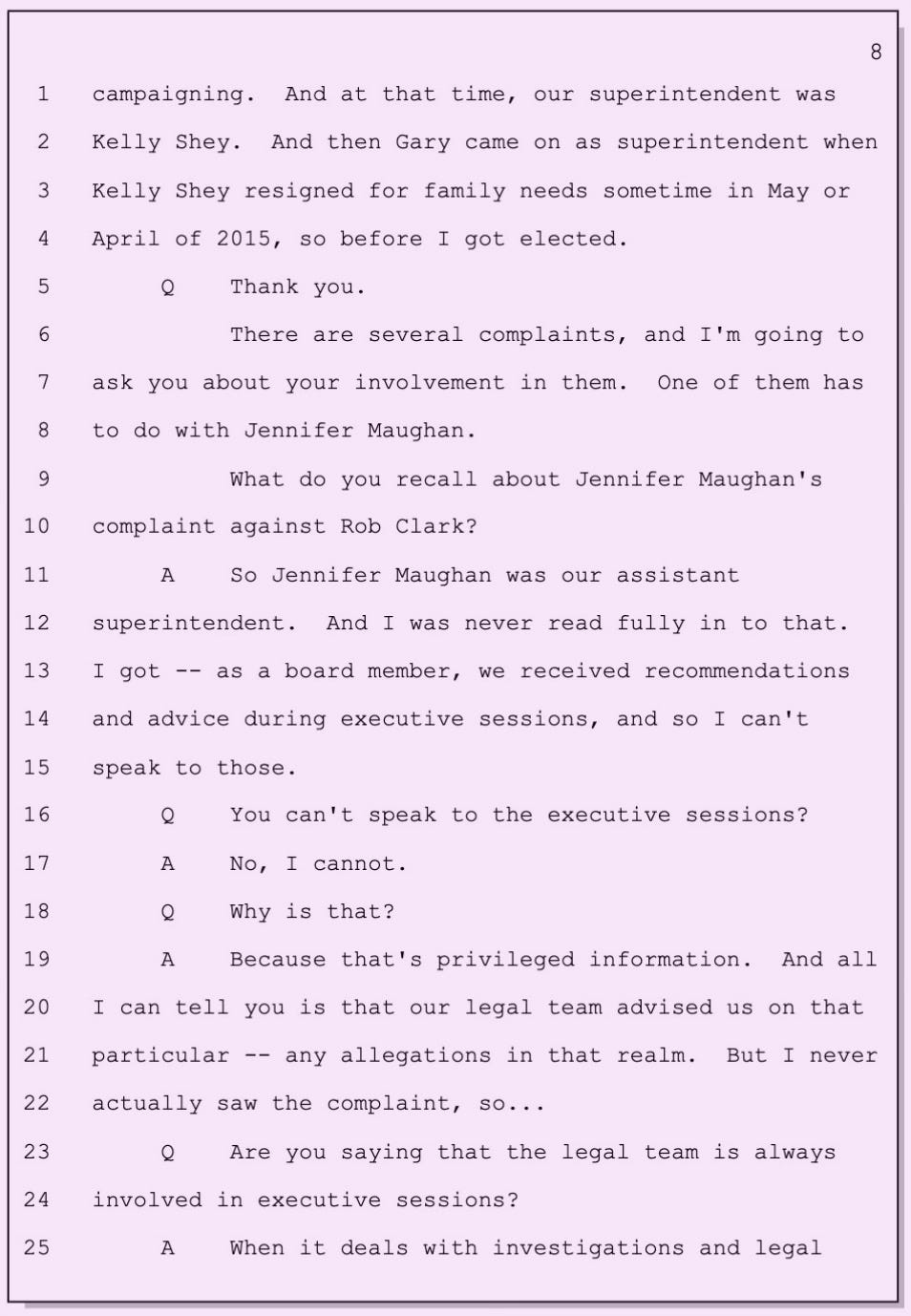
Legally, that may be true.
But from a public accountability standpoint, it creates a black box. Decisions affecting students, staff, and taxpayers were made behind closed doors, with the public left to trust that everything was handled appropriately.
And based on what’s revealed in the deposition, that trust was not earned through transparency or rigor.
Off the Record: Meetings at a Veterinary Clinic
One of the most striking admissions in Stoffer’s deposition isn’t about policy or personnel—it’s about where discussions were happening.
Under oath, Stoffer acknowledges that board-related conversations took place outside official settings, including at a local veterinary office.
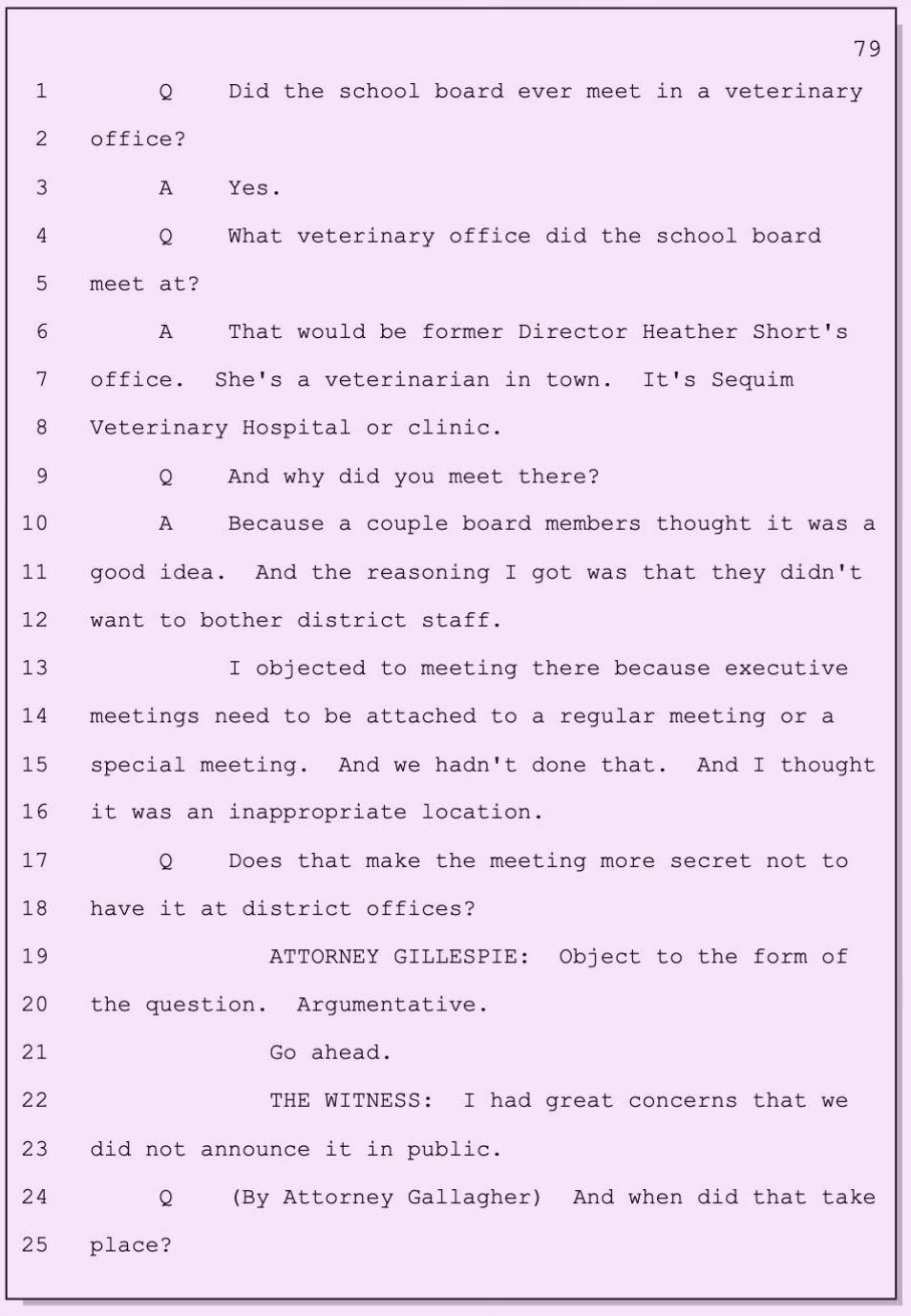
“Yes.” (when asked if meetings occurred at a veterinary clinic)
“It was more of a conversation… not a formal meeting.”
“We would talk about things… but not make decisions.”
That distinction—conversation versus decision—is doing a lot of work.
Because in public governance, especially at the school board level, the issue isn’t just whether a formal vote occurred. It’s whether deliberation, influence, and consensus-building were happening outside the public’s view.
And by his own testimony, they were.
These weren’t chance encounters in a grocery store aisle. These were repeat interactions, in a private location, involving board members discussing district matters—away from agendas, minutes, and public oversight.
When combined with Stoffer’s repeated reliance on executive session to shield details, it paints a consistent picture: Important conversations happening either behind closed doors… or completely off the record.
For a district already dealing with allegations, internal conflict, and legal exposure, that kind of parallel decision-making environment doesn’t build trust.
It erodes it.
A District at War With Itself
If the hiring decisions and reporting failures weren’t enough, the deposition also paints a picture of a district consumed by internal conflict.
Stoffer describes a divided environment where staff, board members, and community voices clashed—often publicly. Social media became a battleground. Allegations and counter-allegations circulated. Board meetings grew contentious enough to require relocation due to crowd size and tension.
He acknowledges monitoring social media activity and expresses concern about how staff behavior online was impacting district culture. At the same time, he describes receiving anonymous emails and letters, unsigned complaints, and coordinated messaging efforts from groups within the community.
And then there’s the “Six Pack.”
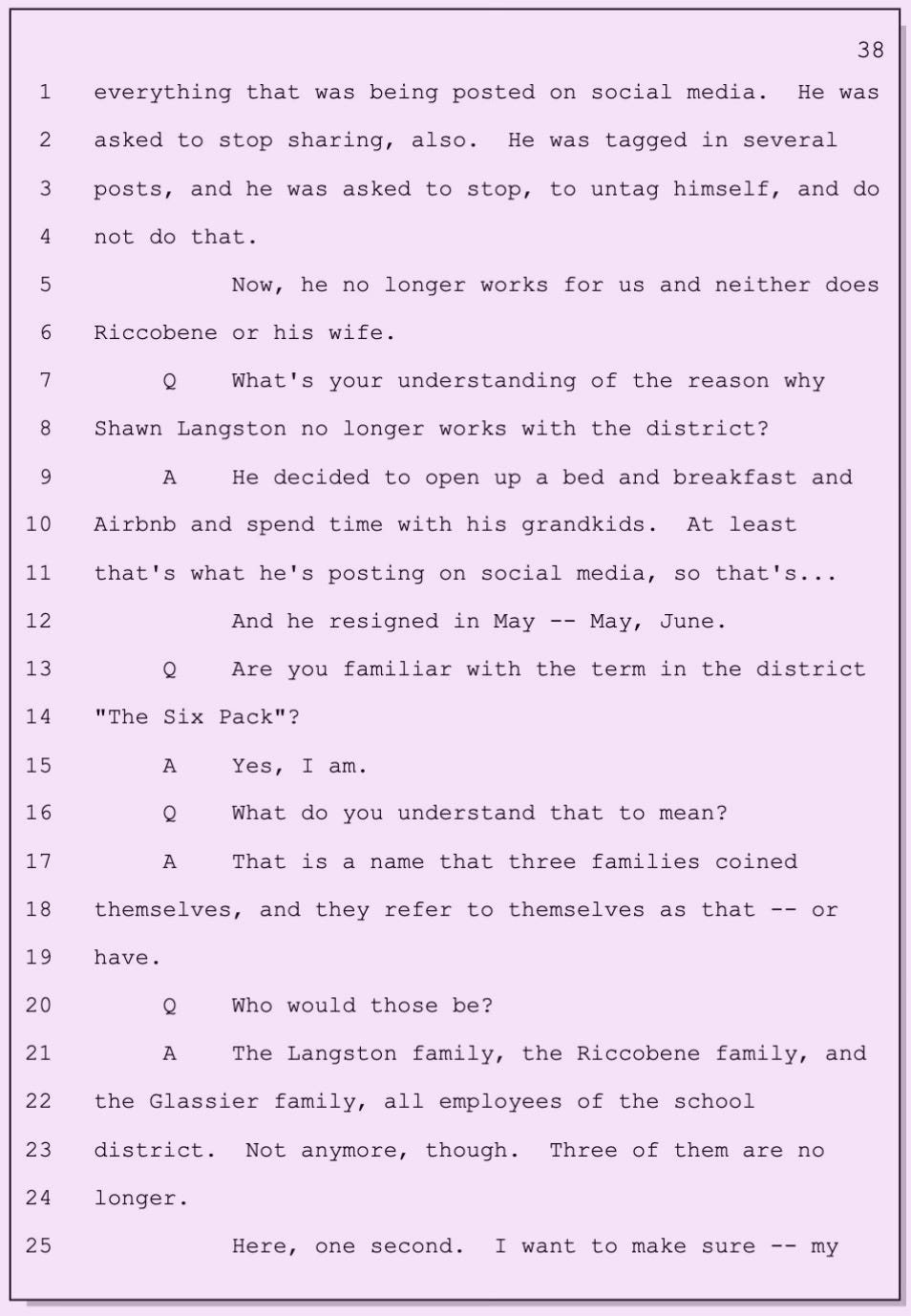
Stoffer confirms the term refers to a group of interconnected families—individuals with ties to district employees and internal dynamics. He stops short of formally assigning them authority, but acknowledges their presence, their coordination, and their role in shaping the environment around key decisions.
This is not the picture of a stable, student-focused institution. It’s a system pulled in multiple directions, with leadership struggling—or unwilling—to assert control.
“I Trusted the Superintendent”
Perhaps the most consistent thread throughout the deposition is Stoffer’s reliance on one justification: trust.
When asked why he didn’t intervene more forcefully, investigate more thoroughly, or challenge decisions more directly, the answer comes back to trusting the superintendent.
He trusted Rob Clark to handle personnel issues.
He trusted internal processes to address complaints.
He trusted that things were being managed appropriately.
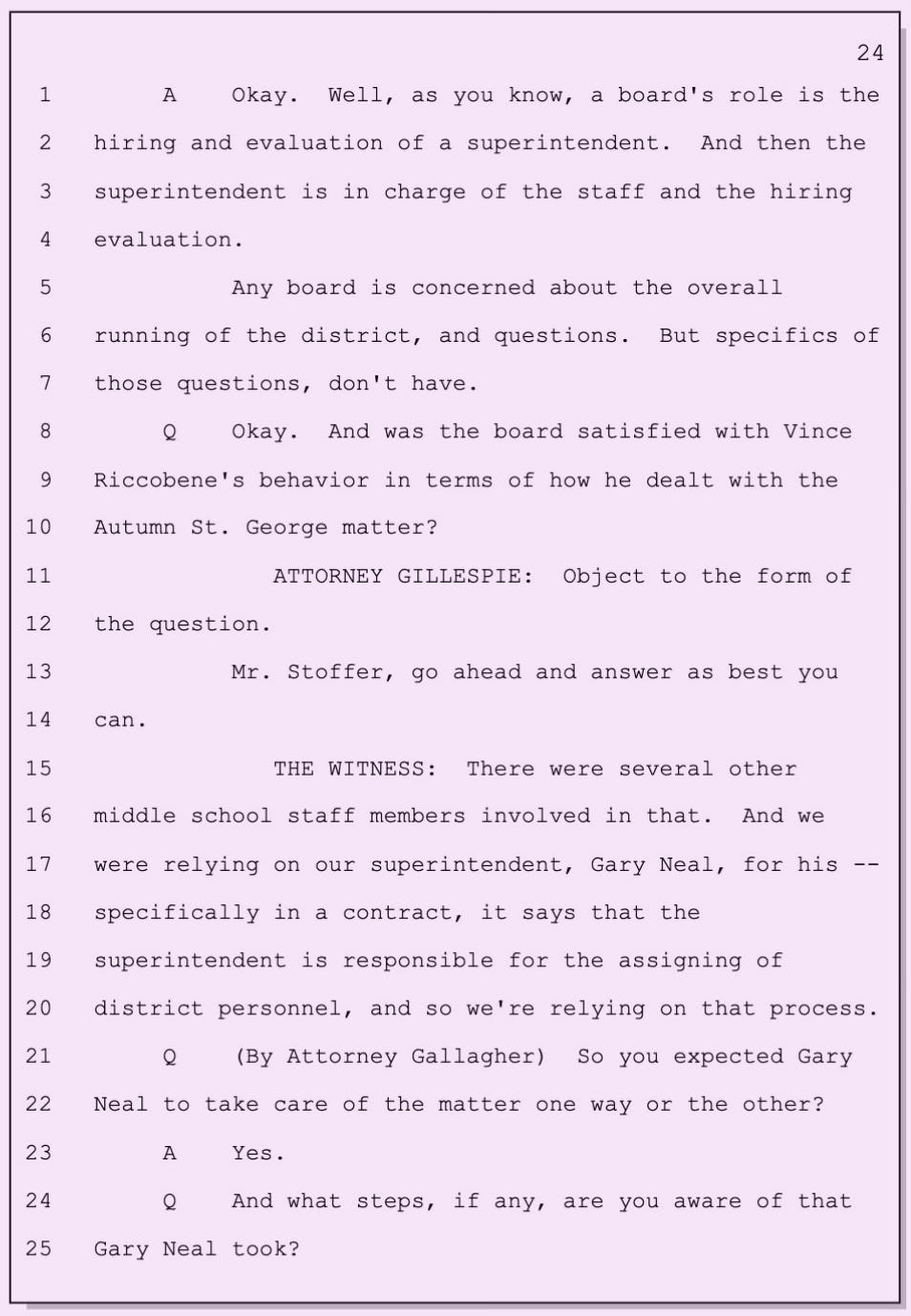
But that raises a fundamental question: if the board’s role is oversight, what does it mean when oversight is replaced with trust?
A school board is not a ceremonial body. It is the governing authority responsible for hiring, evaluating, and—when necessary—holding the superintendent accountable.
In this case, Stoffer’s own testimony suggests that responsibility was, at times, deferred rather than exercised.
Settlements, Allegations, and Limited Awareness
The deposition also touches on complaints that led to legal action and settlements. Stoffer acknowledges awareness of these issues at a high level but repeatedly distances himself from specifics.
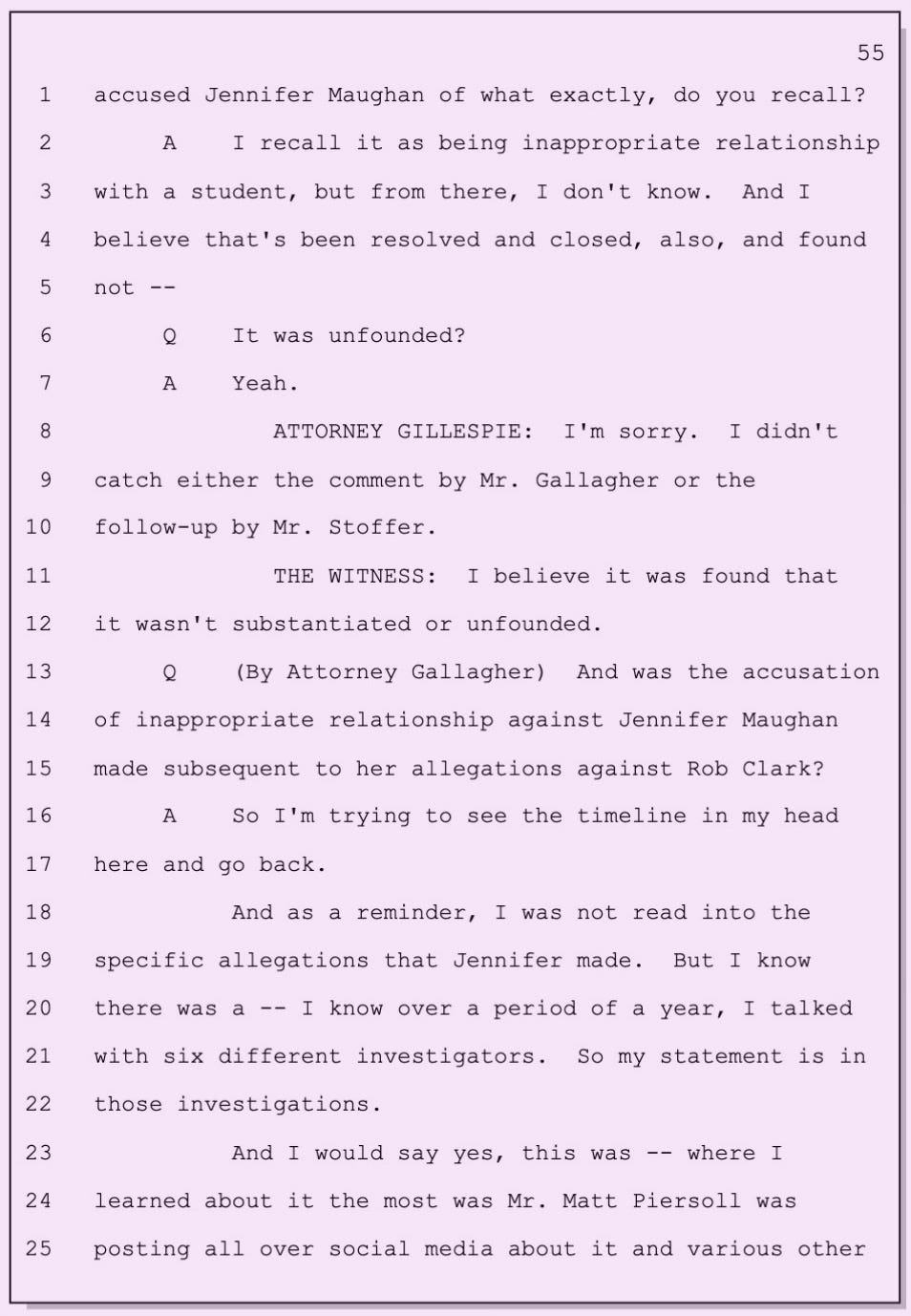
He references legal fees, board agendas, and general outcomes, but claims limited knowledge of the underlying facts—again pointing to executive sessions and legal counsel as the gatekeepers of information.
In other words, the board member helping govern the district knew there were serious issues—but not necessarily the details behind them.
That’s not a reassuring model of governance.
And Yet—Still in Positions of Influence
This is where the deposition stops being a historical document and becomes a current concern.
Jim Stoffer is not an unknown figure. He remains connected to the very systems this community relies on—education leadership, county government through the Charter Review process, civic engagement, and local political structures.
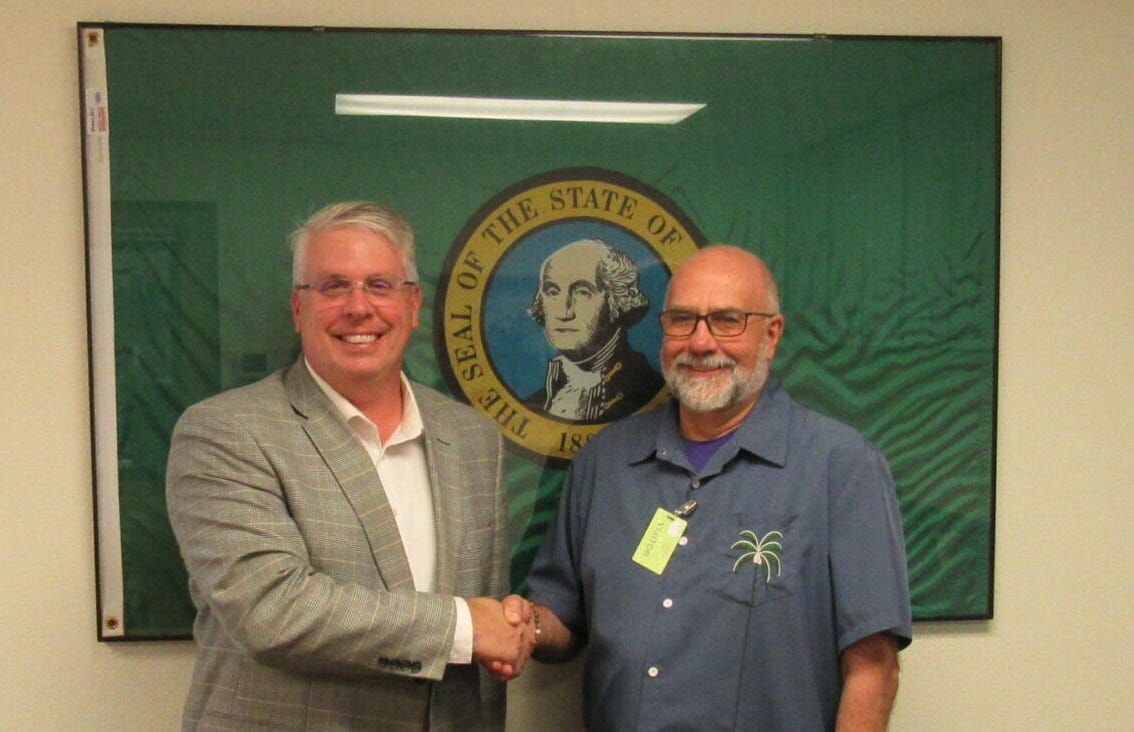
The same judgment displayed under oath—the willingness to overlook red flags, defer responsibility, and rely on opaque processes—doesn’t simply disappear.
It carries forward.
The Takeaway
There’s a tendency in situations like this to look for a single smoking gun—a moment where everything clearly went wrong.
That’s not what this deposition shows.
What it shows is something more subtle, and arguably more concerning: a pattern.
A pattern of:
minimizing warnings
avoiding deeper inquiry
relying on closed-door discussions
and defaulting to trust instead of verification
All of it laid out not by critics, but by Jim Stoffer himself, under oath.
Read It. Decide for Yourself.
The Olympic Herald has made the full deposition available without filters or edits.
If you care about how decisions are made in your school district—and who is making them—take the time to read it.
Because once you do, it becomes much harder to pretend this is business as usual.
Today’s Tidbit: Investigated, Cleared… and Closed
As part of ongoing concerns about conduct, boundaries, and political influence within Sequim School District programs, a formal request was submitted asking the district to investigate whether adults affiliated with the Mock Trial program were improperly involving students in adult political disputes.
The request initially went unanswered. A response came only after the State’s Office of Superintendent of Public Instruction was contacted.
For many in the community, the sequence feels familiar.
Another complaint.
Another internal review.
Another conclusion: nothing to see here.
Below is Superintendent Regan Nickels’ full response:
Dear Mr. Tozzer,
Following your request for review of the Mock Trial Program, an investigation was initiated and has now been completed. The scope and process of the investigation included a review of the Charter Review Commission December 22nd meeting video starting at 3:09:50 and multiple interviews including student, parent and advisors.
In your request for review, you also requested that findings be shared with you. No evidence of misconduct or boundary invasion was found. Please see below.
Allegation 1: Mock Trial advisors directed, encouraged, or influenced students to participate in public political disputes involving those same adults: No evidence of direction, encouragement or influence to participate in public political disputes was found.
Allegation 2: Mock Trial advisors used their roles in an educational setting to advance personal, political, or reputational interests: No evidence that an educational setting was utilized to advance personal, political or reputational interests was found.
Allegation 3: Mock Trial advisors crossed appropriate boundaries between mentorship, instruction, and influence over students: No evidence of Mock Trial advisors crossing appropriate boundaries between mentorship, instruction or influence over students was found.
The district remains committed to maintaining the integrity of all programs and ensuring appropriate boundaries are upheld. Sequim School District takes all concerns raised by community members seriously, and thus this matter has been thoroughly reviewed and is now considered resolved.
Sincerely,
Regan Nickels
Superintendent
Sequim School District #323
The district’s response is appreciated.
But in a community that has seen concerns raised, investigated, and closed before, the question isn’t just whether a review occurred—it’s whether the public is being asked to accept conclusions without ever seeing the underlying facts.
At some point, trust isn’t built by saying “it’s resolved.”
It’s built by showing the work.


