


From a controversial advisory board appointment tied to the Towne Road dispute, to repeat offenders cycling through a permissive system, to a commissioner declining to cite the law behind a $4 million housing decision, to national media narratives that overlook local flooding realities, and finally to new scrutiny of opaque judicial appointments—the theme is consistent. Decisions affecting the public are increasingly made without full accountability.
When “New Voices” Sound Awfully Familiar
Last week, Commissioner Mark Ozias discussed the District 1 appointment to the Heritage Advisory Board, noting that a longtime member had reapplied but that he was recommending a “new applicant.” He framed the decision as an opportunity to bring fresh perspectives and suggested the current member might not be willing to serve a full term. What he did not say—until now—is who that preferred applicant is.
That applicant is Derrick Eberle.

The Heritage Advisory Board exists to identify, preserve, and promote Clallam County’s historic and cultural resources, and to advise the county on how those resources are treated in planning and development decisions. It is meant to safeguard the public’s shared history—not private interests.
According to Eberle’s public LinkedIn profile, he is employed in Tacoma, raising a basic question about availability and local presence for a board charged with advising on Clallam County’s historic and cultural resources. Advisory boards depend on members who are not only qualified, but meaningfully engaged with the community and its history.
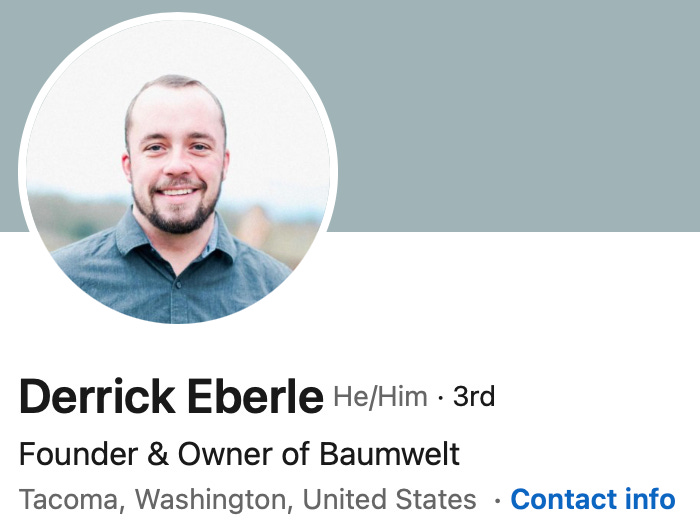

Longtime CC Watchdog readers will remember Derrick Eberle as the private property owner to whom Commissioner Ozias once proposed providing approximately $125,550 in taxpayer-funded electronic automatic gates. Those gates would have effectively converted Towne Road—a historic link between Sequim and Dungeness—into Eberle’s private driveway, serving his residence and his 300-guest wedding venue.
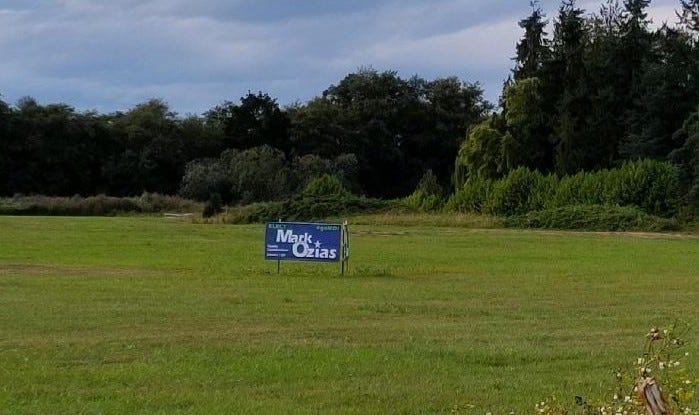
During that same period, Eberle displayed a “Re-Elect Mark Ozias” sign on his property. And while the gate proposal was being debated, Commissioner Ozias emailed Eberle asking for his personal phone number so they could discuss the matter “NOT on county time or my county device.”

When the Jamestown Corporation later floated the idea of abandoning Towne Road and converting it into a trail, Eberle founded the Dungeness Levee Trail Advocates (DLTA) and organized rallies urging officials to leave the road unfinished. Commissioner Mike French attended one rally as a featured speaker. Eberle also spearheaded a Change.org petition opposing the road’s completion.
During this same period, a home burned down while Towne Road remained closed. The Fire Chief later acknowledged that the closure—and the resulting five-mile detour—contributed significantly to the loss. A family was left homeless. Their dogs died in the fire.
Eberle and his wife also filed complaints alleging harassment by Towne Road supporters, triggering a month-long investigation by the Sheriff, Prosecutor, and Commissioner Ozias. The investigation found no evidence to support the claims.
Taken together, the record shows a recurring pattern: Commissioner Ozias and Derrick Eberle working in alignment on issues where private, personal, and political interests directly conflicted with the public’s interest in access, safety, and transparency. Rather than serving as a cautionary example, that history now appears to be a qualification.
Towne Road itself is part of the county’s heritage. The irony is difficult to ignore: a person who worked tirelessly to remove a historic public road from public use is now being appointed to the Heritage Advisory Board.
Commissioners are scheduled to approve this appointment today at 10:00 am. Because it is an agenda item, public comment is allowed at the start of the meeting. If you wish to comment—in person or virtually—use the county’s meeting link.
If you have concerns about this appointment to the Heritage Advisory Board, all three commissioners can be reached by contacting the Clerk of the Board at loni.gores@clallamcountywa.gov.
A Familiar Pattern, A Familiar Outcome
Elizabeth Ann Angel, 54, was booked into the Clallam County Jail on Sunday and charged as a fugitive from justice. Two additional charges—possession of a dangerous weapon and possession of a controlled substance—were released by the prosecutor the following day.
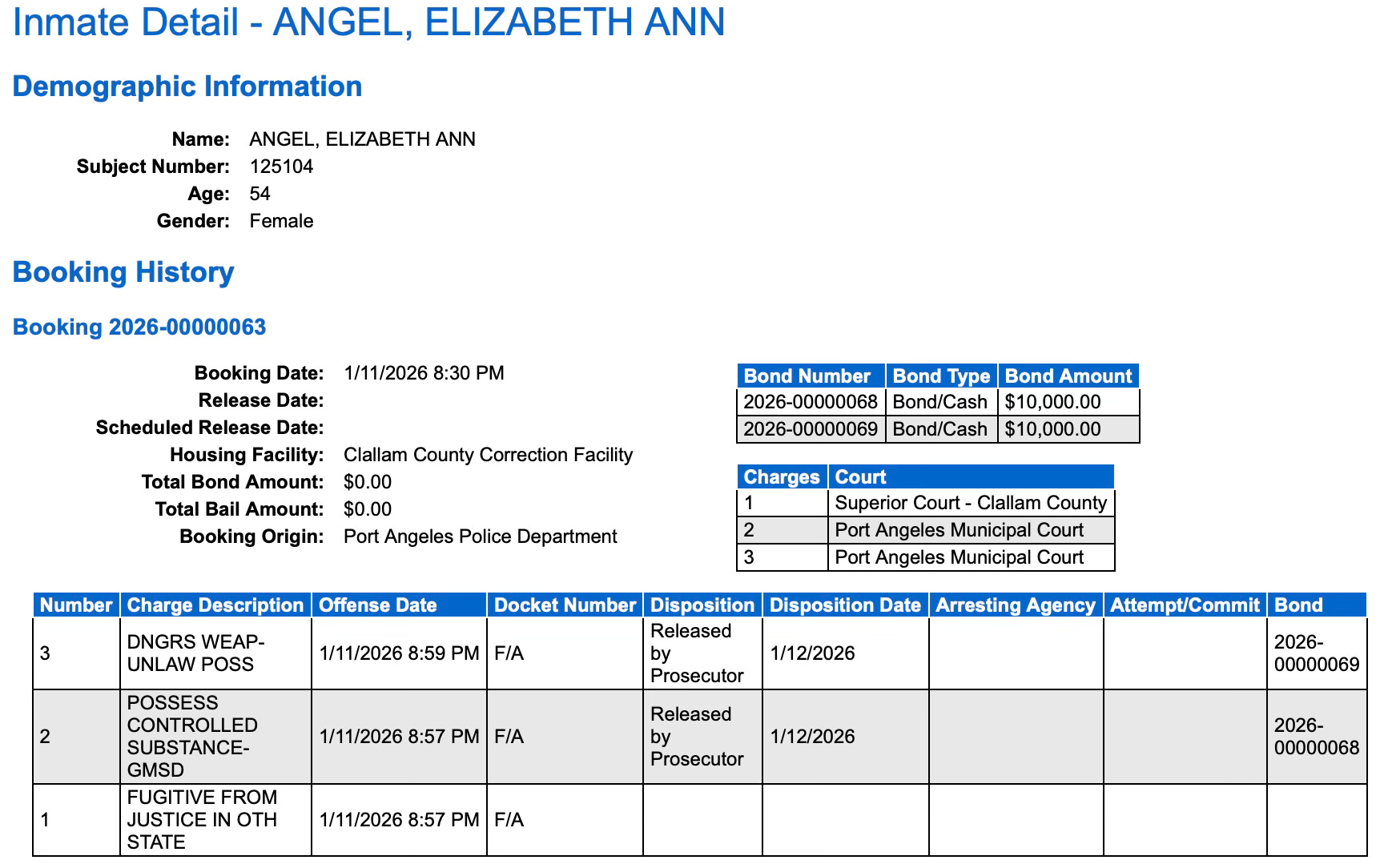
Her record is not local. It is interstate.
In September, Angel was arrested in northern Idaho on drug-related charges. A year before that, she was arrested in Florida for shoplifting and trespass.

Her last known residence? Missoula, Montana.
Once again, Clallam County becomes the terminus.
We now have a familiar mix: repeat offenders with drug histories, an increasingly permissive local environment, and a county government that recently approved an additional $100,000 for drug paraphernalia—meth pipes, snorting kits, and crack-pipe cleaning supplies—under the banner of harm reduction.
We have the dealers. We have the free supplies. We have minimal enforcement. And if you steal enough packages, panhandle long enough, or shoplift enough, the rest appears subsidized.
Meanwhile, the prosecuting attorney, sheriff, police chief, and even a state representative have all indicated willingness to hold a public town hall to discuss harm reduction and repeat offenders. The commissioners, however, continue to refuse even basic engagement.
Is it any wonder this pattern keeps repeating?
French Declines Comment on Evictions
Commissioner Mike French recently responded to a constituent concerned about the Peninsula Behavioral Health North View housing project by stating that the facility is intended for residents not actively using substances. In the same breath, he asserted that Washington’s landlord-tenant laws “do not allow a landlord to evict solely because of substance use.”
That contradiction prompted CC Watchdog to ask a simple, reasonable follow-up: What law supports that claim?
In a formal email, Commissioner French was asked to identify the specific statutes, case law, or guidance underlying his interpretation. CC Watchdog asked whether evictions based on behavior, lease violations, or illegal activity remain permissible. He was asked whether PBH policy is driven by law—or ideology.
CC Watchdog also made clear that, absent a response, we would report that he declined to comment.
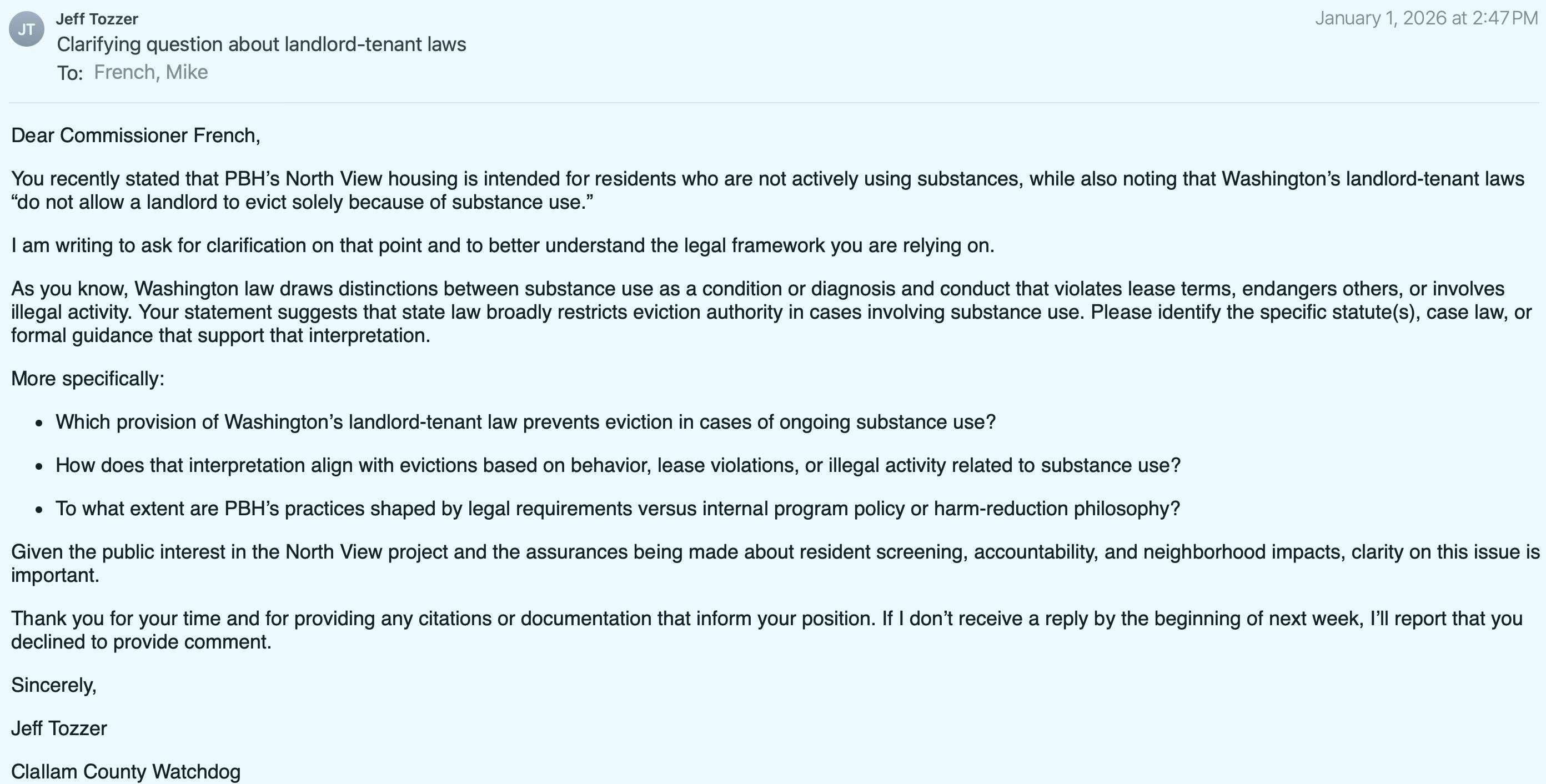
It has now been a week and a half. There has been no reply.
This matters because Commissioner French voted to approve $4 million in taxpayer funding for the North View project. His apparent assumption—that eviction is essentially impossible—drives acceptance of a low-barrier model.
But what if he is wrong?
What if the law allows for more accountability than he suggests? What if this could be high-barrier housing? Instead of investigating, engaging, or clarifying, he chose silence.
Commissioners are elected to represent constituents—not to act as public-relations shields for NGOs.
Floods, Funding, and Selective Empathy
Yesterday, the Peninsula Daily News ran a New York Times article on its front page describing how coastal tribes in the Pacific Northwest face increased flood risks due to climate change. Readers were reminded that water is culturally important to tribal communities.
Of course it is. It is important to every culture that drinks it, farms with it, paddles through it, or floods because of it.
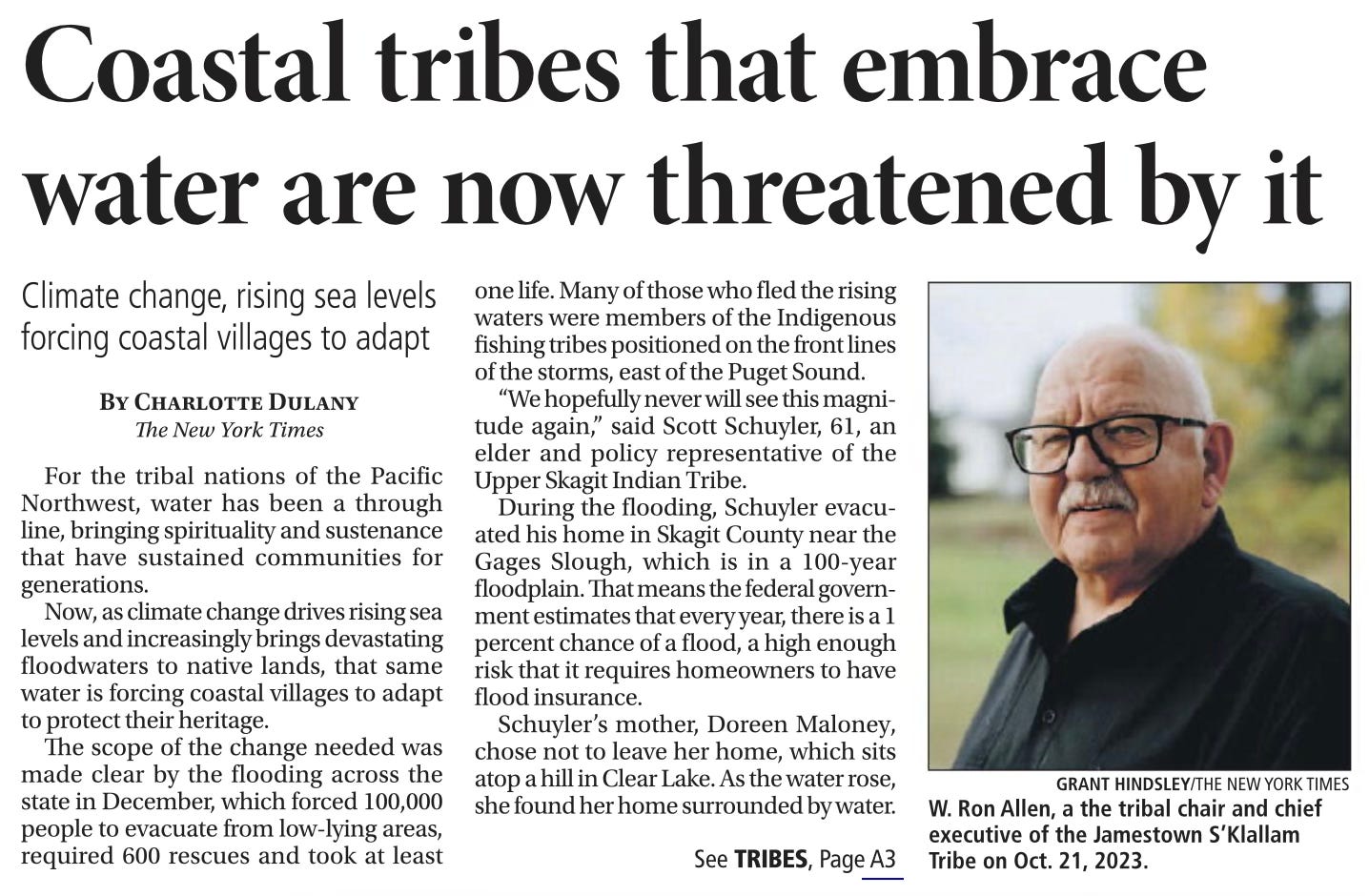
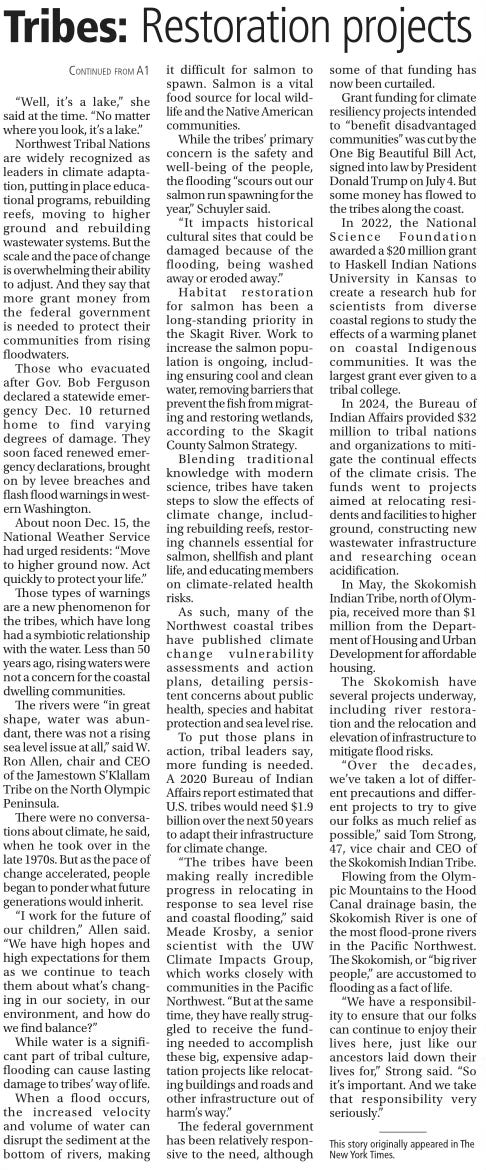
The article implies that recent flooding—such as in Skagit County—has disproportionately affected tribal communities and argues that tribes, widely described as “leaders in climate adaptation,” need more federal grant funding to keep pace.
What went unmentioned is that flooding does not discriminate.
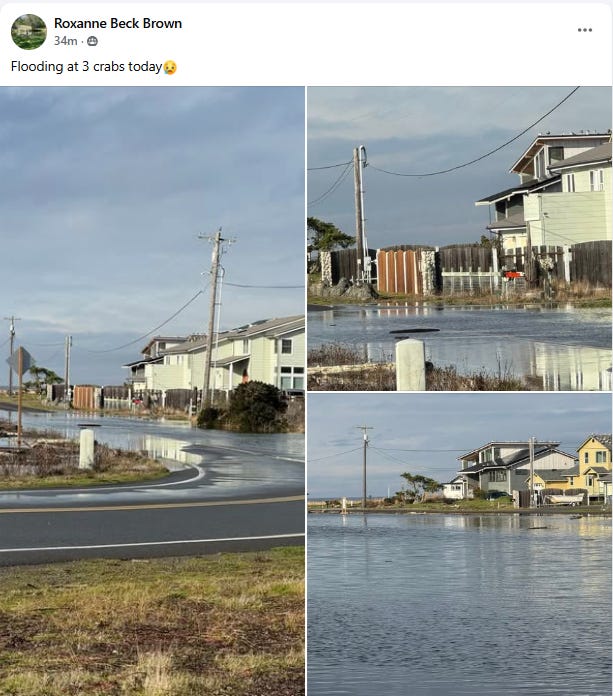
Residents in the 3 Crabs neighborhood of Dungeness have seen flooding worsen dramatically since Jamestown partnered with the county to remove the armored Meadowbrook Creek dike. That lived reality did not make the New York Times narrative.
Jamestown CEO Ron Allen told the New York Times that 50 years ago, rivers were healthy, water was abundant, and sea levels were stable. He emphasized salmon’s cultural importance—without mentioning the tribe’s interest in commercial fish pens in Port Angeles Harbor.
The Jamestown Corporation represents just over 200 local tribal members. Its annual revenues exceed $100 million.
“Disadvantaged” deserves context.
Federal disaster aid and adaptation funding should help all people—not favored categories. Flooding affects everyone. Policy should, too.
A New Watchdog Cracks Open the Courts
A new independent news outlet has entered the Clallam County scene with an in-depth investigative report examining the appointment and conduct of a Clallam County Superior Court commissioner. In its first major piece, The Olympic Herald focuses on an unelected judicial officer whose role carries significant power but little public accountability.
The article examines Commissioner Brian Parker, appointed in January 2025. Commissioners preside over protection orders, family law, juvenile matters, and eviction cases, yet they are not elected and cannot be removed by voters. That makes the integrity of the appointment process especially important.
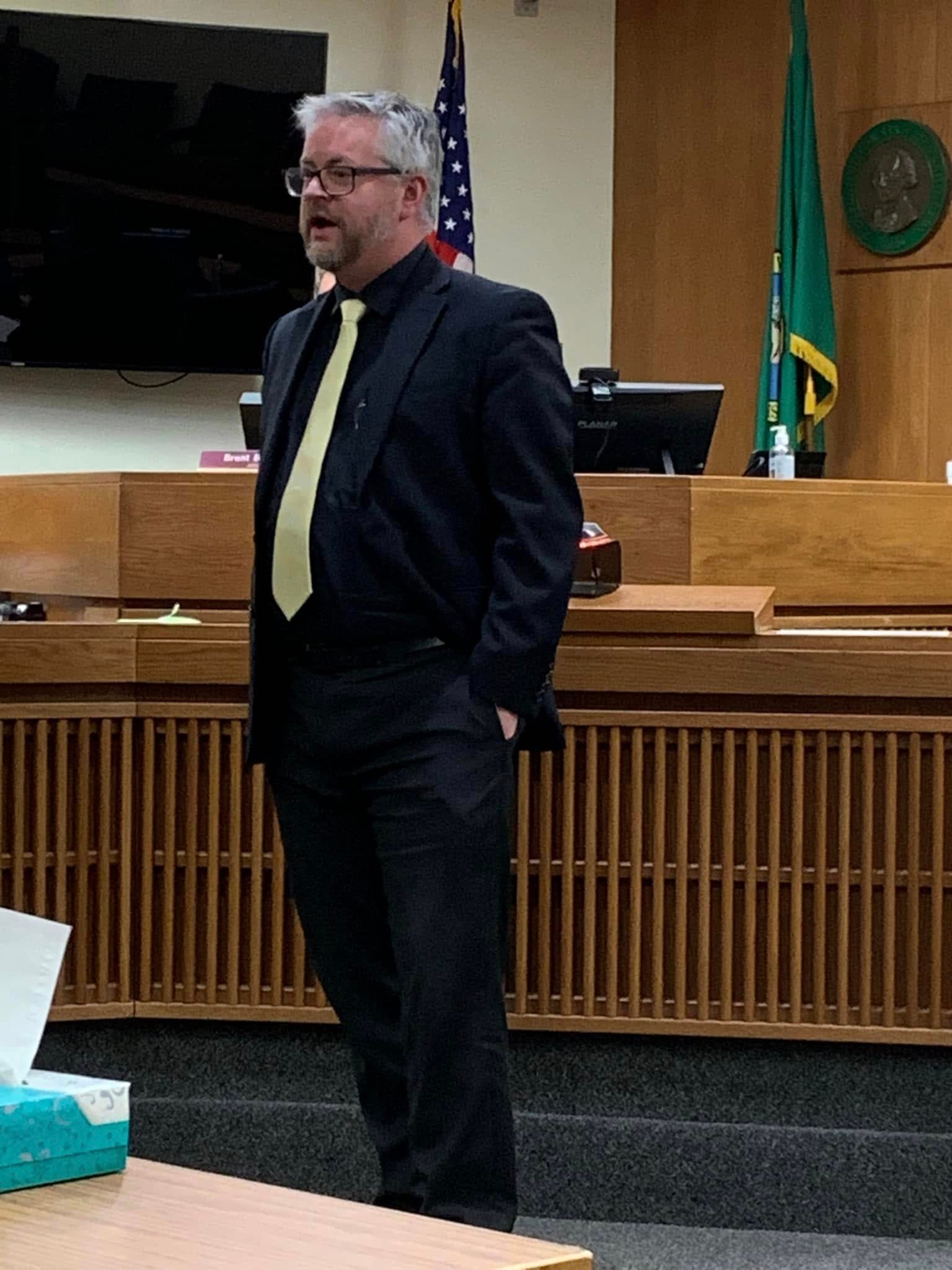
According to the reporting, Parker was previously investigated and arrested following a referral for felony perjury related to sworn testimony in a custody case while serving as a Guardian ad Litem. Although the charge was later reduced, investigators reportedly cited documentary evidence contradicting his statements—raising concerns about credibility in a role that depends heavily on evaluating sworn testimony.
The article also raises questions about how Parker was hired. Standard safeguards, including a probationary evaluation period, were reportedly waived, and key human-resources documentation appears to be missing. In addition, there is no clear record that Parker completed specialized training typically recommended for family court commissioners handling sensitive cases.
The broader issue is not a single individual, but a system with limited transparency and no direct public oversight. The investigation asks whether Clallam County’s judicial appointment process is worthy of the trust it demands—and whether anyone outside the courthouse is truly watching.
When local legacy media fills its front page with syndicated New York Times content, it’s a signal that local accountability journalism is being deprioritized. This is precisely the moment when independent outlets matter most. If you value reporting that focuses on issues and decisions that affect your daily life here at home, consider subscribing to independent local journalism. The Olympic Herald is a new voice worth paying attention to.


