At Tuesday’s Board of Commissioners meeting, a coordinated show of support for harm reduction policies collided with growing public frustration over crime, environmental damage, and declining quality of life. As county officials defend ideology and donors benefit from policy shifts, taxpayers, parents, and volunteers are left asking who this system is really serving — and who is being ignored.
“That Cleaning Up Is Actually Theft”
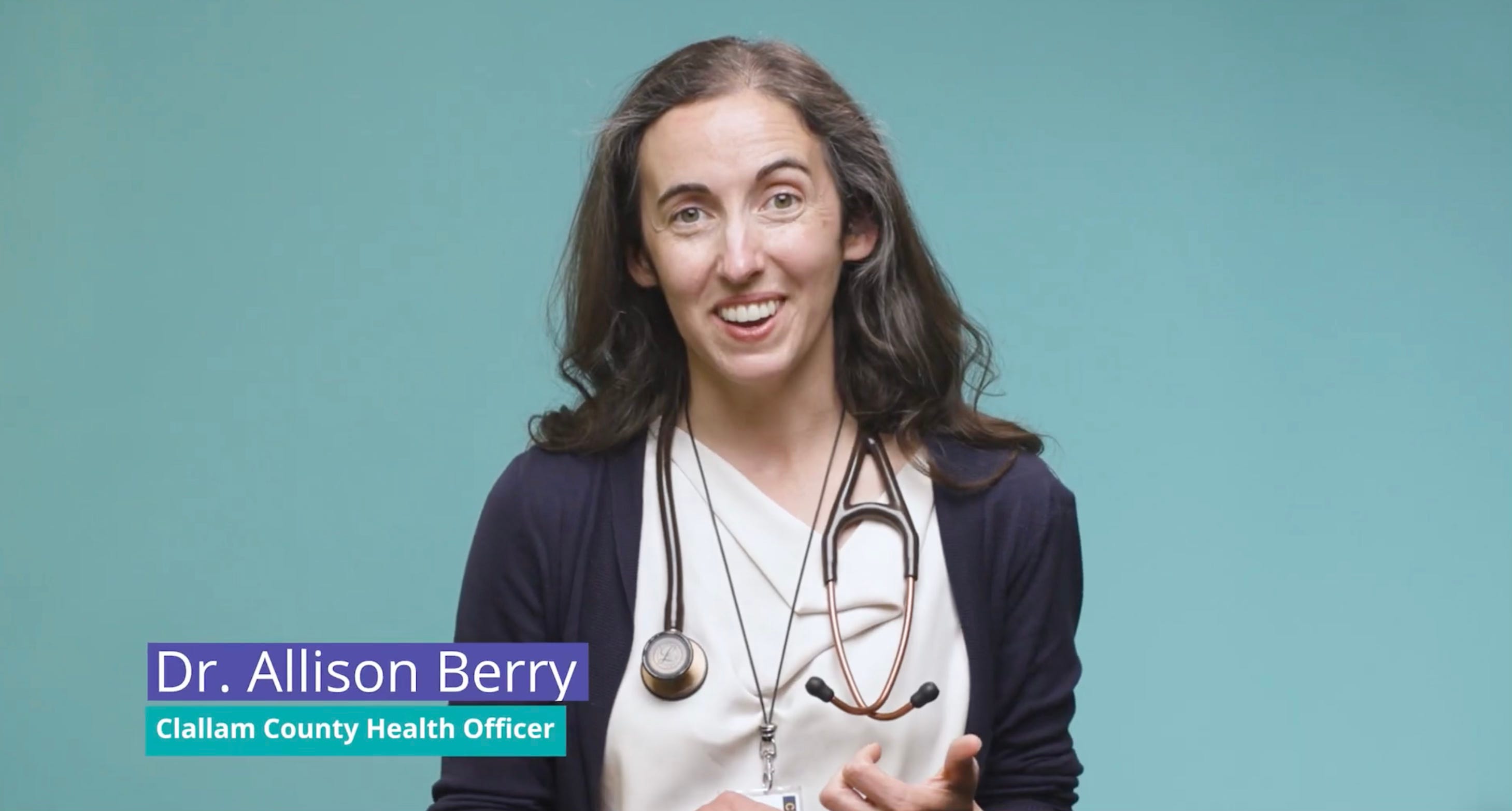
There was a noticeable and coordinated upswell of support for harm reduction during public comment at Tuesday’s Board of Commissioners meeting. Several speakers appeared virtually to praise County Health Officer Dr. Allison Berry, applaud Clallam County’s harm reduction strategy, and frame criticism of the policy as misinformation or stigma. The tone was clear: harm reduction is working, critics are wrong, and leadership should stay the course.
At nearly the same moment public comment was beginning, Dr. Berry responded — for the first time — to an email inquiry from CC Watchdog. The question asked for clarification about a statement she made at the February 17 Board of Health meeting, where she suggested that volunteers cleaning encampments could be committing “theft” by removing supplies. The email requested documentation or evidence supporting that claim, or a clarification if none existed, noting that volunteer groups like 4PA follow protocols to avoid removing personal property in active use.
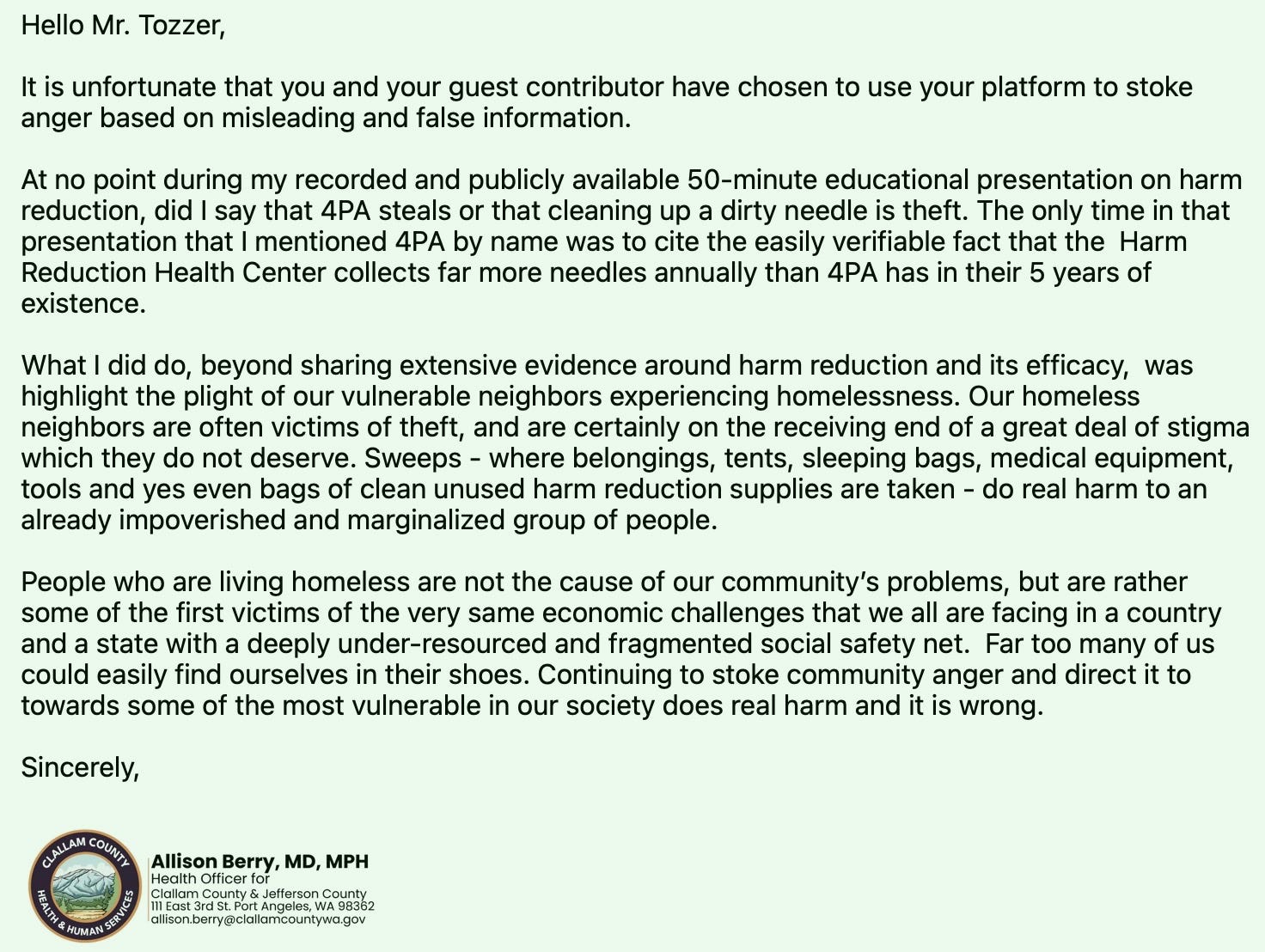
Dr. Berry’s written response did not deny the statement itself, but reframed it. She wrote that she never accused 4PA of stealing and emphasized that sweeps and cleanups can harm unhoused individuals by removing tents, sleeping bags, tools, medical equipment, and even unused harm reduction supplies. She accused CC Watchdog of “stoking anger” and spreading misleading information, and framed unhoused individuals as victims of theft and stigma rather than contributors to community disorder.
However, Dr. Berry’s exact words at the February 17 meeting tell a different story:
“I think it’s important to acknowledge that some of our supplies that are turned in by people who find them are folks who are cleaning up encampments that people still live in. So, that cleaning up is actually theft. It’s taking supplies that someone is still using.”
In Port Angeles, there is no ambiguity about who is cleaning up encampments and needles. It is not the county. It is not a tribal agency. It is 4PA, a privately funded nonprofit operating through volunteers. That comment could only have applied to one entity. Dr. Berry did not need to name them — the implication was obvious.
Dr. Berry speaks eloquently about the theft suffered by unhoused individuals. But her framing omits other victims entirely: children whose bicycles disappear from fenced yards; families whose packages vanish from porches; contractors whose tools are stolen and resold for drug money; and business owners who start each morning scrubbing feces, trash, and needles from their doorways.
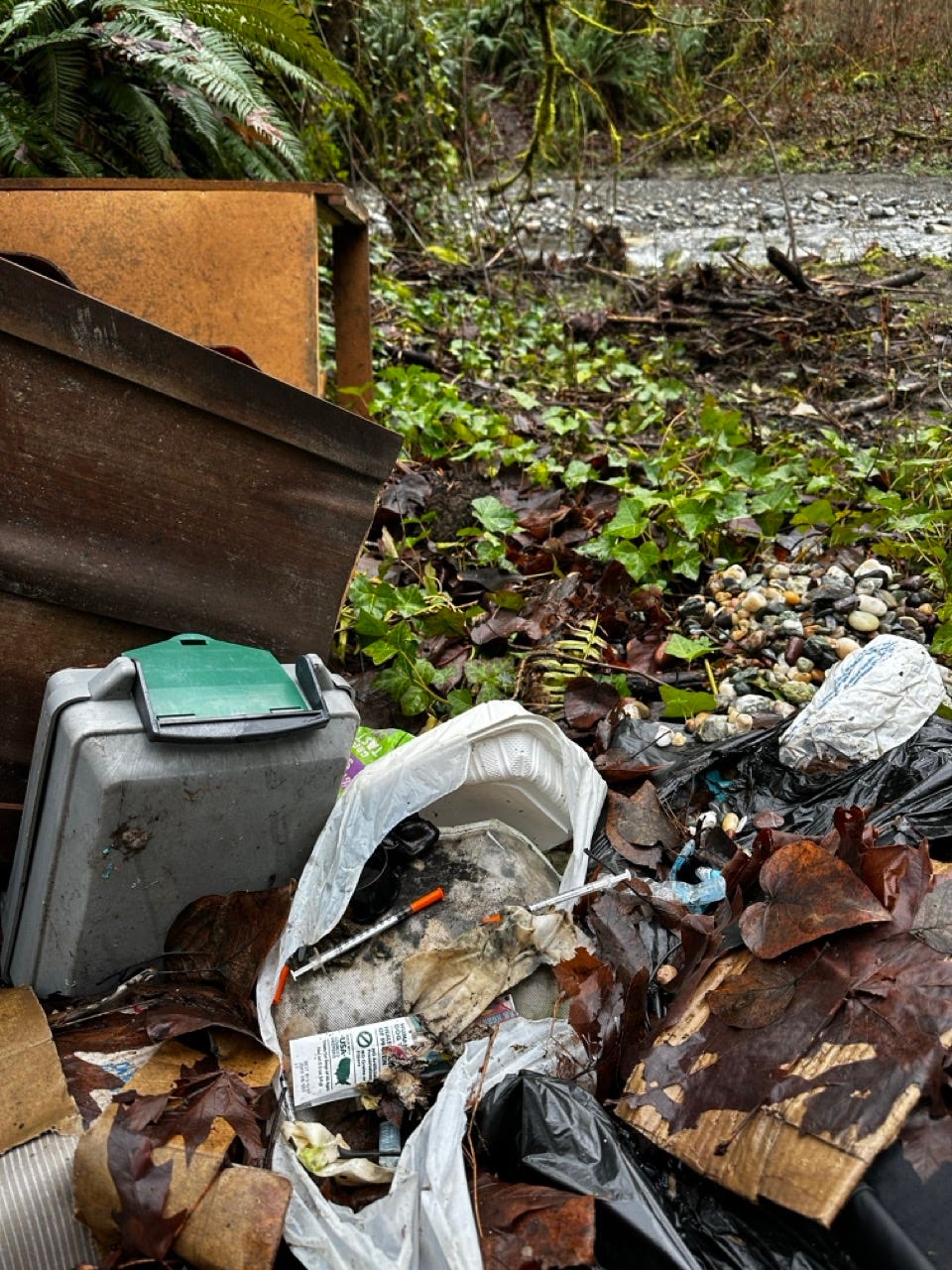
She also does not address the ecological catastrophe unfolding along Tumwater Creek, where encampments, fires, trash, and human waste continue to accumulate — a disaster documented repeatedly and ignored institutionally.
There is a marginalized group in Clallam County. It does not receive paraphernalia, sympathetic PowerPoints, or coordinated public praise. It has no advocacy coalition.
It is called the Clallam County Taxpayer.
Caring about our neighbors does not mean keeping them addicted, sick, and living in the woods. Enabling addiction while condemning those who clean up its consequences is not compassion — it is hypocrisy.
Washington, D.C., Medicaid Beds, and Following the Money
Commissioner Mark Ozias attended county business remotely this week from Washington, D.C., where he is participating in a National Association of Counties (NACo) conference. This is his second trip to D.C. this year. He is attending as the president of the Washington State Association of Counties (WSAC), an Olympia-based NGO that routinely lobbies for higher taxes and expanded government authority without direct voter approval.
Commissioner Ozias has assured residents that Clallam County taxpayers are not paying for his travel. But this week, the Board approved more than $40,000 in payments to WSAC — the very organization funding his advocacy. Taxpayers may not be buying the plane ticket directly, but they are unquestionably funding the organization that does.
During Tuesday’s meeting, Commissioner Ozias explained that he is lobbying to increase the federal Medicaid bed cap for inpatient mental and behavioral health facilities from 16 to 36 beds, while still qualifying for Medicaid reimbursement.
That policy change has very specific local implications.
The Jamestown Corporation, Commissioner Ozias’s largest campaign donor, is currently constructing Salish Trails, a 16-bed psychiatric Evaluation and Treatment facility in Sequim, scheduled to open this year. Under current Medicaid rules, that bed limit is not accidental — it is regulatory.
Washington’s specialized mental health billing guides list daily per diem Medicaid reimbursement rates in the neighborhood of $800+ per bed per day before adjustments. A full 16-bed facility could generate more than $13,000 per day. A 36-bed facility could generate over $30,000 per day.
Kept full year-round, a 36-bed facility could approach or exceed $11 million annually in Medicaid revenue.
Expanding harm reduction policies that maintain addiction, lower treatment thresholds, and increase demand for inpatient psychiatric services dovetails neatly with that revenue model.
From a business perspective, it is capitalistically savvy.
From a public policy perspective, it raises serious ethical questions about conflicts of interest, donor influence, and whose needs are driving legislative advocacy.
Austerity for Public Safety, Champagne for Economic Development
The Clallam County Economic Development Council is planning its annual gala, with tickets starting at $95 per person.
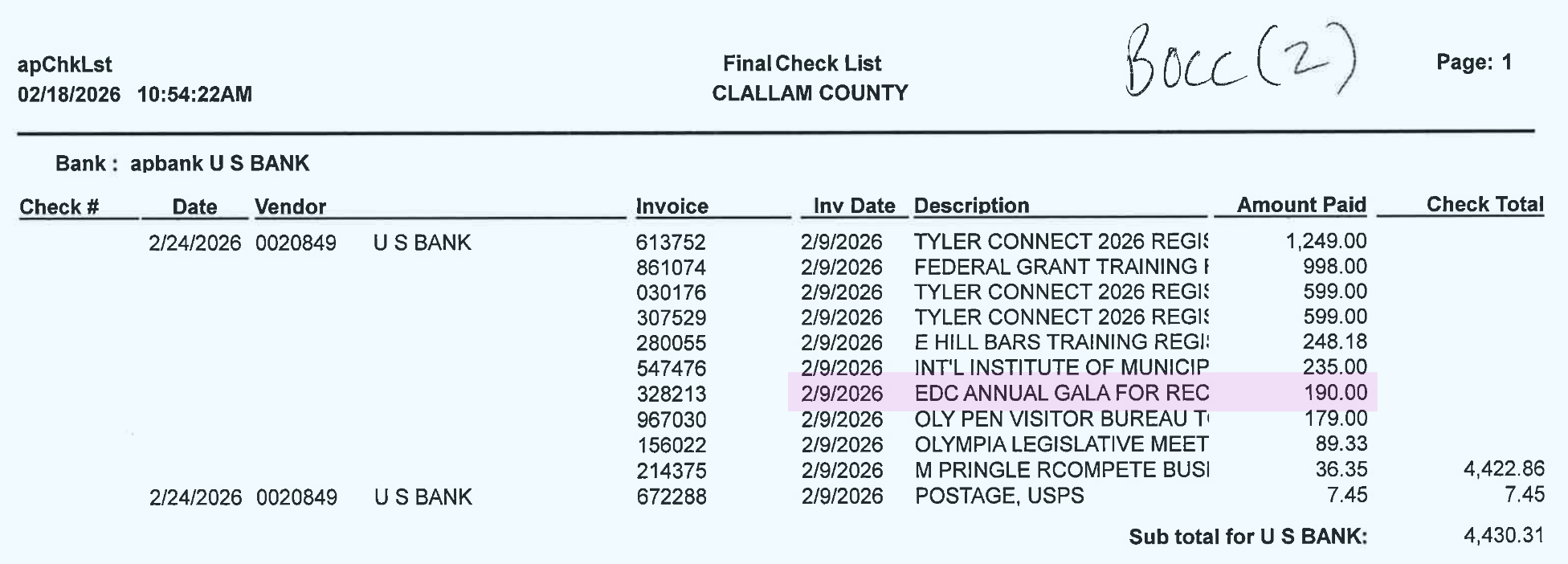
This week, county commissioners approved the purchase of two tickets using public funds.
This comes after repeated warnings that the county is financially strained and may need to cut or constrain public safety services. Residents have been told to brace for reductions, delays, and sacrifices.
Against that backdrop, subsidizing attendance at a gala — complete with networking, elbow-rubbing, and champagne — feels tone-deaf at best.
Economic development matters. But credibility matters too. When leaders plead poverty while funding perks, public trust erodes.
A Shot Seal, Stewardship, and Selective Accountability
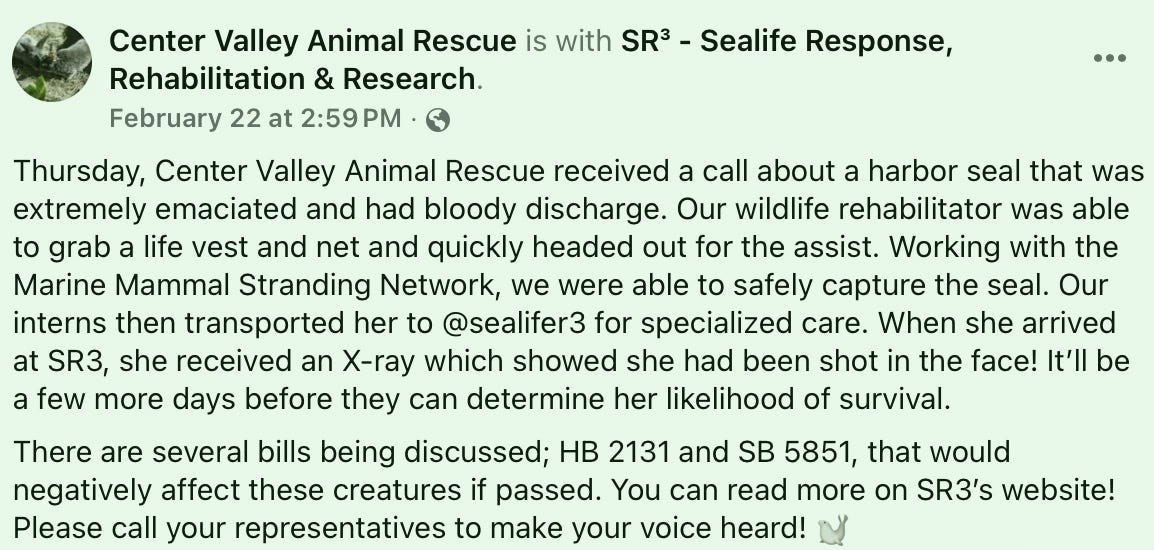
Center Valley Animal Rescue of Quilcene recently captured an extremely emaciated seal for rehabilitation. The animal had been shot in the face, and its likelihood of survival remains uncertain.
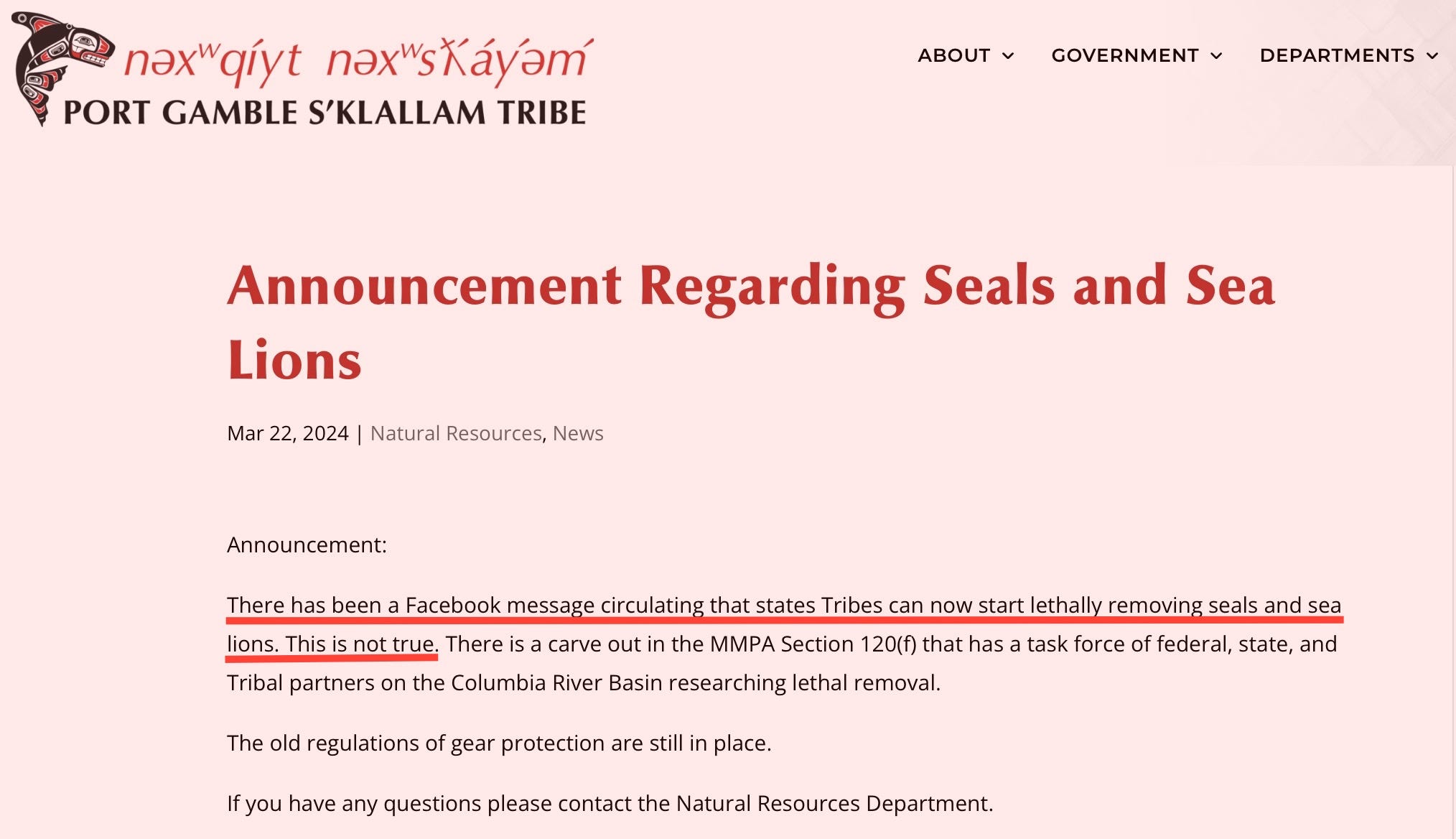
The Port Gamble S’Klallam Tribeissued a reminder that seals and sea lions may not be lethally removed and that questions should be directed to the tribe’s natural resources department.
Residents are frequently told that tribal stewardship represents the highest standard of ecological care, grounded in generations of lived relationship with the land and water since time immemorial.
So the obvious question arises: if stewardship is superior, why are reminders to refrain from killing wildlife necessary?
Environmental protection should not depend on identity or politics. It should depend on enforcement, accountability, and consistent standards — for everyone.
Letter to the Editor: “This Is Personal”
Dear Editor,
This past Saturday morning, while taking my 5-year-old daughter to her ballet class downtown, I encountered something deeply concerning. Two vehicles were parked across from the studio’s entrance. I recognized the people. I’ve known them for years. They are struggling with addiction.
While we waited for the teacher to arrive, I saw repeated lighter strikes inside one car, and a man slumped over in the other, head on the dash, seemingly unconscious. All of this unfolded near young children waiting for class. I called law enforcement, but when I returned after a brief drop-off, I saw more activity, a different vehicle pulling in, and what appeared to be hand-to-hand exchanges. I called for a follow-up, but was told by an officer later that they hadn’t seen any of this activity.
I understand officers can only act on what they witness. But when parents report suspected drug use near a children’s program, I believe follow-up is vital. Even a callback to parents would help ensure a full understanding.
This is personal to me, not just as a parent, but as someone who battled addiction. I’m grateful for the times when small arrests interrupted my cycle long enough for me to choose treatment. It saved my life. In 2021, I lost my older sister to an overdose. We held back, not wanting to push her. I believe if we’d been more proactive, she might still be here.
This is about protecting kids’ spaces and about helping those suffering. We need to break the cycle before tragedy strikes. I urge law enforcement and the community to work together, compassionately, but proactively. Our children, and those in addiction, deserve that effort.
Sincerely,
David Rogers, Port Angeles
This is not an abstract policy debate. It is about children waiting for ballet class while suspected drug activity unfolds feet away. It is about parents calling law enforcement and receiving no follow-up. It is about lives saved when cycles are interrupted — and lives lost when they are not.
David’s letter underscores a truth often omitted in harm reduction rhetoric: sometimes enforcement is not cruelty. Sometimes it is the only thing that creates space for recovery.
Recompete: Big Money, Small Results
The $35 million federal Recompete grant was meant to jumpstart the North Olympic Peninsula economy.
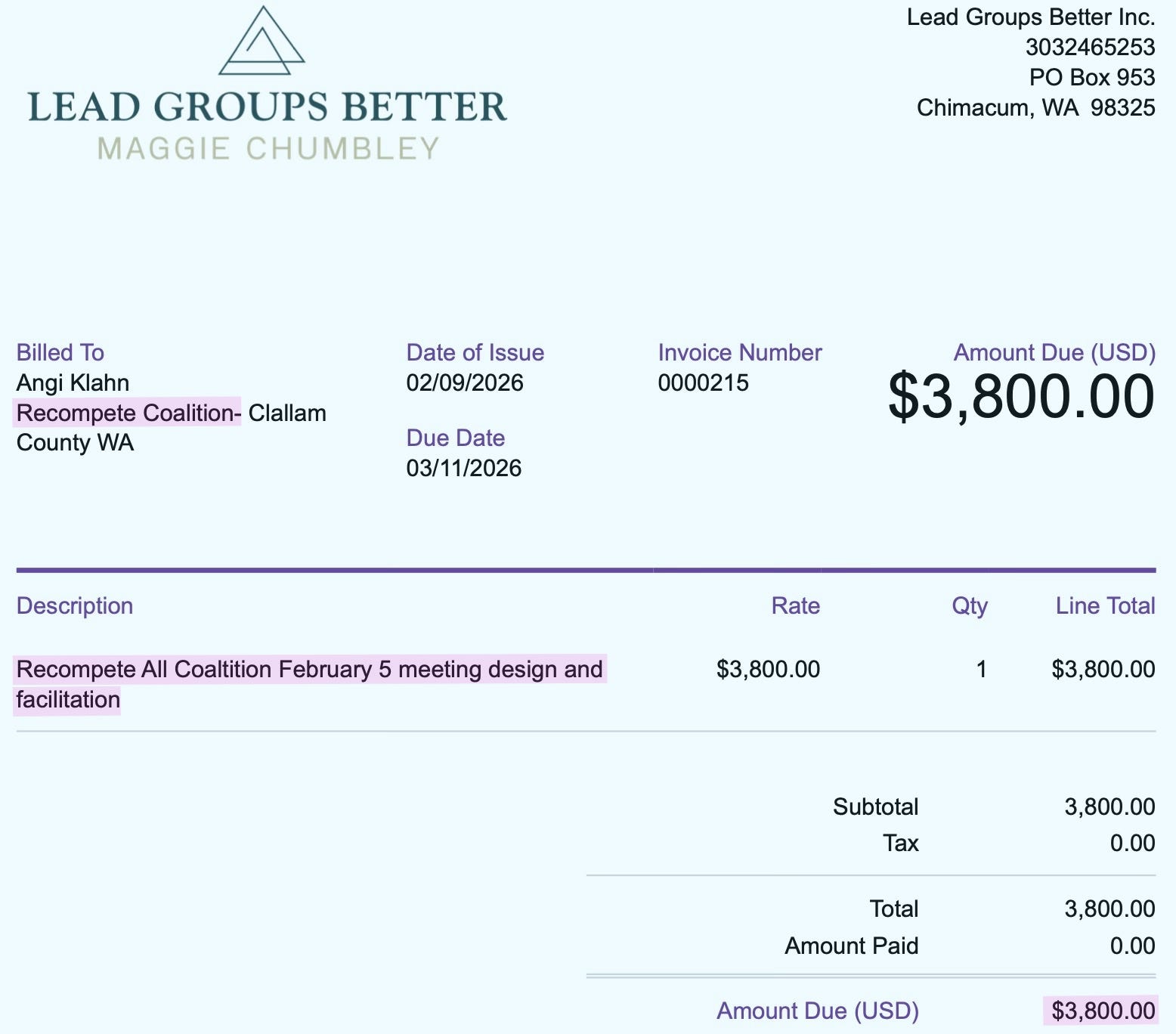
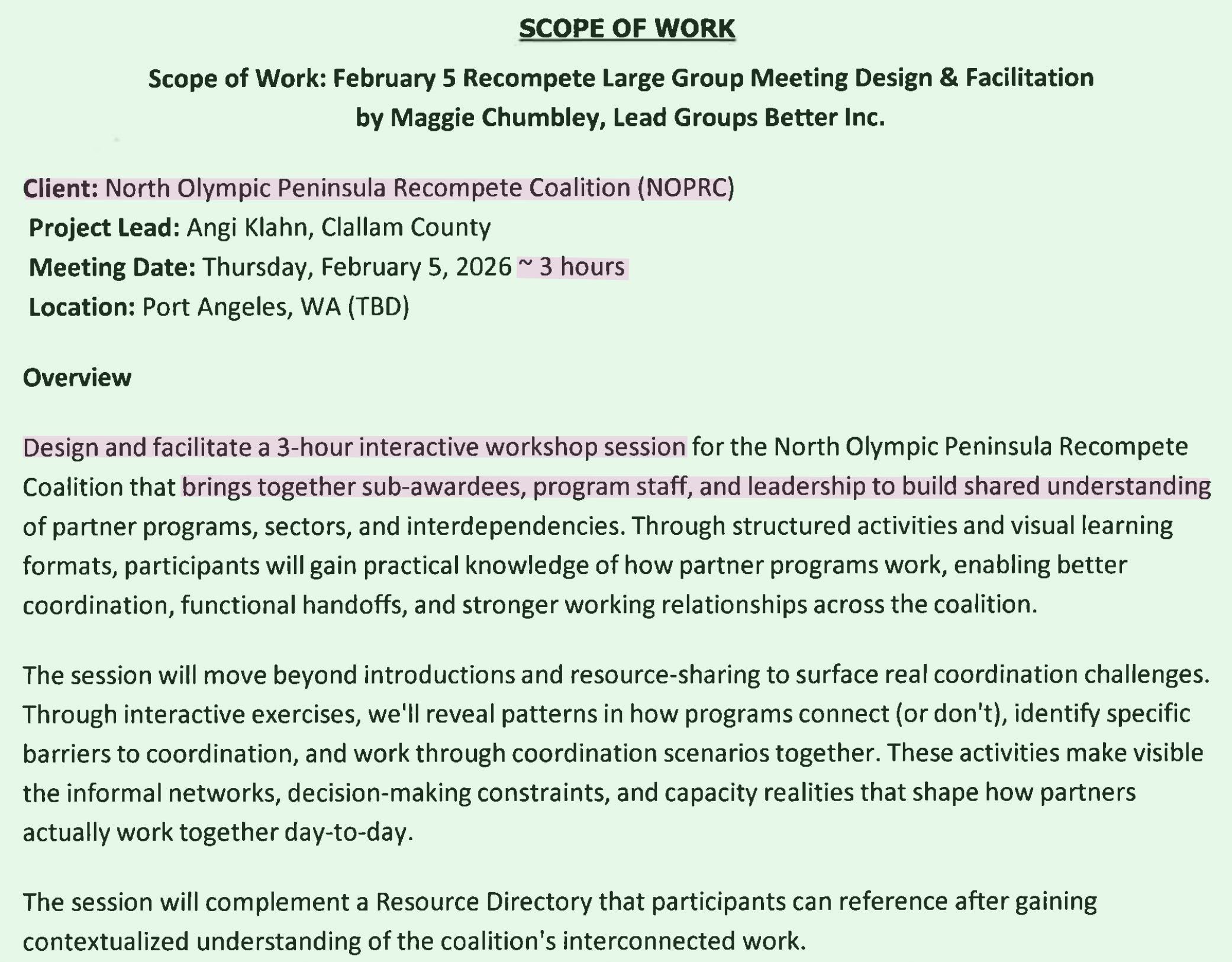
This week, commissioners approved a $3,800 payment for a three-hour workshop — more than $1,000 per hour.
The workshop was held to “design and facilitate” shared understanding among partners.
Meanwhile, questions persist about priorities, outcomes, and whether Recompete is becoming another NGO-driven ecosystem where consultants and facilitators thrive while job creation lags.
Economic recovery should be measurable. Not theoretical.
“Absolutely Insane”
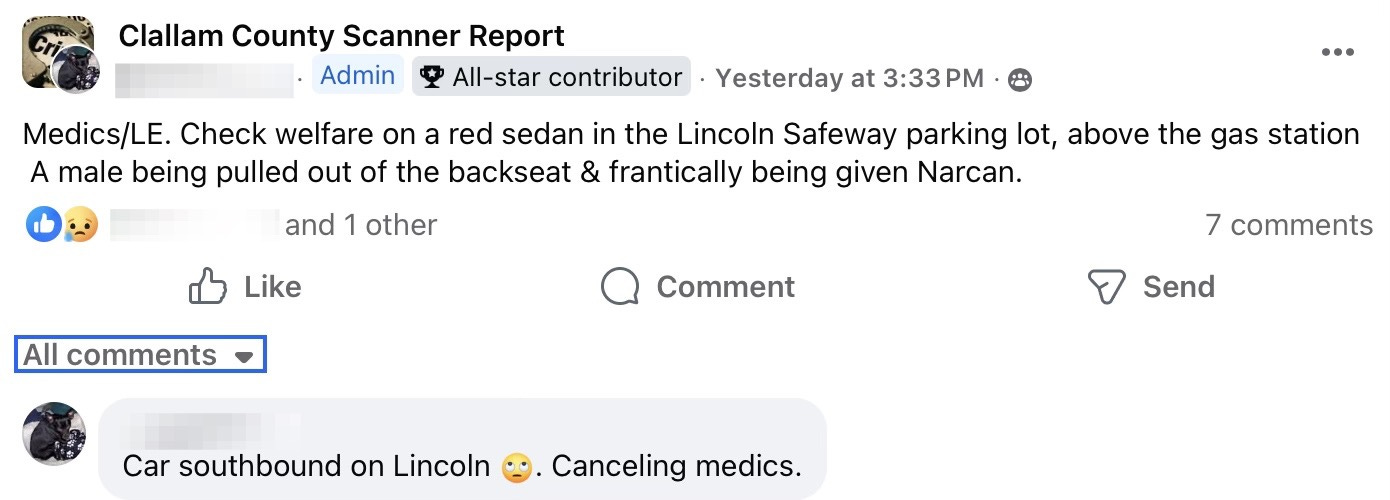
A resident account from Port Angeles describes open-air drug dealing at Safeway, overdoses reversed with Narcan, and vehicles involved in ODs simply driving away.
“Just another day in Port Angeles- drove by Safeway around 3 ish, active drug dealing from a vehicle in north side of parking lot with a literal line of customers waiting their turn to approach the window. Drove by about hour and half later and still there, plus another vehicle stuffed full of people next to it had joined the party. Got home checked scanner page to see if there was any activity after my call, just someone getting narcanned in the same area of the lot then the car driving away!
Absolutely insane that a vehicle involved in an OD can just drive away, regardless who is driving. And the dealers just continue their business with no fear. Tents on the sidewalk and piles of garbage on the planting strip that have been there at least a week. This is at our local grocery! Cluster of young men with foil in hand in the alley. Every person on the city council should be ASHAMED OF THE CONDITION OF THIS TOWN!”
This is not fringe rhetoric. It is daily observation.
When this becomes normalized, governance has failed.
“Not Necessarily Cessation”
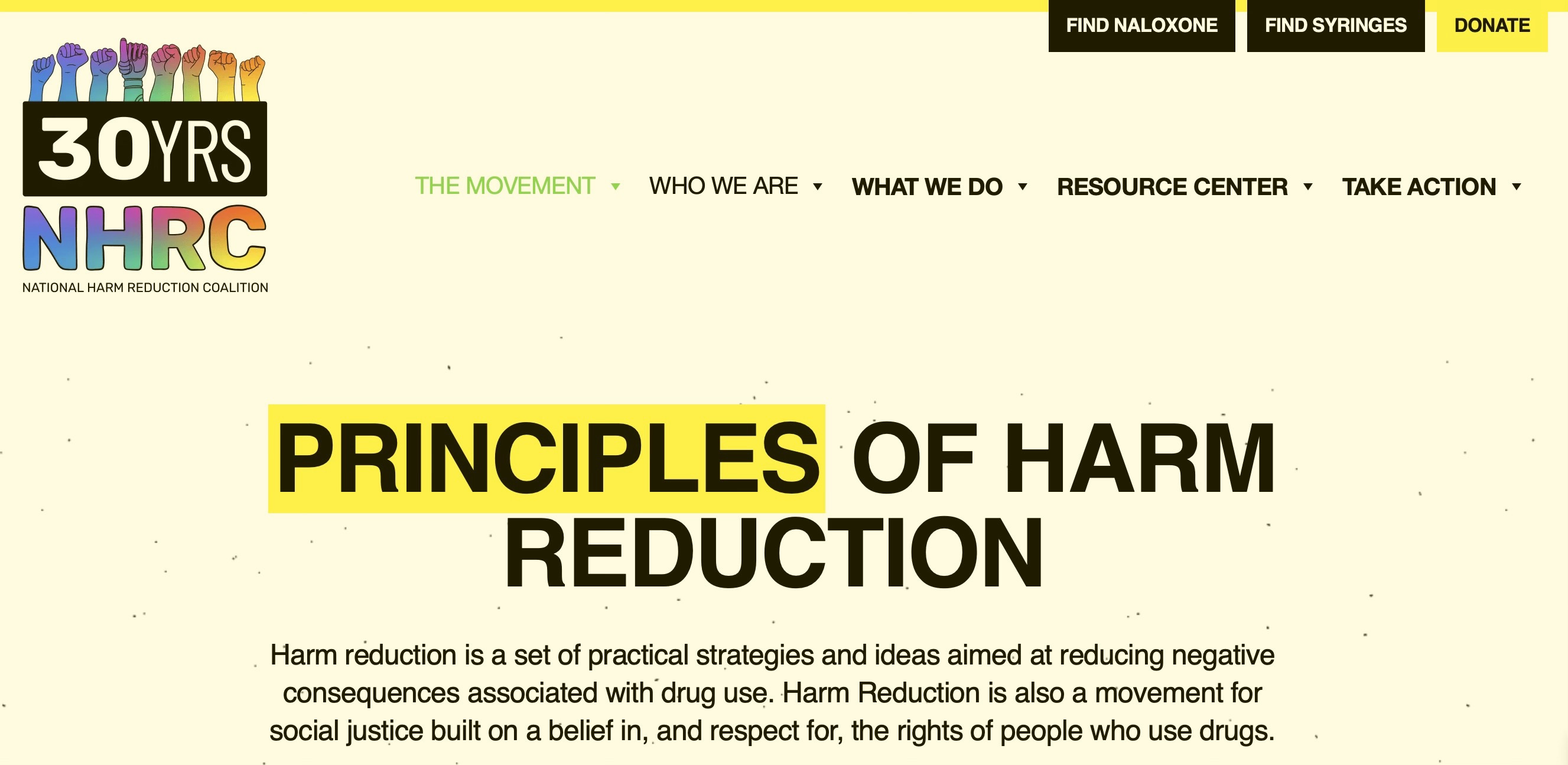
The National Harm Reduction Coalition defines success as quality of life — not necessarily cessation of substance use — and frames harm reduction as a social justice movement centered on the rights of people who use drugs.
For many residents, that language is alarming.
They see cartel-controlled supply chains, increased crime, overwhelmed first responders, and neighborhoods deteriorating. They see policy that manages addiction rather than reduces it.
Former law enforcement officers, parents, and longtime residents are asking whether morality, recovery, and community safety still matter — or whether ideology has replaced outcomes.
The Board of Health and Equal Protection
Under state law, counties have to include one representative from each federally recognized tribe with reservation or trust land in the county on the Board of Health. In Clallam County, that means three tribal seats out of 11 total members — roughly 27% of the board.
Tribal members make up approximately 3.5% of the county population.
Supporters say this structure reflects tribal sovereignty and formal government-to-government relationships. Critics argue it raises questions about fairness, balance, and whether representation on the board is proportional to the broader population.
Public health policy affects every resident, and representation matters.
So does balance.
“News is what somebody somewhere wants to suppress; all the rest is advertising.” — Lord Northcliffe
Independent Journalism Is Doing the Job
As legacy media pulls back — shrinking newsroom staff, reducing investigative capacity, and relying more heavily on press releases — independent outlets across Clallam County are stepping forward to fill the gap.
From Clallamity Jen’s research-driven memes and document deep dives, to The Strait Shooter’s sharp satire that often lands uncomfortably close to reality, to Sequim Monitor’s focus on hyper-local government decisions that might otherwise go unnoticed, a decentralized model of accountability journalism is taking shape. Clallam County Lettersprovides a platform for residents who want their voices heard directly — unfiltered, sometimes uncomfortable, but undeniably real.
Add in Marolee Smith’s continued scrutiny of Port Angeles city government, The Olympic Herald’s courthouse reporting that digs into decisions happening on the second floor that rarely make front-page news, and Forks Twilight Radio 96.7, which keeps the West End informed in real time about issues that matter locally, and you begin to see something important: oversight is no longer centralized. It’s distributed.
0:00
-4:00
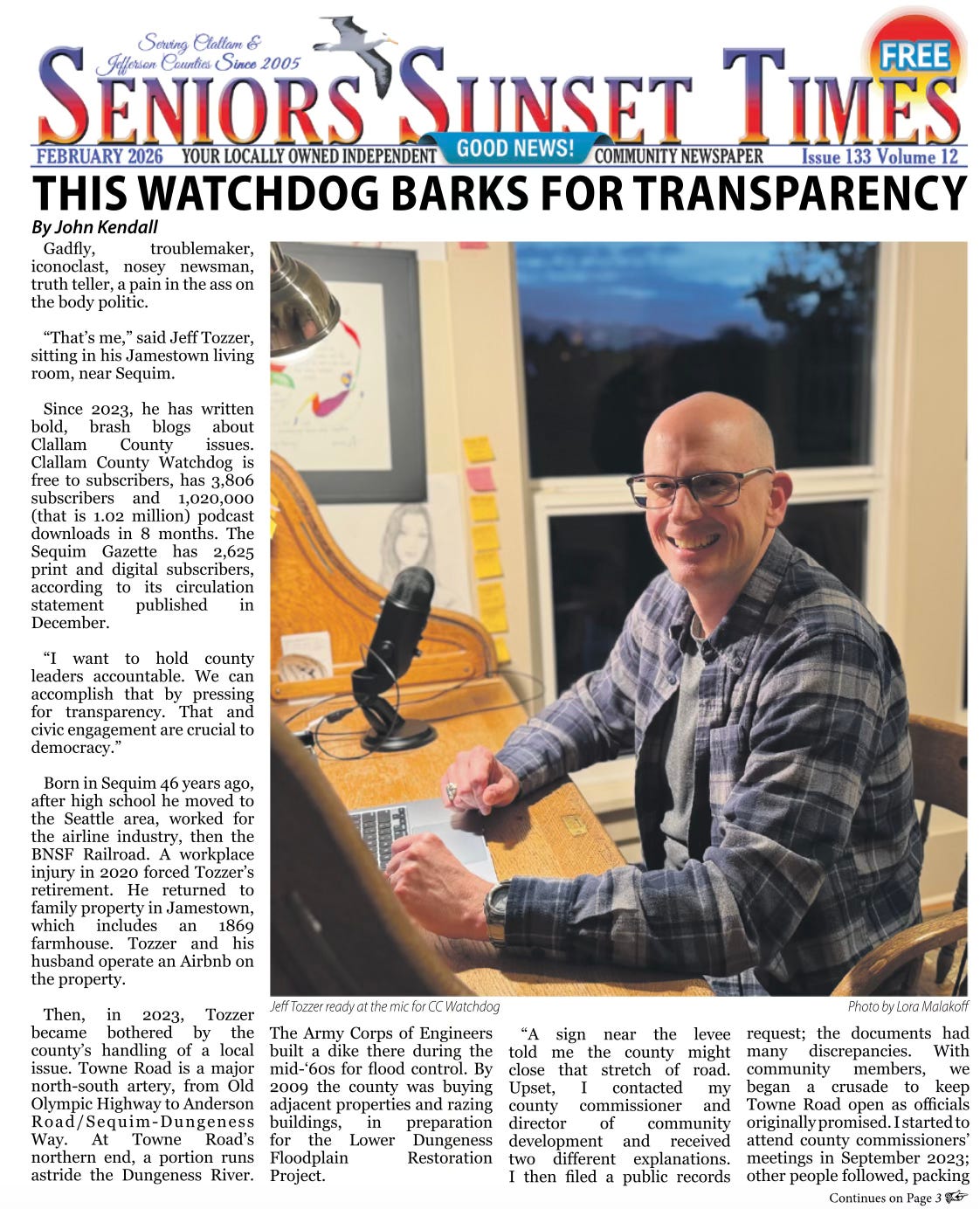
Even print hasn’t disappeared. The Seniors Sunset Times, currently on racks throughout the county, is publishing in-depth looks at the independent journalism landscape itself — The publication has reporters throughout Clallam County and editorial leadership in Clallam Bay. In an era when national headlines dominate, that kind of local focus matters.
You don’t have to agree with every outlet. In fact, healthy disagreement is part of the point. But read them. Compare them. Engage with them.
Democracy does not function in silence. It requires information — and citizens willing to seek it.