

A quiet application filed with the Department of Natural Resources could permanently change who governs a large swath of land overlooking Sequim Bay. The proposal states there is “no known opposition,” yet many local residents are only now learning it exists. Framed as conservation and cultural restoration, the transfer also references commercial shellfish revenue and long-term land consolidation goals. When land held in public trust shifts jurisdiction, it deserves more than silence — it deserves scrutiny.
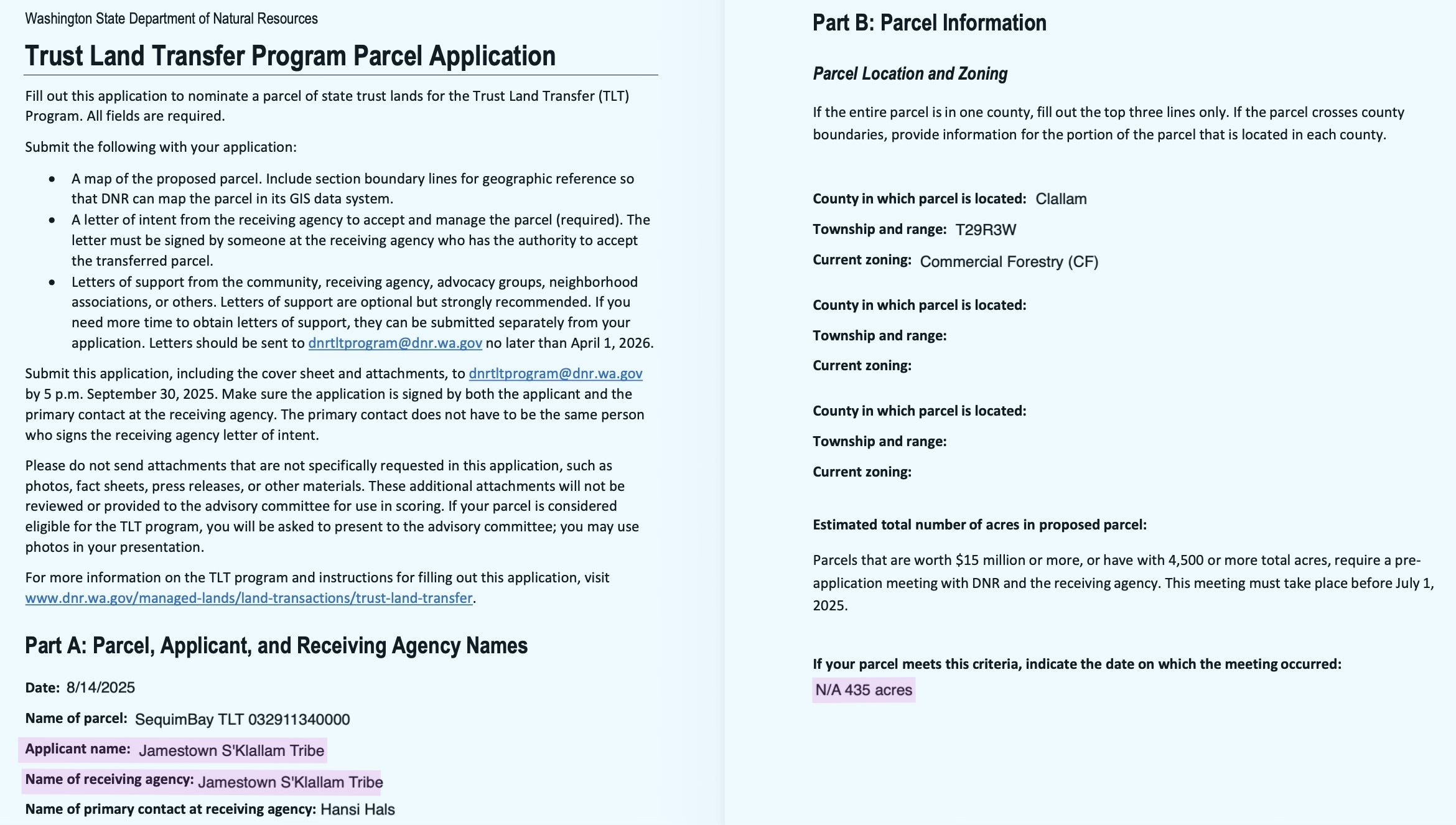
Buried in the Washington Department of Natural Resources Trust Land Transfer (TLT) applications for 2027–2029 is a proposal that deserves far more public scrutiny: 435 acres of Washington State public trust land in Clallam County — the “Sequim Bay TLT” parcel — proposed for transfer to the Jamestown S’Klallam Tribe.
That’s not private land. That’s land currently held in trust for the people of Washington State. That land is owned by you.
The application identifies the parcel as 435 acres of Commercial Forestry land. The receiving agency is the Jamestown S’Klallam Tribe itself — meaning this would shift the land from state trust status into sovereign tribal ownership.
And yet, the application states plainly:
“There is no known opposition.”

How can there be “no known opposition” when most residents have never heard of it?
“Since Time Immemorial”
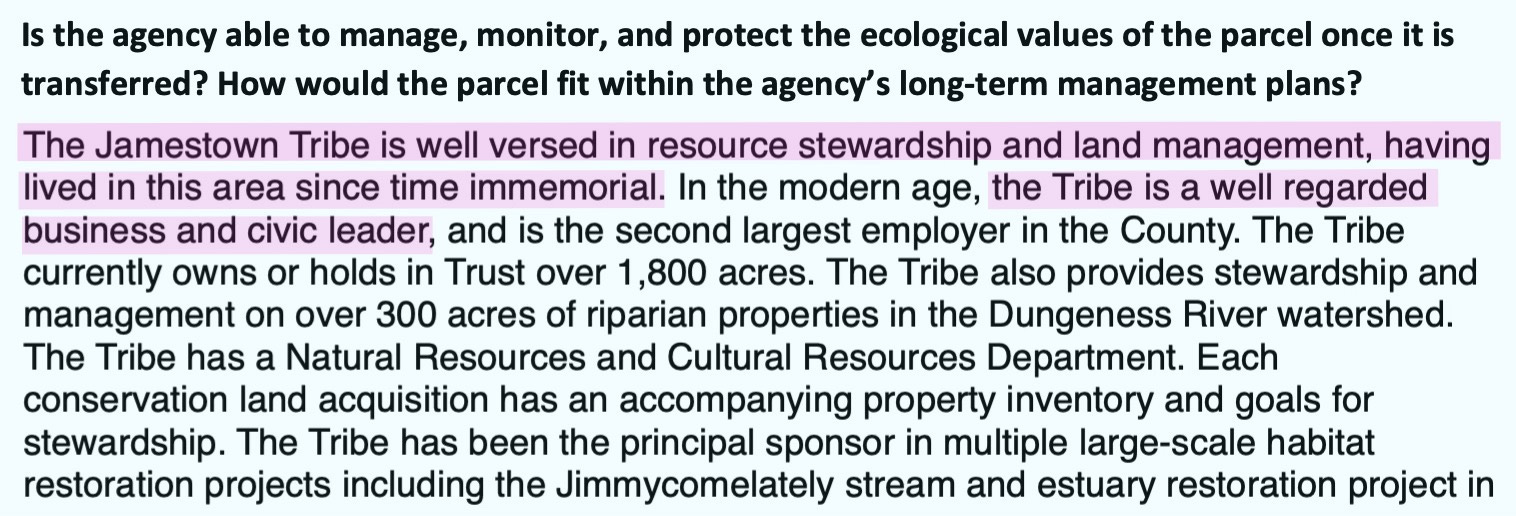
In describing its management capacity, the Tribe writes that it is well versed in resource stewardship and land management, “having lived in this area since time immemorial.”
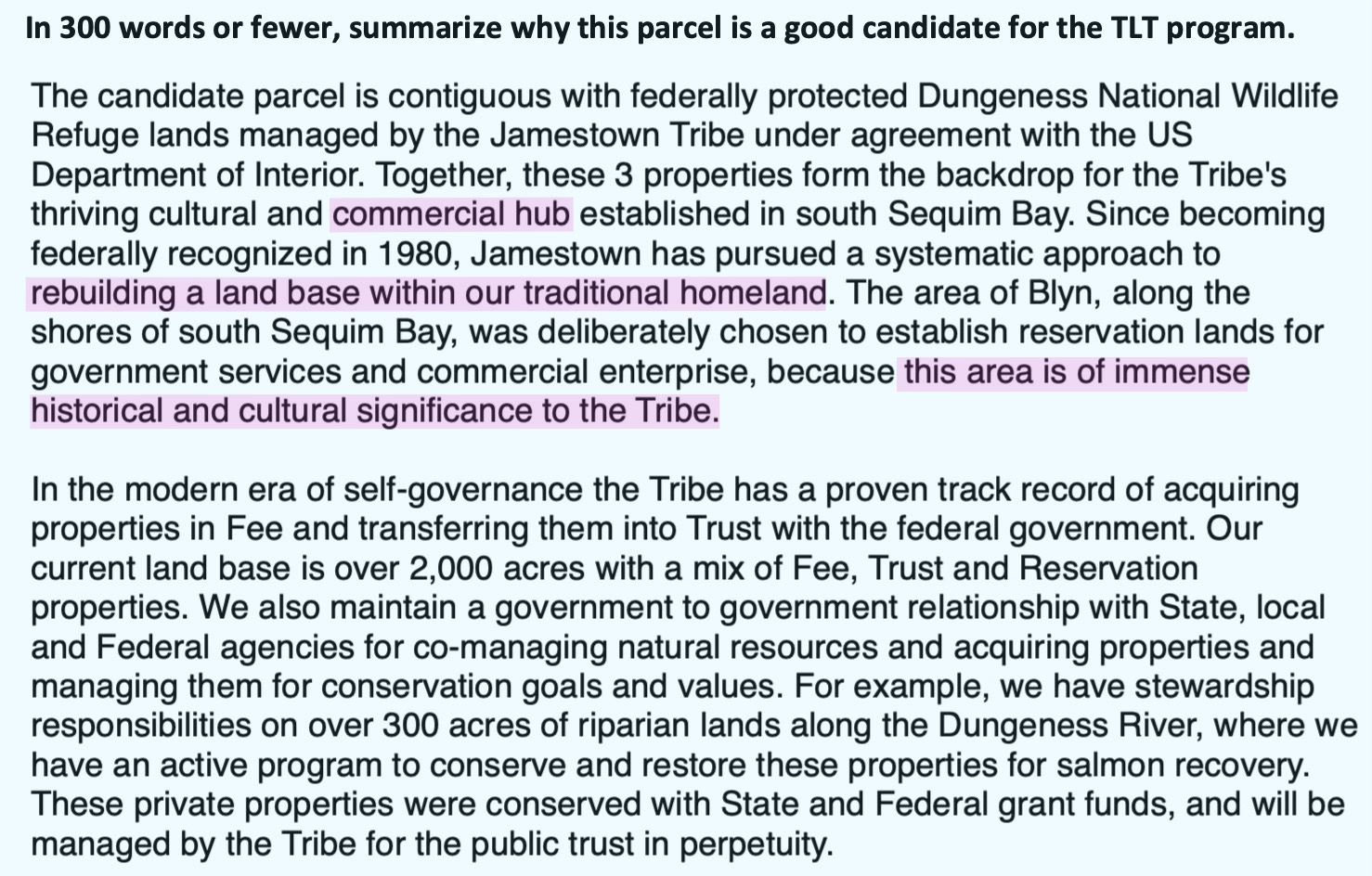
The Tribe concludes by stating the parcel would help “rebuild a land base within our traditional homeland” and was chosen because of its “immense historical and cultural significance.”
The language is sweeping.
But the applicant is also a modern sovereign government with major commercial operations. The Tribe describes itself as the second-largest employer in Clallam County. It owns or holds more than 2,000 acres and operates businesses that include a gas station, hospitality ventures, shellfish operations, and an expanding golf course.
At the same time, the application describes South Sequim Bay as “overburdened, under-served, and vulnerable” — even though Blyn is home to a casino, a new hotel, a cannabis retail store, and a gas station.

That phrasing is not incidental. It mirrors the Washington Department of Natural Resources’ Environmental Justice framework, which directs the agency to “center and incorporate the voices, perspectives, and lived experiences of vulnerable and overburdened communities.”
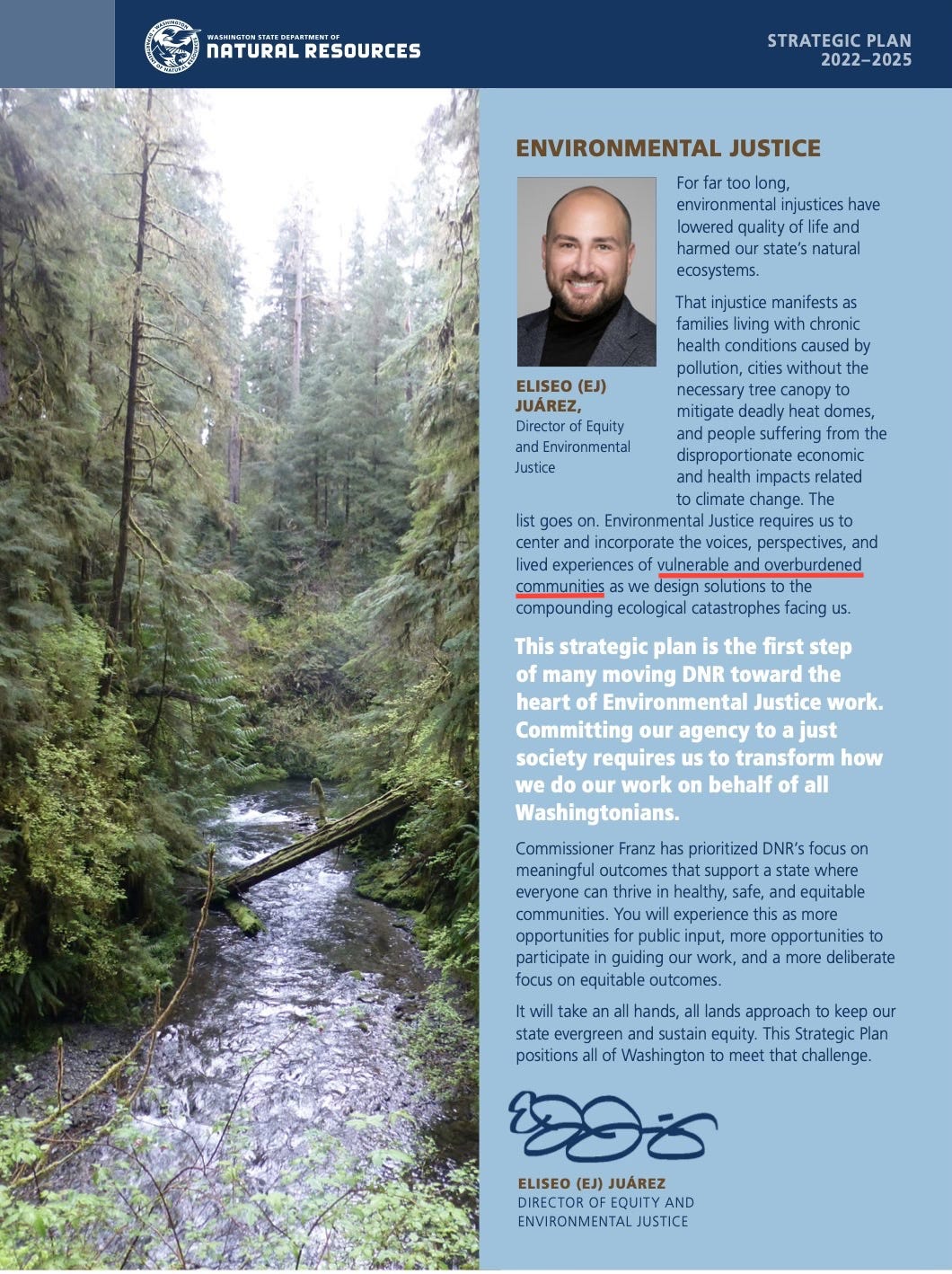
In other words, the language used in the proposal aligns precisely with the criteria that agencies are instructed to prioritize. Whether that characterization accurately reflects South Sequim Bay is a separate question — but the terminology clearly positions the application to score well under DNR’s environmental justice commitments.
However, this proposal is not simply about preservation and delivering equitable outcomes for underserved populations, and the economic section makes that clear.
The Commercial Interest
Under “Economic Values,” the application highlights the Tribe’s significant commercial and subsistence shellfish harvests in Sequim Bay, noting that they provide food and revenue for the Tribe and its citizens. It emphasizes that protecting water quality is essential to sustaining these harvests.
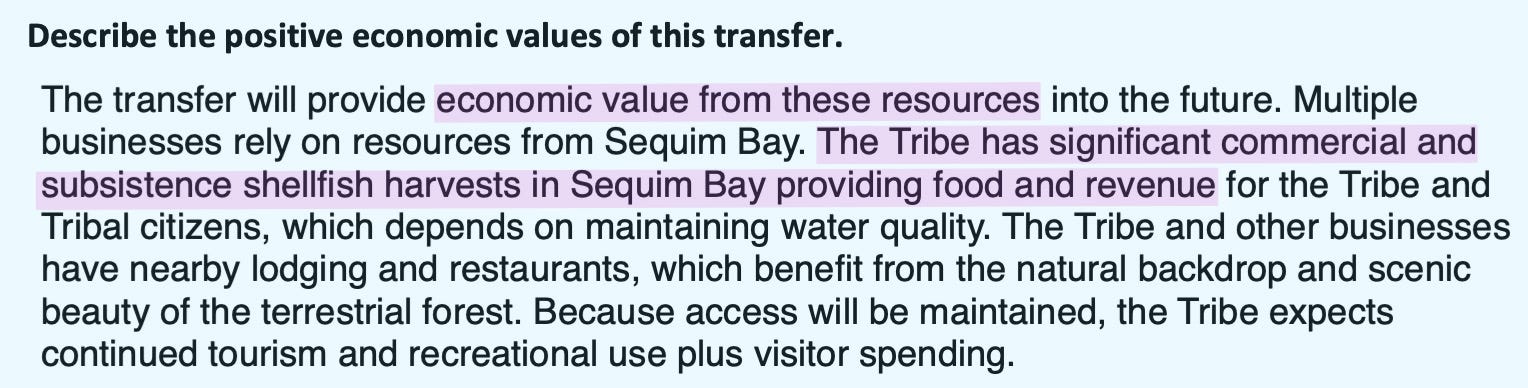
That is explicitly tied to revenue generation.
The application also stresses the parcel’s proximity to the Tribe’s main offices and commercial enterprises and describes the land as forming the backdrop for its thriving cultural and commercial hub.
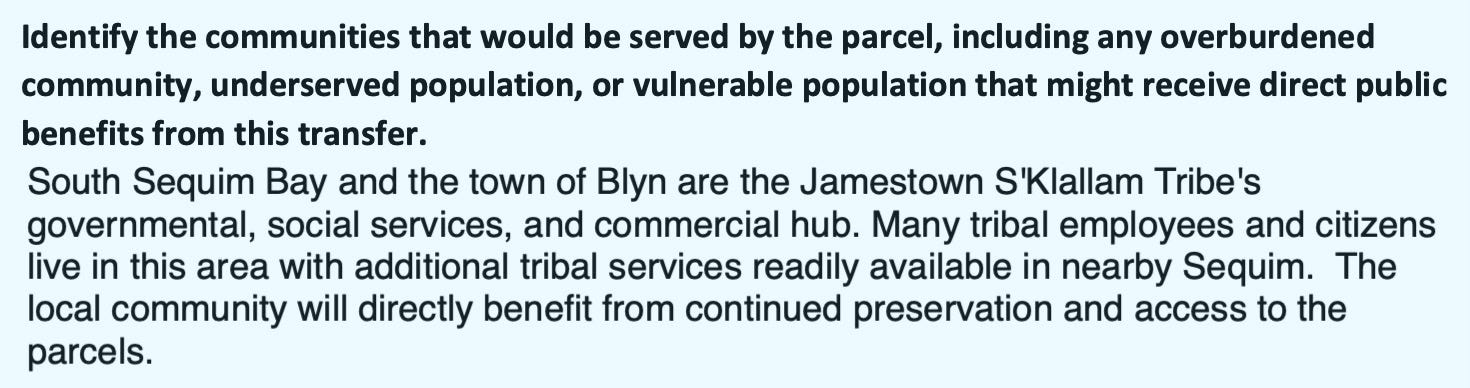
This is not merely an ecological acquisition. It strengthens the economic base of a sovereign government that already operates substantial business holdings.
The video below highlights the Jamestown Corporation’s commercial and “subsistence” shellfish operations and outlines how those ventures factor into the Tribe’s broader economic strategy in Sequim Bay.
Who Supports It?
The Tribe anticipates letters of support from the Port Gamble S’Klallam Tribe, Lower Elwha Klallam Tribe, North Olympic Land Trust, Jefferson Land Trust, Panthera, Clallam Conservation District, and the North Olympic Salmon Coalition.
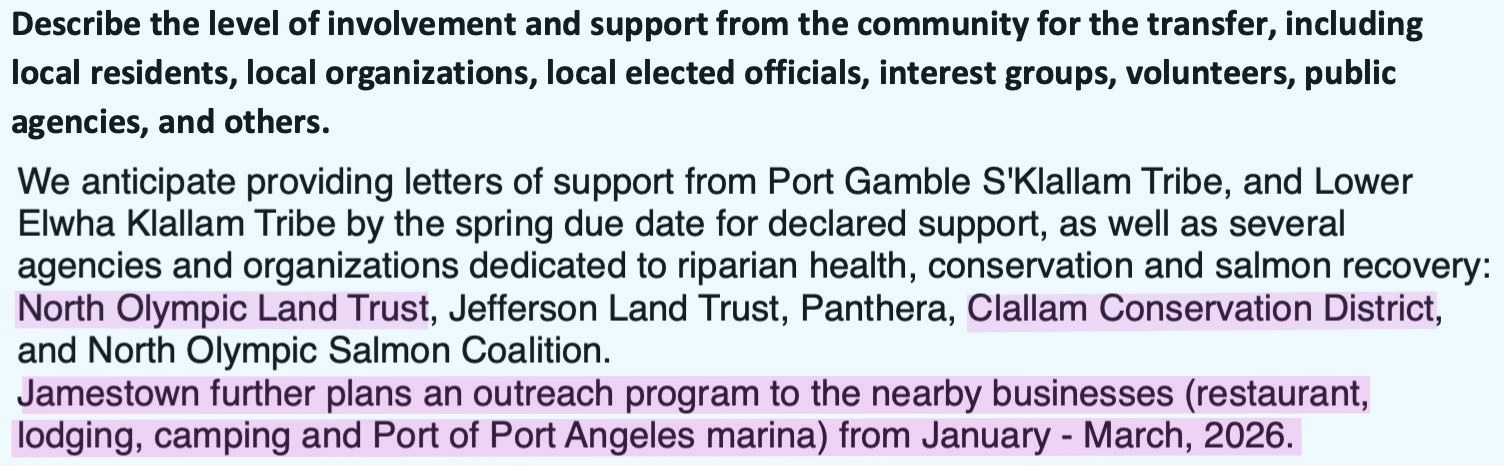
Notice what’s missing: broad public outreach.
Community engagement is described primarily as tribal newsletters, tribal general membership meetings, and updates to tribal committees. Outreach to nearby businesses is planned months after the application submission.
It also appears the Jamestown Corporation may be defining “community” primarily as the tribal community, rather than the broader South Sequim Bay and Clallam County public who are directly affected by the proposed transfer.
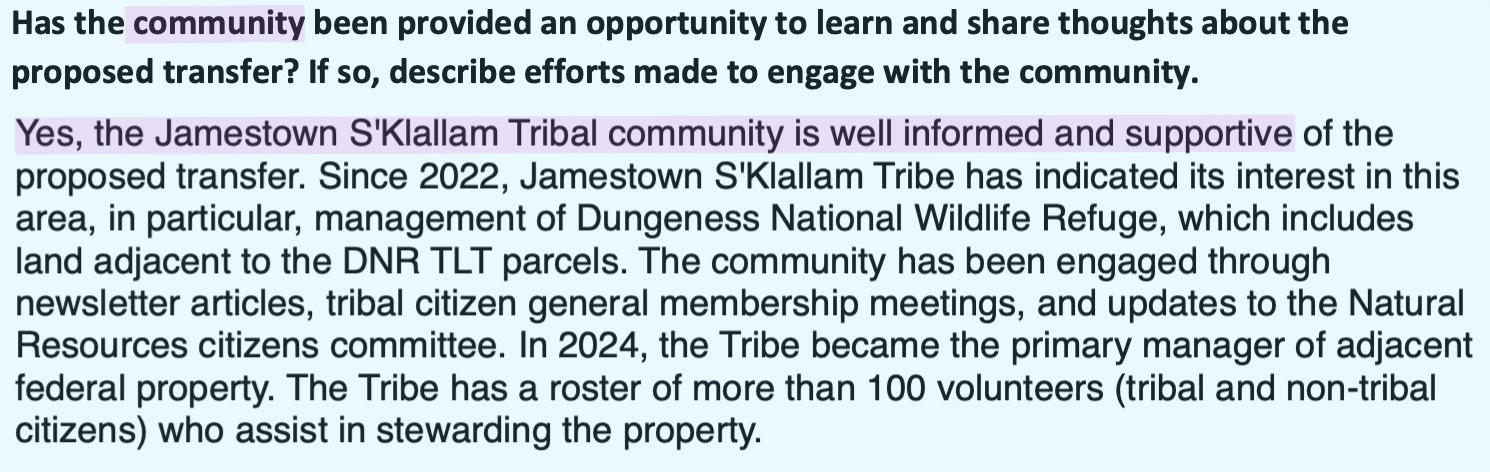
Meanwhile, the document maintains there is “no known opposition.”

How would opposition even materialize if the broader community hasn’t been meaningfully notified?
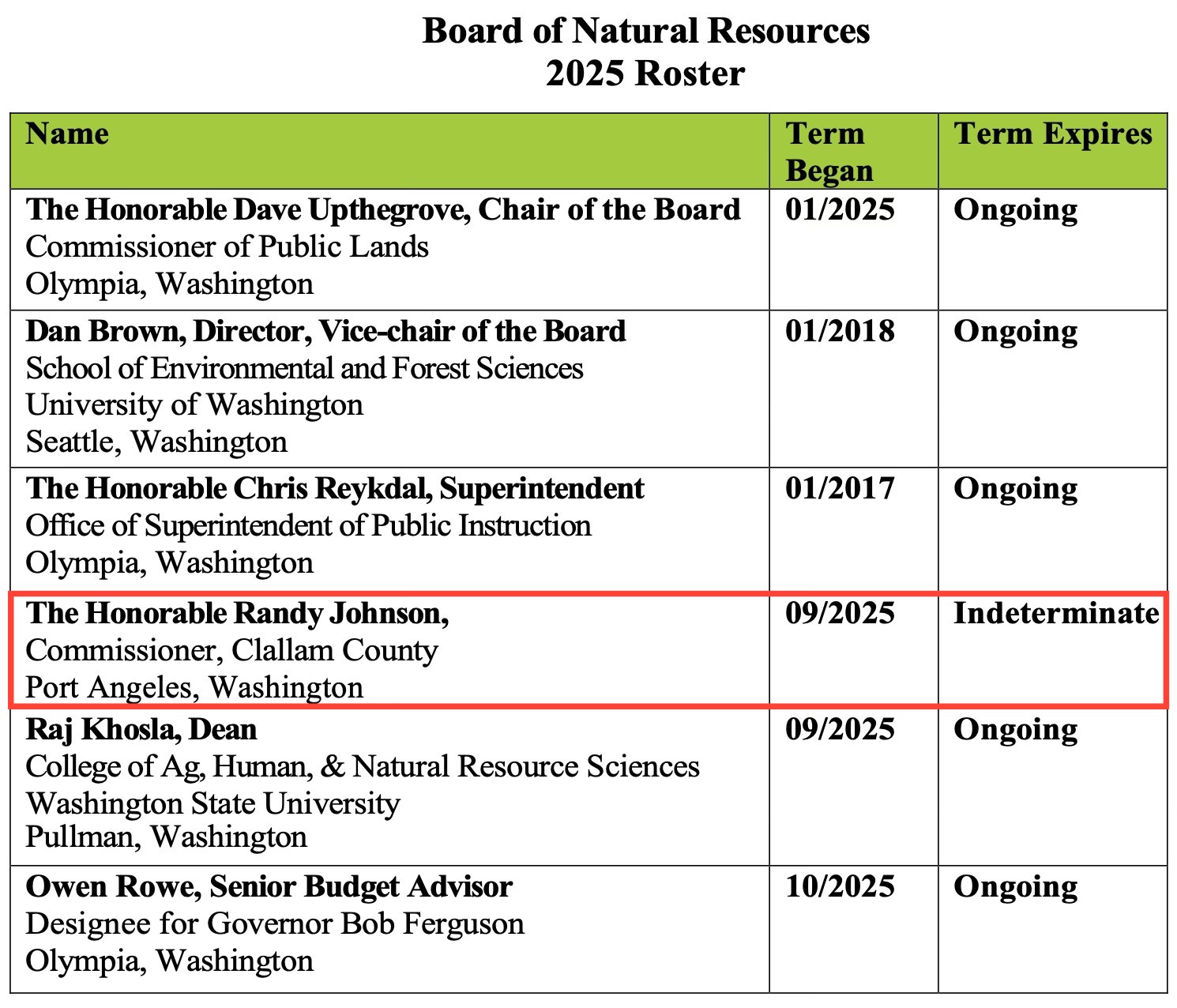
Why hasn’t the public been clearly informed about this proposed transfer? This isn’t a minor administrative adjustment — it’s 435 acres of state trust land. And Clallam County Commissioner Randy Johnson serves on the Washington State Board of Natural Resources, the very body that oversees DNR trust lands. If our local representative has a seat at that table, shouldn’t Clallam County residents at least be aware of what’s under consideration before decisions move forward?
“Cannot Be Developed”
One striking statement in the application says consolidating large blocks of forested landscape will benefit the community by ensuring the land “cannot be developed” in the face of regional growth.

That is a significant policy shift.
This is Commercial Forestry land today. It is managed under Washington’s public trust doctrine. After transfer, it would become sovereign tribal trust land — outside state land-use control and beyond many state transparency requirements.
That is not a minor administrative adjustment. It is a structural change in jurisdiction.
The Bigger Picture
This proposed transfer does not stand alone. Across Washington State, dozens of trust land transfers are currently under consideration. At the same time, legislation such as SB 6097 — sponsored by former Clallam County Commissioner and now State Senator Mike Chapman — would expand the ability of federally recognized tribes to participate in state conservation funding programs. Taken together, these actions reflect a broader shift in how public trust lands are being transferred and who ultimately controls them.
These developments are being framed as conservation and restoration efforts. But they also reflect a broader land consolidation strategy — shifting public trust lands into sovereign or conservation control.
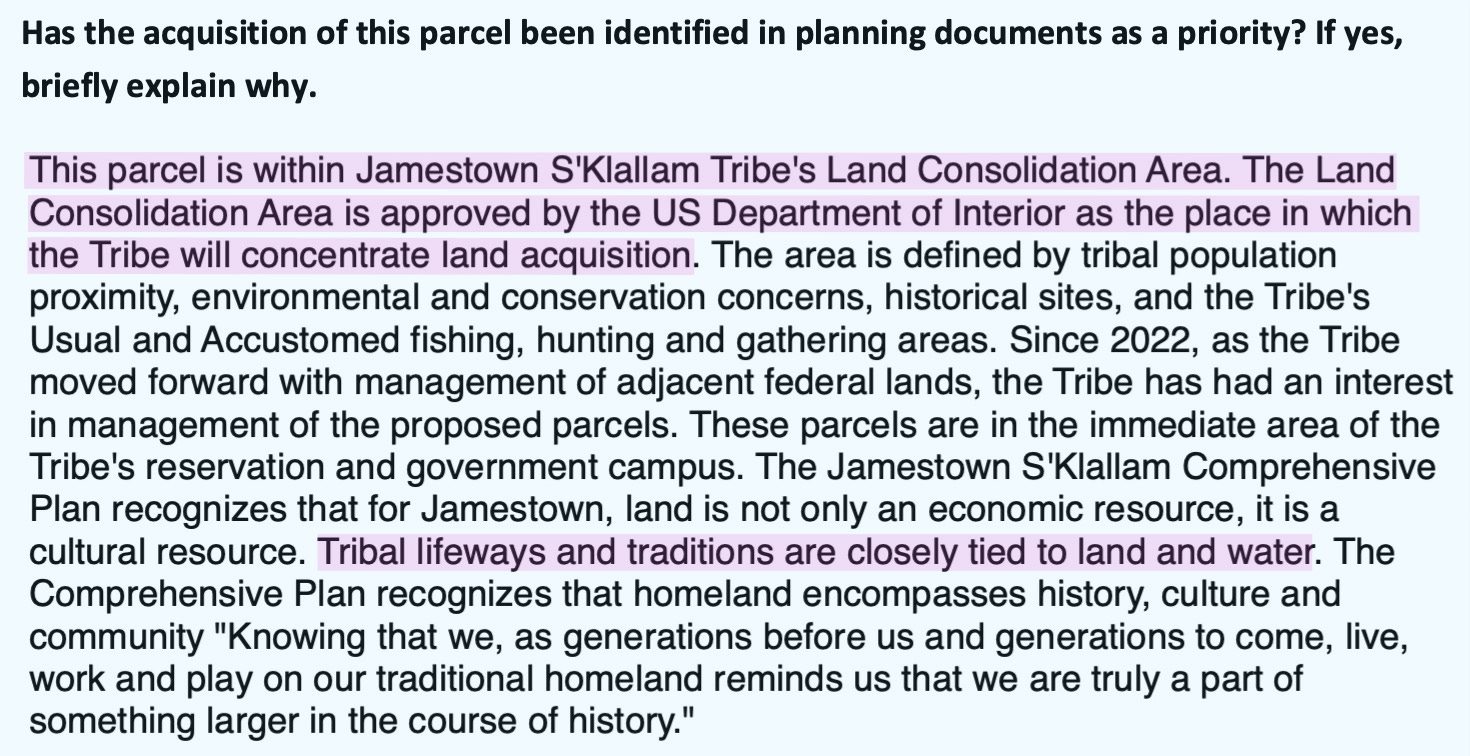
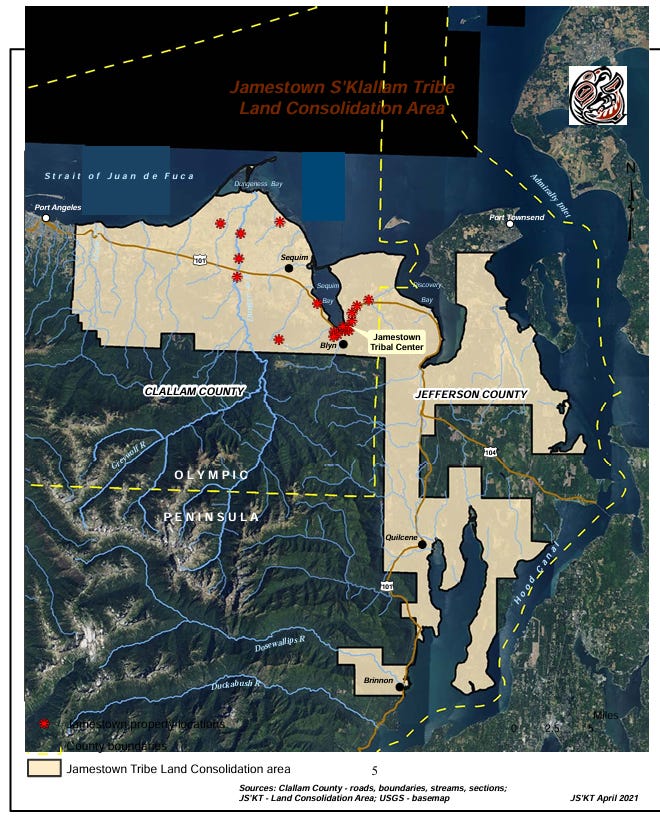
In Clallam County alone, 435 acres of land owned by the people of Washington could move into sovereign status with little public awareness and minimal debate.
If Canada, Russia, or another nation were acquiring 435 acres of public land in Clallam County for economic purposes, would there be public discussion?
Why is there so little now?
Regardless of where one stands on tribal sovereignty, conservation, or economic development, transparency matters. Public land belongs to the public. When that land is proposed for permanent transfer out of state ownership, residents deserve open conversation — not silence.
Four hundred thirty-five acres is not trivial.
And “no known opposition” is not the same thing as informed consent.
What Should Happen Now
If 435 acres of Washington State public trust land are proposed for transfer into sovereign ownership, the public should know before decisions move forward. A County Commissioner discussion, a public briefing, or even a simple explanation of what a Trust Land Transfer means would have gone a long way. Instead, most residents are just now learning about it.
Public trust land belongs to the people of Washington. When it changes jurisdiction, that’s a significant governance decision — and significant decisions deserve public discussion.
If you believe this proposal warrants greater transparency, contact Dave Upthegrove, Washington State Commissioner of Public Lands, at cpl@dnr.wa.gov. Randy Johnson, Clallam County Commissioner and member of the Board of Natural Resources, should also know how his constituents view this proposed transfero. He can be reached at randy.johnson@clallamcountywa.gov. Ask whether there has been a public briefing, how “no known opposition” is determined, and how the community will be informed before any final decision.
Four hundred thirty-five acres of public land should not move quietly.


