


Clallam County taxpayers were told a dire story: multi-million-dollar deficits, looming layoffs, and essential services on the chopping block unless property taxes were raised. That narrative justified higher fees, staff cuts, weakened public safety, and a levy lid lift pushed to the ballot. Then, just days after voters rejected the tax increase, nearly $2 million in previously undisclosed revenue suddenly surfaced—without notice, explanation, or accountability. In this “Sundays with Seegers,” County Commissioner Candidate Jake Seegers explains how this is not a story about spreadsheets or projections. It’s about how long-neglected contracts and distorted budget forecasts drove harmful policy decisions and asked residents to sacrifice for a financial crisis that, by the county’s own numbers, may never have existed.
Podcast Exclusive: Jake explains how he researched this article, spotted the warning signs early, and nearly got caught up in a drug deal.
The Numbers Game
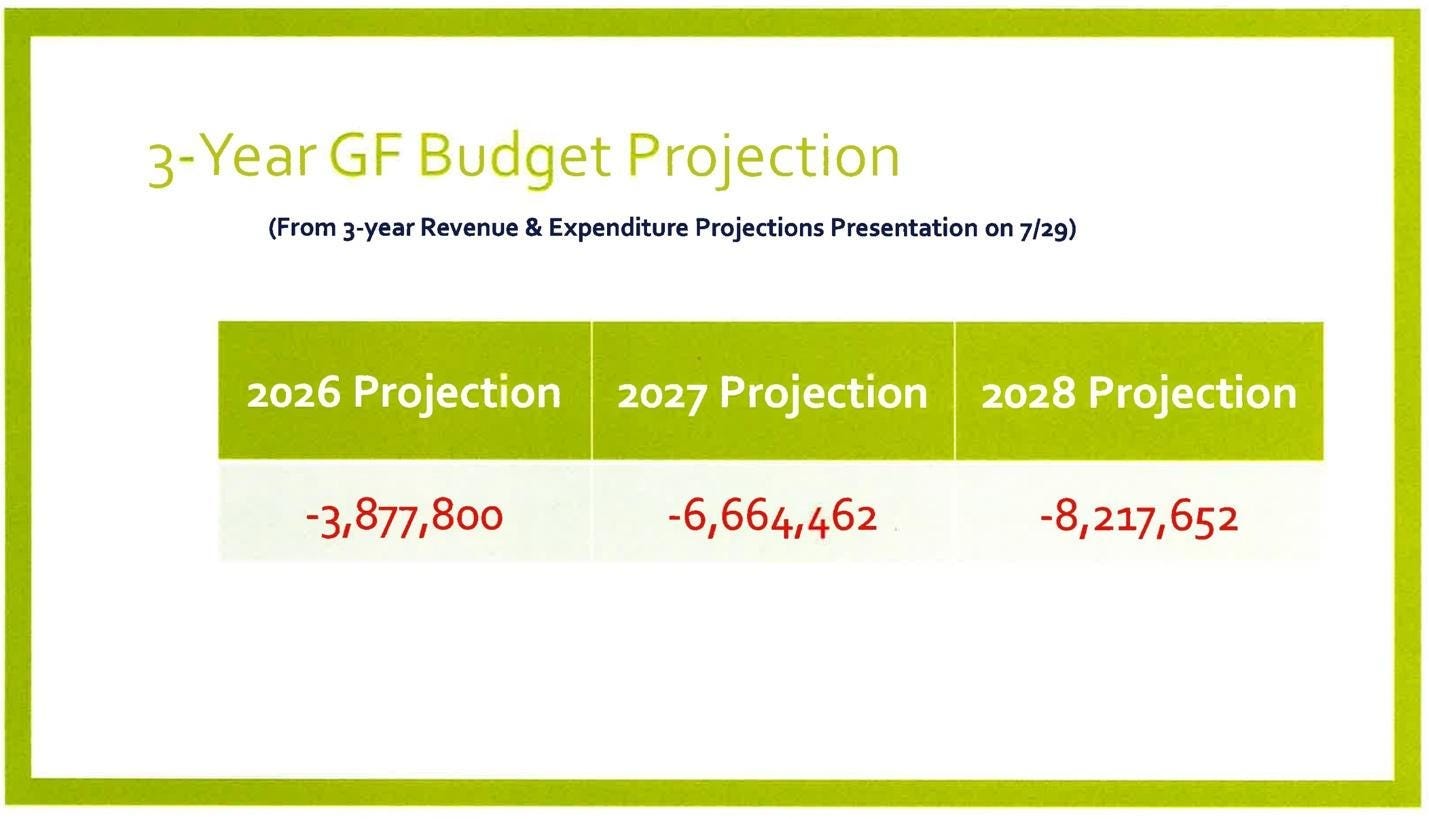
In late July 2025, County Administrator Todd Mielke and the county’s finance team delivered alarming news: Clallam County faced a $3.9 million deficit in 2026, projected to grow to over $8 million by 2028 — a shortfall Mielke said was equivalent to roughly 40 full-time employees.
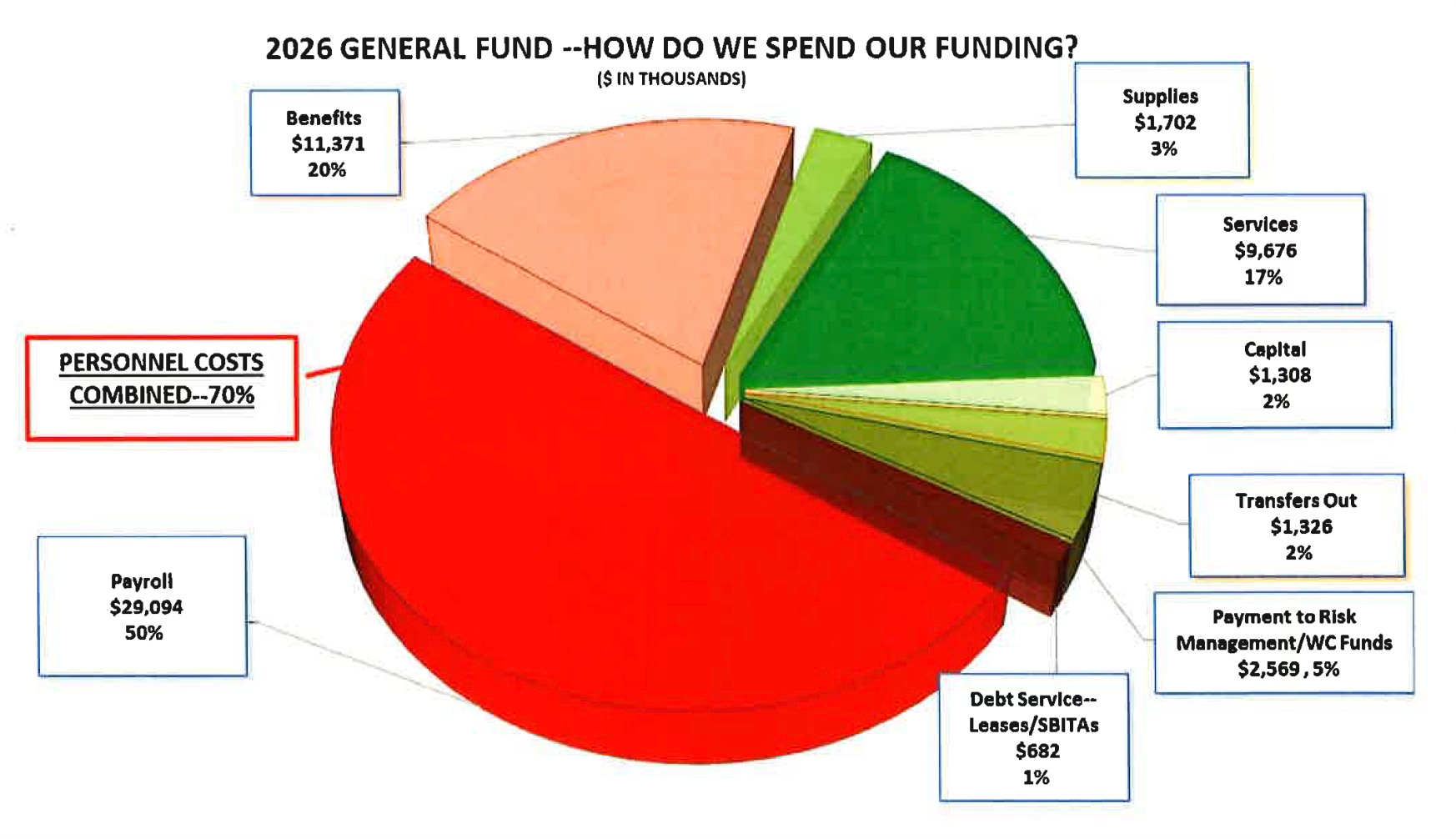
Blame was quickly assigned: soaring indigent defense costs, sharp increases in insurance and workers’ compensation obligations, and payroll consuming 70% of the county’s budget.
Commissioners warned that without new tax revenue, essential services were at risk.
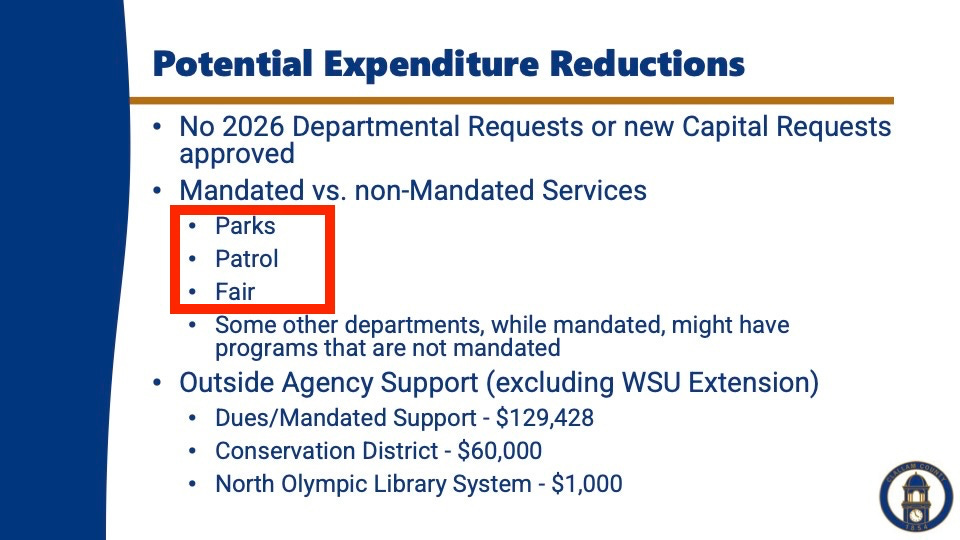
Proposed cuts included parks, patrol, the fair, veterans’ services, and public safety. Commissioner Ozias openly warned of layoffs in the Sheriff’s Office, Parks, and Community Development, predicting “significant impacts to service.”
Despite repeated public calls to examine the budget line-by-line, commissioners chose another path:
Raise property taxes.
In early August, the commissioners voted to place a levy lid lift on the November 2025 ballot, proposing to raise the county levy from $0.7598 to $0.95 per $1,000 of assessed value.

However, before approving the levy-lift resolution, the Clallam County Finance Committee met on July 24. Raising county taxes was already being discussed as a preferred option.
The County’s Chief Financial Officer Mark Lane joked, “It’s really just to keep the Ford Pinto running,” drawing laughter from the committee — including Commissioners French and Johnson — before adding, “We live in an economically distressed, rural county. We can’t afford the Cadillac of county government.”
The message was clear: the commissioners and finance team had already settled on higher taxes as the only way to preserve county jobs and essential services.
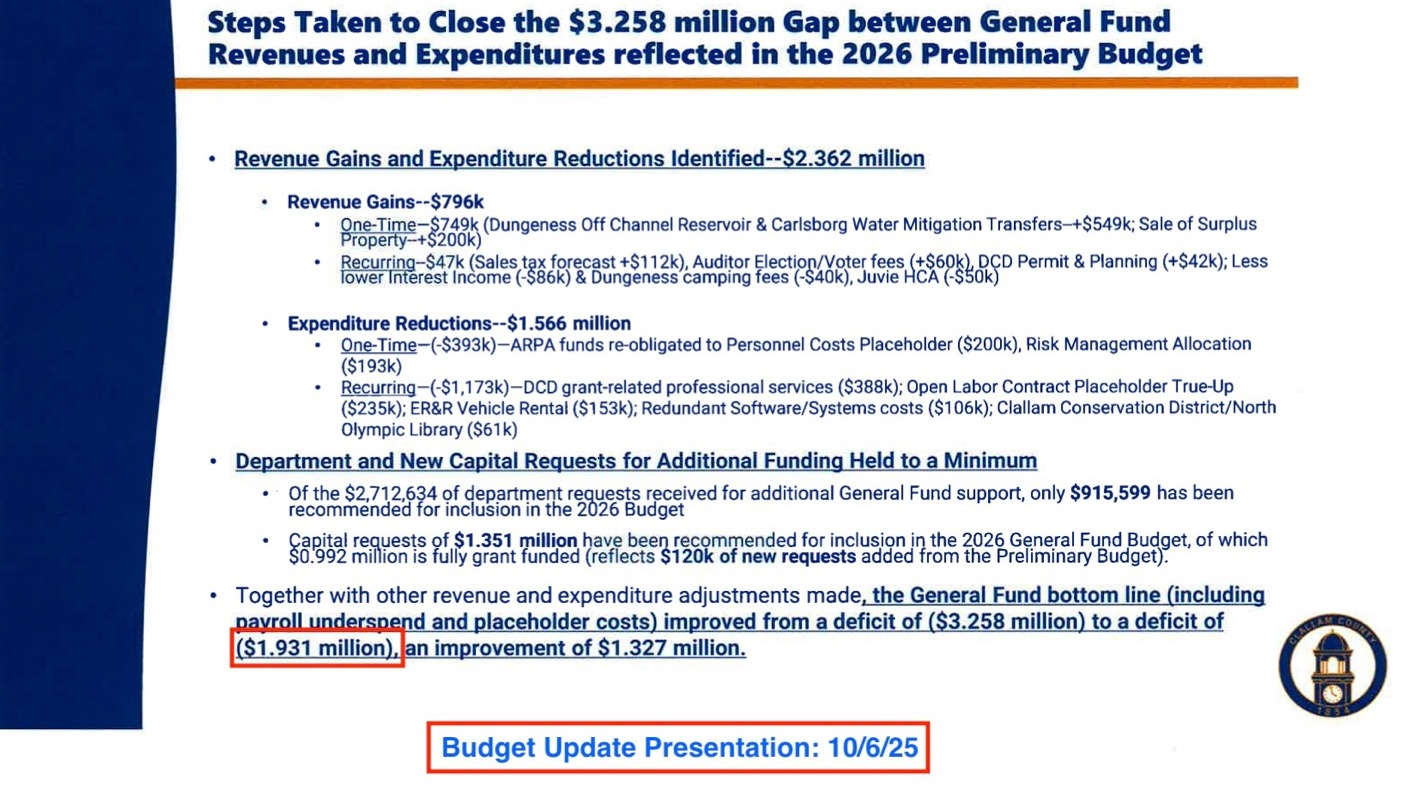
That narrative was sold to taxpayers over the next three months, leading up to November’s levy-lid-lift vote. Remember, just over a week before ballots were mailed, the finance team — after softening its original projections — was still warning of a $2 million deficit for 2026.
On October 29, at a Budget Town Hall in Forks, the public was presented with a set of “options” for balancing the county budget—each framed as a painful consequence if voters rejected the proposed levy increase. Those options included laying off up to 11 full-time employees and imposing a 0.1% criminal justice sales tax.
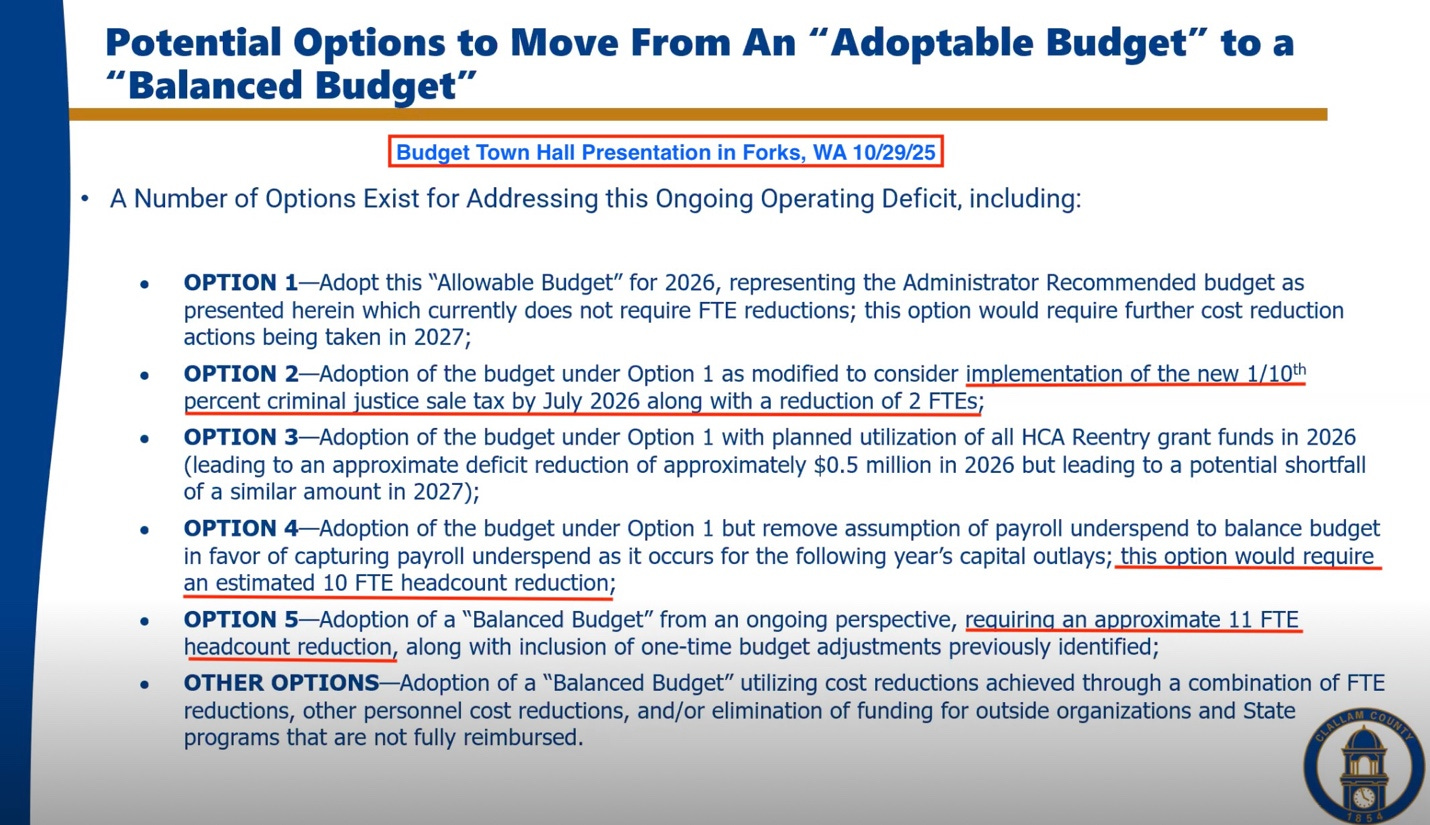
Less than a week before the November vote, the commissioners, administrator, and finance team remained unwavering: without approval of the levy lift, jobs would be lost, and essential services would be compromised.
The $2 Million Reveal
Voters rejected the levy on November 4.
Twelve days later, during a sparsely attended November 16 combined work session/board meeting, nearly $2 million in previously undisclosed revenue from interlocal agreements with Port Angeles and Sequim suddenly appeared in the updated 2026 budget forecast.

No press release.
No public notice.
No disclosure before the election.
A lone public comment captured the moment:
“When I saw the increased revenue from interlocal agreements — [not included in the budget forecast a month ago] — it seemed like something citizens should have known before voting. We want transparency. We don’t want to be handled.”
Commissioner French responded:
“I don’t fully understand what your concern was about the dollar amount for public safety that we had in the budget. I’ll just say that it’s an assumption. That is not money that we know is coming in.”
Mark Lane added:
“The analysis that was done in order to quantify the cost of provision of services to both cities was something that was just completed within the last thirty days or so.”
In other words, when a citizen raised concern about a sudden $2 million swing in the budget forecast and asked why it had not been disclosed before the levy vote, Commissioner French dismissed the concern as irrelevant, and CFO Lane claimed there had been insufficient time — a tight two-week window — to inform the public.
The commissioners and finance team indicated that they couldn’t have done anything differently.
But why were these agreements not updated sooner? According to the Peninsula Daily News, the interlocal agreements were supposed to be reviewed annually. Instead, they went largely untouched for years — until September and October of this year, when the county finally provided the cities with the 2024 “actuals.”
Had these contracts been properly managed, the entire levy-lid lift could have been avoided. At a minimum, the public should have been informed — even just weeks before the vote — of the millions of dollars in additional revenue.
Why it Matters
The failure to charge municipalities their fair share shifted the cost of criminal justice services from city residents onto county taxpayers and distorted county decision-making for years.
In 2023, the county’s draft budget forecasted a $3.2 million deficit for 2024.

The draft budget for the following year estimated a deficit of nearly $4.2 million.

Forecasted deficits drove several damaging policies:
1. The “7% exercise” in 2024/2025.
In late 2024, facing a projected $4.2 million deficit, the commissioners ordered all county departments to either cut expenses by 7% or increase revenues by 7%.
As a result, the Assessor’s Office lost its senior exemption specialist. During 2025 budget meetings, Assessor Pam Rushton told the commissioners that this staffing loss left her team unable to meet state mandates, including verifying senior exemptions, valuing personal property, and auditing land-use claims.
Other county employees were prematurely terminated, including Greg Helwick, a 62-year-old IT specialist with 24 years of service.
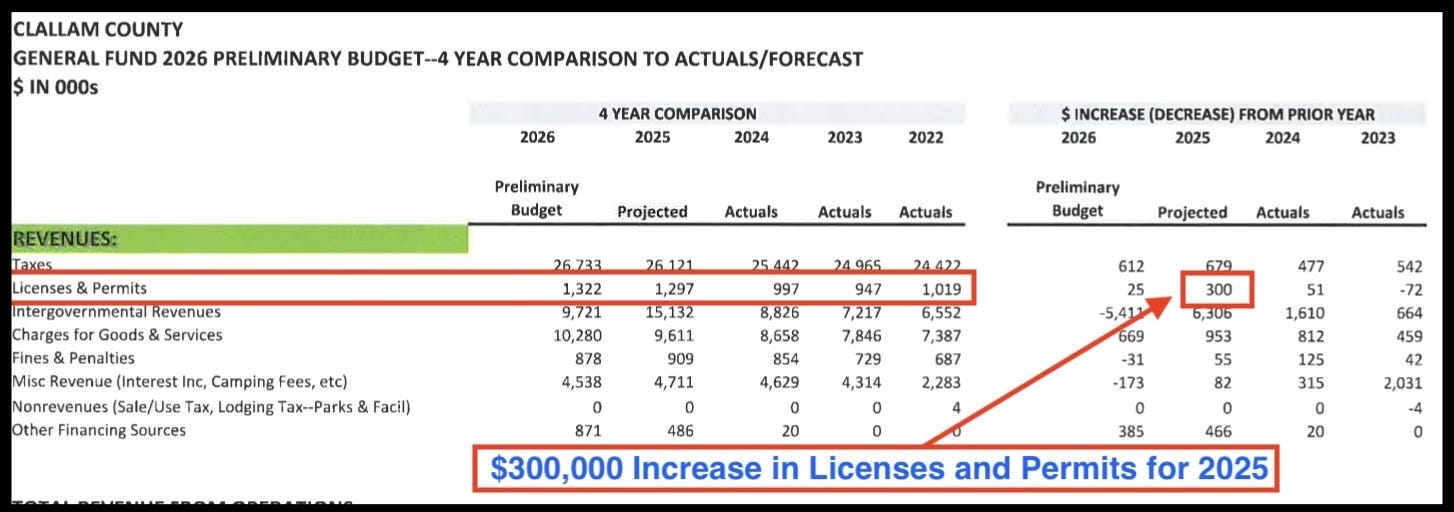
Departments that could raise revenue did so by charging residents more. The Department of Community Development (DCD) proposed increasing building permit fees on a $500,000 home by 20% and manufactured home fees by 52%.
With many local families already struggling to afford housing, the county increased license and permit fees by $300,000, further compounding the burden on residents.
2. Clallam Conservation District’s $5 Parcel Fee
Commissioners Ozias and Johnson committed $125,000 annually to the Clallam Conservation District (CCD) in 2019 during a period of county budget surplus.
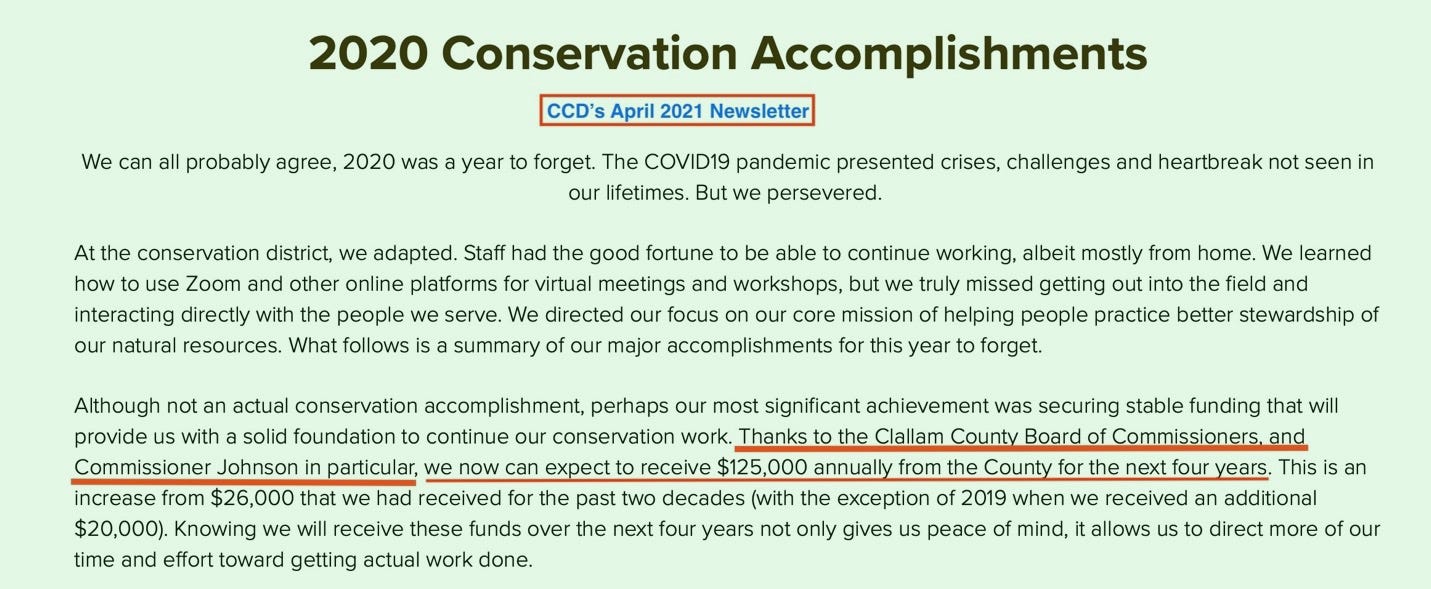
When the general fund could no longer sustain its favored conservation agency, the commissioners instead saddled property owners with a $5 parcel fee — a $2 million obligation over ten years — without allowing a public vote.
Despite 1,032 citizen signatures opposing the fee, the commissioners imposed another tax on their constituents, relying on misleading claims and faulty calculations from CCD regarding the agency’s financial need.
3. Public Safety Erosion
In late 2023, the Clallam County Sheriff Department reported eleven deputy vacancies.
According to Sheriff Brian King, Washington State ranks last in the nation for officers per capita, with an average of 1.36 officers per 1,000 residents. Due to staffing shortages, Clallam employed only 0.82 officers per 1,000 residents in 2025.

Sheriff King has cited recruitment failures due to low pay — Clallam ranked 25th of 39 counties in deputy compensation in 2023.

Notably, Chelan County — similar in population to Clallam — paid its deputies nearly $18,000 more per year.
According to individuals familiar with the negotiations, Clallam County’s labor contract with the deputies’ union expired in June 2024. Contract talks dragged on for nearly a year and a half as the union pressed for competitive pay while the county repeatedly asserted that it lacked the financial capacity to meet those demands.
The county ultimately approved a new contract effective October 1. Just five days later, on October 6, the finance team revised its 2026 budget forecast to reflect $1 million less in projected labor costs associated with the newly signed Sheriff’s Patrol Deputy agreement.

This raises serious questions: Were Clallam deputies forced to accept less competitive compensation because the county negotiated under a premise of financial crisis — a crisis that may not have existed had interlocal agreements with Port Angeles and Sequim been properly maintained? And did that mismanagement directly compromise public safety by weakening deputy recruitment?
4. A Levy Lift the County Never Needed
Clallam citizens invested countless hours attending commissioner meetings, writing letters of opposition to the proposed levy lift, and sharing personal testimony about the financial strain caused by rising property taxes.
Despite this, the commissioners pushed forward, spending county funds to place the levy lift on the November 2025 ballot. Until the final vote, they continued to emphasize that rejecting the measure would jeopardize essential services and county jobs.
“Please support the modest Clallam County general fund levy lid lift this November so we can maintain service across all departments, from Sheriff’s deputies to Public Health to Community Development to elections. The county has worked very hard to cut costs and build efficiencies, but without additional support from you, we will be forced to consider additional painful cuts.” — County Commissioner Mark Ozias in “Clallam Democrats Rising.”
At the same time, while failing to adequately staff the Assessor’s Office to meet state mandates, the commissioners authorized investment in privacy-compromising surveillance technology designed to maximize property assessments.
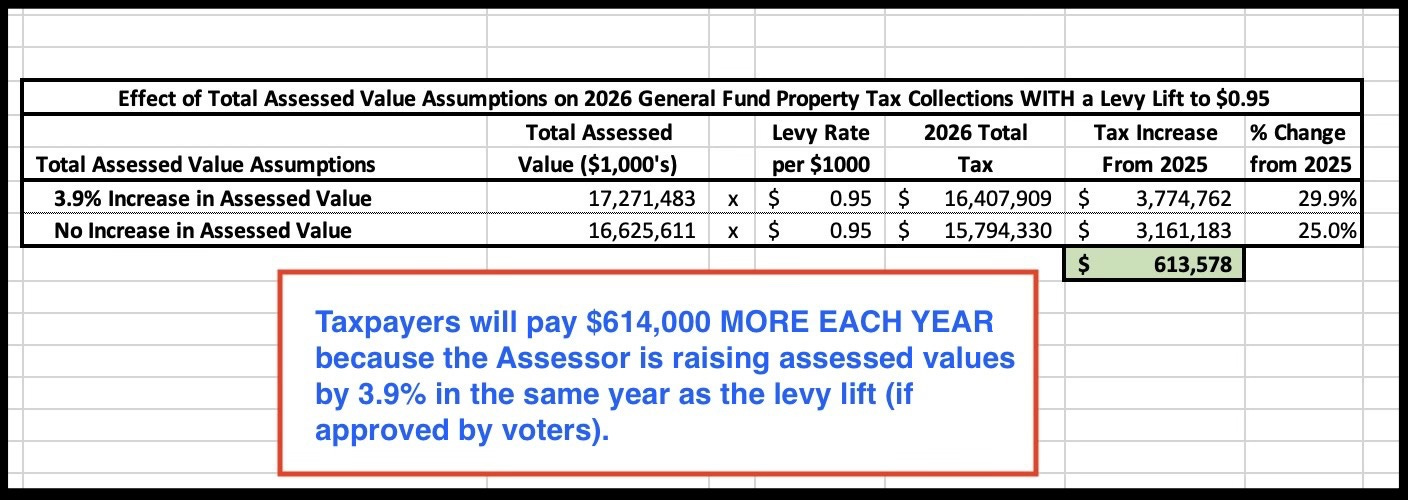
Had the levy lift passed, 2025 assessment increases alone would have extracted an additional $614,000 annually from property owners, on top of the $3.2 million per year the levy lift itself was projected to raise.
The Bottom Line
Three consecutive years of multi-million-dollar deficit forecasts would have reflected balanced budgets had the commissioners, county administrator, and finance team properly updated interlocal agreements.
This critical failure directly contributed to unnecessary terminations, the Assessor’s Office falling out of compliance with state mandates, increased taxes and fees on Clallam residents, weakened public safety, and the waste of both county and citizen resources.
The finance team did not exist before 2018. Their functions were handled by the Treasurer and the Auditor. Today, the three-person finance team costs taxpayers over $500,000 per year in salaries and benefits.
Commissioner Ozias praised the finance team during an August 4th Levy Lid Lift Special Meeting.
“This [3-year budget deficit forecast] is a remarkable body of work. I’ve already had requests from several other county commissioners to share what we’ve learned. So, once again, I would say that our county is a little bit ahead of the curve in a really important way.”
But taxpayers are not paying for a finance department to produce deficit forecasts while overlooking contract revenue that would have eliminated those deficits altogether.
In 2026, the County Administrator will earn $229,000 plus benefits, and each commissioner will earn $119,000 plus benefits.
In the private sector, a seven-person management team costing over $1 million per year that failed to bill customers $2–3 million annually for a decade would not survive.
If it’s unacceptable in the private sector, why is it acceptable in Clallam County?
Call to Action: Demand a Special Meeting
Charter Review Commissioner Ron Richards has called for a special Charter Review Commission meeting to address how millions in county revenue went undisclosed during budget deliberations and a levy-lid-lift vote. Unless the Chair calls it, seven additional commissioners must agree.
That will only happen if the public speaks up.
Call or email Charter Review Commissioners now and urge them to support this meeting. All Charter Review Commissioners can be reached by emailing the Clerk of the Board at loni.gores@clallamcountywa.gov.
This meeting is essential to determine why the revenue was not disclosed, why voters weren’t informed, and whether stronger financial oversight is needed to prevent this from happening again.
Second Call to Action: Ask the Commissioners Directly
The Commissioners Forum is the only regular setting for two-way public dialogue with county commissioners. The next one is this Tuesday at the 10:00 a.m. meeting. For instructions to attend in person or virtually, click here.
If you want answers, show up and ask your leaders how this happened and why the public was kept in the dark.
Accountability requires participation.
Two weeks ago, Jake Seegers asked readers what the greatest contributor to Clallam County’s growing homelessness crisis was. Of 157 votes:
68% said, “Substance abuse/harm reduction”
16% said, “Lack of trespass enforcement”
15% said, “Poor resource allocation”
1% said, “Lack of housing and services”
Editor’s Note: CC Watchdog editor Jeff Tozzer also serves as campaign manager for Jake Seegers during his run for Clallam County Commissioner, District 3. Learn more at www.JakeSeegers.com.


