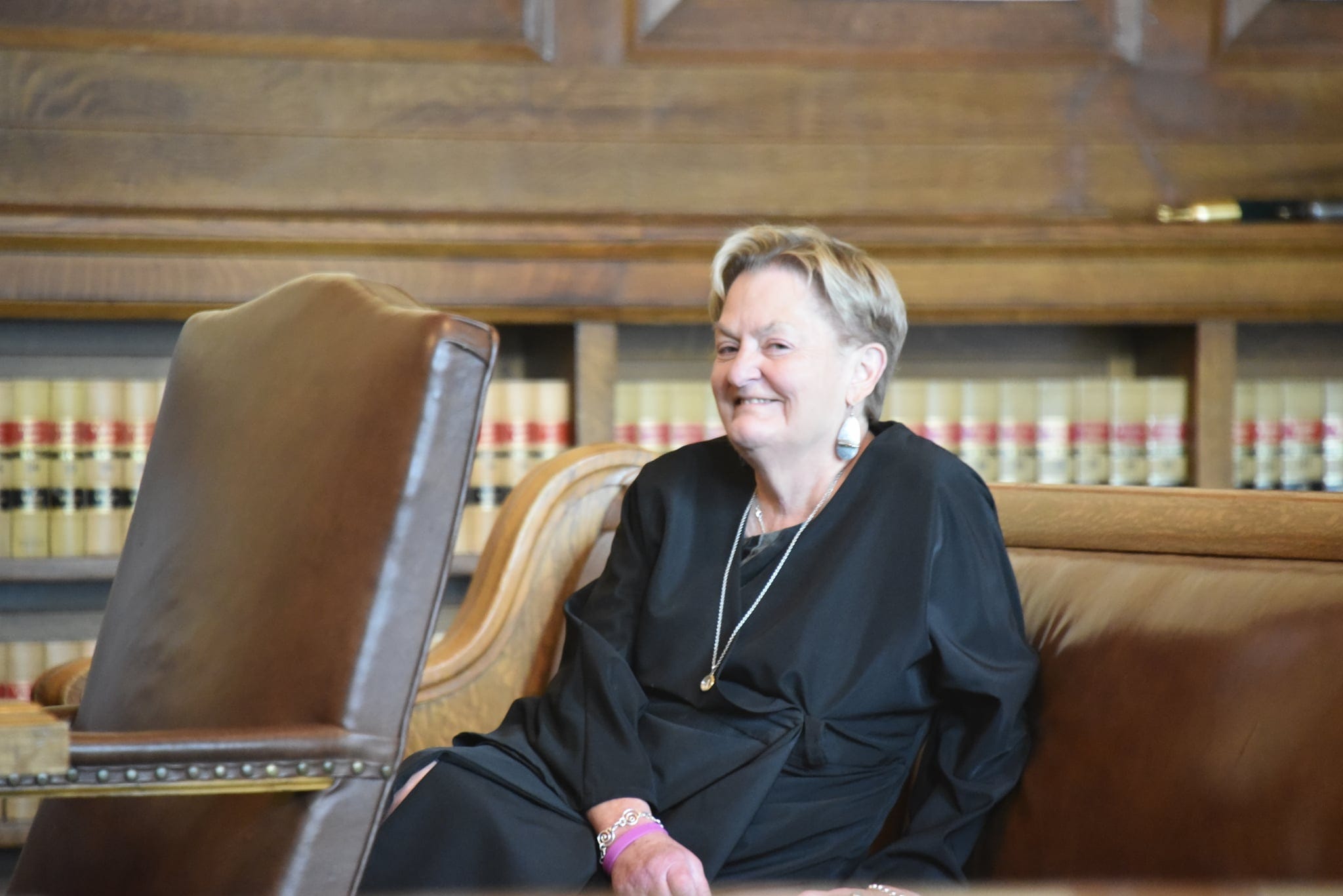

What began as a modest idea to honor the late Justice Susan Owens has rapidly escalated into a proposal to rename the Clallam County Courthouse itself—without public process, without debate, and without any meaningful discussion of how her judicial legacy affected everyday residents. As commissioners praise character and affiliations, they avoid a harder question: should a courthouse symbolize special interests, or equal justice for all?
In the podcast: Public comment highlights.
What started last year as a casual discussion about how to honor the late Justice Susan Owens has moved far beyond a plaque, a tree, or a bench on the courthouse lawn. This week, county commissioners openly floated renaming the Clallam County Courthouse itself—without a public process, without debate, and without any real discussion of how Owens’ judicial legacy affected the people who live here.
Instead, the focus stayed on personality, friendships, and affiliations.
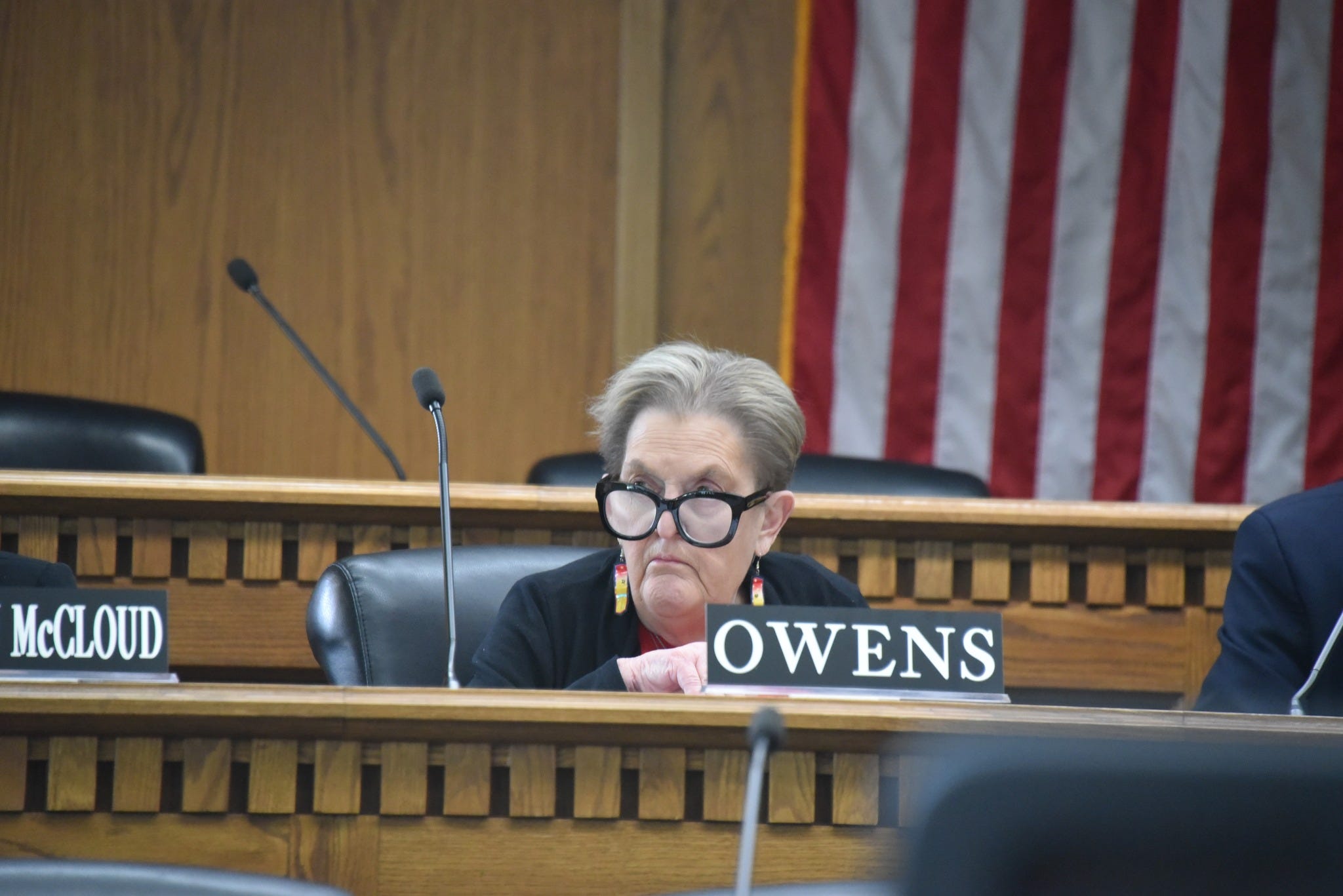
At Monday’s work session, Commissioner Mark Ozias said he believed it would be “wholly appropriate” to consider naming the courthouse after Owens. Commissioner Mike French quickly agreed, saying renaming the courthouse would be “the way to spread the message the furthest.” Commissioner Randy Johnson suggested forming a group to look at memorial options and added that if that group decided the courthouse should be renamed, “that’s great.”
French went a step further, suggesting a courtroom in Forks also be named after Owens, citing her years serving District Court 2 on the West End. Commissioners also floated the idea of naming the historic courtroom in the courthouse after Owens.
What was never explained is why the county’s central symbol of justice—meant to represent everyone—should be named after a judge whose body of work consistently favored certain interests over others.
That question never came up.
When the Rules Suddenly Bend
Monday work sessions are not supposed to include public comment. That has been made very clear in the past—especially in 2023, when Towne Road supporters were repeatedly told by Commissioner French that work sessions are for the public to “observe, not participate.”
That rule didn’t seem to apply this week.
In a rare break from protocol, French invited “stakeholders” in the audience to speak. Karen Unger stood up and was invited to the staff table.
Unger explained that Owens had been her former law partner in 1981, worked in Forks for 19 years, and that the courthouse-renaming effort was being pushed by Washington Women Lawyers. She spoke at length about Owens attending Fourth of July parades in Forks and being a frequent Thanksgiving guest at her home. Owens, Unger said, was a “hometown girl who did good”—even while noting that Owens was from North Carolina and spent roughly a quarter-century living and working in Olympia during her time on the Supreme Court. Owens passed away in California.
“So putting a plaque on a tree, I’m sorry, is not appropriate,” Unger said.
What was not mentioned at the table—but matters for the public record—is that Unger is also a practicing attorney who performs paid legal work for Clallam County. Earlier this same week, county commissioners approved a $6,250 payment to Unger for “Superior Court Conflict” services.
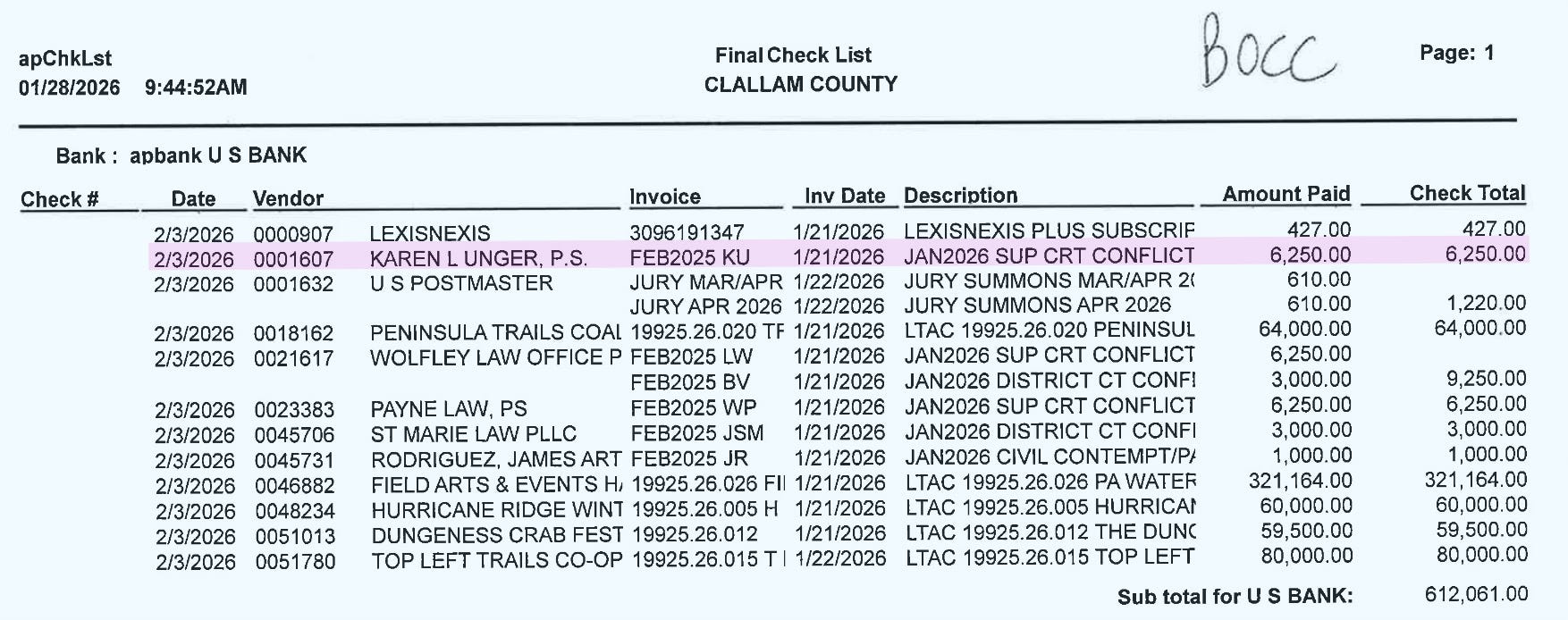
There’s no indication that the payment was improper. But the timing, combined with the special access Unger was given during a work session where public comment is normally prohibited, raises obvious questions about optics and fairness. At the very least, it shows how selectively the word “stakeholder” gets applied—and how easily the rules shift depending on who is speaking and what they’re advocating for.
Support From Tribes—And a Missing Question
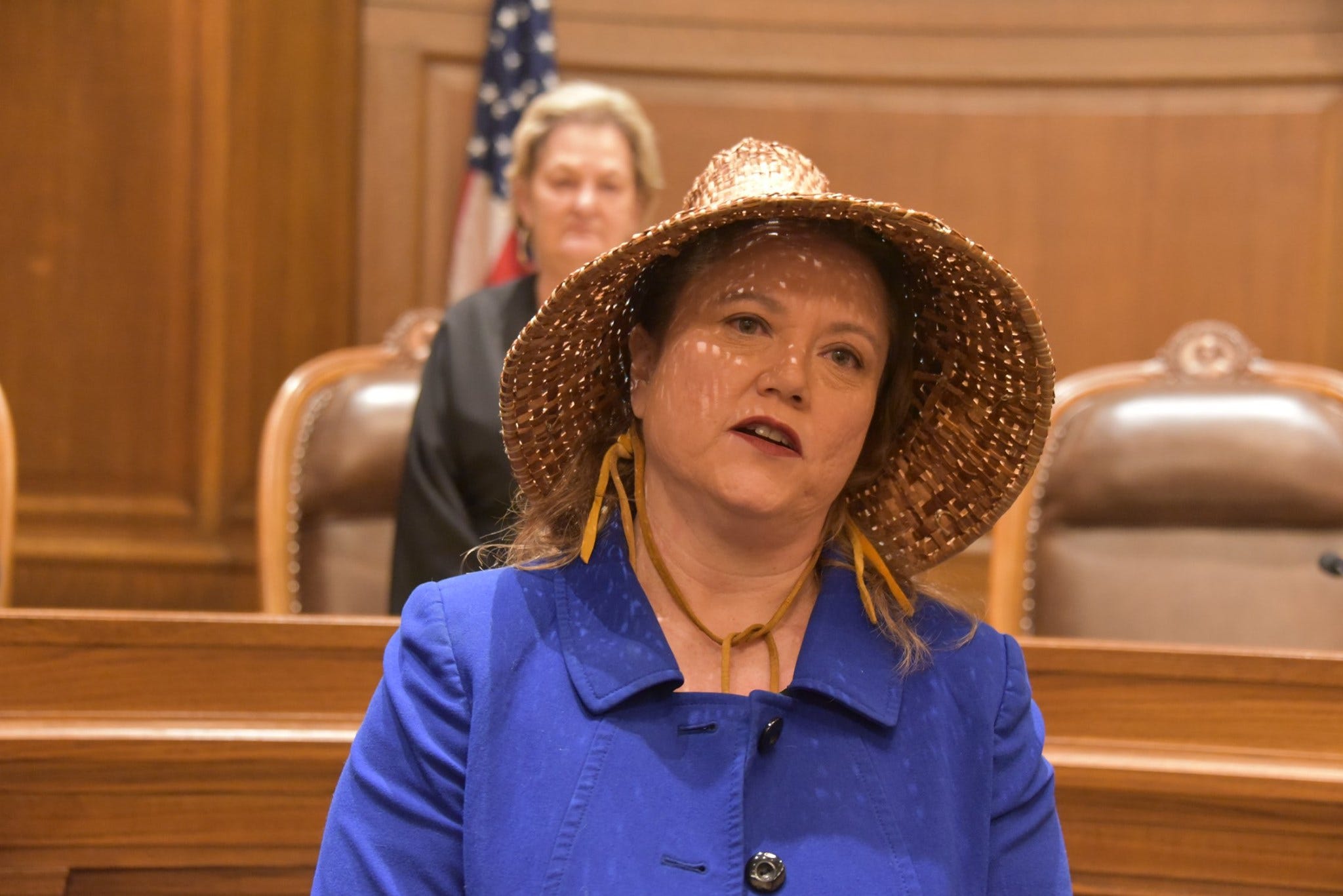
Leaders from the Lower Elwha Klallam Tribe and the Quileute Tribe also spoke in favor of renaming the courthouse. They highlighted Owens’ service as a tribal judge. Owens served as Chief Judge for the Quileute Tribe for about five years and as Chief Judge for the Lower Elwha S’Klallam Tribe’s court for more than six years.
What went unasked was whether either sovereign nation plans to name buildings on their own lands after Justice Owens — or whether the expectation is that Clallam County taxpayers should be the ones to permanently memorialize her legacy.
The Record Nobody Wanted to Talk About
Throughout the discussion, commissioners and supporters spoke warmly about Owens as a person. She was kind. She smiled. She gardened. She was well-liked.
What they didn’t talk about was her record—and how it shaped life here.
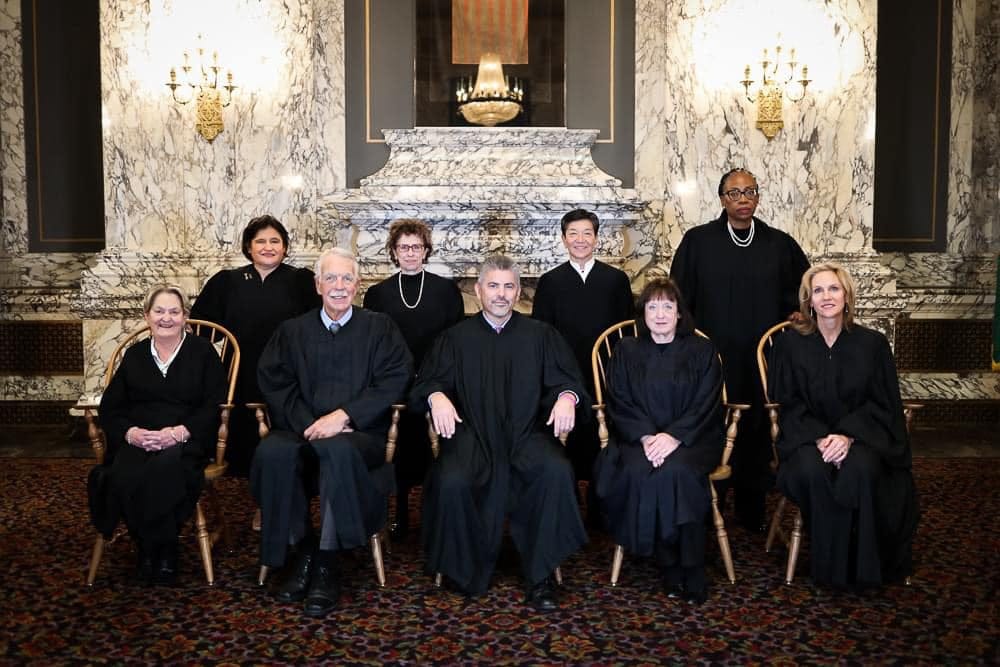
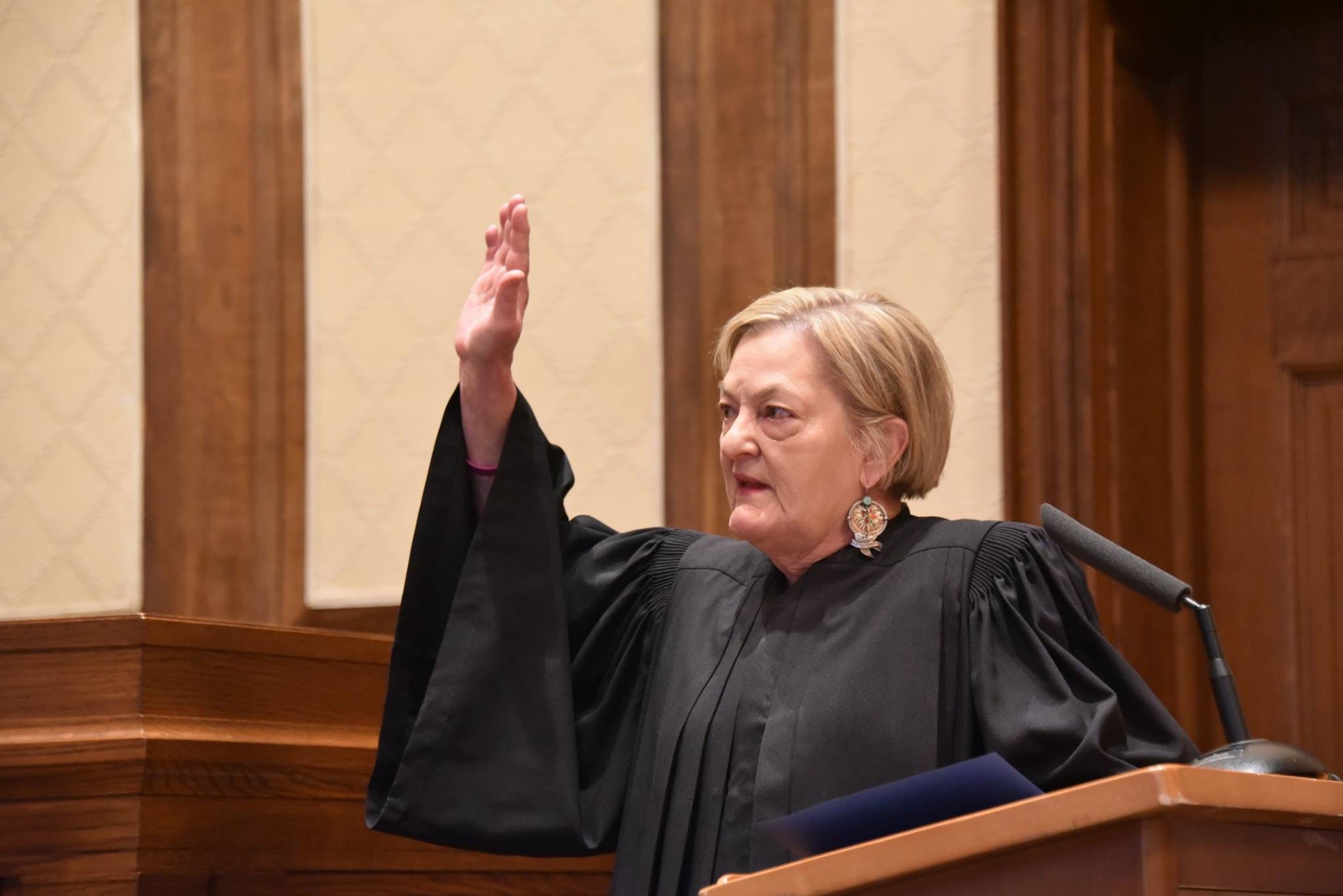
Owens was appointed to the Washington Supreme Court in 2001 by Governor Gary Locke and served for more than two decades. During that time, she was a reliable vote for expansive environmental regulation, broad deference to state agencies, strong interpretations of treaty rights, and a narrow view of when property owners are entitled to compensation.
Those positions regularly aligned with tribal and agency interests. They also helped reinforce Growth Management Act restrictions, shoreline buffers, and regulatory frameworks that continue to limit housing, constrain rural landowners, and keep Clallam County economically depressed.
That record may be admired by some. But it clearly produced winners and losers. None of that was acknowledged on Monday.
A Tale of Two Women
The contrast is hard to miss.
Just last month, this same board quietly removed a woman from the Heritage Advisory Board. She was a longtime Clallam County resident, had served two terms as chair, and is the only person to have built a museum in this county in the last 40 years. She grew up here. She is, by any definition, a hometown contributor.
She was ousted by the commissioners and given a proclamation on paper.
Her replacement, Derrick Eberle, was appointed despite growing questions about whether he even lives in Clallam County—questions the commissioners declined to seriously investigate.
No worksession rally.
No discussions.
No urgency to honor service.
In Clallam County, political connections matter more than local roots.
When Public Input Doesn’t Matter
The contrast becomes even sharper when viewed alongside a very recent example.
Last year, Jake Seegers led an effort to stop the county commissioners from adding a new $5 parcel fee to property tax statements to fund the Clallam Conservation District. The proposal was widely unpopular. Over several weeks, Seegers and other volunteers gathered 1,032 signatures from residents asking the commissioners not to impose the fee.
The message from the public was clear.
The commissioners imposed it anyway.
Now compare that to what happened Monday. No petition. No signatures. No public vote. Just a handful of friends and political insiders speaking during a single work session—one where public comment is normally prohibited—and suddenly the idea of renaming the entire Clallam County Courthouse is moving forward as if it were a foregone conclusion.
It raises a fair question: how is this equitable? When more than a thousand residents speak up, they are ignored. When a small circle of insiders asks for something symbolic and permanent, the rules bend and the path clears.
The pattern should feel familiar. Towne Road was never the commissioners’ to give away. County parks are not theirs to hand over to political donors or favored partners. And the Clallam County Courthouse is not a personal canvas for commissioners to rename based on who has access, influence, or the right connections. These are public assets, held in trust for the people—not bargaining chips to be reshaped behind closed doors.
What the Courthouse Is Supposed to Mean
The building at 4th and Lincoln is currently called the Clallam County Courthouse.
That name matters because it represents everyone.
Most people don’t care much what the courthouse is called. What they care about is whether the people inside it work for all residents—not just tribes, not just NGOs, not just environmental causes, and not just politically connected agencies.
Renaming the courthouse after a figure whose jurisprudence consistently favored certain interests sends a message, whether intended or not, about whose voices count.
A Better Way Forward
This decision rests solely with the Clallam County Board of Commissioners.
Before any renaming happens, the county should slow down, invite formal public comment, seriously consider alternative memorials, and be honest about Justice Owens’ full legacy—personal and professional.
Honor shouldn’t be decided by insider consensus.
Call to Action
Residents who want a say should email the Clerk of the Board at loni.gores@clallamcountywa.gov, which ensures correspondence is shared with all three county commissioners. Decisions about the courthouse should reflect public values—not political comfort.
Because in the end, the courthouse shouldn’t be named for power, prestige, or politics.
It should stand for justice—for everyone.