

For nearly a decade, Clallam County quietly subsidized criminal justice services for Sequim and Port Angeles—by nearly $3 million per year—without required annual reviews, public disclosure, or timely contract updates. Now, after voters were asked to approve a property tax increase just last month, cities are being told they have been underpaying all along. The question isn’t whether costs went up. It’s how county commissioners allowed this to go unaddressed for years—and why voters were never told.
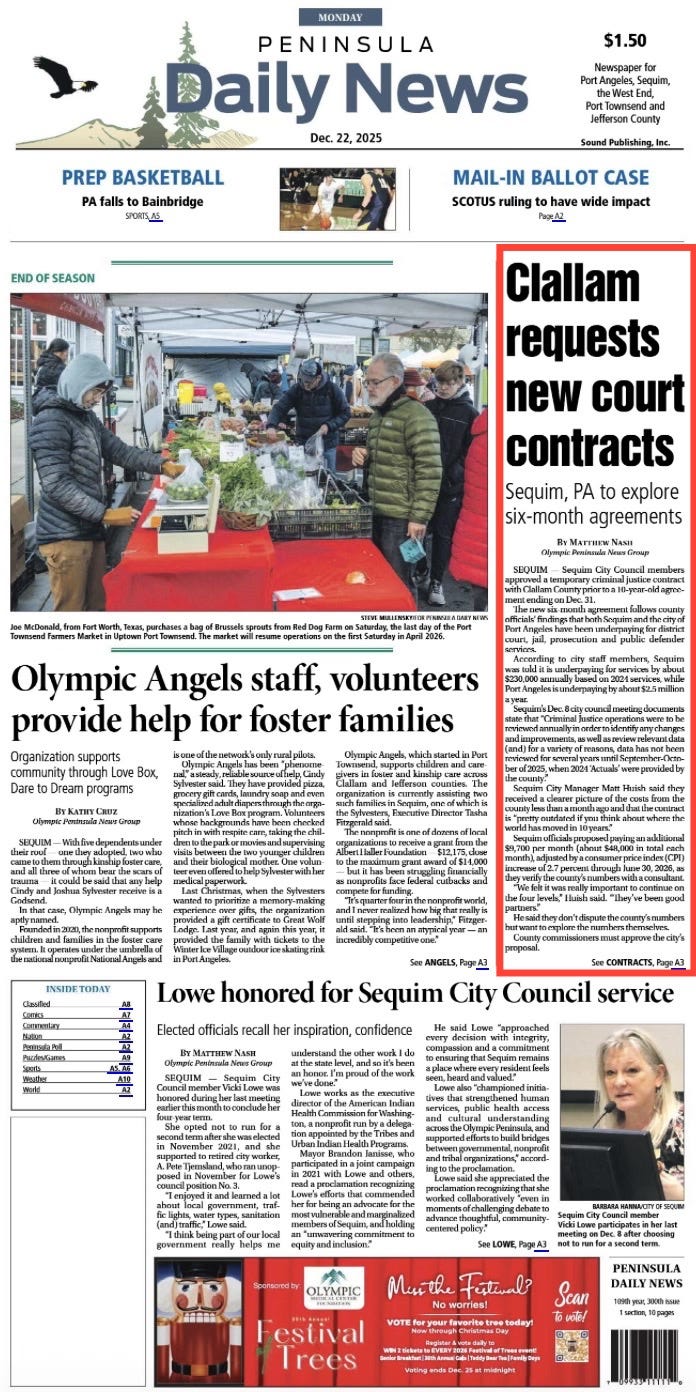
The Peninsula Daily News recently reported that Clallam County officials informed the cities of Sequim and Port Angeles that they have been significantly underpaying for district court, jail, prosecution, and public defender services.
The numbers are not small.
Sequim: underpaying by approximately $230,000 per year
Port Angeles: underpaying by approximately $2.5 million per year
Combined, that is nearly $3 million annually—money the county absorbed while contracts sat largely untouched.
The contracts in question date back 10 years and explicitly required annual reviews to identify changes, improvements, and cost adjustments. According to Sequim’s own council documents, that review did not happen for several years, until late 2025, when the county finally provided 2024 “actuals.”
That failure alone raises a fundamental governance question:
How does a contract requiring annual review go nearly a decade without one—while millions of dollars bleed out of the county budget?
Cities Scramble—County Explains Late
Both cities are now scrambling to understand the numbers.
Sequim approved a six-month interim agreement while it hires a consultant to verify the county’s calculations. Port Angeles, facing a proposed increase of roughly $900,000 over six months, has been far more skeptical, noting it paid for services that were reduced or unavailable during the pandemic and received no reimbursement.
Port Angeles City Manager Nathan West put it plainly:
“It’s going to take some time for our entire council to understand and appreciate why the costs have increased so much.”
That confusion is understandable. What is not understandable is why this situation was allowed to develop in the first place.
Who Was Watching the Store?
This is not a case of inexperience.
Commissioner Mark Ozias has served since 2015
Commissioner Randy Johnson since 2017
Commissioner Mike French since 2023, preceded by five years on Port Angeles City Council
Collectively, the three commissioners sit on more than 60 boards and committees outside the Board of County Commissioners. Two of them—French and Johnson—also sit on the William Shore Memorial Pool board, which is currently under investigation by the state for fraud.
At a certain point, wide-ranging commitments come at the expense of focused leadership.

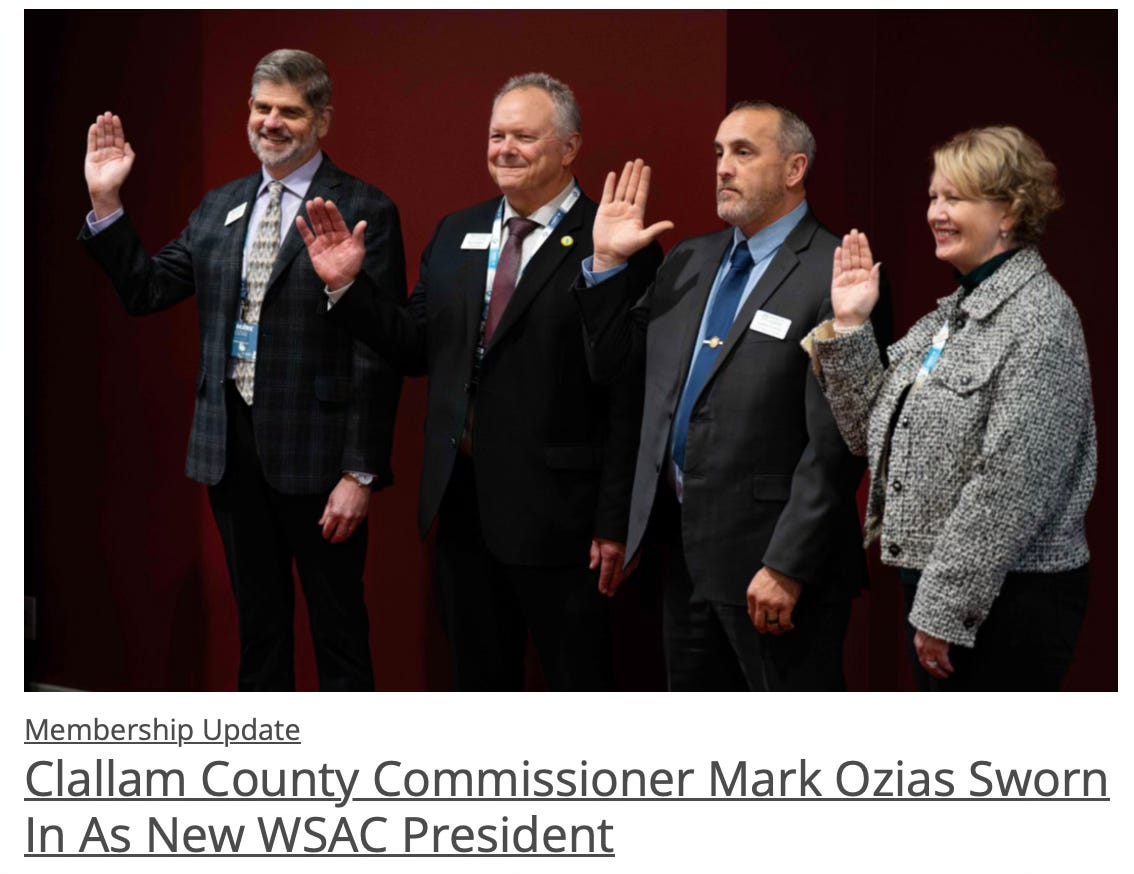
While contracts requiring annual review went unattended, Commissioner Ozias spent last week away at the Washington Association of Counties conferences, where he serves as president, and has already announced two upcoming trips to Washington, D.C. in January and February.
County business, meanwhile, piles up at home.
Who Pays When the County Doesn’t Act?
Here is the most overlooked part of this story:
Most Clallam County residents do not live in cities.
Based on 2025 estimates:
Total county population: ~78,327
Residents in Sequim, Port Angeles, and Forks: ~31,879 (≈40.7%)
Residents outside cities: ~46,448 (≈59.3%)
That means nearly 60% of county residents—those living in unincorporated areas—have been subsidizing city criminal justice services for years without disclosure or consent.
Just last month, those same residents were asked to voluntarily increase their property taxes by $3.75 million.
They were never told the county had already been absorbing a $3 million annual subsidy caused by neglected contracts.
That omission matters.
A CFO, a Shift in Oversight, and No Answers
Clallam County hired its first Chief Financial Officer in 2018, around the same time longtime Chief Accountant Stan Creasey retired from the Auditor’s Office. Before that, financial oversight was split between the County Administrator and the Auditor, with no single position responsible for pulling the full picture together. The CFO role was created to do exactly that—to improve visibility, coordination, and oversight for the Board of County Commissioners.
And yet, even after that change, a nearly $3 million annual subsidy tied to outdated criminal justice contracts went unaddressed and largely undisclosed for years. That leads to an uncomfortable but reasonable question: how did a cost of this size continue without being clearly laid out for commissioners, voters, or the public—especially after the county reorganized its finances specifically to prevent blind spots like this?
Budget Austerity for Some, Subsidies for Others
Over the past year, residents have been told:
Election integrity efforts were at risk
Public health funding was stretched
Public safety resources were limited
A Water Steward position could not be created due to lack of funds
And yet, the county absorbed $3 million per year in undocumented, unreviewed subsidies.
Add to that an estimated $3 million removed from the property tax rolls due to land converted to tribal trust status by the Jamestown Tribe, and the county is effectively operating with $6 million missing annually—in an already economically depressed region.
Still, the commissioners voted to raise property tax rates for roads and the general fund beginning next year.
It is always easier to raise taxes than to fix governance failures.
Even Leadership Took the Week Off
The irony deepened last week.
The courthouse was open.
The clerk was working.
The Charter Review Commission met.
But the three county commissioners cancelled public meetings for the holiday week, while continuing to collect six-figure salaries.

That time could have been used to:
Draft a letter to the Jamestown Tribe requesting a response on lodging and property tax discussions (now ignored for four months)
Hold the monthly commissioners forum that was canceled in November—the only guaranteed opportunity for the public to ask questions directly
Instead, those opportunities passed.
So… How Did This Happen?
Contracts ignored.
Money undisclosed.
Voters uninformed.
Priorities inverted.
The simplest answer is often the hardest to admit:
No one was minding the basics of governing.
A Constructive Path Forward
This is a serious problem—but it’s not irreversible. At the very least, the county should:
Lay out a clear, public accounting of the criminal justice contracts and the year-by-year shortfalls.
Be upfront about intergovernmental subsidies before asking voters for more in taxes.
Actually follow through on annual contract reviews and present those findings in open meetings.
Take a hard look at how many outside boards commissioners sit on, so basic governing doesn’t get sidelined.
Bring back regular public forums, with a real commitment to transparency—even when it’s inconvenient or falls during the holidays.
Call to Action
Clallam County residents deserve answers.
You can contact all three county commissioners through the Clerk of the Board by emailing loni.gores@clallamcountywa.gov and asking, plainly:
How did this go unaddressed for nearly a decade?
Why were voters not informed before being asked to raise taxes?
What safeguards are now in place to prevent this from happening again?
Transparency does not begin with press releases.
It begins with accountability.
And accountability begins when the public insists on it.
The commissioners did not answer the last question emailed to them. Here is today's question (thanks for the inspiration, Robert!):
Dear Commissioners,
Given what this article shows about a major county issue going unnoticed for years, would the commissioners be open to publicly tracking how their work time is actually spent?
Specifically, would you consider recording and sharing how many hours are spent on core county commissioner duties versus time spent serving on outside boards, committees, and associations—and, at a high level, what that time is being used for?
In the private sector, employees are routinely expected to account for how their time is used, especially when big problems slip through the cracks. If something this significant can go unaddressed, what transparency measures are you willing to put in place so the public can better understand how commissioners are allocating their time and attention?
The comment below is provided as a practical example of how constituent questions like these can be addressed through lawful and transparent governance. It models (1) how an individual county commissioner could acknowledge the concerns and route them properly, and (2) how the Board of County Commissioners, acting collectively in an open public meeting, could respond with concrete next steps. The intent is not to speak for the County, but to demonstrate what accountable public engagement can look like, rather than silence.
Mock Response #1: Individual County Commissioner
Individual Commissioner Response (Modeled)
Thank you for raising these questions. They are serious, appropriate, and deserve acknowledgment.
How did this go unaddressed for nearly a decade?
Based on the information currently available in the public record, it appears that oversight gaps developed over multiple years and across successive Boards and administrative periods. While that context does not excuse the outcome, it suggests the issue was not the result of a single decision or individual.
As an individual commissioner, I do not have the authority to direct staff or independently determine why specific actions were not taken in prior years. What I can do is ask that the Board consider, in an open public meeting, whether to direct staff to prepare a documented timeline identifying when the issue first arose, what information was available at the time, and where escalation or corrective action did not occur (Municipal Research and Services Center [MRSC], n.d.-a; RCW 42.30).
Why were voters not informed before being asked to raise taxes?
Voters are entitled to clear, material information when asked to approve any tax or levy. If relevant risks or known deficiencies were not disclosed, that represents a governance failure—regardless of intent.
While I cannot retroactively change prior ballot language, I can raise this concern publicly and advocate that future levy or tax proposals include clearer disclosures of assumptions, risks, and compliance obligations so voters can make informed decisions (MRSC, n.d.-a).
What safeguards are now in place to prevent this from happening again?
That question must be addressed by the Board as a body in a public meeting. As a next step, I will ask the Chair and Clerk to place this matter on a future Board agenda so the Board can determine, in public session, whether additional review, policy direction, or safeguards are warranted (MRSC, n.d.-b).
Accountability is not established through press releases. It is established through an open process, documented decisions, and public follow-through. I appreciate constituents who insist on that standard.
Mock Response #2: Board of County Commissioners (Collective Action)
Board of County Commissioners Response (Modeled)
Following public discussion of this matter at a regular Board meeting, the Board of County Commissioners acknowledges the seriousness of the concerns raised by members of the public.
Regarding how this went unaddressed:
By majority vote in an open public meeting, the Board has directed staff to prepare a documented timeline summarizing when the issue first appeared in the public record, what information was available to prior Boards, and where oversight or escalation did not occur. This review aims to clarify process failures and governance gaps, rather than assigning individual blame, and will be discussed publicly once completed (MRSC, n.d.-a; RCW 42.30).
Regarding voter information and prior tax measures:
The Board affirms that voters must be provided with clear, material information when asked to approve any tax or levy. While past ballot measures cannot be retroactively changed, the Board has directed that future levy proposals include enhanced disclosures that describe known risks, assumptions, and compliance obligations, so voters can make informed decisions (MRSC, n.d.-a).
Regarding safeguards going forward:
Based on this review, the Board is evaluating whether additional safeguards are warranted, including clearer reporting requirements to the Board, periodic compliance or risk reviews, and formal policies clarifying oversight responsibilities between staff and the Board. Any such changes will be considered and adopted, if appropriate, in open public session (MRSC, n.d.-b; RCW 42.30).
The Board appreciates constituents who raised these concerns and participated in the public process. Accountability is achieved through transparent reviews, documented decisions, and public follow-through; the Board is committed to addressing this matter in this manner.
Governance References (APA 7)
Municipal Research and Services Center. (n.d.-a). County commissioner roles and responsibilities.
https://mrsc.org/explore-topics/officials/roles/county-commissioners
Municipal Research and Services Center. (n.d.-b). Open Public Meetings Act basics.
https://mrsc.org/explore-topics/public-meetings/opma/open-public-meetings-act-basics
Municipal Research and Services Center. (n.d.-c). Open Public Meetings Act FAQs.
https://mrsc.org/explore-topics/public-meetings/opma/open-public-meetings-act-faqs
Revised Code of Washington. (n.d.). RCW 42.30: Open Public Meetings Act.
https://app.leg.wa.gov/rcw/default.aspx?cite=42.30