


In this Sundays With Seegers, County Commissioner candidate Jake Seegers highlights a pattern many residents may miss: while leaders say housing affordability is the county’s top issue, they continue raising permit, septic, and environmental health fees—adding costs to anyone trying to build or buy. Seegers points out these aren’t isolated increases, but a deliberate strategy of annual hikes plus periodic larger jumps—small enough to avoid backlash, but significant over time. The result: a steady squeeze on affordability that compounds year after year.
Another Fee Hike
At an upcoming meeting on April 21st, the Board of Health—including the county commissioners—will discuss an increased fee schedule for Clallam County Health and Human Services Environmental Health.
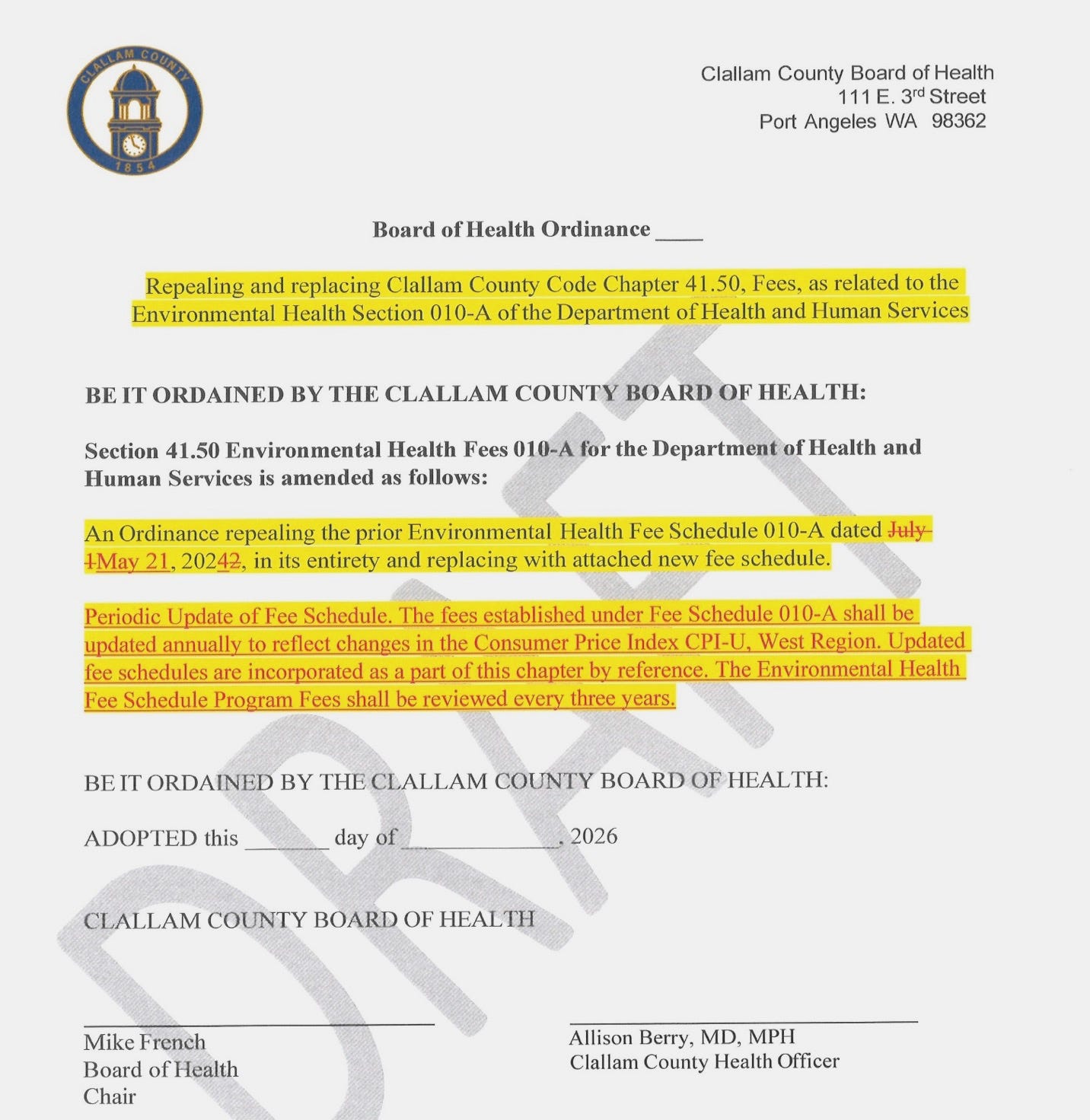
The proposed changes include fees for individual septic systems, water wells, and food handling, including event permits.
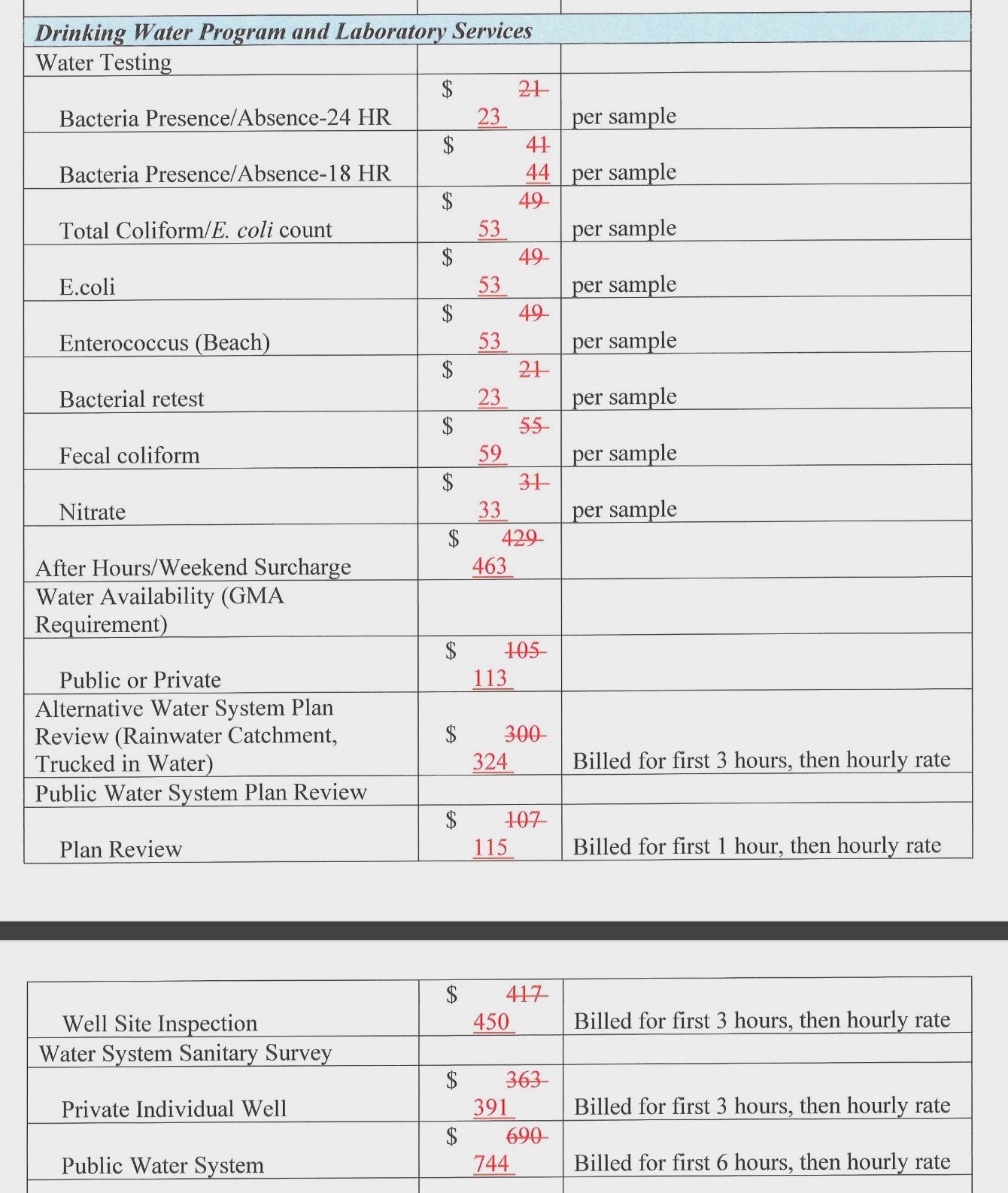
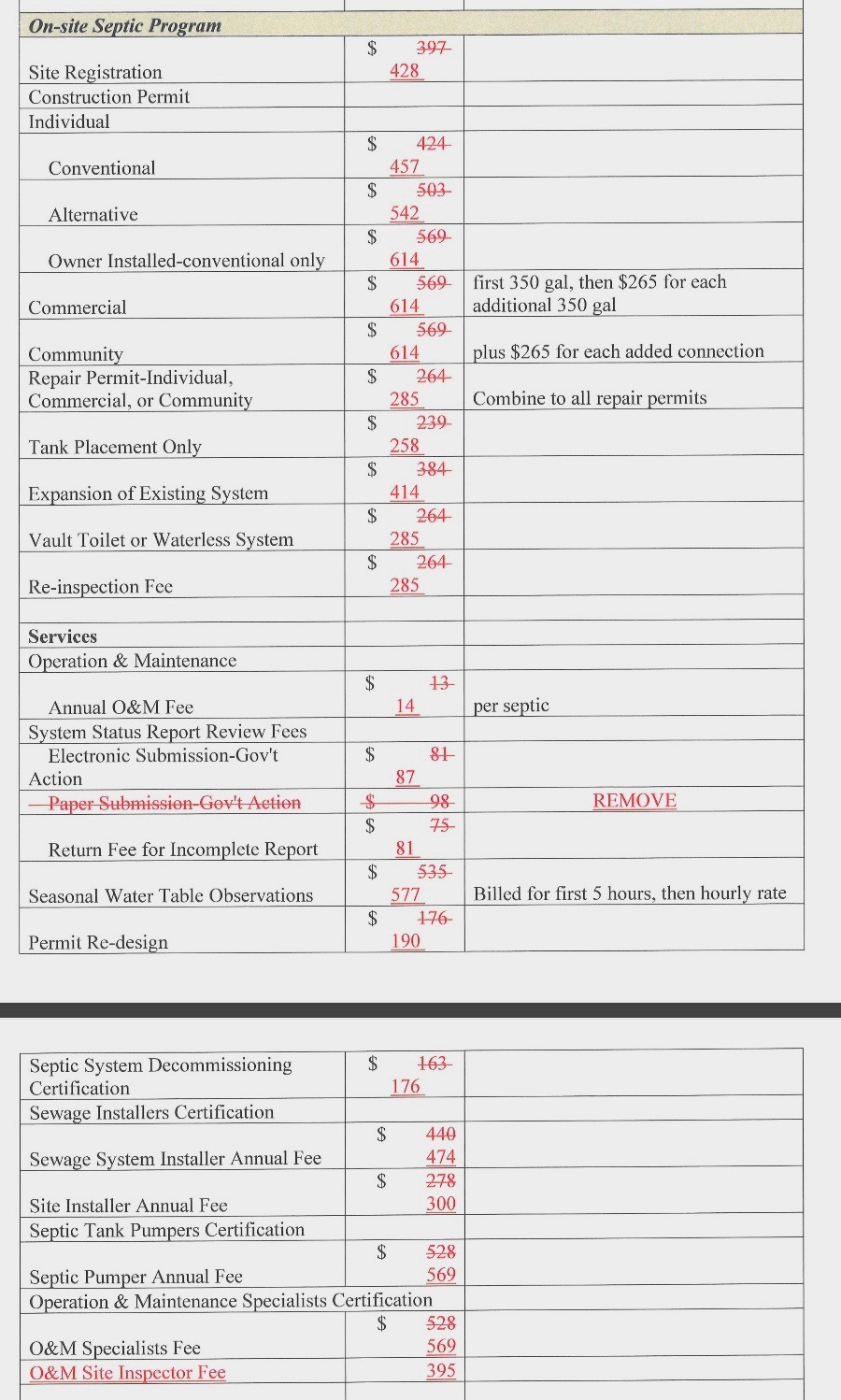
Environmental Health has proposed a 7.7% increase across the board, consisting of a 2.7% Consumer Price Index (CPI) adjustment and a 5% “technology fee.”
Following the Board of Health meeting, a public hearing will be held—likely in the last week of April—to gather input on the proposal.
Fees Undermine Home Affordability
The ability of Clallam residents to afford a home continues to erode. In 2018, the county’s median home price was $293,000; by 2024/2025, it had risen to approximately $525,000—a 79% increase. Over the same period, median household income grew just 29%, according to Federal Reserve Economic Data.
County leadership has acknowledged the severity of the problem.
During a July 8th, 2025 meeting, Commissioner Randy Johnson stated:
“In Clallam County, it continues to rise to probably the No. 1 issue for most county residents — the shortage of housing, and/or the affordability of housing, and/or the percentage of one’s income that one needs to allocate to help pay for housing.”
Commissioner Mark Ozias recently wrote to a constituent:
“The lack of affordable housing and a decayed social safety net… [are] leaving people without options.”
County Commissioner and Board of Health Chair Mike French offered additional context during a December 11th Clallam Bay/Sekiu Advisory Meeting:
“[We’re] pushing against the crosswind of the state building code and energy code that have made it a lot more expensive to build individual units. What was possible 20 years ago is very expensive now. The state has basically said, ‘We want you to be building really resilient, really low cost to maintain and low cost for utilities - we want that kind of house.’ And that has raised the initial cost very high and it’s tough on rural low-income areas. So there’s a lot of headwinds to push against.”
But taxpayers are also facing strong headwinds from their own county. Despite acknowledging the cost pressures created by state policy and the Climate Commitment Act, commissioners continue to compound the problem with increasing permit and licensing fees.
Fees as a Revenue Strategy
As part of the county’s “7% exercise” during 2025 budget discussions, Department of Community Development Director Bruce Emery proposed increases to permit and land division fees.
Those changes drove license and permit revenue up by roughly $300,000 in 2025, climbing from a relatively stable baseline of about $1 million in prior years.
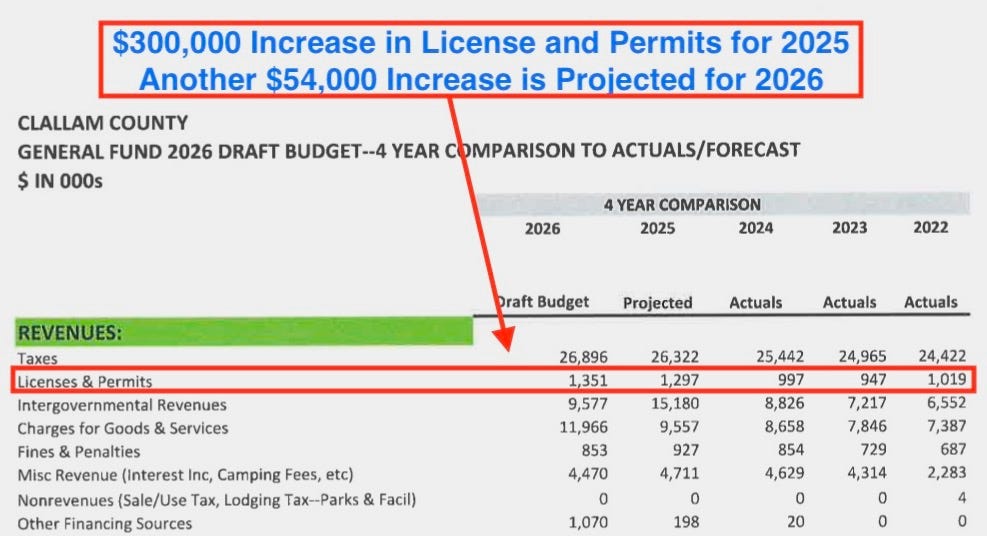
Revenues are projected to increase by another $54,000 in 2026, largely due to additional DCD fee hikes.
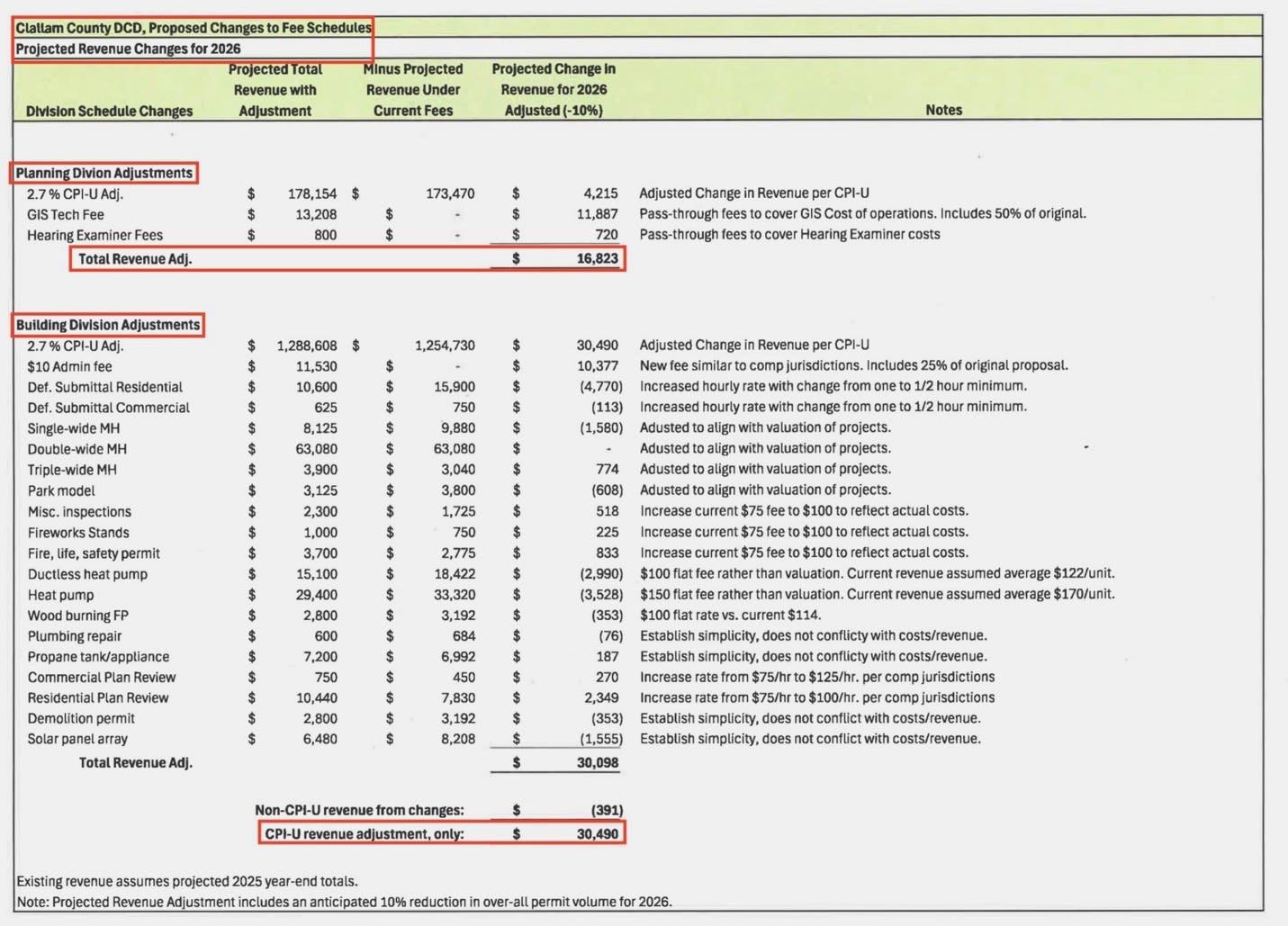
During a July 29th, 2025 departmental budget meeting, Commissioner French supported the increases, stating:
“The building community would prefer reliability… and they are less sensitive to cost.”
But as fees rise, the burden ultimately falls on residents—many of whom are already priced out of building or buying a home.
Behind the Curtain: Internal Discussions on Raising Fees
What’s being proposed publicly is only part of the story.
During an October 15th, 2025 departmental budget meeting with commissioners, Department of Community Development Director Bruce Emery outlined a more detailed—and more strategic—approach to increasing fee revenue.
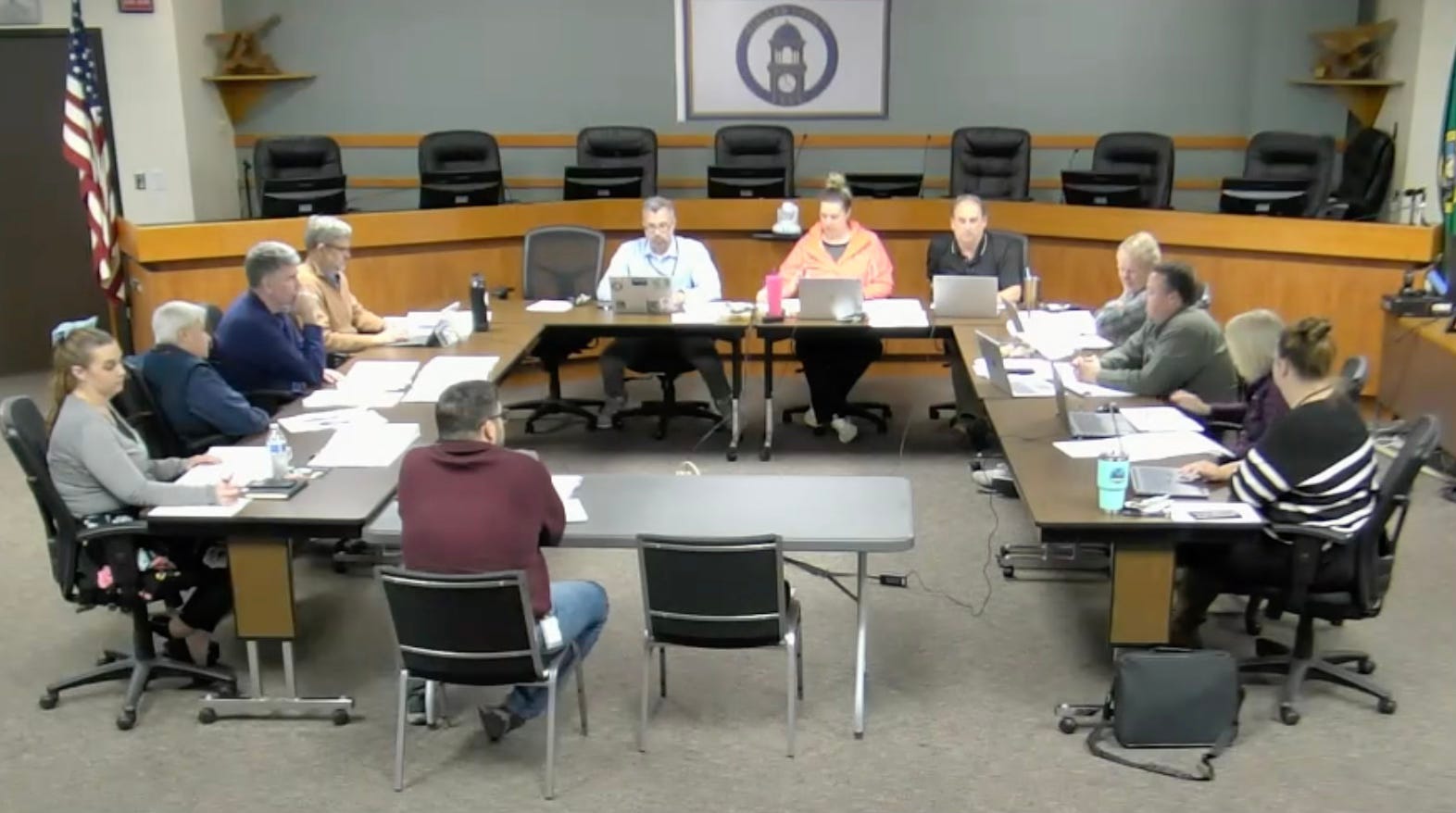
At one point, Emery acknowledged that even automatic fee increases tied to inflation may not currently be lawful without further action:
“We had instruction to work on our fee schedule… it turns out because this stuff is encoded in an ordinance, it requires an ordinance update before being legal.”
That raises a key question: if CPI-based increases require formal ordinance updates, how are ongoing adjustments being handled now?
The discussion quickly shifted from compliance to opportunity.
Emery pointed to specific areas where fees could be increased to generate more revenue—particularly mechanical permits, which cover common systems like furnaces, heat pumps, and ductless mini-splits. While individual permit fees in this category are often relatively small, they apply to a high volume of routine work, meaning even modest increases can add up quickly across the county.
“Our mechanical permit fees are pretty small and we have many of them… given the number of them that we do every year, [these fees] could have a substantial impact on our revenue.”
He also proposed expanding fees into new areas entirely—suggesting that IT-related services be built into permit costs:
“Include a technical service fee along with our permitting structure… that would increase revenues for IT and offset general fund necessity.”
County staff were explicit about the broader goal. Deputy CFO Rebecca Turner described the approach this way:
“We’re trying to think creatively this year… to come up with things [to raise fee revenue] that we haven’t thought of before.”
Even enforcement mechanisms were discussed as potential revenue drivers, including shifting more costs onto residents who challenge code violations.
Taken together, the conversation reflects more than routine cost recovery. It points to an active effort to identify, expand, and institutionalize new revenue streams—often through fees that residents have little ability to avoid.
[Watch the discussion here starting at 3:15:15.]
“If Your Friends Jump Off a Cliff…”
The commissioners, DCD, and Environmental Health often justify fee increases by benchmarking against other counties.
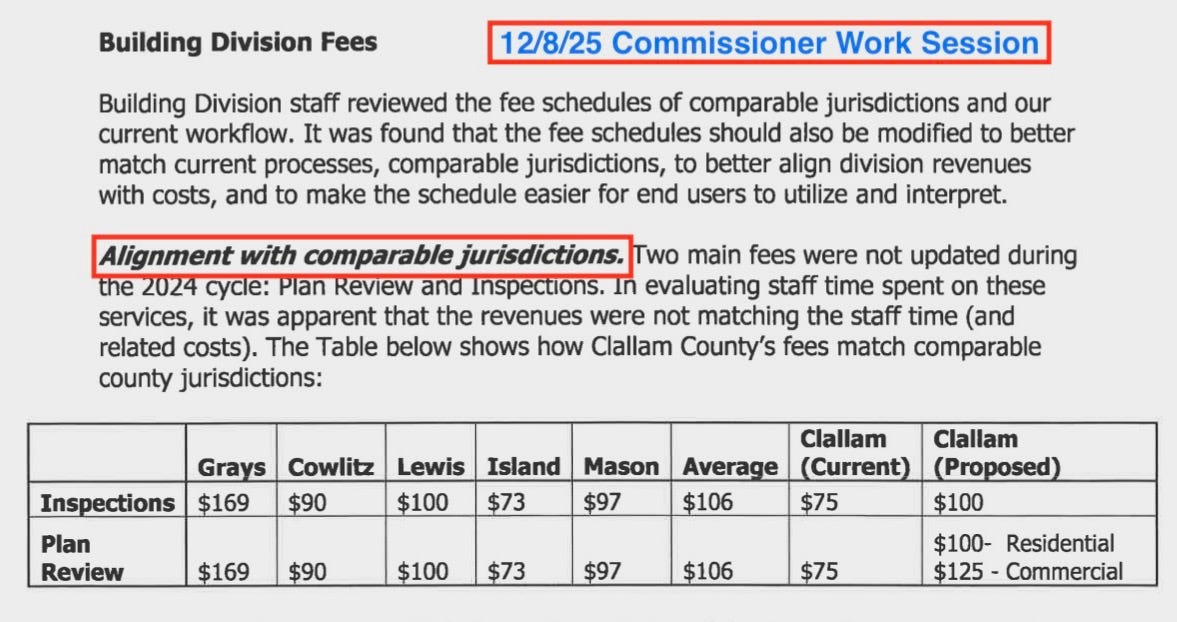
But permitting departments function as localized monopolies—there is no alternative provider for building, septic, or well permits.
Residents must either pay the fees, stop building, or leave.
In private markets, coordinated pricing among captive customers would be considered “collusion.” In county government, it’s policy.
Meanwhile, fees in states like Texas and Idaho are significantly lower than in Washington and Clallam.
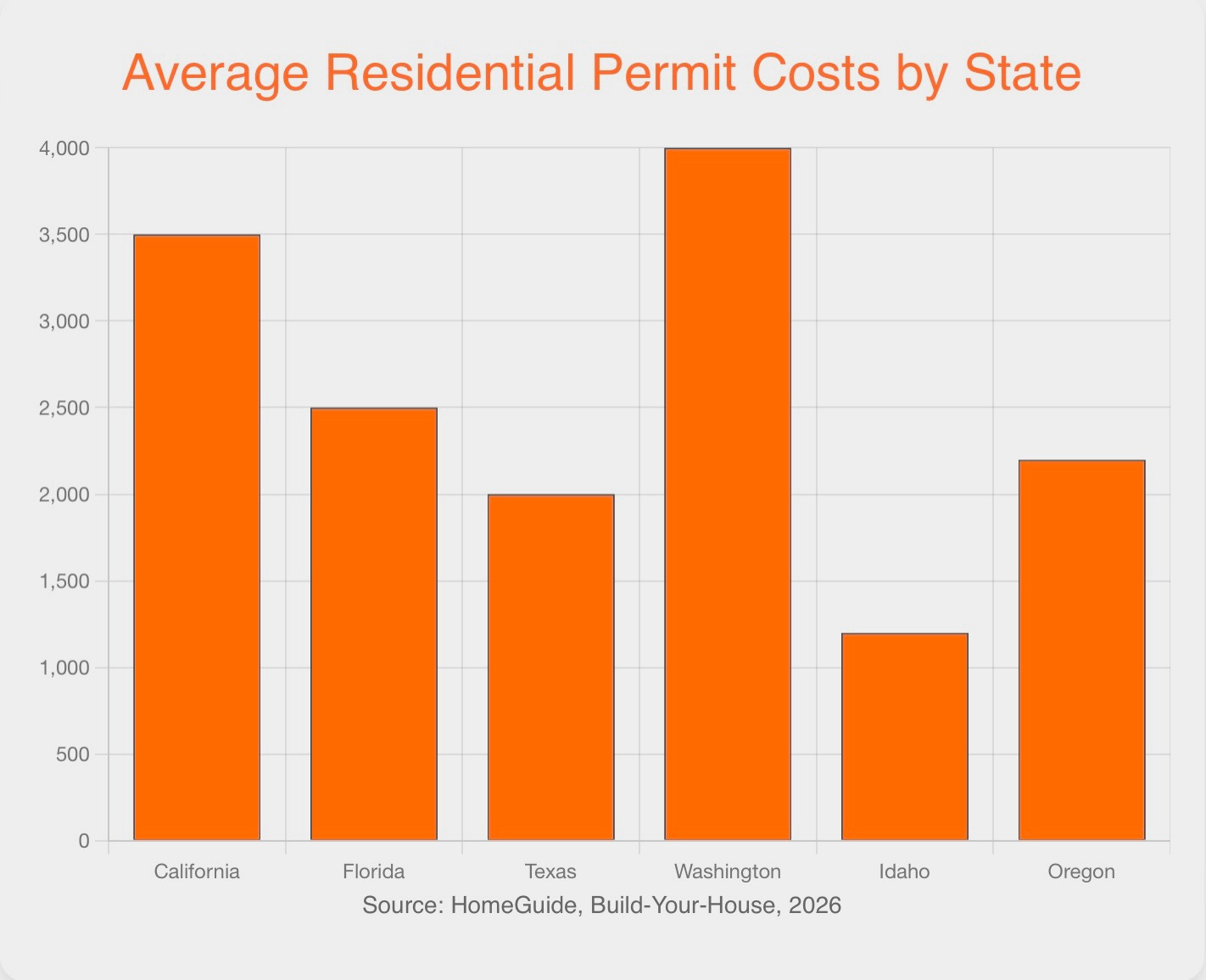
Even the City of Port Angeles offers targeted fee exemptions, recognizing the impact of fees on affordability.
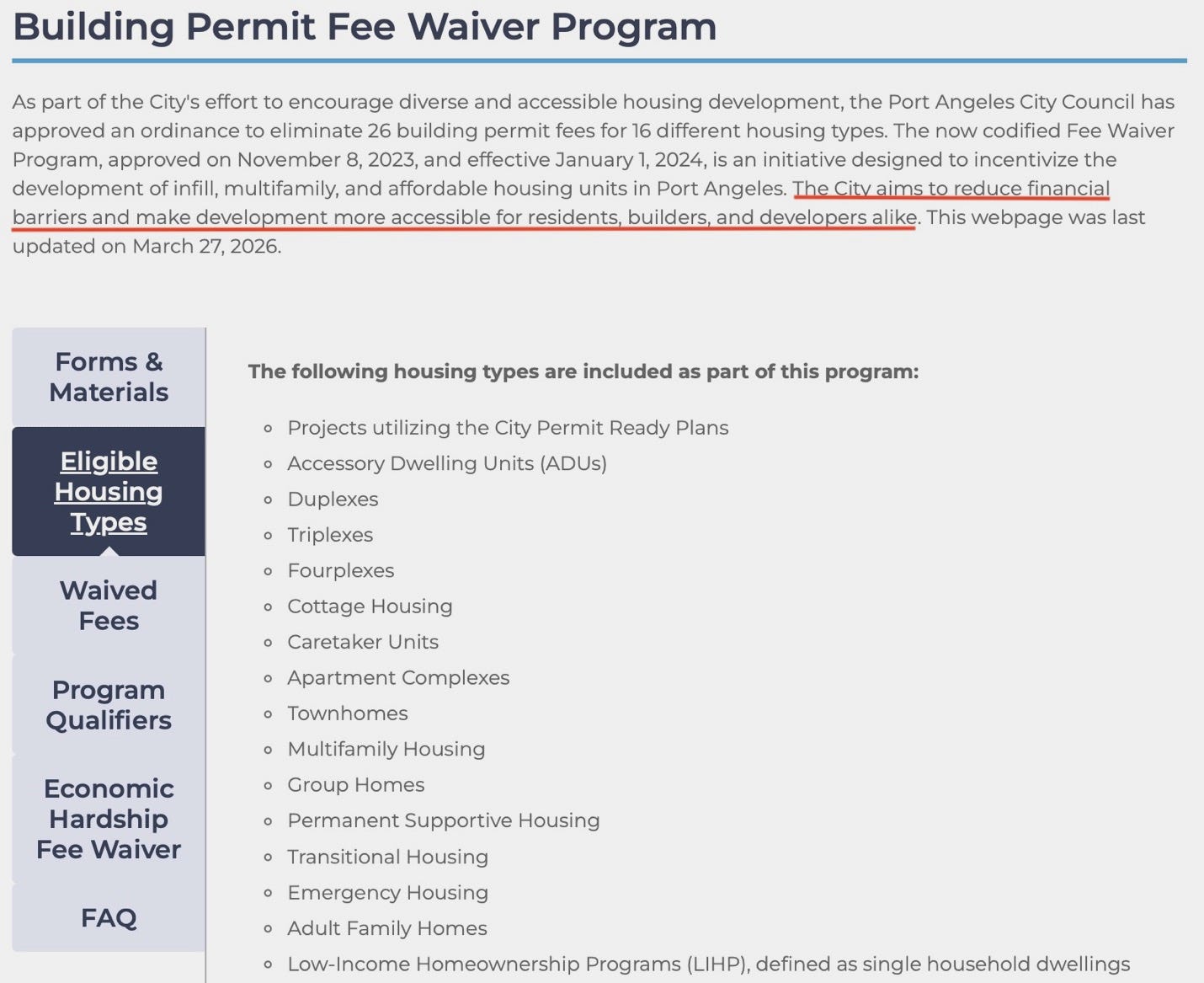
In stark contrast, a local Clallam County contractor recently received a $4,000 estimate from the Building Department for permits and fees to construct a pole barn—with no living space included.
“Cost Recovery” vs. Taxpayer Reality
The county also claims that it must justify the cost of providing services. But, these are services that are essential to citizens of the county.
Health Officer Allison Berry stated,
“A lot of the reasoning behind that is to make sure that costs are actually covered by the fee. There’s a pressure to avoid draining down the general fund for any of these programs. So if you can charge a fee to fund what we do, make sure that fee is adequate to fund those operations.”
But citizens already pay property and sales taxes to fund essential county services—including permitting. They also pay taxes to the state and federal government, some of which returns to the county through grants that often fund nonessential activities.
Addicted to Grants
From 2018 to 2024:
Bellevue Consumer Price Index (CPI) rose 30.4% (used as Clallam’s benchmark)
County tax revenues increased 39.3%
Property tax revenue rose 17%
County expenses surged 51.6%
Federal and state grant revenue skyrocketed 125.7%
(Source: WA State Auditor’s FIT Tool)
The pattern is clear: spending is outpacing both inflation and revenue growth.
When grants decline, programs are rarely cut.
For example, the county continues funding WSU Extension at roughly $50,000 annually, even as grant sources like SNAP diminish. Rather than reduce spending, the county plans to offset the gap with $54,000 in additional fees in 2026.
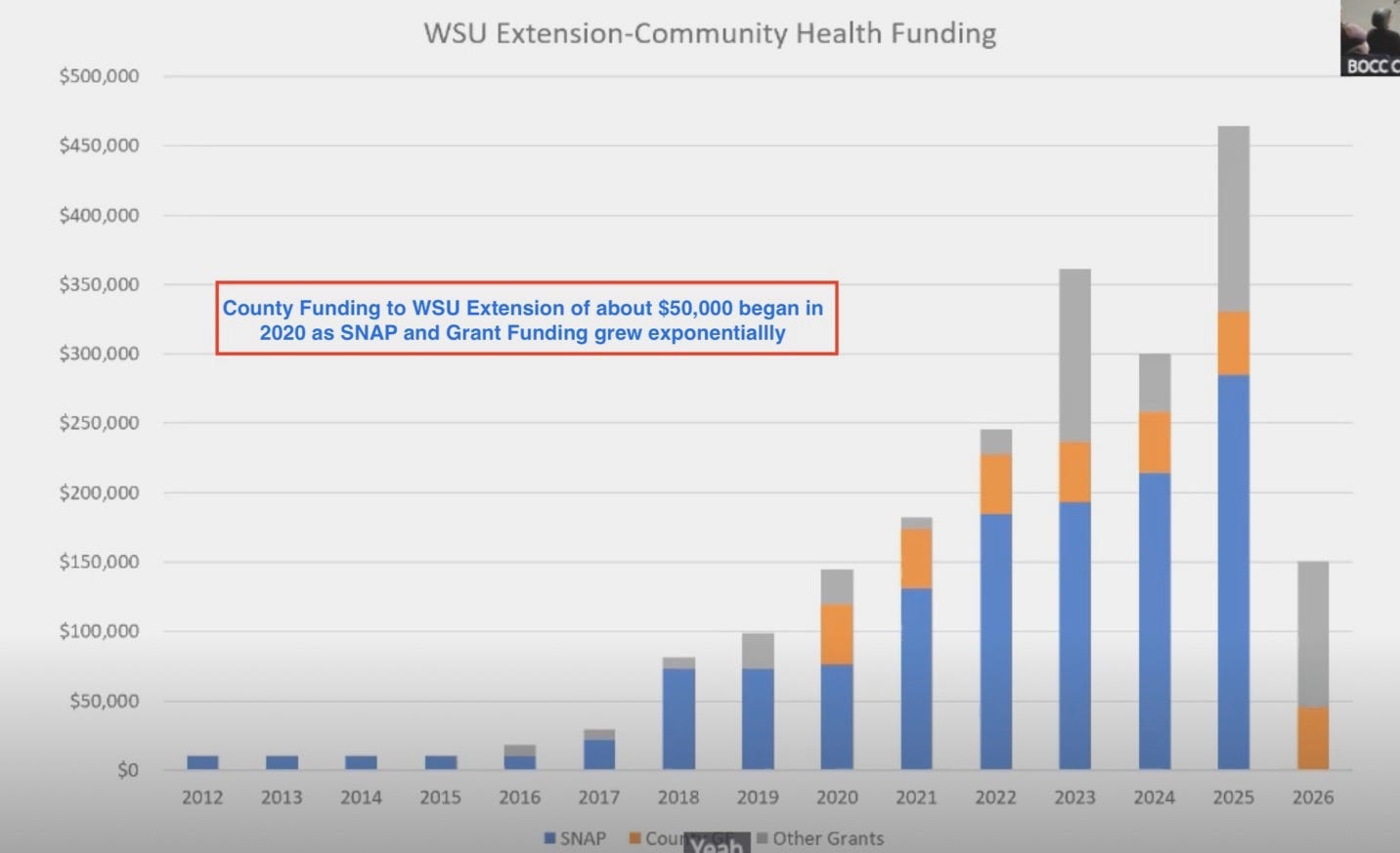
Health Officer Berry articulated the county’s strategy of raising fees to sustain grant-funded programs,
“Similarly, with cuts at the state level, there’s not a lot of extra wiggle…they’re no longer funding the kind of grants we used to see to fill in gaps of our programs. So, now the only way to fund it is through the fees.”
With federal and state budgets under pressure, Clallam’s reliance on grant revenue has leaders scrambling to replace it—often through higher fees on local taxpayers.
Affordability at the Top
While fee increases erode housing affordability, elected and appointed officials continue to receive raises and benefits—despite earning well above the county median.
Forgoing those increases and vehicle perks would save taxpayers an estimated $224,000 in 2026 alone.
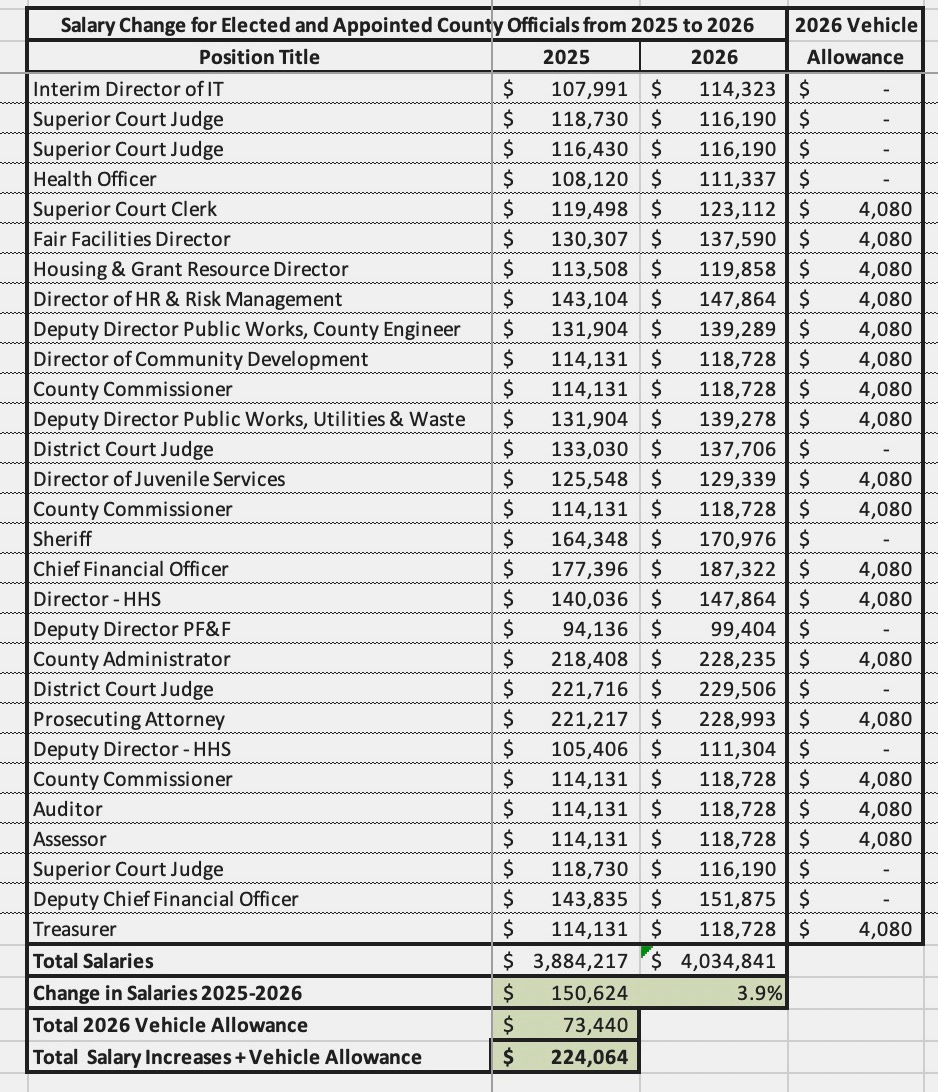
Instead of cutting programs as grants dry up or foregoing costly wage and benefit increases, county leaders have chosen to undermine housing affordability by passing these costs on to taxpayers through higher fees.
A Permanent Upward Ratchet
During the March 17th Board of Health meeting, Environmental Health staff indicated that fee increases are becoming a core part of the county’s budgeting approach:
“Last budget cycle, the CFO’s office requested CPI increases for fees across the county.”
In practical terms, this suggests the county is moving toward a two-tiered strategy: applying annual, across-the-board fee increases tied to CPI, while also implementing larger, department-specific increases every few years.
Commissioner French expanded on this approach:
“When you don’t update your fees on a regular basis, there’s big sticker shock when you do… We want to just have a pretty regular, reliable [increase]… We’re proposing to kind of re-look at that deep review every three years and in the off years, just try to take the CPI.”
In other words, fees will continue to rise annually—incrementally enough to avoid immediate backlash, but steadily enough to compound over time.
Until, eventually, many residents are priced out altogether.
What can you do?
Make your voice heard—before these decisions are finalized.
Email the Commissioners by contacting the Clerk of the Board at loni.gores@clallamcountywa.gov and let them know where you stand on increasing fees and decreasing affordability.
Show up in person on Tuesday, April 21st at the Board of Health meeting and provide public comment at 1:30 PM. Public input matters—especially when decisions directly impact the cost of living in our community.
If you don’t speak up now, these “small” increases won’t stay small for long.
Editor’s Note: CC Watchdog editor Jeff Tozzer also serves as campaign manager for Jake Seegers during his run for Clallam County Commissioner, District 3. Learn more at www.JakeSeegers.com.


