


Race has become a recurring theme in local politics—from school board disputes and county appointments to public health resolutions and campaign rhetoric. But as accusations of racism multiply, many residents are beginning to ask whether everyone is being held to the same standard.
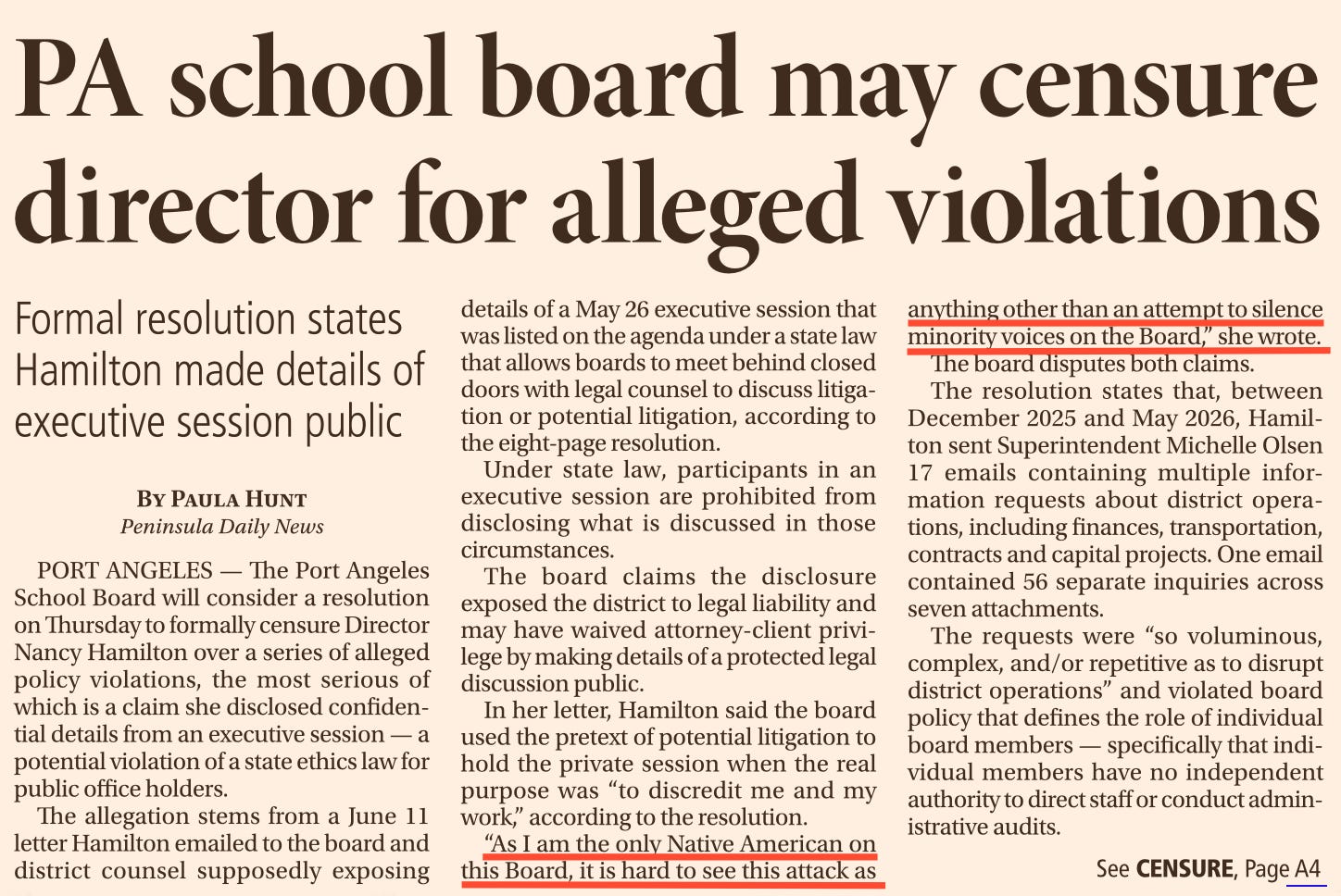
Last week, the Port Angeles School Board voted to censure fellow board member Nancy Hamilton. Every board member except Hamilton voted in favor of the resolution, which accused her of making antagonistic and inaccurate statements about the superintendent and improperly disclosing information discussed in executive session.
Hamilton viewed the situation differently.
“As I am the only Native American on this Board,” she said, “it is hard to see this attack as anything other than an attempt to silence minority voices on the Board.”
The issue quickly expanded beyond the specific allegations contained in the censure resolution. Supporters framed the action as part of a broader discussion about race and representation. Among them was Port Angeles Deputy Mayor Navarra Carr, who also serves as Mike French’s campaign manager. Carr circulated an email urging residents to oppose the censure and stating that it was difficult not to see “racist undertones” in the board’s actions.
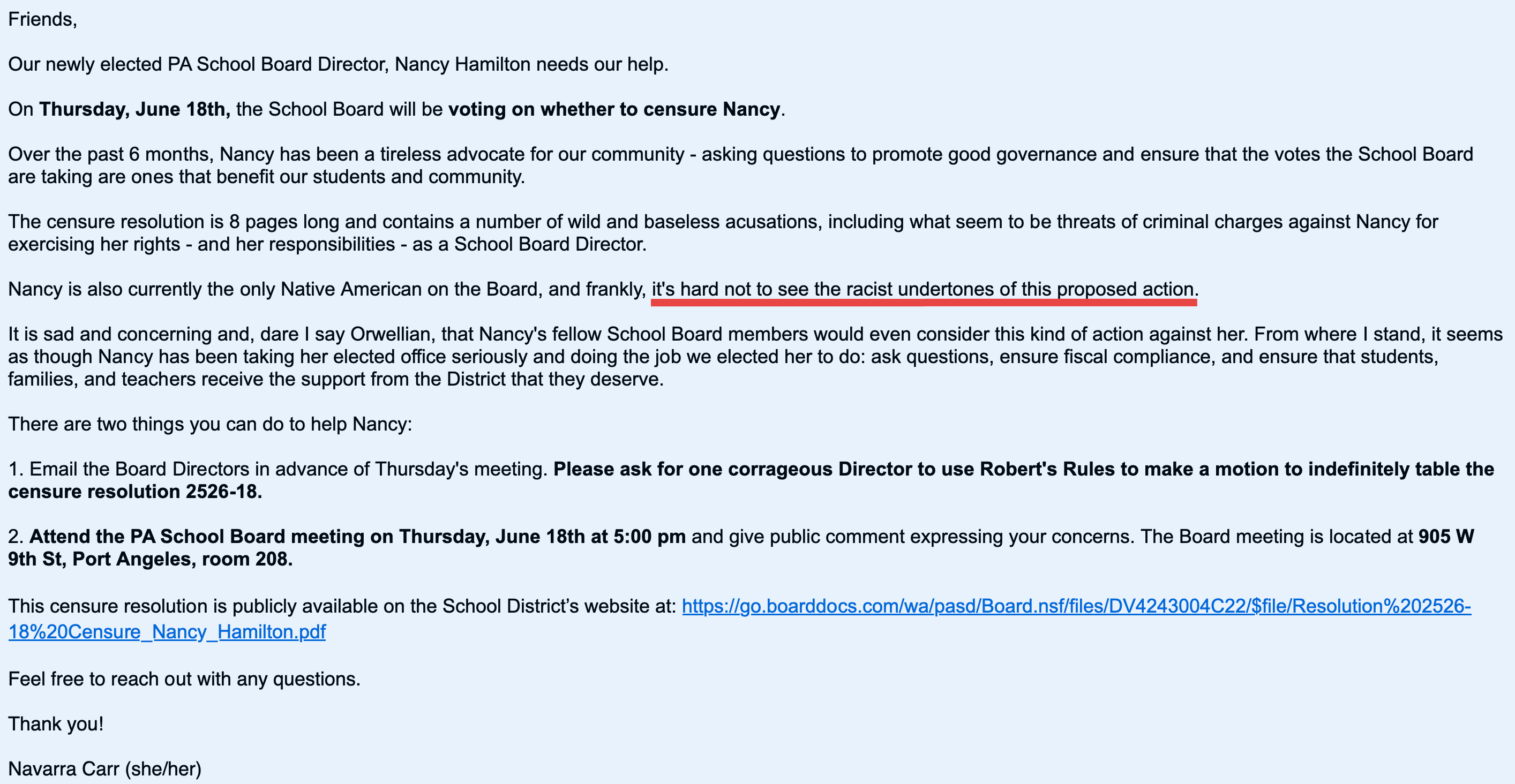
Whether one agrees with Hamilton or the rest of the board is almost beside the point. What matters is how quickly questions of race became central to the discussion. That has become a familiar pattern on the Olympic Peninsula.
Racism as a Public Health Emergency
The modern era of local government’s focus on race arguably began in 2020.
That October, the Jefferson County Board of Health adopted Resolution 65-20 declaring racism a public health crisis. The resolution described racism as both an acute and chronic threat to public health and committed the county to examining policies through a racial equity lens.
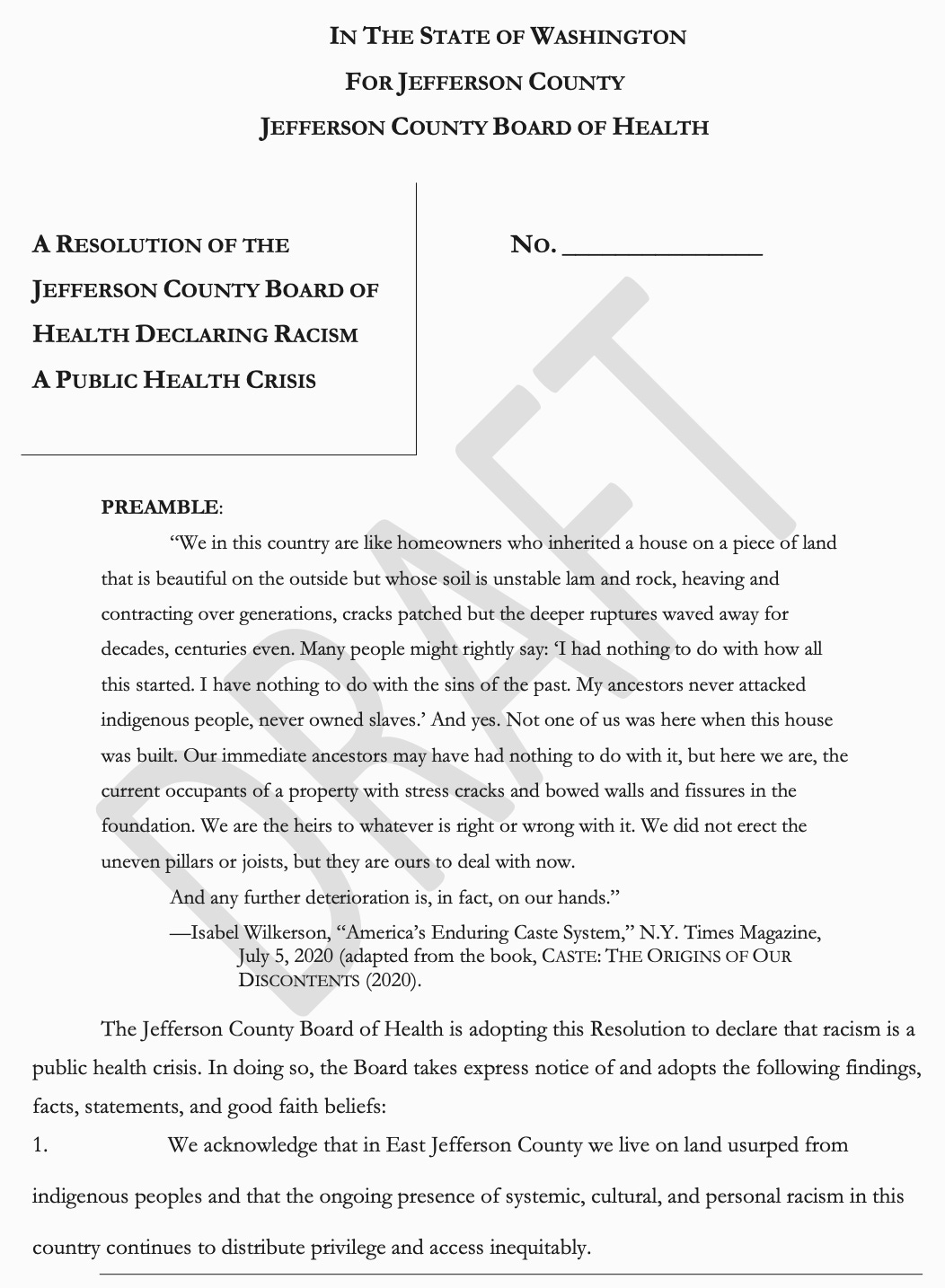
The resolution stated that racism contributes to inequities in housing, education, employment, criminal justice, and health outcomes. It further pledged support for efforts aimed at identifying and eliminating systemic barriers faced by racial minorities.
At the time, supporters argued that the declaration was a necessary acknowledgment of historical and contemporary disparities. Critics questioned whether broad social and political issues were being transformed into public health matters.
Regardless of where one stood on the resolution, it signaled a significant shift. Race was no longer simply one issue among many. It was becoming a framework through which local government would increasingly evaluate public policy.
Calling Out Racism
The Jefferson County Board of Health was not alone in making race a central public issue in 2020.
Many local elected officials were speaking openly about racism, institutional bias, and the need to confront prejudice wherever it appeared.
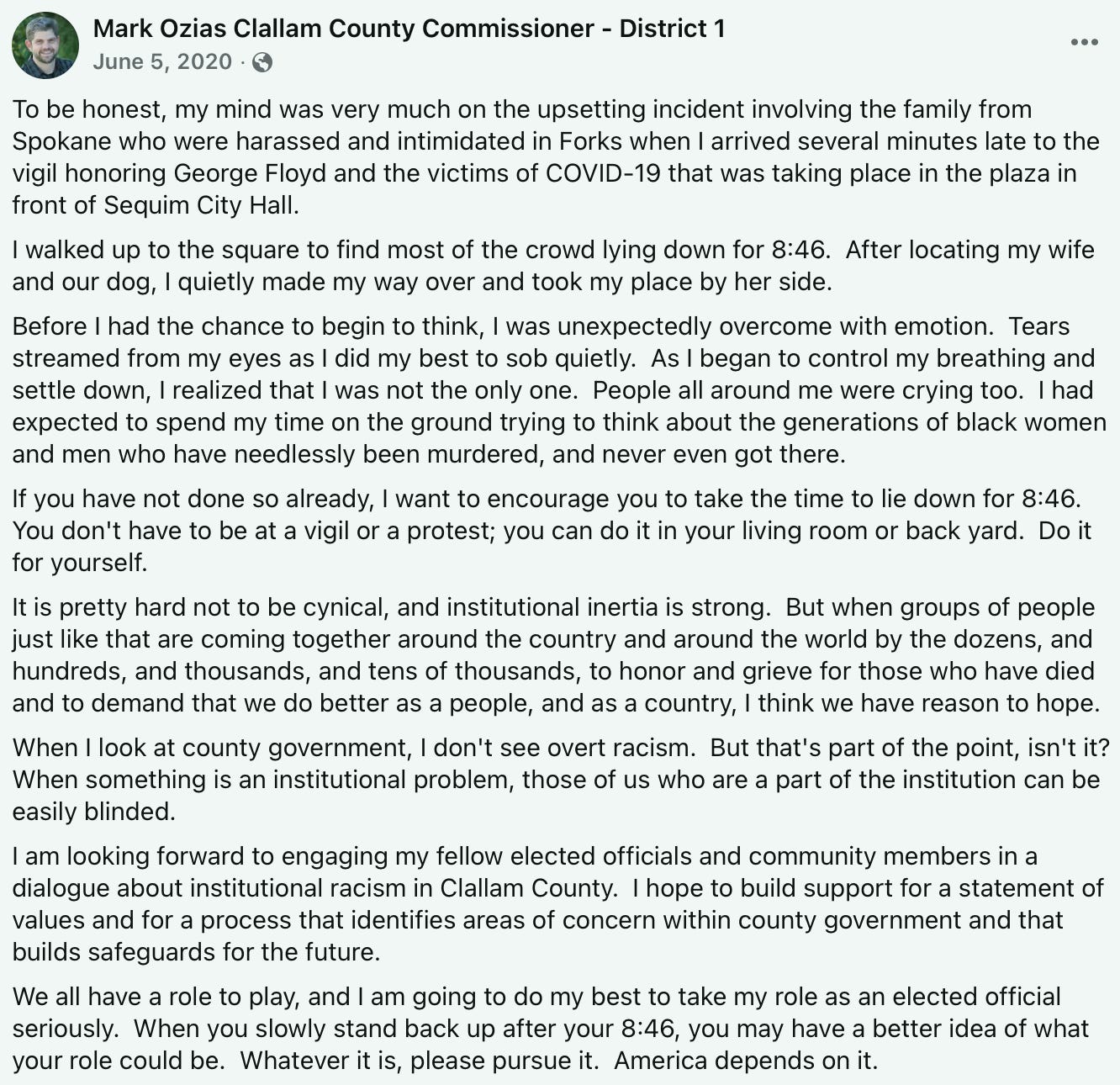
Clallam County Commissioner Mark Ozias wrote that following a George Floyd vigil, he wanted to engage fellow elected officials and community members in a dialogue about institutional racism in Clallam County. He acknowledged that he did not see overt racism in county government but argued that institutional problems can be difficult for those inside the system to recognize.
Commissioner Mike French was equally outspoken.
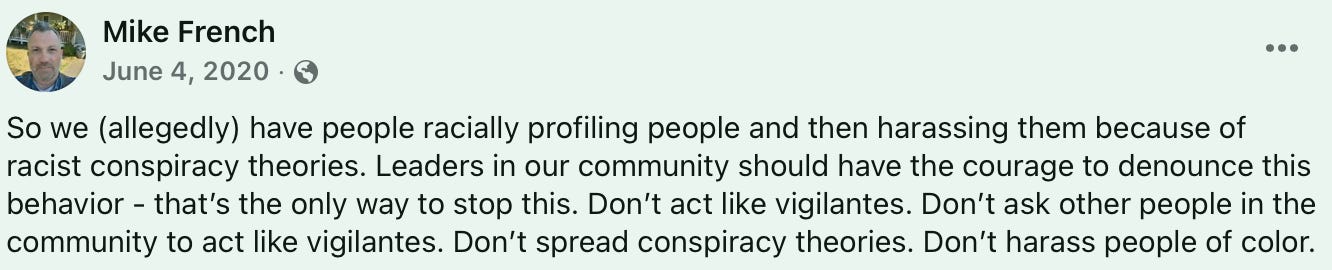
In one June 2020 post, French condemned what he described as racial profiling and harassment, writing that community leaders should have the courage to denounce such behavior.
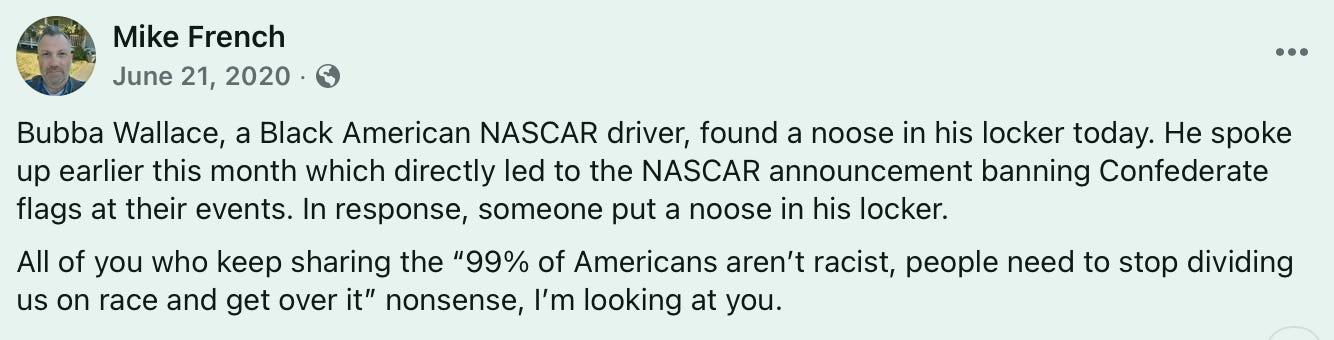
In another, he criticized those who downplayed racism, saying that people who insisted Americans should simply “get over it” were missing the point.
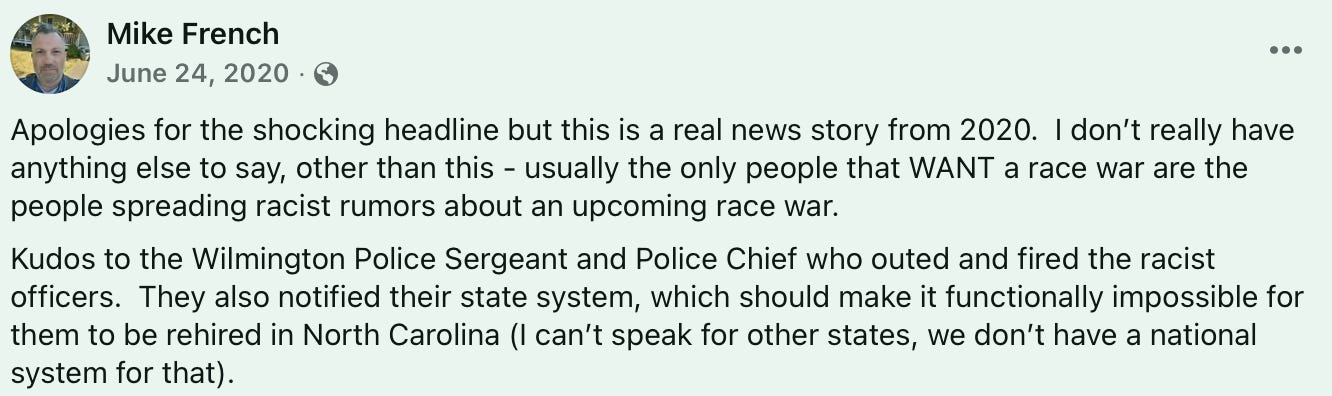
Days later, he warned against those spreading what he viewed as racist rhetoric and conspiracy theories.
Whether one agrees with those statements is not particularly important.
What is important is that both officials established a clear principle: racism should be confronted, called out, and challenged. Silence was not an acceptable response.
That principle seems reasonable enough.
The question is whether it has been applied consistently.
The Rise of Identity Politics
That same year, Port Angeles became the site of another debate centered on race and representation.
In September 2020, the Port Angeles City Council voted to restructure the Public Safety Advisory Board. The discussion was driven largely by concerns that the board was entirely white.
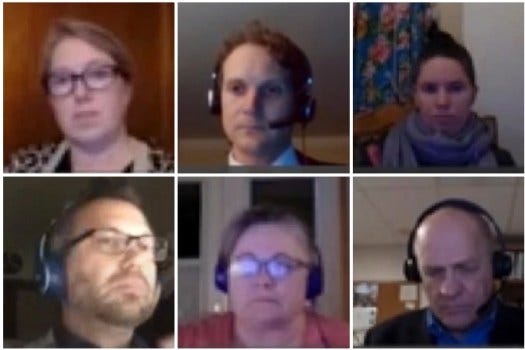
The adopted ordinance added seats for tribal representatives and individuals with experience related to homelessness or substance use disorders. Councilmembers Mike French, Navarra Carr, LaTrisha Suggs, and Kate Dexter supported the measure.
The debate was notable because it focused less on expertise and more on identity. Supporters argued that a board’s effectiveness depended in part on who was represented around the table.
The argument reflected a broader trend in American politics. Increasingly, public institutions were being encouraged to view people not primarily as individuals but as members of demographic groups whose perspectives were presumed to flow from their ancestry, ethnicity, or lived experience.
That philosophy continues to shape public discussions today.
The Rawls Question
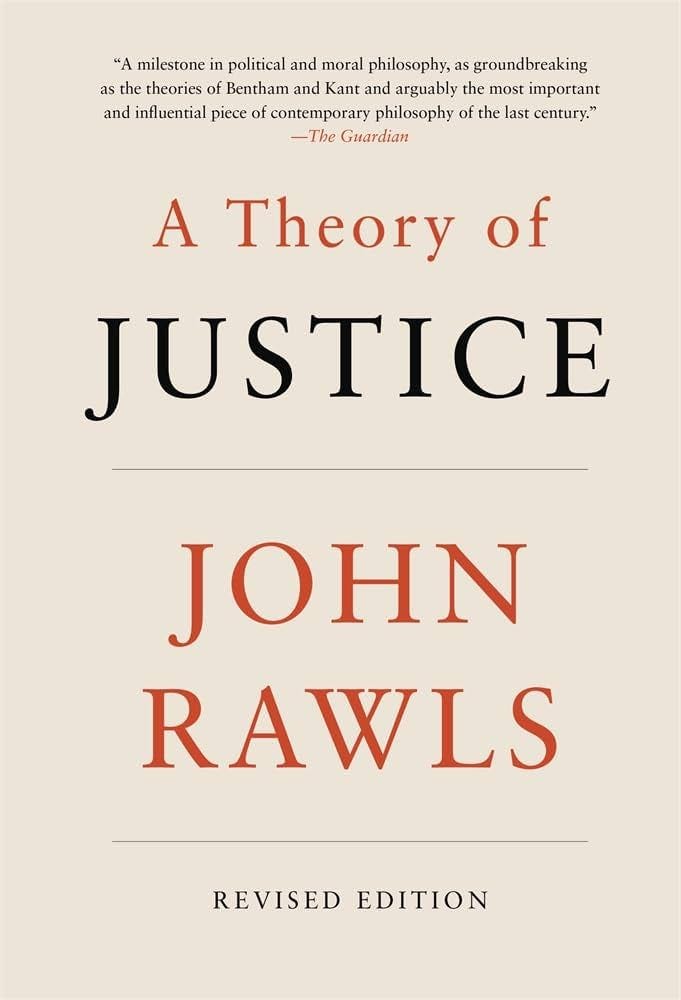
At last week’s commissioner debate, incumbent Commissioner Mike French referenced political philosopher John Rawls while discussing fairness and privilege.
“This is, I think, very classic John Rawls philosophy,” French said. “If you were to be reborn and had to reroll the dice, would you do it? I’m a white man in modern America that has had a very blessed life.”
French was referring to Rawls’ famous “veil of ignorance” thought experiment. Rawls argued that a just society would be designed by people who did not know what position they themselves would occupy within it. The idea was intended to encourage fairness and empathy.
It is a thoughtful exercise. Most people would agree that society should seek to reduce unnecessary barriers and create opportunities for success.
The challenge comes when discussions about fairness become inseparable from discussions about race.
Life does not divide neatly along racial lines. There are wealthy people and poor people in every racial group. There are people born into privilege who squander opportunities and people born into difficult circumstances who overcome extraordinary obstacles.
Some of the most successful people in Clallam County are tribal citizens. Some non-tribal families struggle every day to make ends meet. Human experience is more complicated than demographic categories.
Reducing individuals to racial identities may simplify political conversations, but it rarely reflects reality.
The Double Standard Problem
If racism is truly a problem that must be confronted wherever it appears, then the standard should apply consistently. Yet many residents have noticed that consistency often disappears when the target changes.
Where, for example, were the public condemnations when Paula Allen wrote on social media that white people were a problem and that she was embarrassed to live among them?
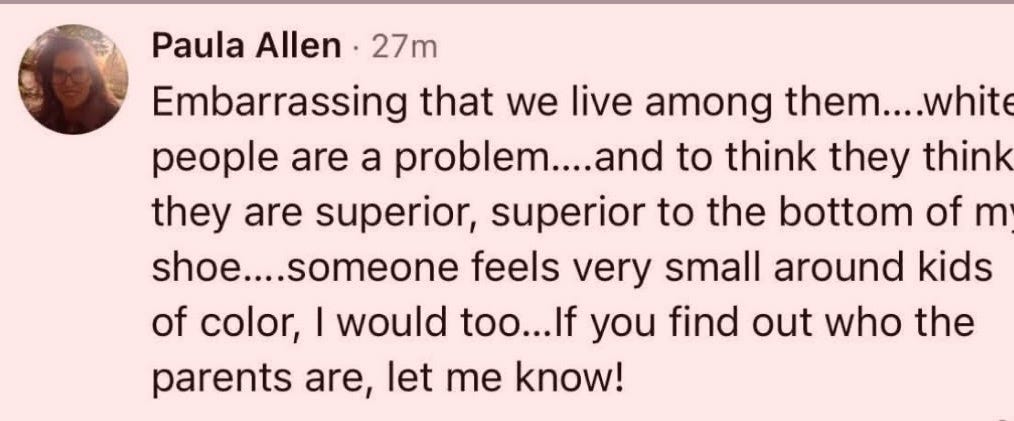
Where were the statements from elected officials denouncing those comments? Where were the calls for accountability?
Similarly, county commissioners were made aware of comments attributed to Rae Hesselbach stating that “the wealthiest white men are a greater threat to safety than the unhoused.”
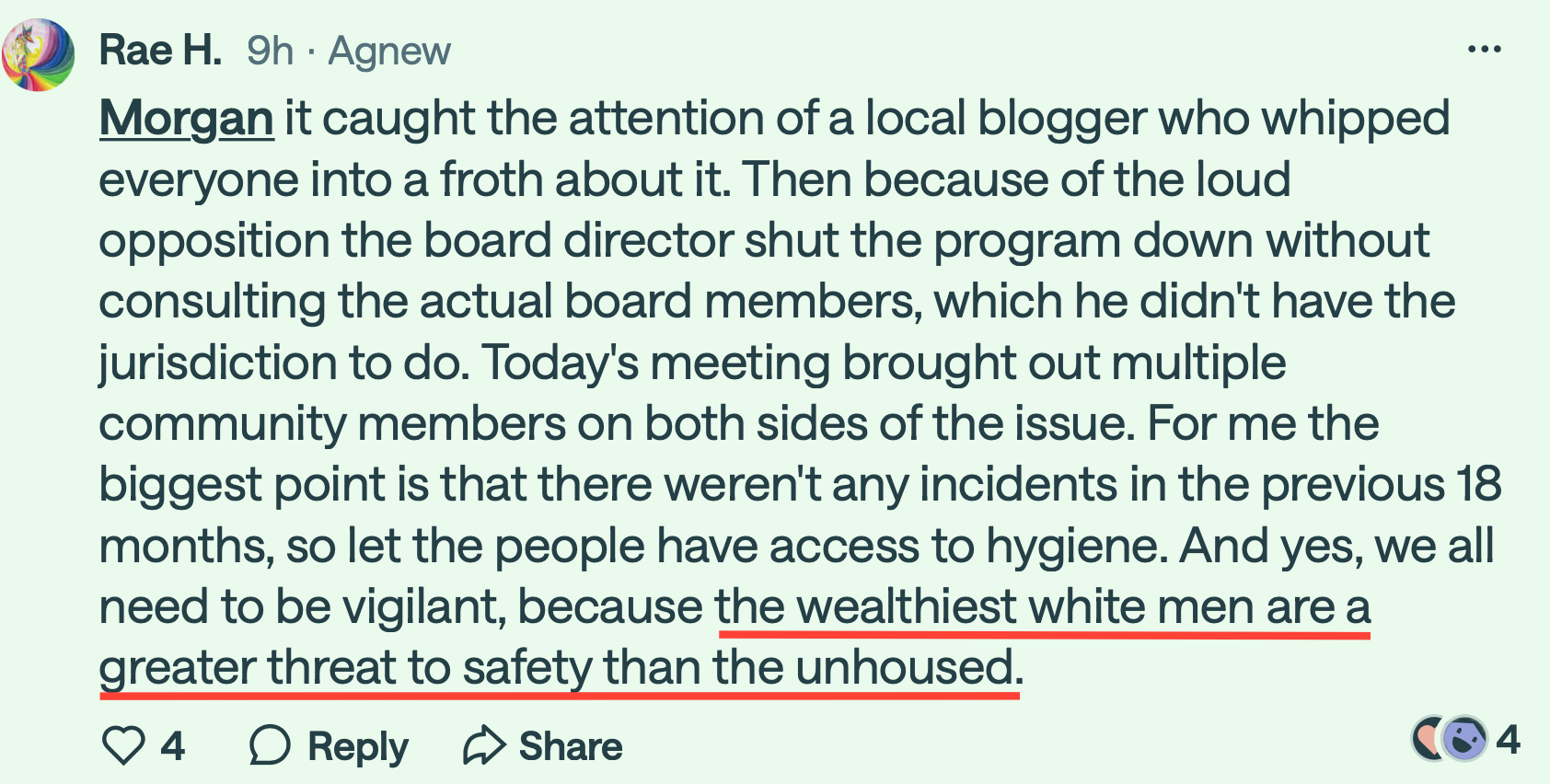
Despite the controversy, commissioners unanimously appointed her to the Developmental Disabilities Advisory Board.
No public statements followed. No emergency discussions were held. No resolutions were drafted.
Many residents cannot help but notice the contrast.
Had similar remarks been directed toward Native Americans, Black residents, or any other minority group, there is little doubt that local officials would have responded swiftly and publicly.
That discrepancy undermines confidence in the principle itself.
When standards are applied selectively, people begin to suspect that the issue is not racism but politics.
Beyond Race
None of this is an argument that racism does not exist. It does.
But the constant emphasis on race as the primary lens through which society should view itself has produced diminishing returns. Instead of bringing people together, it often encourages them to view one another as competing groups with competing grievances.
That is a troubling direction for a country founded on the idea that individuals possess equal rights regardless of ancestry.
Two hundred and fifty years into the American experiment, Americans should be moving toward a society that judges people based on character, conduct, and contribution rather than racial categories. Public officials should be encouraging that vision, not reinforcing divisions that many citizens are trying to move beyond.
The United States remains exactly that: United States.
At least it should be.
Too often, modern politics seems determined to remind us of what separates us while overlooking everything we still share.
Today’s Tidbit: Broadband Funding for Some, Taxes From All
The Washington State Department of Commerce is promoting nearly $790 million in new federal broadband funding opportunities available exclusively to tribal and Native entities.
The grants, administered by the National Telecommunications and Information Administration (NTIA), are intended to expand broadband access, infrastructure, and digital connectivity on tribal lands.

No one disputes the importance of broadband access. In today’s economy, reliable internet service is as essential as electricity and roads.
What makes these programs noteworthy is who pays for them and who can receive them.
The funding comes from federal tax dollars collected from all Americans. White taxpayers pay into the system. Black taxpayers pay into the system. Hispanic taxpayers pay into the system. Tribal citizens pay into the system.
Yet eligibility for these particular grants is determined by ancestry and political status, not financial need.
That raises an uncomfortable question.
If a federally funded program were available only to white communities, would anyone hesitate to call it discriminatory?
If not, why is it different when the beneficiaries are tribal governments?
Supporters argue that tribes occupy a unique legal status recognized by treaties and federal law. Critics argue that taxpayer-funded programs should be available based on need, geography, or income rather than race or ancestry.
Reasonable people can disagree on the answer.
But they should at least be allowed to ask the question.


