


A 60% collapse in timber revenue isn’t just a forestry story. It’s a county budget story. It’s a property tax story. And it’s a story about who pays when legally approved timber sales are delayed or stopped. As environmental litigation and activist campaigns continue targeting public timber sales, county officials acknowledge that financial consequences are already showing up in the budget. The question now is whether taxpayers understand what’s at stake.
Correction: The Calico Cat Social Club debate between Jake Seegers and Mike French will be held on Thursday, August 27, at 6:30 p.m. at the Sequim Prairie Grange. (Yesterday’s article said August 27 was a Wednesday.)
Perhaps the most revealing number buried in last week’s county commissioner Mid-Year Budget Status Review wasn’t the overall budget—it was a single line item: Timber revenue is down 60 percent compared to last year.
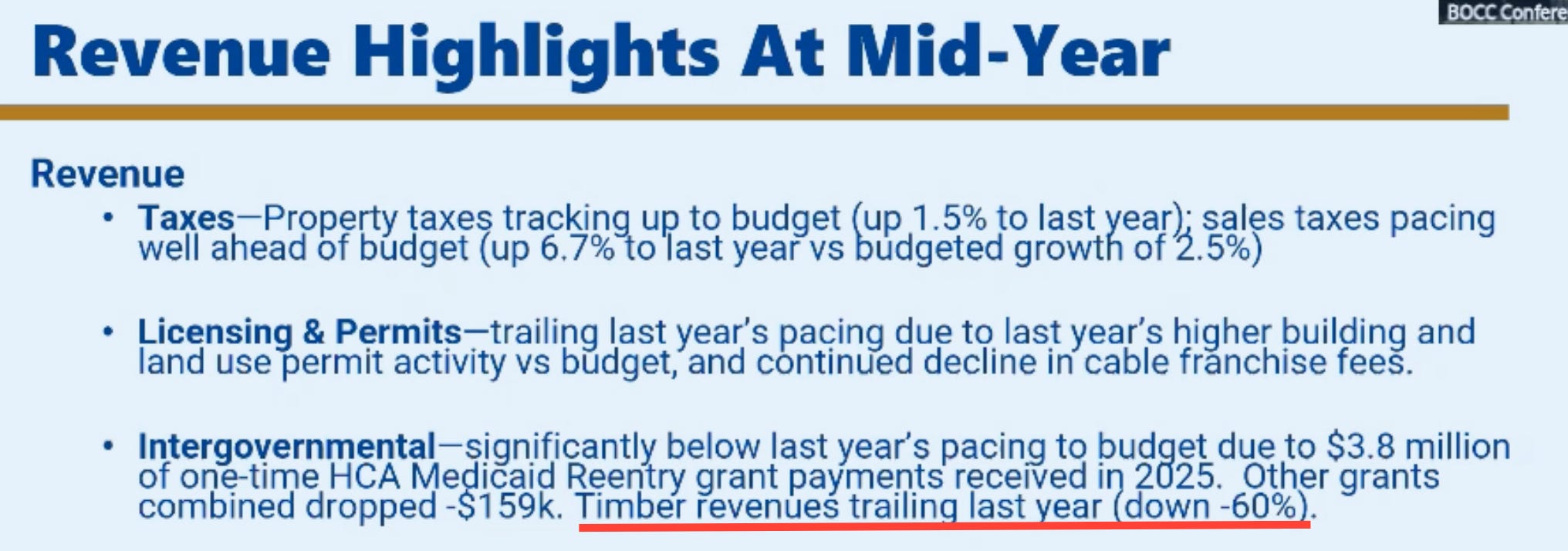
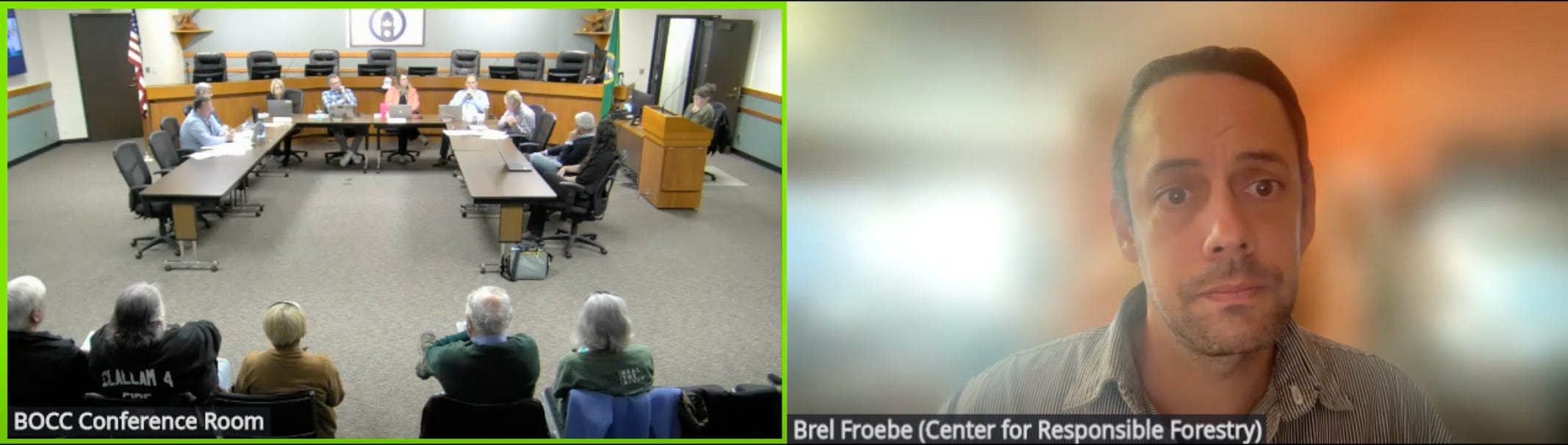
During the presentation, county Chief Financial Officer Mark Lane explained the reason.
“This is largely due to the pauses that have been placed on many timber sales within our area, either due to litigation and/or other policy actions that have been taken.”
That single sentence carries enormous implications.
Revenue from county timber sales doesn’t simply disappear into a general fund. Those dollars help support county government and roads. That money also funds schools, fire districts, libraries, hospitals, and other public services. When those revenues decline, taxpayers eventually make up the difference—either through higher taxes, reduced services, or both.
The Cost of Delay
For years, several environmental organizations have challenged timber sales on county and state lands through litigation, public campaigns, and administrative appeals.
Readers may remember that the Clallam County Board of Commissioners has, on multiple occasions, devoted lengthy meeting time to presentations from activists opposing timber harvests—an opportunity rarely afforded to ordinary taxpayers wishing to address county government in similar depth.
The controversy surrounding the Doc Holliday timber sale is only one example of a broader debate over how public forests should be managed and whether harvesting can coexist with environmental protection.
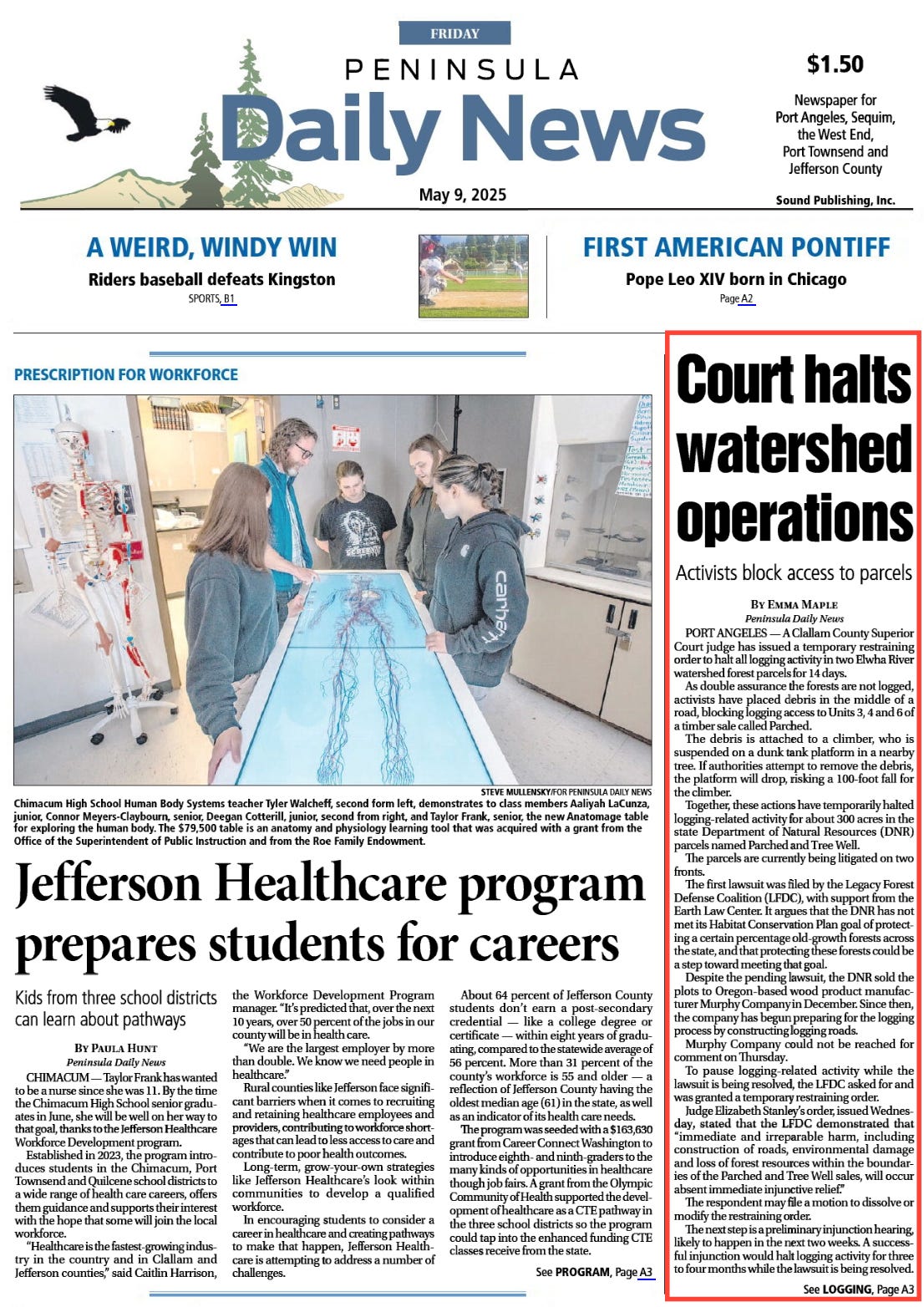
Last year, readers also watched the controversy surrounding an activist who occupied a tree in the Elwha watershed to halt another approved timber project.


The debate extends beyond courtroom filings. In another widely discussed incident, activists documented removing Department of Natural Resources timber sale boundary markers from the approved Doc Holliday timber sale and delivering them to DNR headquarters in Olympia. State officials characterized the removal as vandalism that disrupted an approved timber operation and resulted in significant costs.
Regardless of where one stands on forest policy, the financial consequences of delayed or cancelled timber sales are becoming increasingly visible.
A Former Legislator Examines the Facts
Former Washington State Representative Jim Buck has spent decades working on natural resource policy and rural economic issues.
Recently, he authored a detailed analysis of the Bakers Dozen timber sale, arguing that much of the public discussion surrounding the project omits important facts.
His paper deserves careful consideration.

Buck says that according to the Washington Department of Natural Resources, the Bakers Dozen timber sale encompasses 164 gross acres near Ennis Creek south of Monroe Road.
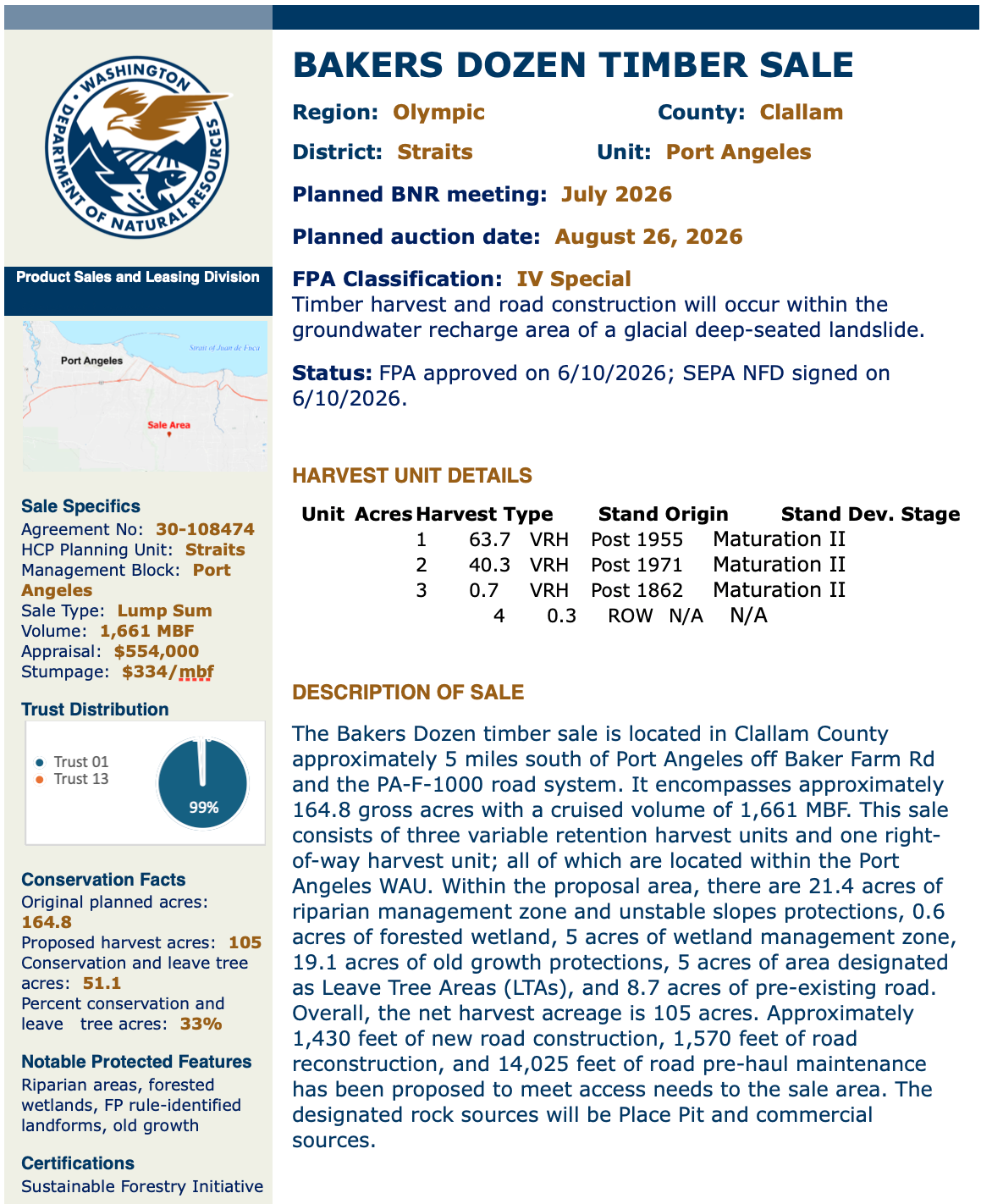
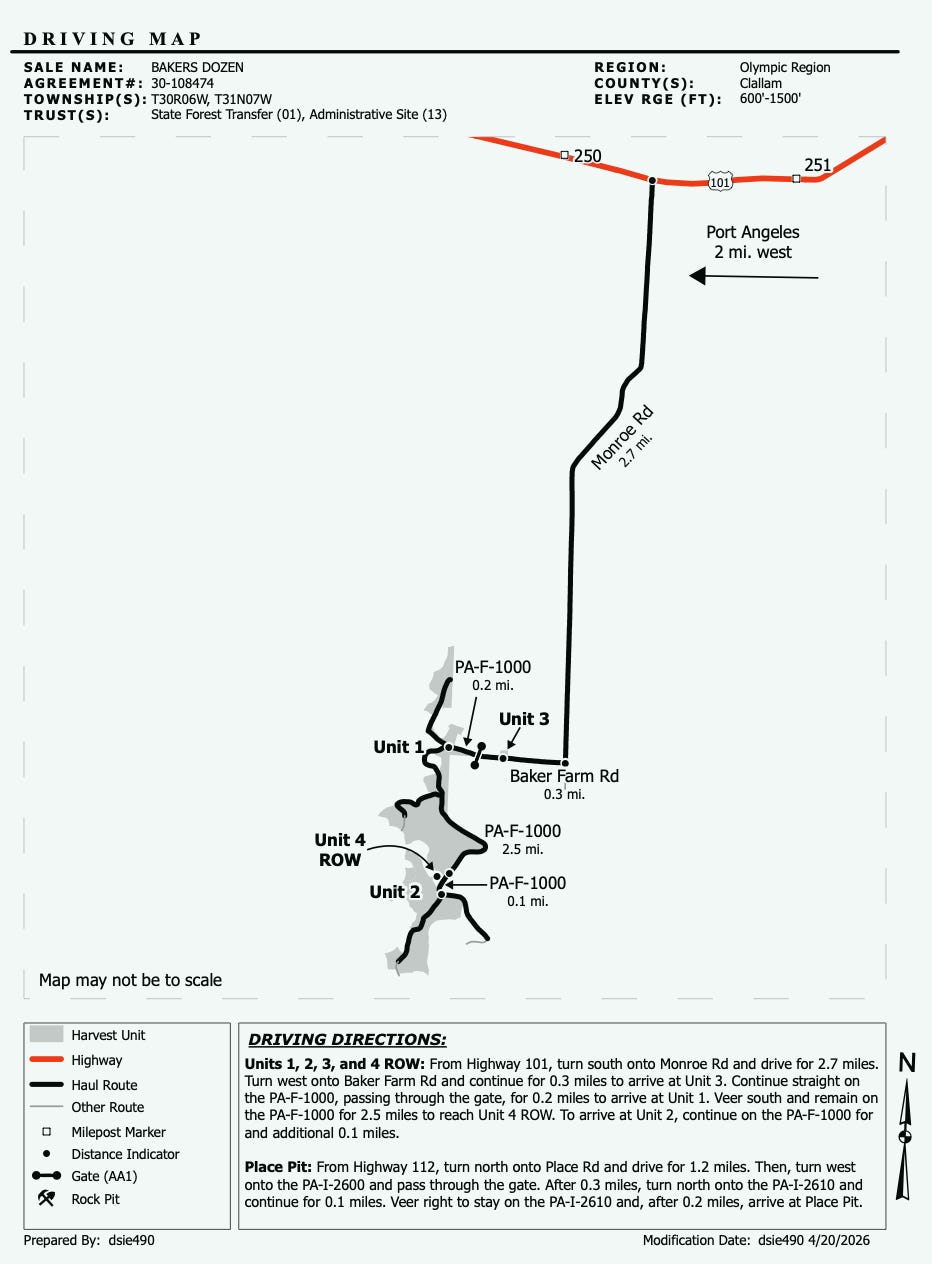
If the sale is cancelled, DNR estimates:
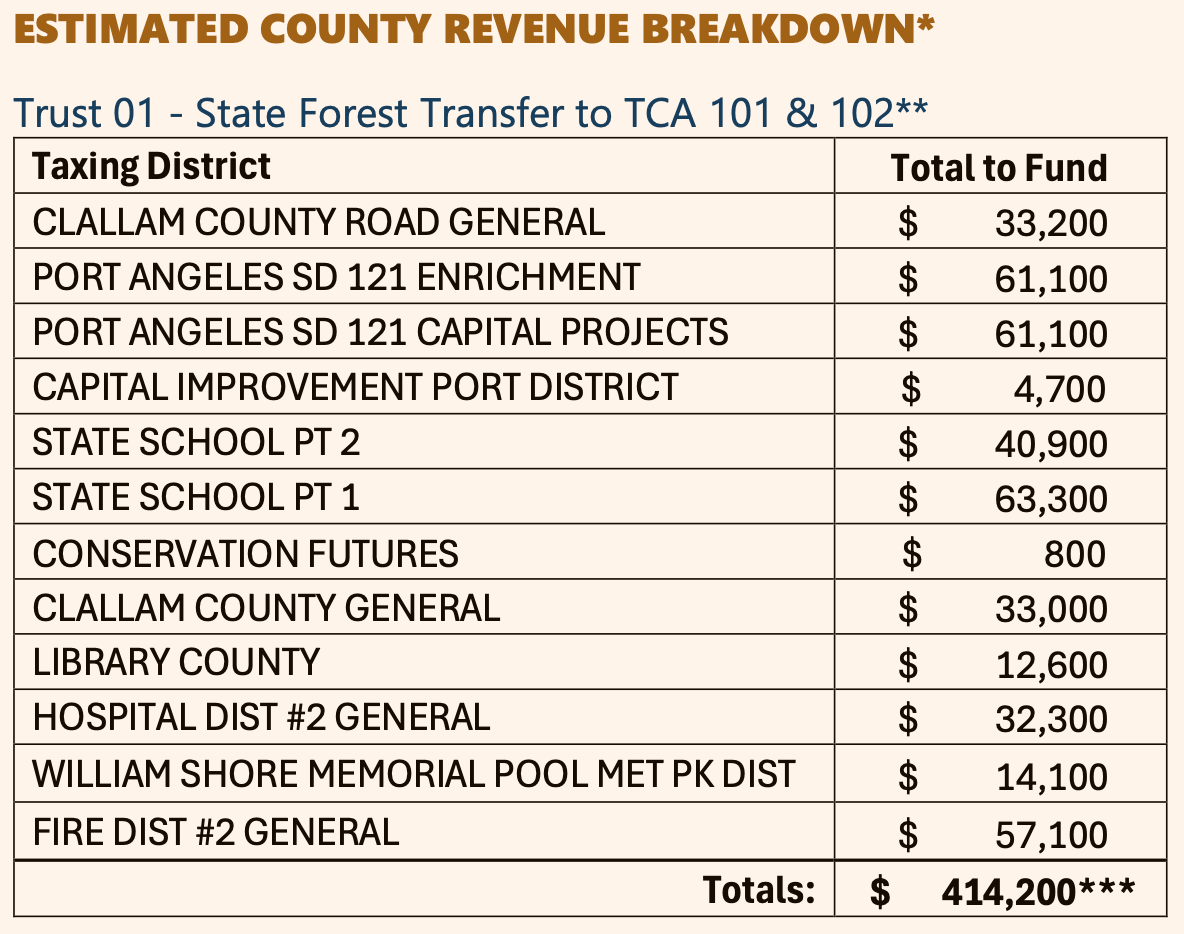
Clallam County taxpayers would lose approximately $751,671 in revenue.
The regional economy would lose an estimated $5.76 million in labor, equipment, transportation, and material spending.
Those numbers alone explain why local governments closely watch timber litigation.
More Than One-Third Is Left Untouched
Buck notes that 51 acres—approximately one-third of the entire sale—will not be harvested.
Those protected areas include:
Riparian stream buffers
Wetland buffers
Steep-slope protections
Old-growth retention
Leave-tree areas
The contract also protects every tree larger than five feet in diameter. According to Buck, preserving these additional large trees alone reduces the harvest’s economic value by more than $1.7 million. In other words, the project already incorporates significant conservation measures before a single tree is cut.
Salmon Protection
One of the primary concerns raised by opponents involves salmon habitat. Buck argues the existing Habitat Conservation Plan addresses those concerns. Standard riparian buffers already require 175 feet of protection on each side of Ennis Creek.
In many locations, additional steep-slope buffers extend protection to more than one-quarter mile. Combined with adjacent unharvested forest, Buck says the project maintains a continuous wildlife corridor from Highway 101 to the headwaters.
He argues there is no documented evidence that harvests conducted under these Habitat Conservation Plan standards harm salmon habitat.
Who Benefits?
According to Buck, revenue generated from the sale supports numerous local public services, including:
Port Angeles School District
Clallam County roads
County government
Fire District No. 2
Olympic Medical Center
Buck’s broader argument is straightforward. The debate should not be framed as “trees versus fish.” Instead, he argues Washington’s Habitat Conservation Plan was specifically designed to achieve both environmental protection and sustainable timber production.
A Bigger Financial Picture
The Bakers Dozen sale represents only a fraction of the county’s overall timber program. The larger concern is cumulative. When multiple sales are delayed or challenged simultaneously, the financial consequences begin appearing in county budgets—as CFO Mark Lane’s 60 percent revenue decline now demonstrates.
For taxpayers, the issue extends beyond forestry. It becomes a question of whether public services should continue receiving revenue from sustainably managed public forests or whether those costs will increasingly shift onto property owners.
Could Managed Forests Also Improve Water Supplies?
Another aspect of forest management receives far less attention: its potential effect on groundwater recharge.
A growing body of research from the arid Southwest suggests that reducing overly dense forests can increase the amount of water that reaches soils and groundwater. A comprehensive review published in Ecological Engineering found that thinning forests in semi-arid regions generally increased groundwater recharge by reducing evapotranspiration—the process by which trees return water to the atmosphere—and by decreasing rainfall intercepted by dense forest canopies.
More recent research in northern Arizona has examined fire-adapted ponderosa pine forests and found that thinning reduced stand-level water use, leaving more water available in the watershed. While the amount of groundwater recharge ultimately depends on factors such as precipitation, soils, and geology, researchers concluded that strategic forest restoration has the potential to improve watershed function while also reducing the risk of catastrophic wildfire.
Much of this work has been conducted by researchers at Northern Arizona University as part of long-term efforts to better understand how forest restoration influences wildfire resilience and water resources.
Of course, Clallam County’s forests are dramatically different from Arizona’s dry ponderosa pine ecosystems. Western Washington receives far more precipitation, supports different tree species, and has different soils, geology, and hydrology. The findings from Arizona should not be assumed to apply directly here.
Even so, they raise an important question for the Sequim-Dungeness region, where water availability and aquifer recharge have been longstanding concerns.
Could strategic forest management provide hydrologic benefits in portions of Clallam County? That question deserves scientific study, field measurements, and careful analysis—not political rhetoric.
The Bottom Line
The county’s own financial presentation confirms timber revenue has fallen dramatically. The causes include litigation and policy decisions that have delayed or paused timber sales. Reasonable people can disagree about where the balance between conservation and timber harvest should be drawn. But taxpayers also deserve to understand the financial tradeoffs.
Every timber sale that is postponed, reduced, or cancelled carries consequences—not only for the forest, but for county budgets, public services, and the property tax bills that eventually arrive in mailboxes across Clallam County.
Today’s Tidbit: League of Women Voters Calls for New Water Task Force
The League of Women Voters of Clallam County is urging the Dungeness River Management Team (DRMT) to create a new Water Resources Task Force for eastern Clallam County, arguing that water supplies face growing pressure from climate change, limited hydrogeologic data, and uncertainty between legal “paper water” rights and actual groundwater availability.
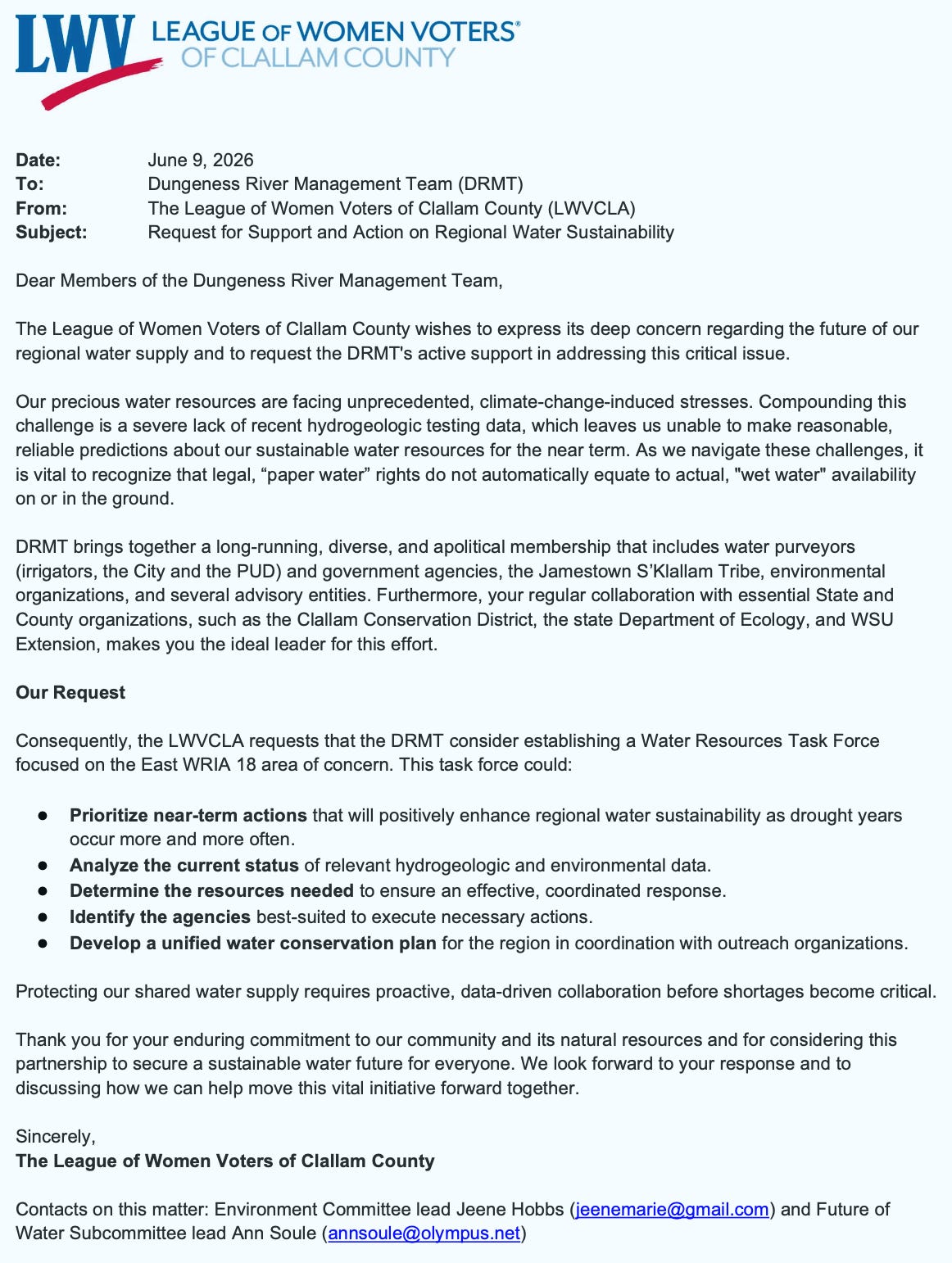
The proposal calls for more regional coordination, updated data review, and a unified conservation plan. The effort aligns with a long-standing LWV priority of creating a county-level “Water Steward” position within county government to oversee water issues.
While water planning is an important discussion, the letter raises questions about whether another task force is the answer. The key question: will a new committee produce measurable results—or simply add another layer of government planning?


