


Americans are free to move wherever they choose—but local policies decide which communities become magnets. Clallam County’s expanding services, open camping tolerance, and taxpayer-funded projects like North View’s 36 units risk drawing homelessness and addiction from far beyond our borders while working families are priced out. County Commissioner Candidate Jake Seegers asks: What kind of community will these policies create for the people who call Clallam County home?
Notice: Commissioners’ Work Session and Meeting canceled this Monday and Tuesday.
The Right to Move
During a recent debate, Mike French and I were asked about the homeless, addicted, and mentally ill being bused to Port Angeles from other communities.
Mike answered,
“This is something that obviously, like, I’ve heard since I’ve been in public office from individuals. People have the right to move around the country; that’s how America works. So, people move around. People come here, people leave here, there’s nothing we can do to stop that.”
On that point, Commissioner French is absolutely correct. Americans are free to move wherever they choose. Government should not decide where someone is allowed to live.
Policy Shapes the Destination
However, the government often influences why people choose one community over another.
Every community attracts certain demographics based on the opportunities, incentives, and quality of life it offers. Some people move for jobs. Others seek warmer weather, lower taxes, better schools, outdoor recreation, or proximity to family. Public policy shapes many of those decisions.
The same principle applies to people struggling with homelessness, addiction, or untreated mental illness. Communities that concentrate abundant services while placing fewer restrictions on public camping, panhandling, and open drug use inevitably become more attractive than communities that do not.
Encounters with the consequences of widespread homelessness and addiction are becoming increasingly common in Clallam County.
Recently, while driving on the Tumwater Truck Route, I noticed a woman slumped over the steering wheel of her vehicle. I stopped to check on her. She was breathing but unresponsive. While I was there, the same State Trooper drove past three times. I tried to flag them down each time, but they never stopped. Concerned for her safety, I called for a welfare check.
A Growing Reputation
During a Homelessness Task Force meeting on December 2nd last year, board members were asked why Clallam residents are not prioritized on the waiting list for local housing. Viola Ware, Director of Housing for Olympic Community Action Programs (OlyCAP), which provides housing and emergency shelter in Clallam and Jefferson counties, offered her perspective:
“If you’re looking at low barrier and permanent supportive housing, the prioritization is the need. A lot of us move to where we think our lives are going to benefit the most…that is a human thing. We seek what’s going to benefit us and our family.”
In other words, people relocate to places where they perceive they'll receive the most support.
In her interview, Chelsea Jones described moving from Missouri to Port Townsend after hearing it was a community where panhandling was allowed and generously rewarded.
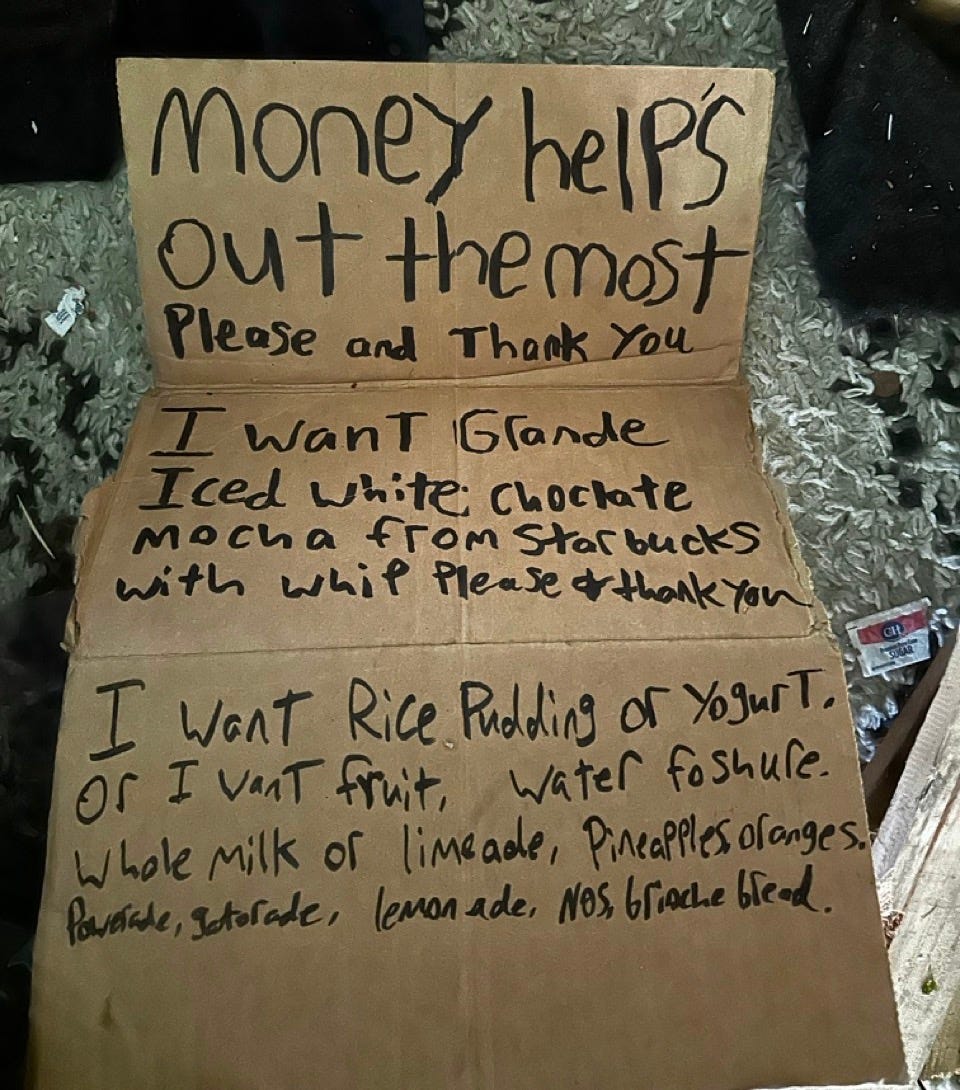
Local policies welcomed her with hassle-free camping in a public forest. Social workers delivered drug use supplies to her tent. According to Jones, those policies made it easier to sustain her addiction rather than overcome it. As she candidly recalled:
“Every dollar I got flying a sign went to drugs.”
Whether every story is identical isn’t the point. Information travels quickly through social networks, outreach organizations, and online communities. People talk. Communities develop reputations.
Clallam County has increasingly developed that reputation with policies that make it a magnet for homelessness and substance abuse.

An Expanding Network of Services
Over the past several years, local government has expanded an extensive network of services for individuals experiencing homelessness and addiction.
Free food is widely available. WSU Extension maintains an up-to-date directory of local food resources here.
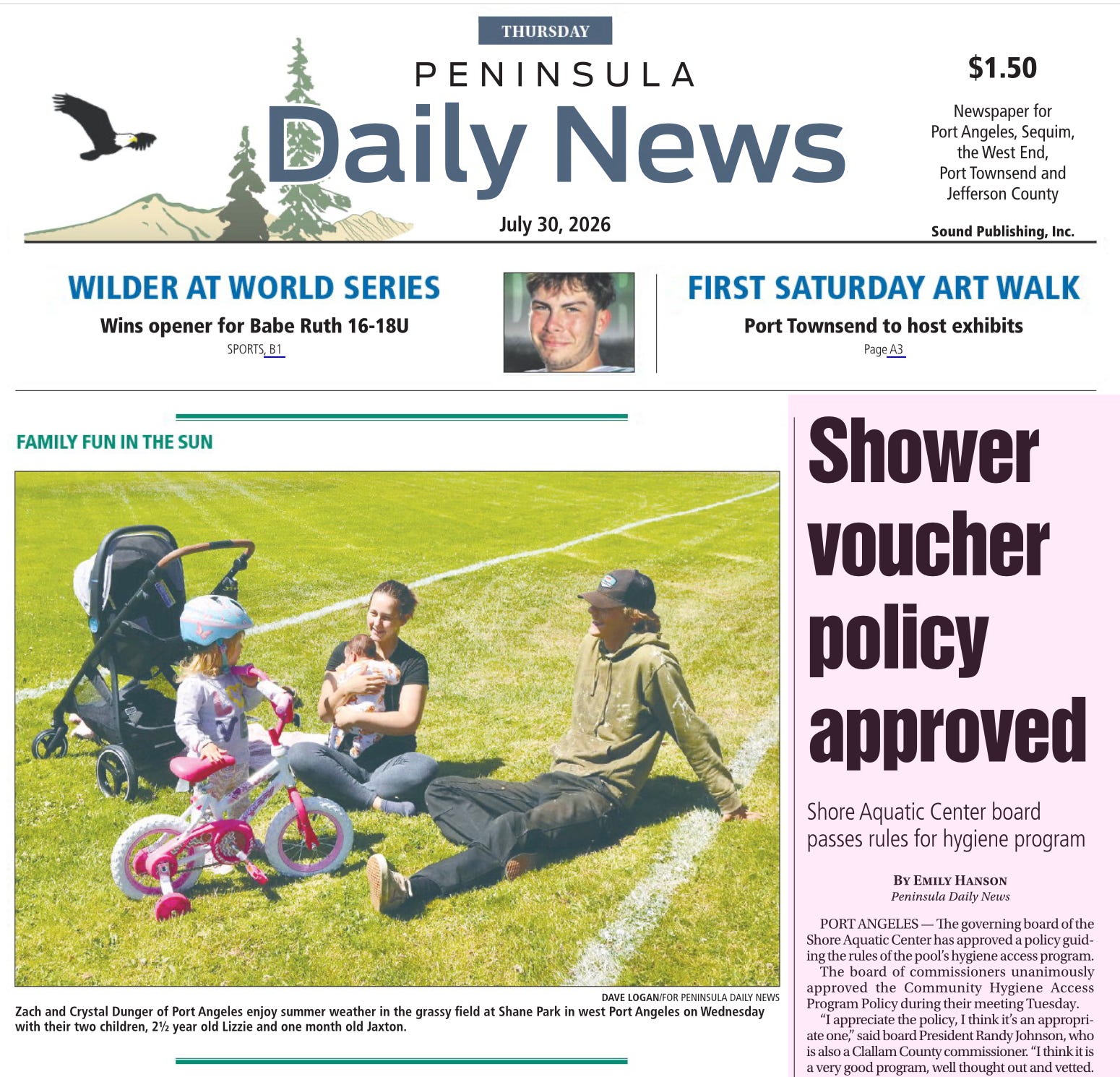
Showers are available at Serenity House, the Salvation Army, The Answer for Youth (TAFY), and now in the same locker rooms used by children and families at the taxpayer-funded William Shore Memorial Pool.
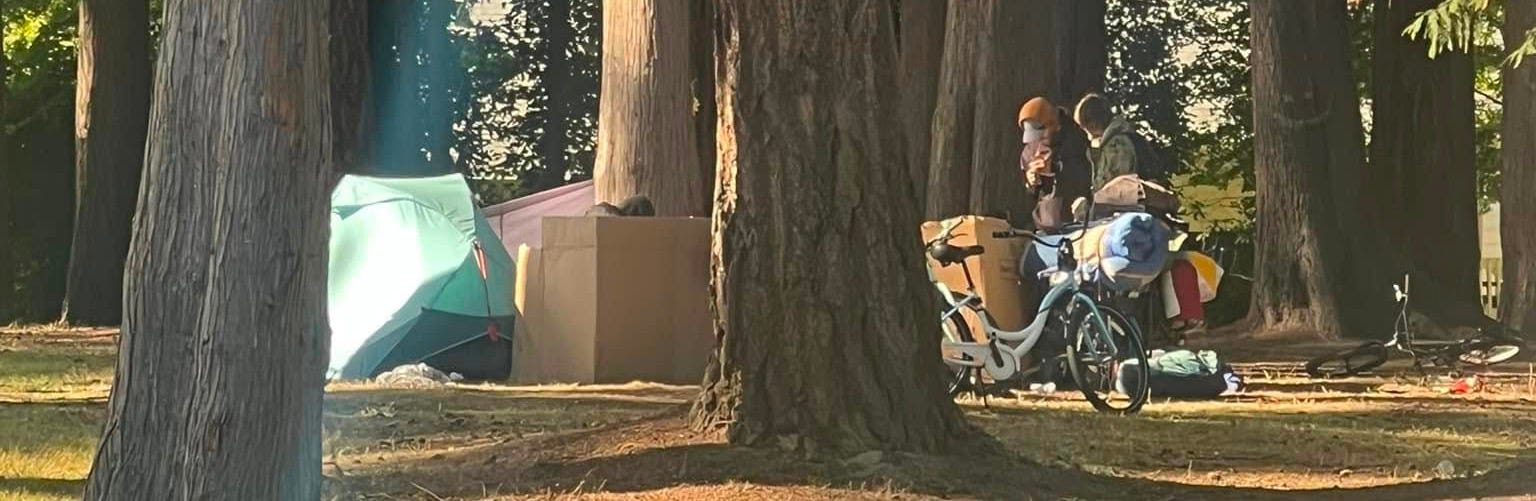
City-owned property has become a largely unregulated option for outdoor camping, substance abuse, and illegal dumping.
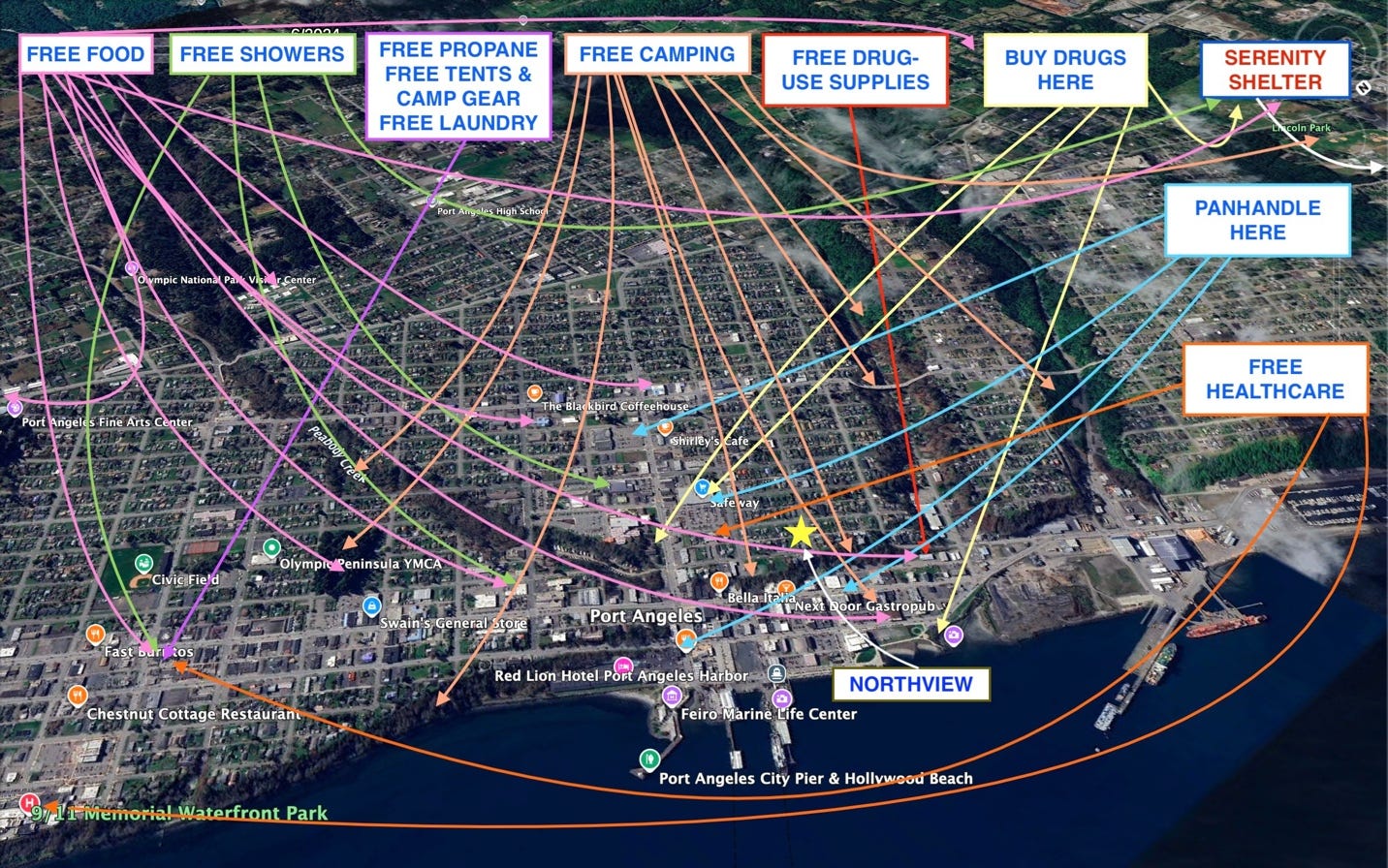
Clallam Transit connects many of these services throughout the county at no cost.
Many neighborhoods have experienced the consequences firsthand, with residents documenting open drug use, drug dealing, illegal camping, illegal dumping, and persistent panhandling in many of the same areas where services are concentrated.
The North View Example
Central to all of these services is Peninsula Behavioral Health’s (PBH) new North View 36-unit apartment complex, which is scheduled to welcome its first occupants in September.
Peninsula Behavioral Health’s new North View Apartments — mostly studio and one-bedroom units with a price tag topping $350,000 per unit — is a project that exemplifies this local policy direction.
My campaign manager and I toured North View earlier this week.
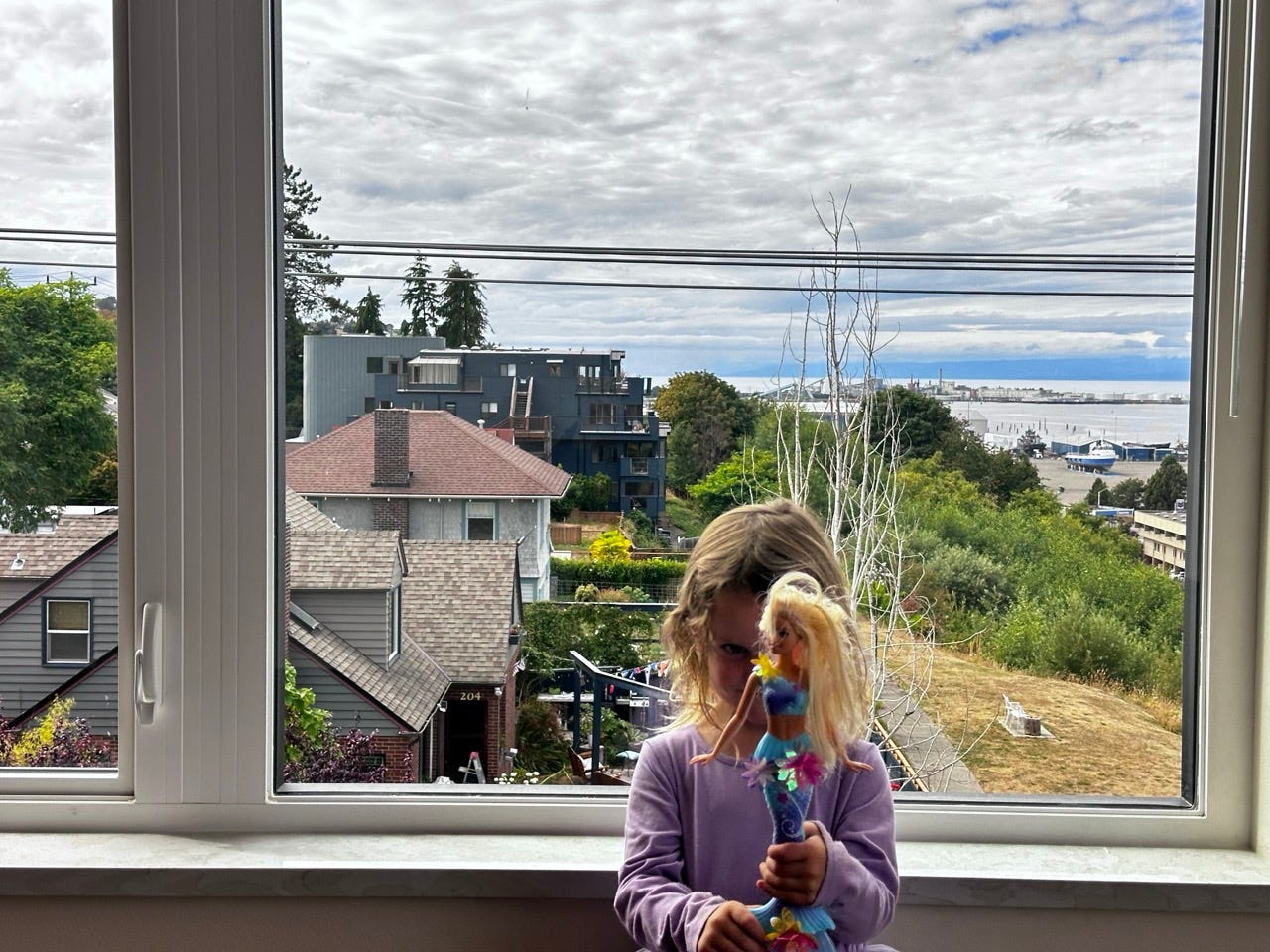
The apartments are beautiful. The quality of construction is exceptional. The setting is quiet, the views are spectacular, and each unit was comfortably air-conditioned despite the summer heat.
My first thought was simple:
“Who wouldn’t want to live here?”


That is precisely why the public policy behind the project deserves discussion.
North View was built primarily with taxpayer funding and government financing. Clallam County alone contributed more than $111,000 per apartment, with additional funding coming from state and federal programs.
Yet, according to staff, occupancy cannot be based on whether someone has lived in Clallam County for decades or arrived last week. Instead, qualified applicants referred by participating service providers enter a lottery.
Local Residents Compete With Outsiders
That reality becomes even more significant when viewed alongside Clallam County’s broader housing data.
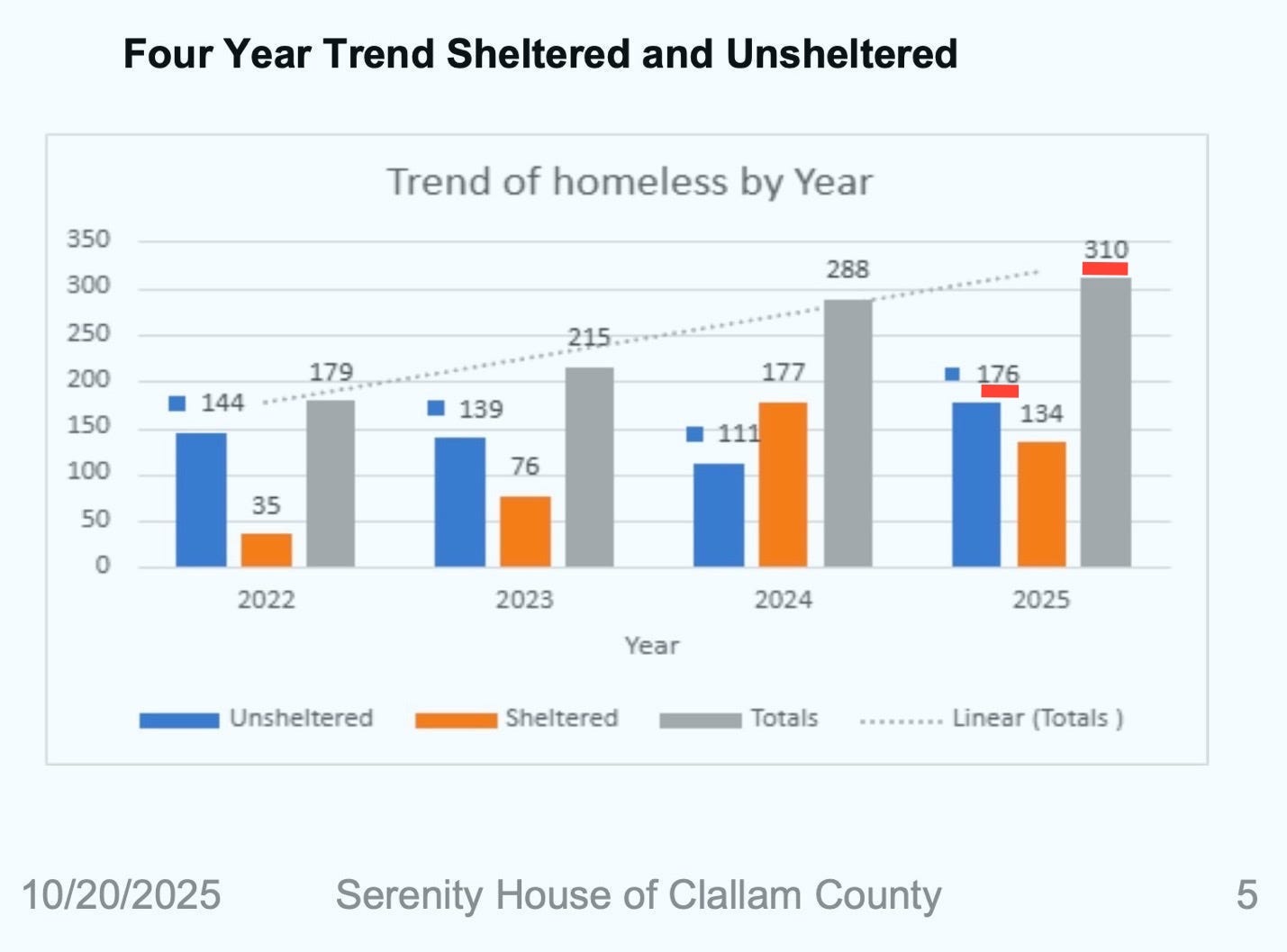
The 2025 Point-in-Time Count identified approximately 310 individuals experiencing homelessness in Clallam County, including 176 who were unsheltered.
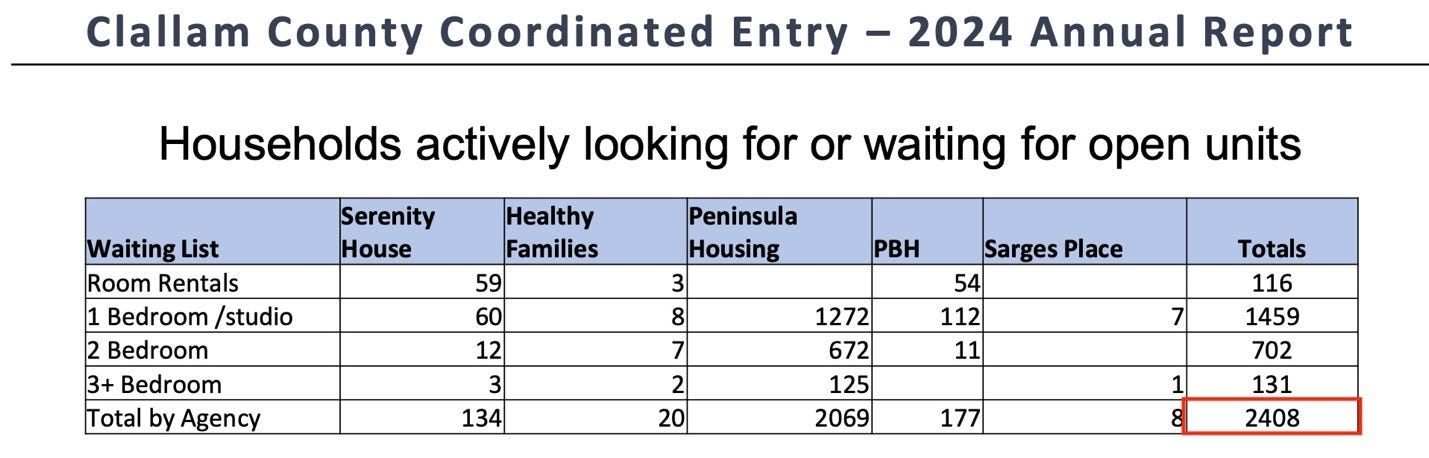
Yet, in 2024, 2,408 households were on the waiting list for housing in Clallam County.
By 2025 — only twelve months later — the waitlist had nearly doubled.
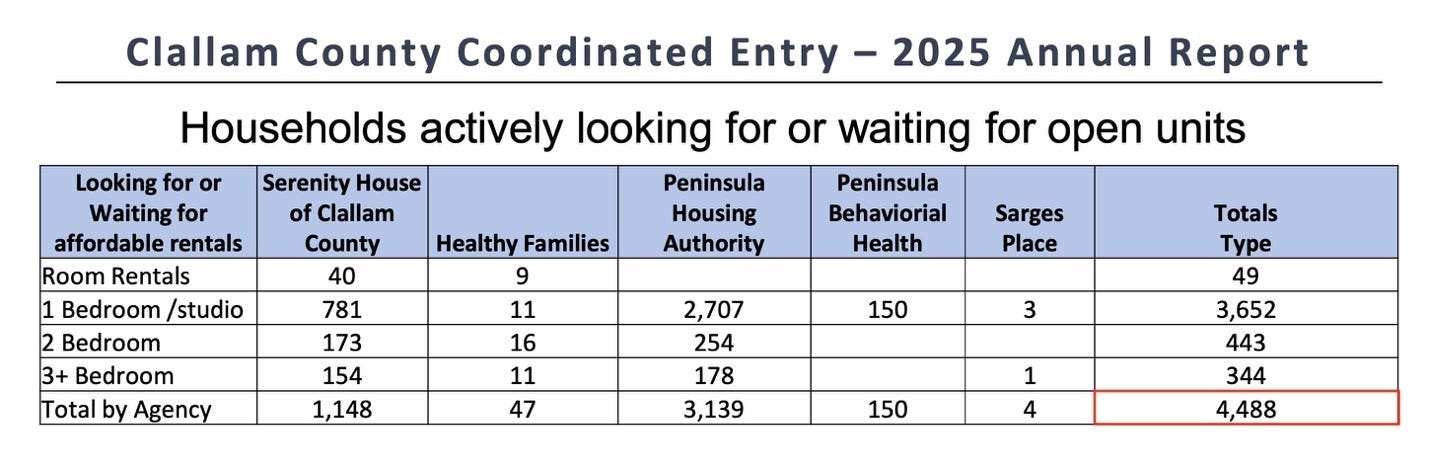
How does a county with roughly 310 homeless individuals end up with nearly 4,500 households waiting for affordable housing?
During a December 2025 Homelessness Task Force meeting, Peninsula Housing Authority Executive Director Debbi Tesch explained why:
“That does not represent just people living in Clallam County. Anybody can apply for our housing. It’s not unusual to have people living in California apply to live here.”
Applicants can apply from anywhere.
When publicly subsidized housing cannot prioritize longtime local residents, thousands of people from outside Clallam County may compete alongside local families for the same limited units.
Federal fair housing requirements and the U.S. Department of Housing and Urban Development (HUD) funding rules often restrict the use of residency preferences. The result – government-funded NGO housing projects are limited in their ability to prioritize local residents.
In other words, government grants, government loans, and state-approved sales taxes often come with strings attached. Those conditions can limit local control and, in practice, seem to attract out-of-county residents to services and housing that many taxpayers believed would primarily benefit local residents.
There is no debating that Clallam County needs more housing across the income spectrum. But we need more housing for the people living in our community. Not housing that will attract individuals experiencing homelessness, addiction, and mental health challenges from out of county.
North View has committed to serving individuals making 60% or less of Area Median Income (AMI) for the next 50 years. For context, HUD set Clallam County’s 2025 AMI for a family of four at $90,400, down nearly 4% from $93,900 in 2024. HUD’s published 60% income limit is $39,840 for a one-person household and $56,880 for a family of four.

During a May 14th 2024 Behavioral Health Advisory Board meeting, PBH CEO Wendy Sisk asked the board for $2 million to help build North View. She claimed that most future residents would be 30% of AMI or lower (33:30). That means the majority of North View’s apartments are intended for individuals earning $19,950 or less per year.
Lessons From Bloomside
What does the foreseeable future look like for North View’s neighbors? In 2024, the Seattle-based behavioral health and housing NGO Downtown Emergency Service Center (DESC) opened Bloomside, a 90-unit permanent supportive housing complex in downtown Burien with on-site wraparound services. As North View’s closest comparable project, Bloomside offers valuable early clues about how this housing model can perform in a similar community setting.

One year later, in a B-Town Blog letter to the editor, Burien resident John L. White asks,
“Have you been by the DESC (Downtown Emergency Service Center) building in Burien lately? What you’ll see are crowds of drug users gathered out front, openly dealing and using drugs in the middle of the day. Where are they getting those drugs? Many are supplied directly by tenants inside the building, just as has happened at other DESC locations in downtown Seattle.”
Mr. White goes on to claim that:
“These individuals are not Burien residents. They are drawn here to buy and sell drugs. To fund their addictions, they are committing crimes throughout our community.”
In its response to local criticism, DESC admits that only one-third of Bloomside tenants are from Burien:
“We also know this work matters to Burien directly: approximately one-third of Bloomside tenants were formerly living unsheltered in Burien.”
The broader policy question is whether Clallam County has thoughtfully considered the long-term consequences of building and expanding a system that attracts applicants from across the nation while local residents and working families continue struggling to afford housing.
Shifting Housing Priorities
This same philosophy extends beyond supportive housing.
In recent years, local governments have adopted zoning changes that encourage greater density, accessory dwelling units (ADUs), and multifamily construction.
Permit fee waivers and other incentives have increasingly favored these housing types, while permit costs, energy code requirements, and construction expenses for traditional single-family homes have continued to climb.
In late 2021, the Port Angeles City Council, including then-Councilmember Mike French, adopted Ordinance 3688, implementing major portions of the City’s 2019 Housing Action Plan. The ordinance substantially revised the zoning code to encourage ADUs, duplexes, townhouses, cottage housing, and multifamily development, reflecting a policy shift toward “missing middle” and higher-density housing over traditional single-family development.
During a recent Port Angeles Business Association Debate, Commissioner French claimed:
“Eight years later you can walk around Port Angeles and see the results of those reforms. You can see duplexes being constructed…you can see ADU’s thickening up neighborhoods naturally. And, if you go down to Oak Street, you can see a 36-unit apartment [North View] being constructed opening later this year.”
But, the result of these reforms has not been an acceleration in overall homebuilding, but rather a shift in the type of housing being built.
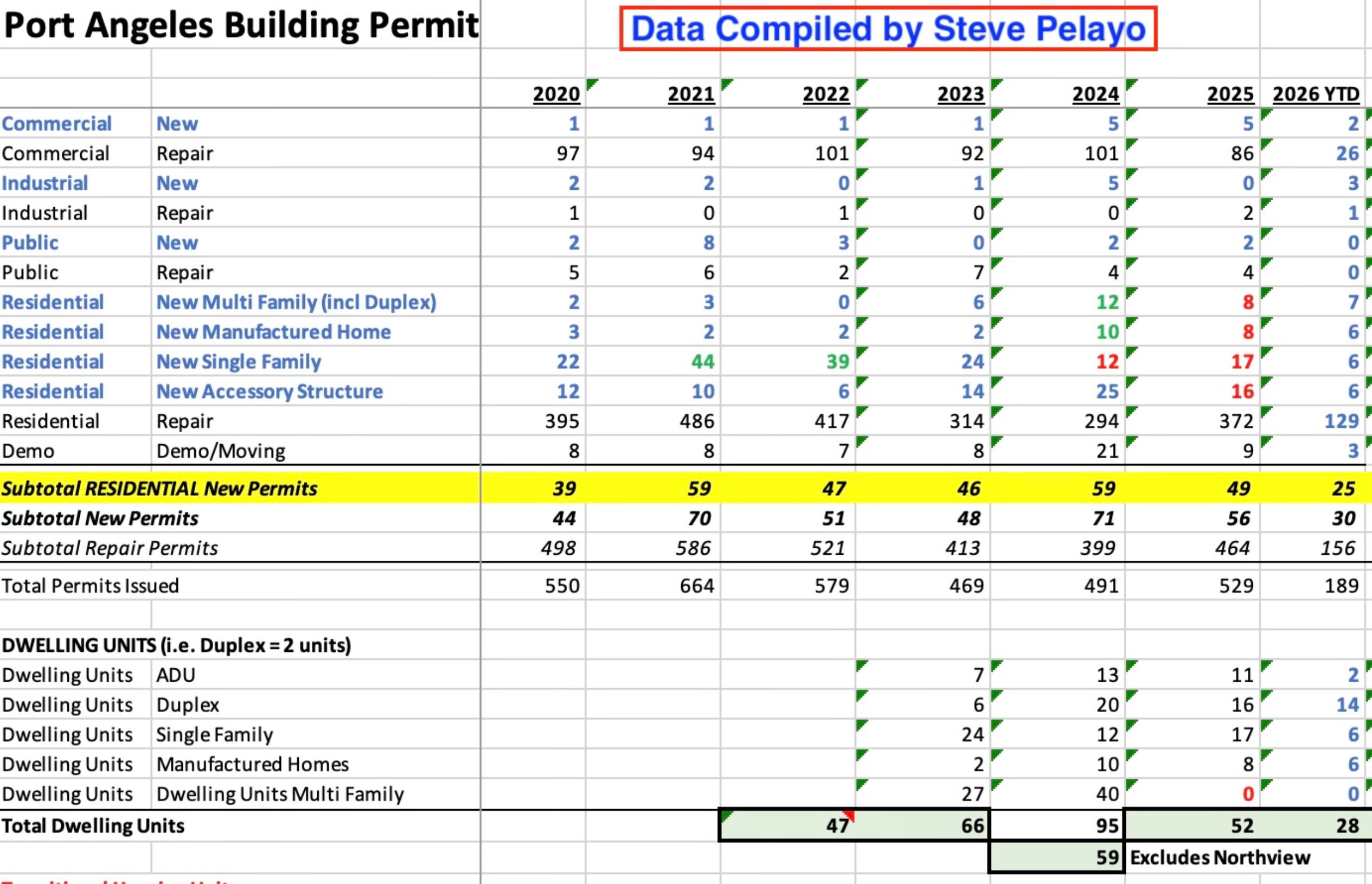
Excluding North View’s 36 units — supported by nearly $5 million from Clallam County and the City of Port Angeles, including a $100,000 permit fee waiver — the City’s total annual housing permits fluctuated between just 47 and 66 units from 2022 through 2025.
Meanwhile, despite the 2019 Housing Action Plan recognizing a substantial need for additional single-family homes, annual single-family permits declined from 39 in 2022 to just 17 in 2025.
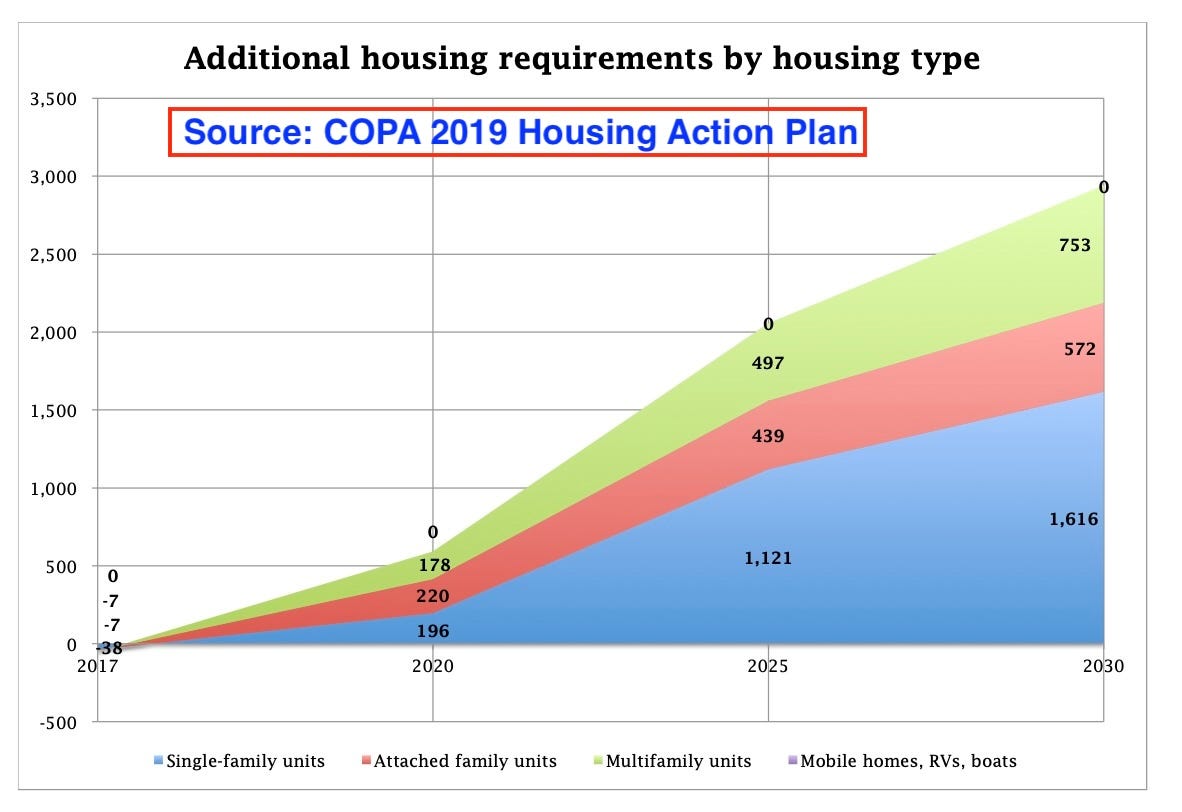
It has changed the type of housing being built and, ultimately, the demographics those policies encourage.
Young families — the demographic crucial to economic growth — are leaving Clallam County, often citing affordability and public safety concerns.
Yet, Clallam County and the City of Port Angeles continue to prioritize projects like North View at the cost of the single-family housing necessary to attract workers in the 80-120% of AMI categories.
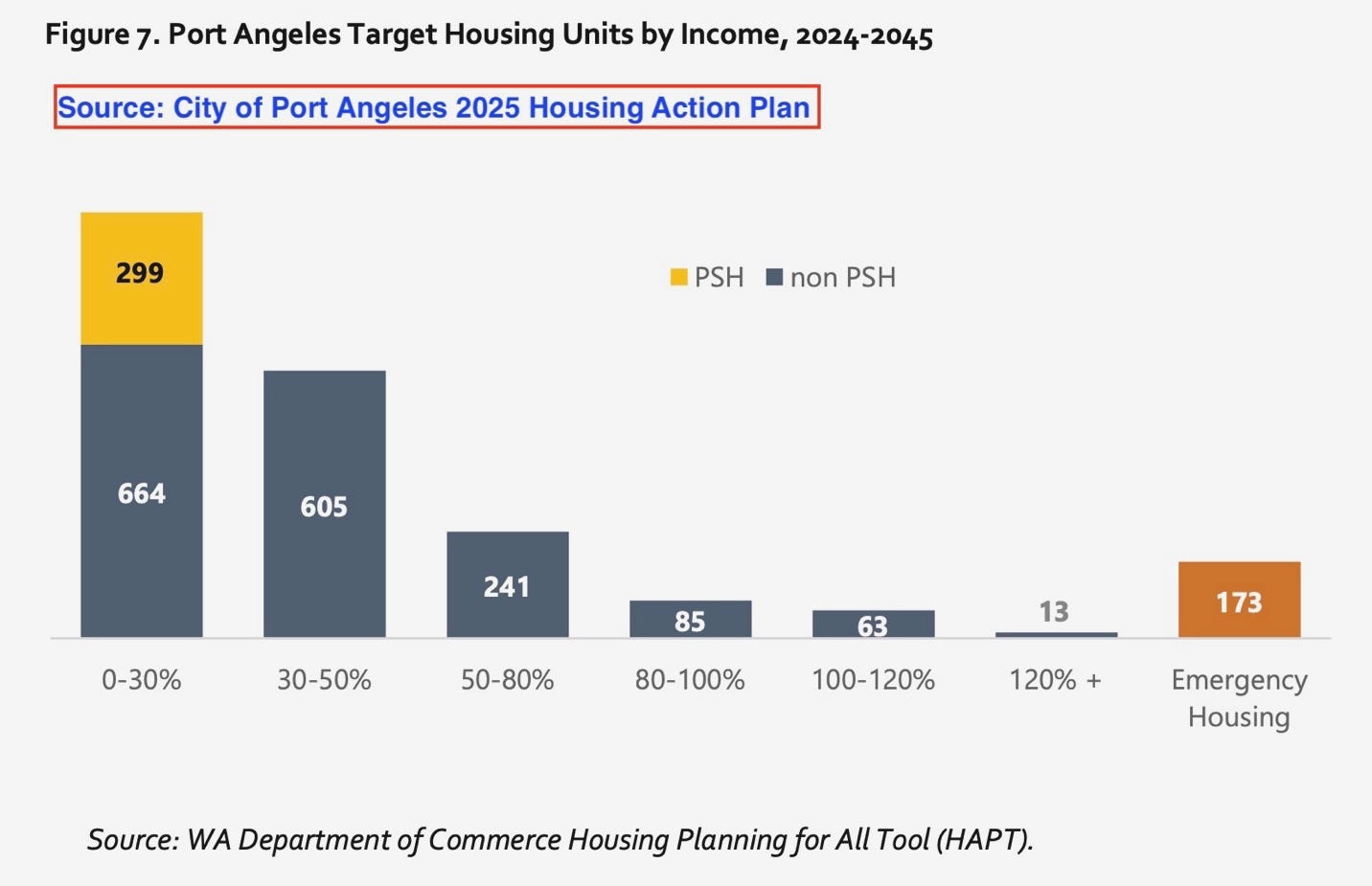
In fact, the City projects that only 13 new homes will be needed to serve households earning up to 120% of Area Median Income (AMI) by 2045. Instead, its focus is almost entirely on housing below 80% of AMI, including 954 units for households earning 0–30% of AMI.
The Economic Cost
This emphasis reflects a broader policy direction, as evidenced by Clallam County’s employment trends. According to the Bureau of Labor Statistics, total employment declined by approximately 400 jobs from 2022 to 2025.
Although nonfarm payrolls increased by 564 jobs during the same period, that growth was driven primarily by government and nonprofit employment, while private-sector jobs in construction, timber, and manufacturing shrank substantially.
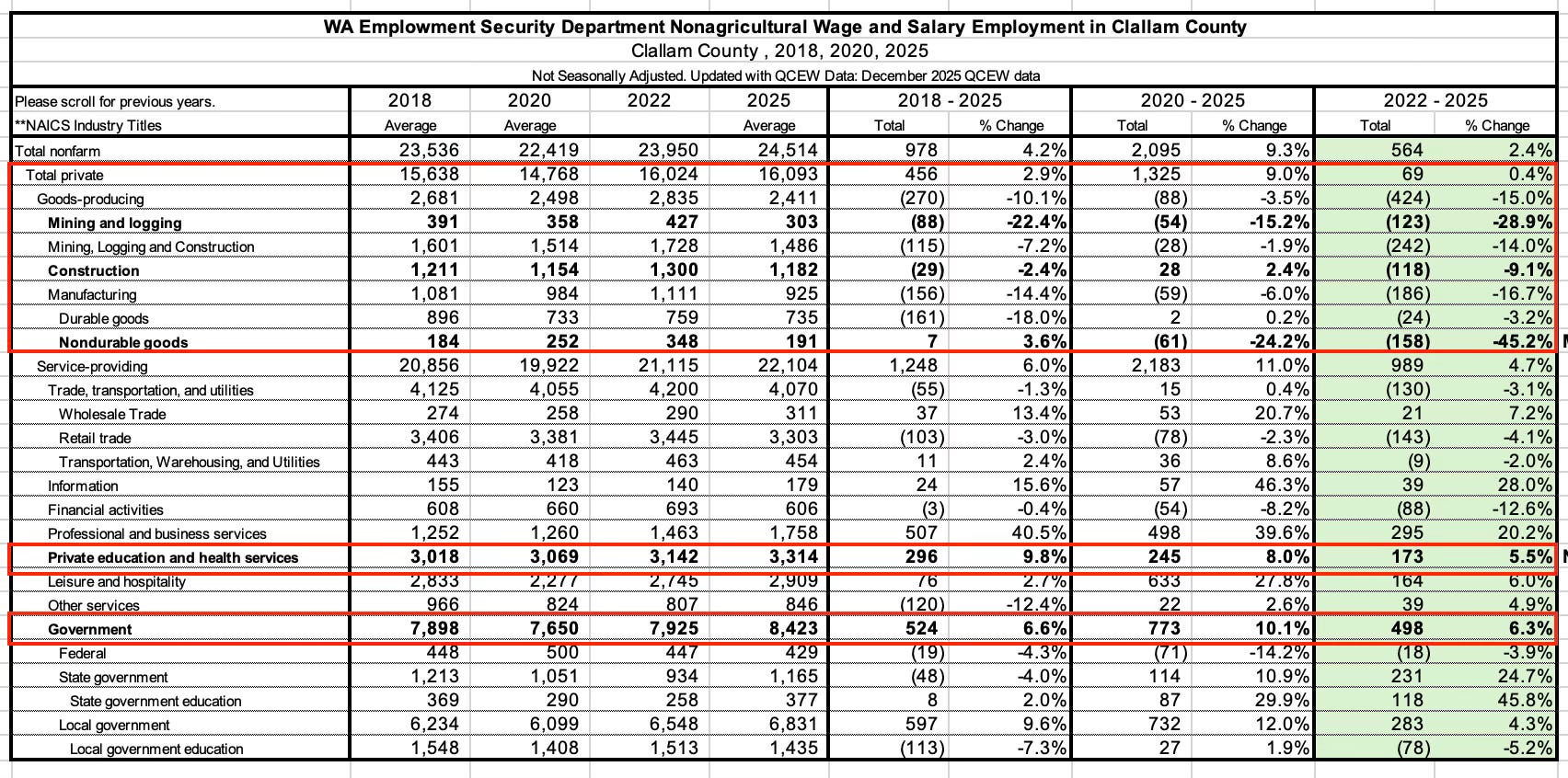
Our community has increasingly invested in programs, grants, housing models, and incentives that primarily serve very-low-income households while making it more difficult and expensive for young working families to build or purchase homes here.
Meanwhile, Clallam County’s natural beauty continues attracting households from more expensive metropolitan areas, placing additional upward pressure on single-family housing prices.
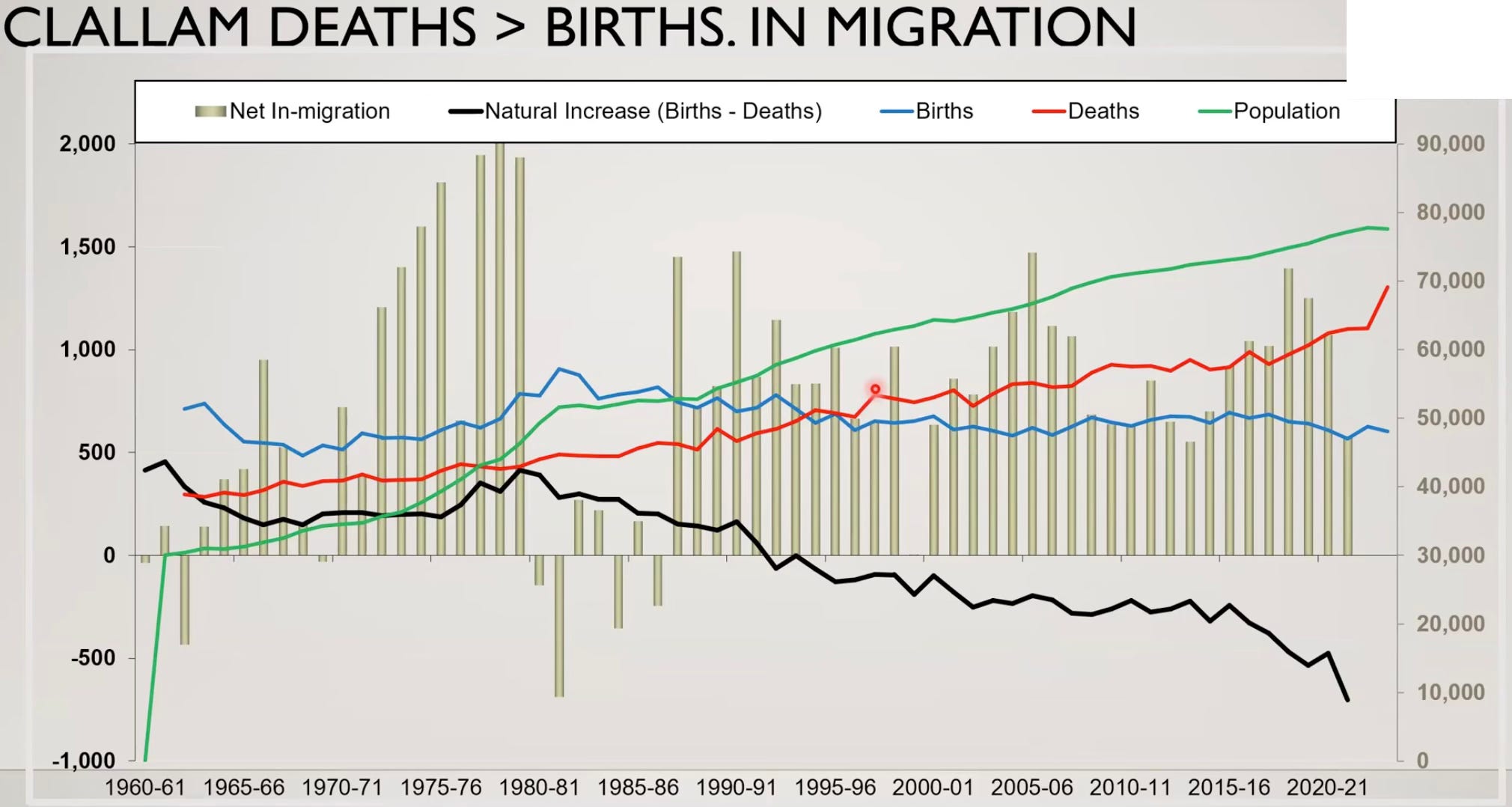
The result is a widening gap. Middle-income working families increasingly find themselves priced out from both directions.
Choosing the Future
Mike French was right about one thing:
We cannot decide who moves to Clallam County. But we absolutely can decide what kind of community our policies encourage.
Every budget, every zoning decision, every grant application, every permit fee, and every enforcement decision sends a message about the future we are building.
Clallam County should continue helping people in crisis. But we should measure success by recovery, independence, safer neighborhoods, and stronger families for those residing here — not simply by the number of programs we fund that serve indiscriminately across geographies.
My priority is to build a county where young families can afford to stay, businesses are confident investing, neighborhoods are safe, and public resources first strengthen the people who already call Clallam County home.
We cannot choose who comes here.
But we can choose the policies that shape the future of the place we all love and call home.
What Can You Do?
In April, John DeBoer—a formerly homeless resident who serves on Clallam County’s Homelessness Task Force and has managed shelters—spoke bluntly at a public safety town hall:
“We’ve reached the point where the money is doing more harm than good… Homelessness became big business… it became a racket.”
More grants, more NGO funding, more taxes, and more government have not fixed homelessness in Clallam County. They have expanded a system that prioritizes bureaucracy over results.
It’s time to demand better. Write the commissioners today and tell them clearly:
Stop chasing grants and funding streams that perpetuate the problem.
Reject the “more money = more success” approach that has failed.
Prioritize only those programs and spending that deliver measurable outcomes for Clallam residents—real reductions in homelessness, safer streets, and accountable use of taxpayer dollars.
All three commissioners can be reached by emailing the Clerk of the Board at loni.gores@clallamcountywa.gov. One short email from you can help shift the conversation from more of the same to results that actually matter.
Editor’s note: This blog is published by Jeff Tozzer, the former campaign manager for Jake Seegers. None of the content here has ever been paid for by Jake Seegers for Commissioner. To learn more about Jake Seegers, visit JakeSeegers.com.


