


From a proposal to rename the Clallam County Courthouse after a state Supreme Court justice, to questions about taxpayer-funded nonprofits sponsoring festivals, to citizens discovering they were accidentally cut out of a major county planning process, this week’s roundup highlights the many ways local decisions—large and small—affect everyday residents.
In the podcast: Public comment highlights from last week's Port Angeles City Council meeting.
Courthouse Renaming Proposal Sparks Questions
Tomorrow, the Clallam County Commissioners will hold a public hearing to consider how to memorialize Washington State Supreme Court Justice Susan Owens.
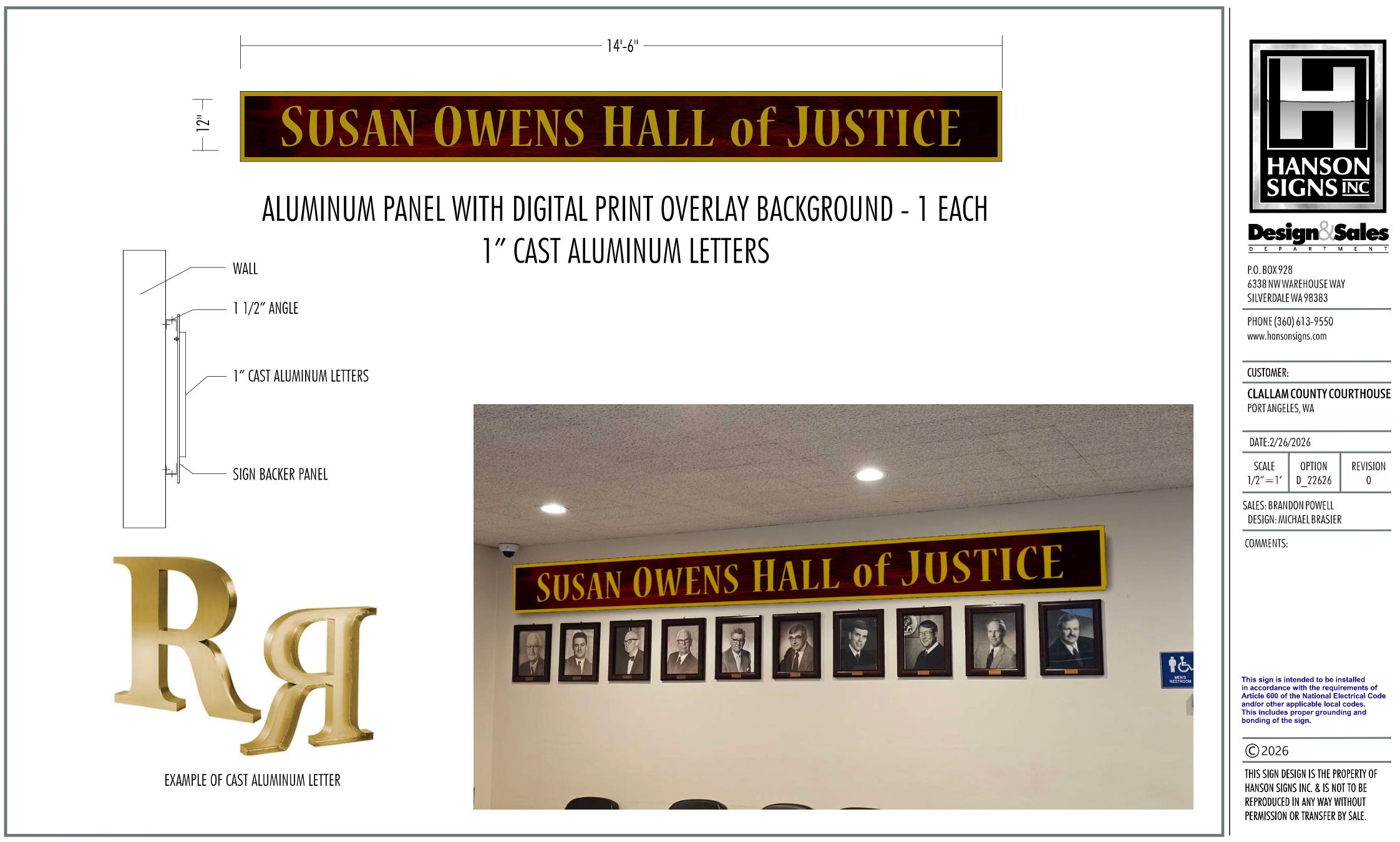
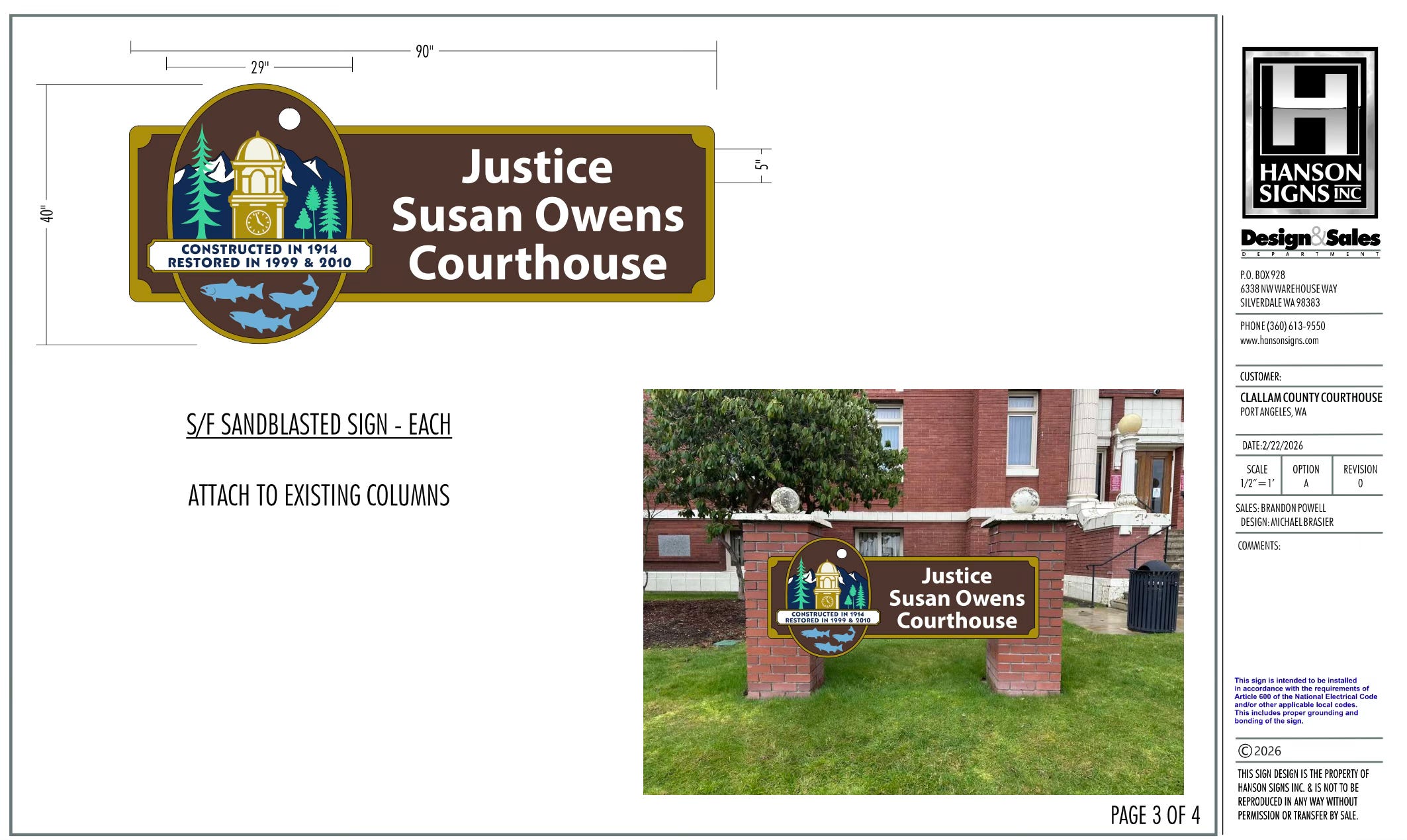
According to public records obtained by engaged citizen Denise Lapio, options currently under consideration include creating a “Hall of Justice” on the courthouse’s second floor, or renaming the historic Clallam County Courthouse itself. The county has been consulting with a signmaker from Silverdale, and potential costs could reach $50,000.
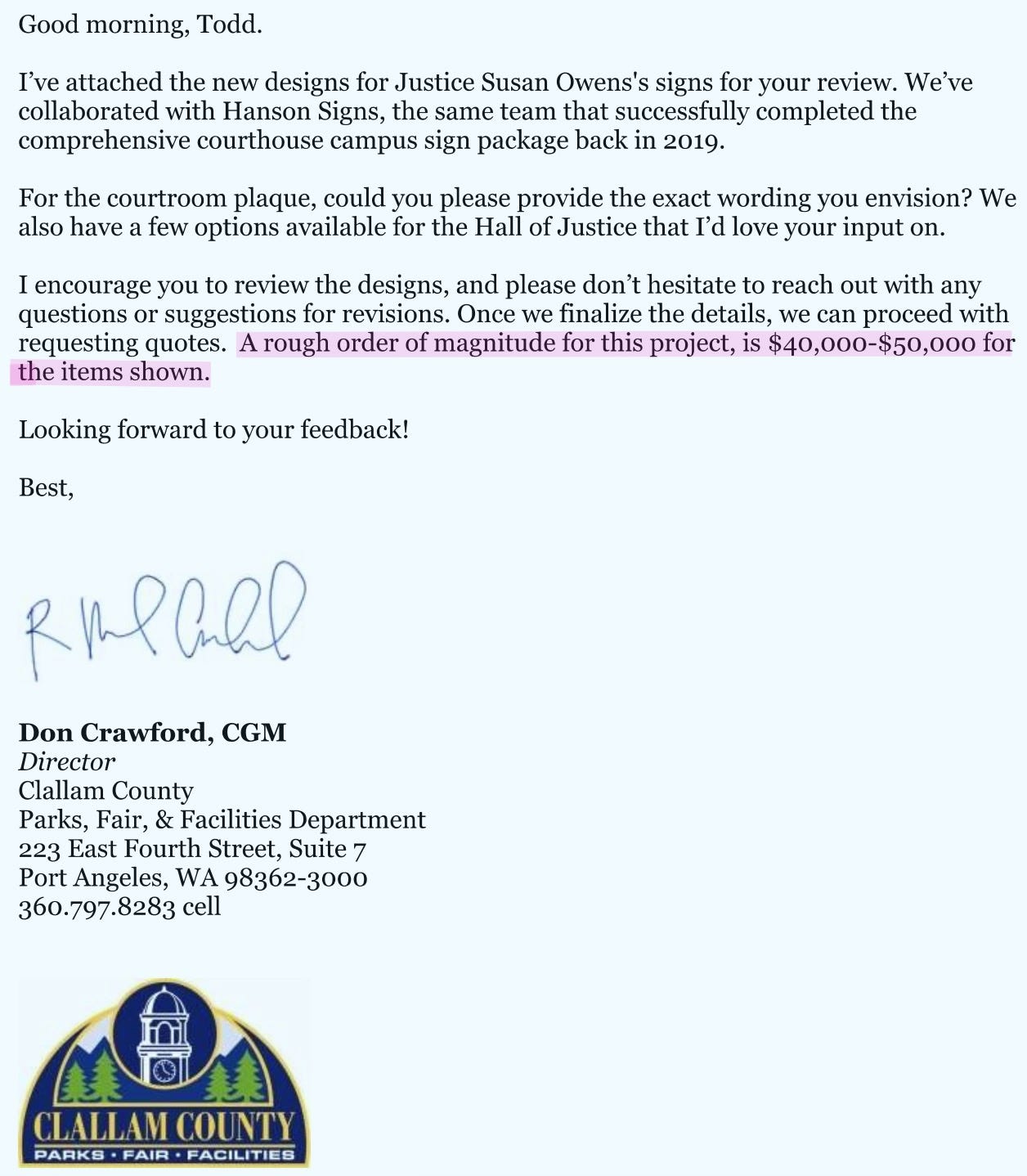
Among the possibilities discussed:
Naming a “Hall of Justice” after Owens on the courthouse’s second floor.
Renaming the historic courthouse building.

Renaming the entire courthouse complex, which Commissioners Mike French and Mark Ozias indicated last month, is their preferred option.
Supporters, including attorney Natelie Columbus, have been actively lobbying commissioners. In one message circulating among advocates, Columbus asked: “When will you be sending us copies of the emails, letters or other contact pushing back on renaming the courthouse?”
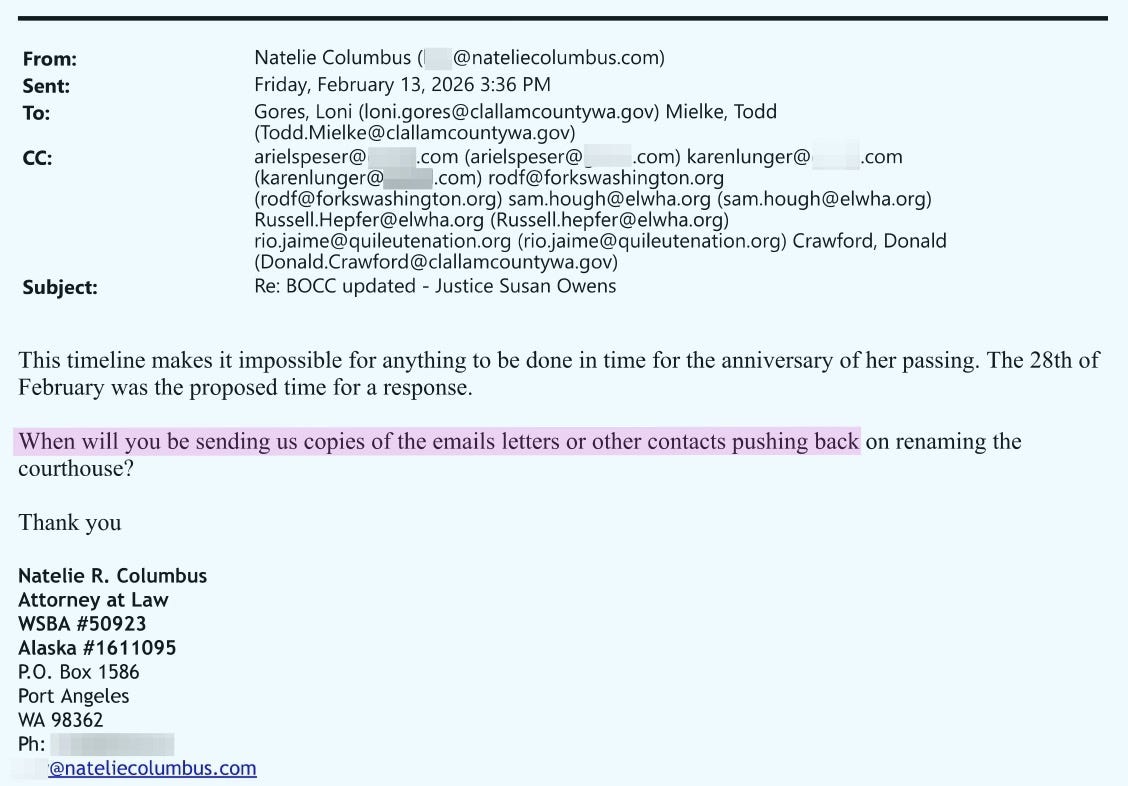
Why do proponents who are pushing for renaming the courthouse need a list of contacts for those who are against it? For some residents, the exchange reinforces a familiar concern in Clallam County—that advocacy and discussions are happening behind the scenes before public input.
Owens served as a judge in District II Court in Forks before being appointed to the Washington State Supreme Court. However, some District II staff have questioned the courthouse proposal, noting that Owens never served in the Port Angeles courthouse and that a memorial is already being prepared in Forks.
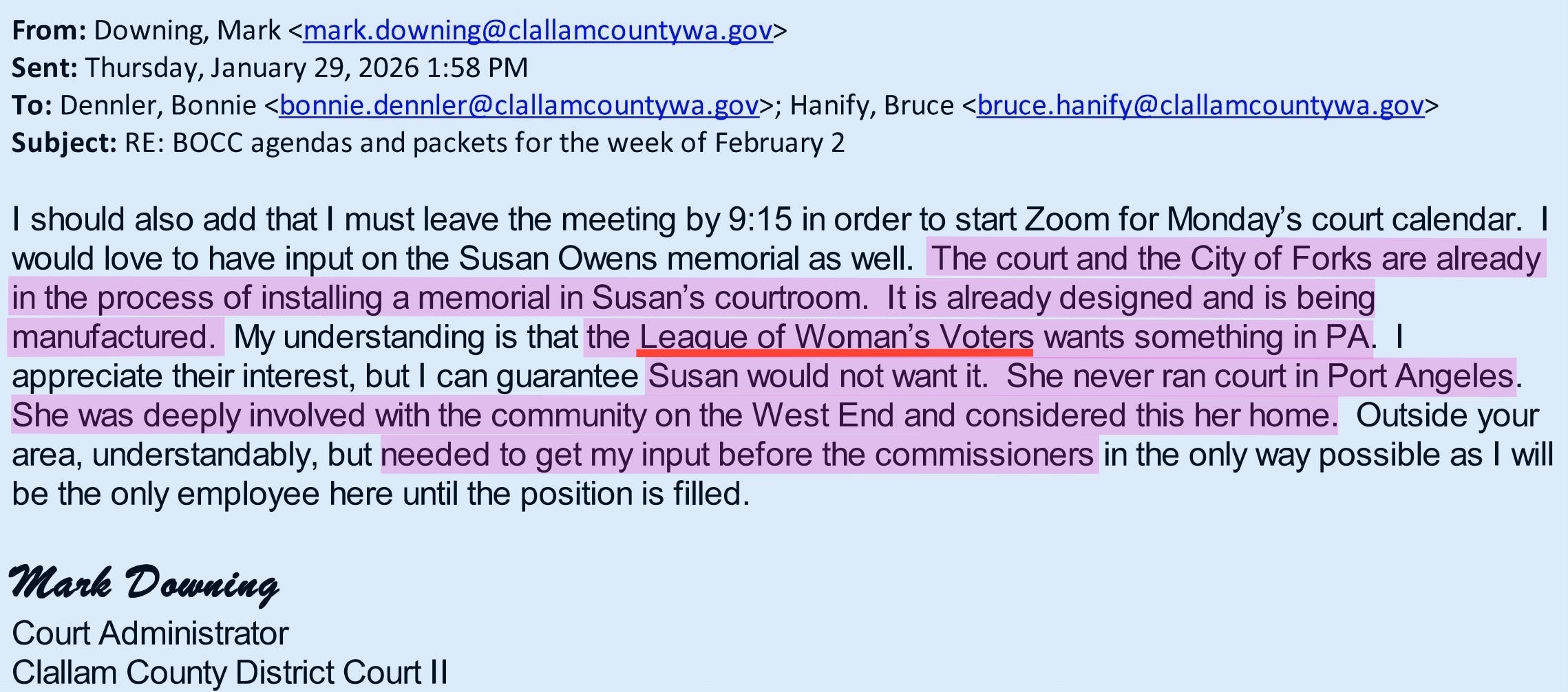
Adding another layer to the conversation, retired Clallam County Judge Lauren Erickson, the first female Clallam County Superior Court judge, passed away last month. Erickson served locally and worked inside the courthouse for many years.
That has led some residents to ask a broader question: if public buildings begin being renamed for individuals, where does it end?
The commissioners will hear public testimony at 10:30 a.m. tomorrow (Tuesday) before deciding how—or whether—to memorialize Justice Owens. Supporters and skeptics alike agree on one point: decisions about renaming public buildings deserve strong public input.
You can contact all three county commissioners by emailing the Clerk of the Board at loni.gores@clallamcountywa.gov.
Forks Community Hospital Responds Quickly to Cleanup Concerns
CC Watchdog recently published photos showing property owned by Forks Community Hospital littered with garbage and drug paraphernalia.
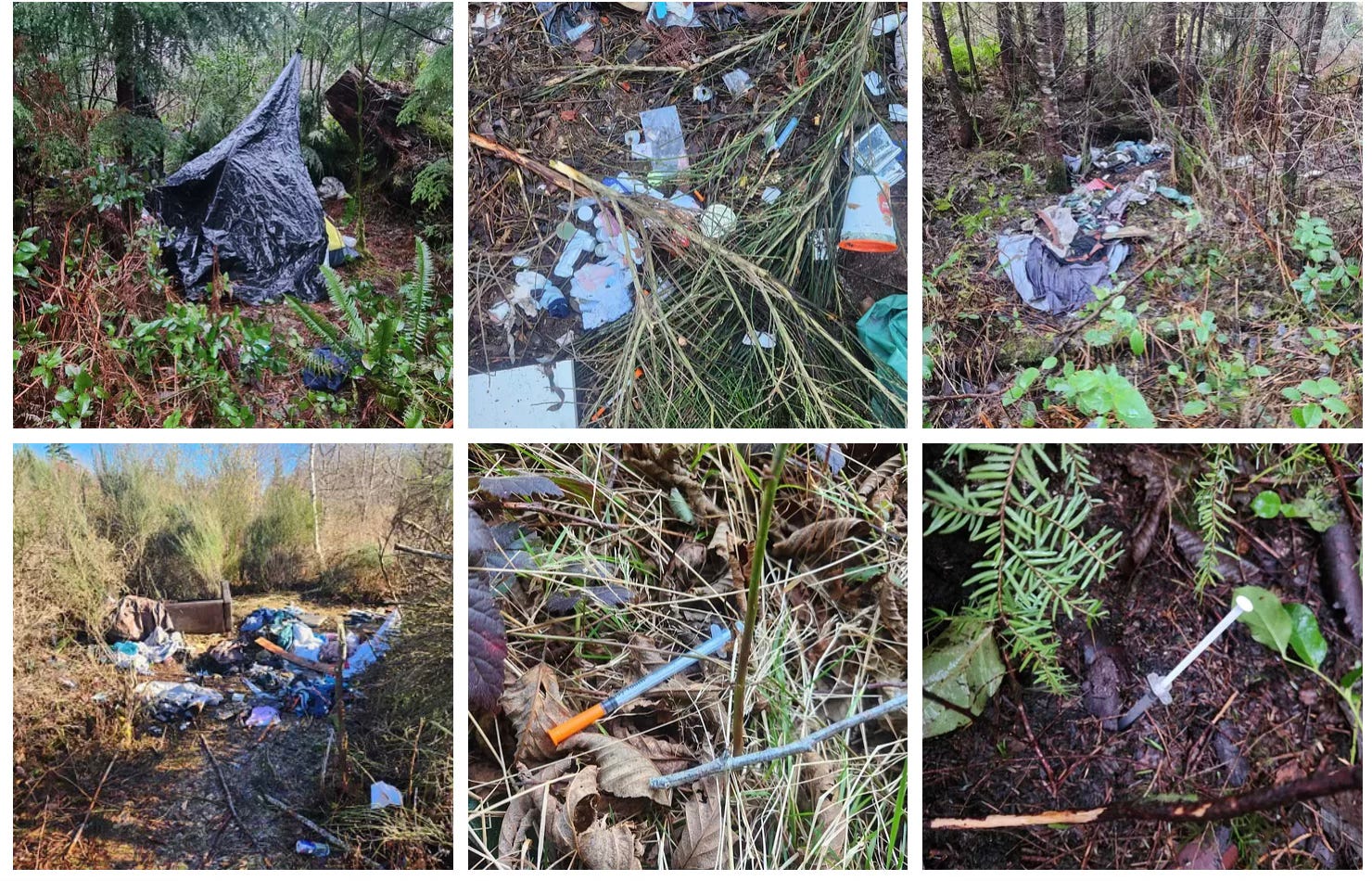
Hospital CEO Heidi Anderson responded quickly with an update explaining the district’s actions.
Once this was brought to our attention, I immediately directed our Facilities team to clean up the areas they found. This action was not taken lightly. I do appreciate the community members who shared their concerns with the district’s property and their willingness to help in clean-up efforts. Unfortunately, due to the liability risk we are unable to allow non district staff in these efforts.
As a public hospital district, our primary responsibility is to ensure safe, accessible care for our patients, visitors, staff, and emergency services. Recently, we conducted a clean-up of district-owned property where unauthorized encampments had been established.
We recognize that homelessness is a complex social issue that impacts individuals in deeply personal ways. However, we must balance compassion with our obligation to maintain patient safety, regulatory compliance, and uninterrupted healthcare operations.
Our organization remains committed to being a partner in addressing community health challenges, including housing insecurity. At the same time, we must ensure that hospital property remains dedicated to its intended purpose: delivering safe, high-quality care to the community.
We appreciate the public’s understanding as we continue working to balance compassion, safety, and stewardship of public assets.
In an era when many public agencies are slow to respond, the hospital’s swift action—and willingness to communicate openly—deserves recognition.
Sometimes the system works exactly the way it should.


When Taxpayer-Funded Nonprofits Sponsor Festivals
Sequim’s Sunshine Festival wrapped up this weekend, bringing crowds, music, and community celebrations to town.

One sponsor stood out: Peninsula Behavioral Health, which contributed $5,000 to support the event.

That raised eyebrows among some residents.
PBH frequently warns about federal funding cuts, solicits donations for critical services, and receives millions in taxpayer funding through county contracts. Yet it also has the financial flexibility to sponsor festivals and receive public praise for its generosity.
Critics argue the money isn’t truly PBH’s to give—it originates largely from public funding.
When asked why the organization participates in sponsorships like this, PBH explained that mental health includes being active and outdoors, and community events support wellbeing.
That may be true. But the episode also illustrates a broader question about nonprofit organizations heavily funded by taxpayers: when they give money away publicly, whose money is it really?
Capitalism Critic Attends Economic Development Gala
The Clallam County Board of Commissioners recently approved three $95 tickets to the annual Economic Development Council Gala.
Initially, CC Watchdog assumed the tickets were for the commissioners.
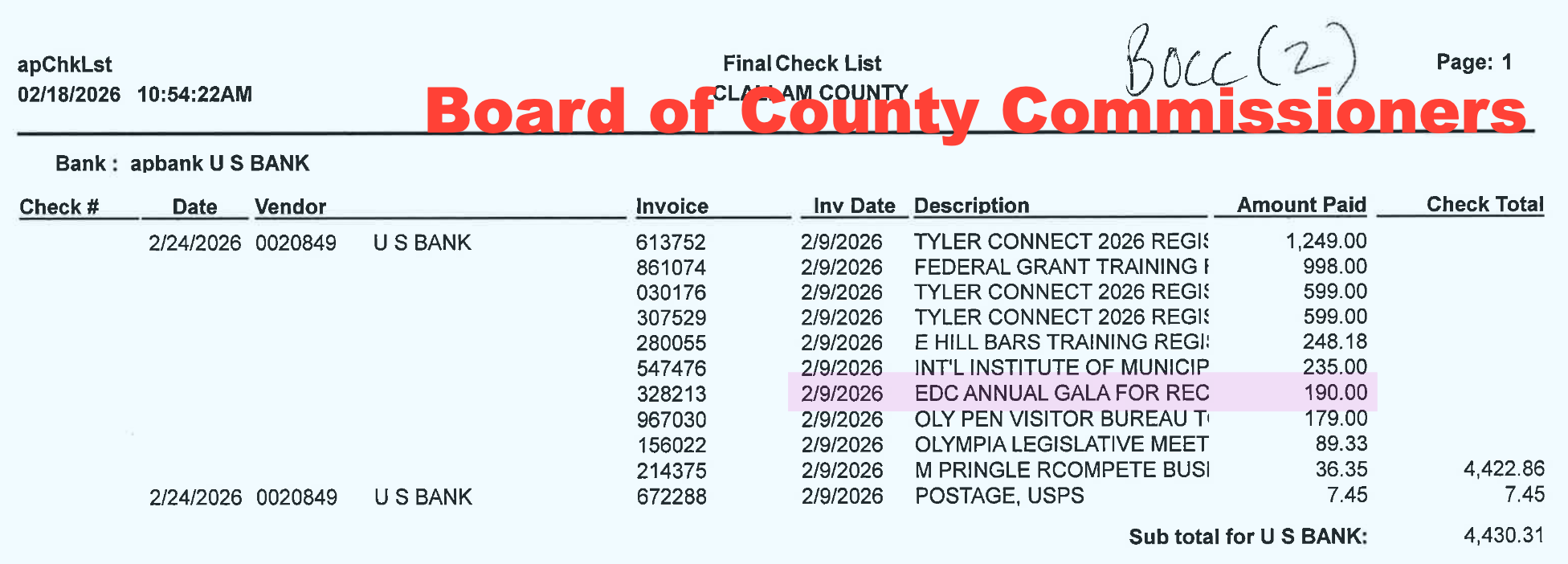
Instead, the tickets were used to send three county employees working on the federal Recompete grant, including Molly Pringle, the grant’s Plan Coordinator.
Pringle has publicly stated that one of her objectives is to “shine a light on white supremacy and capitalism.”
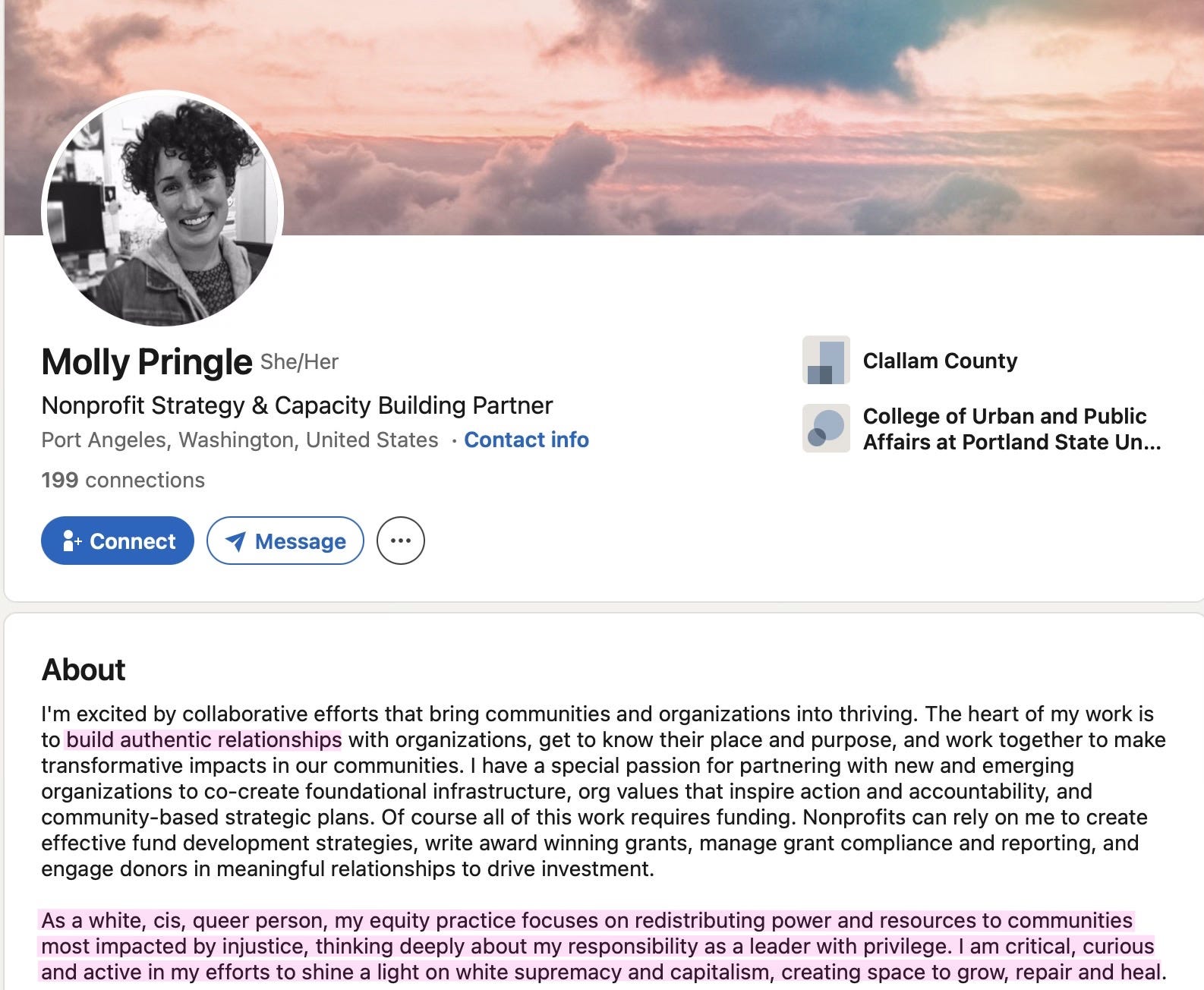
That statement has raised questions given the setting.
The EDC Gala’s keynote speaker this year was the retired president of Starbucks, and the event itself is designed to celebrate economic development and private enterprise.
Pringle’s role involves coordinating a $35 million federal grant intended to reinvigorate the regional economy.
The contrast left some observers wondering how criticism of capitalism fits with attending an event centered around encouraging it.
Dog Neutering Requires More ID Than Voting
The Clallam County Sheriff’s Office recently partnered with volunteers and spent $5,000 in taxpayer funds to spay or neuter 151 local dogs and cats.
The program required proof of low-income eligibility, including documentation such as:
• Social Security card
• Tax return
• Unemployment statement
• Pay stub
• DSHS documentation

There was one exception: homeless residents.
While many praised the program for helping reduce stray animals, others noticed an irony.
To neuter a dog in Clallam County, you must provide extensive identification and documentation.
To vote in federal elections—including choosing the leader of the free world—no identification is required in Washington State.
Citizens Needed for County Boards and Committees
If residents want more influence over local government decisions, there is a straightforward path: apply for one of the county’s advisory boards or commissions by March 25th.
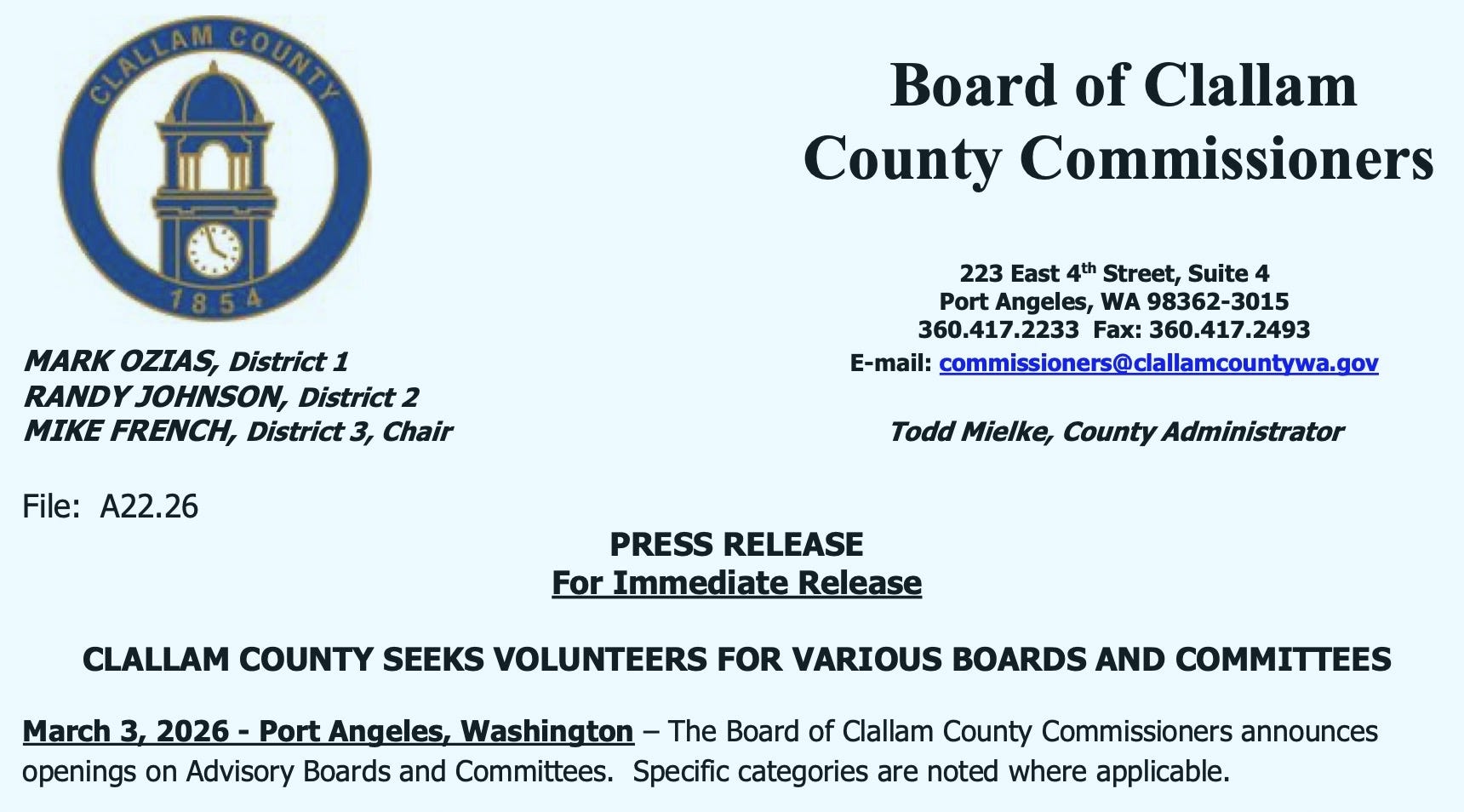
Clallam County currently has multiple openings across a range of committees covering planning, environmental issues, public health, and other policy areas.
These positions may not receive headlines, but they have tremendous influence over decisions made by the County Commissioners. Advisory boards review proposals, gather public input, and influence how policies are developed before final decisions are made.
For residents frustrated with local decisions, serving on one of these committees is one of the most direct ways to participate in government.
Local government works best when citizens show up—and these openings are an invitation to do exactly that.
Paying to Hear the “State of the City”
Port Angeles residents are invited to attend the 2026 State of the City Address with City Manager Nathan West.
The event will reflect on the past year, discuss economic indicators, and outline plans for the future.
It is sponsored by First Fed and will be held at the Field Arts and Events Hall.
There is just one catch.
Admission costs $30 per person, or $200 for a full table.
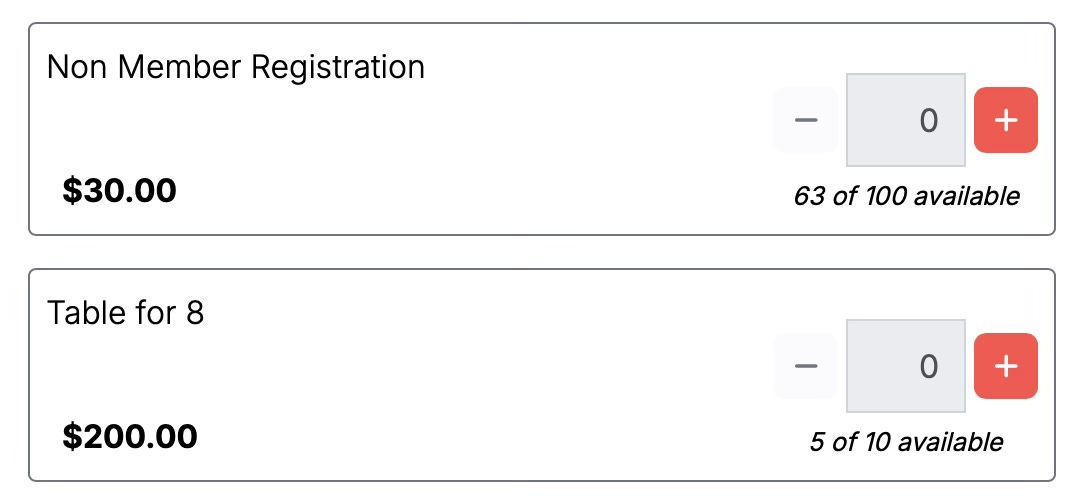
For some residents, that raises a question: if the presentation explains how taxpayer dollars are being spent and how the city’s economy is performing, shouldn’t attending be free?
Those unwilling to pay can still watch through a YouTube broadcast, but critics argue that direct public access to government updates should never require purchasing a ticket.
Residents Discover They Were Left Off Planning Updates
West End resident Heather Cantua recently discovered something troubling while trying to follow the county’s Comprehensive Plan update.
Cantua regularly attends weekly meetings of the West End Business and Professional Association (WEBPA) in Forks. Last year, Community Development Director Bruce Emery attended one of those meetings and passed around a clipboard asking attendees to sign up for email updates about the Comprehensive Plan process.
Cantua signed up.
Months passed with no emails.
Earlier this year, she learned that a Western Region Comprehensive Plan proposal was already moving forward. When she contacted Emery, she was told written comments were due before a meeting the following week.
Then came the explanation.
In a message sent by the county last week, officials acknowledged that the public notification email system had not been functioning during much of the planning process.
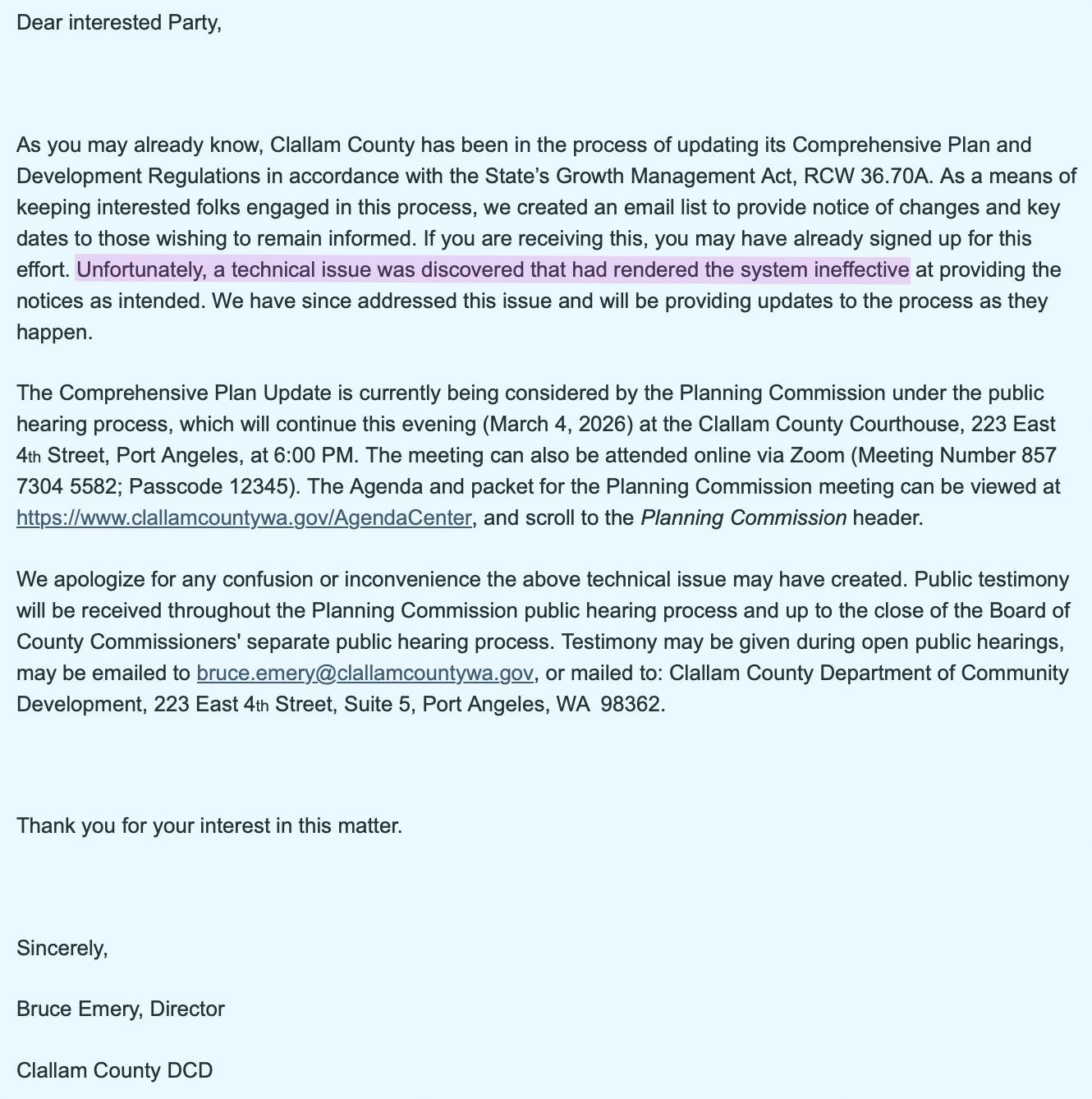
In other words, residents who signed up to stay informed were never notified.
For many, the situation felt like a familiar refrain in Clallam County governance: another major process moving forward with limited public awareness.
Another Out-of-Town Theft Case
Last week Rebecca Louise Richins, 45, was arrested for organized retail theft in Clallam County.
She was released less than 24 hours later.
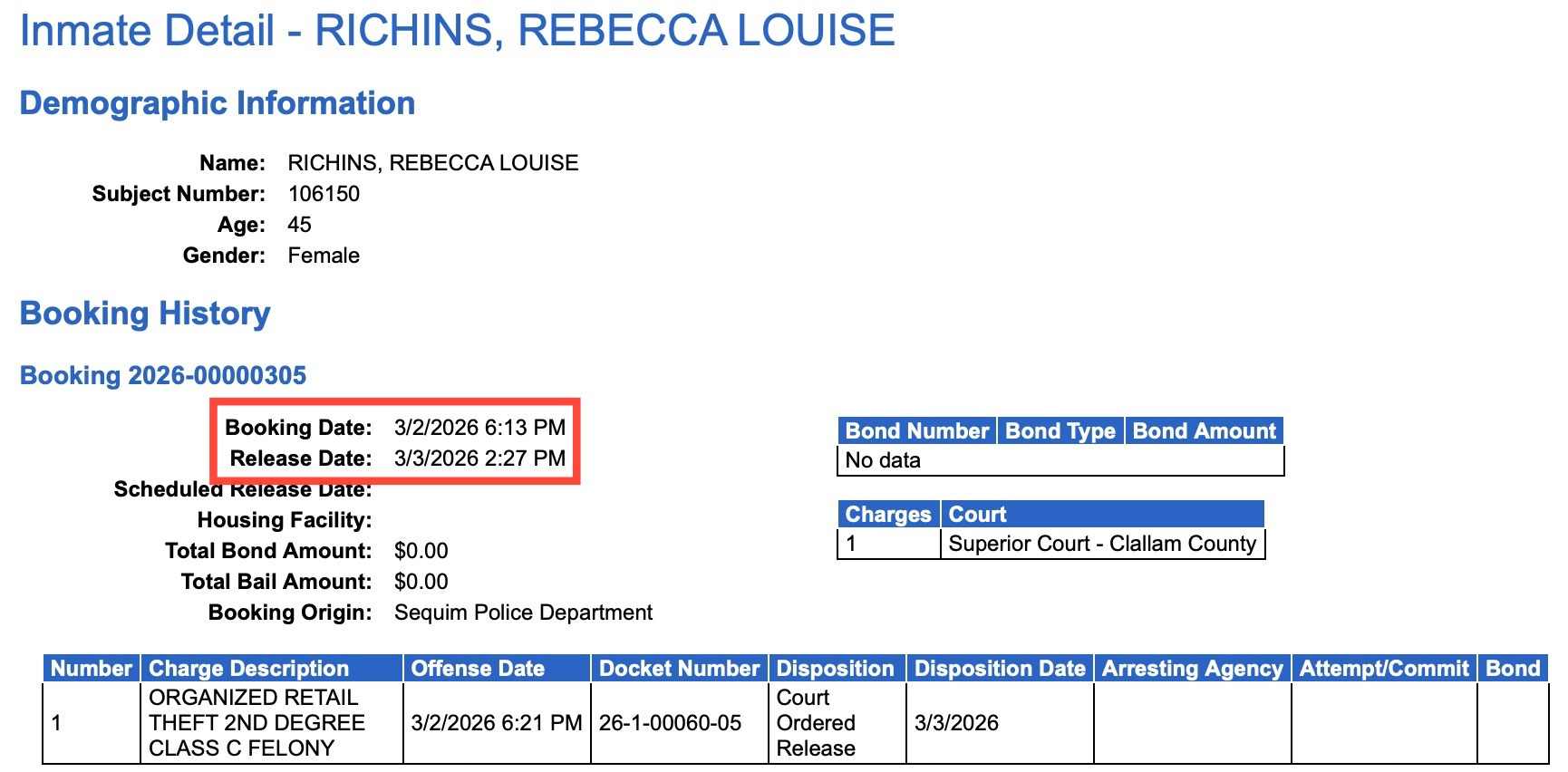
Richins has a criminal history in Kitsap County. In 2013 she was charged with bail jumping after failing to appear in court during a methamphetamine possession case.
Richins—also known as Rebecca Presler—had posted a $50,000 bond before disappearing prior to the verdict.
Residents say cases like this highlight a broader concern: individuals with criminal histories from other counties continue to cycle through the justice system here.
In a county already struggling economically, retail theft drives up prices for everyone.
When Crime Hits Close to Home
One local resident recently shared his experience after discovering someone had broken into a vacant rental house he had been renovating.
Well, criminal county got me the other day. I went by the back of one of my vacant rental houses that I had been working on and noticed the back door ajar — which usually means broken into — because I had propped something against it on the inside and I’m pretty sure it had been locked. I went in through the front and came through the house, not finding anybody inside, and could see that the door had been forced open. The trim was busted off and the strike plate, along with some chunks of wood, was lying on the floor.
That door unfortunately had no deadbolt. I called 911 and asked for an officer to come take a look. Dispatch said police would call and then hung up — PenCom leaves plenty to be desired. Fortunately an officer showed up after I had tidied up a bit and was leaving; he said he was in the area. One of the better PA officers, Bennett — a young fellow I had encountered a few times before — even has a bit of a sense of humor. He noticed a shoeprint on the outside of the door where it swings in.
Anyway, I got a case number and boarded the door closed without damaging it further. After I got back from an errand and some coffee… well, it kinda sucks. It takes a couple hours out of my day, and now I have to redo the strike plate, repair the smashed jamb and broken trim, and touch up some paint. And yeah, I’ll get a deadbolt on the door when I’m ready to redo the strike plate. So there are two trips across town to Hartnagel for door hardware — a matching keyed deadbolt — plus a couple hours drilling the door and repairing the jamb, not to mention the extra expenses that I wouldn’t have had before. Lovely.
Anyway, stuff happens. It just sucks when it happens to you. The house was not ransacked and I’m not sure if anything was stolen. I may have had a couple of duffel bags with shirts and socks, etc., in the back bedroom where the door was kicked in — however, I’m not sure. Other tools and supplies inside were left alone.
Petty crime often gets dismissed as minor. Yet for property owners and residents dealing with it firsthand, the costs—both financial and emotional—add up quickly.

Watchdoggers Paying It Forward
Not every story this week involves politics or crime.
Some simply show the community spirit that still exists across Clallam County.
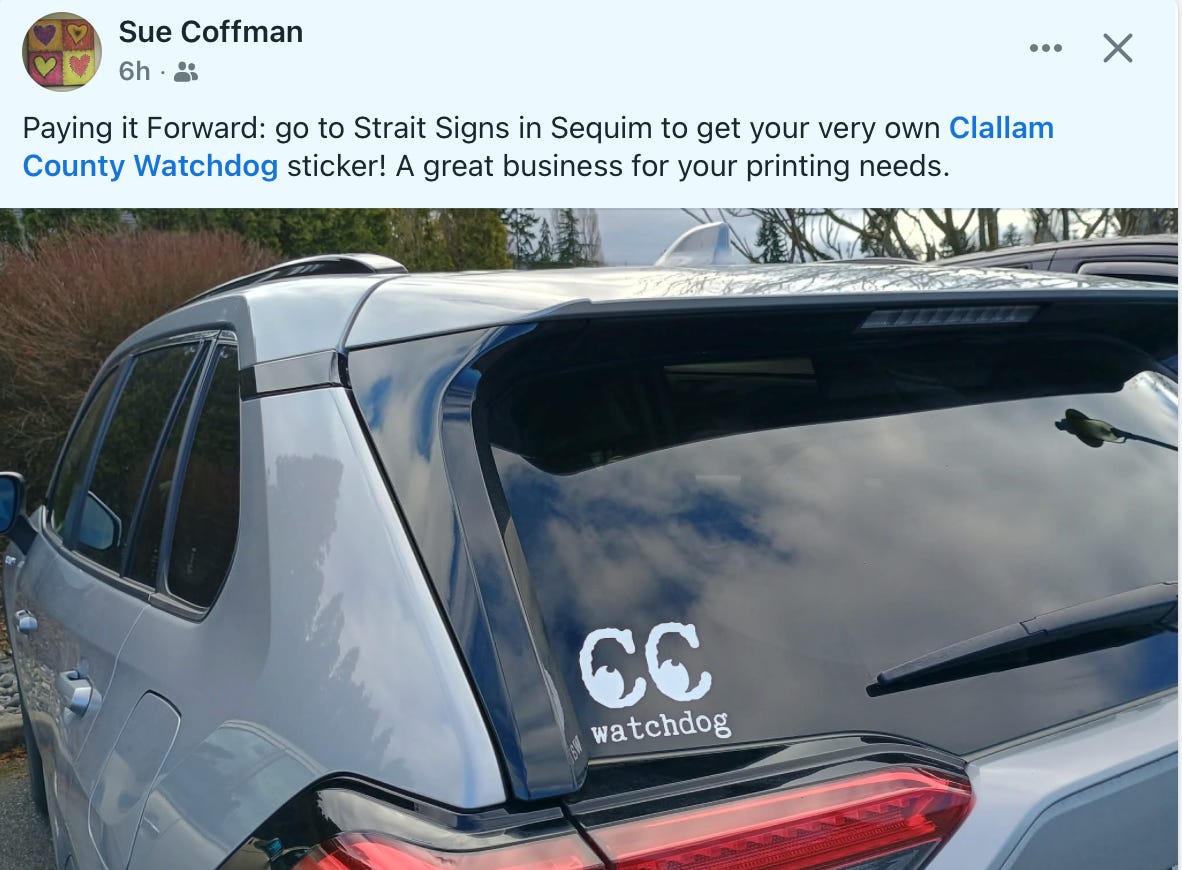
Supporters of Clallam County Watchdog have been visiting Strait Signs in Sequim to pick up a free Watchdog sticker—and leaving money on the tab so the next person can receive one too.
It’s a small gesture, but a meaningful one.
Sue and Ron were among the latest to join the effort, proudly sporting the logo.
It’s one more reminder that while debates about policy and politics continue, many residents are still finding ways to support each other—and local businesses—along the way.


