


A Georgia child molester classified as Level III — the highest risk to reoffend — settled in Sequim. A registered sex offender from the Spokane area preyed on local minors. Last Thursday, voters asked the two District 3 candidates what they would do about public safety. One answered with numbers, enforcement, and treatment. The other sounded like a man who last ran a restaurant a decade ago and still thinks a trespass list is a public-safety plan.
The man Georgia sent west
In 2004, Alexander Holmes Wright was convicted in two Georgia counties of kidnapping and child molestation.
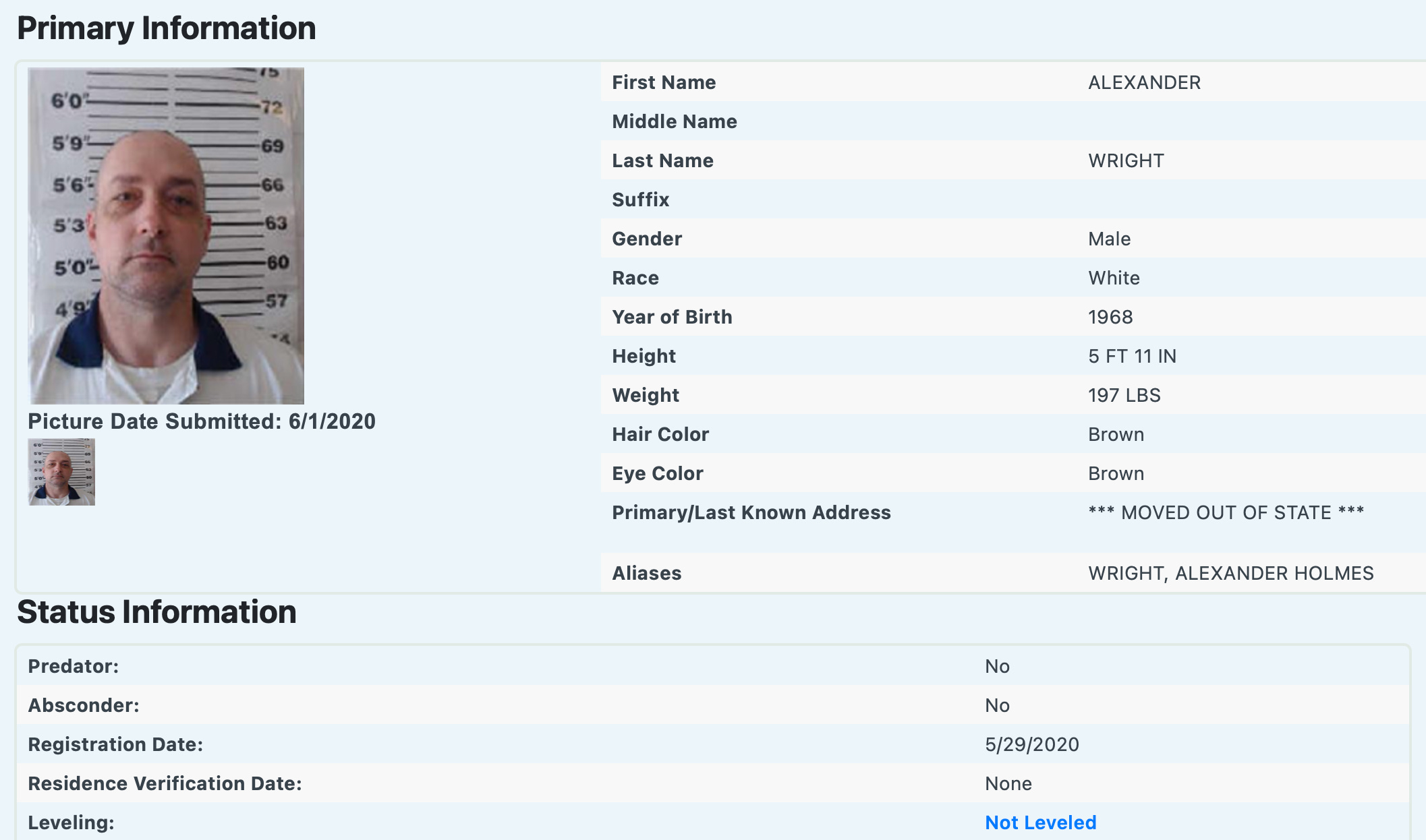

In Camden County, he kidnapped and molested an eight-year-old girl. In McIntosh County, he kidnapped and molested a female toddler. The victims were not related to him. Georgia records later listed him as having “moved out of state.”
In 2020, the Clallam County Sheriff’s Office issued a Level III sex-offender notification. Level III is the classification for offenders most likely to reoffend.
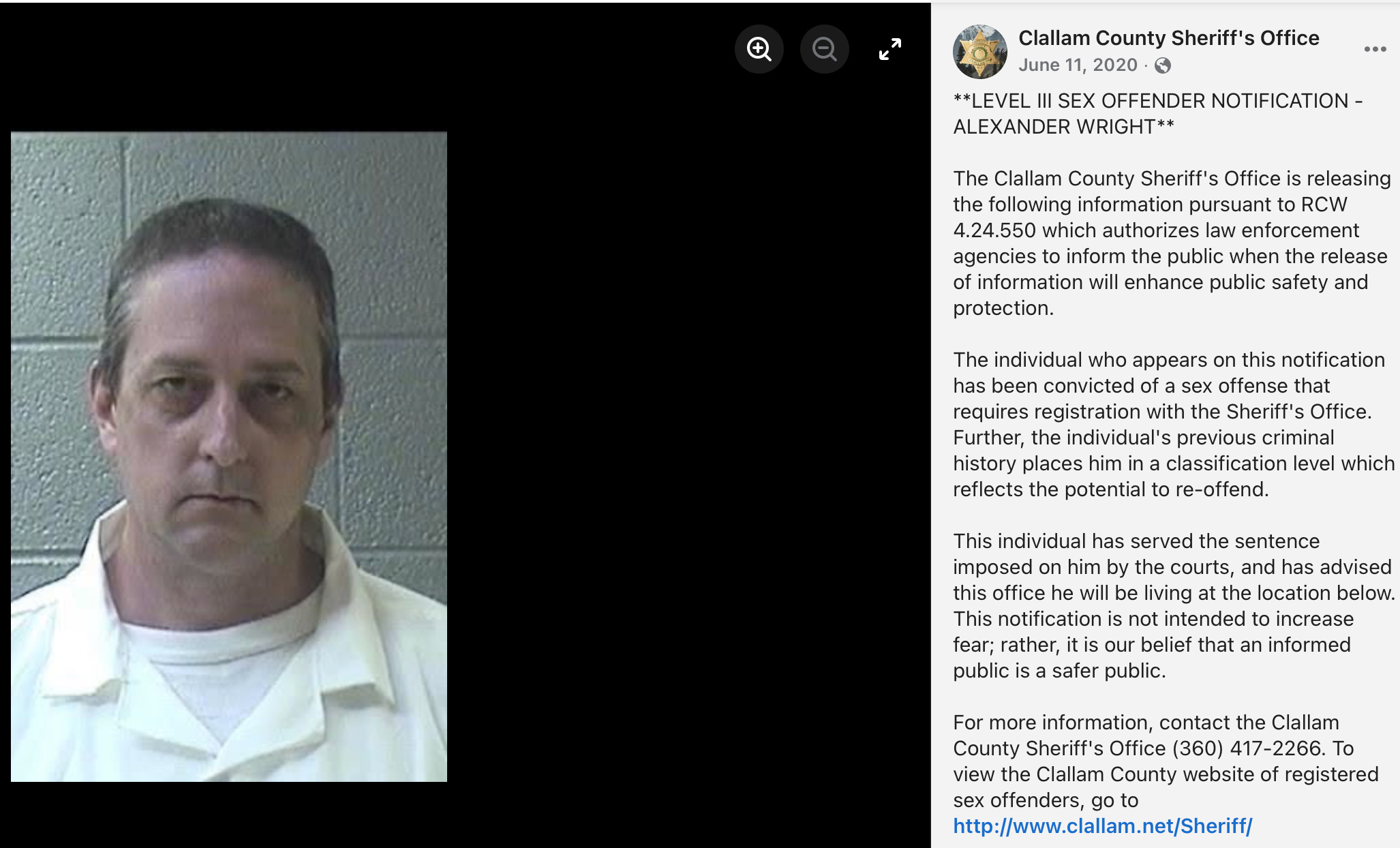
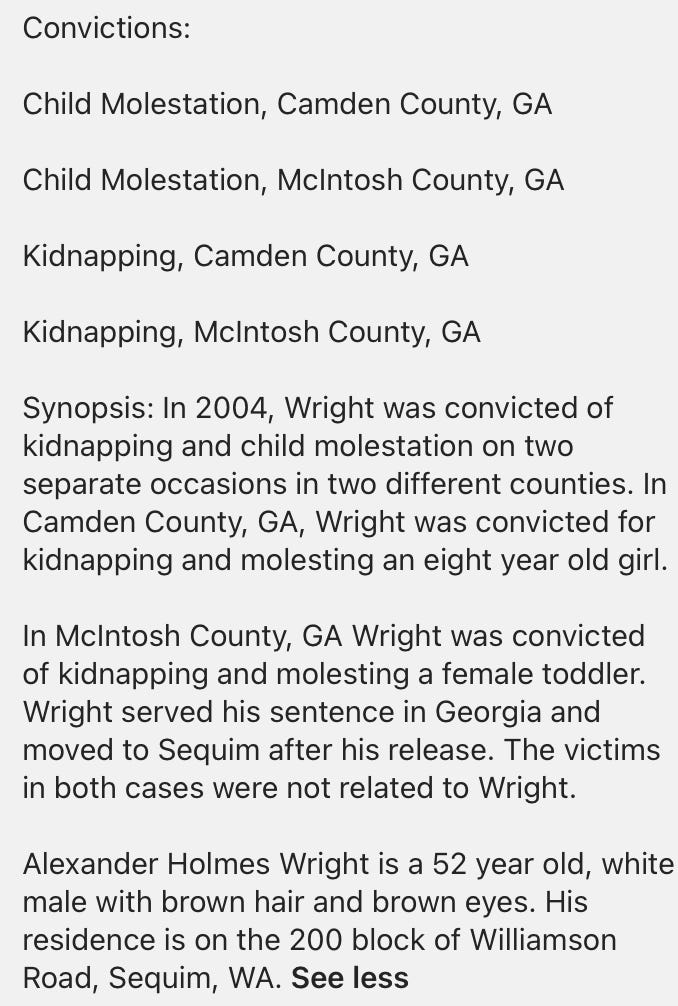
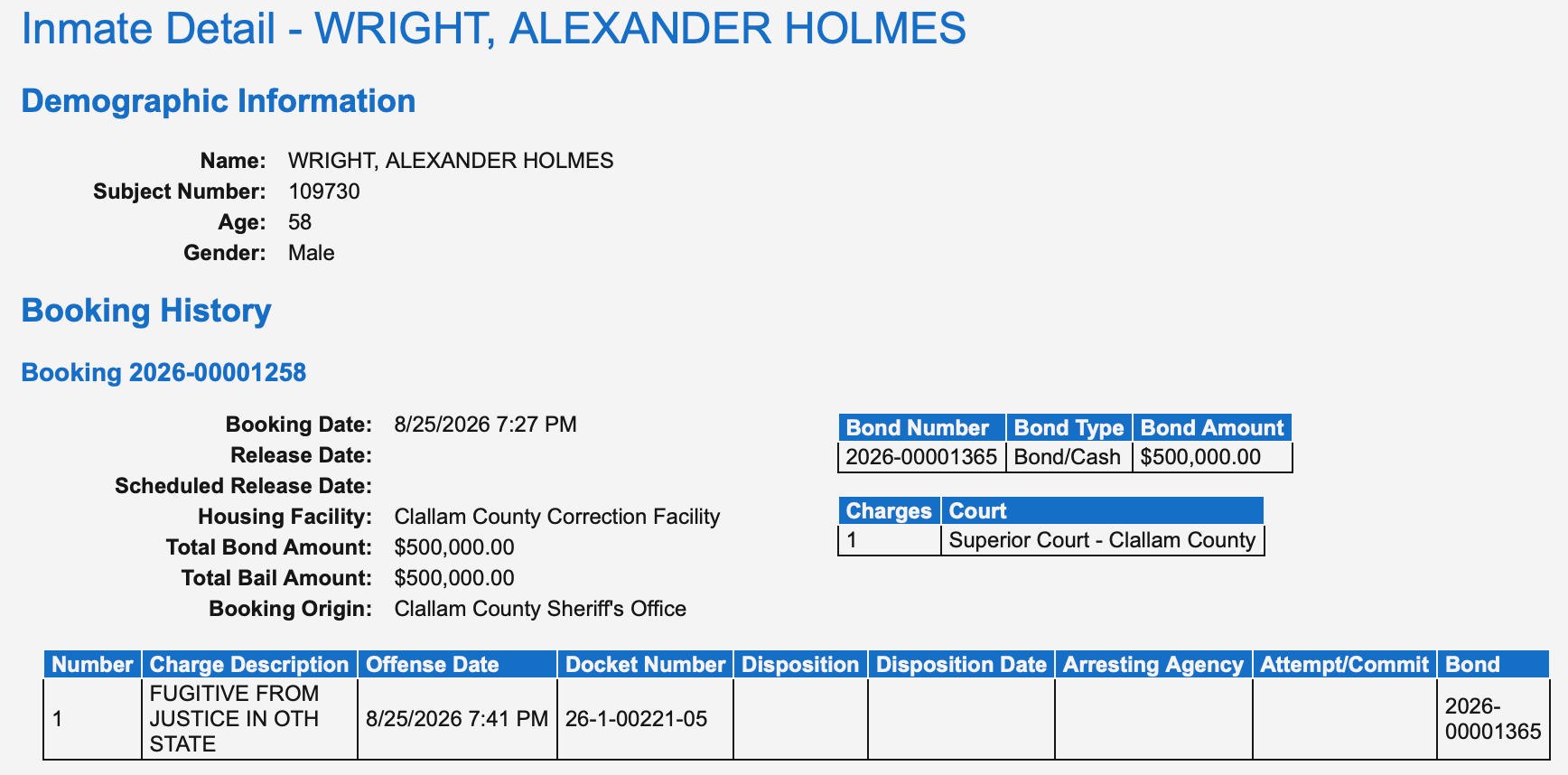
Wright, then 52, was living on the 200 block of Williamson Road in Sequim after serving his Georgia sentence. Registry entries list two child-molestation convictions and two kidnapping convictions, all with sexual motivation, all from 2004, with a listed release date of May 31, 2020.
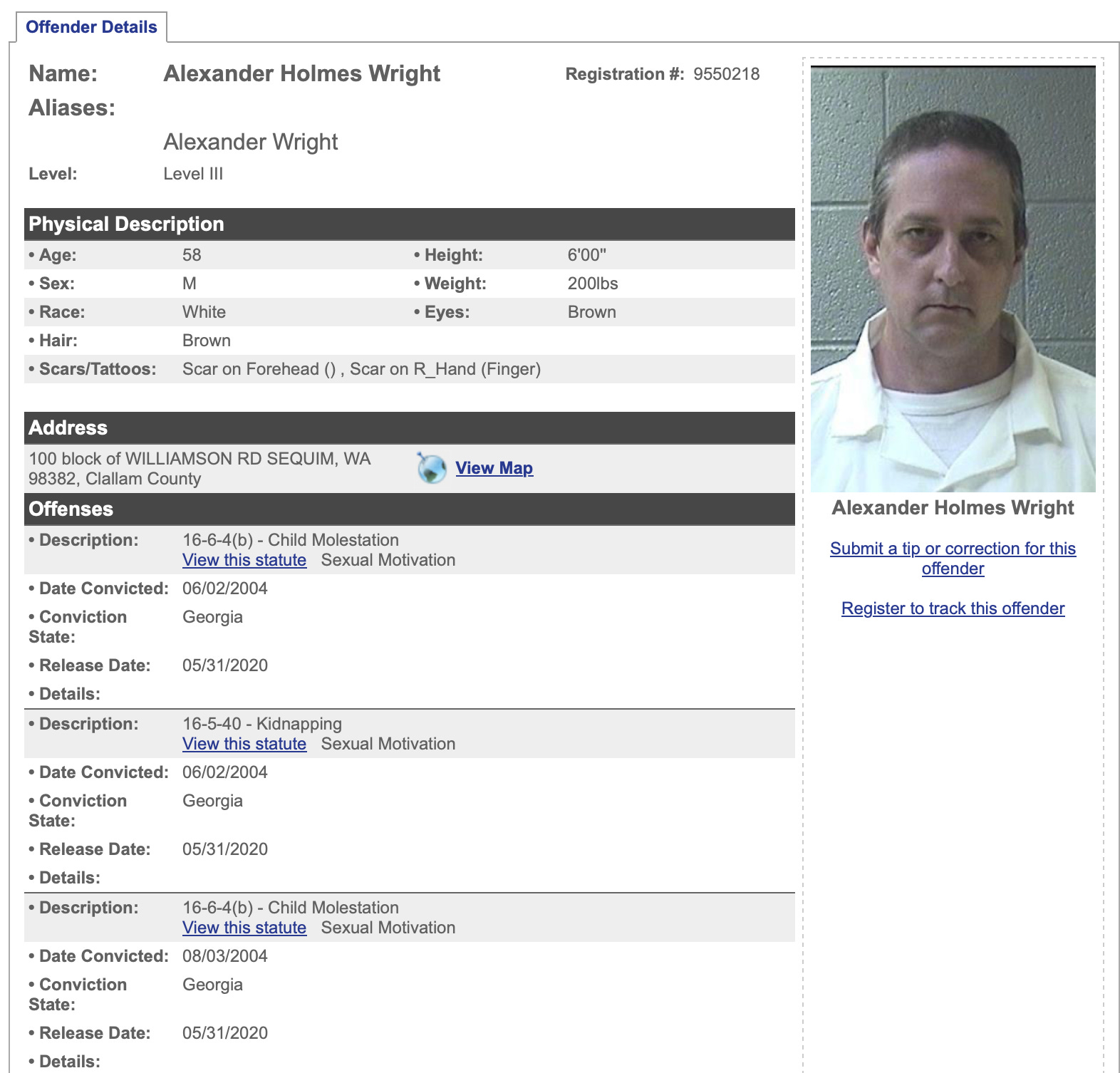

Last week, Wright was arrested and charged as a “fugitive from justice in another state.”
That is not an isolated story. It is a pattern.
Then came the man from Spokane
Last week, Jake Seegers reported on another case: a registered sex offender with ties to Spokane who victimized at least two minors in Clallam County before he was arrested.

Public reporting on that case describes a man previously convicted of second-degree child molestation in Douglas County, later arrested in Spokane County for failing to register, who then spent about a year in Port Angeles. He offered marijuana to a 15-year-old girl at the Gateway Transit Center and sexually assaulted her. When officers later found him, another girl — 17 — was in the bed. In April 2026, he pleaded guilty to rape of a child in the third degree and was sentenced to 48 months in prison plus community custody.
Two different predators.
Two different ZIP codes of origin.
Same county at the end of the road.
Why do so many sex offenders and high-need addicts arrive here from somewhere else? Residents have been asking that question for years.
Is it the permissive drug culture?
Policies that tolerate living outside even when shelter beds sit empty?
Free housing pipelines, free food, free transportation — and now free showers at a family pool, routed through the same harm-reduction system that hands out drug supplies?
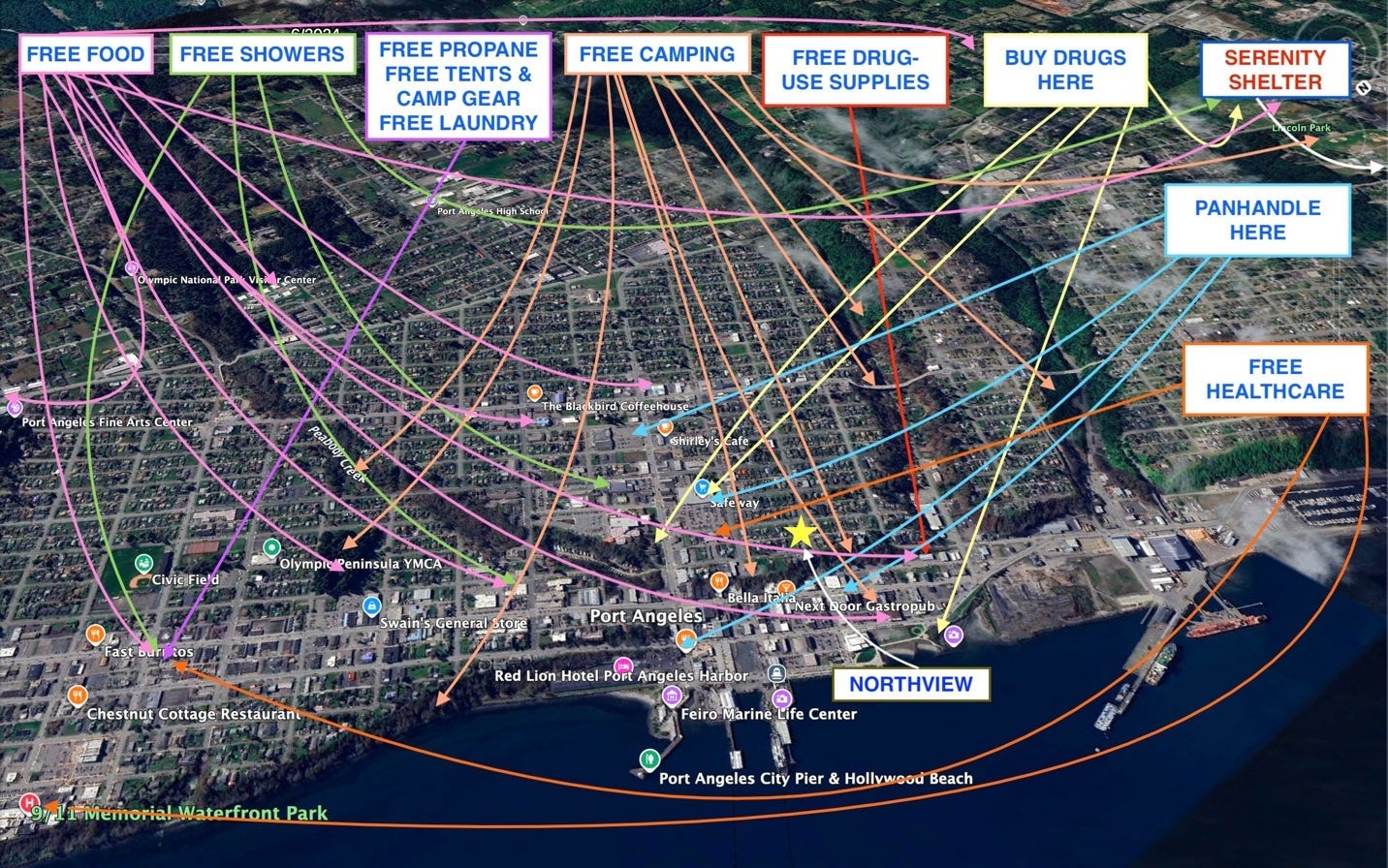
Those are not abstract talking points. They are recruitment features.
The question voters actually asked
Public safety and harm reduction dominated last Thursday’s packed Calico Cat Club candidate conversation in Sequim. One question cut through the slogans:
When a business owner arrives to find someone camping in the doorway amid drug paraphernalia or human waste — and cannot even get to the door to open the business — at what point does compassion for the unhoused become an infringement on the owner’s right to safety and livelihood?
Should laws against public drug use, dealing, and illegal camping be enforced regardless of housing status?
And how does teaching people how to get a better high have anything to do with reducing overdoses or disease?
That is the county a lot of people actually live in.
French’s answer: call the cops and join a list
Mike French’s answer sounded like it belonged to another decade. He leaned on memories of “few problems” from the restaurant he used to operate in downtown Port Angeles. That business chapter is nearly a decade old.
Downtown is not the same place.
The drugs are not the same.
The encampments are not the same.
The cost to businesses is not the same.
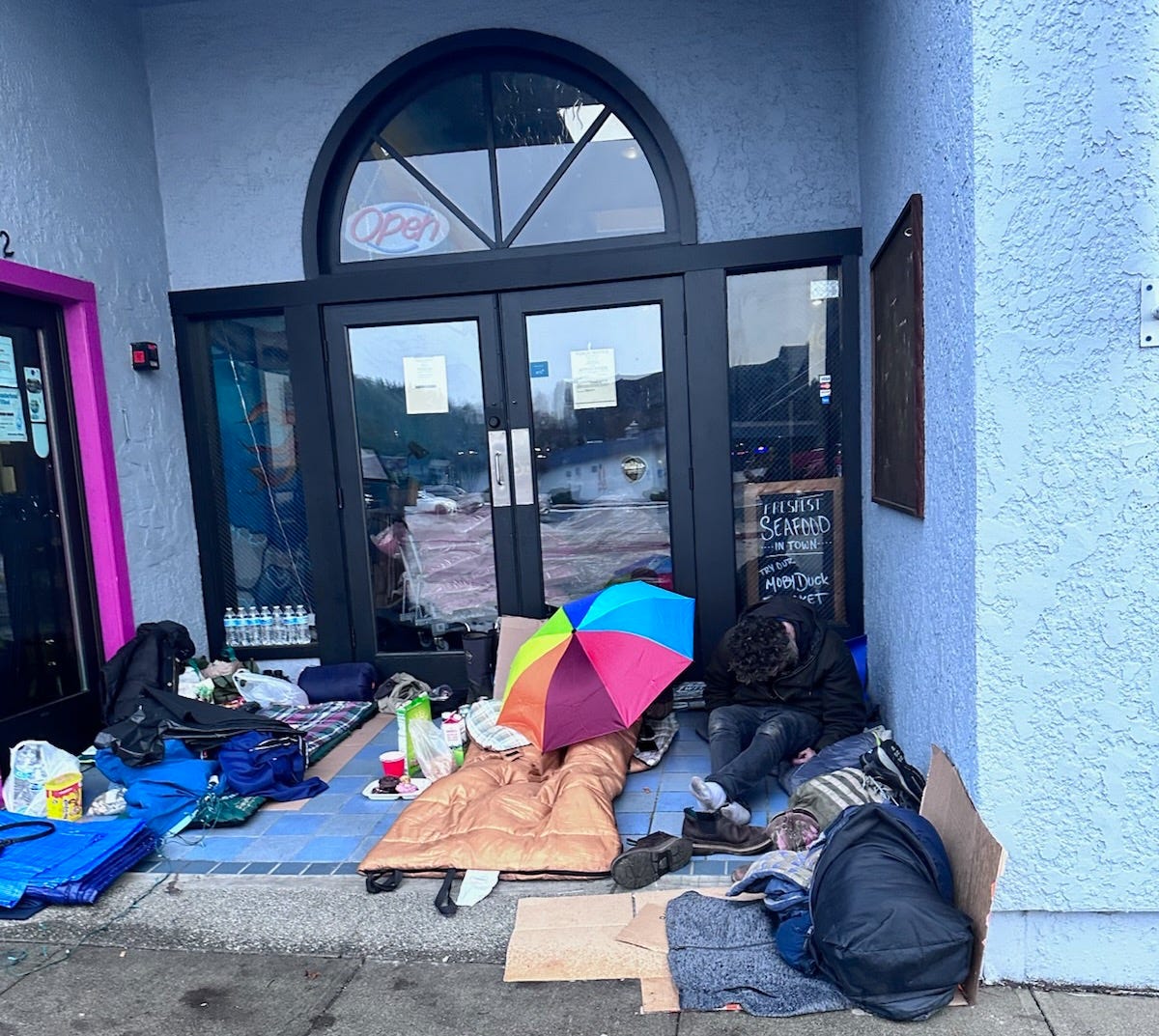
French’s practical advice at the forum was that if someone is camping in a doorway — even amid waste and drug use — the owner can ask them to leave, call police, and join a trespass list.
That may be the legal first step. It is not a county strategy. It puts the burden back on the business owner to report the same problem again and again, while officers already say a large share of downtown calls are trespass calls. Paperwork is not the same thing as prevention.
This is also the commissioner who sits on the William Shore Memorial Pool District board and supports a shower-voucher program that routes people from the Harm Reduction Health Center — which distributes drug supplies to homeless addicts — into a family aquatic center.

He later said he did not know the program existed until social media brought it to light, an unusual admission from someone who is both a county commissioner and a pool-board member. When the policy was revised, his emphasis was on keeping it simple and low-cost, not adding stronger safeguards.
French describes harm reduction as practical and evidence-based. He points to treatment investments and has suggested the county consider a sales-tax increase like the one Port Angeles passed for police. On addiction, he notes that it leads people to do things they otherwise would not do. That may be true. It does not explain why the county should treat doorway camping, public drug use, and illegal camping as problems for shopkeepers to manage one complaint at a time.
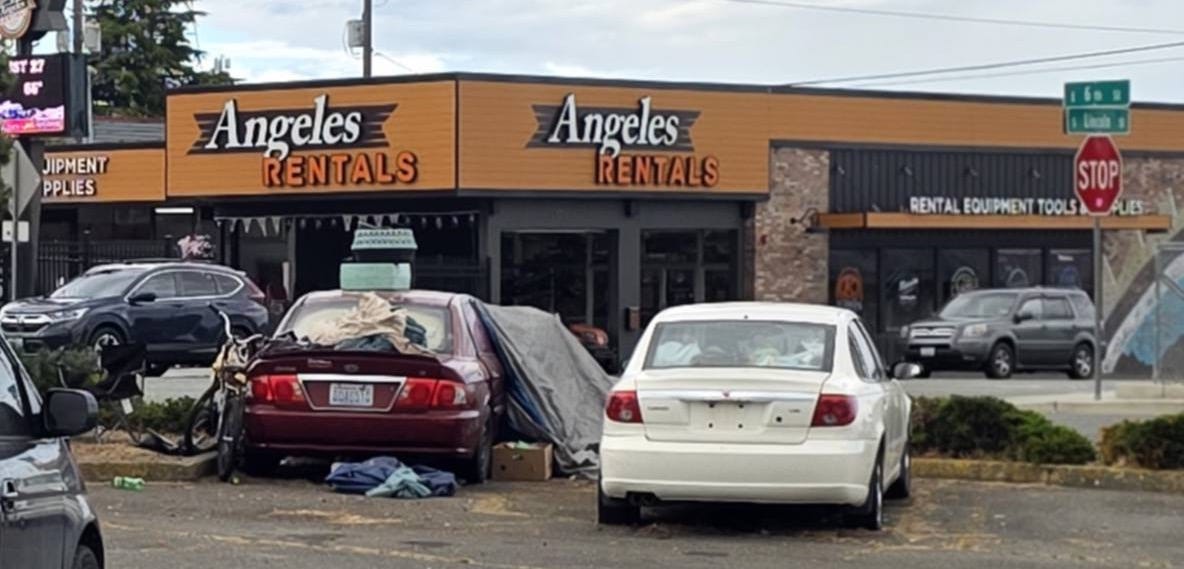
Compassion for people in crisis should not require tax-paying business owners to operate as the front desk of a social-service system. Enforcement, treatment that actually moves people off the street, and clear limits on public disorder are not the opposite of compassion. They are what make compassion workable.
Seegers’ answer: stop paying for the magnet
Jake Seegers did not offer a trespass list. He named the price tag.
Permanent supportive housing, he said, is cost-prohibitive for the scale of the problem, and the units are not prioritized for local people. He pointed to the 36-unit Northview permanent housing complex that prioritizes housing for homeless drug addicts and criminals: about $350,000 a unit, mostly one-bedrooms and studios, beautiful enough that “every single one of us would want to live there” — filled by lottery for people who only have to be “engaged in services” here. That can mean they arrived yesterday or called a provider from out of state.
“We need to prioritize the people that are here,” Seegers said. “And if our funding does not allow us to do that, we need to change how we’re funding.”
Then he put the budget on the table. The cost of what he called “misguided compassion” is $33 million a year out of a $56 million budget — the 2025 law-and-justice bill for jails, indigent defense, prosecution, law enforcement, and courts. Chief Smith and Sheriff King have both said nearly all crime here is related to drugs.
“The cost of compassion is $33 million. That’s how we balance the county’s budget is by prioritizing public safety.”
He said ordinances must be enforced, and that should have been done years ago. On the grotesque edge of harm reduction — instructions on how to get “the best high when you boof” — his answer was blunt: absolutely not.
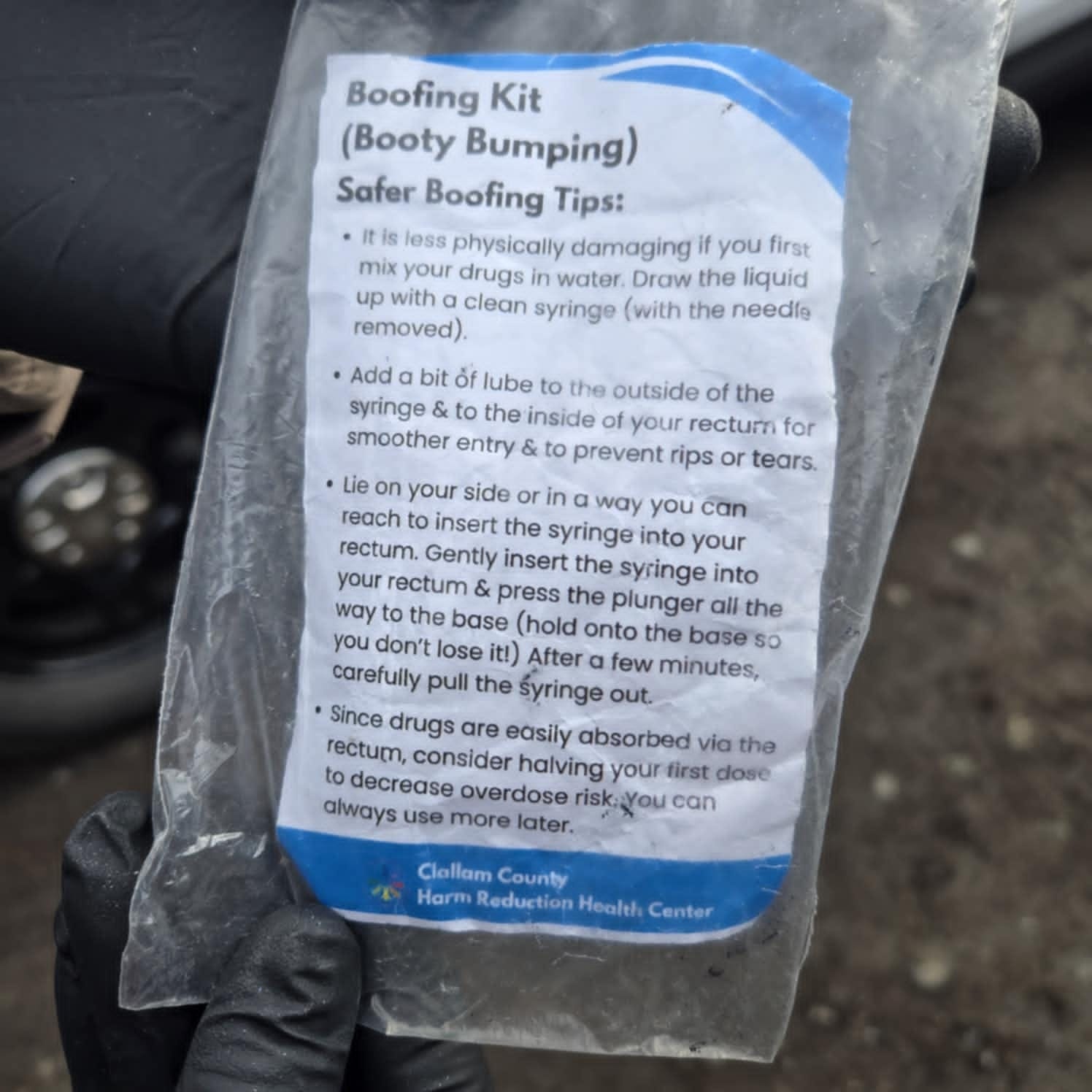
He said he finds it hard to believe the county even operates a harm-reduction health center that goes that far. He also described a grant-funded drug-testing machine that would have taken users’ drugs, tested them, and handed them back with an all-clear — “effectively distribution.” The only reason the county does not have that machine, he said, is that “some sane individuals” flagged the liability and underwriters said no.
That is the race. French manages the symptoms and calls it compassion. Seegers treats the disorder as what it is: a budget drain, a crime problem, and a choice the county keeps making.
The creek taxpayers restored is now a dump
This is not only a Port Angeles story. The same policy weather system has been blowing into Sequim.
Social-media documentarian Woodie Allen filmed the dry summer bed of Bell Creek where it passes under Washington Street, between the Big Elk Restaurant and Les Schwab, accessed off Brown Road.
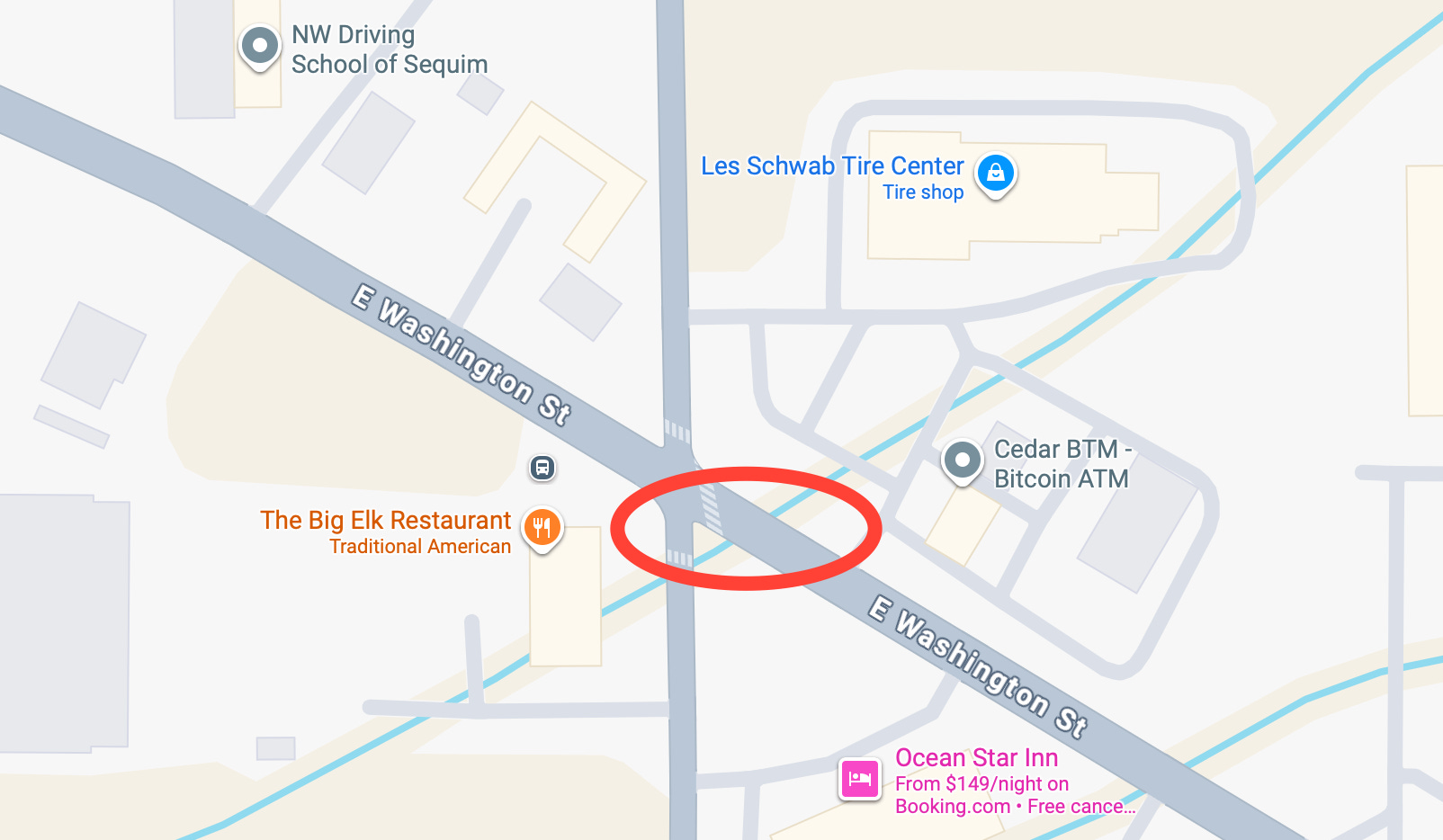
Inside the culvert: clothing, garbage, food wrappers, needles, foil, tourniquets, and the rest of the harm reduction kits linked to the free paraphernalia the county hands out.


Drivers crossing that intersection may be rolling over people trapped in addiction in a pipe that is dry in August and can fill — even flood — in winter.
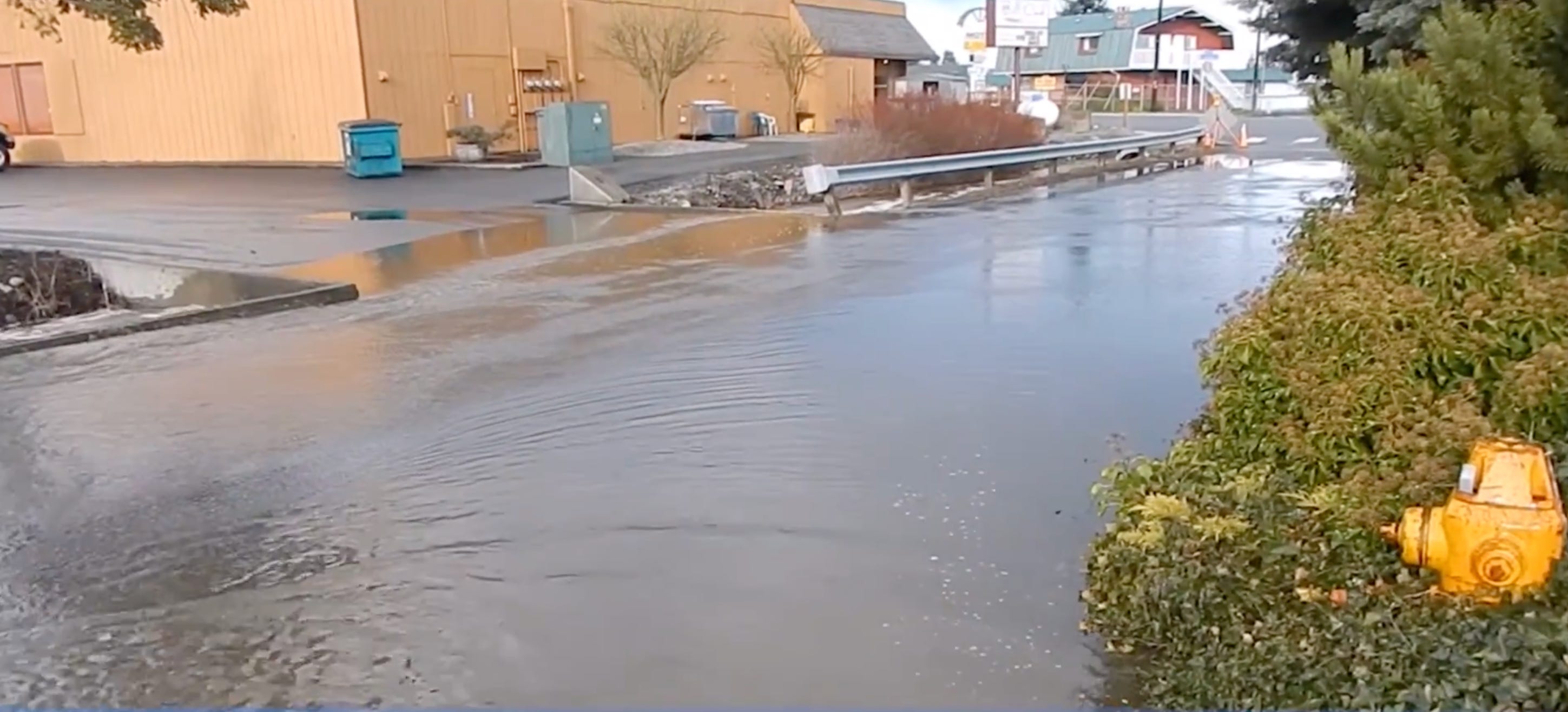
That would be ugly enough if Bell Creek were a forgotten ditch. It is not.
The Washington Department of Fish and Wildlife’s Bell Creek Wildlife Area Unit sits on the east side of Sequim. The state bought the parcels between 1998 and 2001 with U.S. Fish and Wildlife Service coastal-wetlands money and Washington Wildlife and Recreation Program funds.
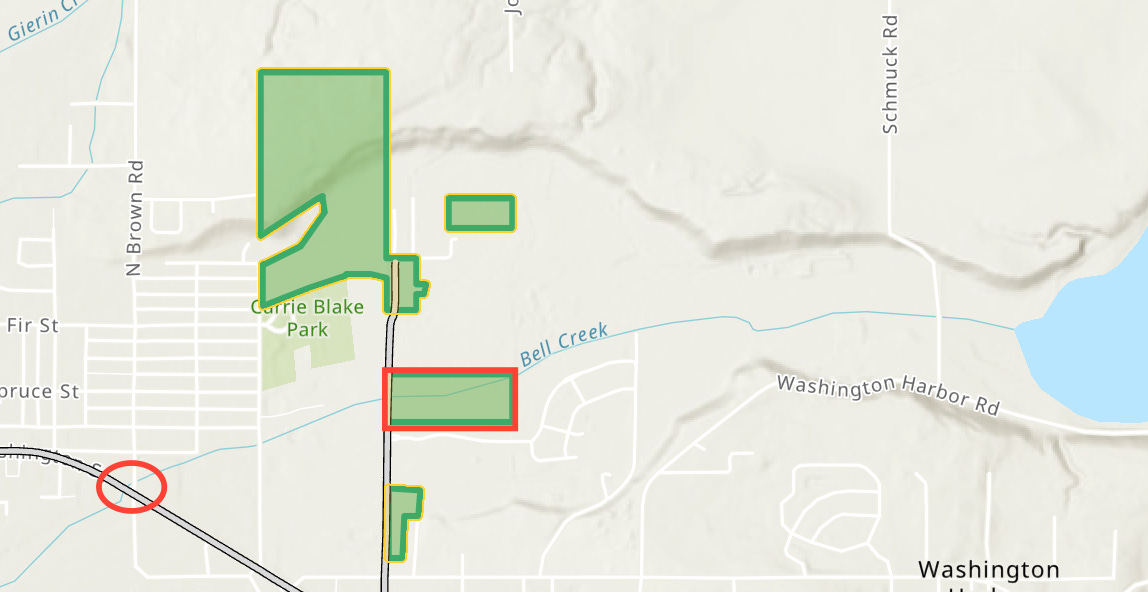
The purpose was stream and riparian restoration, Garry oak and prairie conservation, and protection of valley habitat along Bell Creek’s tributaries. Volunteers planted more than 2,600 Garry oak seedlings and 600 acorns and logged more than 5,300 hours over 24 years. Oregon white oak woodland is a priority habitat; only a sliver of the original oak prairie remains. So the public paid to buy it, restore it, plant it, and protect it.
The current homelessness-and-harm-reduction regime is filling the culvert with garbage and needles that, in a few months, will be flushed into the restored habitat and into Sequim Bay.
Bell Creek is not a separate environmental story from Tumwater Creek. It is the same policy, showing up in a different place: when public disorder is tolerated downtown, it does not stay downtown. It moves into the creeks taxpayers paid to restore.
One vote, five outcomes
Public safety.
Economic prosperity.
Harm reduction.
Moving vulnerable residents from addiction into treatment.
Protecting the County’s most sensitive waterways.
These are not five separate debates. They are one system.
If the county markets itself as a place where camping, public drug use, and free supplies are tolerated, people will come — including people with records like Wright’s and Abram’s.
If business owners are told the remedy is a trespass list, they might keep paying the $33 million crime bill while they mop their own stoops. Or they might leave, and we’ll have one more empty storefront.
If restored creeks become seasonal campsites, the public did not buy habitat. It paid to clean the same ground twice: once to restore it, and again after policy allowed it to be used as a dump.
Jake Seegers is running to enforce the laws already on the books, prioritize locals, measure recovery instead of syringes, and stop using “compassion” as a synonym for “do nothing until it shows up in the jail budget.” Mike French is running to defend the architecture that produced the magnet, the pool vouchers, and the culvert.
In 64 days, Clallam County will choose which one of those worlds it wants more of.
Tomorrow: Live from PABA — Who sits on District Court 1 will shape public safety
Join the Port Angeles Business Association (PABA) live tomorrow as Clallam County District Court 1 candidates Alex Schodowski and Patrick David Murphy lay out their qualifications and their vision for the bench.

This is not a side race. District Court is where public-safety policy becomes a real order: trespass, theft, drug possession, domestic violence, and the cases that decide whether Clallam County embraces accountability or keeps absorbing the same disorder on repeat. The commissioner race sets the budget and the priorities. The judge decides what happens when those cases walk through the door.
PABA is hosting both candidates. Members and the public are welcome. Come ready to listen — and to ask what accountability looks like in this county.
Watch live on PABA’s Facebook page at meeting time. The Port Angeles Business Association offers breakfast meetings with networking and educational programs every Tuesday from 7:30-8:30 am at Jazzy Joshua’s Restaurant, 113 Del Guzzi Drive (off US Hwy 101) in east Port Angeles.
Please note that Joshua's charges $5 for attendees who don't order breakfast, so you might as well order something tasty.
Show up. The court that handles everyday crime is on the ballot too.


