

Reminder: Today, October 13, 10:30 a.m. — pack the room. The comprehensive plan public hearing is open for comment in person or virtually; if the next 20 years in Clallam County matter to you, show up and tell the commissioners and DCD Director Bruce Emery that Futurewise gets no veto, that the Climate Vulnerability Assessment was never required (only a climate resilience element under HB 1181), and that locking a 9°F projection into the plan is not the same as the 1.4°F of actual warming since 1895. Email all three commissioners via Clerk Loni Gores at loni.gores@clallamcountywa.gov and Bruce.Emery@clallamcountywa.gov, then be there so they have to face the people who will live with the result.
When Clallam County faces a budget shortfall, Commissioner Mike French’s first instinct is never “spend less.” It is “find a new levy, a new sales tax, or a new way to split existing ones so the general fund gets more room.” Voters already rejected one property-tax hike. The response has been one-time accounting finds, councilmanic taxes that skip the ballot, a new state law that lets the county pull veterans and developmental-disability funding out of the general levy—and charge you separately—and the 0.1% housing sales tax he put on the Port Angeles ballot that helped fund Peninsula Behavioral Health’s North View complex. Reelect him, and this pattern continues.
The Animal Shelter Question and the Predictable Answer
At a recent Clallam County Democratic headquarters Q&A, French was asked whether he would support an operational levy for animal shelters. The question noted that animal health and control affect public safety and that existing buildings could potentially be repurposed instead of bonding for new ones.
French said an operational levy “is not the first thing that I would step to.” He walked through the Olympic Peninsula Humane Society’s reduced role, the county’s former funding of that work, and the reconvened Animal Solutions Committee. He mentioned current spay-and-neuter support and deferred: “It would be difficult for me to say yes right now… I would want to take the Animal Solutions Committee’s lead, Commissioner Ozias’s lead, and Sheriff King’s lead… I want to let the experts speak first.”
The problem is who sits among those “experts.” The advisory board includes organizations that already receive county funding. When groups that depend on the money recommend a dedicated levy, the outcome is easy to predict. French’s deference is not neutrality. It invites the same solution the county has used before: more dedicated taxes rather than tighter management of existing resources.
Separating Veterans and Developmental Disability Levies: A One-Time General-Fund Boost
The Washington State Association of Counties actively supported ESHB 2442, the “local government tax resources and fund flexibility” package. WSAC’s 2026 end-of-session report and legislative one-pagers highlighted the “bifurcation of the veterans’ and mental health/developmental disabilities levies from the general fund levy.”
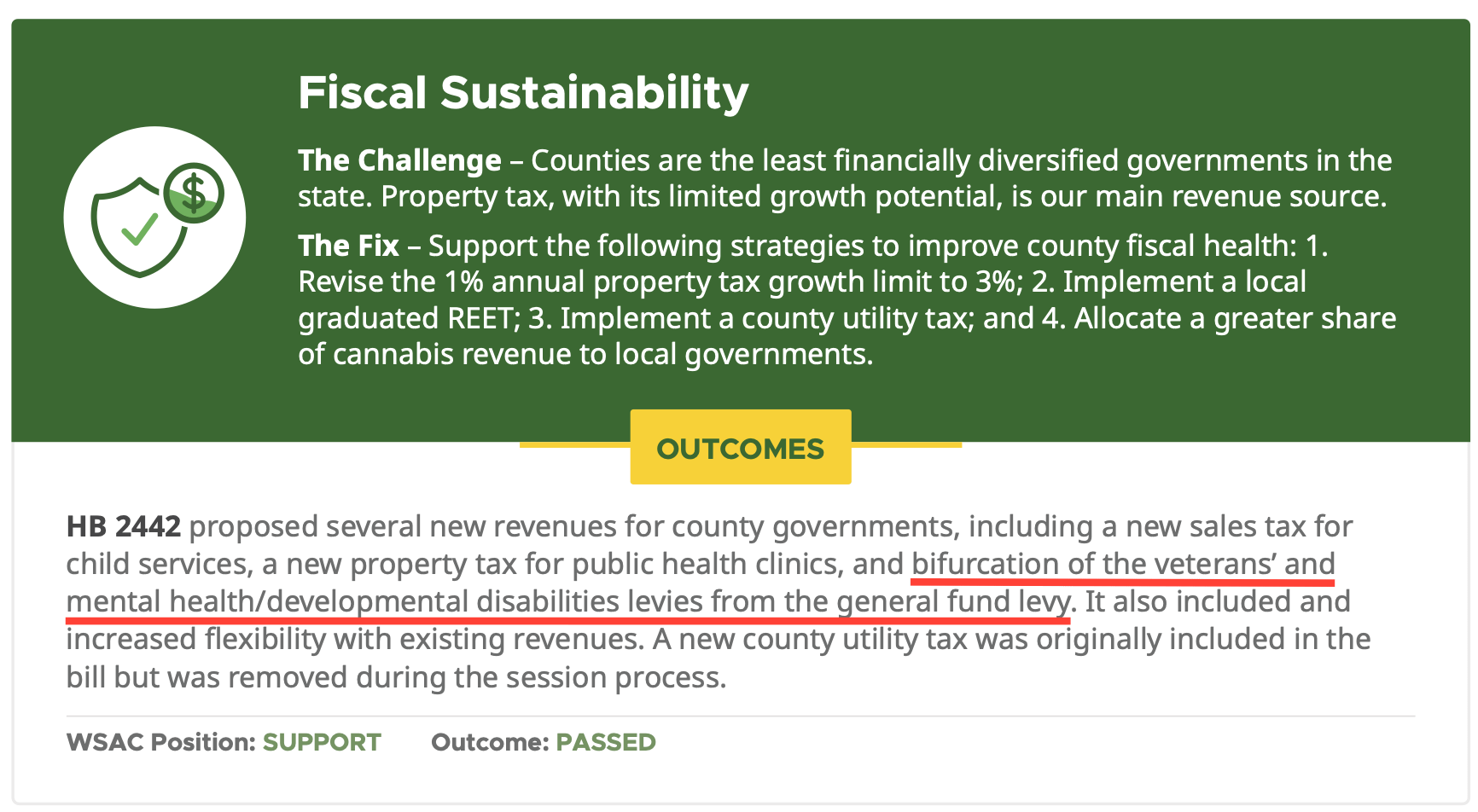
The association listed it under fiscal-sustainability priorities and supported it. The bill passed and takes effect in 2026. It lets counties keep funding those services inside the general levy or pull them out as separate independent levies (veterans up to $0.27 per $1,000 assessed value; developmental disabilities/mental health at a required $0.025).
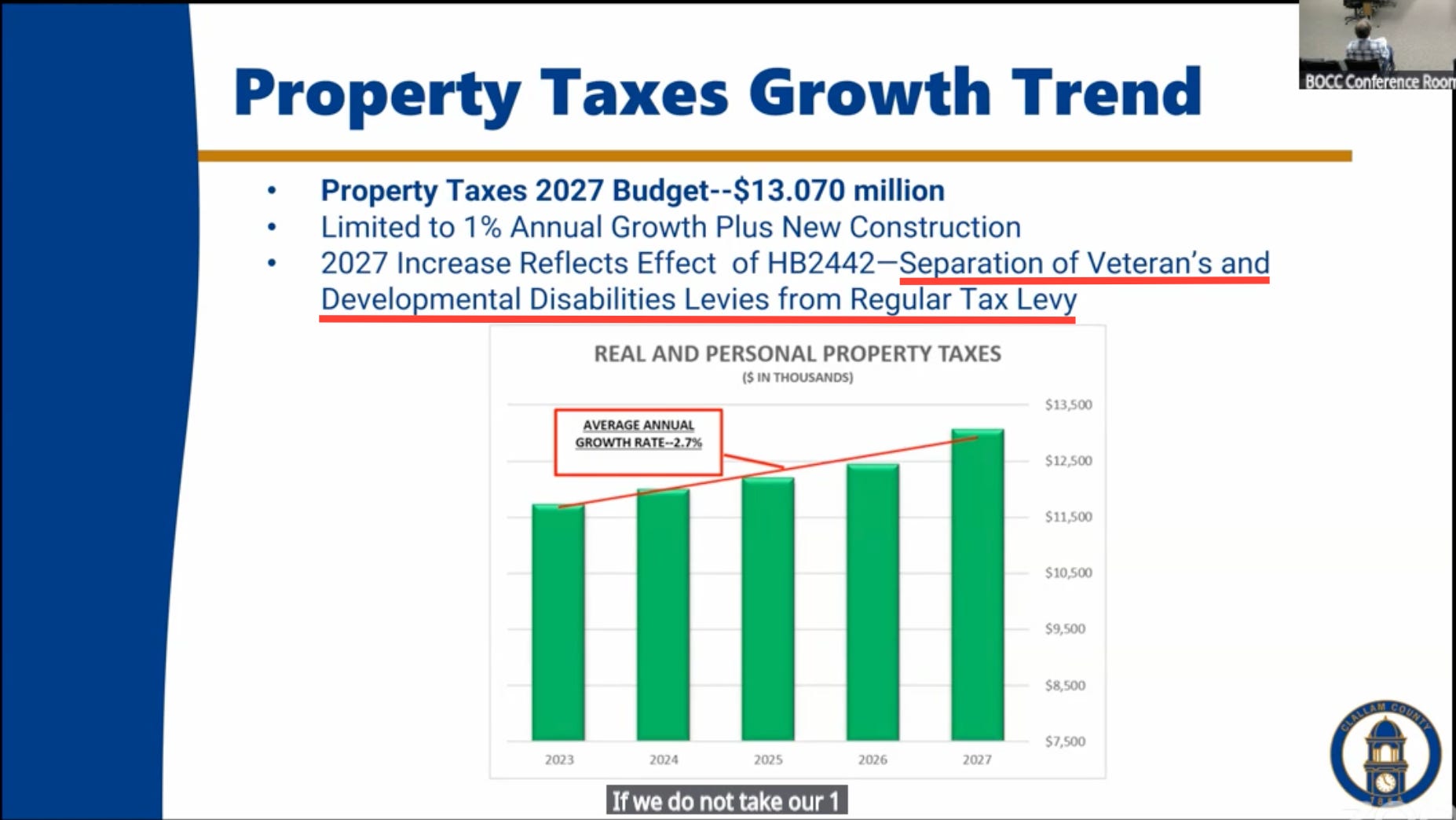
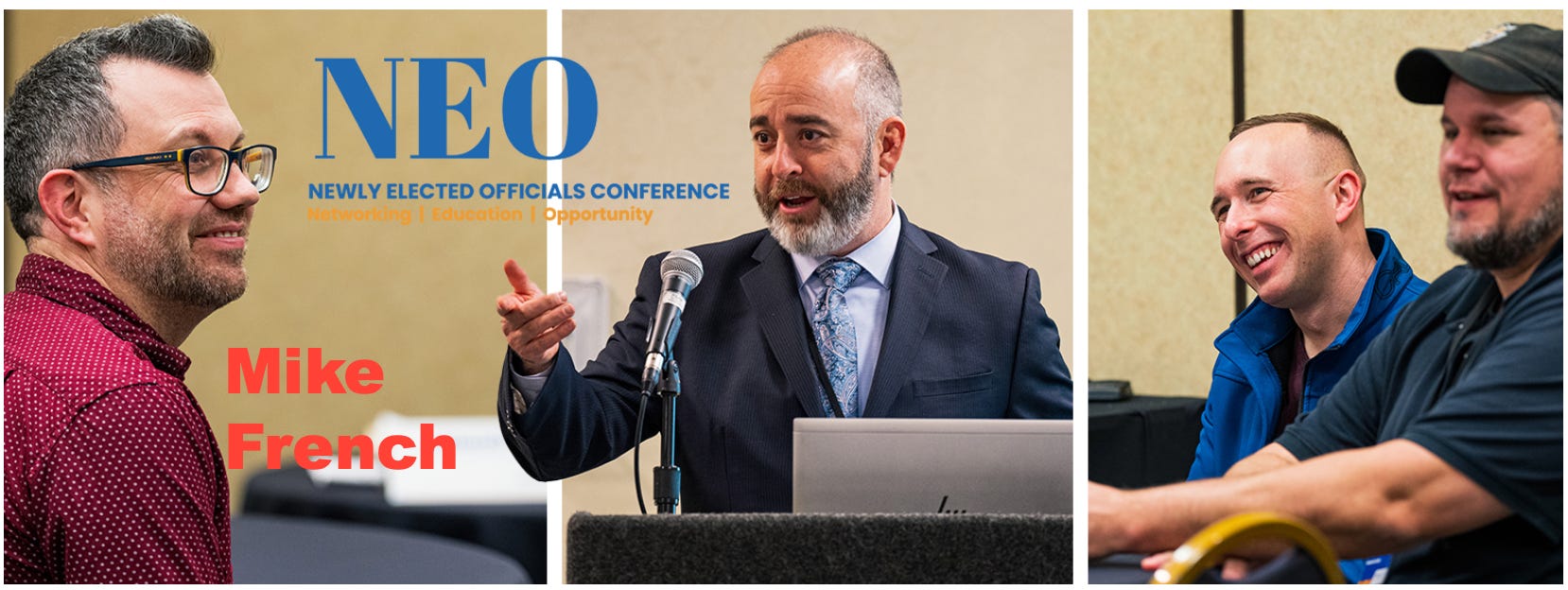
Mike French sits on WSAC’s Legislative Steering Committee. The association’s consistent product is more revenue tools for commissioners, not tools that force efficiency. Clallam staff have already told the board that separating the levies is “appropriate.” County CFO Mark Lane said doing so would cost about $19 more per year on a $500,000 home and that, without the separation, the general fund would have to subsidize those services more heavily. In other words, the dedicated pots stay funded (or grow), while the general levy is no longer required to carry them—freeing capacity for other spending. On your property-tax statement, the items that were previously buried inside the county’s regular levy can now appear as their own line items or rates. You still pay; the accounting simply makes the general fund look healthier while the total bill rises.
This is a one-time structural shift. Once the levies are separated, the county cannot keep “finding” the same relief next year. It is the same pattern as last year’s deficit theater: a historic shortfall produced a levy lid-lift request that voters rejected. Shortly afterward, millions suddenly appeared from previously un-revisited criminal-justice contracts with Sequim and Port Angeles. That too was one-time. The recurring answer remains higher taxes.
The Councilmanic Criminal-Justice Sales Tax
French is on record supporting the 0.1 percent criminal-justice sales tax authorized by House Bill 2015 (RCW 82.14.345). Through June 30, 2028, a county legislative body can impose it by ordinance or resolution—no public vote required—for “criminal justice purposes.” Staff have already modeled it as a way to close the general-fund gap and described it as adoptable without voters. An April 2027 start would bring an estimated $1.487 million in the first seven months of that year, according to the finance presentation. Annually, it’s estimated to add $2.1 million in taxes.
This is the same authority State Representative Natasha Hill (a progressive Democrat, like French) discussed. She called it a vote she did not want to take, then said Democrats put “guardrails” on it: locals must raise the tax themselves, spending is steered toward public defense, diversion, reentry, domestic-violence services, behavioral health, and crisis response, and jurisdictions must meet Criminal Justice Training Commission policy, training, and reporting rules or the state can withhold money.
In a widely circulated “chicken wing” video reported by Brandi Kruse, Hill went further, linking the strings to law-enforcement history, “slave patrols,” and immigration enforcement rhetoric.
The tax still stacks on top of Clallam’s existing 1994 0.1 percent criminal-justice sales tax (which is shared with the cities).
The 0.1% Housing Sales Tax He Put on the Ballot—and the North View Complex It Helped Build
At the same Democratic headquarters Q&A, French took credit for the 0.1% affordable-housing sales tax that began in Port Angeles and spread countywide. He told the audience that local developers “really had very little local match” for state and federal housing grants, so applications “were just scored terribly.” He continued:
“We investigated that and brought to bear local funding. We, the voters at the city of Port Angeles, were the first to vote on a one-tenth 1% sales tax that supports affordable housing. I was the person that proposed that we put it on the ballot. I was the person that appeared at a League of Women Voters forum endorsing that ballot measure… And when we as a local community use sales tax, we’re leveraging all of the tourism that happens to support this. Anyway, so this the voters at the city of Port Angeles adopted that local sales tax that led to the county commissioners adopting it countywide. And so now we have… over $2 million or around that amount annually that we can apply to the local match for these housing developments… We’ve been successful almost every year at getting a multi-million dollar award… That started with this building that’s up on the top of the bluff. It’s a 36 unit apartment building that Peninsula Behavioral Health opened last month.”
That building is North View, Peninsula Behavioral Health’s new complex. According to Peninsula Behavioral Health, the project prioritizes individuals with criminal records and active substance-use issues—exactly the population the county’s harm-reduction and behavioral-health programs already serve. French’s sales tax supplied the local match that unlocked the larger awards. The same commissioner who now defers to “experts” on animal control and supports new criminal-justice and levy-separation tools was the one who first put a 0.1% sales tax on the Port Angeles ballot so housing for the existing system's priority populations could move forward. The county simply followed.
The Cultural Access Tax That Never Really Left
French also pushed a 0.1 percent cultural-access sales tax to fund things like art therapy in jails, heritage, and related programs—also by commissioner-only vote rather than a public ballot. After leaked emails surfaced on CCwatchdog.com, the immediate push cooled.

With Ozias’s support still on record and French still on the board, the same idea is likely to return next year if he is reelected. The estimated revenue is roughly $1.8–2 million annually. The pattern is consistent: when voters or scrutiny intervene, the proposal is paused, not abandoned.
The Choice Is Clear
Every tool French and the WSAC network reach for expands the tax base or rearranges existing levies so the general fund has more room. None of them require the county to live within the revenue voters have already approved. The animal-shelter answer defers to nonprofits that are already funded. Separating veterans and developmental disability raises your property-tax bill while protecting dedicated spending and easing general-fund pressure. The criminal-justice sales tax can be imposed without a vote and is already modeled as gap-closing revenue. The 0.1% housing sales tax he personally put on the Port Angeles ballot supplied the match money that helped build luxury homeless housing. The cultural-access tax remains on the shelf, ready for another attempt.
If Mike French is reelected, the answer will continue to be more taxes. Not tighter contracts, not lower overhead, not living with the “no” that the voters already delivered. There will always be another way to go behind the voters’ backs, and it will be with another levy, another sales tax, or another separation that shows up on your statement.
Stay Engaged This Week
Today
The Board of Commissioners will hold a Budget Town Hall this evening, October 13, 2026 at 5 p.m. in the Commissioner’s Board Room 160, 223 East 4th Street, Port Angeles (or virtually on Zoom). The meeting will cover the Administrator Recommended Budget, the 6-Year Transportation Improvement Program (TIP), and a public question-and-answer session on both. Attend if you want a direct look at next year’s spending priorities and your rising taxes.
Thursday
The Calico Cat Club of Clallam County is hosting a Candidate Conversation for the 24th Legislative District (both positions):
Thursday, October 15, 2026
6:30–8:30 p.m.
Fairview Grange Hall, 161 Lake Farm Road, Port Angeles
Confirmed: Kaylee Kuehn, Marcia Kelbon, and Eric W. Pratt.
Incumbent Adam Bernbaum has been invited.
Each candidate will give a brief opening statement, followed by audience Q&A. Priority for questions goes to Calico Cat Club members, but the event is open. Questions go to the panel as a whole; discussion among candidates is encouraged. No “gotcha” questions.
This is much better than a voters’ pamphlet, show up.


