

A county cashier once walked off with more than $600,000 because one person took the money, recorded it, and reconciled the drawer. Shogren argues the Auditor is the last independent checkpoint before public dollars leave the treasury — and that Clallam is still rubber-stamping missing grant checks, a $5 “fee” that functions like a tax, and a $303.50 recording charge that mostly funds Olympia. Follow the money, she writes, or wait for the next unlocked drawer.
“Trust is not an internal control.” — Washington State Auditor Pat McCarthy
That sentence is the whole job description of a county auditor. Trust is what we owe one another as neighbors. It is not what you use to reconcile a cash drawer, approve a federal contractor, or explain a $303.50 recording fee that barely pays for recording. When government turns a blind eye, fraud does not announce itself. It finds the unlocked drawer, the unreviewed credit card, the “fee” that is really a tax, and the grant file with no paperwork.
I am running for Clallam County Auditor because that office is the last independent checkpoint before public money leaves the County Treasury. The Auditor audits claims before they are paid. The Auditor records the documents that transfer land. The Auditor signs the warrants for sixteen special districts. The Auditor is supposed to be the person who follows the money — not the person who shrugs and says the State Auditor will catch it later.
External audits catch about three percent of fraud. Tips catch forty-three percent. The Association of Certified Fraud Examiners estimates organizations lose roughly five percent of revenue to fraud every year, and that a typical scheme runs twelve months before anyone notices.
In small counties, the range cited for budget leakage — theft, timecard abuse, misuse of property, sloppy grant compliance — is often three to seven percent. That is not a rounding error. On a county budget, it is real money that never reaches roads, public safety, or the taxpayer’s pocket.
Here is what following the money looks like in Clallam County right now.
The unlocked cash drawer: Catherine Betts
From 2003 to 2009, Catherine Anne Betts was the cashier in the Clallam County Treasurer’s Office. She received real estate excise tax payments, recorded them, deposited them, and reconciled them — one person, start to finish. That combination is a textbook failure of internal control.
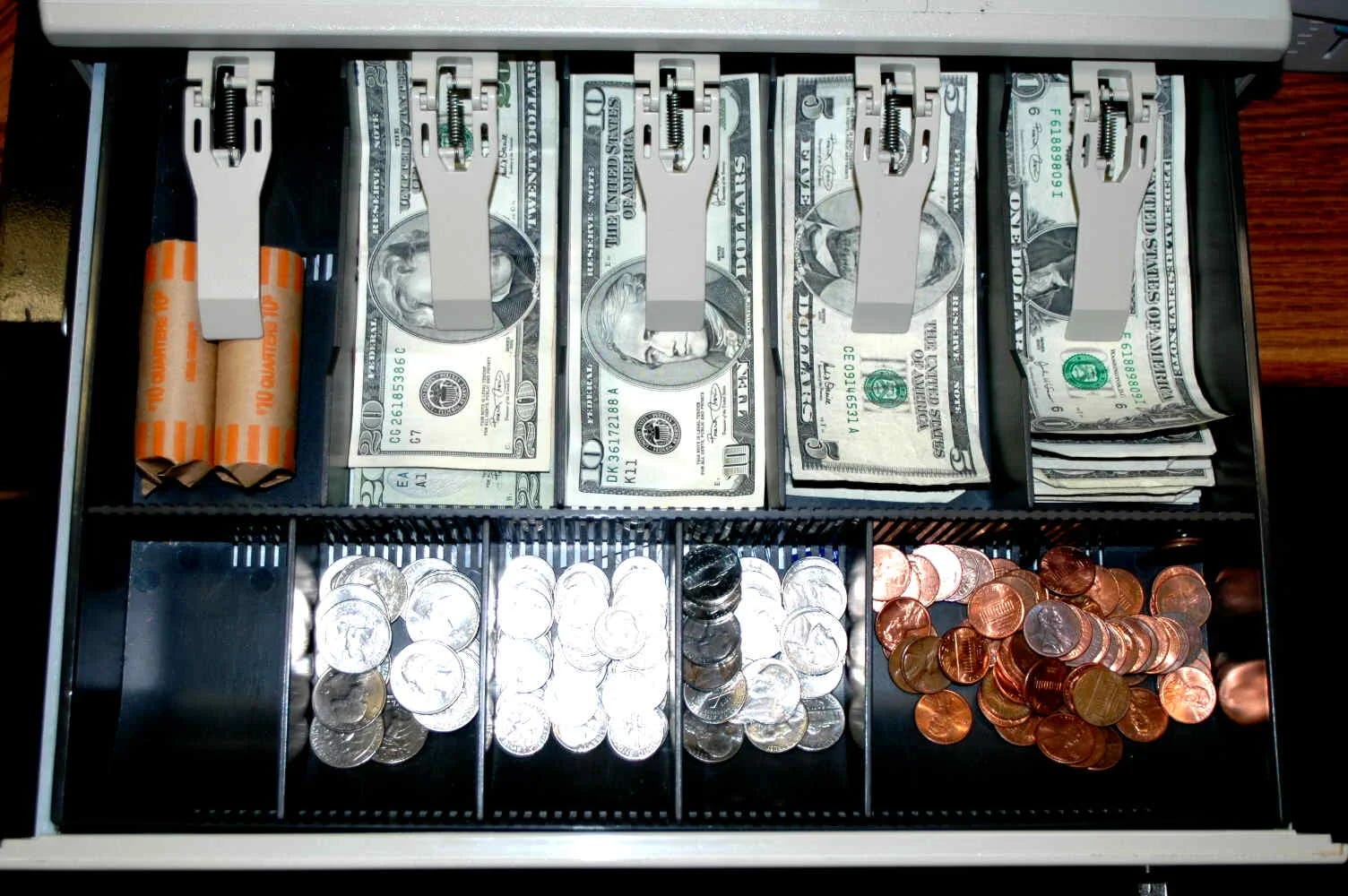
The scheme was simple and patient. Checks paid by the public were exchanged for cash from the drawer. Spreadsheets were manipulated with hidden entries. Documents were altered or destroyed. A State Auditor investigator later calculated cash shortfalls of at least $617,000; other estimates ran as high as $795,595. A jury convicted her in 2011 of aggravated first-degree theft, money laundering, and nineteen counts of filing false or fraudulent tax returns. She was sentenced to twelve years and ordered to pay more than $607,000 in restitution. Authorities never recovered the money.
The lesson is that Clallam County already knows what happens when no one separates duties, no one reviews the reconciliations, and everyone assumes the person at the window is honest. Insurance covered most of the loss. Controls would have prevented it. An Auditor who treats claim review as a rubber stamp is volunteering for the next version of the same story.
Questioned COVID dollars: statewide $1.17 billion, and a local finding
In June 2024 the Washington State Auditor released its review of how state agencies spent federal aid in fiscal year 2023. Auditors wrote a record 86 findings against 11 agencies and flagged about $1.17 billion as questioned costs — money that lacked adequate accounting to show it followed federal spending rules. More than half of those questioned dollars came from Coronavirus State and Local Fiscal Recovery Funds. Questioned costs are not the same thing as proven theft. They are the official way of saying: we cannot tell, from the file in front of us, that this was spent lawfully.
Clallam was not invisible in that era of federal money. The State Auditor’s report for the County’s 2024 books found that the County did not have adequate internal controls to ensure compliance with federal suspension and debarment rules on SLFRF (ARPA “COVID relief”) funds:
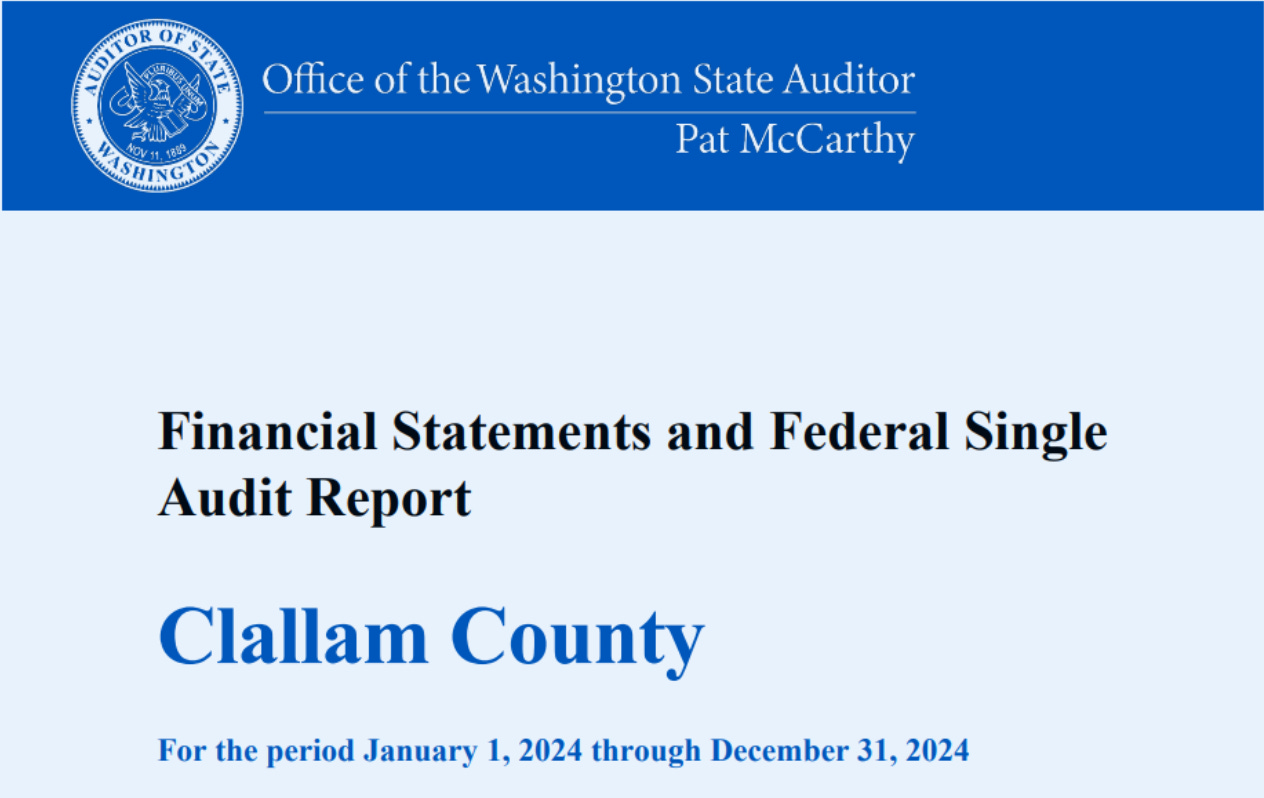
Federal law requires a check — a written certification, a contract clause, or a SAM.gov search — before paying $25,000 or more of federal money to a contractor. The County paid one contractor $31,239 without doing any of those three things.
By the time Report 1038644 was issued, the County had told the State Auditor the finding was fully corrected. Staff were now to route SLFRF purchases through grant administrators, who would verify debarment status before a contract or a disbursement.
In the same official schedule, the County still said it was only “in the process of amending its procurement policy to require that suspension and debarment required language be present in all agreements/contracts entered into by the County.” That rewrite was sitting with the civil division, delayed by “limited staff bandwidth and very high workloads,” with completion hoped for “sometime in 2026.”
An Auditor cannot rewrite federal grant law. An Auditor can refuse to treat a missing SAM.gov printout as a clerical inconvenience. Before a warrant issues on federal money, the file should show the verification. If it does not, the payment waits. That is not hostility to recovery programs. It is the minimum the federal government already required and that Clallam County, on at least one $31,239 contract, did not do.
A new per-parcel property tax dressed as a fee
On September 23, 2025, the Board of Commissioners adopted Resolution 70-2025 by a 2–1 vote and put a system of “rates and charges” on Clallam Conservation District parcels for ten years, 2026 through 2035. Most residential parcels pay $5.00 a year. The District projected about $194,600 in the first year. Over a decade, that is roughly two million dollars taken from property owners, appearing on the same statement as the property tax.
I challenged the charge in superior court as an unconstitutional tax under Article VII of the Washington Constitution and the three-factor test in Covell v. City of Seattle. A true fee is tied to a specific service or burden on the parcel that pays it. This charge funds broad, voluntary conservation programs — education, monitoring, habitat work, grant writing, technical assistance — whose benefits the District itself describes as general and community-wide. It is a flat amount, not a measured nexus to any particular lot.
Instead of support for programs, taxpayer funds have moved into operating accounts and have been used for administrative overhead and for legal defense of the very charge being challenged.
In April and May 2026 alone, “Clallam County Support Funding” — the vehicle for these parcel charges — came in at $22,975.13 and then $71,731.20. May 2026 legal bills included approximately $6,400 to the Seattle law firm Foster Garvey. The Conservation District represents that every dollar collected “stays local” – their own treasurer reports say otherwise:

The superior court granted the County and the District judgment on the pleadings and dismissed the case with prejudice on May 22, 2026. I did not accept that as the last word. I appealed. The opening brief is on file in the Court of Appeals, Division II, No. 62466-4. The question on appeal is whether a county may impose a flat per-parcel charge to fund general public programs and call it a “fee” so it never has to meet the constitutional rules that govern a tax.
Why does this belong in an Auditor’s race? Because the Auditor is the office that will keep seeing this money move — from the Treasurer’s collection, onto District warrants the Auditor’s finance staff process, through reports the public is asked to trust. If we cannot even get a clean answer to whether parcel “fees” are restricted to conservation projects or may pay overhead and litigation, we are not following the money. We are rubber-stamping a “fee” label on what functions as a tax.
Recording fees: a $303.50 first page that is mostly Olympia’s housing policy
Record a deed for anywhere in Clallam — Forks, Sequim, or Port Angeles — and the first page is $303.50. A deed of trust is $304.50. Extra pages are $1. The price does not change with the property. What has changed is that most of that first-page total is a statewide surcharge stack, not what it costs the Auditor to scan the page.
Washington still lists the old service charge in RCW 36.18.010: $5 for the first page and $1 after that. RCW 36.22.250 adds a $183 “document recording surcharge.” Of that $183 surcharge, $126.27 is remitted to the State Treasurer for three Department of Commerce accounts: $99.00 to the Home Security Fund, $23.97 to Affordable Housing for All, and $3.29 to the Landlord Mitigation Program.
RCW 36.22.185 adds an additional $100 for a “Covenant Homeownership Program assessment.”
The $100 Covenant assessment funds a statewide special-purpose credit program. The Legislature required a Covenant Homeownership Program Study — delivered in March 2024 by the National Fair Housing Alliance for the Housing Finance Commission — to document housing discrimination in Washington and to define who the program serves. https://wshfc.org/sites/default/files/2026-09/WSHFCWACHPFULLSTUDY32024.pdf
A separate research project — the University of Washington / Eastern Washington University Racial Restrictive Covenants Project — mapped tens of thousands of racially restrictive deeds and helped make a political case for the bill:

A qualifying Clallam buyer can apply. Most people who record a deed, refinance, or file an easement here will never see that $100 again.
Smaller preservation and archive add-ons push the posted first page to $303.50. A 2025 bill, HB 1858, pulled still more documents — assignments and substitutions of deeds of trust that used to be cheaper — into the high-fee stack.
On a standard first page, $57.73 stays in Clallam County the day you pay — roughly 19 cents of every recording dollar. About $225, or 74 cents of that $303.50, remits the same cycle to Olympia accounts. Some state grant money can return later for local homeless and housing work. That is real shelter funding. It is also money from a statewide pool Clallam County does not control.
Typical U.S. first-page recording fees run $10 to $50. California’s housing add-on is $75.
We should call the $303.50 what it is: a hidden tax on buying, selling, refinancing, and clearing title, charged the same in Clallam County as in King County.
As Auditor, I will show the breakdown on the fee schedule: here is the $5 service, here are the Olympia surcharges. If we want cheaper recording fees, the fight is RCW 36.22.250 and RCW 36.22.185. Until then, every closing in Clallam County is paying for metro housing policy on a rural paycheck.
A Public Integrity Unit — because the reporting path is broken
The pitch for a Public Integrity Unit starts with what has already happened here.
The State Auditor found that the executive director of the Shore Aquatic Center personally benefited from self-insurance payments, a payroll-tax refund that belonged to the district, and credit-card charges totaling more than $41,000, with additional questionable expenses behind that. Two of three County Commissioners sit on the pool district board. The Prosecutor cited a conflict and sent the matter to the Attorney General. Months passed with the director on paid leave before the district board terminated him.
A former Clallam PUD line foreman was paid $24,726 in residency stipends for living in Forks when a state audit found he was not residing there. A former DNR forest-check cruiser was accused of misappropriating about $28,800 in public funds. The “Doc Holiday” DNR land matter required a special deputy prosecuting attorney under RCW 36.27.040 and was referred to Kitsap. Public-records litigation revealed thousands of pages that should have been produced years earlier.
Clallam County has no independent place to take a suspected-employee-fraud complaint. The Sheriff’s public complaint portal is for Sheriff employees. A crime report is supposed to go to the agency with jurisdiction. That is not a reporting system. That is a closed loop.
San Bernardino County’s District Attorney maintains a Public Integrity Unit that investigates and prosecutes misuse of public funds, campaign and residency violations, bribery, timecard fraud, database abuse, and school and development schemes. The case list is not theoretical: a DA employee gambling in a county car on county time; fraudulent off-work orders; a supervisor arrested in a meeting; charter-school fund theft; payroll and travel-document fraud. The unit exists so a complaint does not have to travel through the accused person’s own chain of command.

A Clallam Public Integrity Unit does not require a new department. A part-time investigator with warrant and evidence experience, contracted as needed, would provide the county a place to send a tip that is not the suspect’s supervisor and is not the Attorney General’s 2,000-complaint-a-month inbox.
The common thread
These stories look unrelated only if you stop at the department name. COVID grant files, a cashier’s drawer, a $5 parcel line, a $303.50 recording window, a pool director’s credit card — they are the same failure in different clothing. Someone collected public money. Someone spent it, or sent it, or renamed it a fee. And the office that was supposed to look at the paper before the warrant printed treated the paper as a formality.
Deep Throat, at least in the movie, told the reporters to follow the money. The line is famous because it is ordinary. Money leaves a trail. Fees that are taxes leave a trail. Missing SAM.gov checks leave a trail. A cash drawer that only one person reconciles leaves a trail. The question in this race is whether Clallam’s Auditor will follow that trail or stamp the claim and move on.
Trust is not an internal control. Sunlight is. If you want an Auditor who follows the money — through the recording window, the grant file, the special-district warrant, and the parcel “fee” — that is the job I am asking you to hire me to do.
Virginia Shogren
Candidate for Clallam County Auditor
961 W. Oak Court, Sequim, WA 98382
Virginia Shogren wrote this article, with research and editing assistance from an AI tool. She is a candidate for Clallam County Auditor. Neither the candidate nor her campaign paid Clallam County Watchdog for publication, and Watchdog paid nothing to the author. Learn more at virginiashogrenauditor.com.


