


(Read Part I first: “The Board Wrote Futurewise’s Lawsuit for Them.”)
This is the second half of what happened at the Comp Plan hearing. The first half was Jake Seegers warning the Board it had already written Futurewise’s lawsuit for them. This piece is about the activist NGO that sues counties—and the county association that will not fight it—plus what Commissioner Mike French said days later when asked about those same extreme numbers.
Read Futurewise’s own website. Futurewise was founded as the watchdog of the Growth Management Act. In a normal year, it runs 15 to 20 active legal appeals. During this statewide Comp Plan cycle, it expects its work to triple.

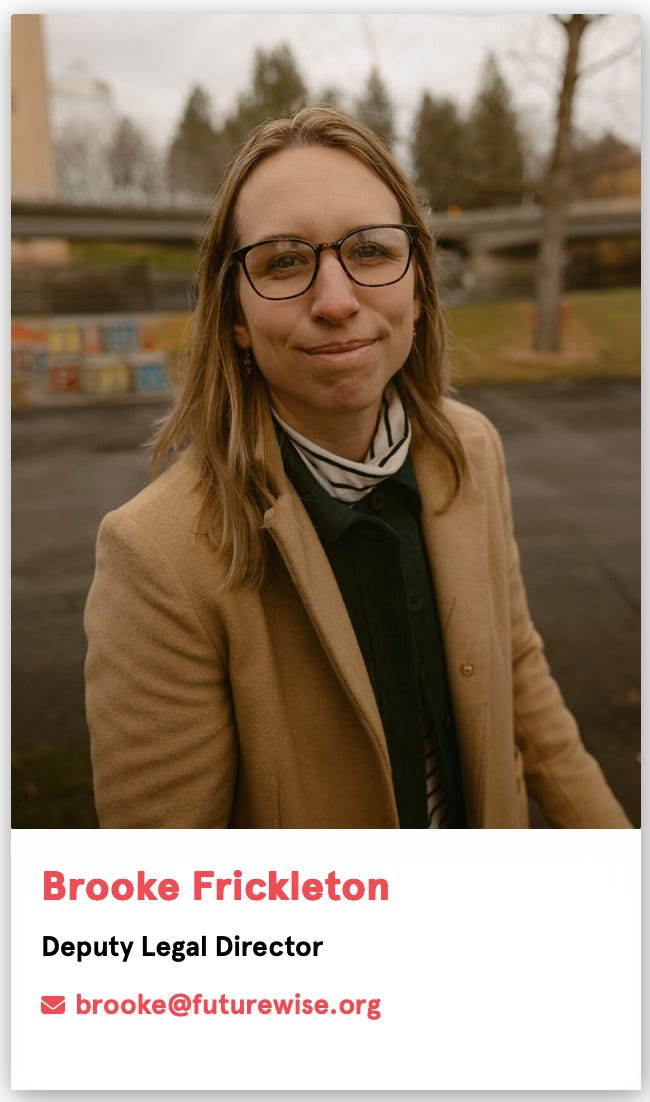
It advertises that it wins about 70 percent of the appeals it brings. Brooke Frickleton, who spoke at the first hearing on the county’s comprehensive plan, is a staff attorney. They comment early. Then they sue. Counties know the pattern. County staff is pressured to write extra language “just in case.” Commissioners adopt it so they will not spend two years in front of the Hearings Board. That is how activist policy becomes local law without anyone voting on it.
Thurston County is the example that Frickleton presented to the commissioners. Futurewise challenged Thurston’s new climate element. The Hearings Board found the County’s action “clearly erroneous.” Futurewise’s own write-up calls it the first real test of House Bill 1181 and “the clearest guidance yet on what compliance looks like.” Frickleton told Clallam the same: soft words aren't enough. As they read it, the statute wants timelines, named responsibility, measures of progress, and priority for “overburdened communities.” Translation: if you put a fat vulnerability study in the record and then write “encourage,” they will come back demanding “shall.”
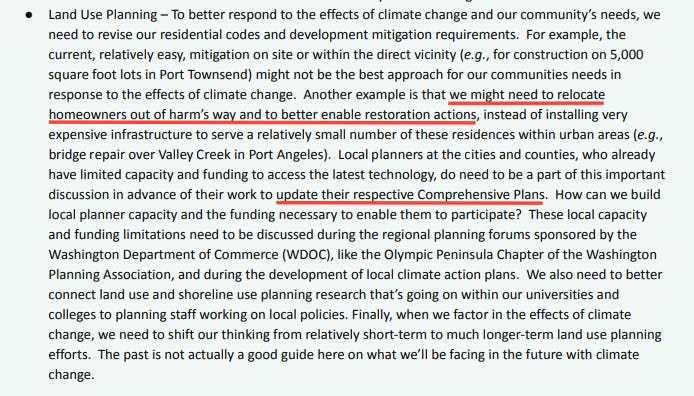
Clallam County produced the Climate Vulnerability Assessment, loaded it with the highest-end projections, and placed it in the official Comp Plan record — giving Futurewise ready-made evidence it can quote in a future appeal to demand stricter, action-forcing policies.
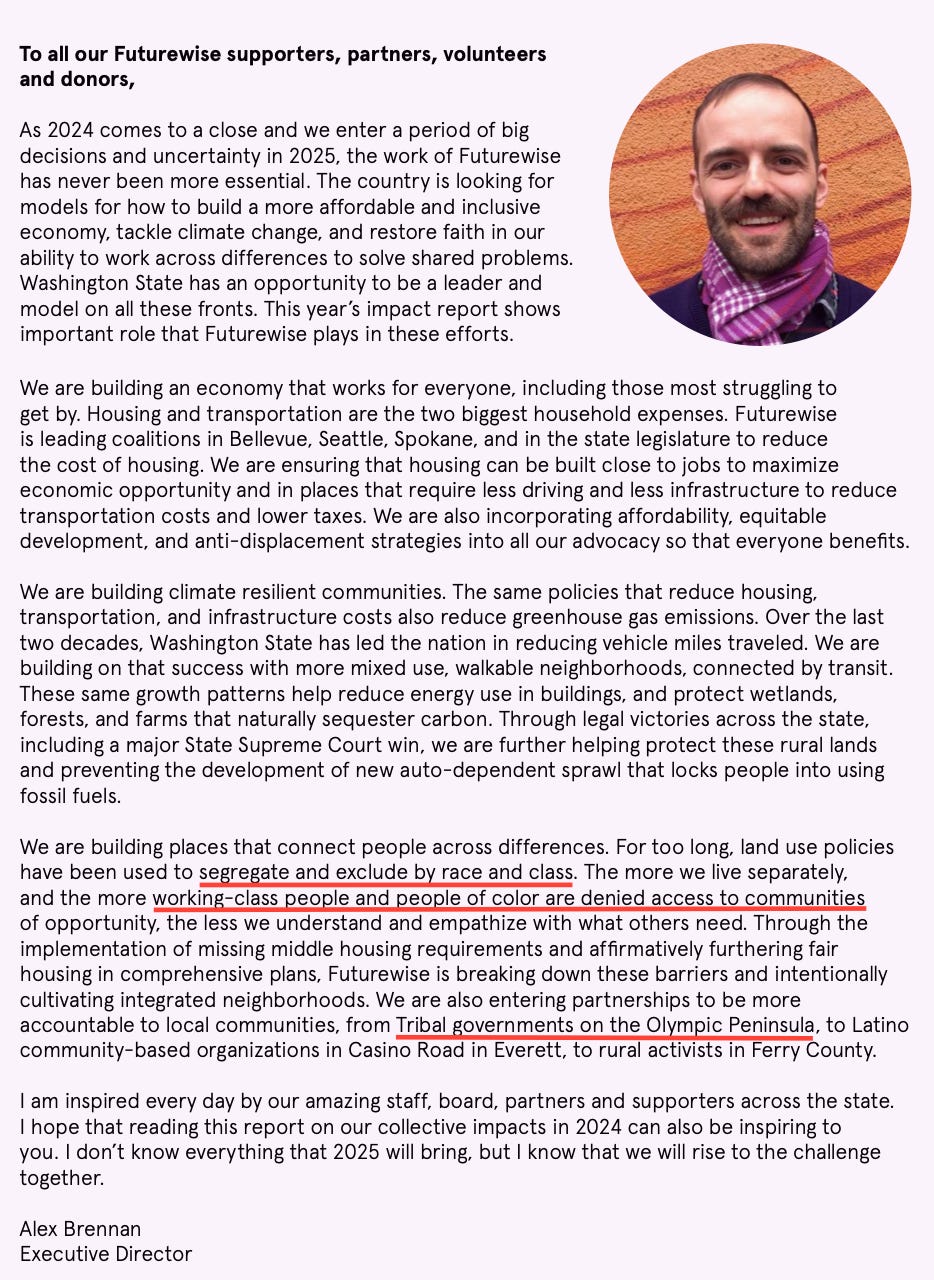
Futurewise’s 2024 impact report says it is partnering “from Tribal governments on the Olympic Peninsula” and that it received a Commerce grant “to support tribal participation in the Clallam and Jefferson County comprehensive plan updates.”
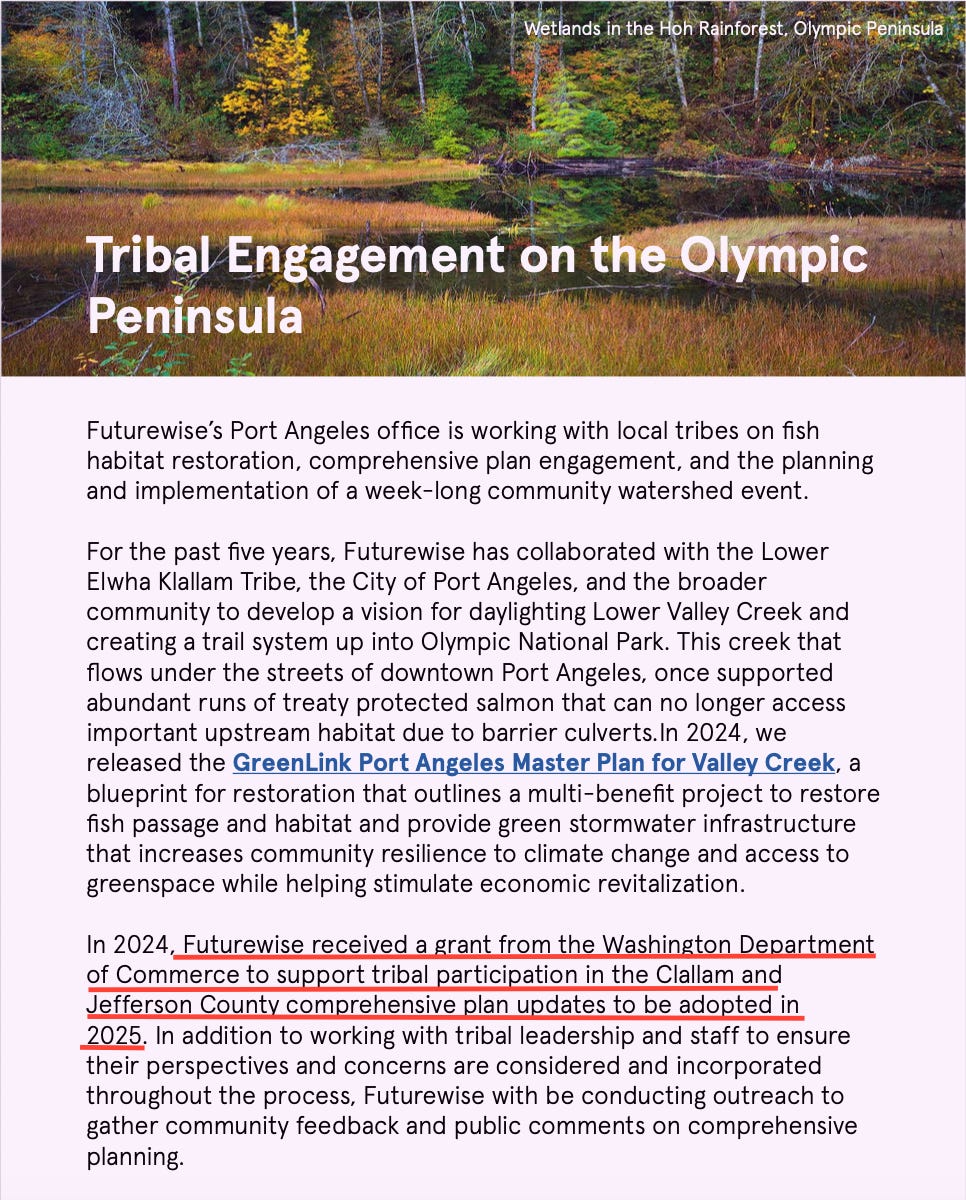
Futurewise has a Port Angeles office. It has spent years on GreenLink and pushing to daylight Lower Valley Creek. When Frickleton says “action,” she means the Comp Plan language Futurewise can later quote in a Hearings Board petition to force stricter county rules — not help for any individual property owner.
Jake Seegers already told the commissioners and Director Emery the quiet part: building the CVA around extreme assumptions and letting activists already committed to one climate-policy outcome run the process was a mistake.
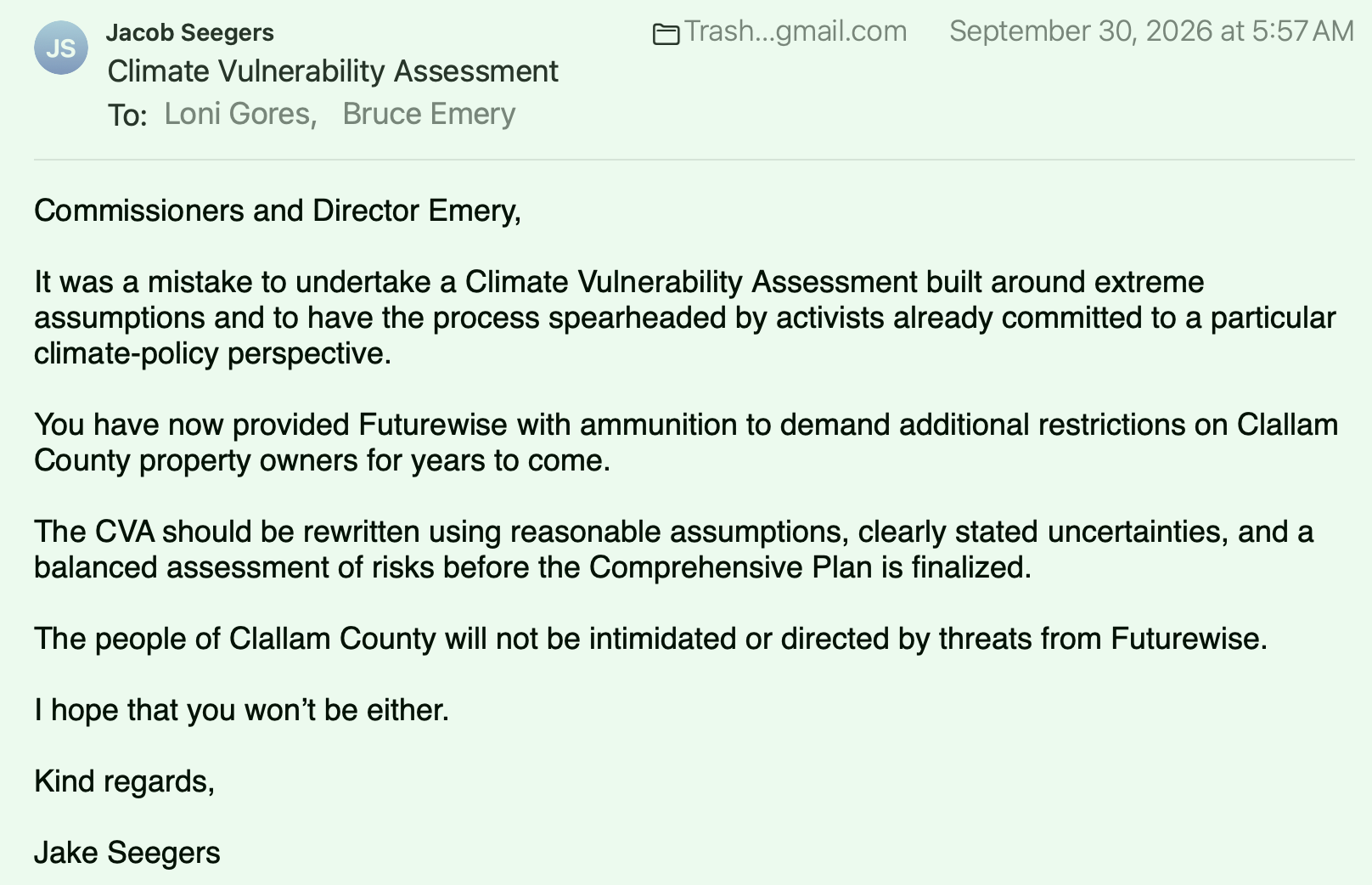
The commissioners and DCD have now given Futurewise ammunition to demand more restrictions on Clallam County property owners for an entire generation.
The numbers Jake flagged are still in the document
Open the Climate Vulnerability Assessment the county paid for. NOAA: since 1895, Clallam’s average annual temperature is up 1.4°F. That is more than 130 years of actual record.
Then the next sentence: by the end of the century, average summer maximum temperatures are projected to rise 9°F from a historical baseline of 68.4°F.
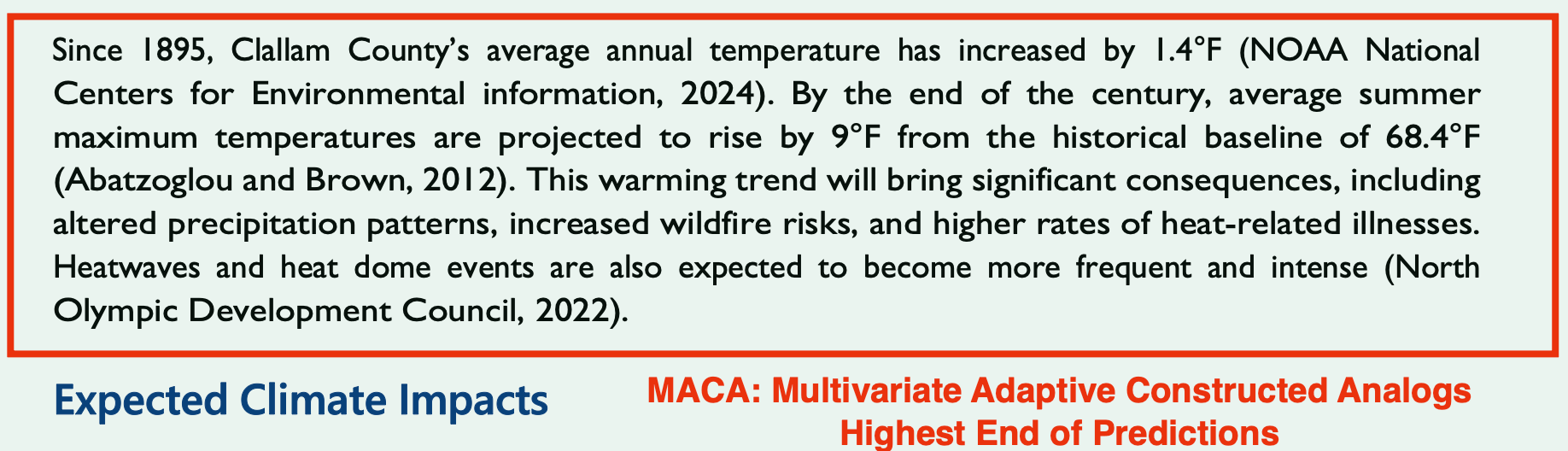
The source is a 2012 downscaling method. The CVA primarily uses RCP 8.5 — the highest-emissions, “business-as-usual” pathway that assumes emissions keep rising as if nothing changes. Under that scenario, the document projects roughly 6°F mid-century and 9°F by 2100 for Clallam. The period from today to the end of the century is about 74 years.
One-point-four degrees in 130 years of real measurements. Nine degrees in the next 74 years under the hottest scenario the consultants chose and then treated as the working forecast. That is the record Futurewise can quote. That is what “best available science” looked like once the consultants and the process participants locked it in.
Mike French continues to insist the Climate Vulnerability Assessment was required by state law. It was not.
On October 6, at the Port Angeles Business Association candidate forum, Commissioner French said of the Climate Vulnerability Assessment: “This is something that is a state requirement, and it should be led by best available science, not by ideology.” (Timestamp 18:54)
Later the same day, at a Clallam County Democrats Q&A, he again treated the Assessment as a legal obligation. He called it a necessary “data collection exercise” required once the legislature mandated climate planning, and he insisted it was driven by best available science rather than ideology.
Mike French is mistaken.
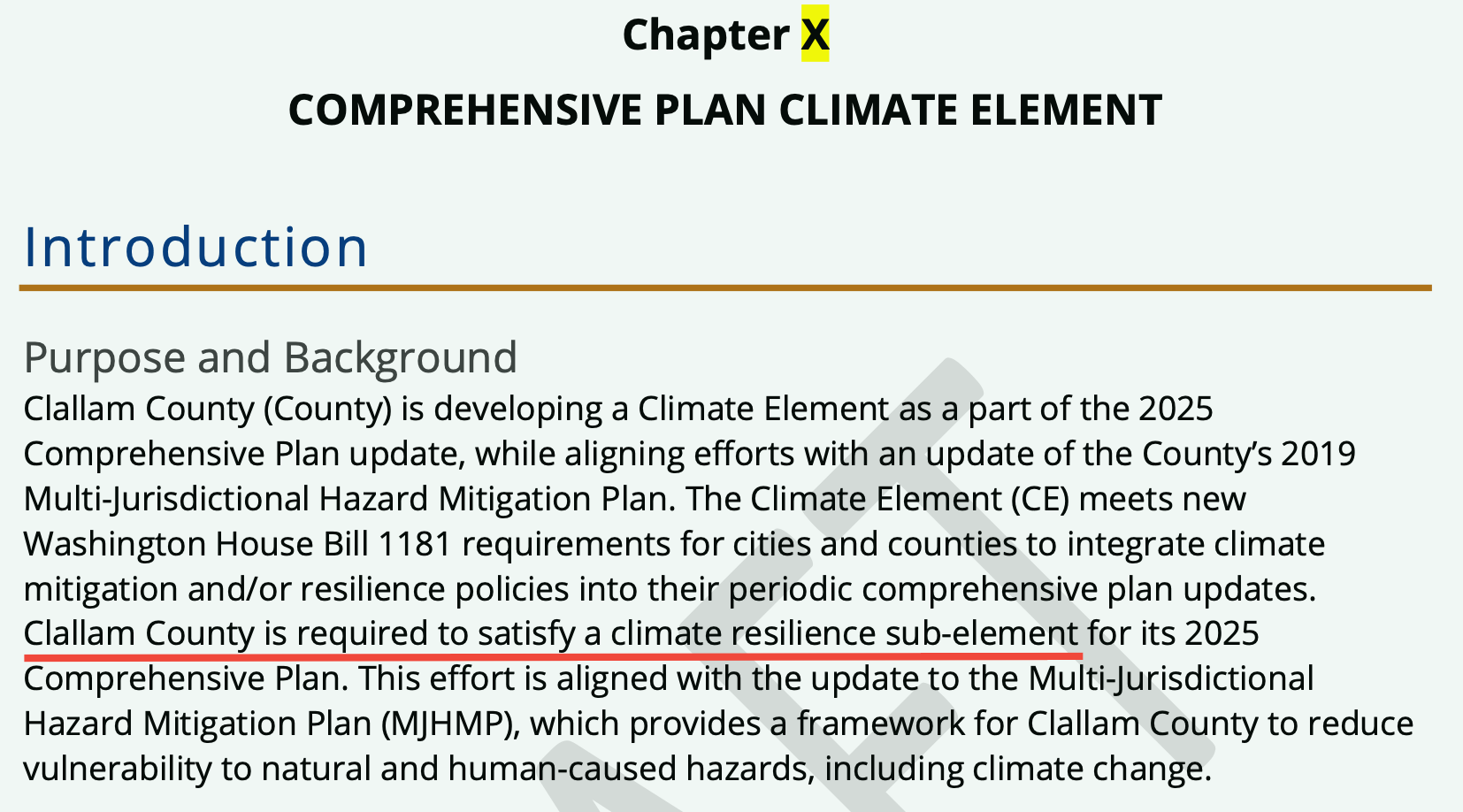
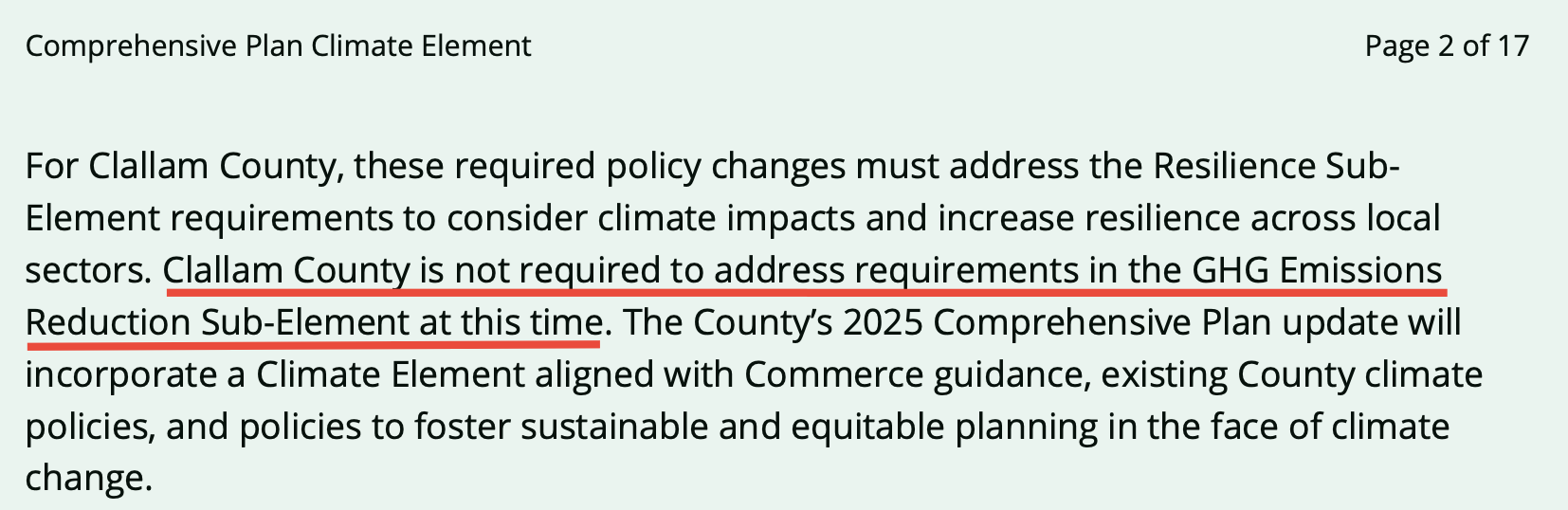
House Bill 1181 requires fully planning counties, including Clallam, to add a climate element to the comprehensive plan. For Clallam, that means only a resilience sub-element. A greenhouse-gas reduction sub-element is mandatory solely for 11 larger counties; Clallam is not one of them. Clallam’s own draft Climate Element says this in plain language: the county “is required to satisfy a climate resilience sub-element” and “is not required to address” the greenhouse-gas section. The same draft notes that staff exceeded HB 1181's minimum requirements.

Washington Department of Commerce guidance treats a climate vulnerability and risk assessment as optional. Jurisdictions can meet the resilience requirements by adapting existing policies, adopting a conforming hazard mitigation plan by reference, or other pathways. The guidance explicitly says a vulnerability assessment “may not be necessary for every county or city.”
The statute requires goals, policies, and programs consistent with best available science and credible projections that address climate-exacerbated hazards and prioritize overburdened communities. It does not require a standalone Climate Vulnerability Assessment document of the kind Clallam commissioned, filled with the highest-end RCP 8.5 projections, and placed in the record. That was a local choice. French’s continued insistence that the CVA itself was required by state law is simply incorrect.
How French and Ozias Fast-Tracked the Study They Now Call “Required”
On February 5, 2024, the Clallam County Board of Commissioners approved a professional services contract with Cascadia Consulting Group for $369,535. The scope was to “update the Hazard Mitigation Plan alongside the development of the Comprehensive Plan Climate Element.” That work included the Climate Vulnerability Assessment.
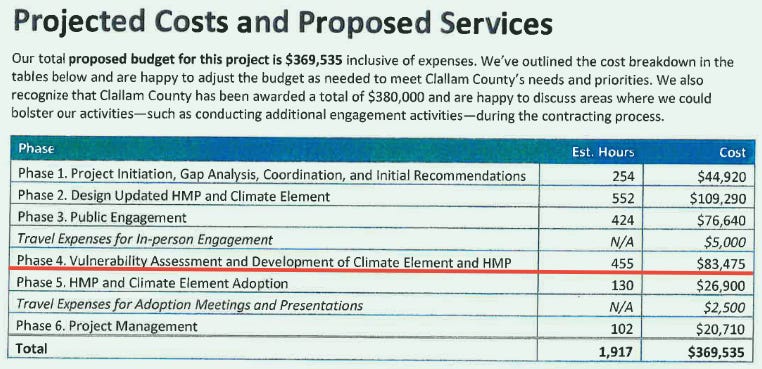
Commissioner Mike French moved to approve the contract; Commissioner Mark Ozias seconded. The process was accelerated — the usual eight-day review was shortened to about 24 hours while Commissioner Randy Johnson was absent.
A later amendment extending the Cascadia contract (covering the same hazard-mitigation and climate-element work) was approved unanimously on February 25, 2025. The finished Climate Vulnerability Assessment report itself was adopted by the Board around September 2025.
When resident John Worthington later raised the Cascadia contract and the spending during a budget meeting, Commissioner Mike French told him he was wrong—that no such contract existed or had not come before the Board. Public records showed otherwise. The episode is documented in the Clallam County Watchdog piece “There’s a hole in the budget, dear Liza.”
With Commissioner Randy Johnson out of town, Mike French moved the contract and Mark Ozias seconded. That is how the Climate Vulnerability Assessment — the document the county was never required to produce — was put in motion and later fed to the North Olympic Development Council (the nonprofit Ozias leads) to help shape the Comp Plan behind closed doors alongside tribal governments. The result is a plan that will make the next 20 years in Clallam County less affordable and more regulated, while giving tribal enterprises and governments the advantages they need to continue acquiring property. As the Watchdog reported in “Climate Change of Address,” that is exactly what they said they would do with the Comp Plans in 2021—and that’s exactly what they are doing.
French’s answer at the Clallam County Democrats event, October 6
Four days after the first comprehensive plan hearing, at a Clallam County Democrats Q&A, French was asked about his opponent’s comments that the county used extreme assumptions from the Climate Vulnerability Assessment. His reply:
“So the question was about this morning at a debate there was a question that my opponent stated something about the climate vulnerability assessment in our comprehensive plan update and he made some what I think are pretty outlandish claims about it. … [HB 1181] requires us to plan for climate change… climate change is a reality and it absolutely impacts development… Water being by far the most… in 100 years we can see how glaciers have basically disappeared in the Olympic Mountains or shrunk considerably and many of our water sources are largely glacier fed including the Dungeness and Elwha rivers.
So that requirement to plan for climate change… we then had to do some data collection… that’s what that climate vulnerability assessment is — basically a data collection exercise to know what are we planning for, what is the worst case scenario, what is the best case scenario, what’s an average scenario. And I think that everything that you heard from my opponent is just rhetoric and it is just ideological opposition to climate change interventions. I certainly don’t share his opinions. … [A Planning Commission member] said what drove that process was best available science. That’s what drove the process, not ideology, not some extreme assumptions. … I trust the process that we went through. I know the county staff… They’re not scheming around their personal ideological positions. They’re professionals… this is an obvious case of my opponent has very strong ideological positions and he’s accusing… Anyway, I don’t think that’s what happened with this climate vulnerability assessment. I think it was driven by best available science.”
That is Mike French’s defense: the 9°F summer projection under RCP 8.5 isn't extreme; calling it extreme is “ideology.” The same document that records 1.4°F of observed warming since 1895 is now the “best available science” that must govern Critical Areas, shorelines, wells, and housing for the next 20 years. French treats choosing the hottest pathway and the leap from observed history to that projection as unremarkable data collection. The Planning Commission member he cites is defending the process he helped run. The public is told the alternative is mere “rhetoric.” And he continues to claim the study itself was required by law when it was not.
WSAC could have been the shield. Clallam turned it into a tax lobby
The Washington State Association of Counties (WSAC) exists to be “a voice for Washington State’s 39 counties.” Its job is to advocate for counties. Its president is currently Clallam County Commissioner Mark Ozias. Mike French sits on the legislative steering side that decides what WSAC pushes in Olympia. Randy Johnson is a member.
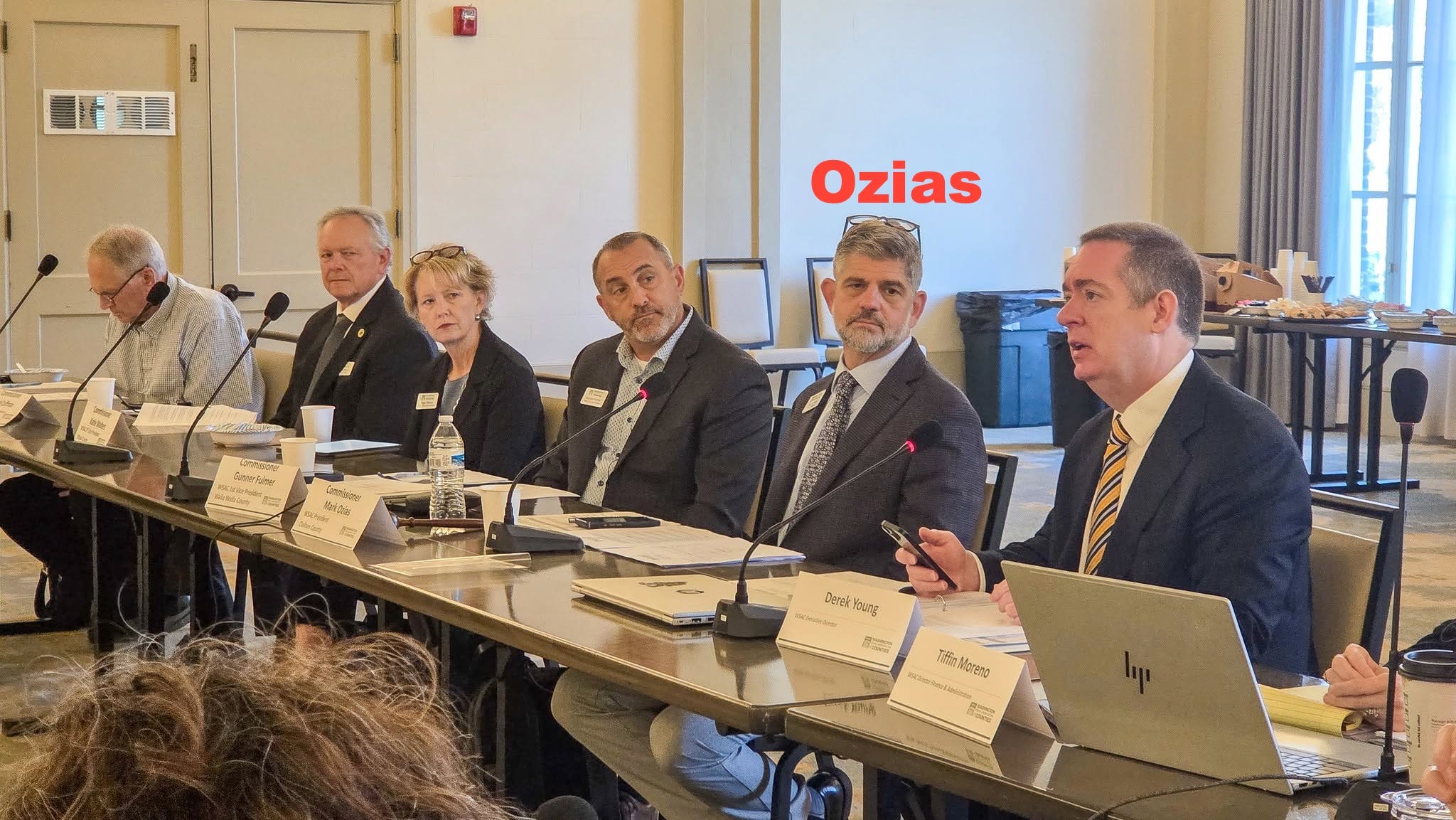
If any county in the state had the muscle to tell Futurewise to back off, it is the association whose president represents Clallam. WSAC could stand in Olympia and at the Hearings Board and say: counties will meet the statute — but they will not be bullied past it.
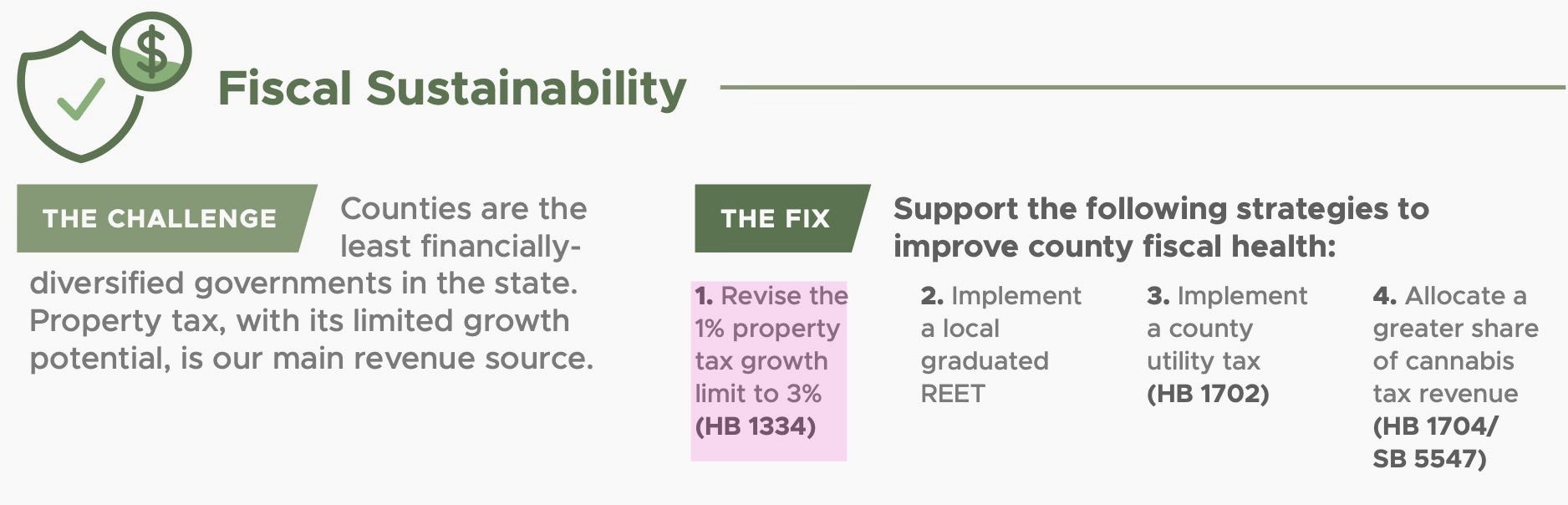
WSAC does not do that. Instead, they push for taxes voters haven't approved.
Its statewide habit is consistent: raise the maximum amount commissioners can levy without a public vote (from 1 percent to 3 percent) and support a pay-per-mile tax. More board-only taxing power. More “flexibility” for the dais while cutting constituents out.
Fighting a Seattle land-use litigator who openly advertises 15–20 appeals a year and a 70 percent win rate would have defended every rural county in the association. Instead, the president of WSAC is the same commissioner whose nonprofit circuit (the NODC) helped write the climate mandate that Futurewise is now holding. You can't fix that with a mission statement. You fix that conflict by showing up for the people who still pay the dues.
A Comp Plan is not a brochure. It is the 20-year instruction book for Critical Areas, shoreline rules, housing, wells, rentals, and what “climate risk” means when a planner is considering issuing you a permit. Extreme assumptions in, extreme code out. Futurewise does not need to invent a record. Clallam County, under the leadership of Board Chair Mike French, already typed it up for them under the false claim that it was “required.”
Tomorrow, Tuesday, October 13, 10:30 a.m. — pack the room
If the next 20 years in Clallam County matter to you, sit where they have to see you. Do not send one polite email and stay home.
Tell the commissioners and DCD Director that Futurewise does not get a veto. Tell them the Climate Vulnerability Assessment wasn't required by state law—only a climate resilience element was. Tell them to meet HB 1181 only — not the extra vulnerability study, not the hottest forecasts, not the activist rewrite. Tell them the 1.4°F of real warming since 1895 is not the same thing as locking a 9°F summer projection under RCP 8.5 into the plan that governs your property for two decades. Tell them you do not want that extreme set of assumptions turned into the instruction book for the next generation of permits, buffers, and restrictions.
Write all three commissioners through Clerk Loni Gores at loni.gores@clallamcountywa.gov and write DCD Director Bruce Emery at Bruce.Emery@clallamcountywa.gov.
If they will not serve the people in the room, those people will stop treating the dais — and WSAC — as anything but another nonprofit that answers to someone else.
Read Part I if you have not already. Then show up Tuesday.
Bonus: From Citizens to Residents: Who Gets a Say?
In the draft Comp Plan, the county is quietly replacing the word “citizens” with “residents” in the public-participation section (31.01.500). The original text described how the County reached out to “citizens and landowners.” The new language says “residents and landowners.”
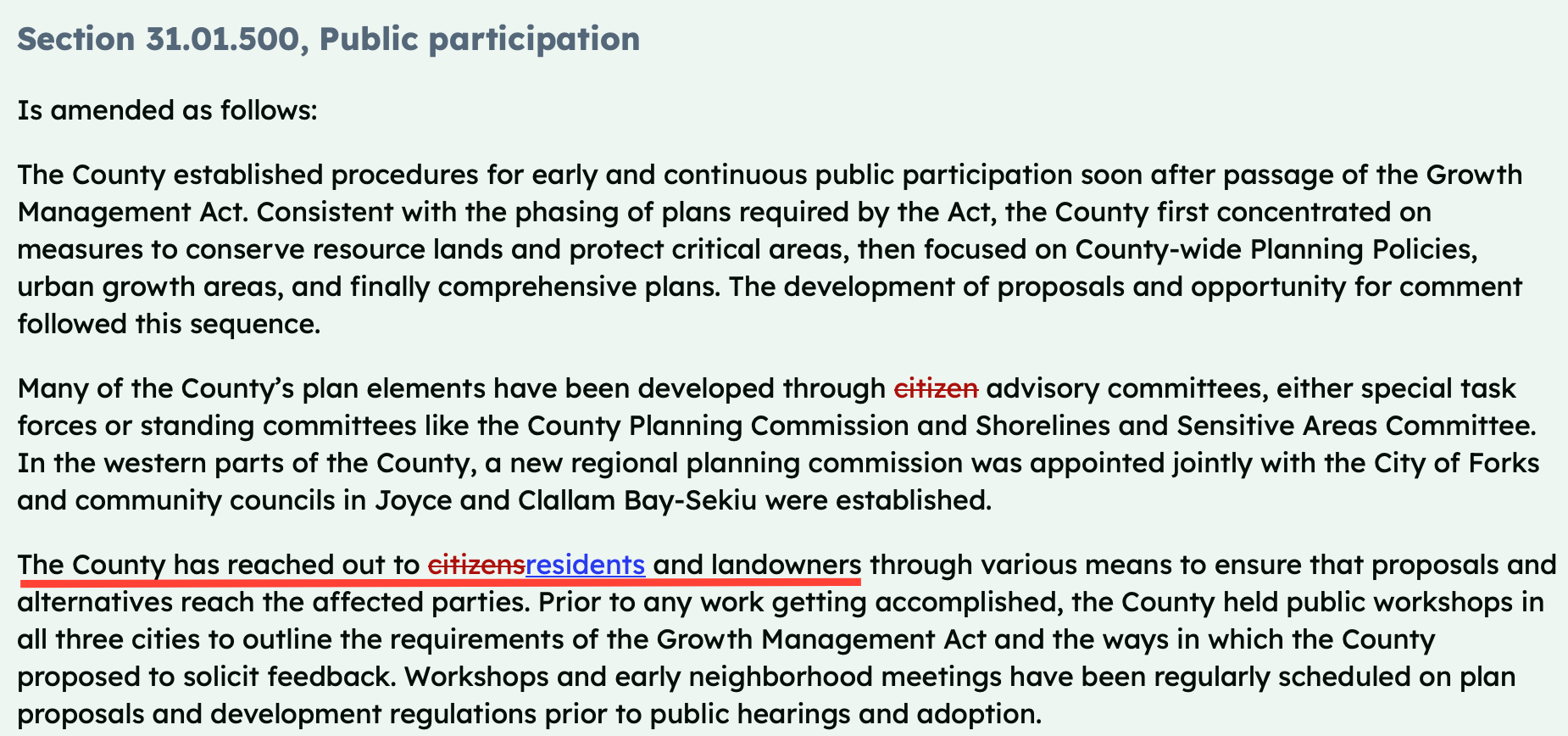
“Citizen” has a legal meaning. “Resident” does not. The change is small, but it broadens who the county is inviting into the process that will set the rules for Critical Areas, shorelines, wells, and housing for the next 20 years. The draft does not explain the switch or limit the new language to people who are lawfully present. If the next 20 years of Clallam County land-use policy matter, that is a change worth asking about.
Stay Engaged This Week
The Calico Cat Club of Clallam County is hosting a Candidate Conversation for the 24th Legislative District (both positions):
Thursday, October 15, 2026
6:30–8:30 p.m.
Fairview Grange Hall, 161 Lake Farm Road, Port Angeles
Confirmed: Kaylee Kuehn, Marcia Kelbon, and Eric W. Pratt.
Incumbent Adam Bernbaum has been invited.
Each candidate will give a brief opening statement, followed by audience Q&A. Priority for questions goes to Calico Cat Club members, but the event is open. Questions go to the panel as a whole; discussion among candidates is encouraged. No “gotcha” questions.
This is much better than a voters’ pamphlet, show up.


