


Lincoln warned that a free people die by suicide, not by foreign armies. Shogren applies that to Clallam elections: a tabulation system she says an auditor once called “easily hackable,” a results page that opened with a password during testing, and a canvassing board that said refusing to certify is a crime. If the public cannot watch the count without a vendor password, she writes, the county cannot correct course at the polls.
“Shall we expect some transatlantic military giant, to step the Ocean, and crush us at a blow? Never! All the armies of Europe, Asia and Africa combined … could not by force, take a drink from the Ohio, or make a track on the Blue Ridge, in a trial of a thousand years.
At what point then is the approach of danger to be expected? I answer, if it ever reach us, it must spring up amongst us. It cannot come from abroad. If destruction be our lot, we must ourselves be its author and finisher. As a nation of freemen, we must live through all time, or die by suicide.”
— Abraham Lincoln, Lyceum Address (1838)
If the United States is a tank, you do not destroy it from the outside. You disable it from the inside. On the Peninsula, that does not mean a foreign army. It means election software no one here can lawfully inspect.
Official channels tell us that ballots are “processed” or “accepted.” They rarely say, in plain language, that each vote was counted as cast. I think that gap in language matters. What I can show from this county is not a courtroom verdict that any race was switched. It is a pattern: vintage certification, early access to a results screen, a canvassing board told that refusal to certify is a crime, and officers who treat “we follow the law” as a reason not to look. That pattern is consistent with a system the public cannot independently verify. If the ballot box cannot be verified, the county cannot course-correct at the polls.
What I have documented in Clallam County
People reasonably ask what any of this has to do with this county. Below is what I have witnessed and put on the record.
Clallam County Auditor: “easily hackable,” and a vendor the auditor is not allowed to identify
In 2016, during the Democratic presidential primaries, I sat down with Auditor Shoona Riggs to raise election-integrity concerns. As I have stated publicly since that meeting, Auditor Riggs told me that the electronic system Clallam County uses to tabulate votes is “easily hackable.” She further said that a vendor representative comes to each machine before each election to “work” on it, and that she is not allowed to know that person’s identity.
That is my account of the conversation, not a recorded transcript. It is still the conversation I have carried for a decade. The auditor is statutorily charged with certifying the accuracy of our results. She has certified election after election with, on my account, actual knowledge that the machines were described to her as easily hackable and were serviced by people whose names she said she could not have.
On January 6, 2017, the U.S. Department of Homeland Security designated election infrastructure — voter-registration systems, voting equipment, tabulation and reporting systems, storage facilities, and polling places — as a critical-infrastructure subsector of Government Facilities.

An auditor who has been told of serious vulnerabilities, and who certifies results anyway, is not handling a routine local paperwork issue. She is handling infrastructure the United States has already classified as critical.
Clallam County Elections Manager: password access to a results page during testing — now under Secretary of State review
On July 8, 2026, I publicly observed the officially noticed Logic and Accuracy (L&A) tests conducted by the Clallam County Elections Division. I was the sole observer at the 1:00 p.m. Accessible Voting Unit test and was joined by a Republican Party observer for the 2:00 p.m. tabulation-system test.
L&A is a test deck, not a live canvass of voted ballots. However, it does not answer what staff then demonstrated. During the tabulation-system test, Elections Manager Ian Hillway stated that he needed a password to access the results page. He also stated that, because the election was not yet final, he could bypass a pop-up warning that accessing the results page was “illegal,” but that he would do so for purposes of the testing.
Later in the same test, Secretary of State representative Les Bowen stated that there is “no tabulation before election day.” I pointed out that ballot scanning begins well before election day, and that Mr. Hillway had already indicated the results page was reachable with a password and a willingness to click past a warning labeled “illegal.”
The public position of the Secretary of State and of Washington counties has been that tabulation of voted ballots, and production of results, does not begin before election day. Password-protected access to a results page during official testing, plus the ability to dismiss a warning marked “illegal,” is hard to reconcile with that message. The question is not only whether the July 8 screen showed a test deck. The question is who else has that password, and when it can be used on a live election.
On July 14, 2026, I asked the Secretary of State in writing for a formal review. On September 10, 2026, the Secretary of State agreed to review Clallam County election procedure during the 2026 General Election under RCW 29A.04.570.

Because the same office certified the system it will now review, the review is not free of institutional conflict of interest. Time will tell whether a system that permits that kind of access meets the standards the State says it certified.
Clallam County Auditor: the SAVE Act — follow it, and lobby Congress not to adopt it
On August 25, 2026, at a Port Angeles Business Association forum, I asked Auditor Riggs whether Clallam County would follow the SAVE Act’s proof-of-citizenship and voter-ID provisions for federal elections if Congress adopted the Act. She said she would follow it. That is the correct answer for an election official. The livestream was posted on the Association’s Facebook page; Radio Pacific covered the debate the next day.
PABA videos: https://www.facebook.com/PortAngelesBusinessAssociation/videos
Radio Pacific, Aug. 26, 2026: https://www.myclallamcounty.com/2026/08/26/election-security-takes-center-stage-in-clallam-auditor-race/
Fourteen days later, on September 8, 2026, Auditor Riggs signed a letter to Senator Patty Murray asking Congress not to include the SAVE America Act in the FY 2027 National Defense Authorization Act or in any reconciliation package.
Auditor Riggs will follow the Act if it becomes law, and she has simultaneously asked Congress not to make it law — while she is a named candidate on the 2026 ballot and is therefore barred from sitting on the Canvassing Board this year.
Clallam County Elections Manager: “The legal ramification of refusing to certify is a crime”
On August 18, 2026, I attended the Canvassing Board meeting to certify the August primary. I submitted written and oral comment: that electronic tabulation can be altered (citing the September 18, 2025 examination under oath of a confidential witness in Case No. 1:25-cv-00425-STV, U.S. District Court for the District of Colorado); that I had watched pre-certification access to a results page at the July 8 L&A tests; that early scanning plus internal results access is its own vulnerability; and that DHS designated this infrastructure as critical in January 2017.
I asked the Board to amend its rules to keep electronic systems out of signature verification and vote tabulation and to return to paper processes the public can watch without proprietary software, passwords, or a results screen that can be opened before certification.
When the vote on certification came, there was a pause. Ian Hillway — sworn in to sit in Auditor Riggs’s seat — turned to the other designees (Commissioner Mark Ozias in place of Commissioner Mike French, and Dee Boughton in place of Prosecuting Attorney Mark Nichols) and told them that “the legal ramification of refusing to certify is a crime,” citing RCW 29A.60.200.
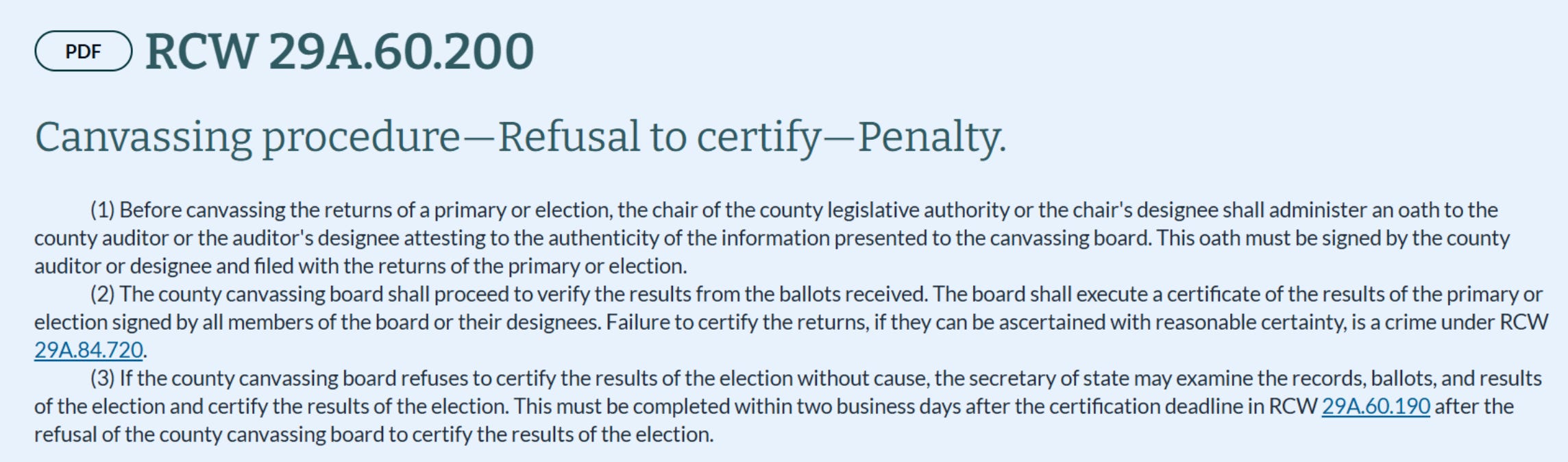
Failure to certify the returns, if they can be ascertained with reasonable certainty, is a crime under RCW 29A.84.720. That clause is the whole fight. I had just put on the record reasons to doubt that certainty. The response was not to examine those reasons. It was to recite the penalty. Certification followed.
Clallam County Commissioner: “We are going to follow the law”
The defense of the status quo has been offered from more than one direction. The argument is: we are following the law as written; our hands are tied. That was, in substance, Commissioner French’s response when I spoke with him on September 11, 2026, after a Soroptimist International forum.
A commissioner’s duties are not the auditor’s. The county auditor administers elections. The board’s tools are oversight, budget, inquiry, and referral. Once a commissioner is on actual notice of alleged defects in how the county conducts elections, the lawful response is not “we cannot look.” It is to put the allegations in front of the officers who do have statutory power: the auditor, the prosecuting attorney, the Secretary of State, and, where the facts warrant it, the Attorney General. The board can demand records, ask whether existing Title 29A and Secretary of State requirements are being met, and seek a charter or legislative change if the written law is the problem. What it cannot do is treat “following the law” as an answer to a claim that the law itself is not being followed.
A county officer who has been told of vulnerabilities in systems the United States has classified as critical infrastructure is on notice that the subject is not optional. The responsible next step under Washington law is to refer, to investigate through lawful channels, and to use the powers of the office.
“I was just following the law” is a complete answer only if the officer is performing every duty the law imposes and is not using the statute as a reason to decline inquiry and referral. If the claim is that Clallam’s system has known weaknesses, the question for Commissioner French is not whether he may invent a remedy the RCW does not authorize. It is whether, having been told, he used the authority he does have.
Certified — to 2005
At the August 18 certification meeting, Elections Manager Hillway said the tabulation system is state and federally “certified.” That sentence is true as far as it goes. What it leaves out is: certified to what standard?
Clallam County tabulates on ClearVote 2.3. The U.S. Election Assistance Commission certified ClearVote 2.3 to the Voluntary Voting System Guidelines 1.0 — written in 2005.
EAC, ClearVote 2.3: https://www.eac.gov/voting-equipment/clearvote-23
VVSG 1.0 (2005): https://www.eac.gov/vvsg-10-2005
Nearly every Washington county still runs a system certified to that same 2005 baseline. The EAC has since adopted VVSG 2.0. Older certifications were not automatically withdrawn, so “certified” can mean “certified to a standard written when flip phones were new.”

Certification is not the same thing as a current security review.
First the algorithm, then the ballots
The reason officials talk about “processing” ballots more readily than “counting” votes is not explained by Clallam County alone. It is also the subject of sworn statements from people who say they worked these systems from the inside. One of those statements is the November 29, 2020 declaration of Terpsehore P. Maras, filed as Exhibit 13 in Bowyer v. Ducey, No. 2:20-cv-02321 (D. Ariz.). Maras describes herself in that declaration as a private contractor and “LOCALIZER” with operational experience in election sources and methods in the United States and overseas. She has separately stated in public that the work spanned 45 countries.
Maras declaration (PDF): https://img1.wsimg.com/blobby/go/5955d0ae-e3e2-44d0-b692-fd5157ddcf32/downloads/TORE_MARAS_Unredacted_Declaration.pdf
I offer the declaration as corroboration of a method, not as a substitute for Clallam County facts. In it, Maras describes a “trapdoor” in the mixing and encryption step. Anyone who knows the commitment parameters, she writes, can “take all the votes and give them to any one they want.” She says election result spikes are not paper or thumb drives first: the algorithm allocates a block, and “the PEOPLE . . . creat[e] the evidence to BACK UP the block allocation.” That last sentence is the inside of the tank — software sets the result; paper is arranged to match it.
Maras’s declaration is one sworn account of a tabulation design in which the algorithm can be manipulated to set a block of predetermined results and people then create the paper to back up that block. Clallam County still has to answer for Clallam County.
The grievance over an election-integrity writ
In 2022, the Attorney General’s Office, then led by Bob Ferguson, filed a Washington State Bar Association grievance over my work on a constitutional writ involving noncitizen voter registrations. That grievance went to a hearing in March 2025, then to the Disciplinary Board and the Washington Supreme Court. Oral argument was on September 15, 2026, at the Temple of Justice. The Court has not ruled. My license remains active and eligible to practice.

TVW oral argument, Sept. 15, 2026: https://tvw.org/video/washington-state-supreme-court-2026091075/
As discussed at oral argument, the grievance by the Attorney General raises important questions: can the State Bar pursue discipline against lawyers primarily over perceived controversial or unpopular subject matter, including election integrity matters? Are lawyers entitled to a jury in order to defend themselves as against quasi-criminal counts asserted by the State?
A return to constitutional elections
Article I, Section 1 of the Washington Constitution says the quiet thing out loud: “All political power is inherent in the people, and governments derive their just powers from the consent of the governed, and are established to protect and maintain individual rights.”

Abraham Lincoln was right about the physical exterior strength of the US to fight off foreign adversaries – which I have compared here to a tank. But in order to take out that tank, no foreign army has to take a drink from the Dungeness. If we lose the ballot box, the tank will be destroyed from the inside — by software we cannot inspect, by officers who will not inquire, and by a certification statute recited as a threat instead of as a duty to ascertain the returns with reasonable certainty.
If I am elected Auditor, I will work to return Clallam County to elections that put that power back where the Constitution left it: with the people. Paper that can be watched. Procedures that can be audited without a vendor password. Certification that follows examination, not the other way around. That is the job. That is the promise.
Virginia Shogren
Candidate for Clallam County Auditor
961 W. Oak Court, Sequim, WA 98382
Credit for tank analogy: Terpsehore P. Maras
Virginia Shogren wrote this article, with research and editing assistance from an AI tool. She is a candidate for Clallam County Auditor. Neither the candidate nor her campaign paid Clallam County Watchdog for publication, and Watchdog paid nothing to the author.


