


In this Sundays With Seegers, commissioner candidate Jake Seegers addresses a rumor head-on. Everyone has heard the stories: people struggling with addiction and homelessness are being transported to Port Angeles from communities across Washington. Public records show that, at least in the treatment system, transportation from outside the county is not a rumor—it happens. The more important question is what happens after people arrive.
The Question Residents Keep Asking
During an April Public Safety Town Hall, Mike French was asked whether Clallam County’s homelessness and harm-reduction services are drawing people from outside the area. He said he does not have definitive data. His answer was still “generally no.”
He offered remoteness instead. Someone with a warrant elsewhere, he suggested, might head for a place less connected to the community they are trying to leave. He also warned against blaming outsiders. “The focus right now is on finger-pointing,” he said, and treating arrivals as “not our community” would be “an abdication of our responsibility.”
That does not answer the question residents were asking. If remoteness is the main draw, why are so many people concentrated exactly where the services are? And it does not address a narrower claim: that public agencies, hospitals, courts, and treatment systems are moving vulnerable people from elsewhere in Washington to Port Angeles. They are, and the history of a treatment facility at Fifth and Race shows how that happens.
French returned to the subject in a later debate, after he and Jake Seegers were asked about homeless, addicted, and mentally ill people being bused to Port Angeles. French said:
“This is something that obviously, like, I’ve heard since I’ve been in public office from individuals. People have the right to move around the country; that’s how America works. So, people move around. People come here, people leave here, there’s nothing we can do to stop that.”
On the constitutional point, he is right. Americans can move where they choose, and government should not decide where someone is allowed to live. Choosing to travel here is not the same thing as a hospital, court, or treatment system sending someone here.
A $450,000 State Grant
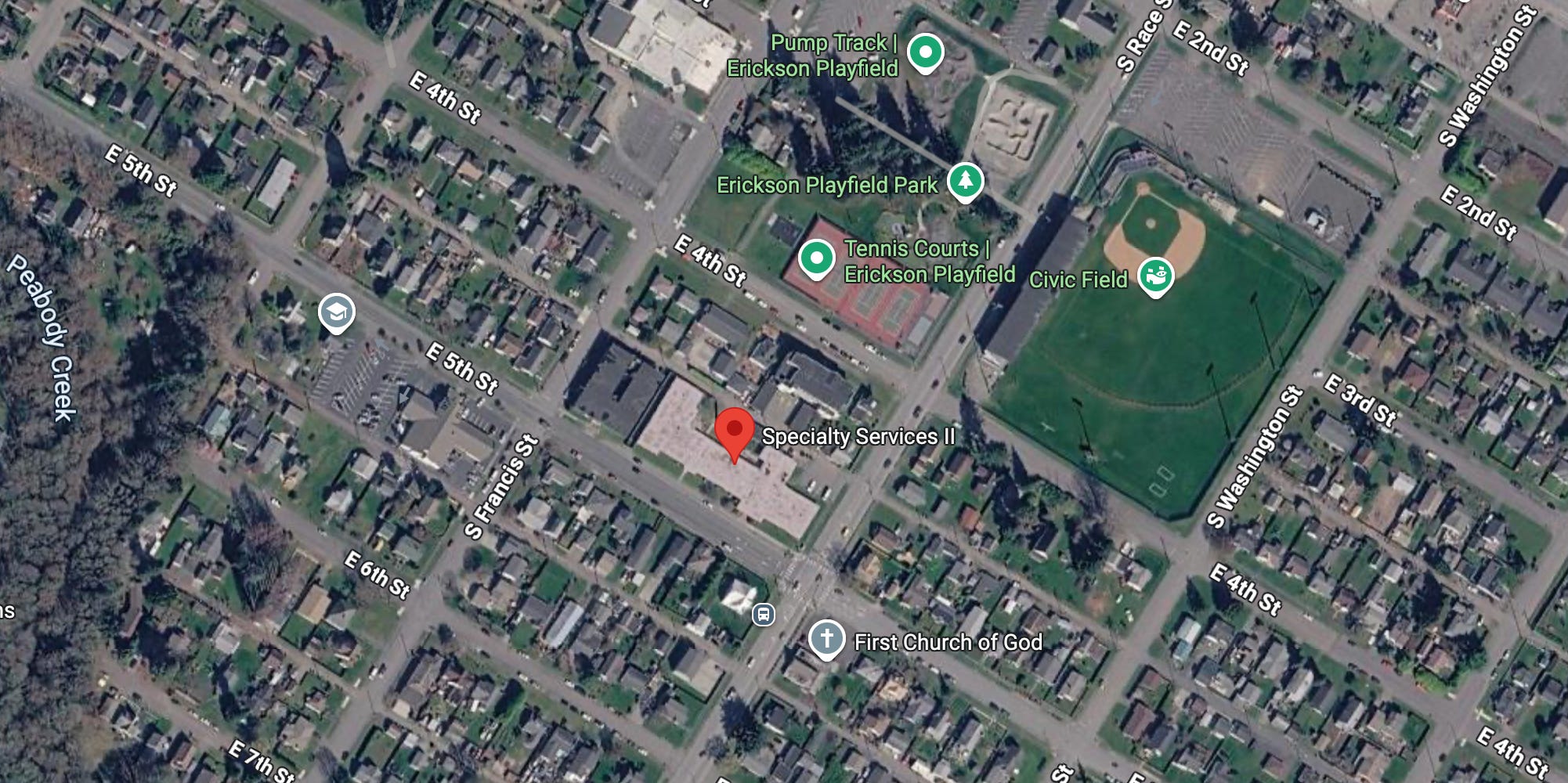
The story begins in 2014 with the former Port Angeles Care Center at 825 E. Fifth Street.
CRALI Properties, associated with Craig Phillips of American Behavioral Health Systems (ABHS), purchased the former nursing home for $175,000. Phillips told the Peninsula Daily News that Specialty Services, a business under the ABHS umbrella, had received a $450,000 grant from the Washington Department of Social and Health Services to purchase the building, remodel it, and establish treatment there. The money was part of a $2.6 million legislative appropriation intended to establish eight 16-bed inpatient treatment centers around Washington.
But Specialty Services was not simply opening another business.
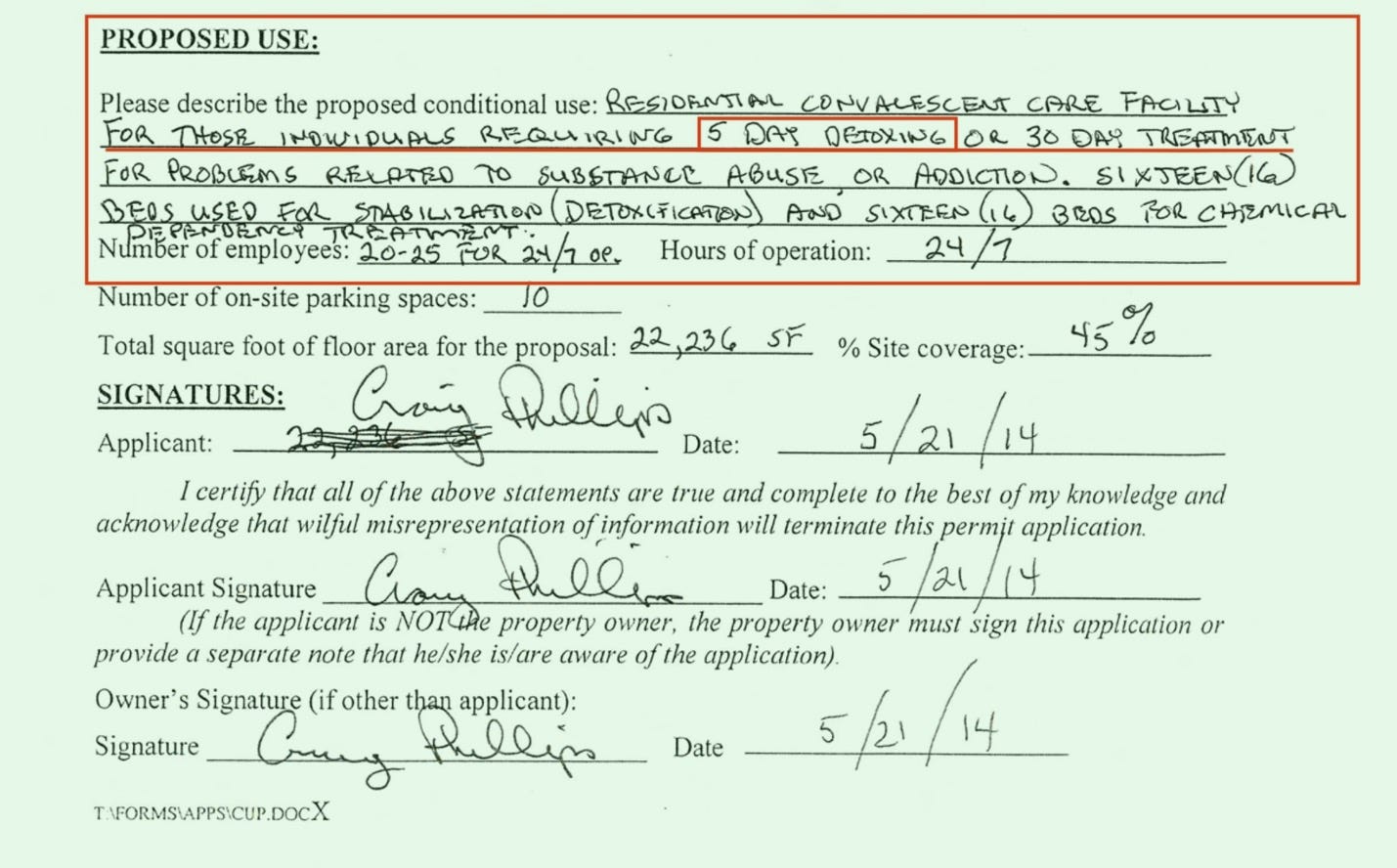
Operating a residential chemical-dependency treatment facility at that location required a Conditional Use Permit (CUP) from the City of Port Angeles, and the proposal sparked significant debate among neighbors. The initial plan called for a 16-bed inpatient treatment center, with an additional 16-bed detoxification center proposed for the same building if funding could be secured.
Supporters argued that people struggling with addiction were safer in treatment than on the streets.
Danetta Rutten, a former Clallam County probation officer who lived in the neighborhood, told the Peninsula Daily News that there was “nothing to fear” from the treatment center.
“And I live in this neighborhood, too,” Rutten said.
“We have more to fear about what’s on the corner and what’s walking the street not in treatment than we have to fear with people that are in treatment.”
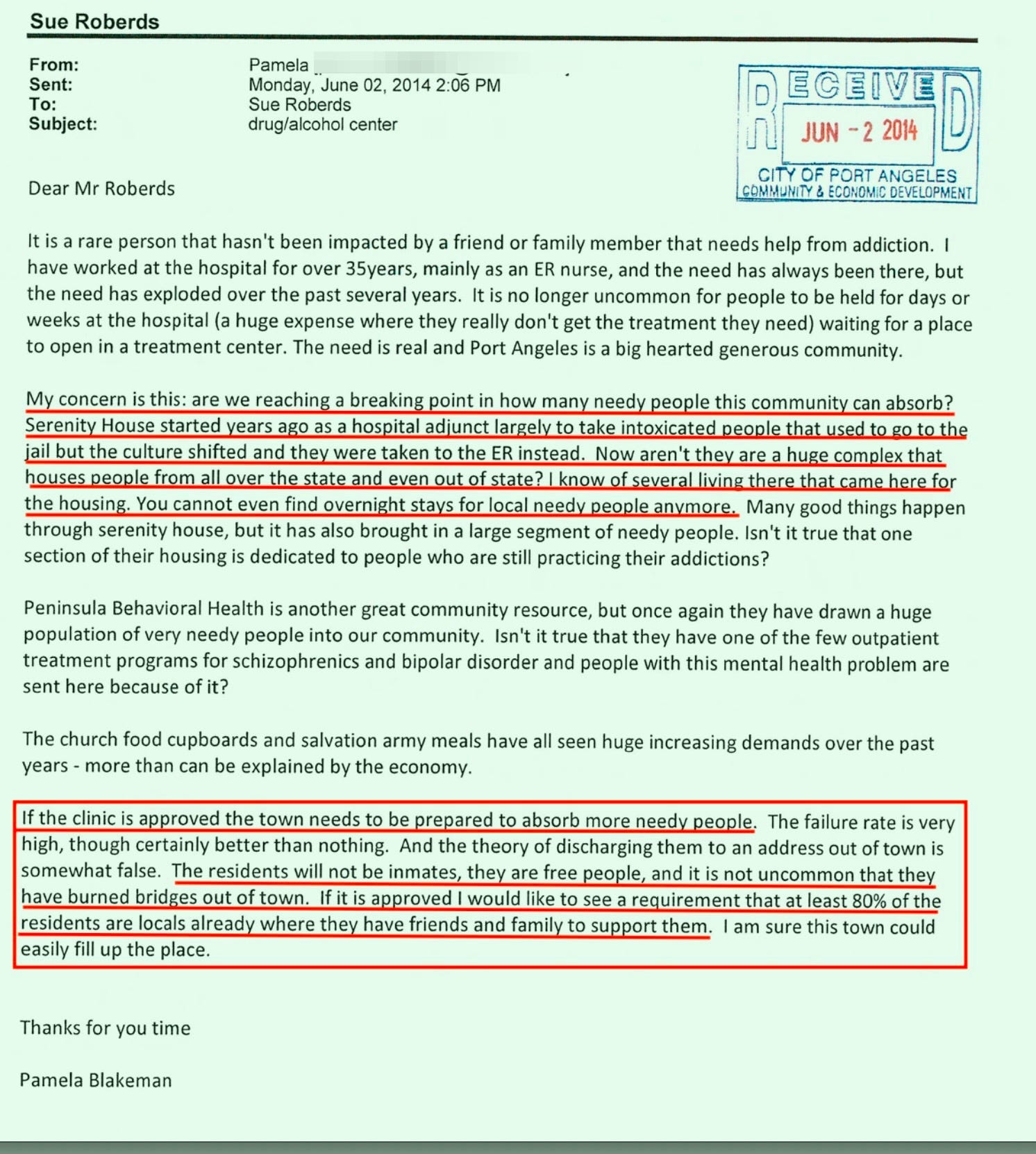
But some neighbors raised a concern that would become particularly relevant in the years ahead: What would happen when patients brought to Port Angeles from elsewhere left the facility or completed treatment?
Pamela Blakeman put the concern bluntly:
“If the clinic is approved, the town needs to be ready to absorb more needy people.”
Other residents raised concerns about transportation and whether people brought to Port Angeles from other parts of the state would actually return home—or remain in the community.
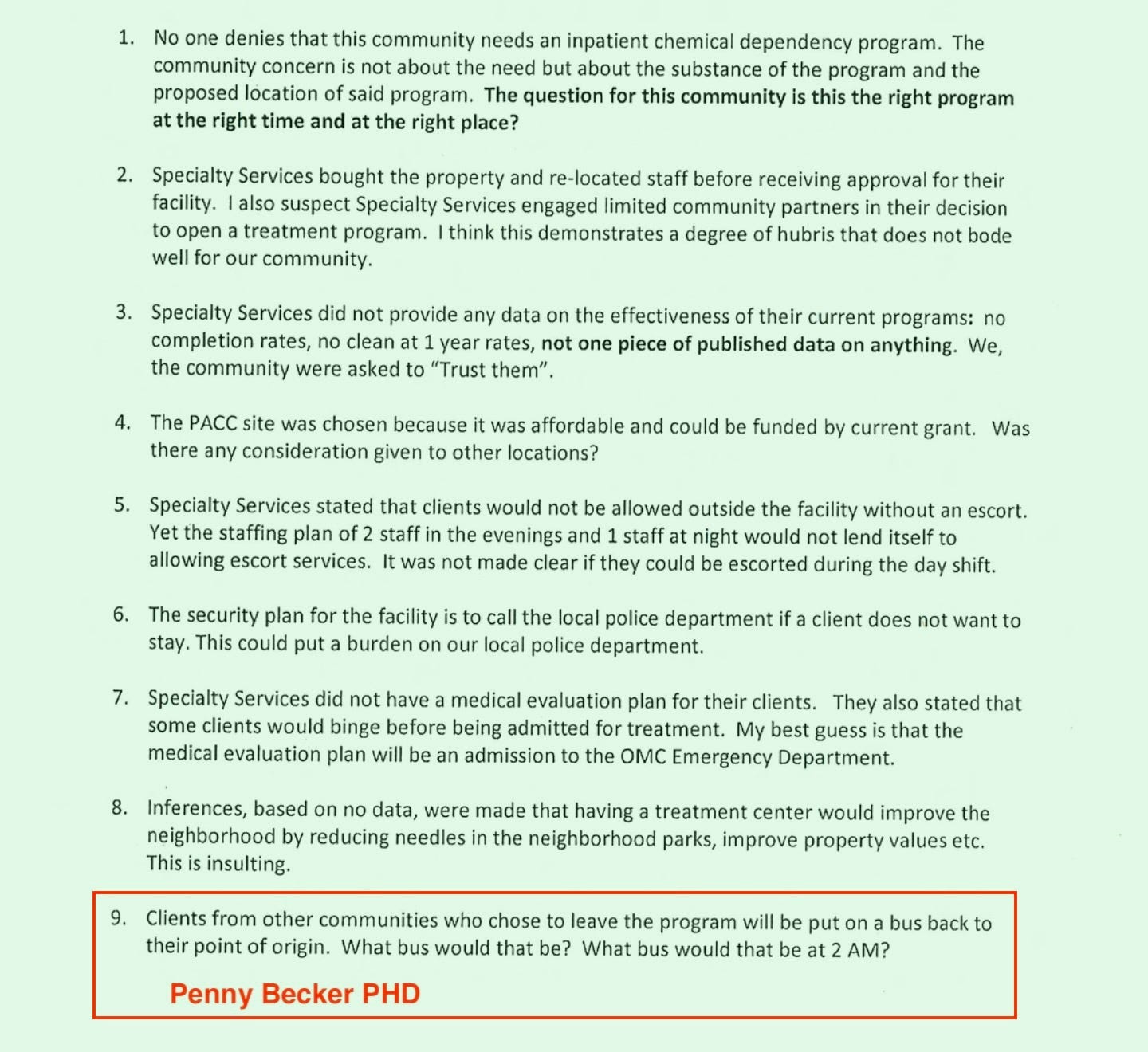
Many of those concerns sound remarkably familiar today.
ABHS representatives attempted to address them.
The proposed facility would provide residential treatment for people requiring short-term detoxification or longer-term substance-abuse treatment.
ABHS representatives sought to reassure neighbors that patients would be supervised while in treatment and that the facility would not simply release people into the surrounding neighborhood.
And there was another important assurance:
Clallam County residents would be prioritized.
As reported by Peninsula Daily News, Sally Beaven, then director of Specialty Services, promised:
“We’ve come to fill a need.”
Craig Phillips echoed,
“I know from 30 years of experience that if there’s no inpatient treatment on the Peninsula, then the 16 beds will be full all the time.”
The Promise to Prioritize Locals
That wasn’t merely a talking point; it became a condition of the permit.
When the Planning Commission approved the conditional use permit, it imposed five conditions. Condition No. 4 stated plainly:
“The applicants will prioritize occupancy for Clallam County residents.”
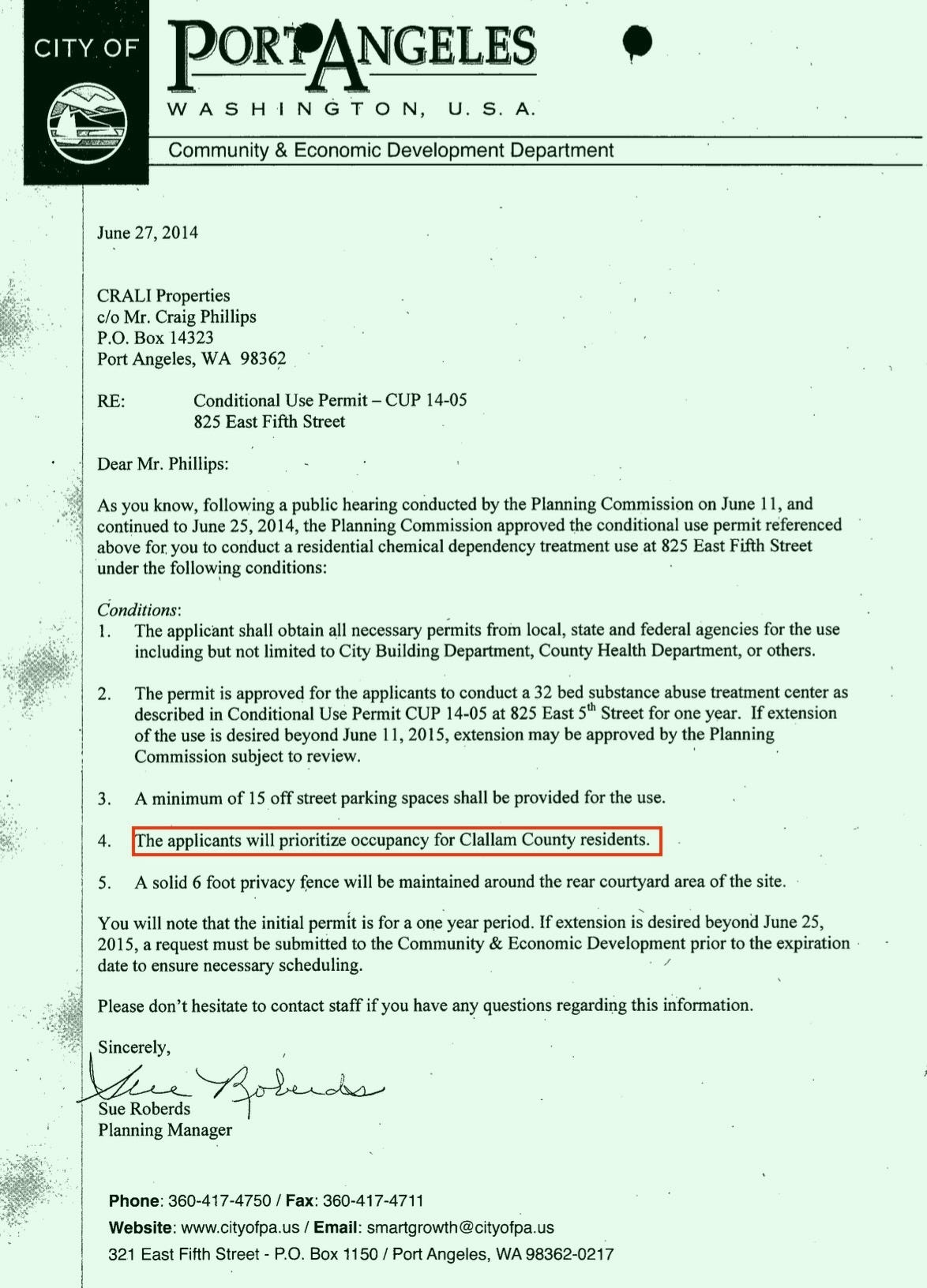
The permit was initially approved for twelve months, through June 11, 2015. Continued operation beyond that date was subject to review based on compliance with the CUP conditions.
When the City conducted that review in 2015, Assistant Planner Scott Johns recommended extending the permit indefinitely, stating:
“All 5 original conditions of approval have been met by the applicant.”
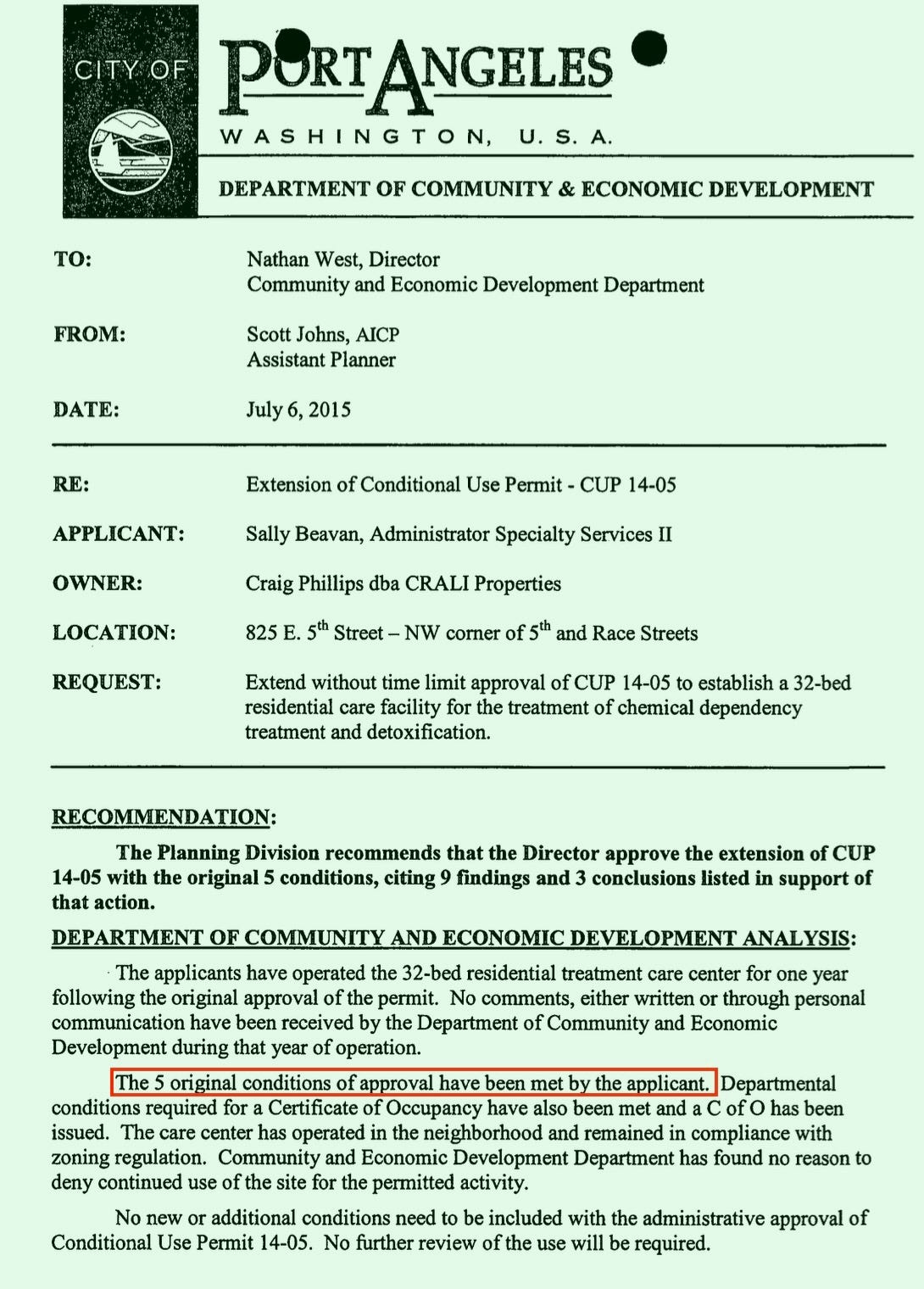
But the City’s justification for determining that the local-priority requirement had been satisfied is revealing.
Immediately beneath the requirement that Specialty Services “prioritize occupancy for Clallam County Residents,” the City’s review stated:
“SSII (Specialty Services 2) has remained inclusive of all counties in the State of Washington, including Clallam County.”
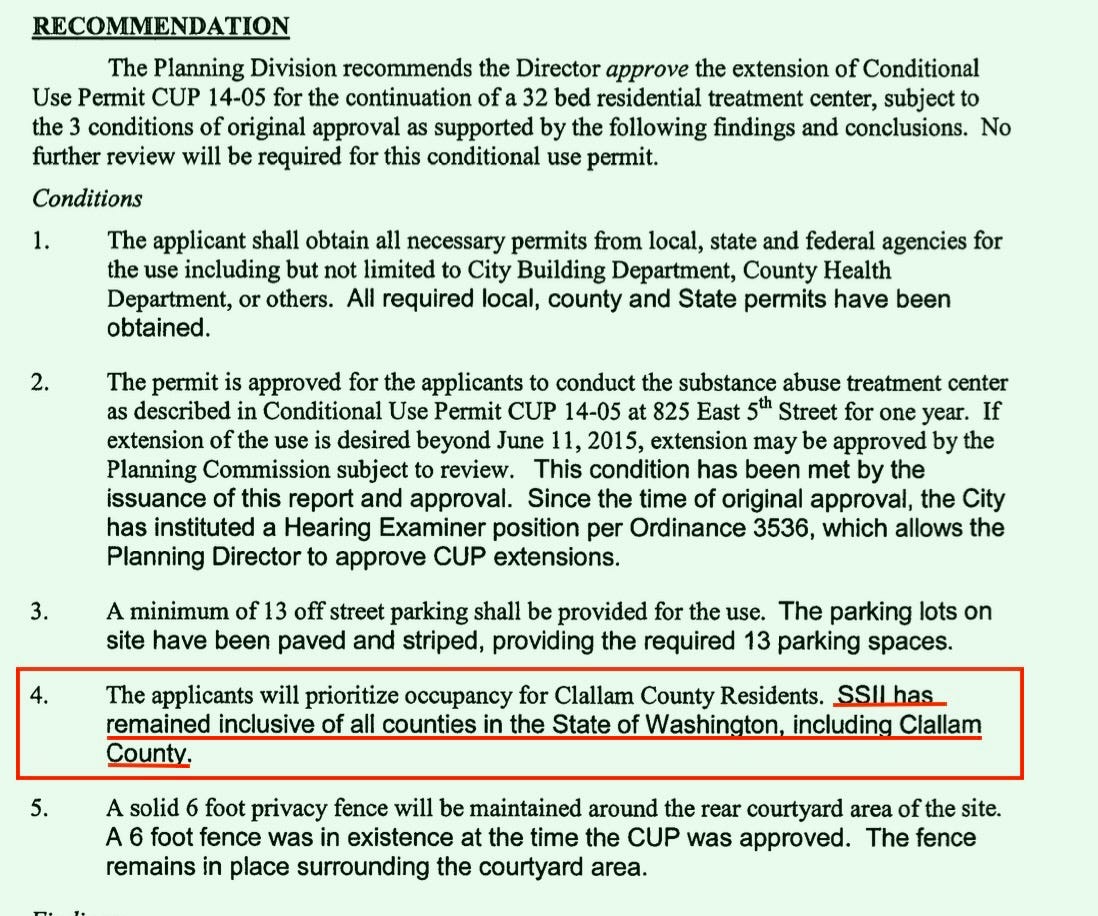
Those are not the same standard.
Prioritizing Clallam County residents means giving Clallam County residents preference.
Being inclusive of all counties means treating Clallam County as one county among 39.
Yet City staff concluded that all five conditions had been satisfied and recommended extending the permit indefinitely.
Nathan West, then Port Angeles’ Director of Community and Economic Development and now City Manager, approved the extension.
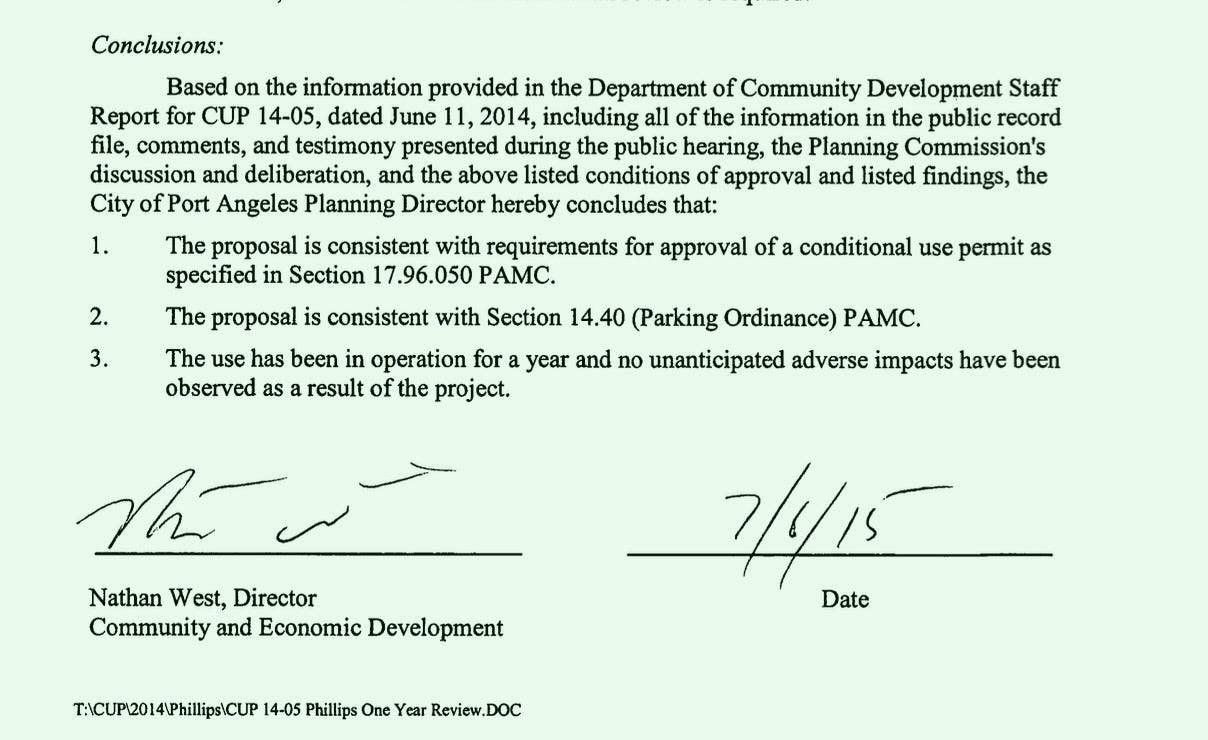
A treatment facility established in Port Angeles with state funding had been permitted with an explicit requirement to prioritize Clallam County residents. Yet when the City later reviewed compliance with that requirement, it apparently treated serving patients from throughout Washington as sufficient.
Then City Council Erased the CUP
Even a weak condition is still a condition—until the code changes.
Six years later, that is exactly what happened.
In December 2021, the Port Angeles City Council adopted Ordinance 3688 as part of a broader effort to increase residential building capacity, provide greater flexibility for housing development, and remove regulatory barriers to new housing.
Mike French was serving on the Port Angeles City Council at the time. He has since pointed to those housing reforms as contributing to the multifamily, duplex, and ADU development now occurring in Port Angeles.
“On housing, eight or nine years ago, when I was at the city, I was one of the people advocating for some common-sense reforms to make it so that we have more housing options and types available. We did regulatory reforms to make sure that we weren’t putting up barriers in front of housing developers and increasing costs for no reason. We had zoning reform, including setbacks, minimum lot sizes, things like that, and then adding incentives. We added a multifamily housing tax exemption so that people who wanted to build four units or larger could get a small property tax break, or, if they promised affordability, a larger property tax break. And then I would say that, eight or nine years later, you can walk around Port Angeles and see those housing types being constructed. You can see, probably two or three blocks away, a duplex being built across from Hamilton. Go up to 14th and E, a couple blocks off 14th, and you can see a whole neighborhood of duplexes being built… Those duplexes that you can walk around and see being built, or a lot of times some of the ADUs, they were illegal to build eight years ago. So we made the changes”
But the sweeping zoning changes had another consequence.
They made treatment facilities an outright permitted use. Specialty Services therefore no longer needed the Conditional Use Permit that had governed the facility—including its explicit requirement that “the applicants will prioritize occupancy for Clallam County Residents.”
In response to a public-records request asking the City for the current Conditional Use Permit governing Specialty Services, City Clerk Kari Martinez-Bailey confirmed that the old CUP no longer governed the use:
“Council made the use permitted out right in December 2021 with Ordinance 3688, therefore the CUP we provided has been non-applicable for at least five years.”
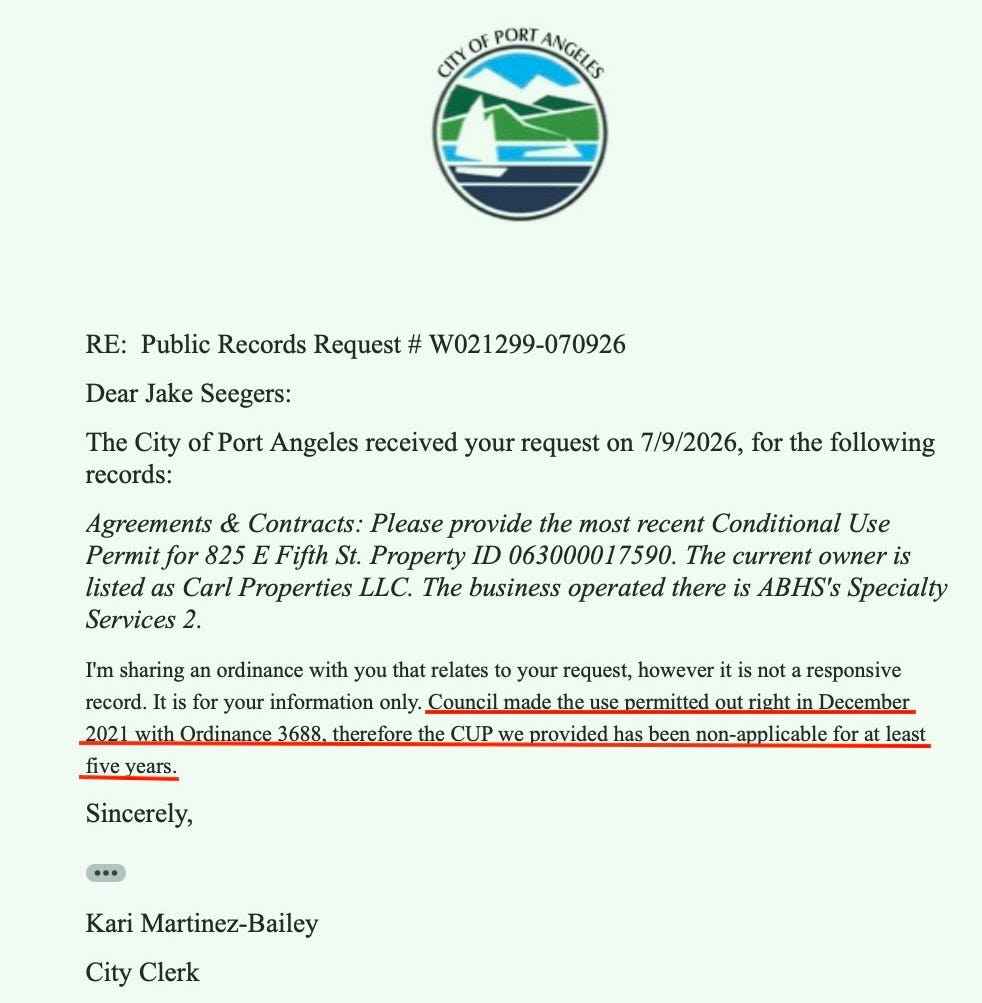
In other words, the zoning change eliminated the need for the conditional-use approval that had contained the local-priority requirement.
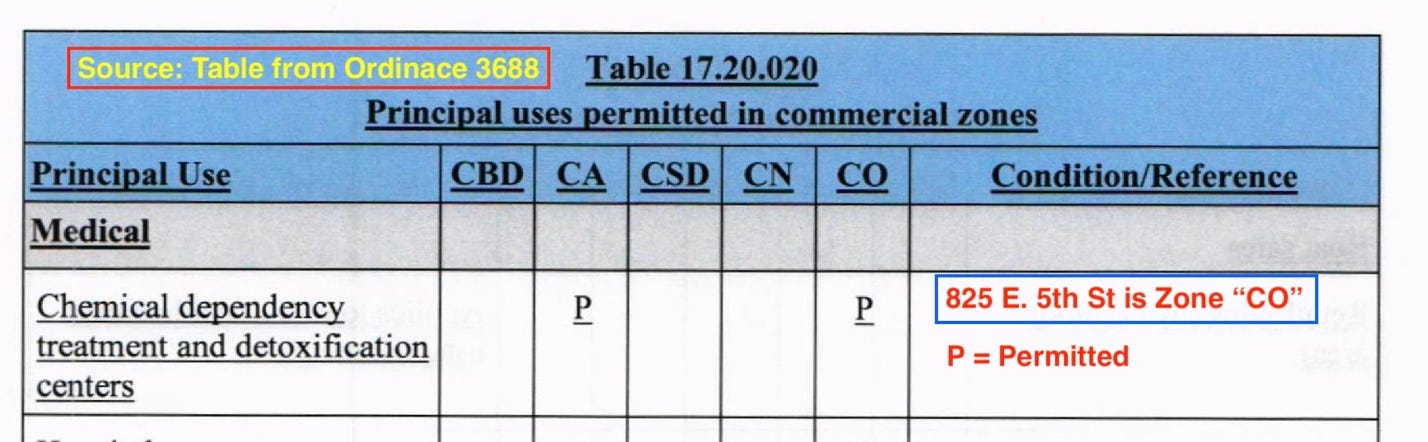
The original local guarantee and the leverage to enforce it disappeared with Ordinance 3688, passed by Mike French.
No Longer Local
Local leaders did not hold ABHS to the requirement to prioritize Clallam County residents. Eventually, that requirement disappeared altogether.
Specialty Services once offered both detoxification and inpatient treatment for men and women. Its Conditional Use Permit also explicitly required the facility to prioritize Clallam County residents.
Without that mandate, the model changed dramatically.
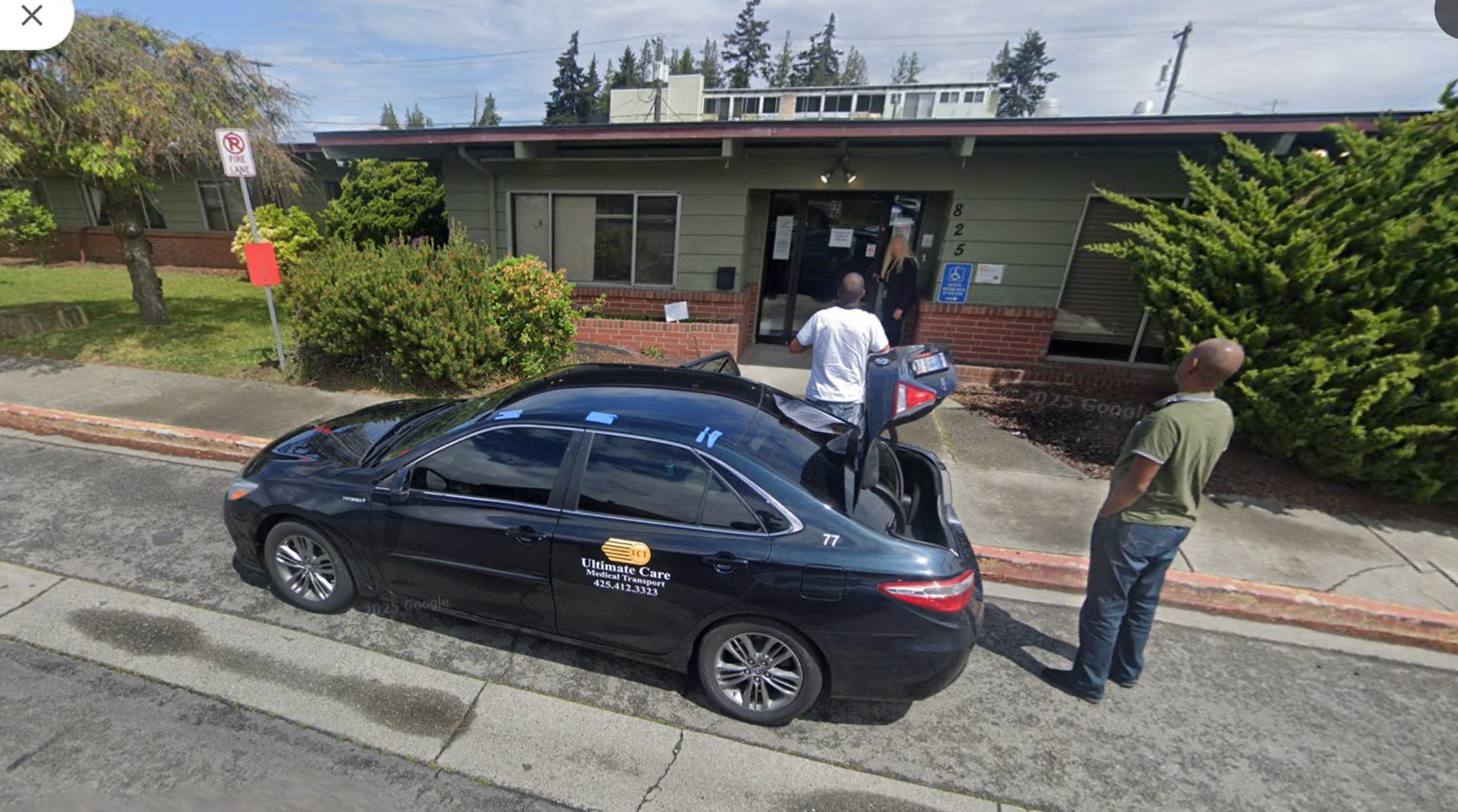
Specialty Services II now operates as an inpatient treatment center for men only. Detoxification is no longer offered. That represents the loss of a critical component of local recovery services. For someone dependent on fentanyl and ready to enter recovery, detox may be necessary before transitioning into residential inpatient treatment.
Specialty Services is no longer required to prioritize Clallam County residents and provide the same spectrum of treatment services originally envisioned for the local community.
After repeated attempts to reach Specialty Services management to arrange a sit-down meeting were unsuccessful, I began speaking with current and former employees.
What they told me deserves attention.
The employees I spoke with estimated that a large majority of the patients they encounter come from outside Clallam County. One estimated the number could be as high as 90%.
Those are employee estimates, not independently verified patient data. But they raise an important question: How did a treatment facility established with public funding and originally permitted with an explicit requirement to prioritize Clallam County residents evolve into one that primarily serves patients brought in from elsewhere?
A Statewide Pipeline
Parent company American Behavioral Health Systems (ABHS) does not exclusively serve Clallam County.
The organization has a longstanding relationship with the Washington Department of Corrections to provide residential substance-use treatment for people involved with the criminal-justice system. That includes participants in Washington’s Drug Offender Sentencing Alternative, or DOSA.
DOSA allows eligible individuals to receive substance-use treatment as part of an alternative criminal sentence. But placement in residential treatment is not the same as incarceration.
ABHS is not a jail. A DOSA participant can physically walk away at any time.
That does not mean leaving is permitted under the terms of the person’s sentence or that there are no consequences. Walking away from required treatment can constitute a DOSA violation and result in DOC or court action.
But ABHS employees are treatment providers, not correctional officers. They do not operate a secure correctional facility designed to physically prevent a patient from leaving.
That distinction is important.
It means someone involved with the criminal-justice system can be transported from another Washington community to an ABHS treatment facility and then leave before completing treatment. Once outside the facility, the treatment provider cannot simply detain that person as a correctional institution could.
And that possibility is not merely hypothetical.
There are documented cases elsewhere in Washington involving DOSA participants or other justice-involved individuals who entered ABHS treatment, left or failed to complete the program, and were subsequently implicated in serious criminal incidents in the communities where they had been placed.
What Can Happen When Someone Walks Away
In March of this year, police in Chehalis arrested Moises Castillo Flores, a Walla Walla man who prosecutors said was supposed to be serving a residential DOSA at ABHS.
According to The Chronicle, Castillo Flores had recently abandoned treatment. Police subsequently arrested him for allegedly breaking into Mint City Coffee Roasting. He also had an active warrant from Walla Walla County.
That doesn’t mean everyone who leaves treatment commits a crime. But it demonstrates something important:
An out-of-county DOSA participant can be placed at an ABHS treatment center, leave treatment, and remain in the community where that facility is located.
An older, far more serious example exists.
In 2012, convicted felon Charles Wallace was released from the Spokane County Jail into the care of ABHS for inpatient drug treatment. According to a timeline later released by the Spokane County Sheriff’s Office, Wallace left treatment within days.

Weeks later, Wallace shot Spokane County Sheriff’s Deputies Matt Spink and Mike Northway during a traffic stop before ultimately killing himself following a pursuit.
That makes the transportation and discharge process especially important.
The Transportation Disconnect
I have spoken with local law-enforcement officers, service providers, and people actively using drugs who describe the same troubling pattern: people are transported to Port Angeles from outside Clallam County for treatment at Specialty Services, then complete treatment or leave the program early and remain in the community.
Current and former employees described efforts to arrange transportation when patients leave. But they also said patients are not necessarily escorted to the bus station or placed aboard transportation that will actually take them home.
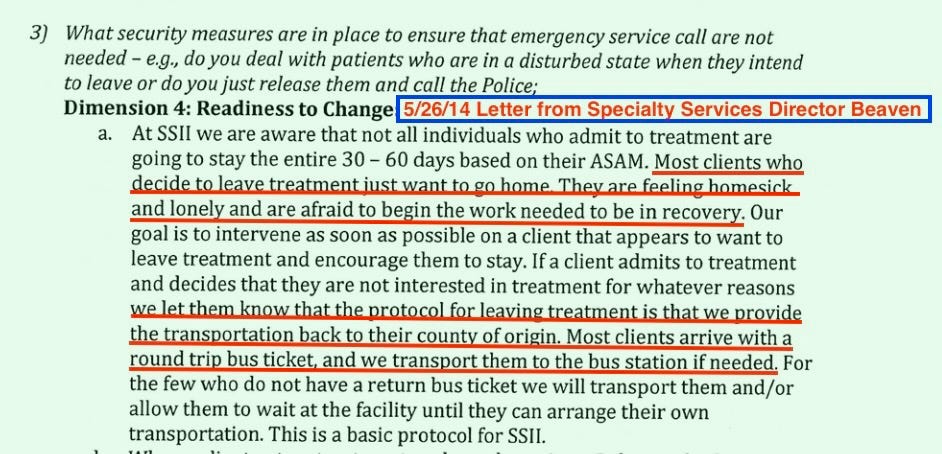
That is a far cry from what Specialty Services’ director told the community in 2014.
At the time, residents were assured that patients simply wanted to get better and return home—and that those leaving the facility would be provided return bus tickets, with a service provider making sure they actually got on the bus home.
Despite her support for the facility, Kathy Wahto, then executive director of Serenity House, offered a warning that now sounds remarkably visionary:
“Local people must currently go out-of-area for inpatient treatment. Too many never return home safely. Exiting treatment into a strange community without the support of a caring family often reverts in immediate reversion to addiction.”
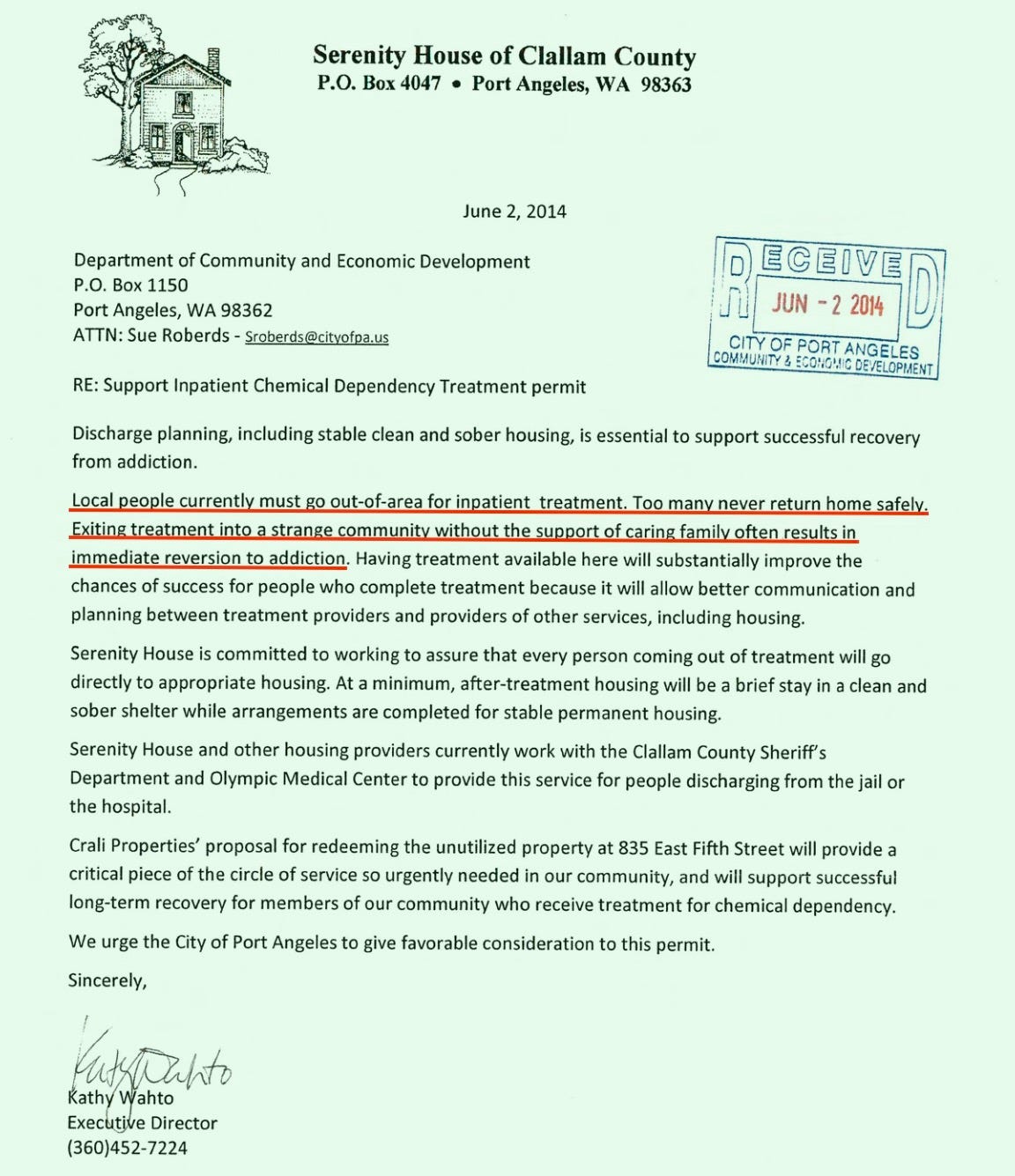
That was the danger she identified in 2014: sending vulnerable people into treatment far from their homes and support networks can leave them stranded in an unfamiliar community when treatment ends or fails.
More than a decade later, the concern has been reversed.
Instead of Clallam County residents being sent elsewhere and potentially stranded there, employees, service providers, law enforcement, and people living within the local drug culture describe patients being transported here from communities across Washington—and some remaining here after their treatment ends.
The original CUP attempted to provide at least one safeguard by requiring Specialty Services to prioritize Clallam County residents. That condition is gone. The detox program is gone. And the assurances about transportation home deserve renewed scrutiny.
Local leaders helped create Clallam County’s own Hotel California for patients brought here from across the state:
They can check out any time they like—but they may never leave.
Then I Heard From Leia
After I began talking publicly about this issue, I heard from a former driver for Dungeness Line.
Her name is Leia.
She described driving the shuttle route between SeaTac, Seattle hospitals, and Port Angeles.
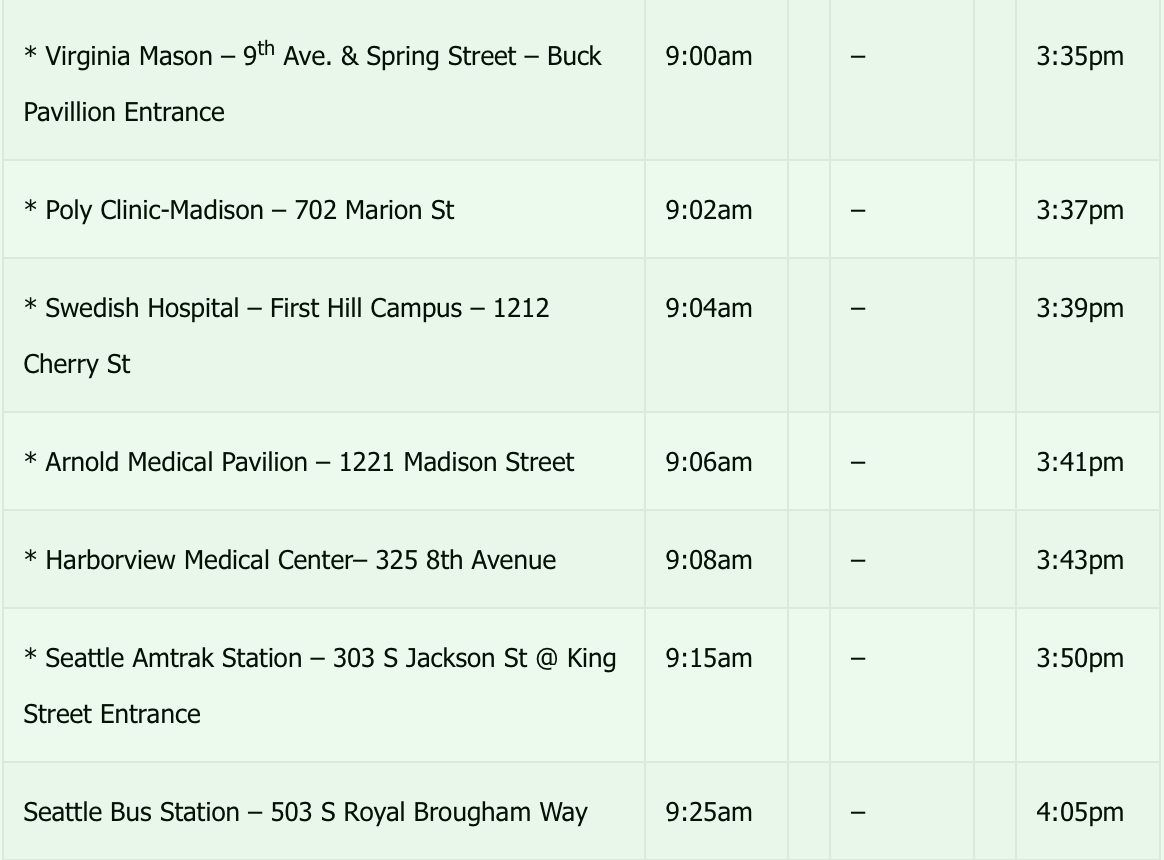
She said she began noticing a pattern.
Several times a week, she recalled picking up passengers at Virginia Mason Medical Center who were headed to Port Angeles. According to Leia, passengers openly discussed detox, treatment, homelessness, and addiction. They had been instructed to travel to the treatment facility near Fifth and Race.
But the shuttle did not take them there. Its final stop was Gateway Transit Center in downtown Port Angeles. And, according to Leia, nobody was waiting for them.
“When the shuttle pulled into the Gateway Transit Center, there was no one there to meet them.”
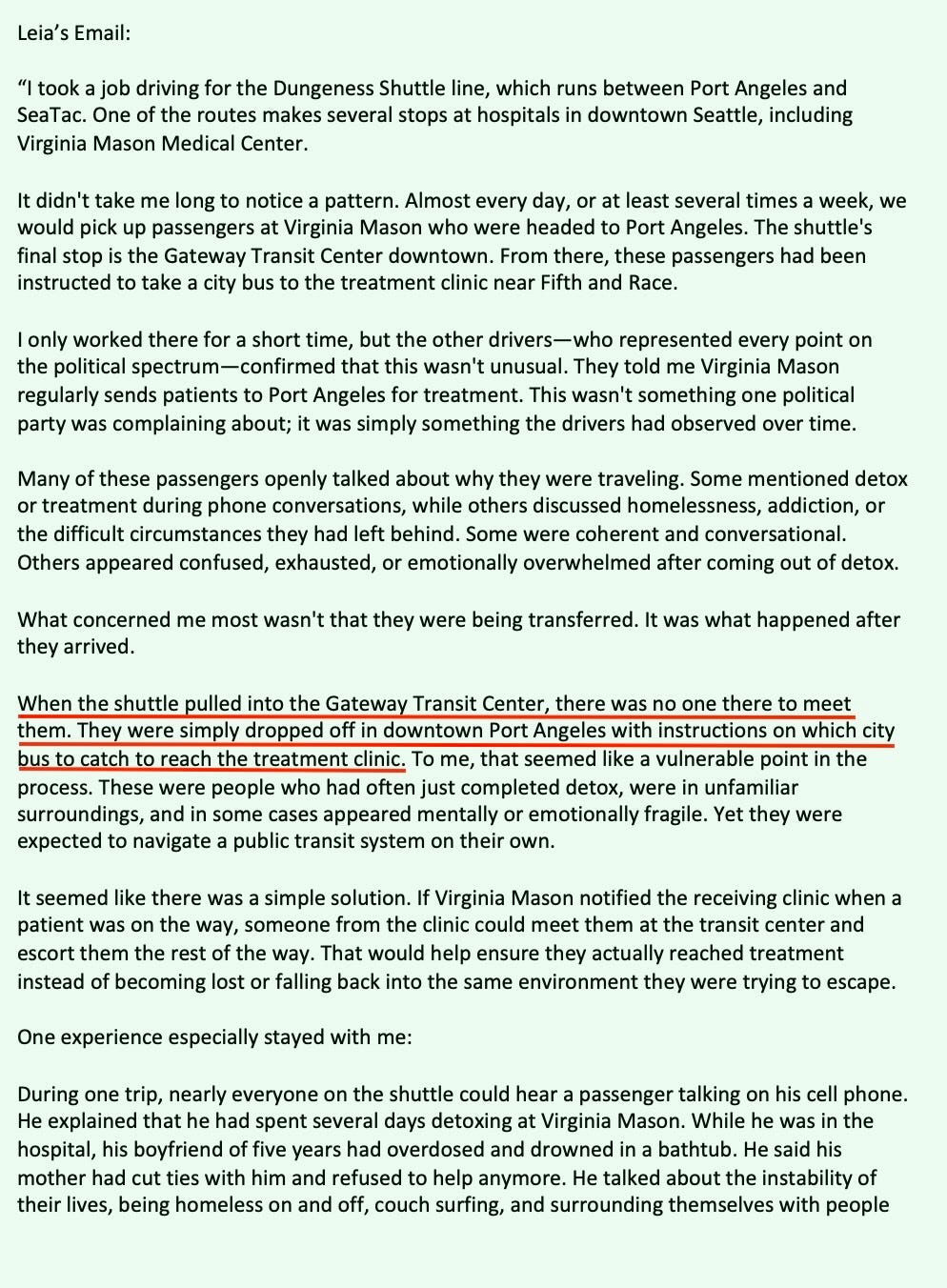
She says they dropped the passengers downtown and told them which city bus to take to reach the treatment facility.
One passenger particularly stuck with her.
He told Leia that he had just spent several days detoxing at Virginia Mason. While he was there, his boyfriend had died from an overdose. He described homelessness, addiction, and an estranged family.
When the shuttle reached Port Angeles, Leia asked whether somebody from the treatment center was meeting him.
According to her account, nobody was.
He and another passenger told her they had simply been given directions for the city bus that would take them to treatment.
Leia is careful about what she is—and isn’t—claiming.
She does not blame Dungeness Line. The shuttle company was simply providing transportation. And she does not claim that these passengers necessarily failed to reach treatment.
Her concern is the gap:
“It seems risky to discharge people directly from detox, transport them to a different community, and then expect them to find their own way across town using public transportation without anyone meeting them.”
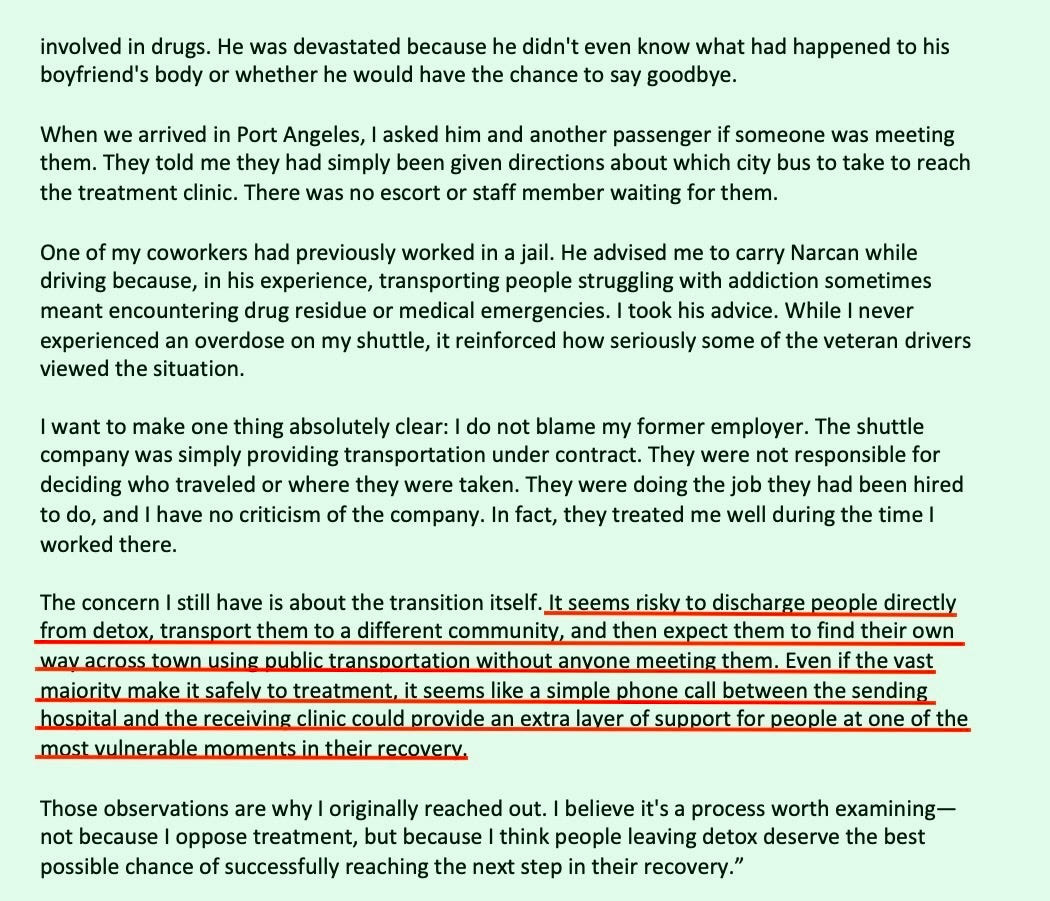
Her proposed solution is remarkably simple: communication between the sending hospital and receiving treatment center so somebody can meet vulnerable patients and ensure they actually arrive.
And then: make sure that they get home.
So are People Being Bussed Here?
For treatment, yes—evidence shows people are transported to Port Angeles from elsewhere in Washington.
That statement should not be stretched beyond what the evidence establishes.
The documents do not prove that every out-of-county patient becomes homeless here. Leia’s account does not establish how many transported patients fail to reach Specialty Services. Nor have I found public data showing how many Specialty Services patients originate in Clallam County versus elsewhere.
Those numbers should be made public.
But we don’t need speculation to identify the policy questions.
The original Port Angeles treatment facility was established with a $450,000 state grant. Its CUP required prioritizing Clallam County residents. The City’s own 2015 review acknowledged admissions from throughout Washington while nevertheless concluding that the permit conditions had been satisfied. Later zoning changes made the CUP itself inapplicable.
Meanwhile, ABHS participates in statewide treatment systems, including DOC-funded treatment, and firsthand testimony describes people traveling from Seattle-area hospitals to downtown Port Angeles before navigating the final leg to treatment on their own.
Those are facts worth examining.
Treatment Itself Isn’t the Problem
This is where an important distinction matters.
I support local treatment.
People battling fentanyl, methamphetamine, and alcohol addiction need somewhere to go when they decide they want help.
I want capacity for both men and women.
Port Angeles once had co-ed residential treatment and withdrawal management/detoxification at the same Fifth Street location with a mandate to treat locals first.
Today, this ABHS location provides inpatient treatment to men only.
I have met people trapped in addiction and living outside who are waiting for treatment. I have asked them: Why not ABHS?
The answers are often the same:
They don’t offer detox.
They don’t treat women.
I want detox back at Specialty Services.
I want a written protocol that Clallam residents are first in line for scarce beds, and that no one is discharged into our parks and public spaces after they are brought here from other communities.
It’s time to work with our local treatment provider — the one that promised to “come fill a [local] need” — to make these changes.
Treatment is not the enemy.
An unlocked statewide funnel with no local duty is.
Leadership Had a Tool
The 2014 CUP required local priority and a one-year look-back. Staff converted “prioritize” into “include.”
Then, in 2021, the City Council—with Mike French serving as a councilmember—changed the zoning and made the treatment use permitted outright. According to the City Clerk, that made the old CUP “non-applicable.”
With it went the condition requiring local priority.
ABHS switched gears and transformed into a statewide pipeline — including DOC and hospital discharge desks — into our community.
We keep hearing that services are not a magnet.
We keep seeing otherwise.
Our treatment slots, outreach hours, jail beds, and sidewalks are finite. When they are consumed by people sent here for a program that they can walk away from, Clallam residents wait longer for the help we were promised ABHS would deliver.
The history of Specialty Services shows how a program originally presented as a local resource can evolve into part of a statewide system.
The next step is not to demonize treatment or the people who need it.
It is to insist on transparent numbers, reliable transportation protocols, clear responsibility when somebody leaves treatment, and an honest accounting of whether the system is meeting the needs of the community in which it operates.
That is a conversation that Clallam County, Port Angeles, and ABHS must be willing to have.
What Can You Do?
Clallam County once had a local detox and residential program for men and women, with a permit condition that locals come first. Detox is gone. The women’s beds are gone. The local-priority rule is gone.
Email the Clallam County commissioners at loni.gores@clallamcountywa.gov and the Port Angeles City Council at council@cityofpa.us. Ask for a local detox facility that accepts both men and women and puts Clallam County residents first in line for scarce beds. Ask that no one brought here from another community be discharged onto our sidewalks, parks, or transit center.
A short note is enough. Say you live here, and say what you want back.
This article was approved by Jake Seegers for Commissioner (IND), 131 East First Street, Port Angeles, WA 98362.


