

Property owners across Clallam County are opening property tax statements with disbelief. Double-digit increases are hitting households already struggling in one of Washington’s most economically fragile regions. At the same time, millions of taxpayer dollars are flowing into projects owned or operated by sovereign tribal governments—entities that do not pay the same taxes local residents do. As Olympia celebrates another round of spending, many taxpayers are asking a simple question: if we are paying more every year, why does it feel like we are getting less?
Many Clallam County property owners are still reeling after receiving their latest property tax statements. For many households, increases are in the double digits—far outpacing the income growth of families living in this economically challenged corner of Washington State.
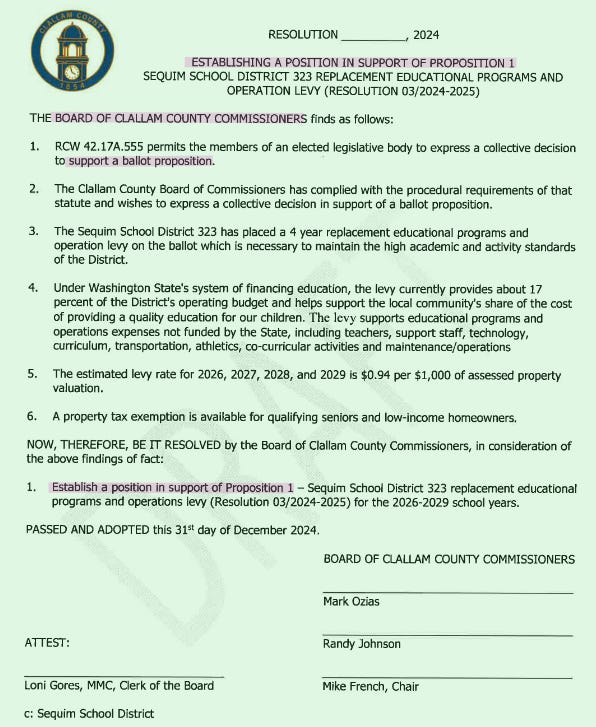
County government had some role in that increase, though commissioners have pointed out that some of the biggest spikes came from voter-approved measures. The commissioners themselves, however, strongly supported those measures—backing levy lid lifts for Olympic Medical Center, which continues to struggle financially, and passing resolutions supporting school bonds and levies in two districts. While officials now emphasize that voters approved the increases, it is worth remembering that the same officials encouraged residents to vote yes.
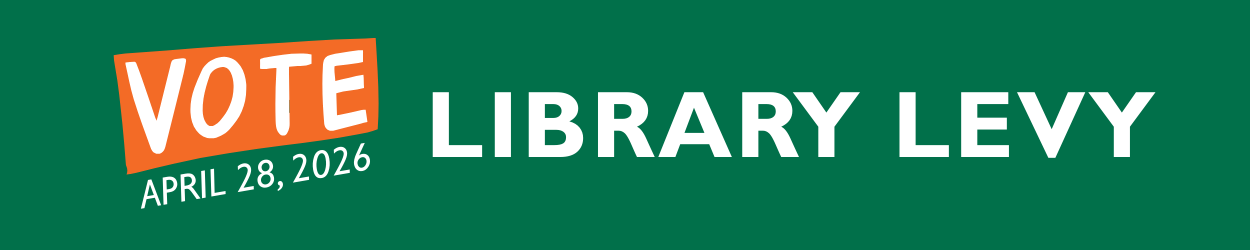
And the requests for more taxes keep coming.
In April, the North Olympic Library System will ask county residents to approve another levy lid lift.
In Olympia, lawmakers are continuing a similar trend. Last year brought the largest state tax increase in Washington history. This year, legislators passed a new income tax measure that now awaits the governor’s signature.
With billions in taxes being raised at every level of government, many residents are asking the same question:
Where is all this money going?
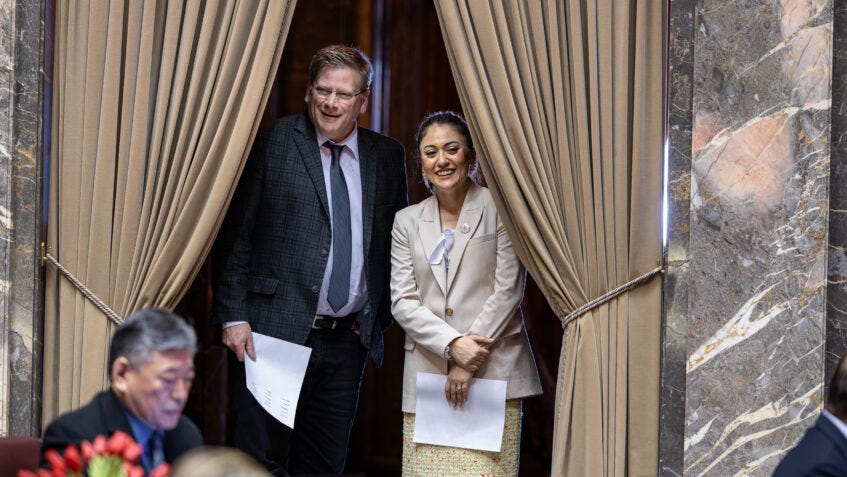
State Senator Mike Chapman of the 24th Legislative District—who previously served as a Clallam County Commissioner—recently sent constituents an email highlighting projects funded through the state’s capital budget.
The capital budget funds construction projects across Washington, from schools and community centers to historic preservation efforts. Chapman noted that more than $53 million in capital investments are headed to the 24th District.
The projects highlighted in his message were:
Hoh Highlands Resiliency and Governance Center – Forks ($4.1 million)
Funding will help relocate the Hoh Tribe’s governmental and emergency operations to higher ground away from a tsunami- and flood-prone coastal zone.Lower Elwha Klallam Tribe Wellness Center – Port Angeles ($3.3 million)
The project will repair and upgrade an existing facility where septic failures threaten the delivery of behavioral health services.Dungeness Railroad Bridge Replacement – Sequim ($2.55 million)
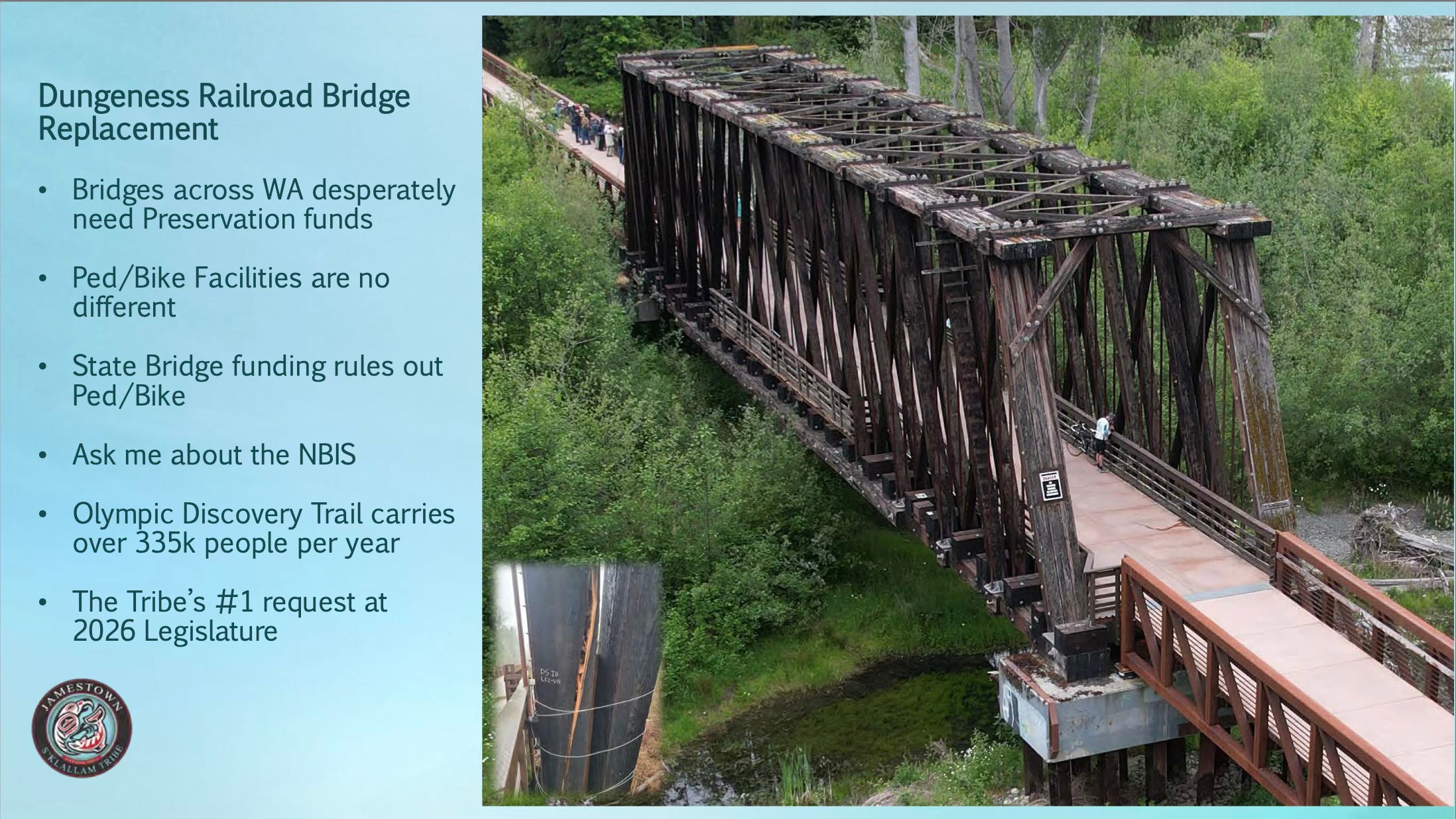
A deteriorating wooden bridge on the Olympic Discovery Trail will be replaced with a steel replica to keep the popular crossing open.Quinault Tribal Courthouse – Taholah ($2 million)
A new courthouse will replace the facility destroyed by fire in 2024 and will be built in a location more resilient to floods and wildfire.
If you look closely, a pattern emerges. Tribal operations center. Tribal wellness center. Tribal courthouse.
The one project that did not explicitly mention a tribe in the description—the Dungeness Railroad Bridge replacement—is located on land owned by the Jamestown S’Klallam Tribe, which acquired the property years ago.
The bridge is undoubtedly a beloved feature of the Olympic Discovery Trail connecting Carlsborg and Sequim. But it is important to note that the bridge and surrounding property are no longer public land.
Public access continues by agreement from the Jamestown Corporation, not by obligation.
The Jamestown Corporation controls the property and has the authority to close it for private events, including fundraising dinners such as the “Dine on the Dungeness” benefit, where tickets have sold for $160 per person.

That distinction matters. While many residents still experience the park as a public space, it is now tribal land governed by federal trust status.
In January, the Jamestown Corporation told the Sequim Gazette that officials were working with “community partners” on a capital funding campaign for the bridge replacement.
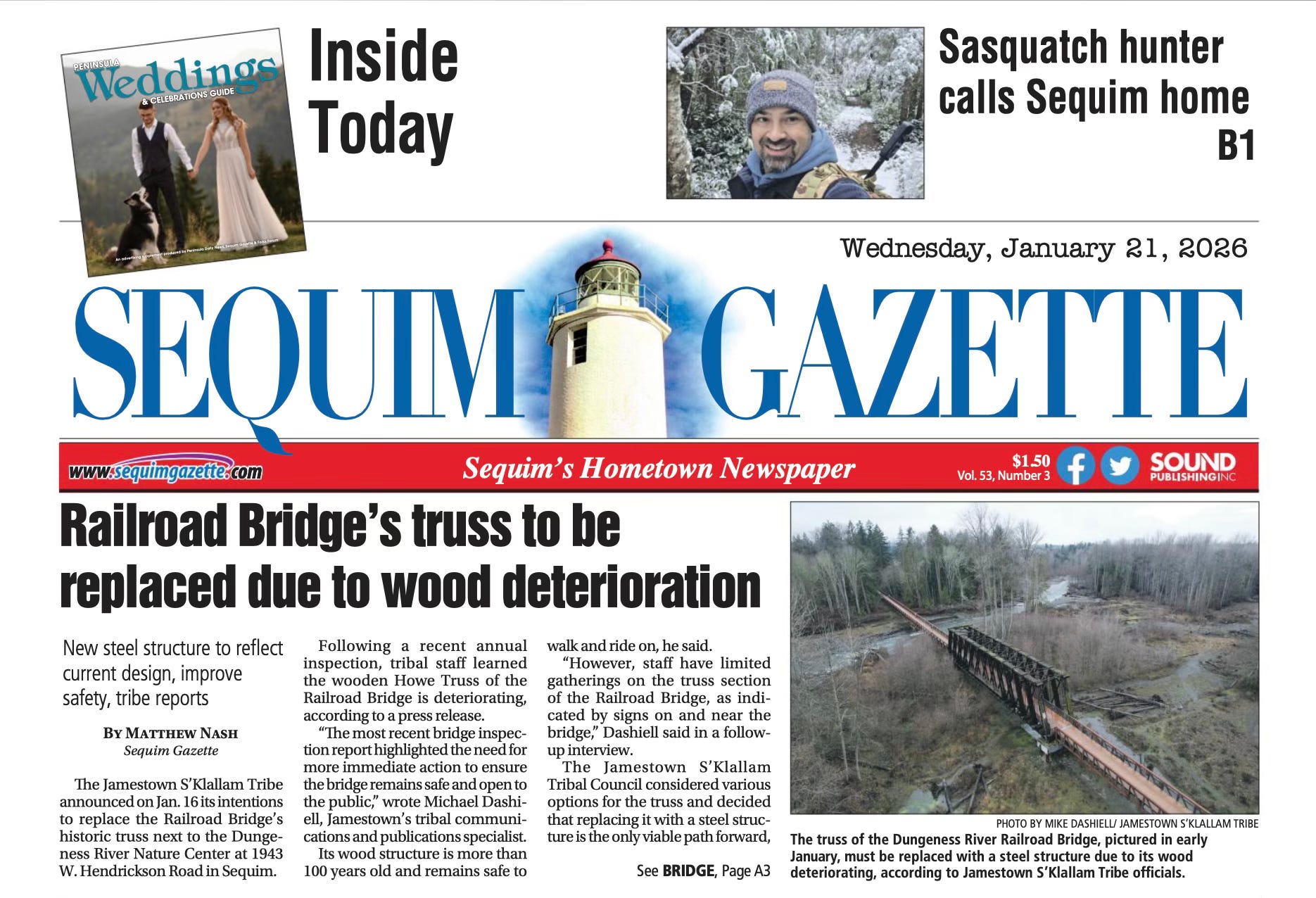
Now we know who some of those community partners are.
Washington taxpayers.
Residents who pay sales taxes, gas taxes, capital gains taxes, B&O taxes, and a long list of other state and local taxes—many of which tribal governments and their corporate entities do not pay.
Those taxpayers will help fund the bridge replacement, and lawmakers will rightfully highlight the project as a success.
Campaign finance records from the 2024 election also show that Senator Chapman’s campaign received contributions from Jamestown and other tribal interests—perfectly legal donations that are common in Washington politics.

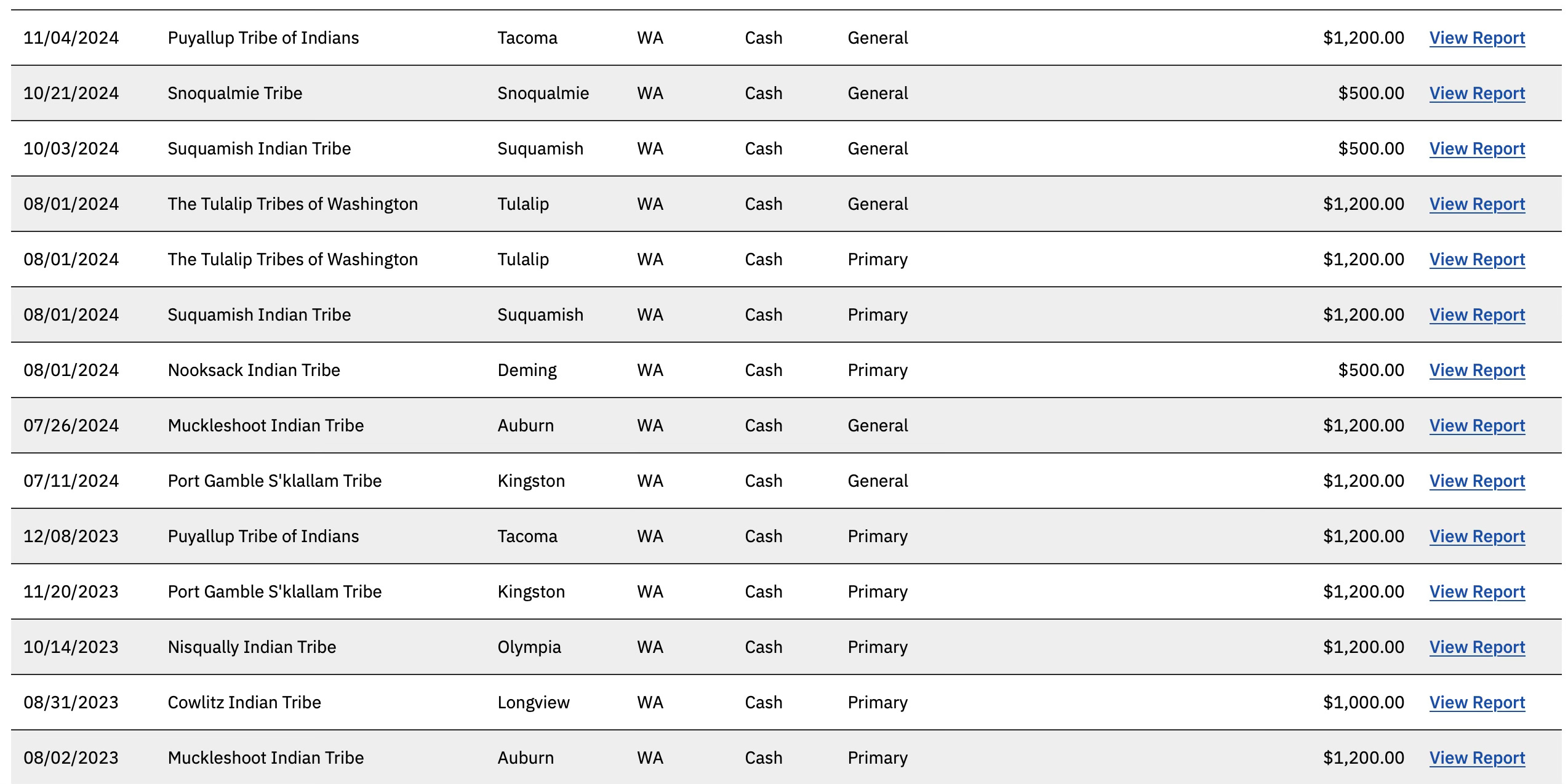
Observers might simply view it as part of the normal relationship between elected officials and well-resourced stakeholders.
Still, as tax bills continue to climb for homeowners across Clallam County, some residents are beginning to ask whether the balance between taxpayer burdens and taxpayer benefits has drifted out of alignment.
When taxpayers see millions flowing into projects owned by sovereign governments that do not pay the same taxes they do, it naturally raises a question: what would that money mean if it were invested in institutions that serve the entire community? A hospital trying to stay solvent, a school district struggling to pass levies, a rural fire district stretched thin, or a public library system preparing another levy lid lift might tell a very different story if even a fraction of those dollars flowed their way.
“Sovereignty” traditionally meant independence.
Today, many taxpayers wonder whether it increasingly looks more like partnership—one where the public often ends up covering a significant share of the bill.
Residents who want to hear directly from lawmakers will have an opportunity this week.
Coffee with Colleen will host Senator Mike Chapman and Representative Adam Bernbaum to discuss the recently concluded legislative session and the budgets now awaiting the governor’s signature.
📅 Wednesday, March 18 — 8:00 AM
Meeting ID: 894 7451 0306
Passcode: 187447
For more details, click here and scroll to the bottom of the page.
Participants are often able to submit questions through the Zoom chat.
Given the growing tax burden facing local households, residents may have a few questions worth asking.


