


In this Sundays With Seegers, County Commissioner candidate Jake Seegers examines public records showing Clallam County nearly launched a program that would have tested illegal drugs and returned them to participants for use. Despite warnings of significant legal and financial liability, commissioners unanimously approved the effort. The program was ultimately stopped after a county risk manager intervened. The records raise a fundamental question: when does harm reduction become government-facilitated drug use?
Harm Reduction Almost Broke Clallam County
When Health Officer Allison Berry was appointed in 2018, Clallam County’s harm reduction program was relatively simple: participants exchanged used syringes for clean needles on a one-for-one basis.
The stated goal was straightforward: reduce the spread of HIV, hepatitis, and other bloodborne diseases among people who were already injecting drugs.
Over the next eight years, however, Health Officer Berry and the Clallam County commissioners steadily expanded harm reduction far beyond its original scope. What began as a syringe exchange evolved into a comprehensive Harm Reduction Health Center that distributes supplies for virtually every method of drug consumption.
Today, participants receive syringes, smoking supplies, foil, naloxone, boofing kits, and other drug-use supplies. “How-to” literature not only explains alternative methods of consumption, but details how to achieve the most effective high.
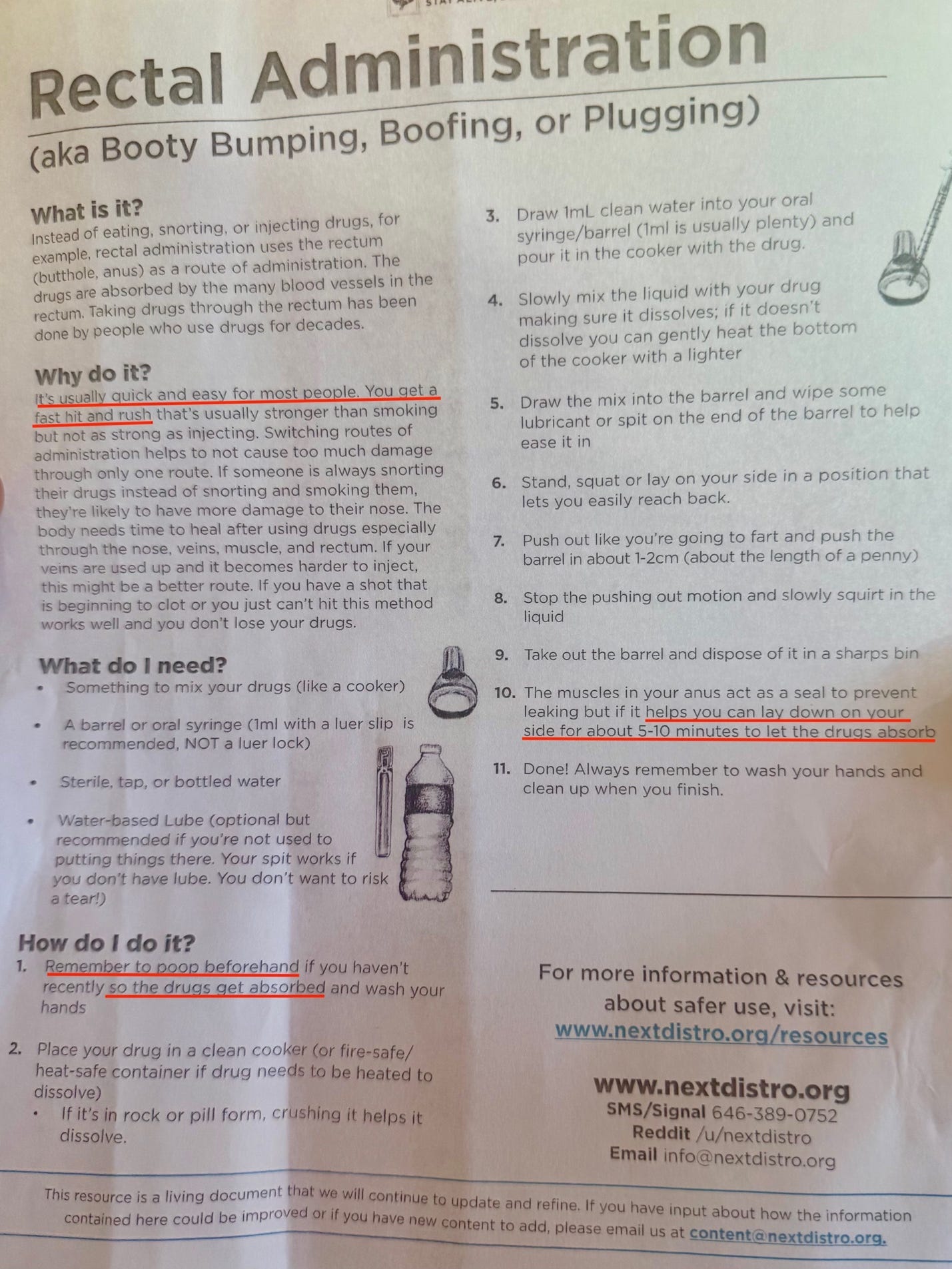
The transformation of a simple disease-prevention strategy into a distribution center for drug-use supplies and resources did not happen by accident. It was the result of a deliberate and sustained effort to expand harm reduction at nearly every opportunity.
Health Officer Berry and the commissioners frequently justified each expansion as a necessary response to the worsening overdose crisis. Yet at every stage, the same question received little discussion:
At what point does reducing the harms of drug use become facilitating drug use itself?
For the Health Officer and the sitting commissioners, there appears to be no limit to their commitment to expanding harm reduction.
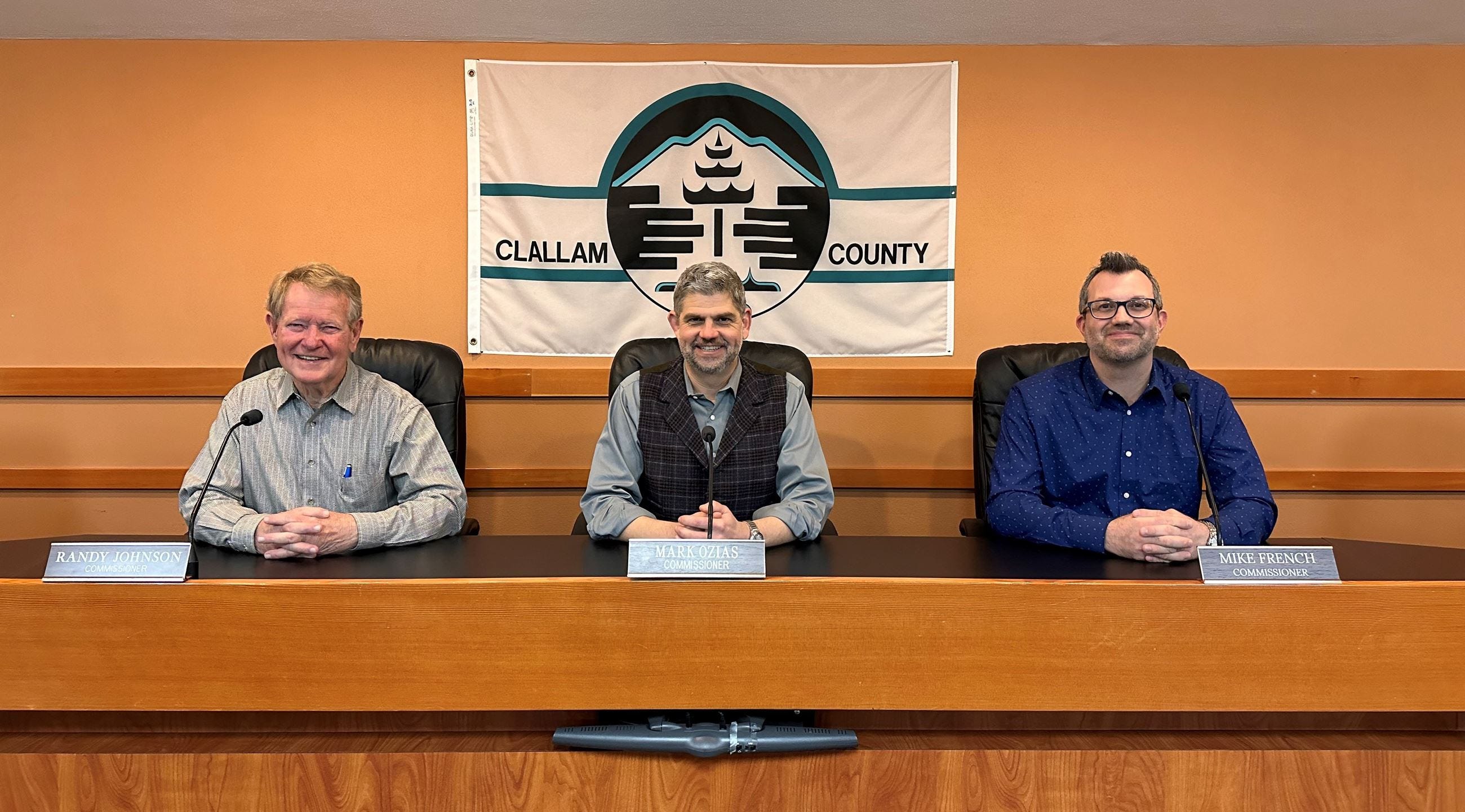
That commitment reached a new level in 2023 when Clallam County joined the University of Washington’s ADAI (Additction, Drugs, and Alcohol Institute) Drug Checking Project. Commissioners Randy Johnson, Mark Ozias, and Mike French unanimously approved the grant-funded program that could have exposed county taxpayers to millions of dollars in liability.
Take a Ride in My Drug-Testing Machine
In late 2022, Health Officer Berry began advocating for a grant-funded portable drug-testing machine, also known as a mass spectrometer.
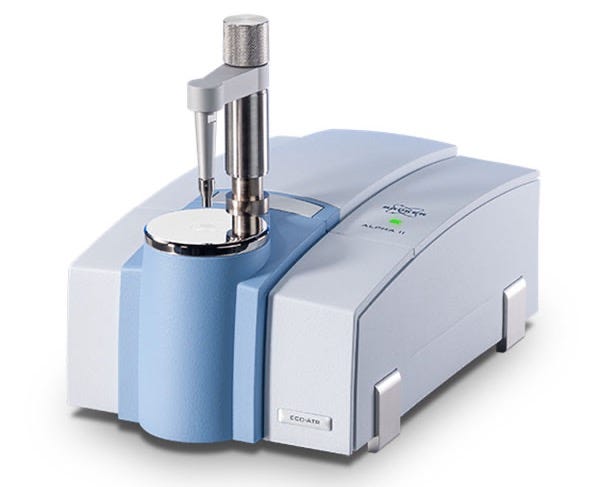
During a December commissioner work session, she stated that the purpose was to better inform response efforts. Berry’s statements, along with her emails, indicated that the county prosecutor, Sheriff’s Office, Port Angeles Police Department, and others had signed off on the program.
The problem with these claims was twofold.
First, the Sheriff’s Office, Port Angeles Police Department, and Coroner’s Office would not have access to the machine. The spectrometer was intended exclusively for the Harm Reduction Health Center.
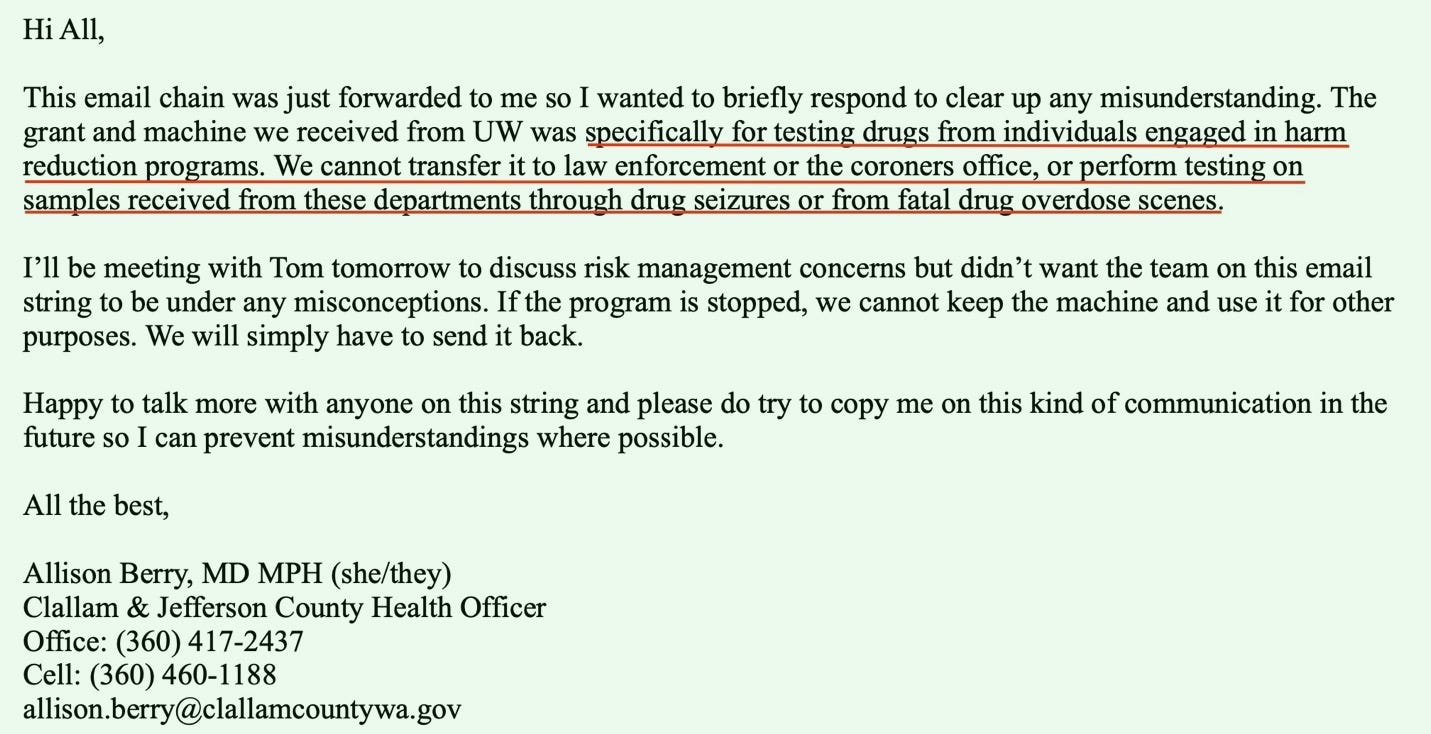
If the primary goal was data collection, why exclude the very agencies that routinely encounter illegal drugs through investigations, arrests, and overdose deaths?
Second, an email from then-County Administrator Rich Sill indicates that the Sheriff had raised concerns that returning drugs to participants after testing could be unlawful under Washington law.
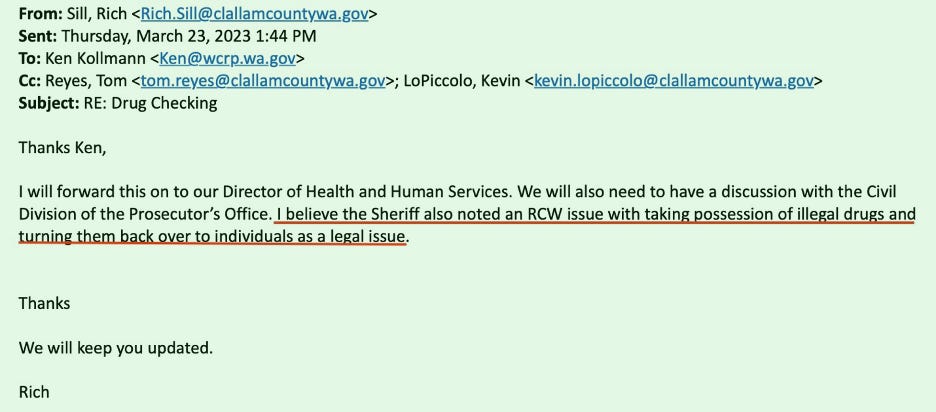
An individual who delivers an illegal substance to someone who later dies from using it may be charged with controlled substances homicide under RCW 69.50.415.
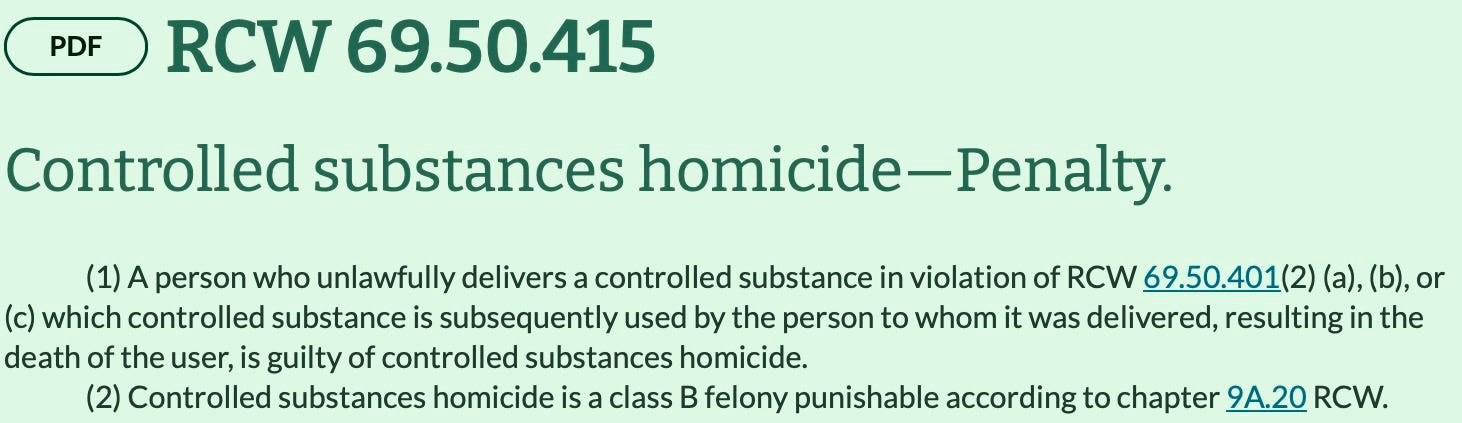
While ESSB 5536 would later take effect in August 2023, providing protections for public-health employees involved in distributing harm-reduction supplies and testing illegal substances, it did not explicitly provide protections for returning drugs to participants after testing.
The drug-checking program was scheduled to begin before those protections took effect. It also would have launched during the worst overdose period in Clallam County’s history. According to the Coroner’s Office, trailing-twelve-month (TTM) overdose deaths peaked between April 2023 and March 2024, with 51 deaths during that period.
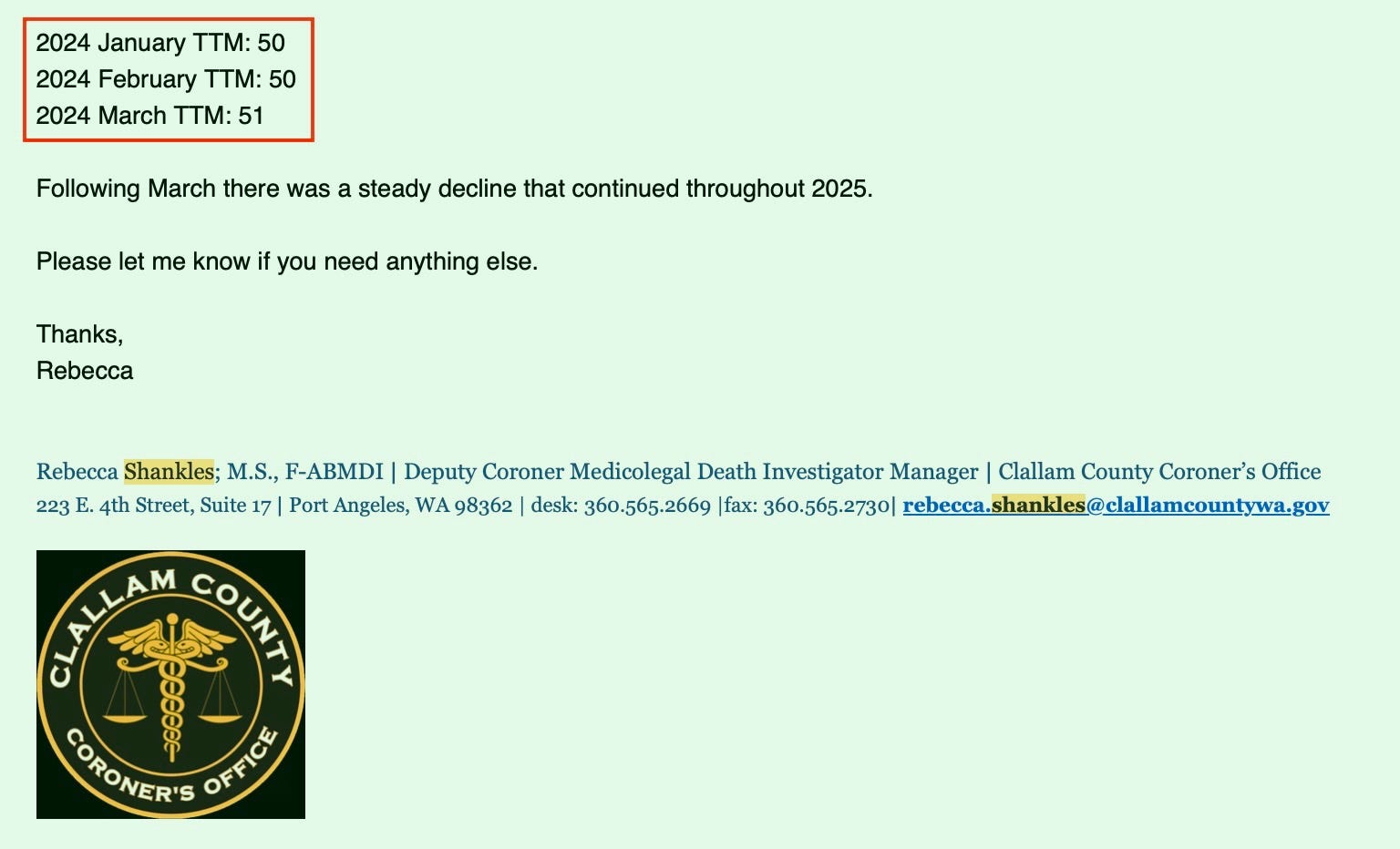
That equates to nearly one overdose death every week.
What were the chances that one of those individuals would have used the drug-checking program? If a participant received a contaminant-free result and later died, could county employees face legal exposure under RCW 69.50.415?
The potential legal and financial liability was significant.
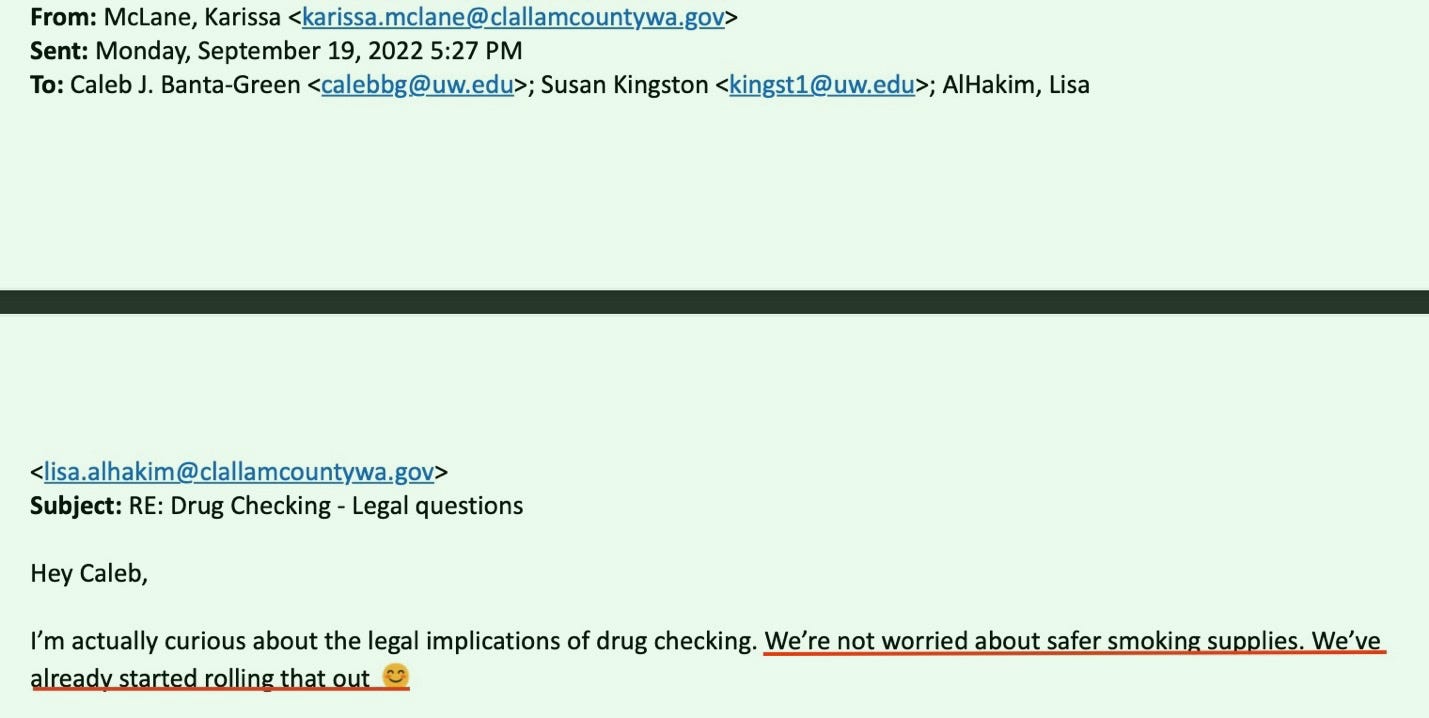
Yet liability concerns appeared to carry little weight. In fact, nearly a year before ESSB 5536 took effect, the county had already begun distributing drug-use supplies beyond syringes as part of its ongoing expansion of harm reduction.
The Process
When the drug-checking program was presented to commissioners during a January 30, 2023 work session, Commissioner Johnson asked the obvious question:
“That’s great, but where are they [illegal drugs] coming from, the Sheriff’s office?”
Karissa McLane, then Public Health Nurse Supervisor for Clallam County Health and Human Services (HHS), explained that participants in the county’s harm reduction program would bring their own drugs in for testing.
A month earlier, during a December 12, 2022 work session, then-Commissioner Bill Peach asked:
“If it turns out that it is illegal drugs, can they get arrested?”
McLane responded:
“That’s a good question. Yes. People can bring their drugs in to get tested. We’ve consulted with our prosecuting attorney’s office and discussed with our sheriff’s office and have determined that people will not be arrested for bringing drugs in to get tested from us.”
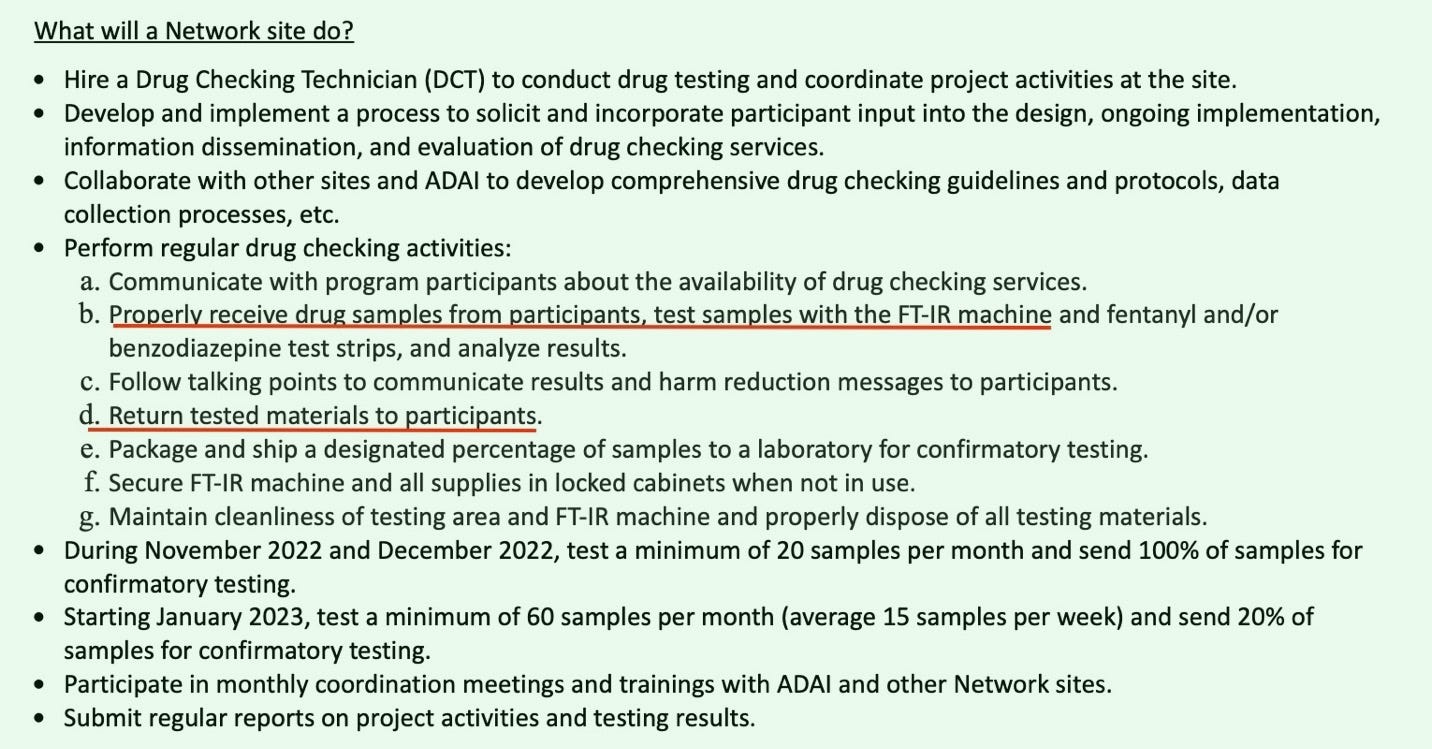
The proposed process was straightforward:
An individual acquires illegal drugs — possibly from any of several open-air drug markets in Port Angeles, like Safeway or the Veterans Bell.
They bring those drugs to the Harm Reduction Health Center.
A county health employee tests them using the mass spectrometer.
The results are shared with the participant.
The drugs are returned to the participant for use.
The problem is that sophisticated testing by a trusted county health professional can create a false sense of safety when contaminants are not detected. Liability disclosures attempted to address this by explaining that a test result “doesn’t always mean a drug is safe to use.”
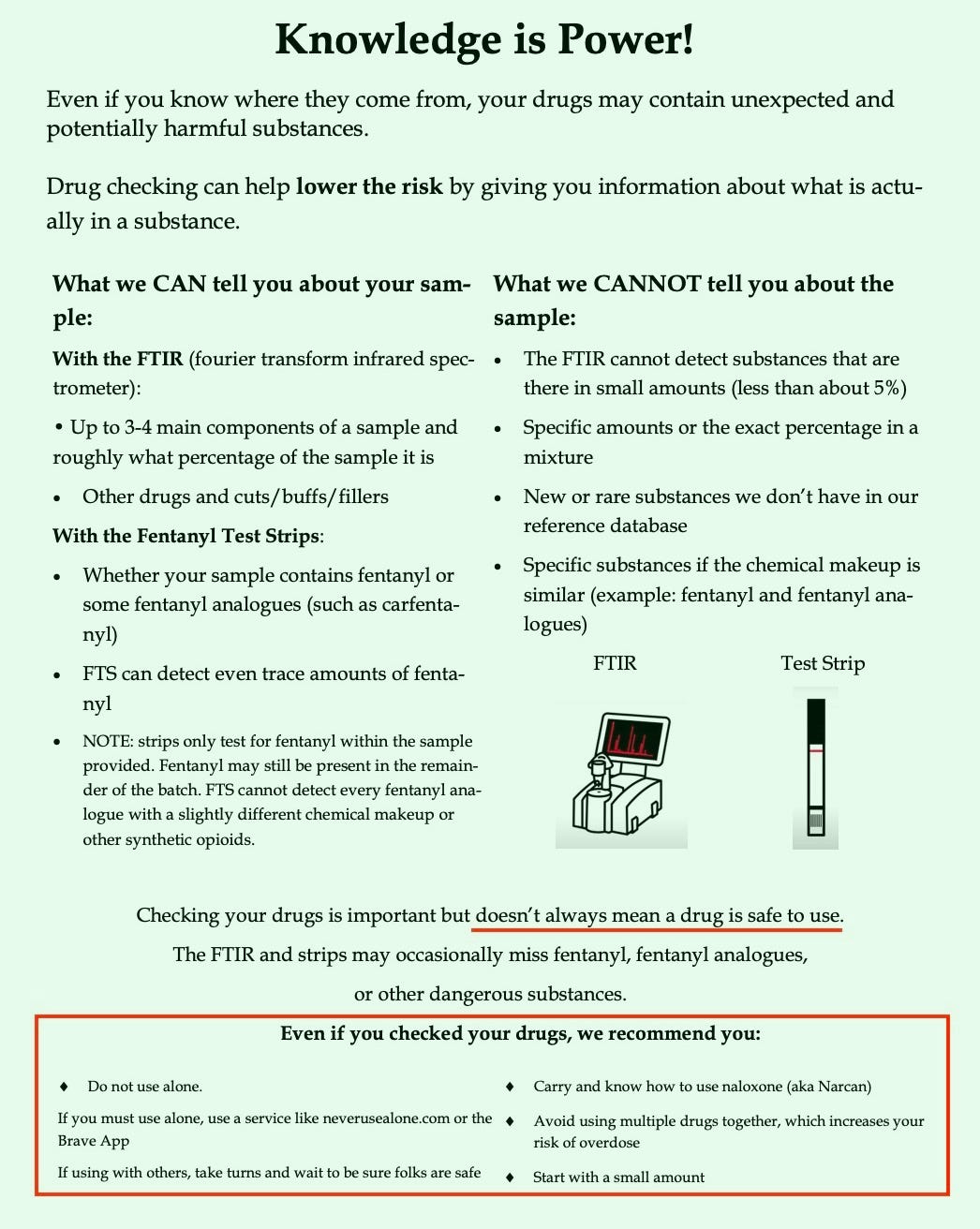
But common sense would suggest a simpler message:
“Drugs are never safe to use.”
“Fentanyl will kill you. Don’t use it.”
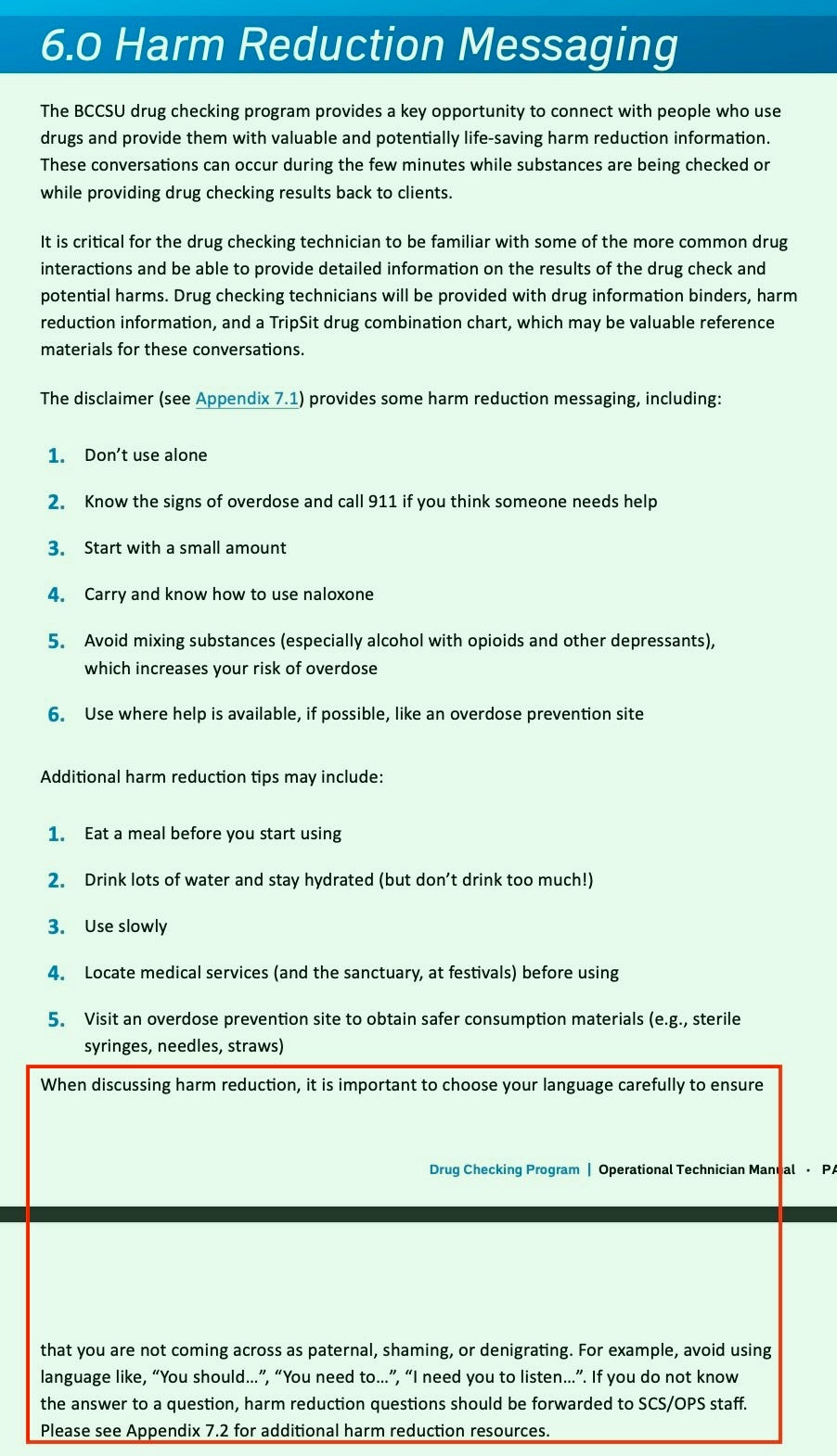
Yet participants were unlikely to hear such unequivocal language. “Harm Reduction Messaging” guidelines attached to emails obtained through a public records request cautioned:
“When discussing harm reduction, it is important to choose your language carefully to ensure that you are not coming across as paternal, shaming or denigrating.”
When a participant hands illegal drugs to a trusted county health professional, receives a contaminant-free result, and leaves with those drugs—along with a pipe, syringe, or boofing kit—the message received is clear:
Go ahead and use it. It’s been checked.
Blinders
But what would have happened if a county health employee deemed a drug contaminant-free and the participant later died from an overdose?
The answer could have been millions of dollars in liability, litigation costs, settlements, and judgments ultimately borne by taxpayers.
The potential exposure extended beyond Clallam County.
During a January 2023 commissioner work session, Karissa McLane explained that the drug-testing machine would eventually be integrated into harm reduction’s planned mobile van. In partnership with Jefferson County, the mobile unit would provide drug testing and distribute supplies throughout both counties.
After the presentation, Commissioner Ozias asked:
“Commissioners, any other questions?”
The audience could have heard a pin drop.
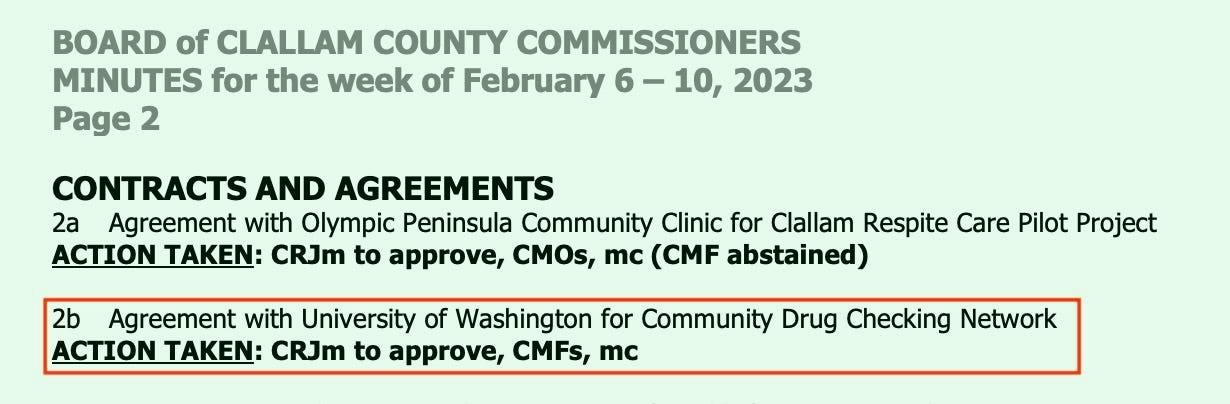
On February 7, 2023, Commissioner Johnson moved to approve the program; Commissioner French seconded, and the board unanimously approved it without further discussion.
Following the vote, Commissioner Ozias enthusiastically remarked:
“[This] is really exciting! It’s really exciting to see the University [of Washington] being engaged so broadly and directly in communities like our county. I really appreciate that. So, thanks to our public health team for facilitating this.”
Just a Matter of Time
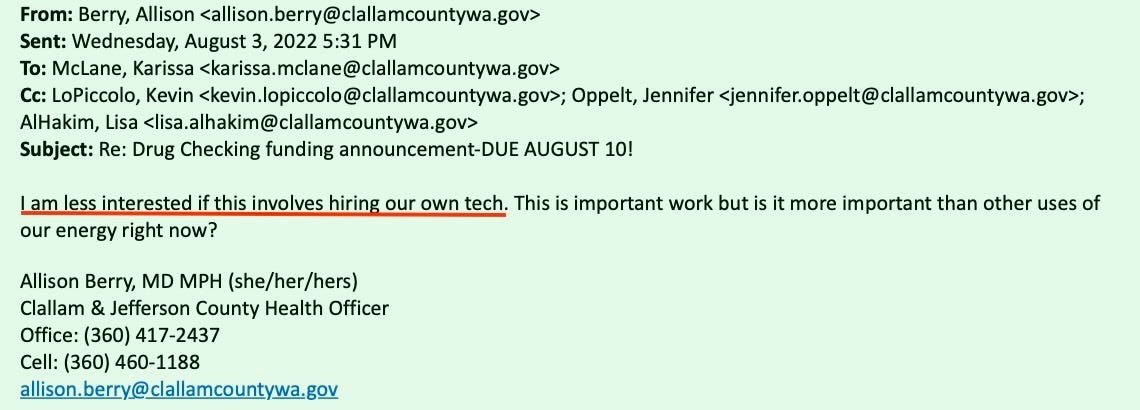
Despite the liability risks, Health Officer Berry and HHS appeared to downplay the importance of having a qualified technician operate the drug-testing machine. While discussing the grant, Berry wrote:
“I am less interested in hiring our own tech.”
Lisa Al-Hakim, then-Prevention Specialist/SSP Coordinator for Clallam County Public Health, proposed an alternative. The Hepatitis Education Project (HEP), a Seattle nonprofit and fellow ADAI Drug Checking Grant recipient, had hired an “OD Prevention Coordinator” instead of a dedicated technician.
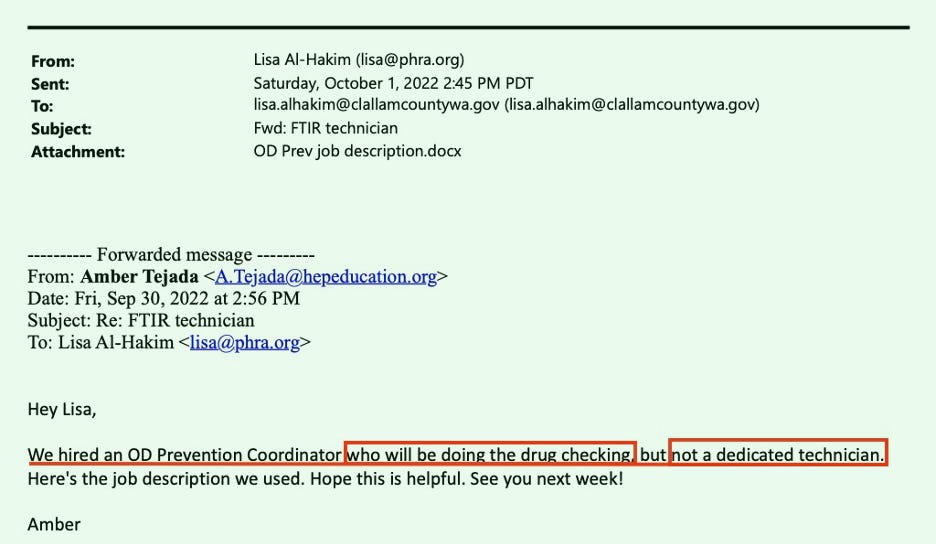
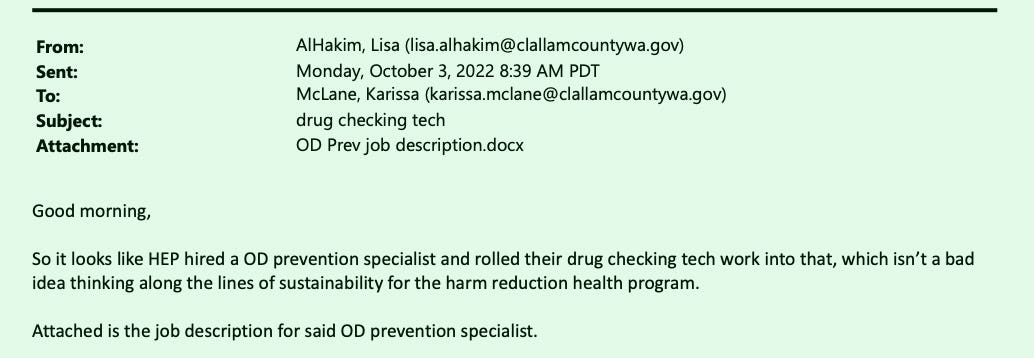
The decision appears to have been driven by cost and long-term harm reduction sustainability. Al-Hakim wrote:
“So it looks like HEP hired a OD prevention specialist and rolled their drug-checking tech work into that, which isn’t a bad idea thinking along the lines of sustainability for the harm reduction health program.”
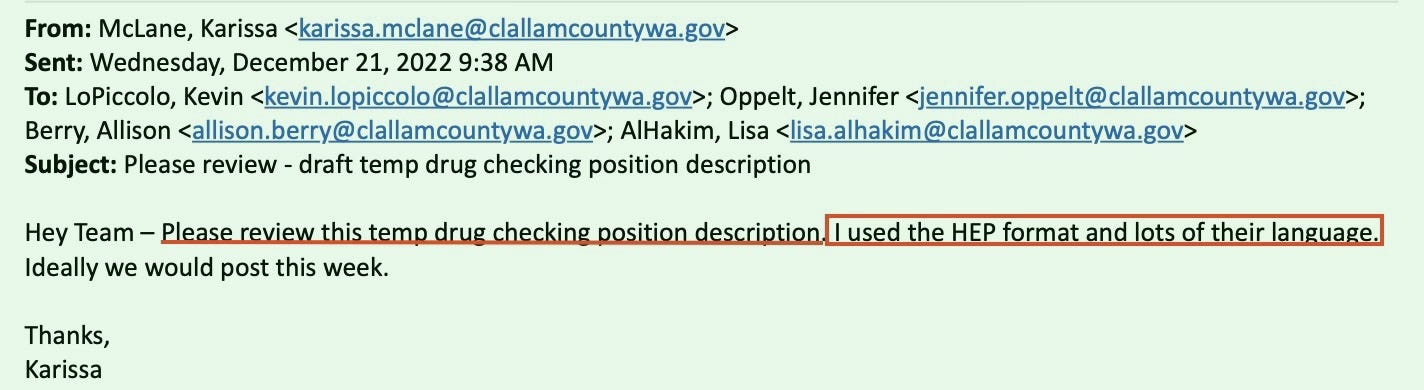
Clallam County followed HEP’s lead.
The problem is that the Drug Checking Network grant specifically required a Drug Technician.
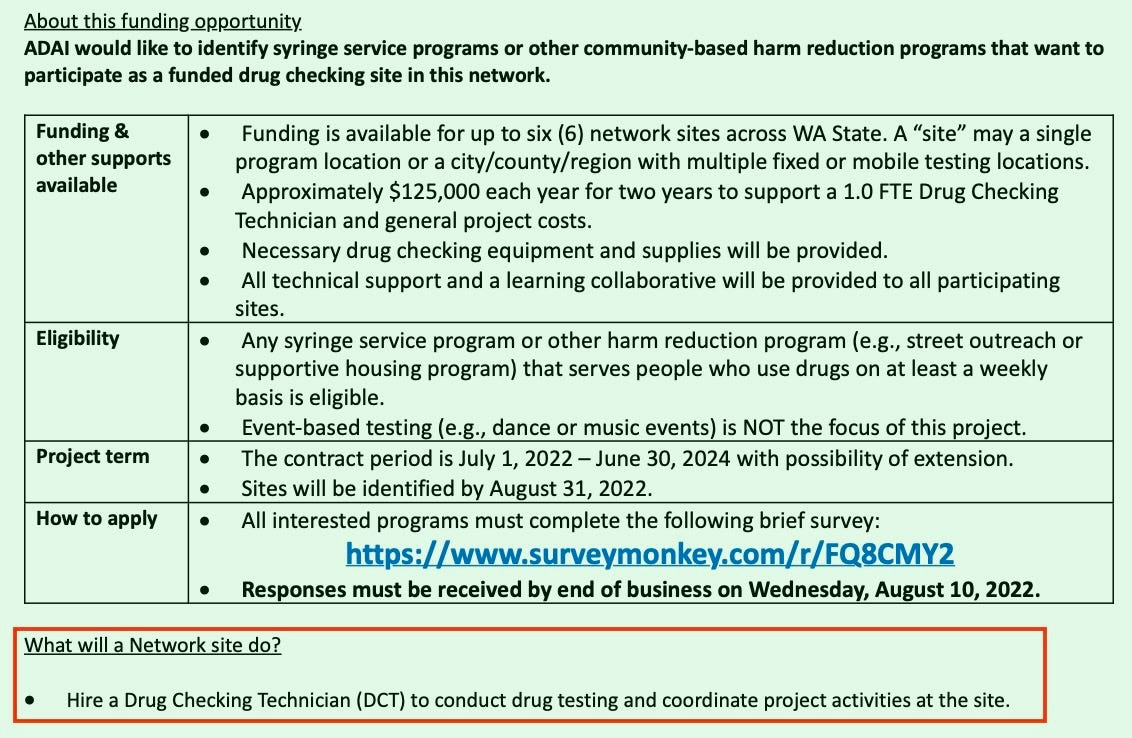
And, Clallam County’s scope of work committed to hiring one.
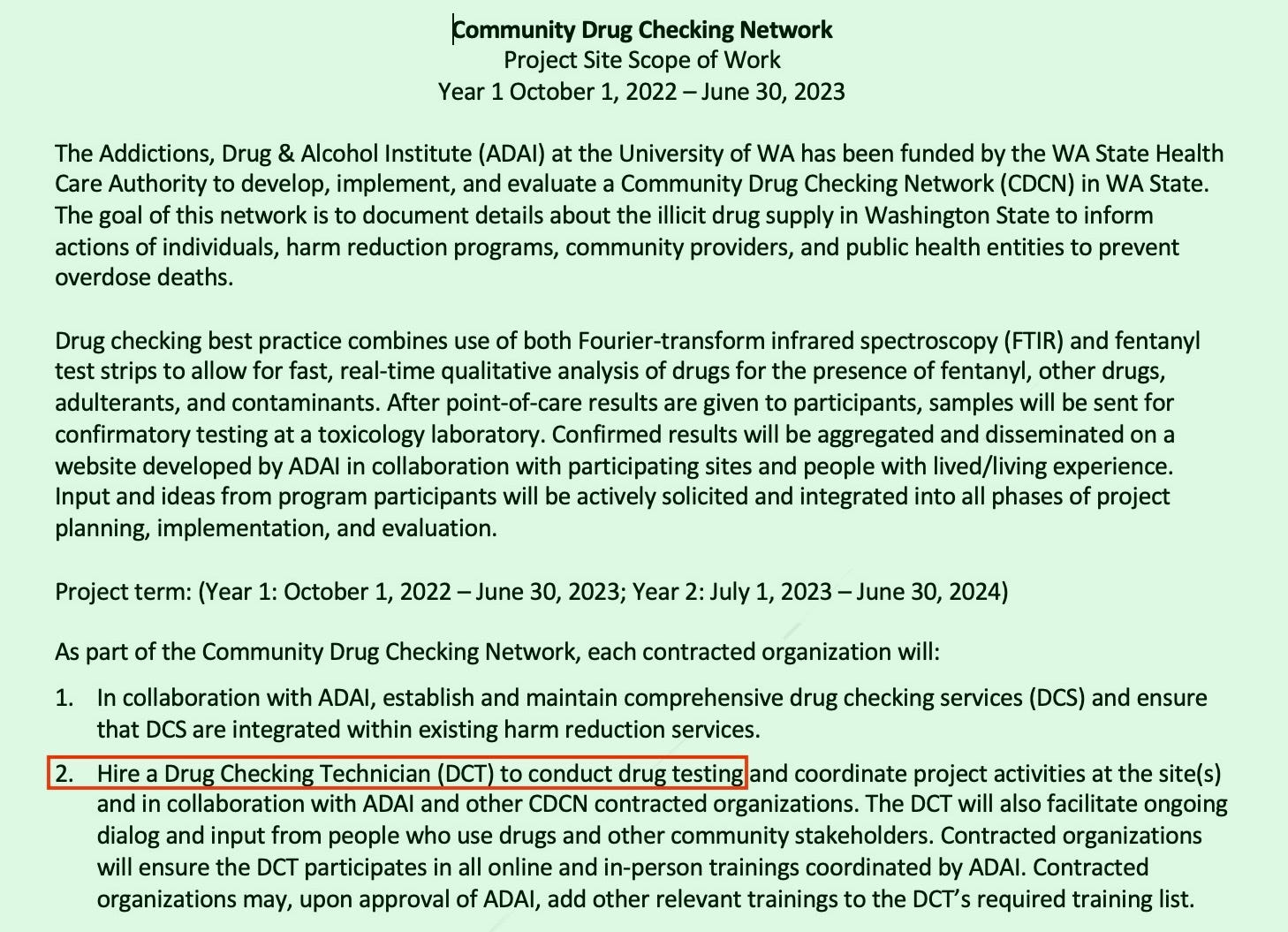
Instead, the OD Prevention Coordinator position emphasized lived experience and social-service work rather than technical qualifications.
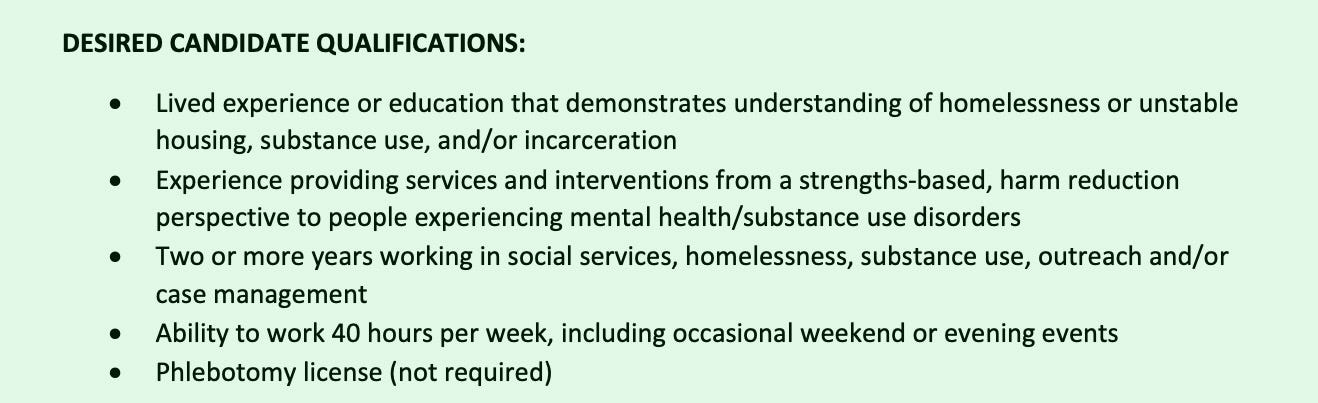
But technical expertise was critical to interpreting the spectrometer's results.
Before a training session led by Yarelix Estrada of the New York City Department of Health, internal emails acknowledged that interpreting the machine’s spectra readings required experience. The training materials warned:
“We do not trust machines. Do not take the first match and assume it to be true. The art of drug-checking is in the technician’s ability to think critically about the sample and OPUS is only a tool.”

Drug checking was not simply a matter of pushing a button. It required the judgment and critical analysis of a trained technician.
Instead of prioritizing technical expertise, the county specifically encouraged individuals with personal histories of substance use to apply.
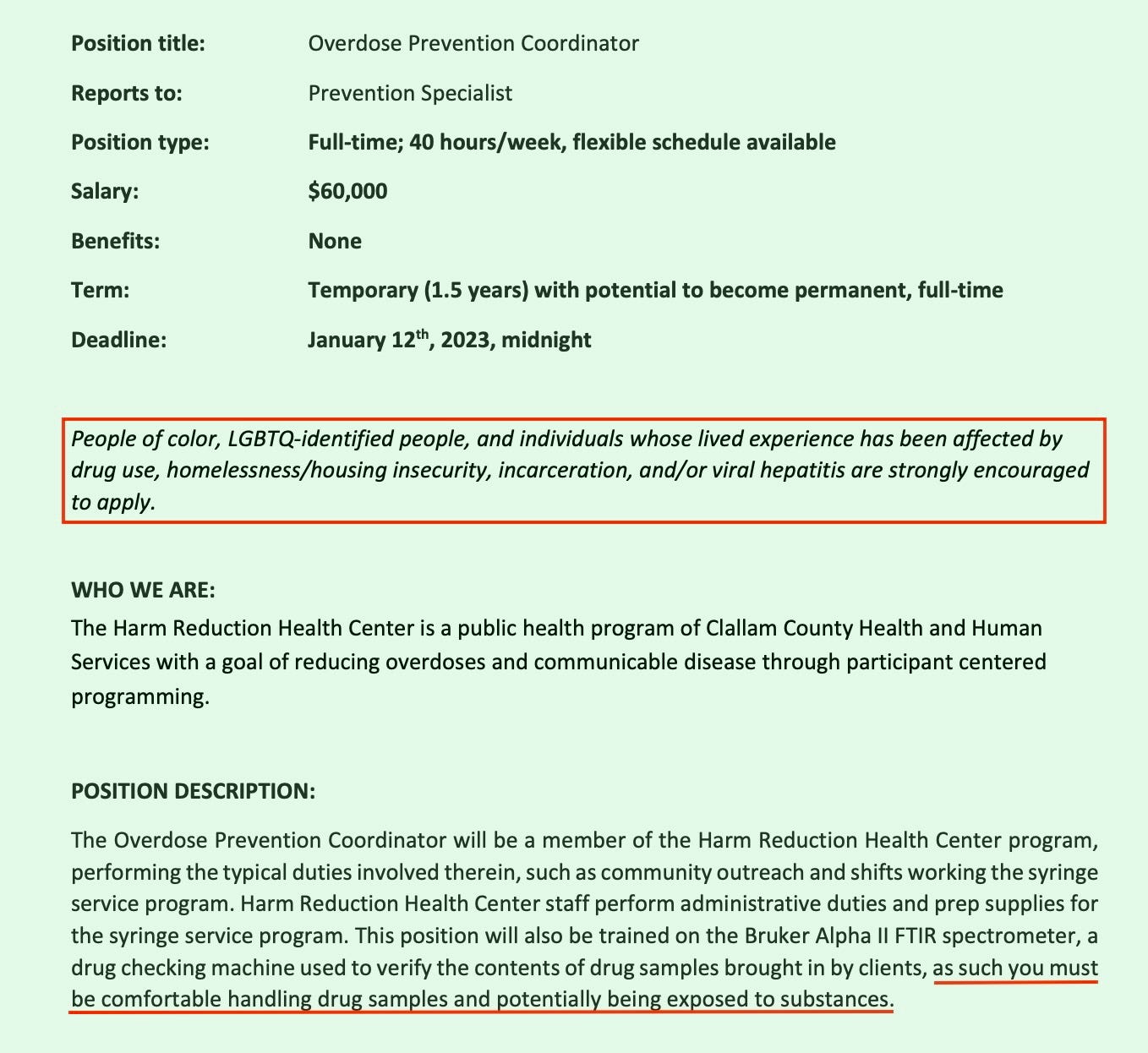
Additionally, the position description stated that candidates “must be comfortable handling drug samples and potentially being exposed to substances.”
Encouraging individuals in recovery to apply for a position that requires handling the very drugs they were attempting to avoid does not seem like harm reduction.
The drug-testing machine would have become part of the county’s mobile harm reduction van, with complex analyses potentially conducted not by a Drug Technician, as discussed in the grant, but by an outreach coordinator—possibly someone in recovery—who would handle a constant flow of illegal drugs. That employee would have been responsible for interpreting results, giving drugs to participants, and communicating whether or not contaminants had been detected.
It is difficult to imagine a scenario carrying greater potential for error—or greater liability for Clallam County taxpayers.
A Voice in the Desert
While county officials pressed forward with expanding harm reduction despite significant liability concerns, one employee stepped forward to protect the county from itself.
When Tom Reyes, Deputy Director of Human Resources and Risk Management, learned of the drug-checking program, he immediately recognized the risks and voiced his concerns:
“I believe it is only a matter of time before a lawsuit is filed on someone, or some agency, providing testing. I hope Clallam County is not that first!”
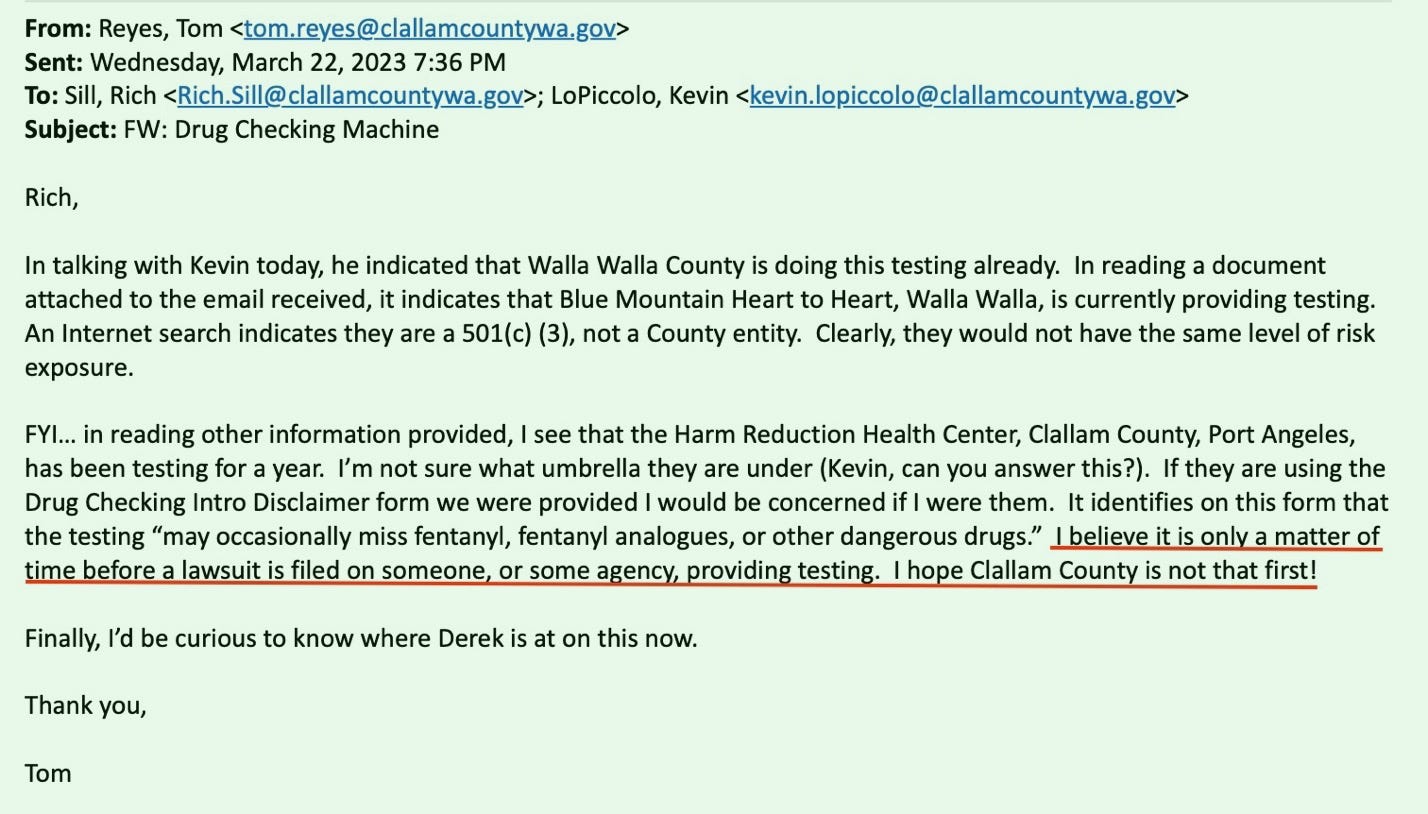
Also of concern, most of the other participants in the ADAI drug-checking program were NGO’s, not government departments.
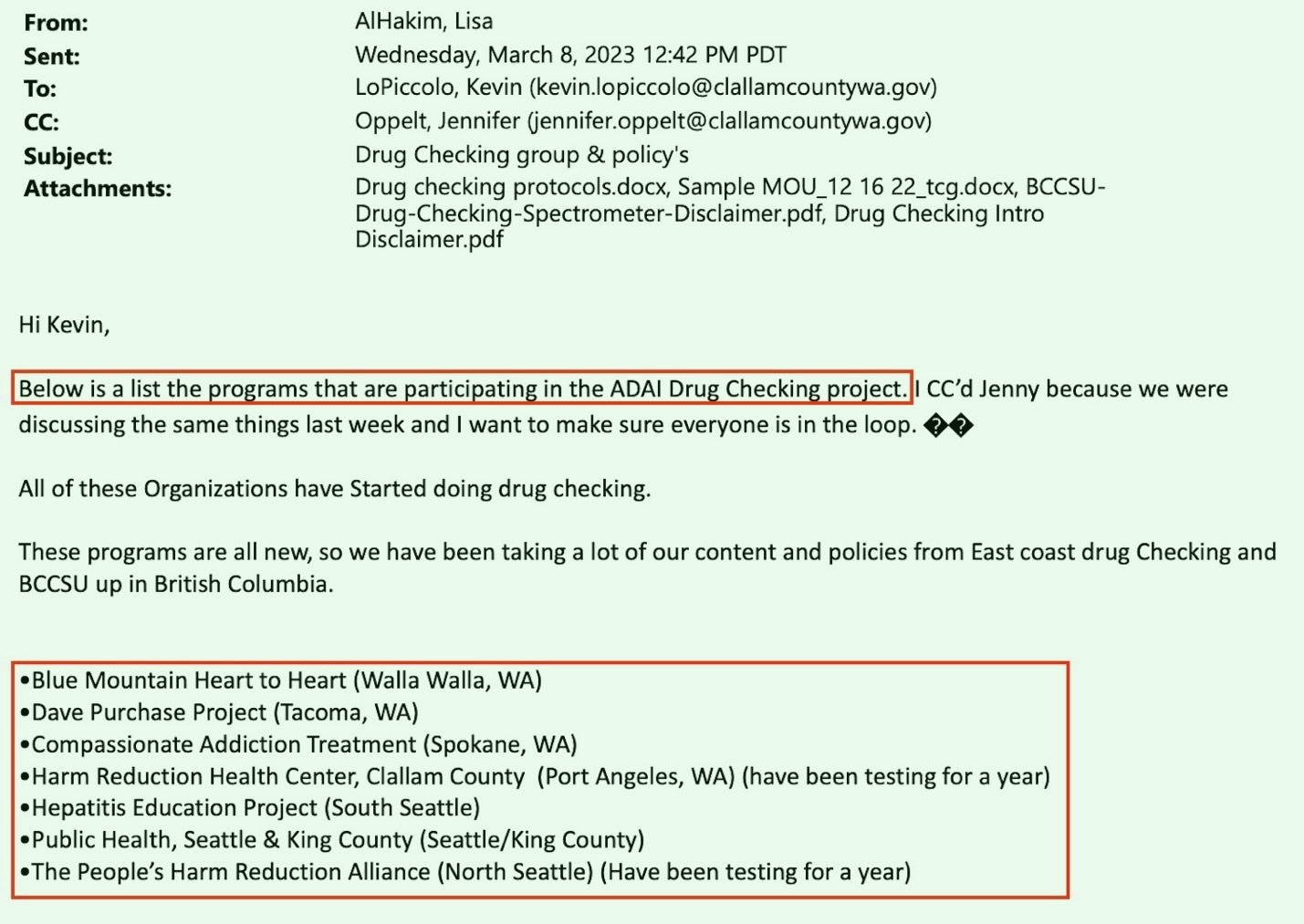
In the same email, Reyes noted:
“An internet search indicates they are a 501(c) (3), not a County entity. Clearly, they would not have the same level of risk exposure.”
A former detective with the Clallam County Sheriff’s Office, Reyes acted quickly despite apparent internal pressure to dismiss the liability concerns. He contacted Derek Bryan of the Washington Counties Risk Pool, the insurer that provides coverage for Clallam County.
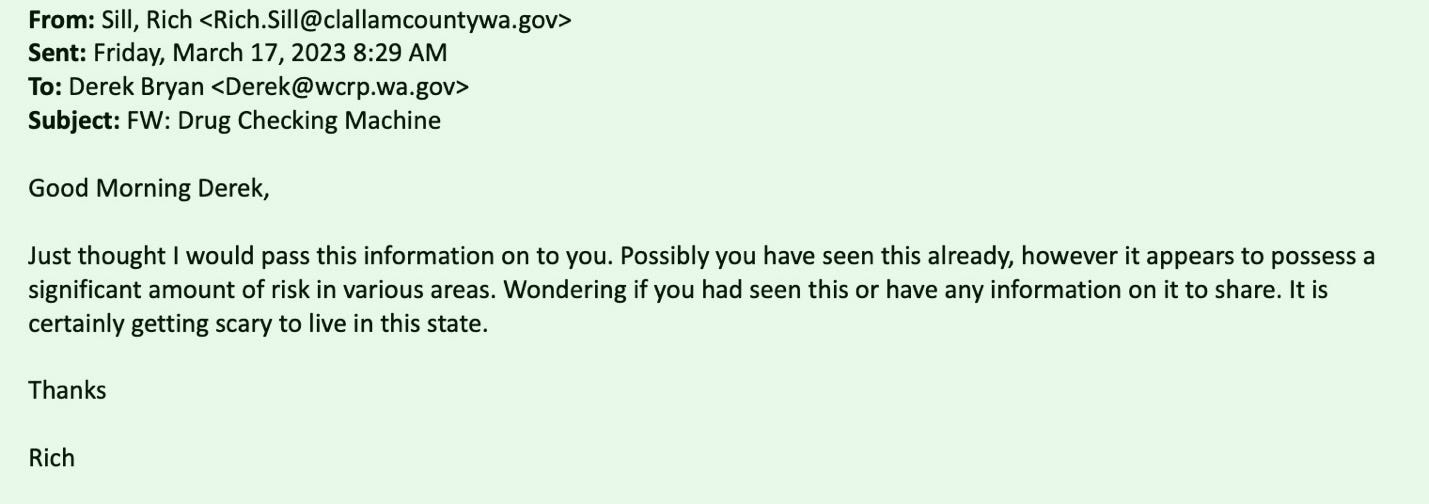
Less than a week later, a response from Ken Kollmann effectively stopped the program in its tracks.
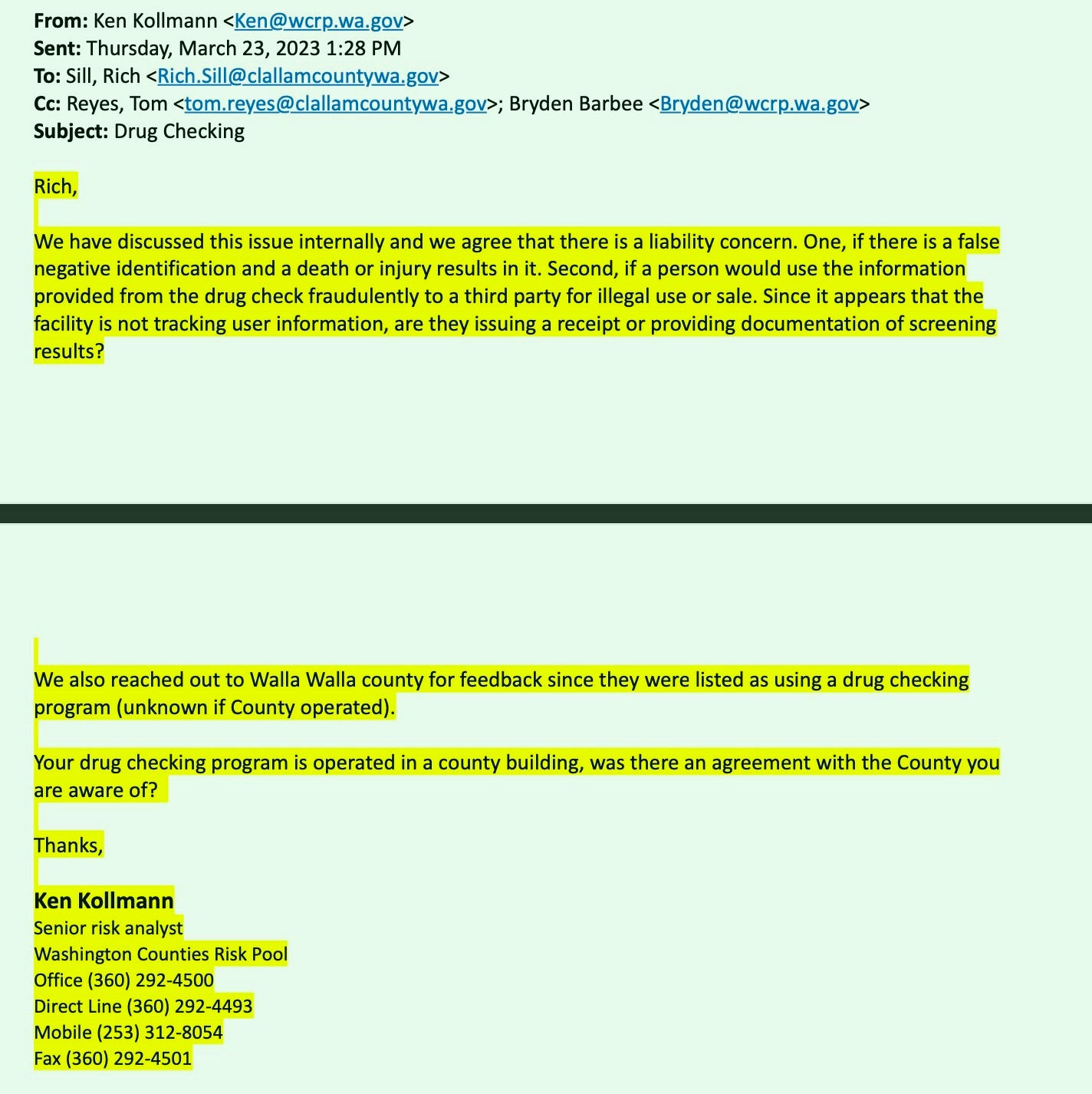
The county dodged a bullet—one that its Health Officer and commissioners had been willing to put the county in front of.
Common Sense Prevails
The drug-checking machine was never the real story.
The story is how far county leadership was willing to go in its effort to expand harm reduction.
Public records show that pursuit of the ADAI Drug Checking Grant was part of a broader, coordinated effort to grow harm reduction services in Clallam County.
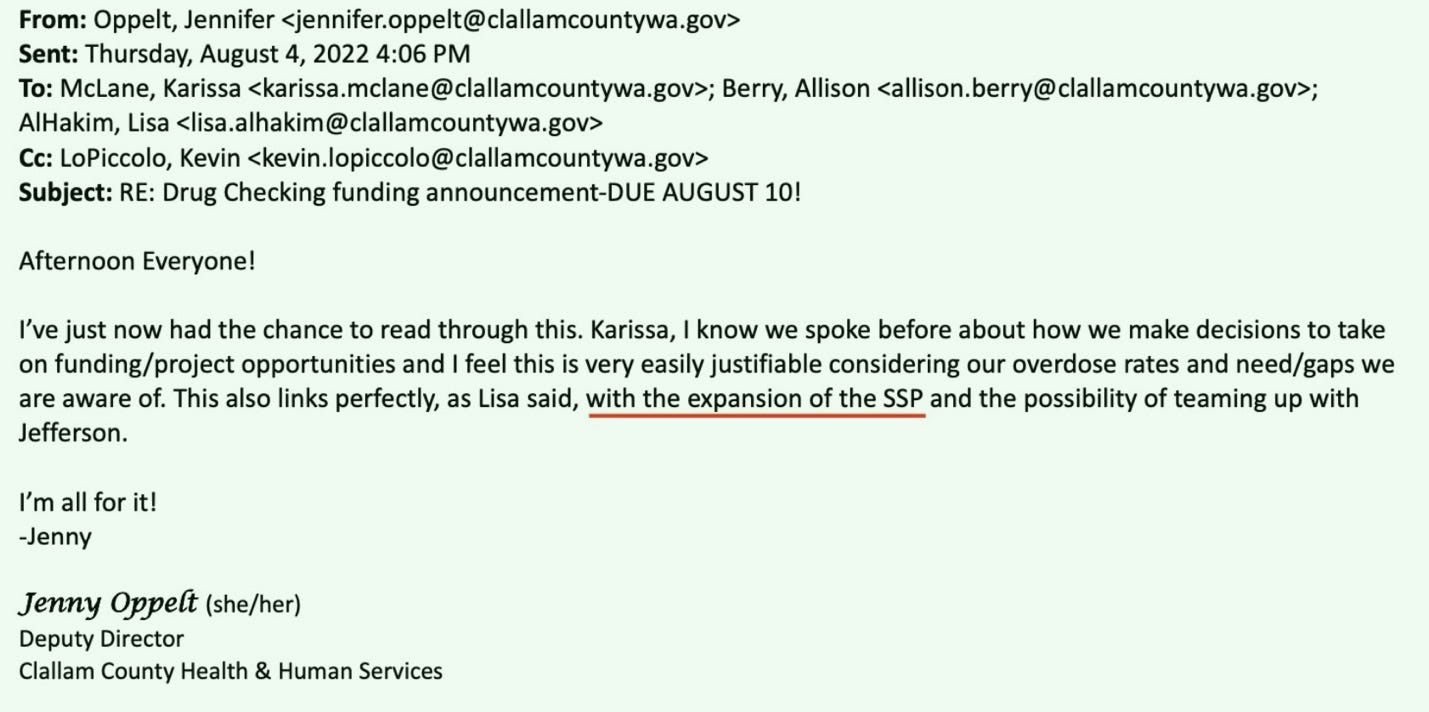
The Harm Reduction Health Center had already taken possession of the machine and was actively promoting the program months before final approval was granted.
When the program encountered resistance, Health Officer Berry attempted to salvage it by appealing to the pity of Tom Reyes:
“Our staff are already incredibly overstretched and watching this position go unfilled and the money sit wasted has been deeply demoralizing to them. We cannot afford to lose any more staff to burnout this year.”
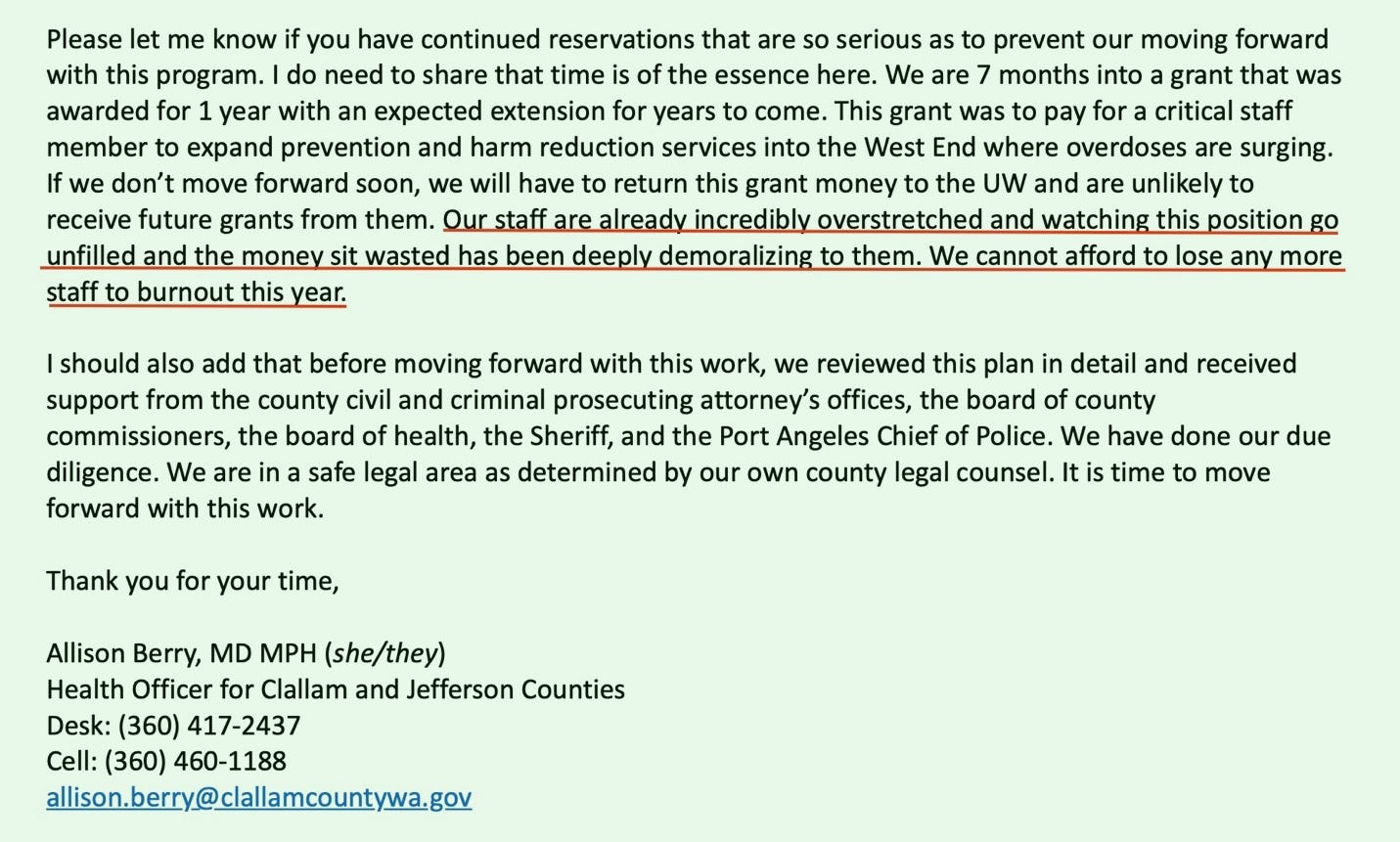
But Reyes understood what others seemed unwilling to acknowledge. As Deputy Director of Human Resources and Risk Management and a former Sheriff’s Office detective, he recognized the extraordinary liability being created by a county-operated drug-checking program.
While commissioners and public health officials focused on expanding harm reduction, Reyes focused on legality, liability, and common sense.
He elevated his concerns to the Washington Counties Risk Pool, and within days, the program was effectively dead.
Although Clallam County had already acquired the machine, it was ultimately returned to the University of Washington. The county dodged a potentially catastrophic mistake because one employee was willing to ask the questions that elected officials and public health leadership would not.
Yet losing the drug-checking program did not slow the expansion of harm reduction.
In 2018, the county’s syringe exchange had no dedicated employees and a modest budget of just over $60,000. Various employees, including Dr. Berry (Unthank), pitched in to run the program, totaling 0.51 full-time equivalent (FTE) employees for the entire year.
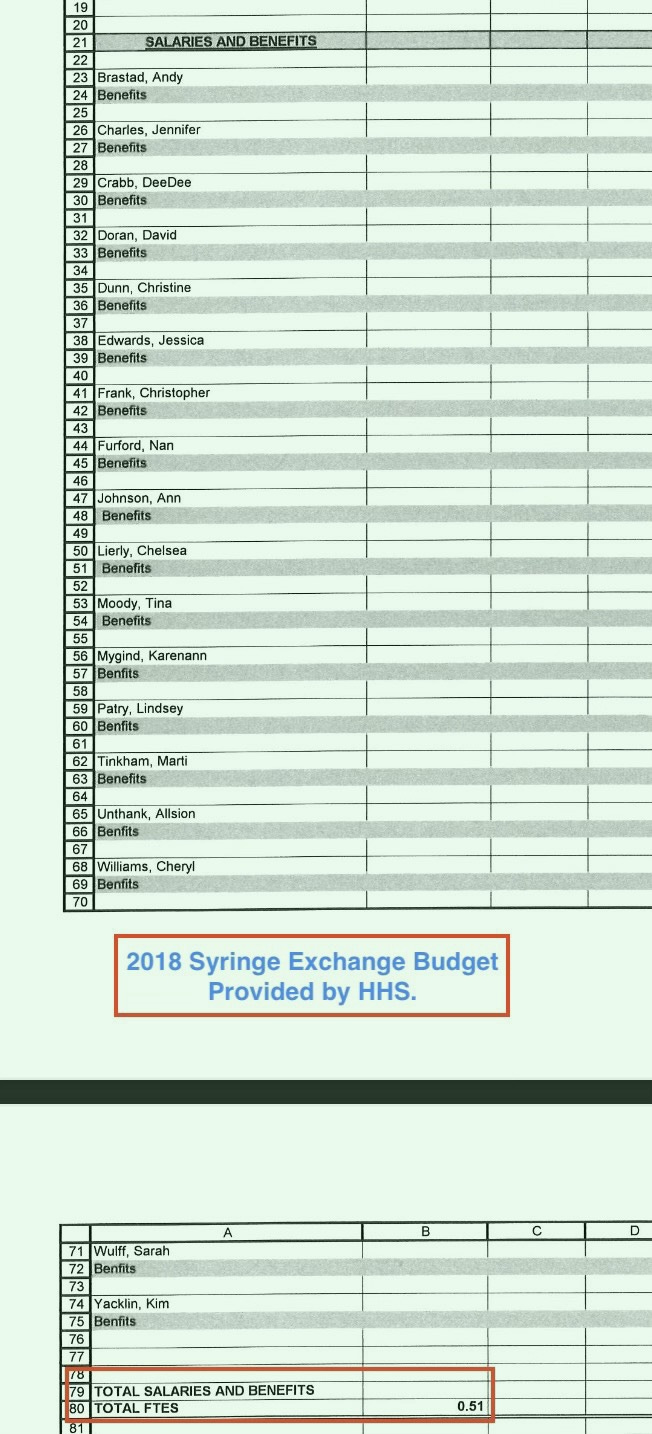
By 2025, the Harm Reduction Health Center employed four full-time staff and operated on a budget of $531,010 per year—roughly equivalent to the cost of four Sheriff’s deputies. At a time when residents are demanding greater public safety, that’s a significant allocation of resources toward a program that seems to expand harm.
Monthly participant encounters increased nearly fivefold, from 212 in 2023 to 975 in 2025.
Meanwhile, overdose deaths in Clallam County have more than tripled since 2018—far outpacing increases nationally, statewide, and in other states that resisted the aggressive expansion of harm reduction policies.

The pattern is difficult to ignore.
When legal concerns emerged, county leadership pressed forward.
When liability concerns emerged, county leadership pressed forward.
When common-sense objections emerged, county leadership pressed forward.
The drug-checking machine was simply the most extreme example.
In the end, Clallam County was protected not by its commissioners, not by its Health Officer, and not by the advocates determined to expand harm reduction at every opportunity.
It was protected by a lone voice willing to challenge the prevailing narrative and insist on accountability.
Clallam County needs more leaders willing to do the same.
Because when government becomes so committed to an ideology that it is willing to expose taxpayers to extraordinary risk in pursuit of it, common sense is no longer optional—it is essential.
What can you do?
The future direction of harm reduction in Clallam County will ultimately be determined by elected officials and public health leaders—but they need to hear from the people they serve.
If you have thoughts about the county’s approach to harm reduction, drug testing, overdose prevention, or the use of taxpayer resources, consider sharing them with the Board of County Commissioners and Health Officer Dr. Allison Berry. All three commissioners can be reached through the Clerk of the Board at loni.gores@clallamcountywa.gov.
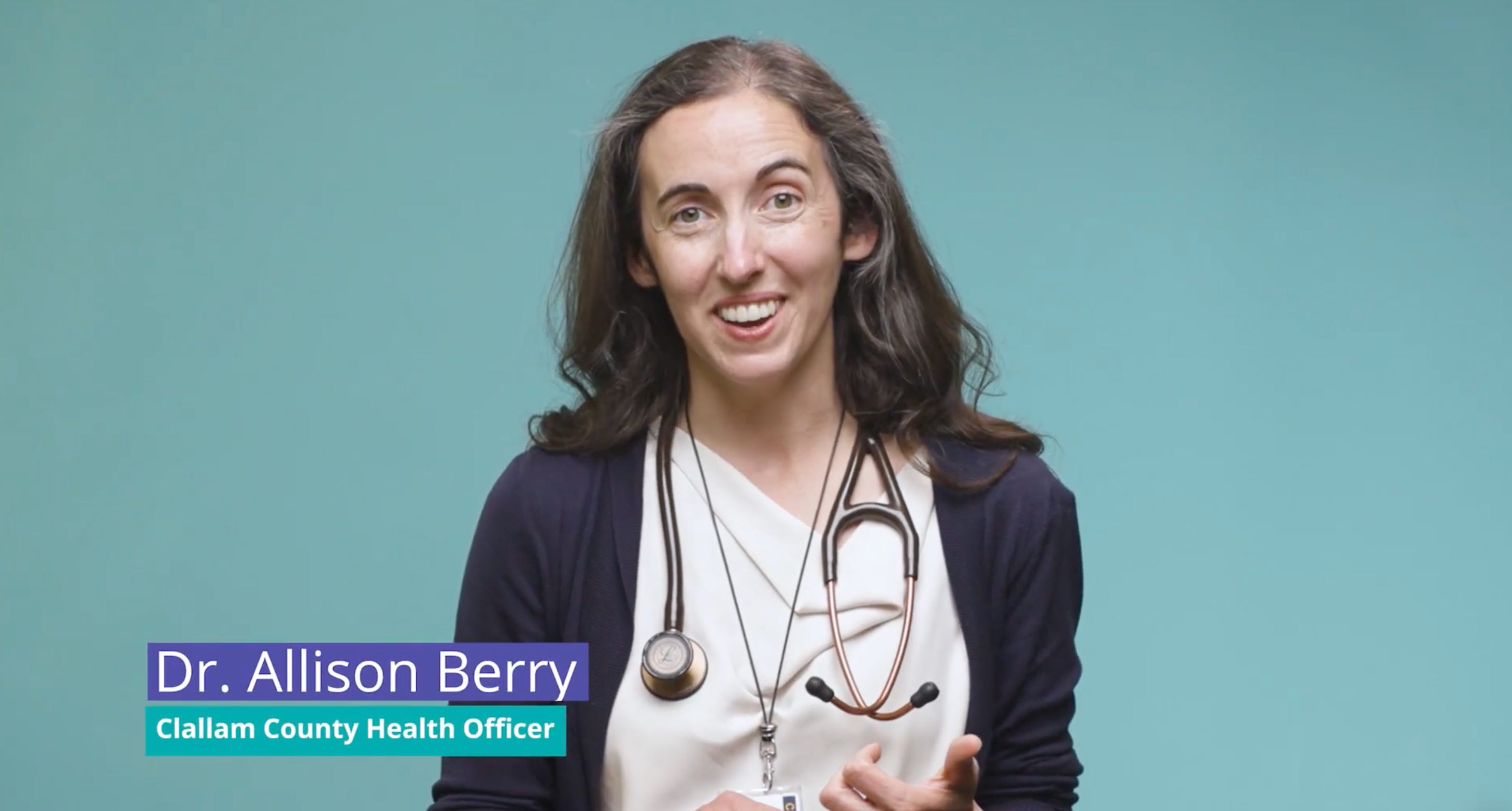
Dr. Berry can be reached directly at allison.berry@clallamcountywa.gov.
You can also make your voice heard during public comment at the next Clallam County Board of Health meeting on Tuesday, June 16, at 1:30 p.m. in the Commissioners Boardroom at the Clallam County Courthouse in Port Angeles. Public comment is available both in person and via Zoom.
Whether you support the county’s current approach, oppose it, or believe changes are needed, local government works best when citizens participate. Make your voice part of the conversation.
Today’s Tidbit: First Commissioner Debate Set for Tomorrow
Clallam County voters will get their first chance to see incumbent Commissioner Mike French and challenger Jake Seegers face off tomorrow night in a candidate forum hosted by the Clallam County Democrats.
The debate begins at 6:00 p.m. Monday, June 15, at Democratic Headquarters, 124 W. First Street in Port Angeles, with a Zoom option available for those unable to attend in person. The format includes opening statements, audience questions, Zoom questions, rebuttals, and closing remarks. Organizers say anyone may ask questions, though comments will be limited to 30 seconds, and audience members are expected to remain respectful.
Whether you’re supporting French, Seegers, or are still undecided, this is the first direct, live comparison of the candidates’ positions before the August primary. Candidate forums will be recorded and posted online for those unable to watch live.
For more details, including virtual attendance instructions, click here and select the event on Monday, June 15.
PDC Complaint Update
The Jake Seegers campaign is currently working with the Washington State Public Disclosure Commission regarding a complaint filed by Paul Pickett.
As part of that process, PDC staff have advised that certain Clallam County Watchdog articles and podcast segments discussing Jake Seegers may require campaign sponsor identification (“Sponsored by Jake Seegers for Commissioner, 131 E. First St, Port Angeles, WA, 98362”). The campaign has raised concerns regarding the proposed disclosure language because no campaign funds have been paid to Clallam County Watchdog, and no compensation has been exchanged for the publication of these articles or podcast segments.
In addition, Clallam County Watchdog frequently includes independent commentary and analysis that may not be reviewed, approved, or endorsed by Jake Seegers or his campaign. Podcast episodes and articles containing commentary reflect the views of Clallam County Watchdog and are not reviewed by the campaign prior to publication.
The campaign and PDC staff continue to discuss these issues and work toward compliance with Washington’s campaign finance laws.


