


The pitch was simple: Put Peninsula people back to work. The federal slides, the local plan, and the woman hired to run the program say something else. Race and tribe are on the page. Preferred partners are named in bold. A hydroseeder is bought for a tribal enterprise while local businesses already do that work. A lot of the cash moves through NGOs. Read the documents. The conclusion is sitting there.
Recompete arrived as a rare win. The North Olympic Peninsula received about $35.6 million from the U.S. Economic Development Administration, 2024 through 2029, to close the gap in prime-age employment and rebuild timber, maritime, and natural-resource jobs. Clallam County is the lead applicant. Commissioner Mike French chairs the coalition and has made the grant a centerpiece of his public service. That is a fair thing to list. It is also fair to read what the grant actually rewards.
Year one is the first hard look. Officials said they would move roughly 900 people into good jobs over five years. Year one produced about 31 placements.
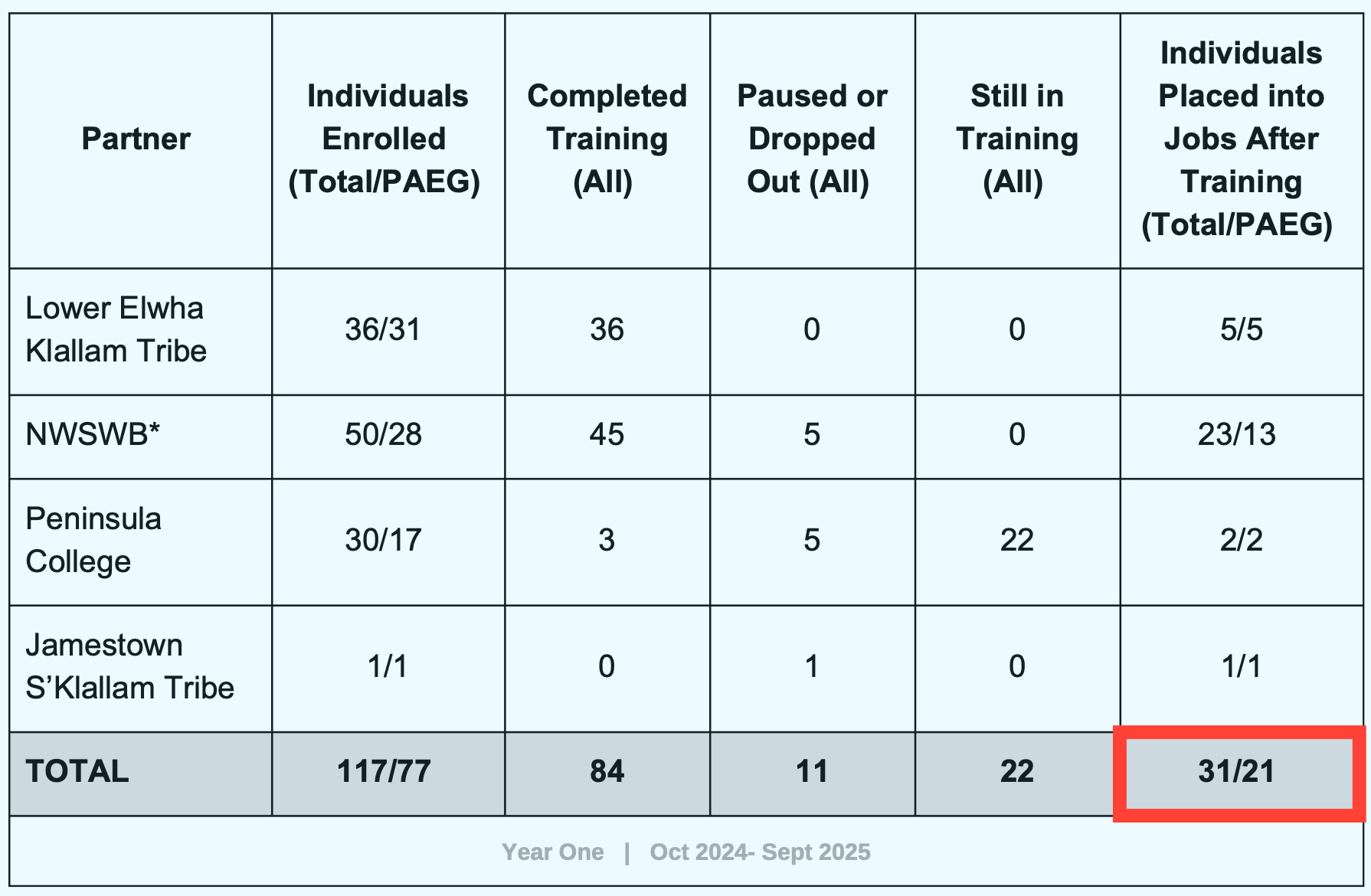
More people enrolled and trained than got hired. At 31 placements in year one, the five-year promise is still mostly a promise.
Page 9 is not a jobs chart. It is a group chart.
EDA’s Phase 2 overview does not describe the six national winners as “places with too few paychecks” and stop there. Page 9 is labeled service area and demographics. It lists the winners by race and identity:
Allentown: 14% Black / African American; 70% Hispanic / Latino
Birmingham: 80% Black / African American
San Juan: 16% Black / African American; 99% Hispanic / Latino
Eastern Kentucky: 1% Black; 1% Hispanic; 100% rural
North Olympic Peninsula: two counties plus five Tribal Nations
Wind River: “Majority Native American”; two Tribal Nations
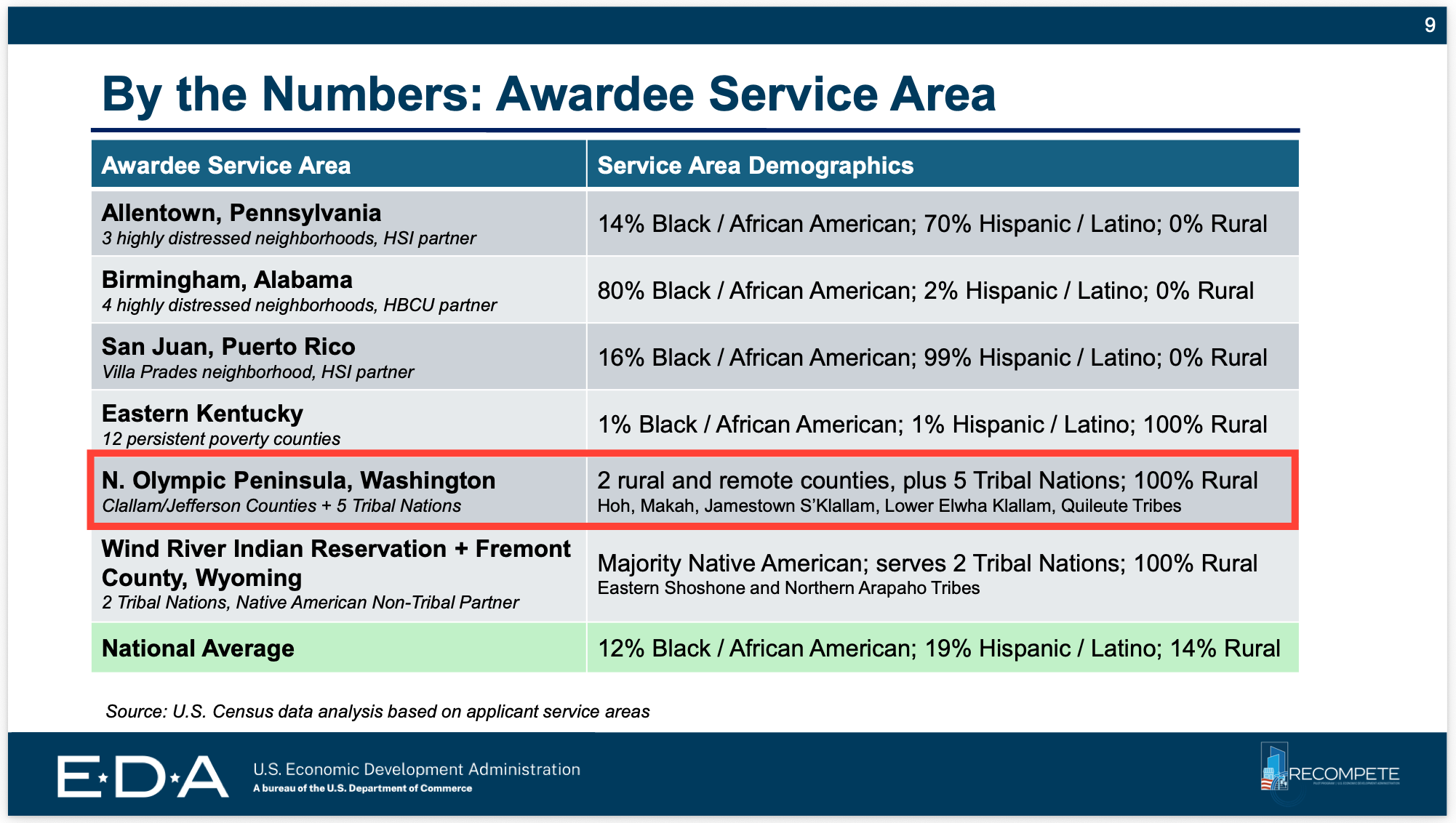
A workforce program that needs a racial scorecard is not treating every out-of-work adult the same. It sorts communities by group and calls the sorting “equity.”
The scoring rules match the slide. EDA asked whether benefits would be shared “equitably.”
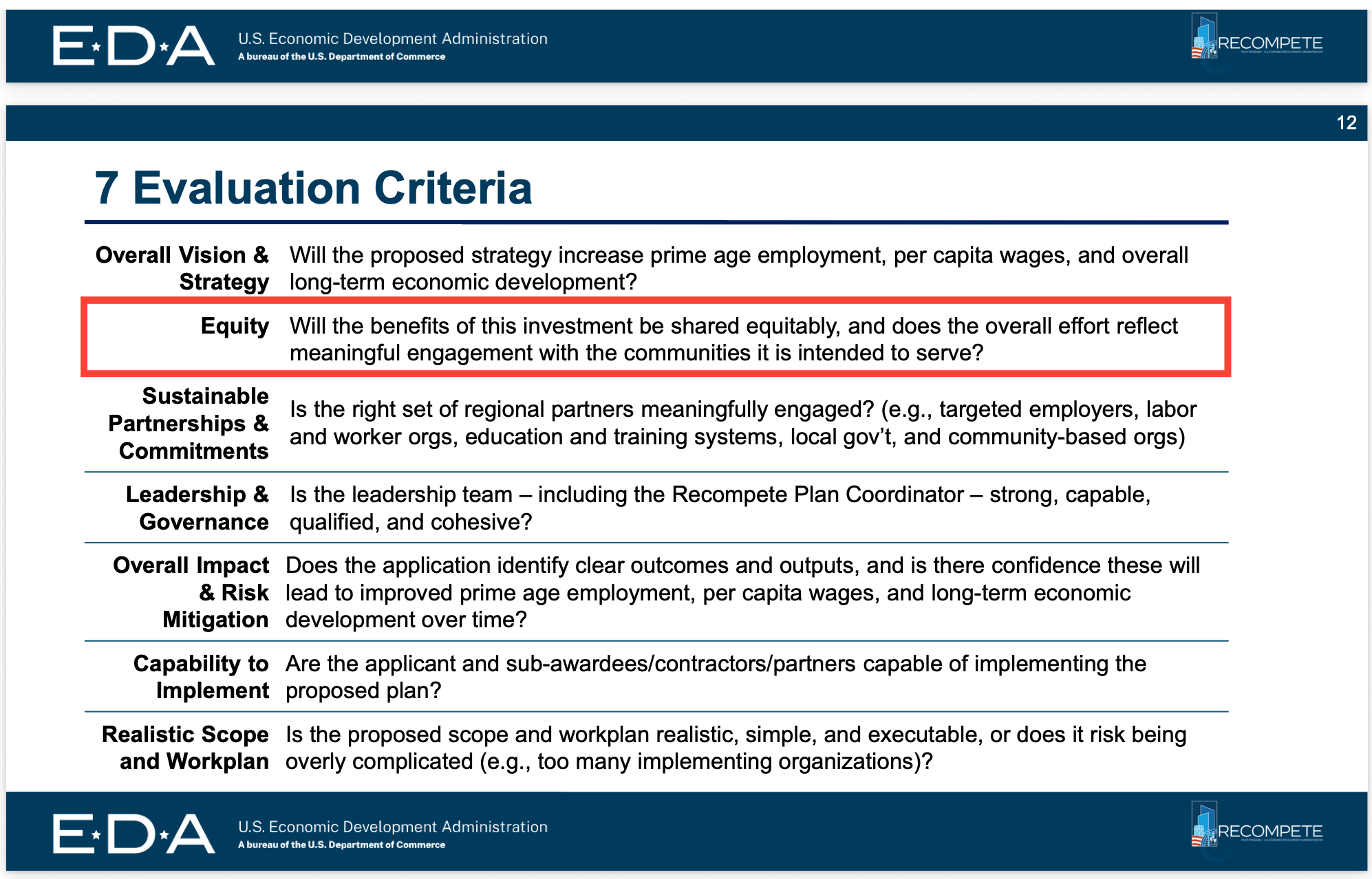
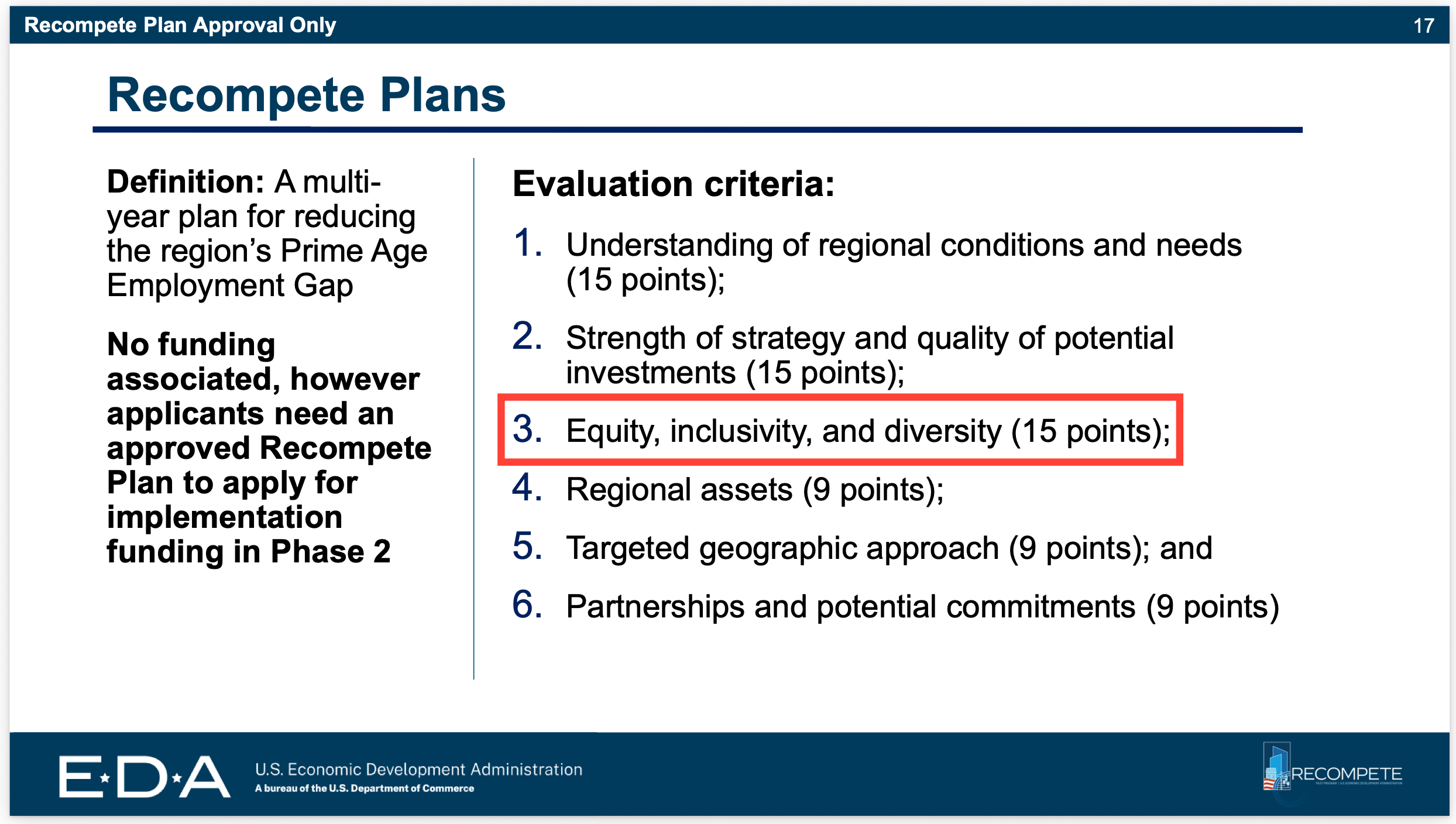
Equity was a criterion for the whole plan and for each project. In Phase 1, “equity, inclusivity, and diversity” carried the same weight as the strategy itself.
Finalists sat through a session called “Executing on Equity.”
The formal notice ties the program to executive orders on “advancing racial equity” and names preferred classes: Black, Latino, Indigenous and Native American, Asian American, Pacific Islander, women and girls, and Tribal lands.


All Tribal lands were eligible by default.
If the same chart had listed any other race as the favored class, most people would see the bias at once. The method does not change because the approved word is “equity.”
The local plan puts Tribes in bold
Clallam’s strategy has four parts. Three sound like workforce policy: remove barriers to work, train people for good jobs, and create jobs in maritime and natural resources. The fourth is the sorting rule: “address equity issues by building capacity and programs in Tribal nations and underserved communities.”

EDA’s own write-up of the award uses the same emphasis. About $35 million would build timber and maritime industries “within five Tribal Nations, Clallam County, and Jefferson County,” and “add economic development capacity to five Tribes.” The five are named in the paperwork: Hoh, Makah, Jamestown S’Klallam, Lower Elwha Klallam, and Quileute.
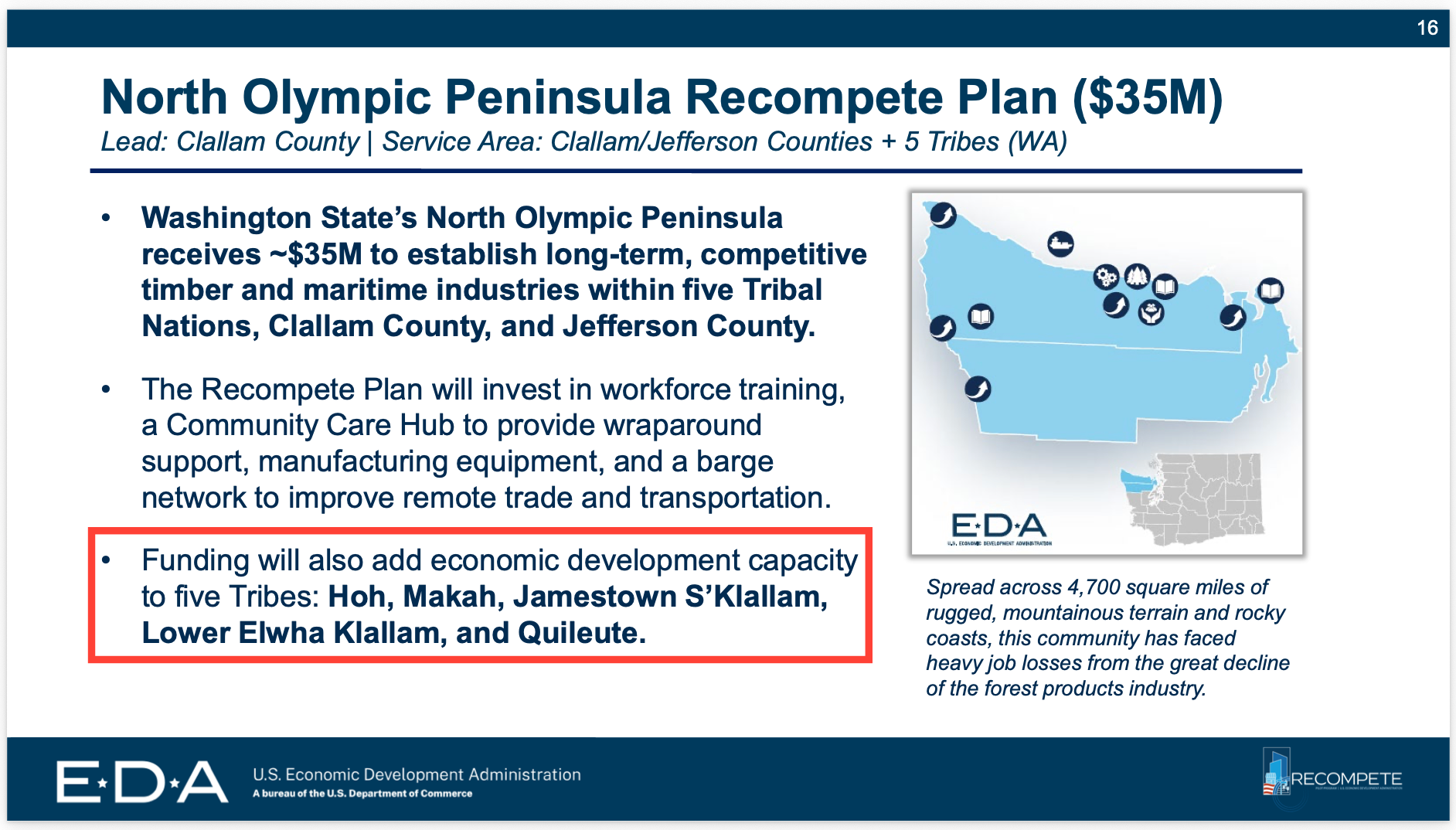
That is the deep dive. Not every distressed worker first. Tribes, as a category, first.
The money follows the words. Commissioner Mark Ozias’ NGO, the North Olympic Development Council (NODC), received $8.27 million to build capacity and send subawards to five tribes and the City of Forks. After those pass-throughs, more than $1 million stays with his NGO as an administrative fee.
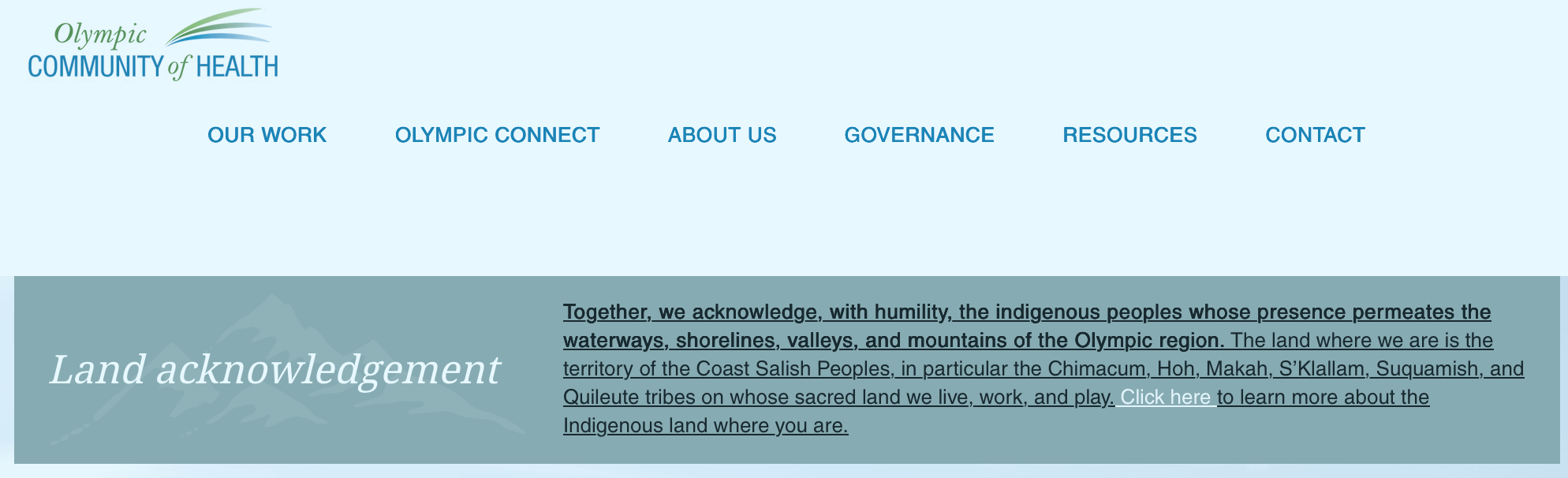
Olympic Community of Health (OCH) received about $9.8 million for “barrier removal,” care hubs, and coordination. OCH is not a mill or manufacturing hub. It is a professional class with a land acknowledgment at the top of its website.
Then comes the line that needs no theory.
A scope of work under the NODC subaward says the Jamestown S’Klallam Tribe will buy a hydroseeder and a mini excavator so JKT Development, a tribally owned enterprise, can expand into hydro-seeding as “a new area of business.”
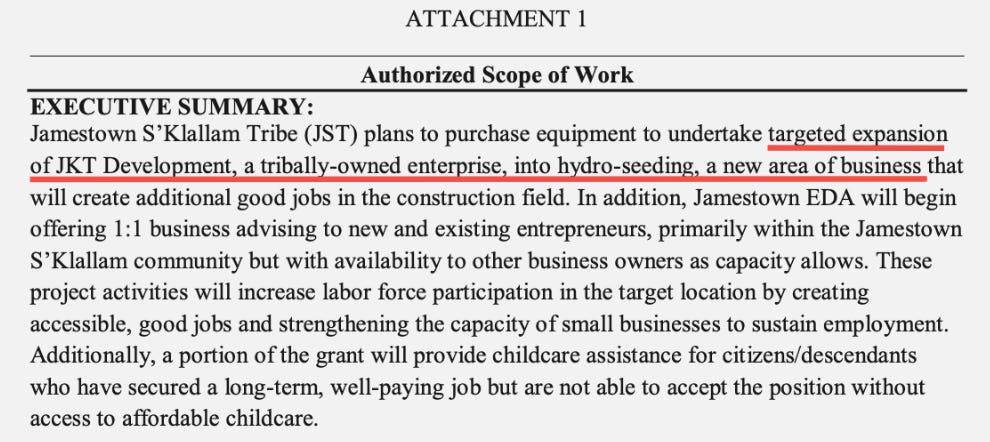
Next comes marketing, operations, and three to four hires. Hydro-seeding is not missing in our region. Local companies already own the trucks, already bid the jobs, and already pay the taxes that keep county government running. The grant does not “include” those small businesses. It subsidizes a tax-advantaged competitor and calls the result “justice.”
If equity meant equal rules, a family business that bought its own rig would not have to watch federal money buy one for someone else.
“Tribal poverty” does not describe this partner
A national poverty rate is not the same thing as the Jamestown Corporation. Federal data have long shown American Indian and Alaska Native poverty far above the U.S. average. A widely cited Census figure for people identifying as American Indian or Alaska Native alone was about 29 percent. That number is real in many reservation communities. It is not a snapshot of Jamestown.
The Jamestown Tribe reported 509 enrolled citizens in 2024, with 213 living “in area.” County and tribal documents in recent years put the local count in the same place: just over 200 members in the service area. That is a small local membership, not a missing workforce. It is also not a cash-poor startup. Public reporting puts the tribe’s annual budget at more than $100 million. The tribe’s 2024 tribal citizen report listed $85.9 million in revenue for that year.
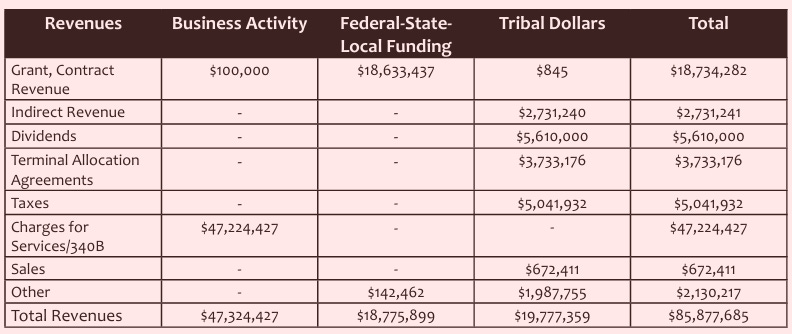
The local enterprise list for these 200 local members is well known: casino and resort, golf course, development company, clinics, land surveyors, gas station, and a cannabis shop. Clallam County, on the other hand, serves about 77,000 people.
So the federal story is: Tribes are “communities most impacted.” Therefore, this grant is needed to repair historic injustices. The local facts are: one named partner, the Jamestown Tribe, has just over 200 members living here, already operates on a nine-figure scale, and still receives a federal hydroseeder to open a line of work that private businesses already perform.
Poverty on distant reservations does not explain that purchase. Identity on page 9 does.
Mike French’s own vocabulary makes the problem easy to see. “Equity” here does not mean the same shot for every underemployed adult. Inclusion means the coalition table, not an open bid. Lived experience becomes a credential. “Communities most impacted” becomes a sorting hat: tribe over taxpayer, NGO over small business, identity over a paycheck. Repair and redistribution are how a transfer of public money gets described as moral hygiene.
That is why some residents hear “reparations.” They never print “reparations,” but Page 9 still sorts the winners by race and tribe.
The coordinator said the quiet part
The county’s Recompete Plan Coordinator is Molly Pringle. That job is supposed to keep a $35 million workforce grant pointed at work.
Her own LinkedIn description points somewhere else:
“As a white, cis, queer person, my equity practice focuses on redistributing power and resources to communities most impacted by injustice, thinking deeply about my responsibility as a leader with privilege. I am critical, curious and active in my efforts to shine a light on white supremacy and capitalism, creating space to grow, repair and heal.”
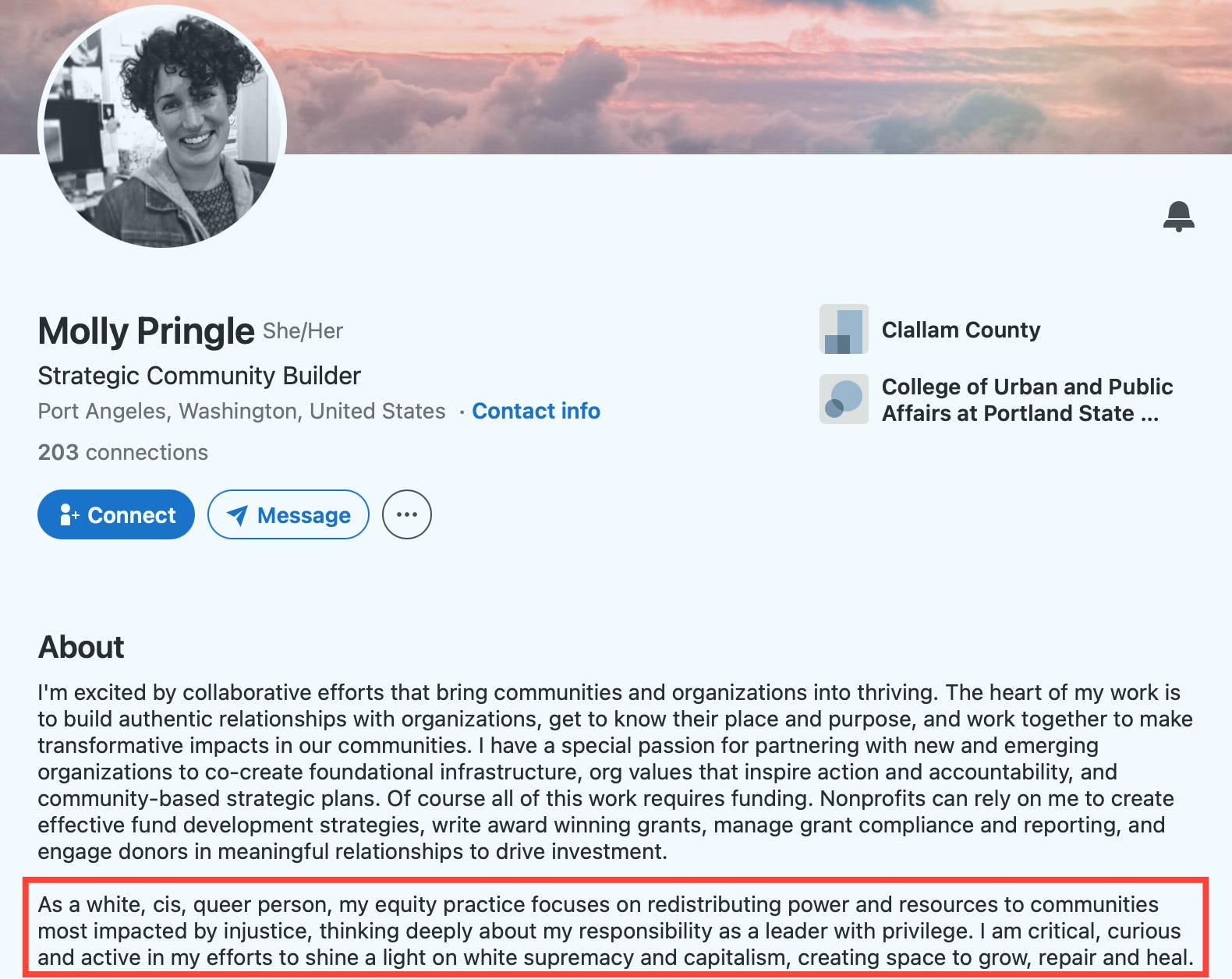
Those are her words.
Redistributing power and resources.
Privilege.
White supremacy.
Capitalism as the thing to confront.
That language fits page 9. It fits “capacity for Tribal nations.” It does not fit “every person who needs a job gets the same chance.”
A jobs grant is supposed to put people on payroll. Her stated work is moving power and money. Those are not the same assignment.
Own the check. Own the design.
Distress on the West End is real. Tribal governments are real governments. None of that requires a jobs brand that scores people by race, prints a winner sheet by percent of Black, Hispanic, and Native DNA, writes five Tribal Nations into the local equity strategy, routes millions through nonprofits, and then buys equipment for a wealthy local tribal corporation’s new business.
French has asked voters to treat Recompete as proof that the region finally got a once-in-a-generation chance. Leadership includes the scoring rules, page 9, the subawards, the coordinator’s philosophy, and 31 placements in year one. You don’t get credit for the $35 million without the rules that spent it.
The region was promised workers. The documents describe preferred groups. The hydroseeder is the small item that makes the large design visible. Readers can decide whether that package is a workforce plan — or a jobs program that picks winners by race and tribe.


