


Olympic Medical Center isn’t just underperforming—it’s consistently ranking near the bottom compared to hospitals nationwide, according to its own patient experience data. While leadership points to challenges and staffing pressures, the numbers reveal something more troubling: a system where patients feel unheard, uninformed, and underserved—and where those trends aren’t improving.
If you want to understand how a hospital is really performing, you don’t start with press releases—you start with patient experience. That’s exactly what Press Ganey surveys measure.

After each visit, patients are asked direct, practical questions: Were you treated with respect? Did providers listen? Was your room clean? Did you understand your discharge instructions? Would you recommend this hospital to others?
These aren’t abstract metrics—they’re the fundamentals of care.
Press Ganey then converts those responses into percentile rankings. A score of 90 means a hospital is performing better than 90% of its peers nationwide. A score of 50 is average. Below that? You’re falling behind.
Olympic Medical Center isn’t just below average—it’s consistently near the bottom.
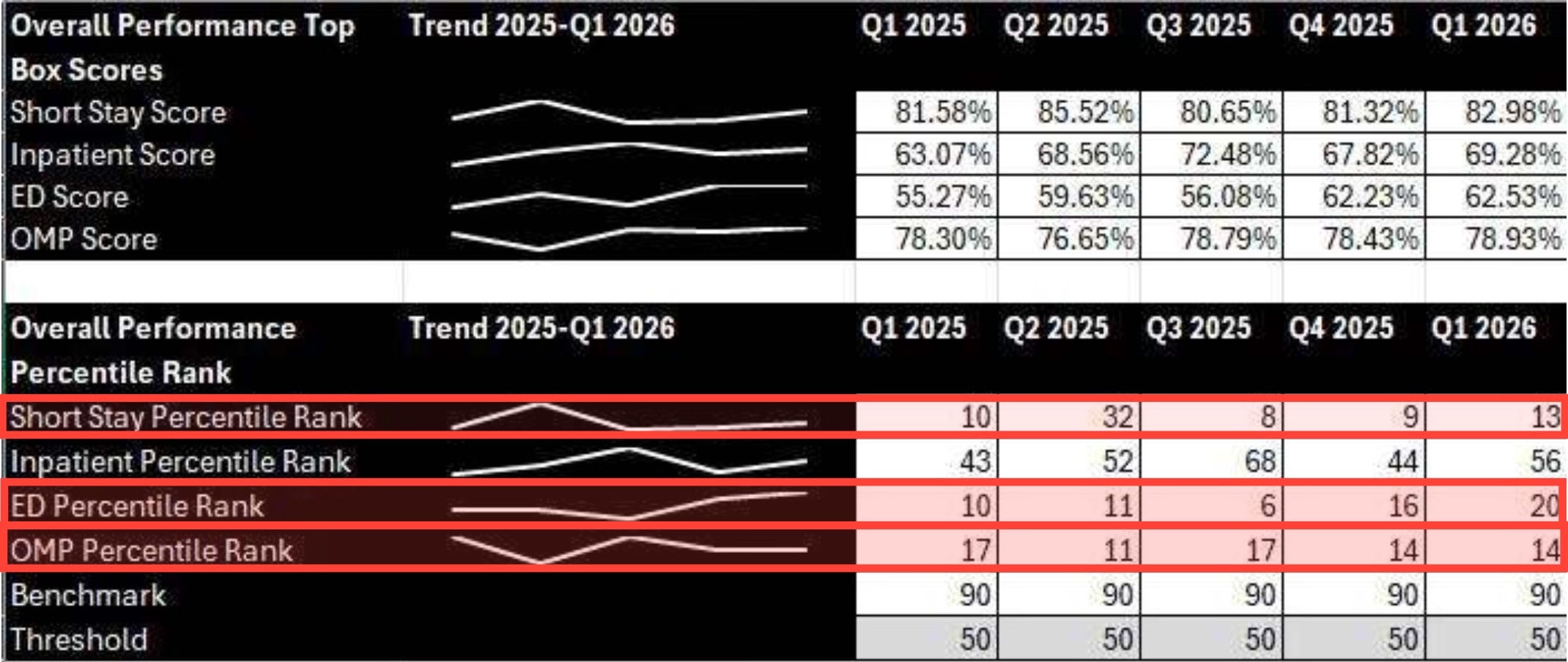
According to the most recent Press Ganey survey results:
Short Stay Percentile Rank: 10 → 32 → 8 → 9 → 13
ED Percentile Rank: 10 → 11 → 6 → 16 → 20
Outpatient (OMP) Percentile Rank: 17 → 11 → 17 → 14 → 14
The benchmark for excellence is the 90th percentile. The threshold for “average” is 50th percentile.
OMC isn’t close to either.
These numbers mean that in critical areas—emergency care, short stays, outpatient services—Olympic Medical Center is performing worse than 80–90% of hospitals in the country. And this isn’t a one-off bad quarter. The trend line shows persistent underperformance with only minor fluctuations.
That matters because these scores reflect real patient experiences. Not theoretical models. Not internal performance metrics. Actual people answering whether they felt heard, respected, and properly cared for.
And the answer, overwhelmingly, is no.
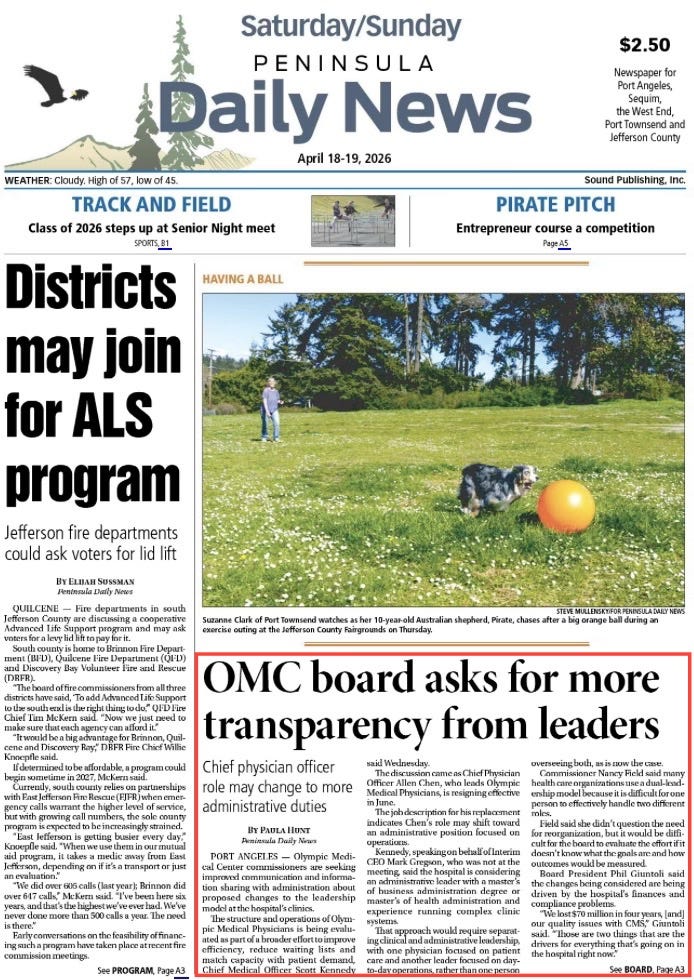
This aligns with concerns that have surfaced repeatedly in CC Watchdog coverage—questions about staffing, leadership decisions, financial pressures, and patient outcomes. It also echoes broader reporting, including from the Peninsula Daily News, which has highlighted operational and financial strain at OMC.
But here’s the key point: hospitals under pressure don’t automatically produce poor patient experiences. Many facilities facing similar constraints still perform at or above average. What separates them is leadership, accountability, and culture.
So the question isn’t whether OMC is struggling.
The data confirms it is.
The real question is: what is being done about it—and why aren’t patients seeing improvement?
Because when nearly every category sits below the 50th percentile—and many hover near the bottom—that’s not a temporary dip.
That’s a system-level failure.
And for a community that depends on this hospital, the County’s largest employer, that’s not just concerning.
It’s unacceptable.
Today’s Tidbit
On April 15, the Clallam County Sheriff’s Office issued a public alert confirming that medetomidine—“rhino tranq”—had entered the local drug supply, mixed with fentanyl. The warning was serious: increased overdose risk, more complicated treatment, and severe withdrawal symptoms.
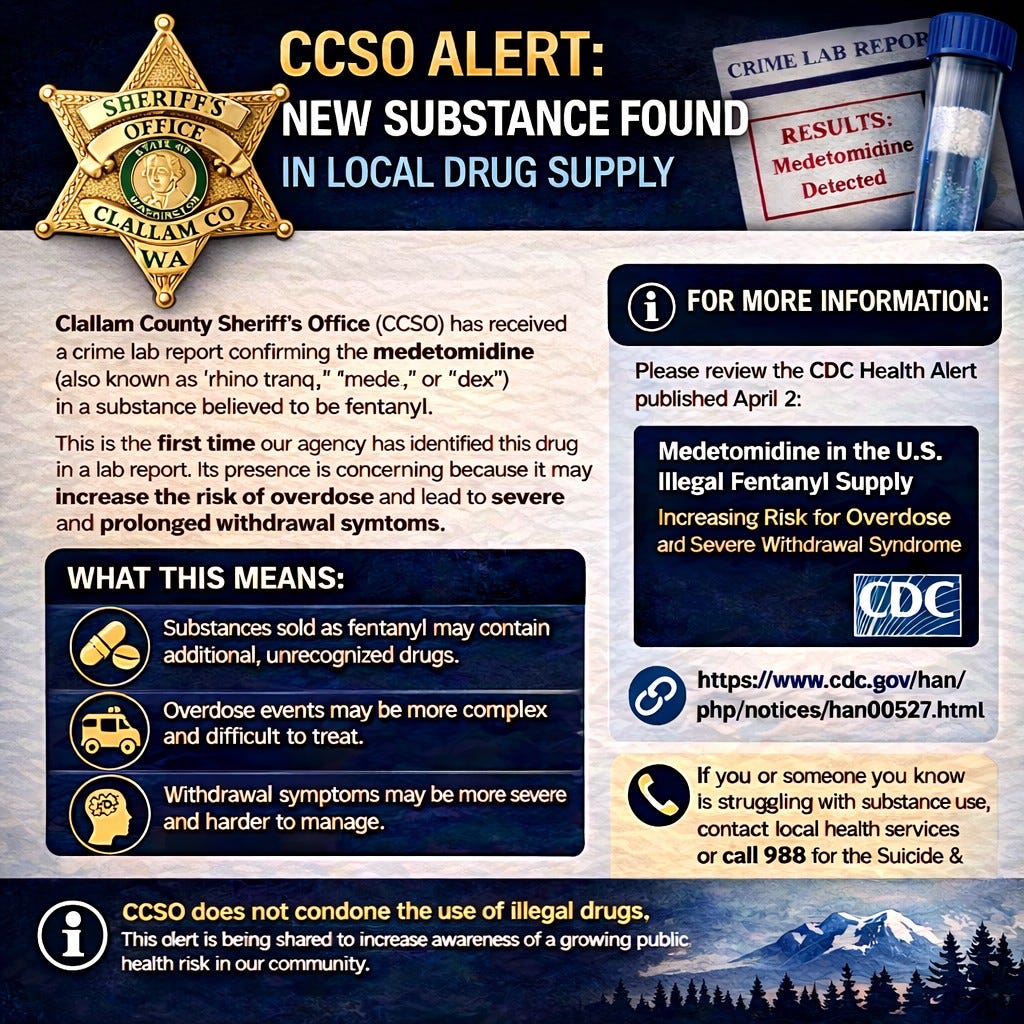
But this wasn’t new information inside county government.
According to the Clallam County Letters Substack, on February 27, a resident emailed County Health Officer Dr. Allison Berry and the Board of County Commissioners raising concerns about changes in the street drug supply and warning that more dangerous substances were likely making their way into communities like ours.
In a March 3 email, County Health Officer Dr. Allison Berry acknowledged that medetomidine had already been seen locally, noting it appeared “rare at present” but was being monitored. That acknowledgment came more than a month before the Sheriff’s Office alerted the public.
So while the information existed, the response stayed largely behind the scenes—limited to internal awareness, coordination with partners, and distribution of test strips through harm reduction channels.
What was missing was a clear, public-facing alert.
No countywide advisory. No broad warning to families, first responders, or the general public that a more dangerous and unpredictable drug supply had arrived.
Instead, that message came later—from law enforcement.
If the goal is to reduce harm and save lives, timing matters. Awareness matters. And how that information is communicated matters.
The issue isn’t whether officials knew.
It’s why the public wasn’t told sooner.


