


In 2024, Clallam County commissioners formally urged voters to pass Olympic Medical Center’s levy lid lift. Voters did. Property-tax collections for Hospital District 2 doubled. A newly released consultant report — and OMC’s own board discussion about taking another 1 percent hike — show why more tax money was never going to fix empty clinic slots, unused buildings, and years of losses.
Two years ago, the Clallam County commissioners took sides.
On July 16, 2024, they passed a resolution supporting OMC’s levy lid lift — the ballot measure that asked voters to raise the hospital’s property tax. Their resolution said the extra money was needed to keep the hospital open around the clock, keep care local, and help hire and keep staff.
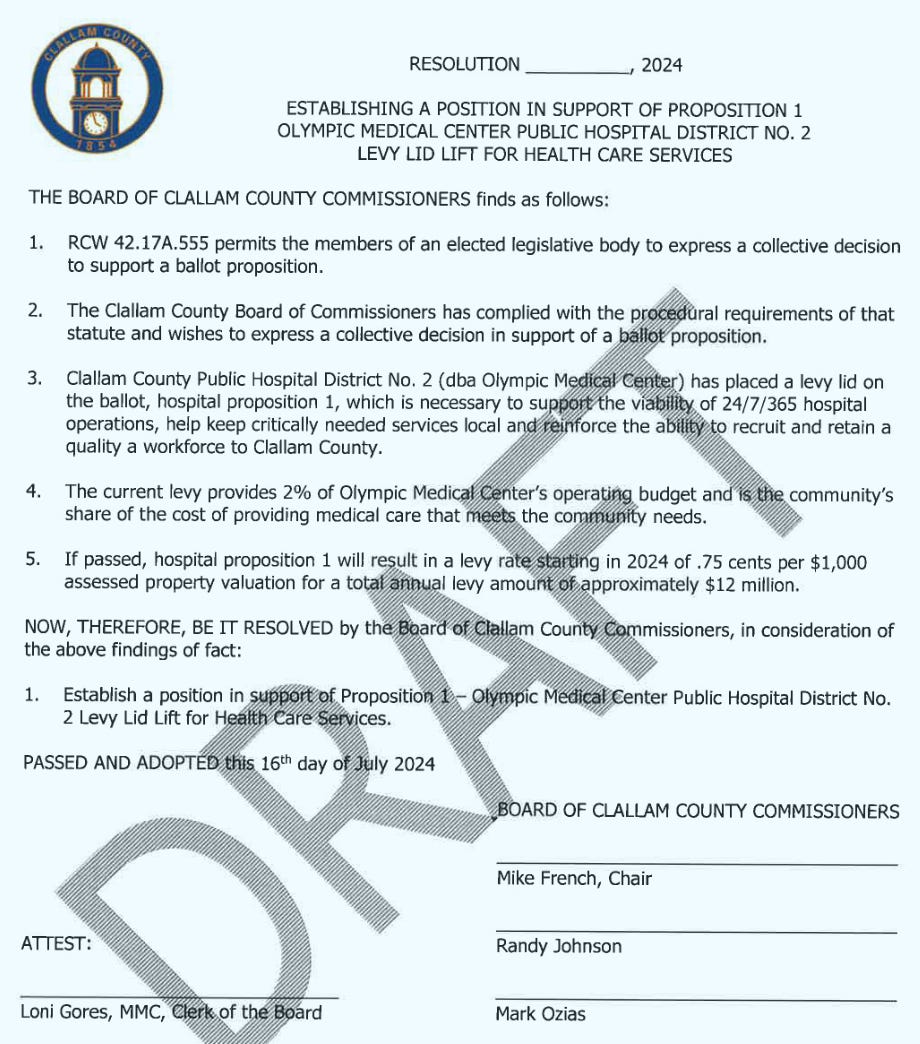
Voters agreed. In the August 2024 primary, about 6 in 10 voters in the hospital district said yes.
Washington law lets a public hospital collect up to 75 cents for every $1,000 a property is worth. Before the vote, OMC was collecting only about 31 cents. After the vote, it jumped to the legal maximum: 75 cents.
The hospital’s tax take went from about $5 million a year to about $12 million a year. More than double.
If you live in Hospital District 2 — roughly from Lake Crescent to the Jefferson County line — that extra money comes from your property tax bill.
That was the big raise. It already happened.
What they want now is smaller — but it is still a raise
State law also lets the hospital bump the total dollars it collects by 1 percent a year without going back to voters. Think of it as a yearly cost-of-living increase on the tax, not another huge jump.
Last November, the OMC board skipped that 1 percent. They kept 2026 collections about the same as 2025: roughly $11.8 million. One OMC commissioner said skipping it was “foolish.”
“I think we should be taking the 1 percent that is allowed by law… We are foolish to leave money on the table.” — OMC Commissioner John Nutter, Peninsula Daily News
Others worried the public already thought the 2024 tax hike had solved the hospital’s money problems.
It had not.
Last month, the Peninsula Daily News reported that OMC finally showed a profitable quarter — about $604,000 in the black after losing $1.7 million in the first three months of the year. June itself made only about $14,000.
That sounds like good news, but read the fine print.
Some of that profit came from one-time items: settlements, grants, and accounting adjustments. The hospital also got a $6.1 million check from a state program for struggling hospitals. That helped cash on hand rise to 30 days — still a thin cushion. A healthy hospital usually wants more. OMC still owed vendors about $23 million. From 2022 through 2025, it lost about $70 million, including about $16 million last year.
Hospital Commissioner Penney Sanders said the board should take the 1 percent this year: “We didn’t take it last year, but we believe we should take it this year.”
On an $11.8 million levy, 1 percent is about $118,000 before new construction. Helpful. Not a game-changer. Nothing like the 2024 doubling.
The consultant report is easier than it looks
In June, a firm called Kaufman Hall briefed the OMC board. UW Medicine required that study before deciding whether to partner with OMC. The report is in the public board packet.

Ignore the jargon. Here is the translation:
Kaufman Hall said OMC could improve in two ways:
Run the hospital better — about $29 million a year, if the changes actually get done.
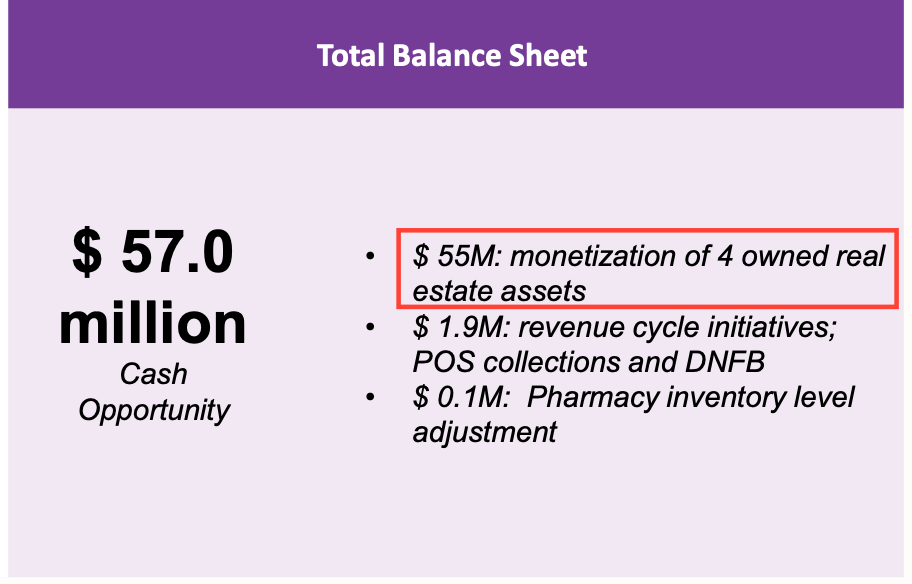
Raise cash one time — about $57 million, mostly by selling four buildings the hospital already owns and then renting them back.
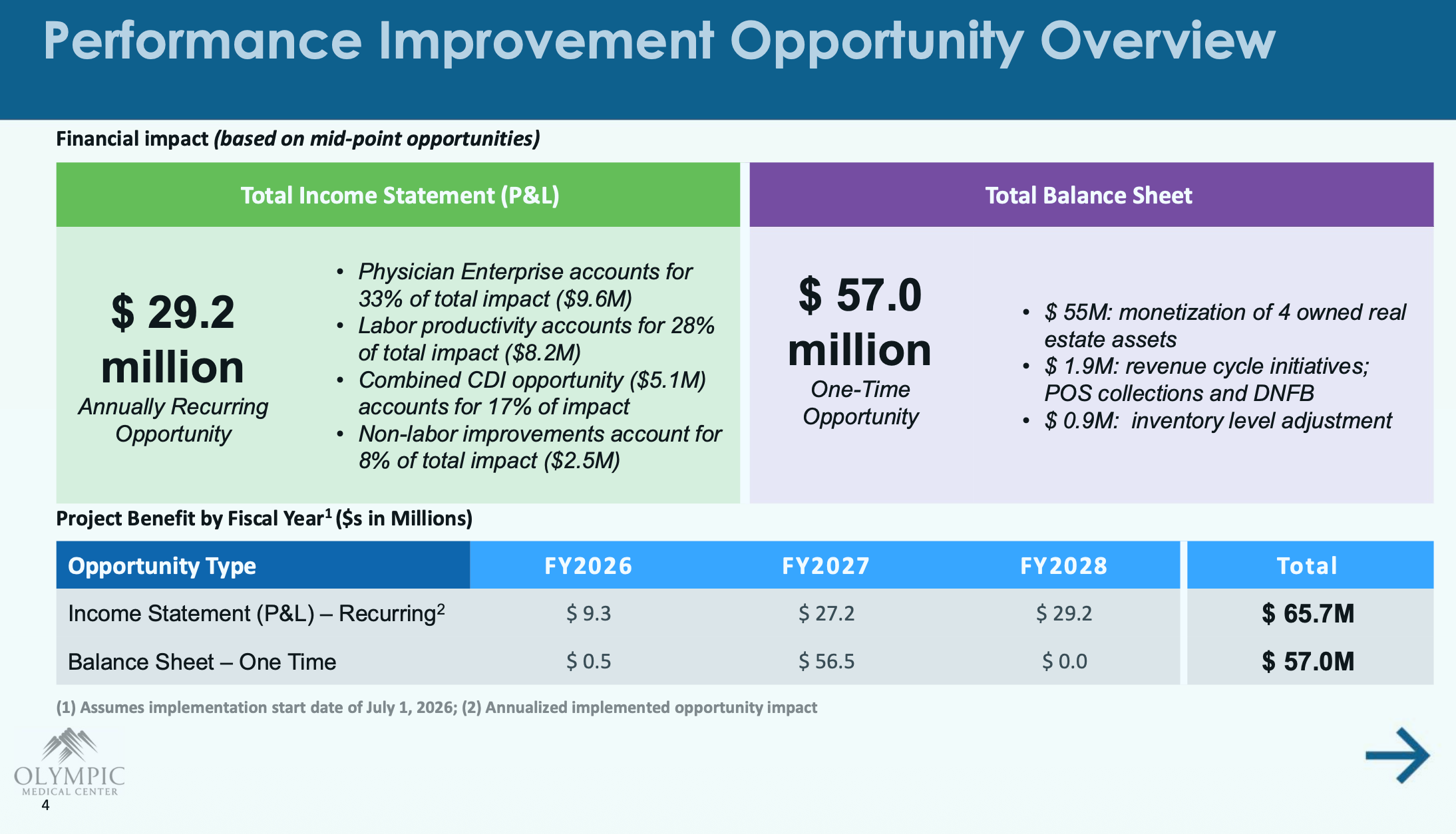
Add those together, and you get the consultant’s two buckets: a yearly operating target, and a one-time cash grab. Only the first bucket can change whether the hospital makes or loses money next year.
The yearly $29 million is not a check in the mail. It is a to-do list:
Book appointments and use doctor time better: about $9.6 million
Use staff time more efficiently: about $8.2 million
Write medical charts so insurers pay the correct amount: about $5.1 million
Spend less on supplies: about $2.5 million
The consultants said those savings would start small and grow — roughly $9 million this year if work began in July, then the mid-$20 millions next year, then about $29 million by 2028. That only happens if managers follow through.
The number that should make people stop
Patients wait a long time to see a doctor at OMC. At the same time, many appointment slots sit empty.
Kaufman Hall looked at more than 210,000 clinic appointments in 2025. Doctors’ schedules were only filled about 67 to 68 percent of the time. The industry target they used is 85 percent.
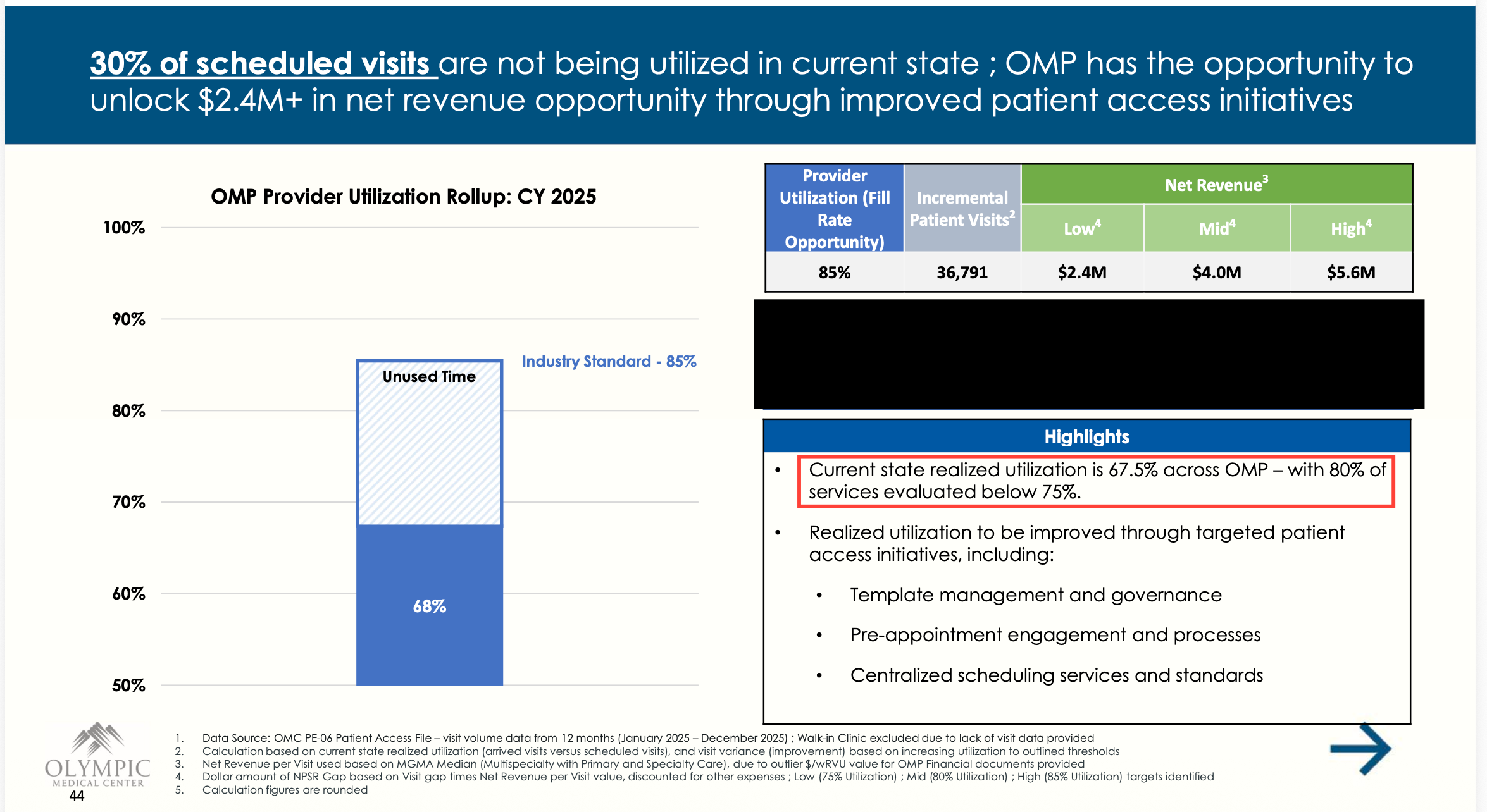
Average wait for a new patient: about 41 days. The target: under a week. Cardiology: 90 days. Urology: 80 days. Primary care: 53 days.
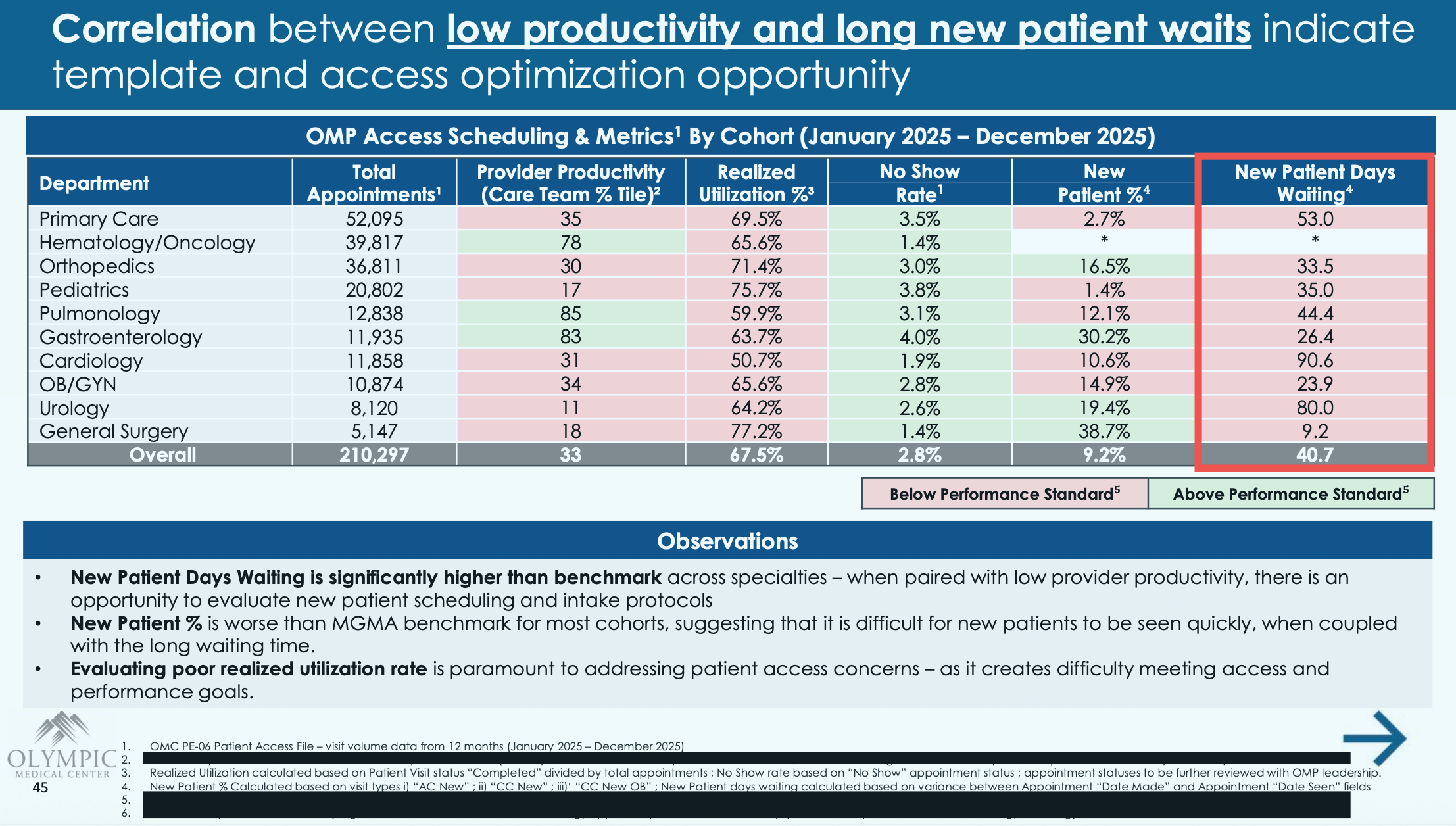
The newspaper’s write-up of the same report said filling those empty slots could mean about 37,000 more visits and $2.5 million to $5.5 million more in clinic revenue — plus more money if those patients then use the hospital.
So the story is not “there are no appointments.” The story is “there are appointments, but the schedule is not being used well.” Kaufman Hall measured realized clinic use at 67.5% against an 85% standard. That is an operations problem. The 2024 lid lift already more than doubled the district tax. Extra property tax does not fill an empty slot on a calendar. A 41-day new-patient wait, with cardiology at 91 days and urology at 80, is what internal scheduling looks like after the money arrived.
Selling the buildings you already own
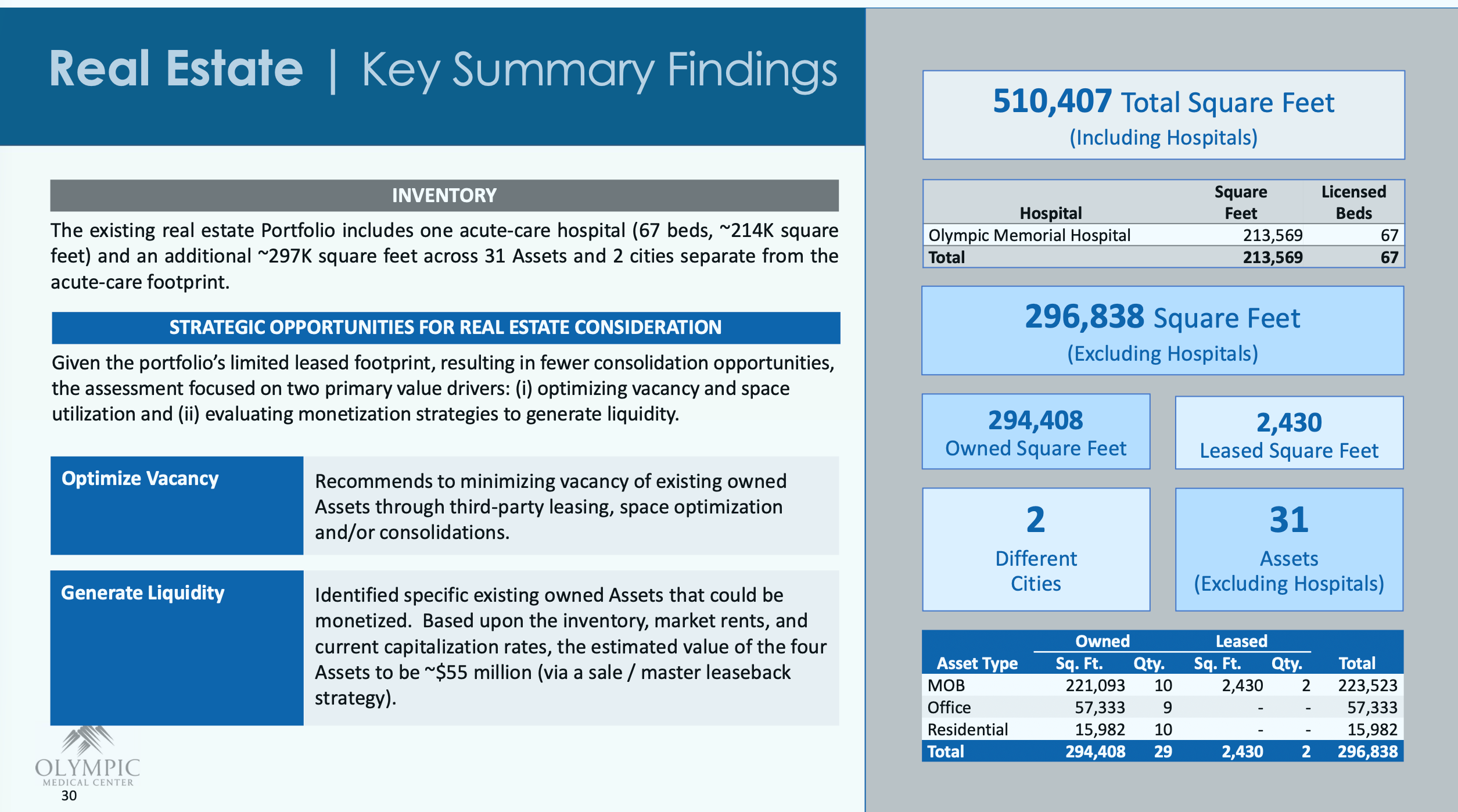
OMC already owns the hospital — and a lot of extra space. About 297,000 square feet in 31 properties around Port Angeles and Sequim, not counting the hospital itself. Some of it sits empty.
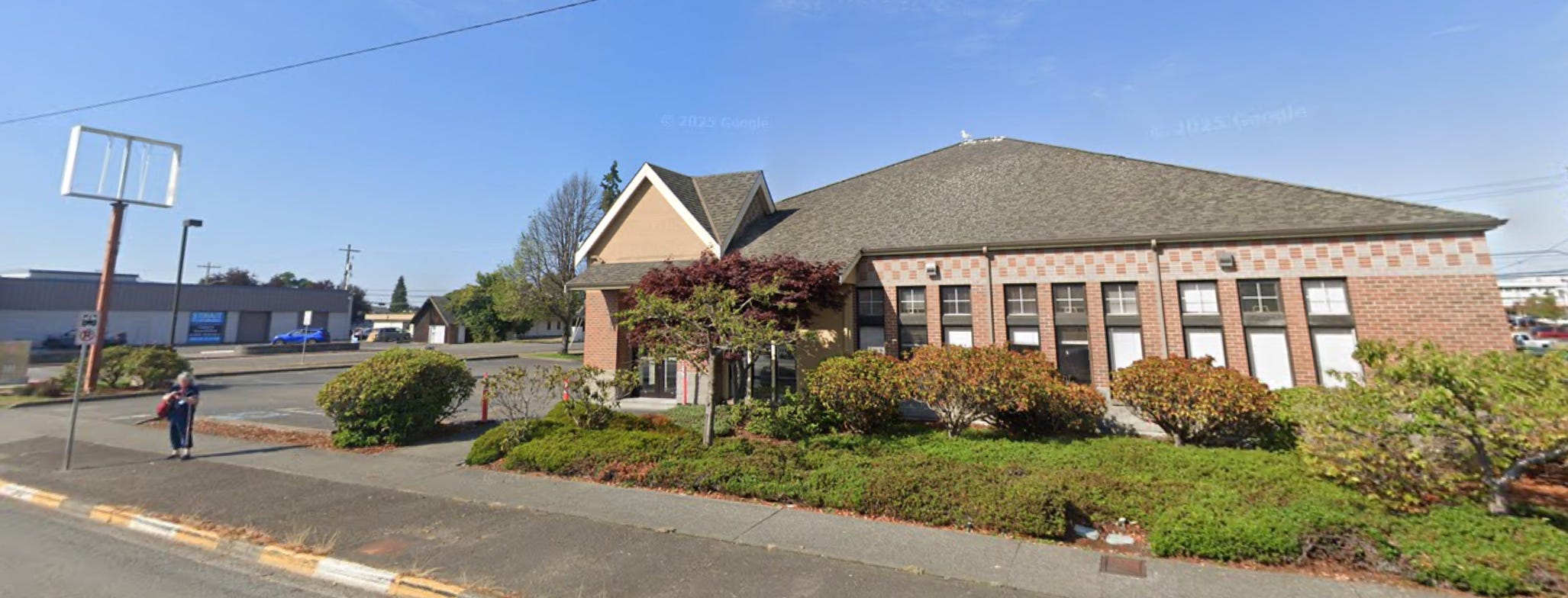
The old Wells Fargo building on Front Street is one example. It has been vacant for years.
Kaufman Hall’s idea: sell four of those buildings for about $55 million, then rent them back.
That sounds like a win. It is not free money.
Think of selling your house and staying in it as a renter. You get a big check at closing. Then you pay rent every month, forever.
Hospital deals like this are usually written so the hospital still pays almost every bill that comes with the building. Not just rent. Property taxes. Insurance. Repairs. All of it.
Here is the tax twist. While OMC owns those clinics, they are off the tax roll. Sell them to a private landlord, and the county can start taxing the buildings. In this kind of lease, OMC — meaning the public — would pay that new tax bill too. Taxpayers would be paying rent to use buildings they used to own, plus the landlord’s property taxes.
These leases also usually raise the rent a little each year, often about 3%. The payment grows even if no more patients walk in the door. Today’s cash can become tomorrow’s bigger bill.
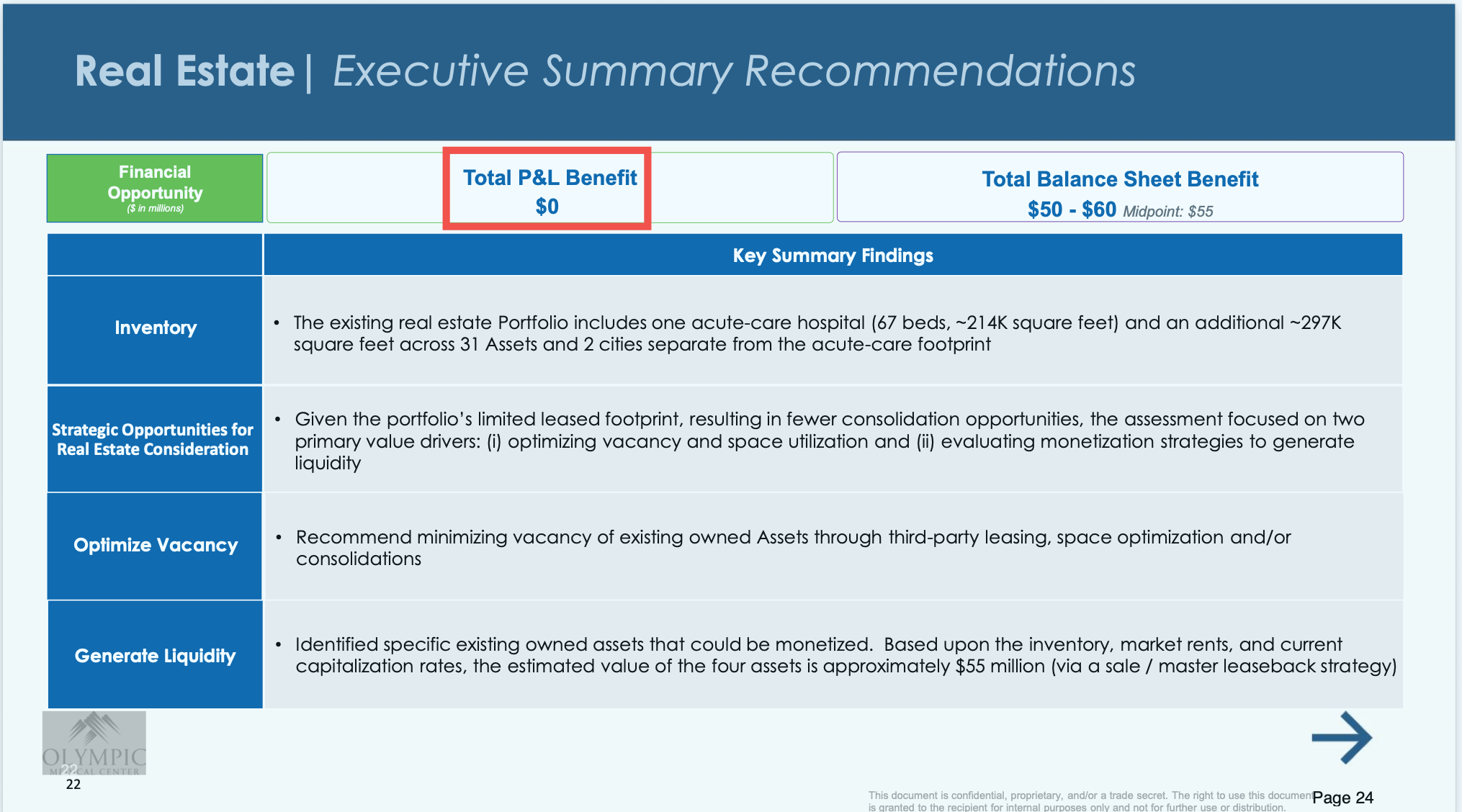
Kaufman Hall’s own slide put the yearly profit from this idea at zero. Translation: the sale can refill the checking account once. It does not fix the hospital losing money year after year. It is a short-term cash move, not a turnaround.
Taxpayers already own those clinics. They already pay to heat, insure, and maintain empty rooms. Selling them would not change that workload. It would add a landlord.
Clallam County’s Culture
In July 2024, the Clallam County commissioners did not leave the hospital question to voters and walk away. They passed a resolution telling the public to approve OMC’s levy lid lift. Their pitch was the only play this county government culture ever seems to know: the hospital is in trouble, so residents should pay more.
Voters did. People in the hospital district now send OMC more than double what they did before. That was not a rounding error. That was a political choice.
Two years later, the books still do not look like a turnaround. OMC lost money for years after the tax hike. It just posted a small profitable quarter, but it included one-time help. Hospital commissioners are talking about taking the next 1 percent the law allows without another vote. That is the same reflex: if the last pile of public money did not fix it, ask for a little more.
Kaufman Hall did not say the problem was that taxpayers had been stingy. The consultant said clinic schedules are only about two-thirds full, new patients wait about 41 days against a target of under a week, charts are under-coded, staffing is loose, and buildings the public already owns sit underused.
Their real-estate idea — sell four clinics and rent them back — puts cash in the bank once. Their own slide scored the yearly profit from that deal at zero. The rent, the new property-tax bill on those buildings, and the usual yearly rent increases would then sit on the operating statement forever.
A tax increase can buy time. It cannot book an empty appointment. It cannot occupy an empty suite. It cannot make a commissioner look at operations instead of the levy.
County commissioners sold the public the solution they always sell. Hospital commissioners collected it. The Kaufman Hall packet is the homework that neither board can hide behind before taking another rate hike. The record is now public. The empty slots are public. The next ask for money should be answered with one question: what did you do with the last pile of cash fleeced from the taxpayers?
Stay Engaged
This morning at 7:30
The Port Angeles Business Association is hosting a conversation between both candidates for District Court #1 Judge.

PABA is pleased to welcome Alex Schodowski (above, left) and Patrick David Murphy (above, right), candidates for Clallam County District Court 1 Judge. Join PABA as both candidates present their vision for the court and share their judicial qualifications with our community. To access the livestream of this meeting, visit PABA’s Facebook page.
This morning at 10:00
During the regular weekly meeting, the Board of County Commissioners will review the preliminary 2027 budget. For instructions to attend in person or online, click here. Public comment is allowed.
Tomorrow at 8:00 am
Join the EDC’s “Coffee with Colleen” tomorrow, September 2nd at 8 AM to hear a Recompete update from Molly Pringle, Recompete Plan Coordinator, and Carolyn Edge, Communications & Media Coordinator. This federal grant is the cornerstone of Commissioner Mike French’s reelection campaign.
Zoom: https://us02web.zoom.us/j/89474510306?pwd=VlIrRHh5RG1nYVh3V3JXRzFSMmRodz09
Meeting ID: 894 7451 0306
Passcode: 187447


