


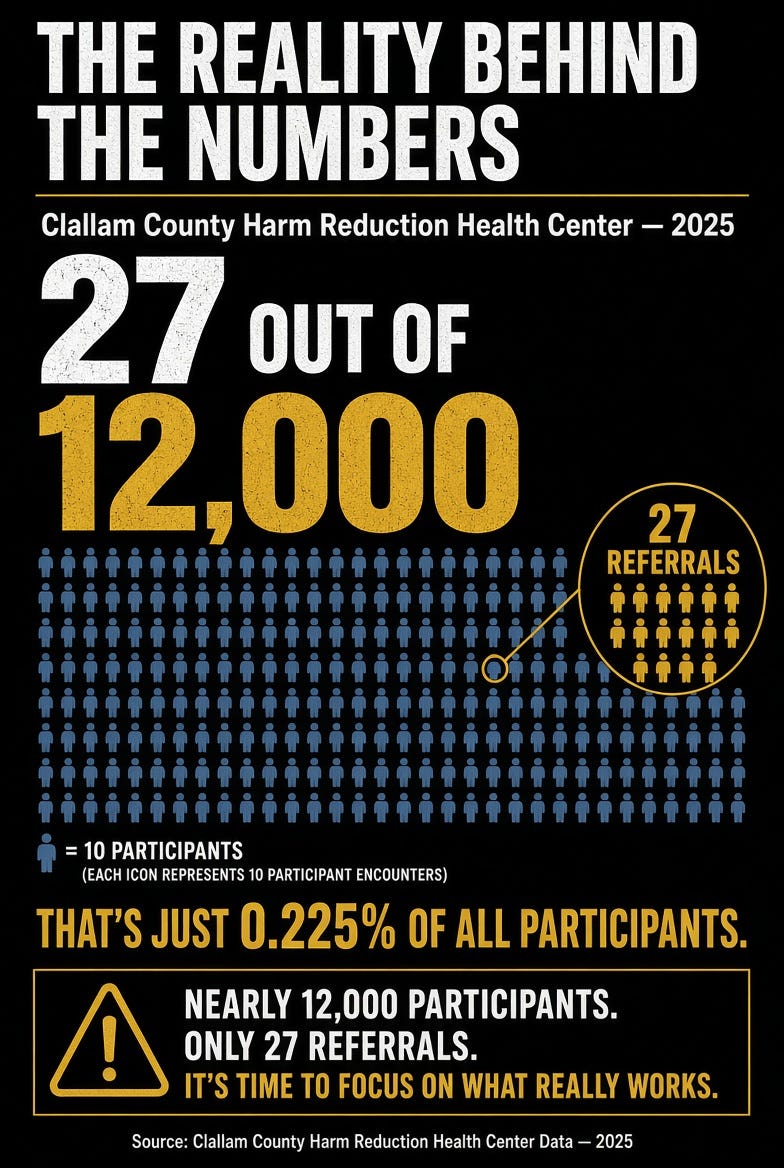
At a Sequim Rotary forum, Commissioner Mike French said Clallam County expanded harm reduction after the Jamestown Healing Clinic opened, so the program could “leverage that connection” and send active users to treatment. The county health officer who oversees that program also works at the clinic. Last year the Harm Reduction Health Center logged about 12,000 encounters and 27 on-site treatment assessments.
Much of the District 3 commissioners’ race has narrowed to one argument the public will not drop: harm reduction.
Incumbent Mike French, who also chairs the Board of Health, defends the Harm Reduction Health Center as an evidence-based program the county should stand by. Independent challenger Jake Seegers says the county should count how many people leave addiction, go back to a one-for-one needle exchange, keep naloxone available, and stop handing out smoking kits, foil, straws, and rectal “boofing” supplies.
A month before the election, Peninsula Daily News published the county’s preferred version of that argument.
The paper that cleaned it up
The October 2 piece, “Health program addresses perception,” quotes French as a supporter of best practices and Seegers as the man who says the program enables addiction. It then hands the rest of the column to Health and Human Services Deputy Director Jenny Oppelt and HRHC coordinator Lari Karan.
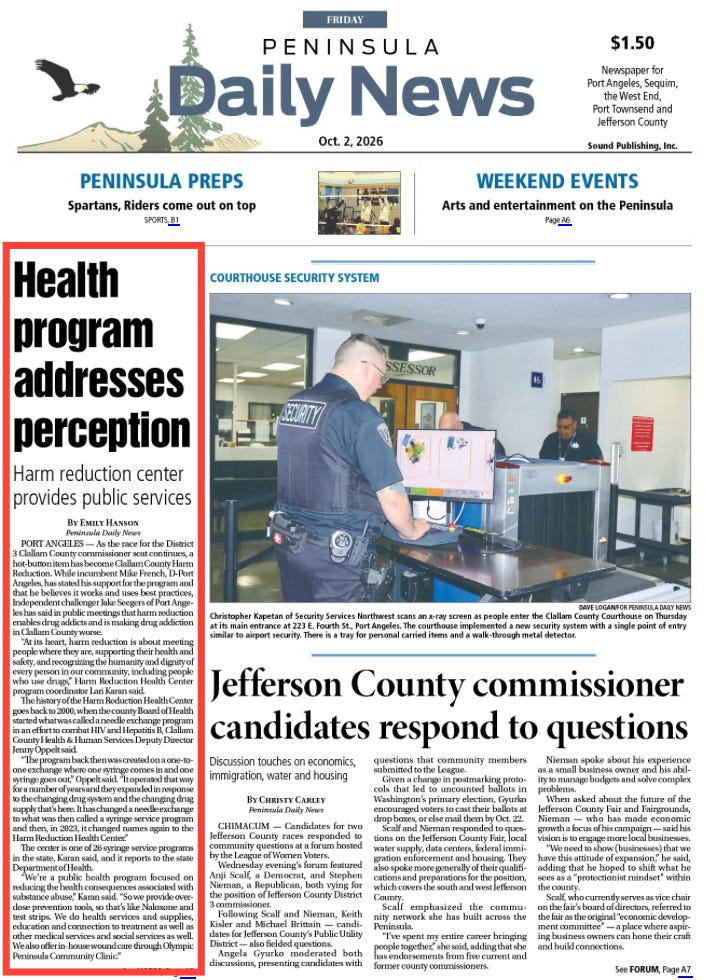
Oppelt walks readers through the origin story. In 2000, the Board of Health started a needle exchange. “One syringe comes in, and one syringe goes out.” Then the drug supply changed, the exchange became a syringe service program, and in 2023 it was renamed the Harm Reduction Health Center.
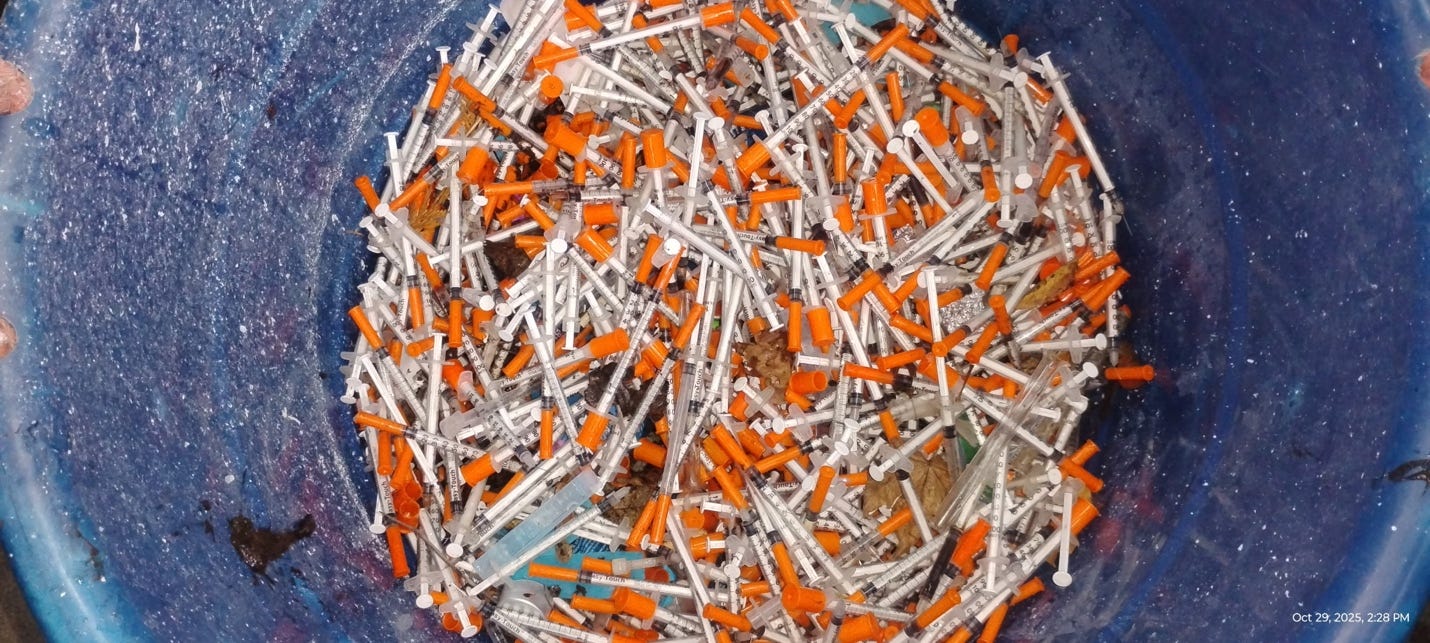
What the article does not say is that the county no longer runs an exchange. Participants are not required to return a used syringe. The 2025 county report lists 137,499 sterile syringes distributed and 67,244 sharps returned by participants. The same report lists 20,848 sterile pipe kits and 4,274 “other injection alternatives.” The offering includes foil, straws, and boofing kits. The old program and the current one share a building and a press release. They are not the same policy.
“We do not provide substances,” Oppelt stated in the article, which only means the county does not hand out drugs. But in 2023, it tried to. Jake Seegers reported that commissioners approved a plan to take illegal drugs from addicts, test them, and give those same drugs back. A county risk manager stopped it over legal and financial liability, so the program never launched. The county did not try to supply the substance. It did try to accept it, test it, and return it for use. That is more than the paper admits.
Then the success story. Oppelt says Clallam had 46 overdose deaths in 2023, the most on record, and 22 accidental drug overdose deaths in 2025, about a 51 percent drop. The next sentence in the Peninsula Daily News story is a tell: “Harm reduction is not the only reason for that increase.” They meant decrease. But the slip fits the argument. The paper treats the drop in deaths as the center’s success, then concedes that the Jamestown clinic and other outreach did much of the work.
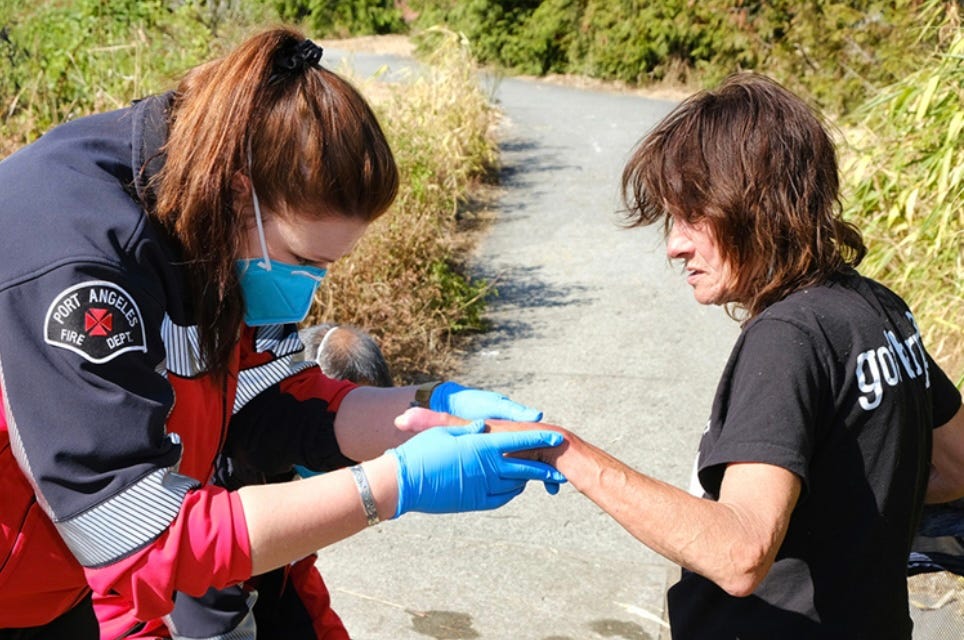
Port Angeles Fire Department has already claimed a large share of that decline for Operation Shielding Hope, the community-paramedic response that started engaging overdose survivors who used to walk away.
The Jamestown clinic, which opened in 2022 and operates a mobile unit dosing clinic in Clallam Bay since March 2024, belongs in the picture too. So does the national fall in overdose deaths after fentanyl’s peak. Seegers has also pointed at the longer curve: from the year Allison Berry became health officer, 2018, through the local peak, Clallam’s overdose deaths rose far faster than Washington’s or the nation’s. A two-year drop after a record year is not a reason to hand out unlimited supplies.
The client spotlight does the rest of the work. Kristyn Milom, who does not use drugs, says she goes for nutrition drinks, cold compresses, and tampons, and that staff sees her as a human being.
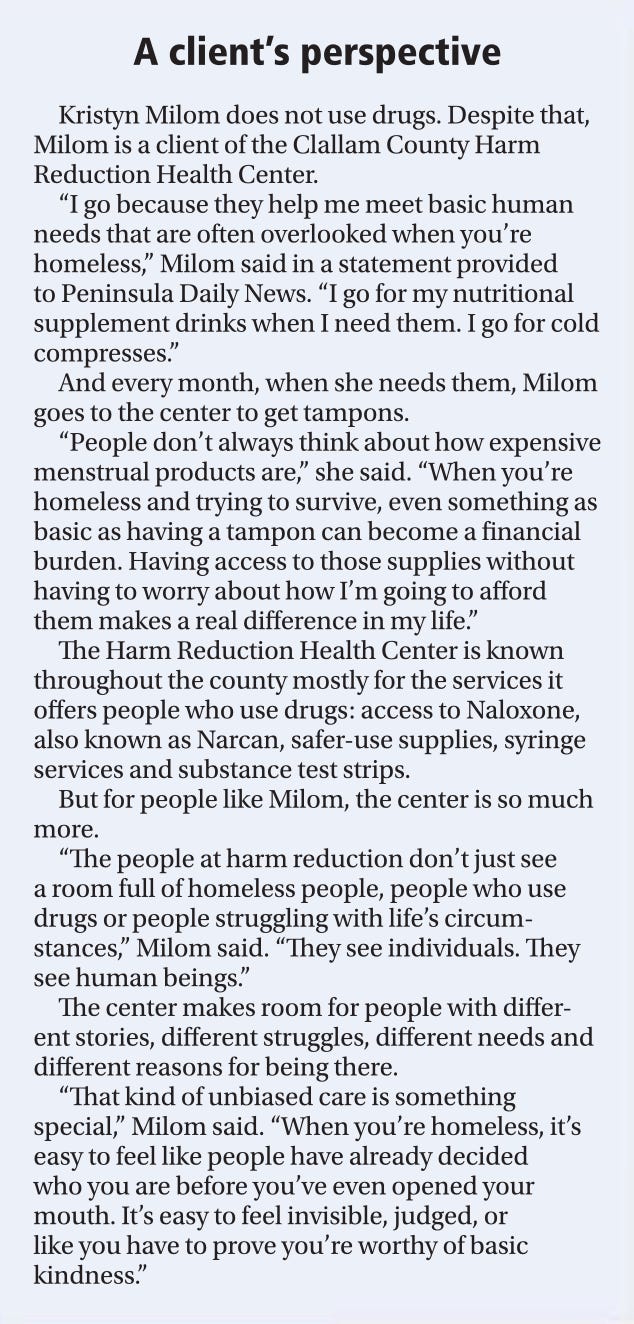
Hygiene items and a clothing closet are real needs. Serenity House, TAFY, food banks, and a long list of other providers also offer them. Seven pages of free-food options in this county do not require a stop at the syringe counter. Using a homeless woman who needs tampons to soften a debate about meth pipes is your local government and legacy media colluding to propagandize.
What French said when the paper was not writing it
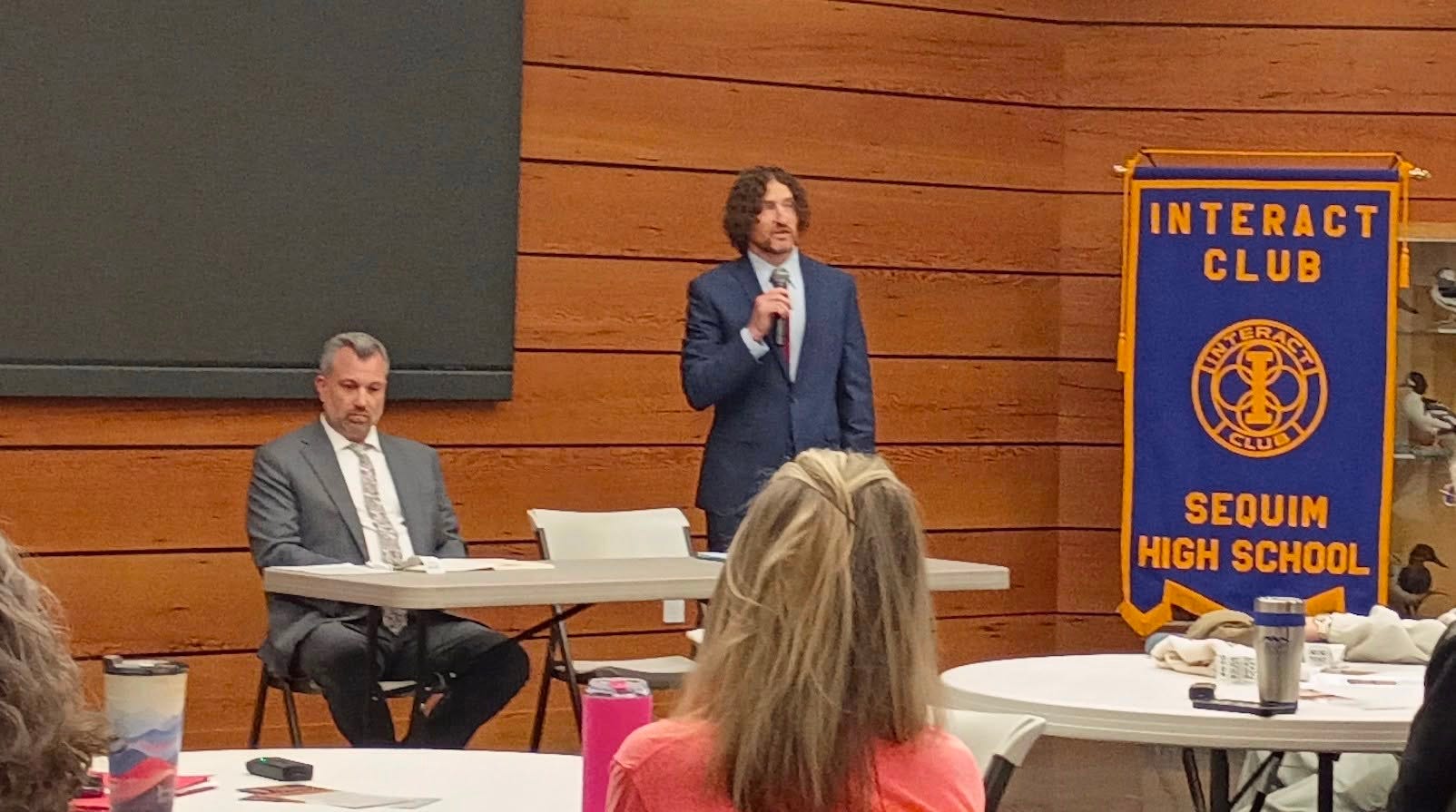
Last week, at the Sequim Rotary candidate forum, French said he wanted to clear up misconceptions.
“So, the first thing is, yes, Clallam County had an expansion of harm reduction a few years ago. A lot of that was response to, again, the Jamestown Healing Center opening, and harm reduction being a way to create a connection with active drug users so that you can leverage that connection to get them to go to treatment. So that’s the desire behind that expansion.”
That is the bluntest public explanation yet of why the program grew. The MAT Clinic opened in Sequim in 2022. The county renamed and broadened the program in 2023. French’s own account ties the expansion to the clinic: meet users with supplies, then move them to Medication-Assisted Treatment.
Jamestown is not a volunteer booth. The tribe runs the Healing Clinic as part of a profitable health enterprise. CC Watchdog has already reported the scale of that billing. By Mike French’s own account at the Sequim Rotary forum, the county expanded its taxpayer-funded supply program after the Jamestown Healing Clinic opened, specifically to create a connection with active users and move them into that clinic.
In his rebuttal to French, Jake Seegers did not argue about how many supplies went out. He argued about what happened next: 27 on-site treatment assessments out of about 12,000 encounters last year. “That’s a terrible conversion rate,” he said. “We are not actually pushing people to the treatment and the help that they need at harm reduction. We’re giving them drug use supplies.” If the expansion was about treatment, the county’s own tally, as Seegers read it, says it failed.
Health Officer Allison Berry oversees this arrangement. The Board of Health appointed her (then Allison Berry Unthank) on September 4, 2018. She already worked at Jamestown Family Health Clinic. She is now also health officer for Jefferson County, and the state Board of Health bio lists her part-time work in primary care and substance-use treatment at the Jamestown Healing Clinic. One of Berry’s employers, the County, writes the harm-reduction policy. The other employer, Jamestown, treats the patients that policy is supposed to produce, and gets paid for the visits. French chairs the board that keeps her in the first job. Nobody at Peninsula Daily News thought that was worth mentioning.
The Indiana story, and the budget cut he wants credit for
French then told the room the county has since cut the harm reduction program. He said he talked to Jamestown, Peninsula Behavioral Health, community paramedics, and 4PA. Joe DeScala of 4PA, French said, told him about half the supplies recovered on cleanups were unused. Staffing at the HRHC was reduced. Supplies were scaled back. Told that way, it sounds like a commissioner who heard the public and trimmed the waste.
Seegers answered with the other half of the story. The reduction followed the loss of state grant funding. The board didn't discover restraint after years of complaints. Full-time employees and drug-use supplies came down because the money dried up. French called it a course correction. Seegers called it a hole in the budget.
French closed with rural Indiana. He called the current local program evidence-based, and warned what happens if services like these are removed.
Scott County, Indiana, experienced a real outbreak in 2014 and 2015. About 215 HIV infections were eventually tied to it, in a town of roughly 4,200, almost all from injecting drugs with shared equipment. The county had about five HIV diagnoses in the prior decade. Indiana banned syringe sales without a prescription and did not allow needle exchanges. Possession could be a felony. The governor authorized a temporary exchange in 2015 after dozens of cases were already confirmed. Sharing then fell sharply. One study of participants found about an 88 percent drop in syringe sharing.
That is an argument for sterile syringes in a place that had none, during an injection outbreak of HIV. It is not an argument for Clallam County in 2026.
Clallam has had a syringe program since 2000. It is not facing a Scott County-style HIV cluster. The Indiana emergency program was a restricted exchange plus testing, contact tracing, and treatment. It was not a service desk for meth pipes, foil, straws, and boofing kits, and it was not needs-based distribution of hundreds of syringes with no return required.
Researchers credited sterile syringes, not a wider selection of crack pipes to choose from. Austin, Indiana, was an injection-driven HIV outbreak. The intervention tied to the drop in sharing and new infections was a syringe-services program: sterile needles, a place to return used ones, and a link to testing and treatment. That finding does not cover pipes, foils, or the rest of a safer-use menu.
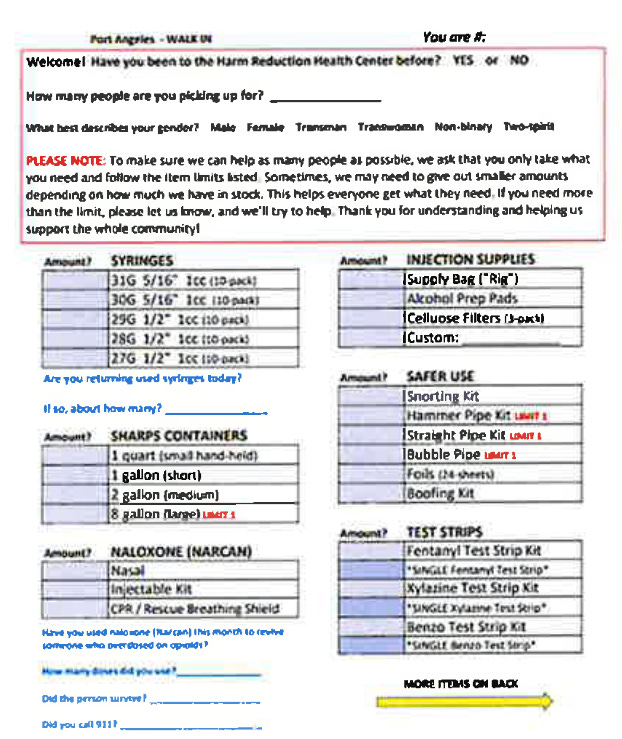
Clallam County’s Harm Reduction Health Center does both. It runs syringe services and also hands out safer-smoking supplies, along with naloxone, test strips, wound care, and referrals. Using Indiana to defend the whole center treats evidence for one tool as evidence for the entire package.
Just like a seatbelt study can justify using seatbelts. It cannot justify handing out the rest of the car.
French wants both sides at once. The harm reduction program had to grow to feed Jamestown’s clinic. The program also had to be cut because unused supplies were piling up in cleanups. And the cut program is still the evidence-based model that stands between Clallam County and an HIV outbreak from a state that outlawed syringes. Those claims do not survive contact with each other.
The choice on the ballot
Seegers is not proposing to take naloxone away. He is proposing to measure the thing French says the expansion was for. How many people leave addiction. He would return syringe access to a one-for-one exchange, which is how this county ran the program for years, and drop the county-issued kits for smoking and rectal use. French has now said, in front of a Rotary club, that the broader program was built to move people into the Jamestown’s clinic. The county’s report says 27 assessments came out the other end.
Peninsula Daily News had the interviews, the website, and the death counts. It did not have the Rotary quote, Berry’s dual jobs, the 27 referrals, or the difference between an exchange and a supply desk. Readers can decide whether that was an oversight or another reason local papers are in decline. The timing, a month before the election, does not make the omission look accidental.
Stay Engaged This Week
PABA Seegers / French Forum on Tuesday
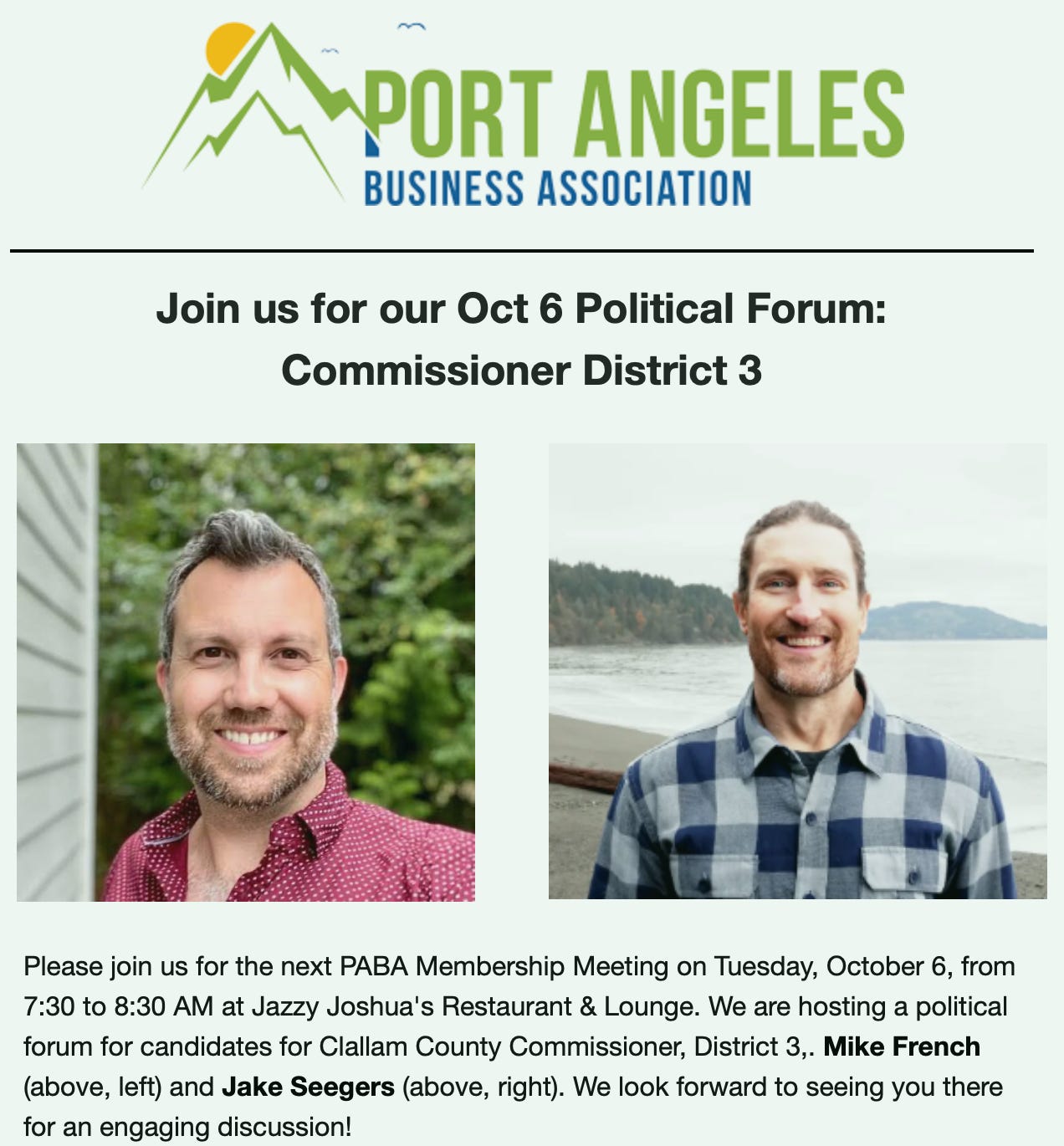
The forum will be broadcast live on PABA’s Facebook page.
Todd Ortloff Show: Seegers / French conversation
Tuesday – Candidate forum for Clallam County Commissioner District 3 with incumbent Mike French and challenger Jake Seegers. 1 pm on 1450AM, 101.7 (Port Angeles), 101.3 (Sequim), or listen online.

Teresa Fox Town Hall Wednesday

Wednesday, October 7, 2026, 6:00 p.m., Sequim Prairie Grange at 290 Macleay Rd. She will open, then turn it over to the room. Incumbent Emily Randall is invited. Fox’s case is that Randall has been missing local forums while campaigning for candidates outside the state, and that the district deserves someone who shows up. She is running as a business professional and emergency manager, not a career politician. Details at foxforwa.com or info@foxforwa.com.


