


In Clallam County, traditions that arrived only recently are increasingly treated as sacred heritage, while many places, symbols, and experiences that defined this community for generations are vanishing. Heritage can be created, adopted, celebrated, and even marketed—but it can also be erased. The question worth asking is simple: when everything becomes heritage, whose heritage survives?
“The totems are cultural symbols telling various stories,” Jamestown S’Klallam Tribe CEO Ron Allen told Salish Current in 2024. They’re an “art that captures our identity and history.”
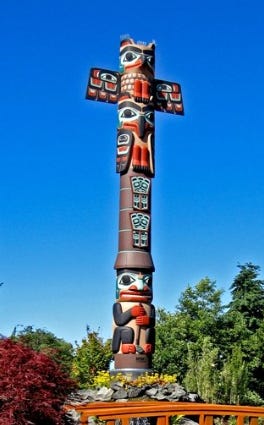
Totem poles are clearly important to the Jamestown Tribe today. Seven stand in front of the 7 Cedars Casino. More than 35 rise across the Jamestown campus in Blyn. The opening ceremonies of Sequim’s Sunshine Festival traditionally begin with a “Hooya Hooyay” dance around the 30-foot totem pole that towers over the civic plaza in front of City Hall.

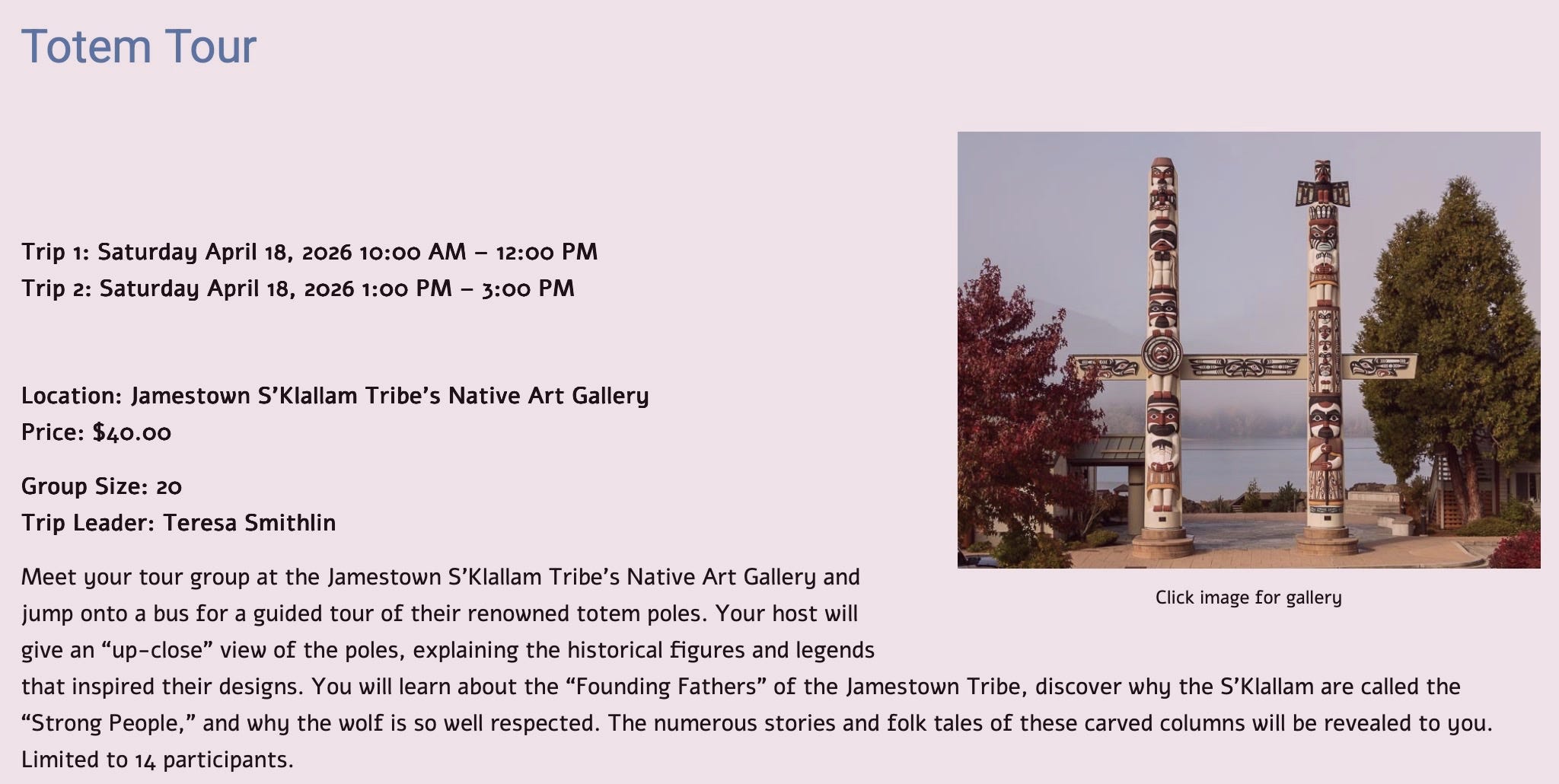
Visitors can even pay $40 for a guided “totem tour” to see the poles.
One stands at the tribe’s golf course holding a golf club.
There have even been guided bike tours around the Sequim area highlighting the poles.
But the history of the totem pole itself is interesting. Totem poles may be part of Jamestown’s modern identity, but they have not been part of local S’Klallam culture since “time immemorial.” The large carved poles most people recognize originated primarily in Southeast Alaska and northern British Columbia and were historically associated with tribes such as the Tsimshian, Haida, and Tlingit. When a totem pole was brought from Southeast Alaska to Seattle in 1899 and erected in Pioneer Square as a curiosity, it drew crowds because many residents of Washington had never seen one before.
Historical records show the S’Klallam did display poles of a different kind. Captain George Vancouver wrote that the poles he observed displayed the heads of enemies, noting that “the heads appeared to carry the evidence of fury or revenge, as, in driving the stakes through the throat to the cranium…”

One CC Watchdog subscriber noted that the first totem pole carved by a Jamestown tribal artist and displayed in the area dates back to just 1969.

If that is accurate, it suggests the tradition is relatively modern here, adopted from northern coastal tribes such as the Tsimshian of the Prince Rupert, British Columbia region. History records that the Jamestown people once clashed violently with Tsimshian groups on the Dungeness Spit, where 18 members of that tribe were massacred.
When Heritage Is New—and When It Disappears
Heritage is an interesting thing. Sacred history can begin as recently as 1969. Traditions can be invented—like deciding every year to celebrate “Friendsgiving.” But heritage can also be lost.
Part of my own heritage, every August when I was a kid, was making the trip to the big city of Port Angeles to shop for back-to-school clothes at Lamont’s (now Country Aire) and getting a new pair of shoes at McLean’s. After our shopping, Mom would take me to the Cornerhouse Restaurant for a slice of pie.
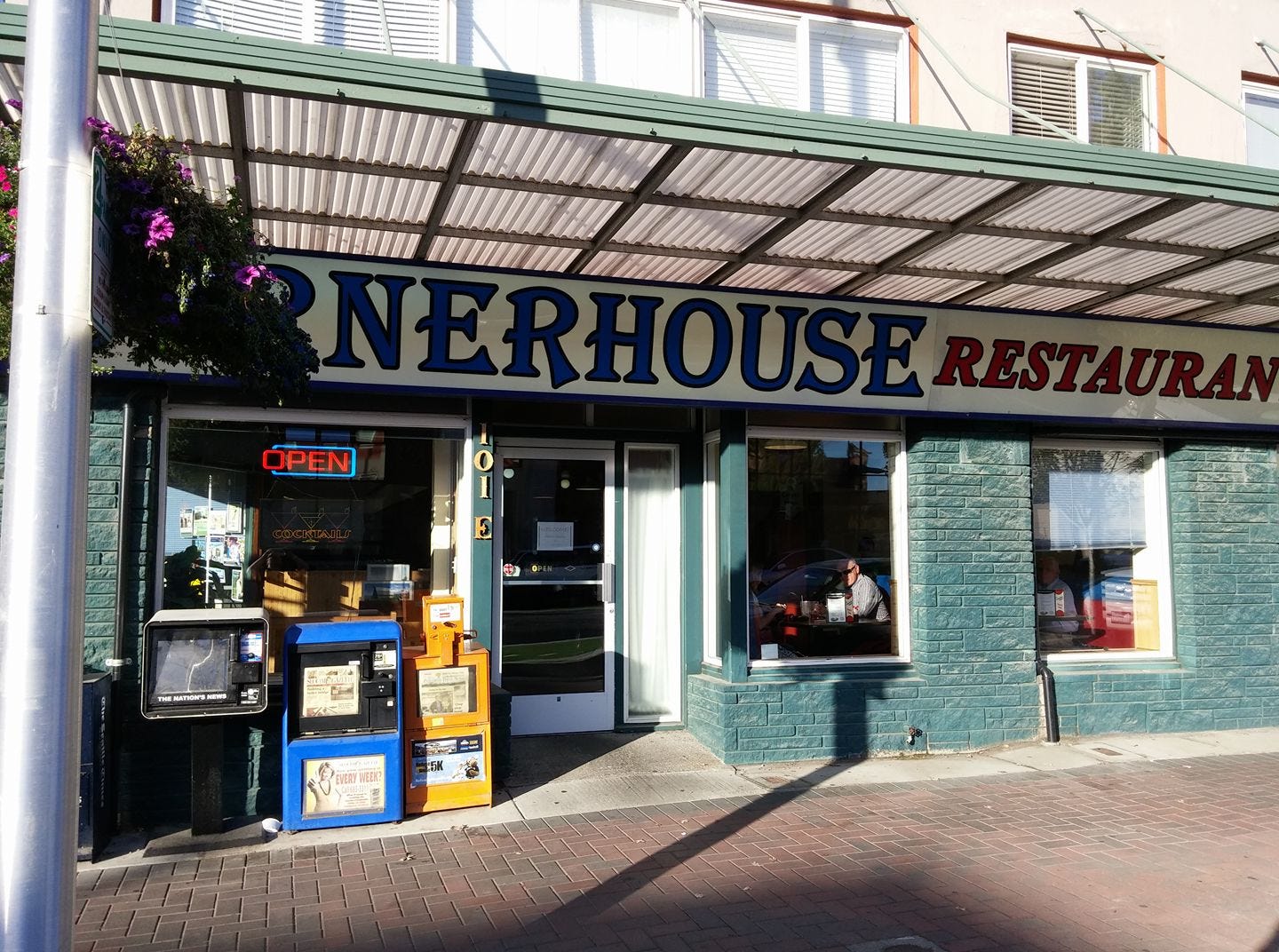
That restaurant stood in one of the original buildings in downtown Port Angeles. In 2019, the entire block was demolished to make way for the Lower Elwha Klallam Tribe’s proposed 106-room hotel. Today, the lot still sits empty. No restaurant. No jobs. No tax revenue. No pieces of pie. Just an empty scar in the middle of Port Angeles’ downtown shopping district.
That’s how quickly heritage can change.

Remember the 3 Crabs?
Another place full of memories was the 3 Crabs Restaurant. Generations of class reunions were held in its banquet room. The restaurant was famous for clam chowder—and yes, the pie from the rotating, glass display case was pretty good too.
For many people across Washington, mentioning Sequim immediately brought the response: “Isn’t that where 3 Crabs is?”
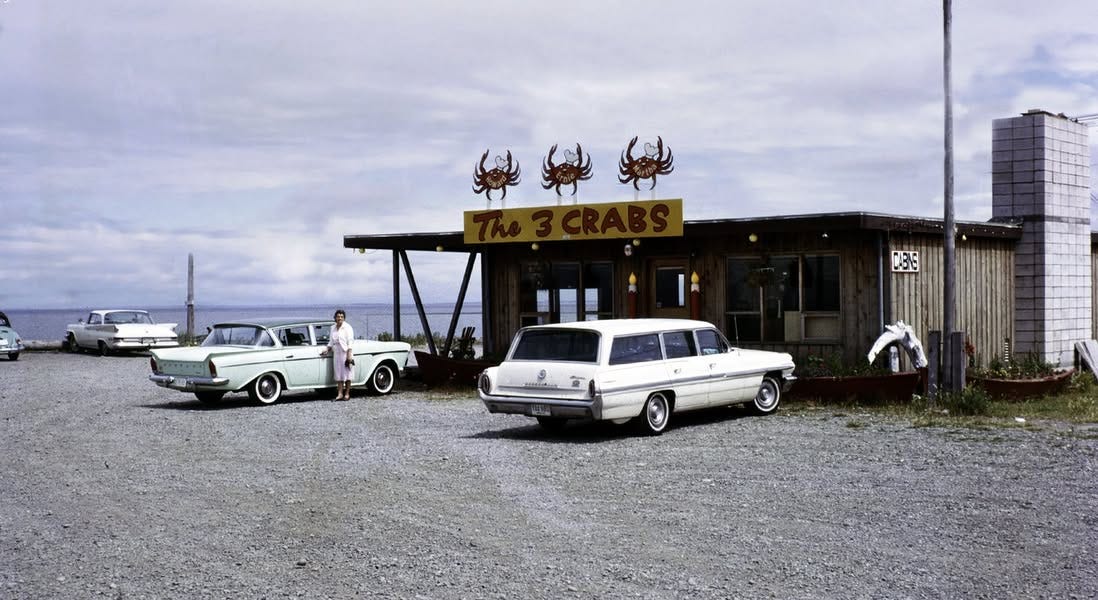
The restaurant was demolished when the Jamestown Tribe pursued restoration of the Meadowbrook Creek estuary. The estuary project may have environmental value, but many locals still miss the landmark restaurant that once stood there.
The Elwha River and a Lost Era
Part of this county’s heritage was the power of the mighty Elwha River. For decades, its dams produced electricity and provided a stable water supply for the City of Port Angeles.

Those dams were removed in the name of salmon restoration, and with them disappeared another chapter of the region’s industrial and civic history—just like the mills they once powered.
Today, Port Angeles faces water restrictions during late summer.
The Mountain Goats
Hiking in the Olympics is a tradition for many families. For generations, hikers would look up toward the jagged peaks and see mountain goats navigating cliffs that seemed impossible to climb.
But mountain goats were not native to the Olympic Mountains. They were introduced in the 1920s when the Washington Department of Game released about a dozen goats between 1925 and 1929 to establish a hunting population. With no natural predators, their numbers grew into the hundreds.
By the late twentieth century, scientists in Olympic National Park concluded the goats were damaging fragile alpine ecosystems by grazing rare plants and disturbing soils. They also became aggressive toward visitors, seeking salt from human sweat and urine.
After decades of study and debate, removal began in 2018. Many goats were captured and relocated to the North Cascades, where the species is native, while others were culled.
Tribal governments were formally involved in this process. The National Park Service consulted with several Olympic Peninsula tribes—including the Jamestown S’Klallam Tribe, Lower Elwha Klallam Tribe, Port Gamble S’Klallam Tribe, Makah Tribe, and Quileute Tribe—during environmental review and decision-making. Tribal representatives supported the removal because the goats were not historically native and were harming alpine plants that tribes consider culturally significant.

The Lost Road to Olympic Hot Springs
The Elwha River Ranger Station and the road to Olympic Hot Springs once served as another major gateway into Olympic National Park alongside Hurricane Ridge. It was a beloved route for locals and tourists alike.
That road washed out during a major storm in November 2017. Floodwaters from the Elwha River—reshaping its channel after dam removal—eroded the riverbank and destroyed large sections of Olympic Hot Springs Road.

The National Park Service has studied rebuilding the road farther from the river, but the cost could reach tens of millions of dollars. Tribal leaders from the Lower Elwha Klallam Tribe have expressed concerns about rebuilding deeper into the valley, saying the river corridor is culturally important and should be allowed to recover naturally. Some tribal representatives have favored limiting road construction and keeping access primarily by trail or shuttle.
The Irrigation Ditches That Built Sequim
My great-great Aunt Gladys lived past 100 years old. She used to tell me stories about the days when traveling from Sequim to Port Angeles took an entire day because wagon wheels sank into the dust.
She was famous locally because she was the last living person who attended Sequim’s first Irrigation Festival in 1896—she was just a baby in a bassinet.
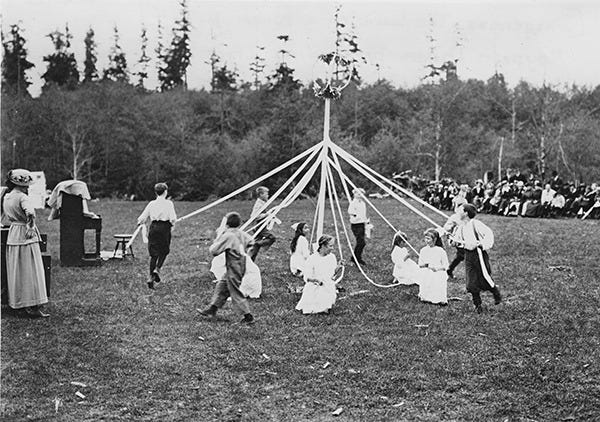
Her family (Grant) helped dig the irrigation ditches that transformed the Sequim Prairie into a fertile plain. For more than a century, that network of ditches was a defining part of the region’s agricultural heritage.
Today, the Jamestown Tribe has threatened litigation if the original irrigation ditch running through the heart of Sequim is not converted into a pressurized pipeline and buried underground.
Columbus and Competing Histories
Clallam County commissioners don’t celebrate the heritage of Christopher Columbus or the Italian-American community. Instead, they now read annual proclamations that criticize European settlers as “colonizers” while describing others of European descent as “indigenous,” language drawn from United Nations-style declarations about systemic racism.
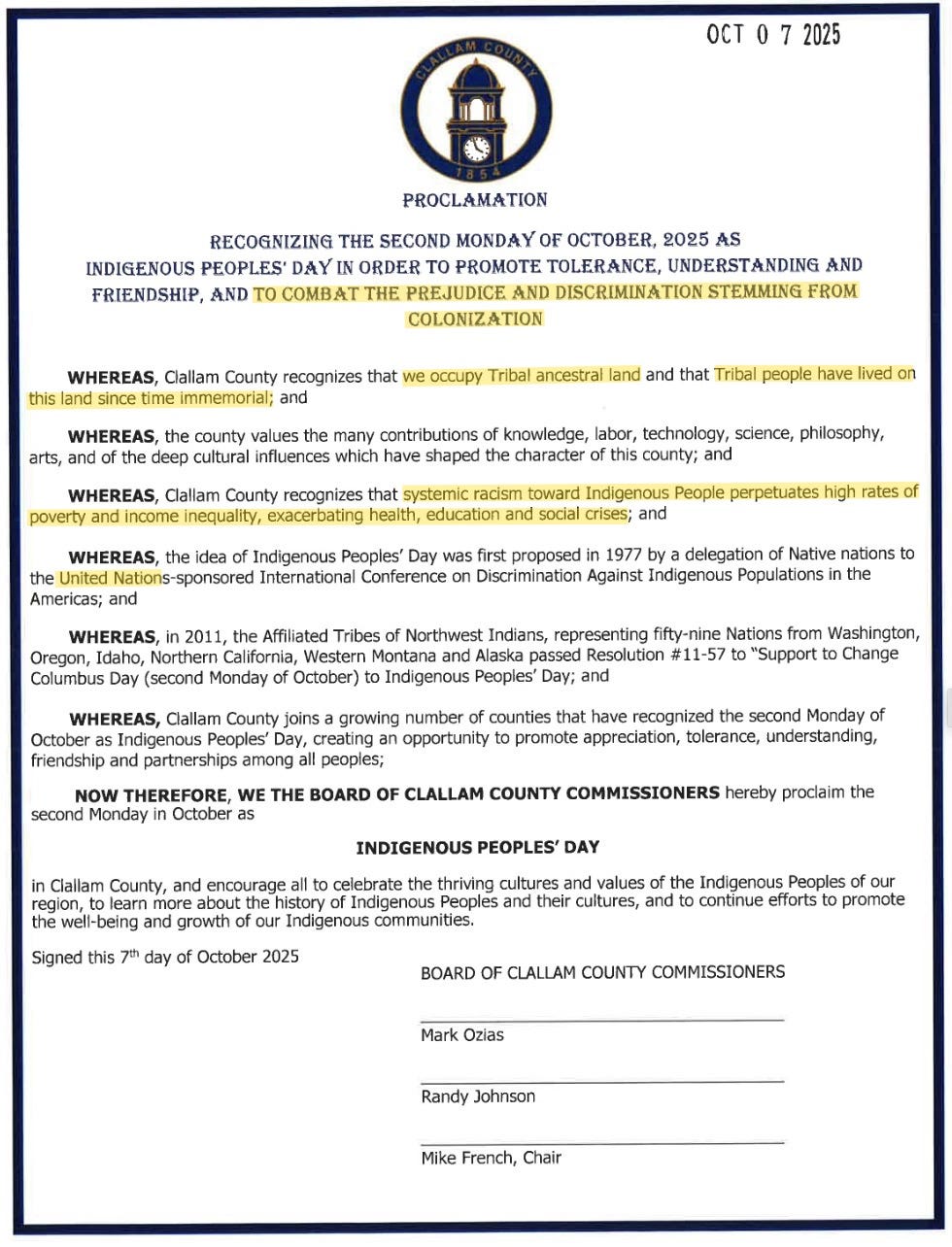
The shift reflects how quickly historical narratives—and whose heritage is recognized—can change.
The Disappearing Identity of Blyn
Blyn itself once had a distinct identity. It was a logging hub and a railroad stop at the south end of Sequim Bay, complete with sawmills, a shingle mill, a dance hall, and an auto club. It had its own post office and was named for Captain Marshall Blyn, a 19th-century land inspector.
For decades, a sign on Highway 101 marked the entrance to Blyn.
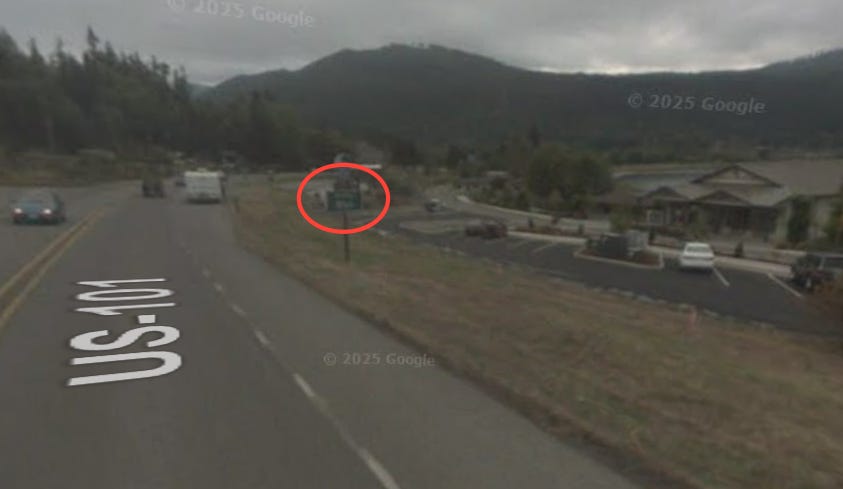
That sign quietly disappeared. In its place, a roadside sign now welcomes travelers to “Jamestown S’Klallam Territory.”

The Jamestown Tribe originally settled in Jamestown, north of Sequim. Blyn became identified as tribal headquarters after the tribe gained federal recognition in 1981. Jamestown itself was designated a floodplain, so federal funds could not be spent there, making land in Blyn the focus of tribal development.
The historic identity of Blyn, however, is slowly fading.
The Stories We Tell
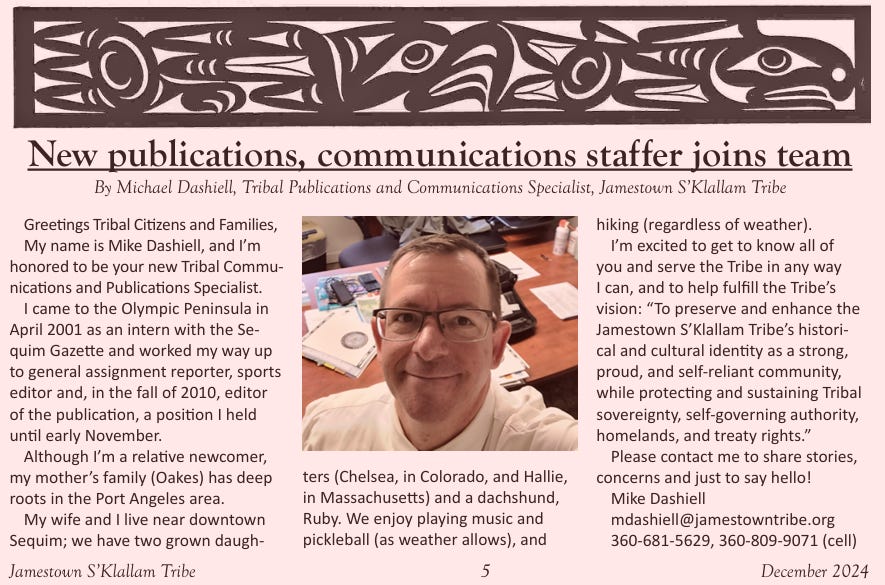
For nearly a quarter century, Sequim Gazette reporter and editor Michael Dashiell documented the community’s milestones—its triumphs, tragedies, celebrations, and controversies.
In 2024, after more than two decades telling the community’s stories, he left the newspaper to become the Jamestown Tribe’s publications and communications specialist.
Journalists like Dashiell become part of a community’s heritage because they record it.
A Stadium With a New Name
For generations, Sequim students played football games at the Sequim High School stadium.
Today it is called Stáʔčəŋ Stadium, a word meaning “wolf” in the S’Klallam language.
And Now the Courthouse
For more than a century, residents of Clallam County have walked into a building called simply the Clallam County Courthouse—a name representing all 77,000 residents of the county.

My mom worked there. The desk I sit at today once belonged to my grandfather, who bought it from a judge who worked there. My great-great-grandfather’s photograph hangs inside the courthouse; he watched it rise from the ground when it was built in 1914.
Now, commissioners are considering renaming the courthouse after Washington Supreme Court Justice Susan Owens. Two letters supporting the renaming have come from the Lower Elwha Klallam Tribe and the Quileute Tribe. Owens served as a county judge in Forks before joining the state Supreme Court and worked with both tribal courts.
Enough Is Enough
Heritage should unite communities, not divide them.
Totem poles that appeared only recently are now treated as sacred symbols. Meanwhile, restaurants, landmarks, traditions, roads, and names that shaped generations are quietly disappearing.
Every community evolves. But when too many pieces of shared history vanish, something deeper is lost.
Maybe it’s time to stop rewriting the past—and start preserving the heritage that brought us together in the first place.
Call to action
Today at 10:30 a.m., the County Commissioners will consider a proposal to memorialize Justice Susan Owens by renaming the Clallam County Courthouse. Whether you support or oppose the idea, this is exactly the kind of decision that deserves public attention and engagement. You can attend the meeting in person or join via Zoom by clicking here, and make your voice part of the discussion. Public comment is allowed.


