


Across Sequim and Clallam County, accusations of “dog-whistle racism” are increasingly being used not to illuminate bias—but to shut down debate, delegitimize critics, and elevate political narratives that serve a select few. When elected officials call residents racist without evidence, rewrite meeting minutes, suppress dissent, and weaponize claims of harm to advance their agendas, the public loses its voice. This is the story of how the term “dog whistle” has become a political bludgeon—and how the people paying the bills are the ones being silenced.
A racist dog whistle is traditionally defined as a coded phrase that appears neutral on its surface but is meant to trigger racial anxieties in a targeted audience. It’s a metaphor: most people hear nothing unusual, while a select group receives a hidden message.
But lately, according to many locals, the dog whistles aren’t coming from shadowy figures on social media—they’re coming from elected officials themselves.
Sequim’s 2023 Vision Statement Fight
At the April 2023 Sequim City Council retreat, an effort to update a decade-old vision statement quickly morphed into a debate about racism, identity, and language.
The original opening line read:
“Sequim will maintain its friendly, small-town lifestyle and overall high quality of life…”
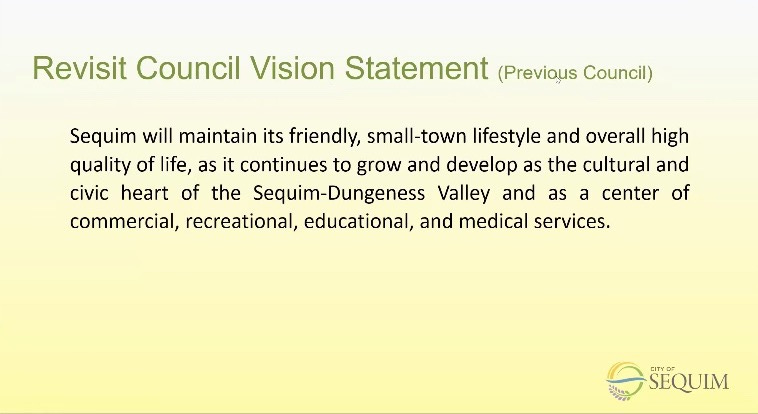
Councilmember Lowell Rathburn proposed this revision,
“Sequim, located in the ancestral homeland of the Jamestown S’Klallam Nation…”
Rathburn also wanted to add the term inclusive.
Councilmember Vicki Lowe, a Jamestown S’Klallam descendant, supported the changes and argued that the phrase “high quality” sounded “exclusive and elite.” She preferred replacing it with “accessible quality of life.”
Councilmember William Armacost proposed additional language reflecting the council's responsibility to residents. He suggested adding,
“…an exceptional community that is welcoming, well-maintained, and safe.
Then Lowe returned to the phrase “high quality” and said:
“High quality is a dog whistle for white people, basically. So, I think, if we can just say something besides ‘high quality’ everybody will feel like we’re talking about them.”
By any plain-language or fair-minded standard, that statement assigns motives and characteristics to an entire group of people solely on the basis of race.
That is, by definition, racist.
[To listen to the Sequim City Council retreat, click here, advance the video to 1:25:04, and listen for 11 minutes.]
The Hypocrisy Problem
Oddly, Lowe’s own tribe uses the term “high-quality” liberally:
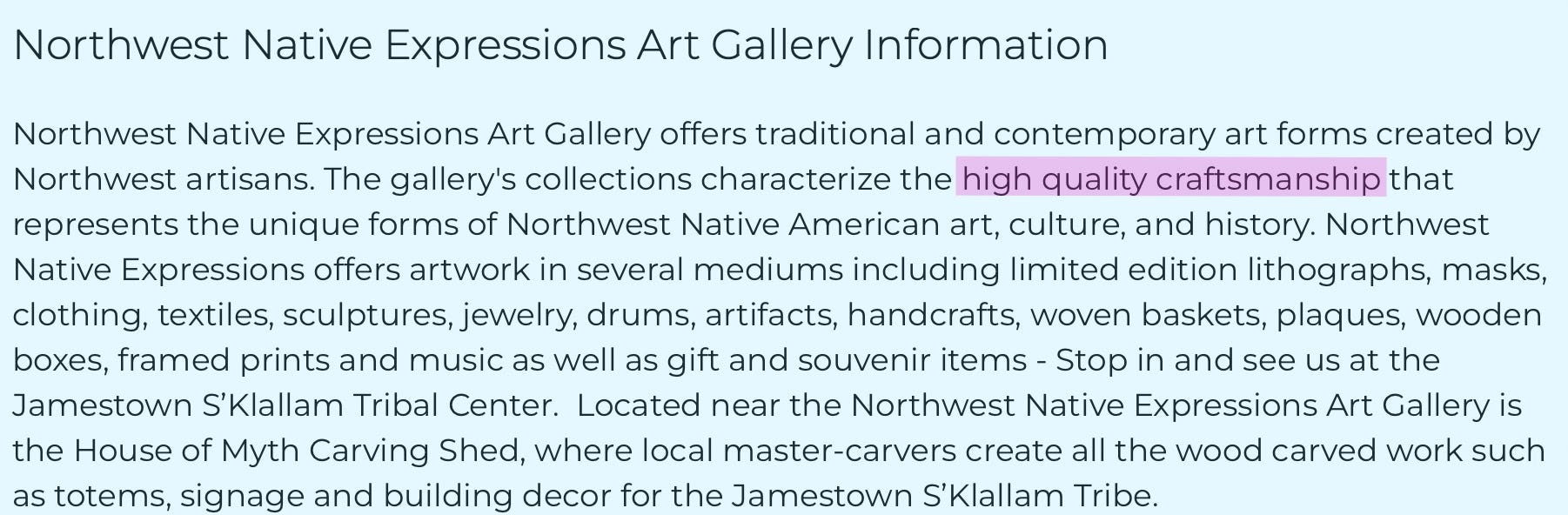
The Jamestown S’Klallam art gallery praises the “high quality craftsmanship” of its collections.
The Tribe’s aquaculture partnership advertises “high-quality seafood” produced locally.

So the phrase is perfectly acceptable in Tribal marketing and commerce—but somehow becomes a “dog whistle for white people” when used in a city vision statement.
Armacost Pushes Back—But the Minutes Bury It
At the following council meeting, Armacost said he found the comments at the retreat to be “offensive and racist.”
Lowe explained that she tries not to use the term “White” because she knows it is offensive. Then she described rental discrimination she had experienced as a young, unwed mother, suggesting that it related to her appearance as a Tribal descendant rather than her financial situation.
Yet the official meeting minutes summarized the entire tense and important exchange about the retreat as:
“Councilor Armacost felt it was good overall.”
This is precisely why municipalities should record and post meetings in full. Minutes that omit controversy do not protect transparency—they erase it.
[To listen to Armacost’s comments and Lowe’s explanation, click here and advance to 51:17.]
2020: Lowe Condemns Racism—But Only Some Forms of It
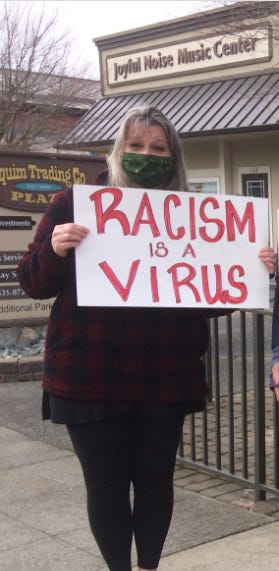
In a 2020 city meeting, while giving public comment, Lowe passionately warned of racist comments online:
“Tribal people have expressed fear of being in public with a brown face, needing mace, needing help dealing with anxiety about going into public. ‘Indian idiots.’… We feel unsafe to go grocery shopping, ride buses, go to the post office, go for a walk in our own community. We all need to do what we can to stop racism.”

Yet when she asserted that “high quality” is a dog whistle “for white people,” no similar introspection followed. No apologies. No calls for accountability. No recognition that assigning negative motives to an entire race is, by definition, racist.
It appears some racism is condemned—and some is accepted—depending on who says it, and whom it targets.
[To hear Lowe’s comments about racism, click here and advance to 1:19:47.]
The Dog Whistle Accusation Moves to Clallam County Government
The rhetoric didn’t stop in Sequim.
Just a month ago, Charter Review Commissioner Paul Pickett accused commissioners and public commenters of racism over a proposed amendment that merely required the Board of Commissioners to answer letters about land-trust transfers. The proposal didn’t mention tribes, race, or ethnicity.
Pickett said:
“Listening to people talk about the Tribes, at best, shows a lot of ignorance about history and law and, at worst, is dog whistle racism… If there are people feeling uncomfortable here, you should feel uncomfortable.”
Labeling the public “racist” or “ignorant” without evidence is not public service—it’s intimidation. It chills participation, suppresses dissent, and erodes trust in local democracy.
During her term, Charter Review Chair Susan Fisch has sat silently as Pickett labeled the public racists and called a fellow commissioner an “asshole”—twice.
[To watch Commissioner Pickett make his remarks, click here and advance to 54:14.]
And Then It Got Personal
Pickett has posted a meme targeting this website—mocking it as the “Clallam County Crotchdog: Sniffing out imaginary problems,” accompanied by an image of one dog sniffing another’s rear end. Given that I am openly gay, many readers have asked: Is this a homophobic dog whistle?
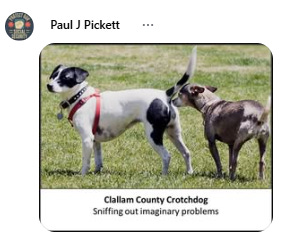
If “dog whistle” now means anything that offends someone based on identity, then Pickett’s post certainly checks the boxes under the standards he applies to others.
The Holy Letter: Praise Without Context
Commissioner Christy Holy wrote a glowing letter to the editor praising Chair Susan Fisch’s “exemplary leadership” and lamenting online criticism as “a high school slam book.”
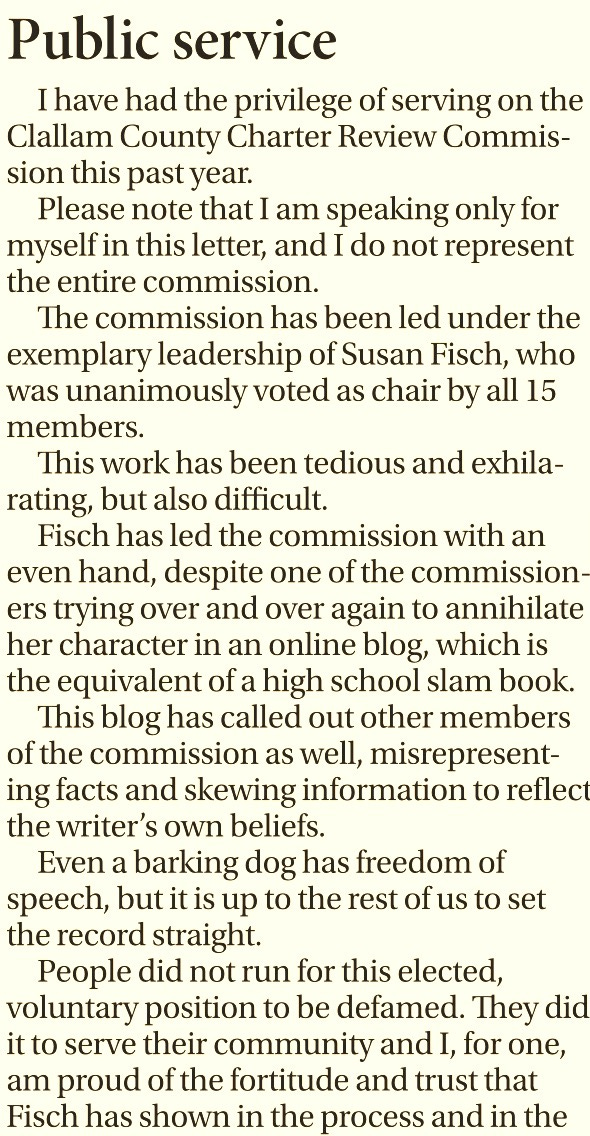
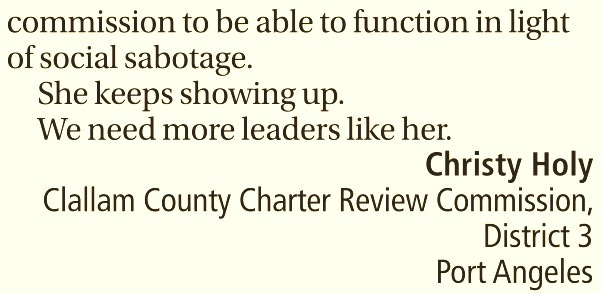
Holy’s letter omitted substantial facts:
Fisch has repeatedly ignored established rules and abused Robert’s Rules of Order to silence dissent.
She continues to selectively enforce decorum, interrupting commissioners she disagrees with while allowing repeated insults from her allies.
She pushed, for nearly seven hours of meeting time, for new rules restricting the reporting of public information—an unmistakable attack on First Amendment rights and government transparency.
She unilaterally assigned a highly controversial public-survey project to her close friend Jim Stoffer’s committee—without a vote, without discussion, and without any input from the full commission. That single decision effectively dictated the commission’s priorities for the entire term and, arguably, charted the direction of Clallam County government for the next five years, until the Charter Review reconvenes.
If Commissioner Holy says “showing up” is the standard for “exemplary leadership,” then the bar for local governance has fallen dangerously low.
Ironically, the one meeting Fisch missed—run by Vice Chair Chris Noble—was widely described as the most functional of the year.

Hijacking a Once-in-Five-Years Democratic Process
The Charter Review Commission is supposed to be the public’s chance, every five years, to shape the county’s governing document.
Instead:
Rules were invented or ignored.
Agendas were manipulated.
Dissenting commissioners were sidelined.
The public was lectured, labeled, and dismissed as a “vocal minority.”
Transparency was sacrificed in the name of political convenience.

The voters’ pamphlet promised “good listeners,” “collaborative workers,” and “balanced approaches.”
What the county received were coordinated activists pushing predetermined agendas—and using accusations of racism to bulldoze anyone who got in their way.
The Tide Is Turning
Residents across Sequim, Port Angeles, and Clallam County are noticing a pattern:
If you question policy, you’re labeled racist.
If you ask for transparency, you’re “attacking public servants.”
If you don’t accept fringe ideology, you’re “ignorant.”
If you want your government to strive for high-quality, you’re a “dog whistle.”
People are tired of paying for a government that treats them like the enemy.
Tonight, the Charter Review Commission meets at 5:30 p.m. at the courthouse.
Instructions for virtual and in-person attendance are available here. All Charter Review Commissioners can be reached by emailing the Clerk of the Board at loni.gores@clallamcountywa.gov.
It’s your county. It’s your charter. It’s your right to be heard.
And no dog whistle—real or imagined—should ever silence that.
November 24, 2025
Hi Christy,
Something you said at last night’s CRC meeting caught my attention. Could you provide examples of the misrepresentation you referenced?
Thanks,
Jeff
Commissioner Holy did not reply.
December 3, 2025
Dear Executive Committee,
As a member of the Charter Review Commission, I am formally requesting that the following matter be placed on the agenda for our next scheduled meeting as a discussion and possible action item.
Agenda Request: Discussion of Public Apologies or Possible Censure of Commissioners Paul Pickett and Jim Stoffer
I am requesting that the full Commission discuss whether to formally ask Commissioners Paul Pickett and Jim Stoffer to provide public apologies for conduct that has undermined public trust and the integrity of the Commission’s work. Failing the receipt of those apologies, I am requesting that the Commission consider whether censure is appropriate.
Authority for Considering Censure Under Robert’s Rules of Order
As stated in our approved rules and bylaws, the Charter Review Commission conducts its meetings under Robert’s Rules of Order. Under Robert’s Rules, a deliberative body may vote to censure a member when it deems a formal expression of disapproval necessary.
A censure is:
A formal rebuke or statement of disapproval recorded in the minutes,
Adopted by a simple majority vote,
Introduced like any other main motion (with a second and debate), and
Distinct from disciplinary actions such as suspension or removal.
Censure is not punitive in itself; it is a procedural tool used by assemblies to formally condemn conduct that the body believes was inappropriate or damaging to its integrity. It is therefore within the authority of this Commission to consider such a motion.
Incident Involving Commissioner Paul Pickett
During the November 10th Charter Review Commission meeting, following public comments on a proposal regarding communication on Trust Land Transfers, Commissioner Pickett stated:
“Listening to people talk about the Tribes, at best, shows a lot of ignorance about history and law and, at worst, is dog whistle racism.”
“If there are people feeling uncomfortable here, you should feel uncomfortable.”
Publicly calling commenters racist or ignorant—without evidence—risks creating a chilling effect on public participation. Government bodies have an obligation to maintain an environment where community members feel safe expressing their views, even unpopular ones. Comments of this kind may discourage future participation, suppress dissent, and erode trust in our process.
Incident Involving Commissioner Jim Stoffer
Public records indicate that Commissioner Stoffer shared confidential attorney-client-privileged material with at least one outside individual who had no formal connection to the Commission, and also sent this material to his personal email, without authorization from the Commission.
Our bylaws make this expectation clear:
ARTICLE XI – PUBLIC STATEMENTS
“Statements purporting to represent the views or pronouncements of the Commission or committees thereof shall not be made except as directed or authorized by a majority of the entire Commission…”
While the Commission later voted to declassify the information, that vote does not alter the fact that the original unauthorized disclosure occurred. Although we may eventually receive a legal opinion from the Prosecuting Attorney’s Office, the issue before us is one of process, protocol, and maintaining the Commission’s credibility.
Why This Agenda Item Is Necessary
If the Commission does not address conduct that undermines public trust, civility, or confidentiality standards, our silence risks being interpreted as approval. Over the past year, the Commission has already faced public criticism for inconsistent application of rules, politicization of deliberations, disregard for survey input, and pursuit of personal agendas.
This issue provides an opportunity to reaffirm our integrity and demonstrate that all members are held to the same standards of professionalism and respect.
To that end, I request the Commission consider the following:
Issuing a formal request for public apologies from Commissioners Pickett and Stoffer; and
If apologies are not offered, proceeding to a discussion and vote on whether censure is appropriate under Robert’s Rules of Order and our adopted procedures.
Thank you for your consideration. Please confirm that this item will be placed on the agenda for the next meeting.
Respectfully,
Jeff Tozzer
Clallam County Charter Review Commissioner
No reply from the Executive Committee (Susan Fisch, Chris Noble, Mark Hodgson).
Decemeber 4, 2025
Dear Executive Committee Commissioners Susan Fisch, Chris Noble, and Mark Hodgson,
I noticed that my requested agenda item, “Public Apologies or Possible Censure of Commissioners Paul Pickett and Jim Stoffer,” was not included in the upcoming agenda. I am requesting an explanation as to why I am the only commissioner whose agenda items are routinely excluded, and the only commissioner who is required to take their agenda items to a vote at the start of each meeting.
Previously, the Executive Committee stated:
“Your suggested discussion item was not included in the draft agenda because it does not pertain to a proposed charter amendment or a recommendation to the Board of County Commissioners. As always, you may move to add an item to the agenda.”
However, this justification is inconsistent with the committee’s own past practices, as several agenda items have been added that did not meet that stated criteria.
Given this discrepancy, I am requesting clarification on why a different standard appears to be applied to my submissions.
Thank you,
Commissioner Jeff Tozzer
No reply.
December 6, 2025
Dear Members of the Charter Review Commission,
I want to clarify an important point raised at our last meeting. Commissioner Stoffer asserted that any discussion related to allegations involving his conduct must be held in executive session and that his name could not be referenced publicly. This is incorrect.
Under RCW 42.30.110(1)(f), a governing body may enter executive session to evaluate complaints or charges against a public officer, but it is not required. The law gives the Commission full discretion to discuss such matters publicly. In fact, if an executive session were proposed, the subject of the complaint has the right to request an open, public discussion.
Nothing in the statute prohibits identifying the officer whose conduct is at issue. The OPMA contains no provision granting anonymity to public officials, nor does it restrict the Commission from naming a public officer when discussing alleged violations of process, misuse of information, or mishandling of privileged material. The only restriction is that the content of attorney–client privileged communications may not be disclosed — not the identity of the person who shared them.
This clarification matters because public records confirm that Commissioner Stoffer forwarded attorney–client privileged materials to both his personal email and to a private community member with no official role in this Commission. To date, he has declined to answer questions about these disclosures.
It is therefore concerning that Commissioner Stoffer is insisting the Commission adhere to rules that do not exist, while disregarding the rules that do — particularly those involving confidentiality and the proper handling of privileged documents.
The public expects transparency. The law allows transparency. And the Commission should not be prevented from discussing an issue simply because the subject of the allegation objects to it.
Thank you for your consideration.
Appreciatively,
Commissioner Jeff Tozzer


