


Two years into a $35.6 million federal “jobs” program, the public scoreboard is 21 people who finished training and later reported work or higher pay. The sales pitch was 900. The new official target is 603. The money did not shrink with the goal. Commissioner Mike French still wants another term on the strength of a grant that is better at funding government than at putting workers on payrolls.
The campaign is built on Recompete
Mike French’s reelection pitch is not public safety, government efficiency, or more community engagement. It is Recompete.
He chairs the North Olympic Peninsula Recompete Coalition. He told voters the coalition brought $35.6 million in federal money to “create good jobs and train and connect our residents to living-wage jobs.” His own issue paper said the point was to “transition 900 North Olympic Peninsula residents into full-time family wage jobs in a 5-year period.”
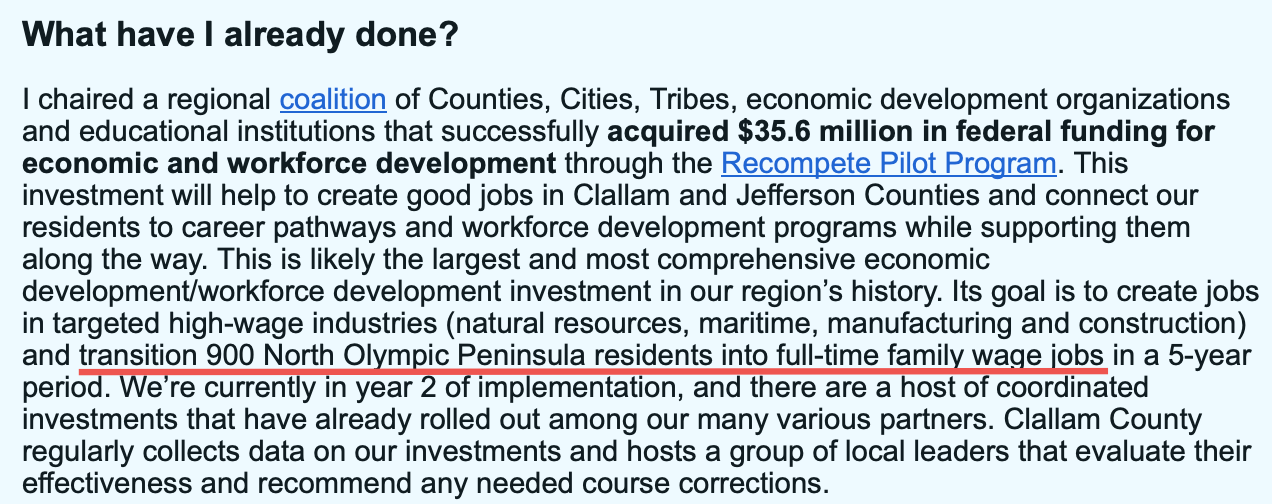
When he announced he was seeking a second term, he called it one of the county’s “best chances to really change the story of the North Olympic Peninsula.”
That is his cornerstone. Check the foundation.
The goal shrank. The check did not.
Last week the story changed.
According to Radio Pacific, Recompete Plan Coordinator Molly Pringle told the Clallam Economic Development Council the program’s five-year workforce goal is now 603 people who go through training and then land a job or raise their income. Through March, that number was 21.
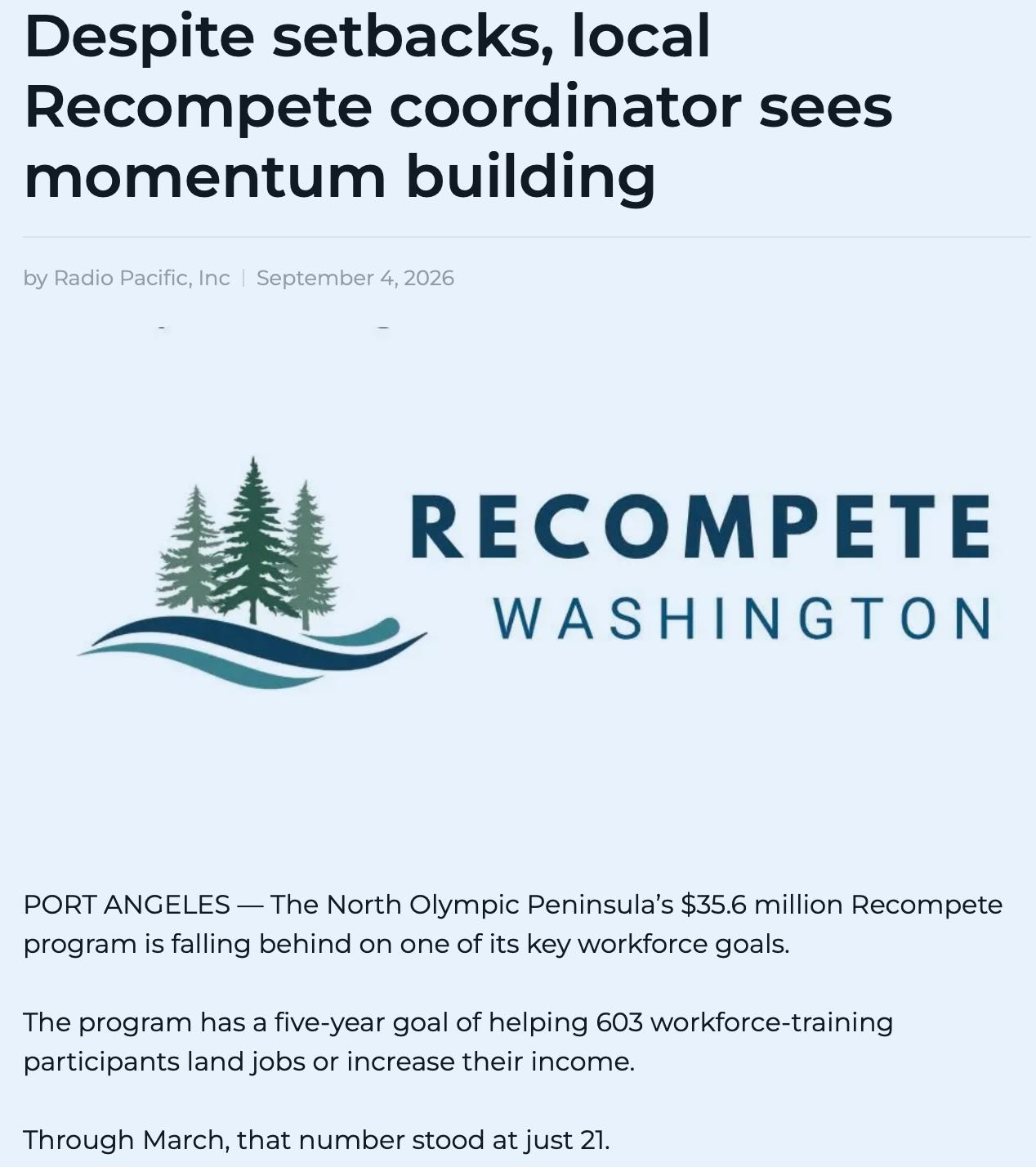
“So, our five-year goal for that is 603 individuals, and that’s very ambitious,” Pringle said. “Reporting only 21 in our last day to report that went through March, we understand that we’re lagging there.”
She blamed a three-month federal shutdown that became a nine-month wait for mobile training units, then a delay in curriculum. The units are finally running, she said. The 603 target stays. The early years were “getting the programs in place.”
Separately, partners reported 45 jobs created through March. That total includes jobs created to run Recompete. The grant is counting some of its own payroll as success.
Do the math the way a voter would. Two years into a five-year clock, the public-facing placement number is 21 against a goal already cut from 900 to 603. That is a one-third reduction in promised workers. The award was not cut by a third. Equipment, like the hydroseeder and excavator, will still be purchased with grant dollars for the Jamestown Corporation. The county will still get campaign speeches touting Recompete's success.
Year-one county reporting was no better: 208 enrolled, 31 job placements, only 21 of them prime-age. French sold us 900. The jobs pipeline is barely dribbling.
Follow the SOW, not the slogan
The gap between “900 family-wage jobs” and “21 people reported an outcome” is not a mystery. It is written into the scopes of work (SOW).
Take the subaward that moved from the North Olympic Development Council — the NGO where Commissioner Mark Ozias sits as vice president — to the Lower Elwha Klallam Tribe. Ozias is also a sitting Clallam County commissioner. French chairs Recompete. Two of three county commissioners are inside the same federal pipeline, one as coalition chair, one on the pass-through board. That is not an independent audit. That is a family photo.
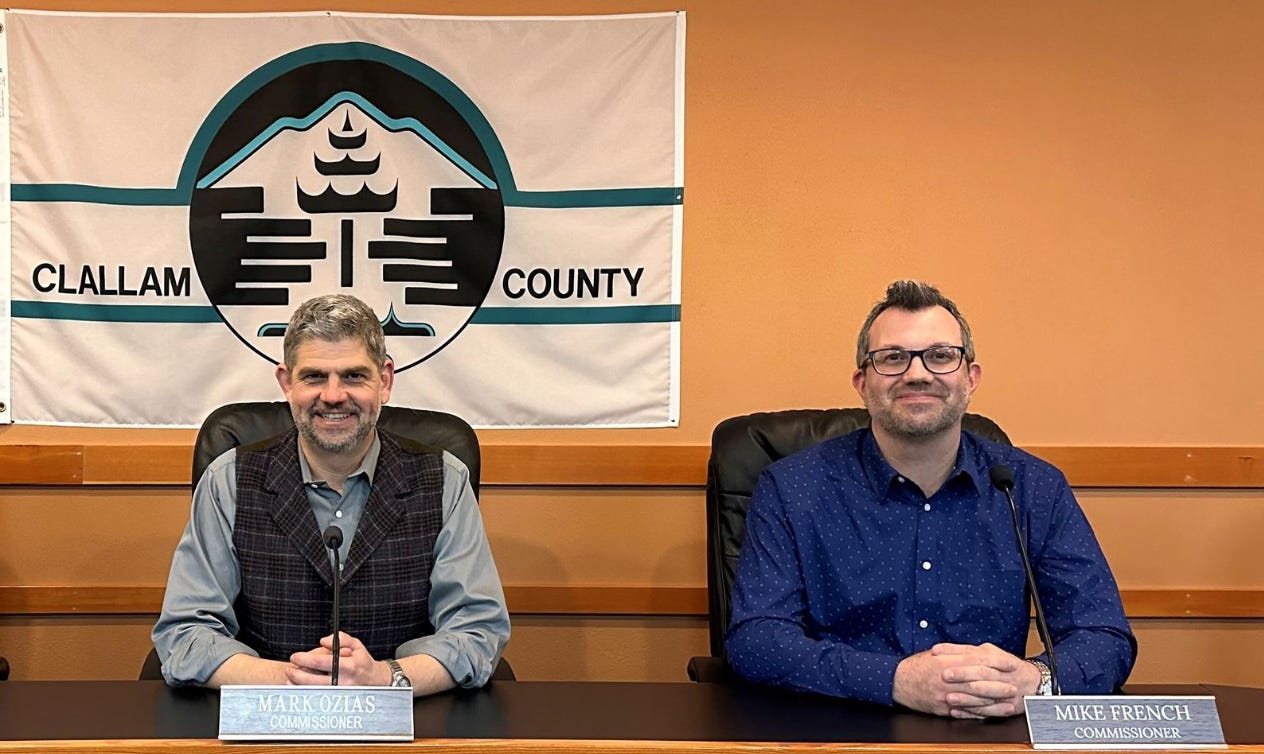
Exhibit B, “Approved Services,” is the Tribe’s own statement of what the money will do.
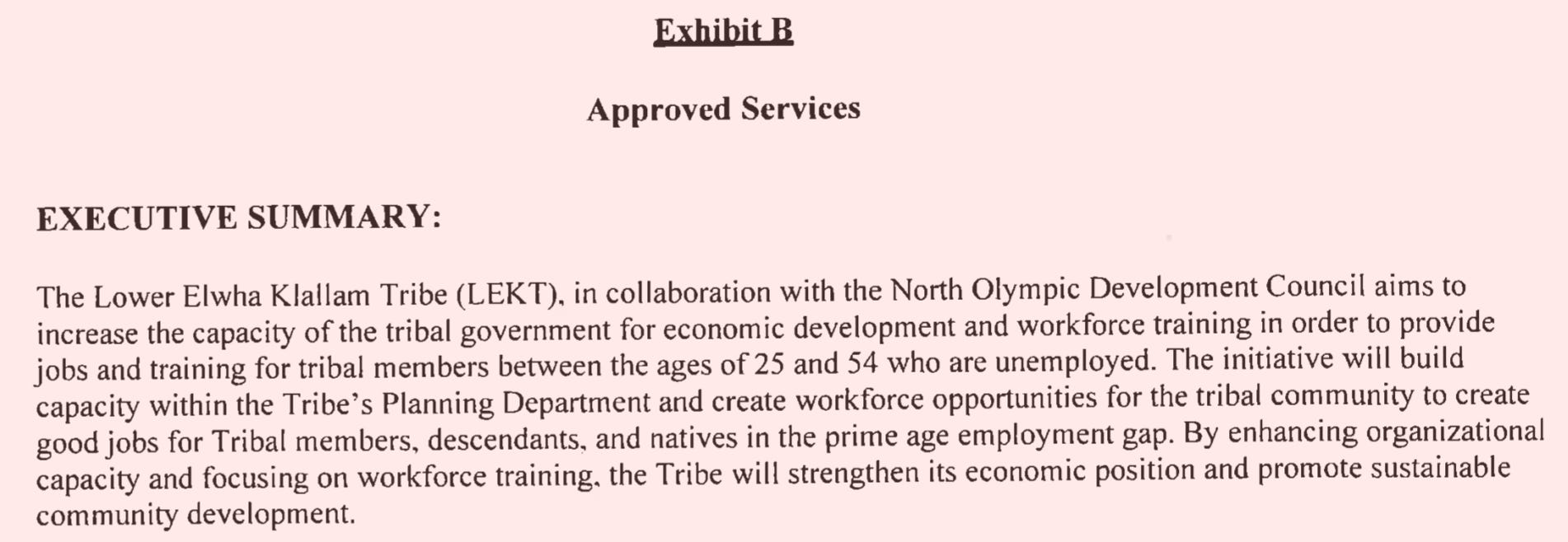
The executive summary promises jobs and training for unemployed tribal members ages 25–54. Then the table tells you how.
First, hire the grant admins
The Tribe will “build capacity” by creating two new government jobs:
Economic Development Project Manager
Workforce Development Coordinator
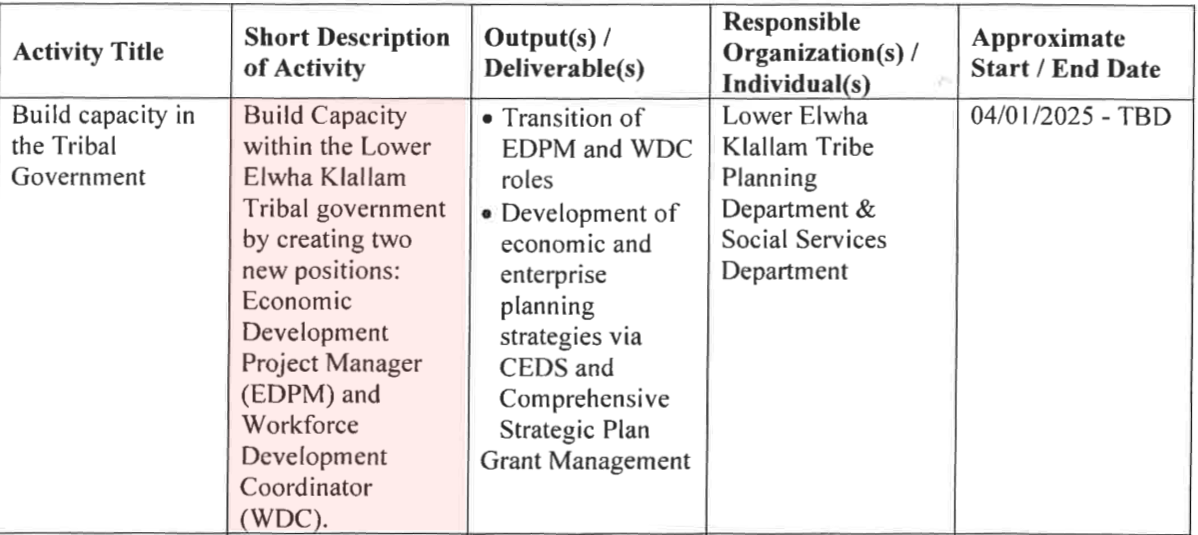
The first “jobs” this program creates are salaried positions inside the Planning Department and Social Services—people whose work product includes comprehensive plans, grant management, coalition meetings, surveys, and outreach publications.
Then train almost no one
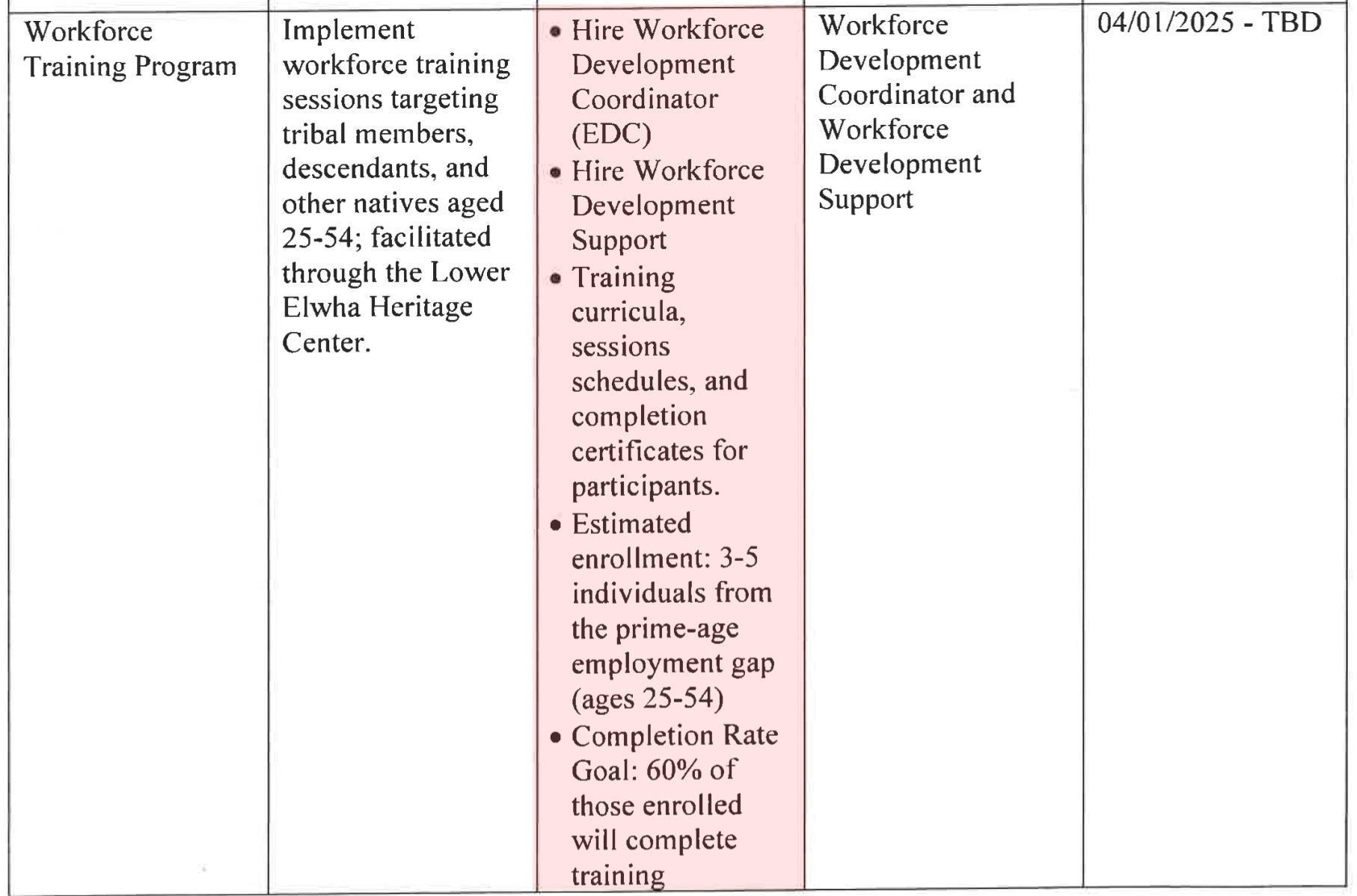
The Workforce Training Program, run through the Lower Elwha Heritage Center, sets:
Estimated enrollment: 3–5 people from the prime-age gap
Completion goal: 60%
Employment outcome: 50% of completers get a “good job in a relevant field”

Did you catch that?
If five are enrolled × 60% = three finish.
Three × 50% = one or two people get the “good job.”
If three are enrolled × 60% = two finish.
Half of two is one.
So the federal investment, on the Tribe’s own numbers, funds two new tribal-government jobs with benefits in order to put one or two unemployed 25-to-54-year-olds into work. That is not a workforce strategy. That is not a jobs program with two staff. It is two staff with a jobs program stapled on.
The other “outputs” are paperwork
Other deliverables in the same document are not jobs:
planning reports
five project phases (Health & Wellness Center campus design, water comprehensive plan, wastewater / Highway 101 infrastructure design, construction funds “secured”)
a 10% increase in grant proposals
“10 of jobs created” as a line item with no industry, wage, or employer
community surveys
outreach materials
attendance at NOPRC coalition meetings and quarterly NODC sub-recipient meetings
“resource-sharing agreements” and “joint progress reports”
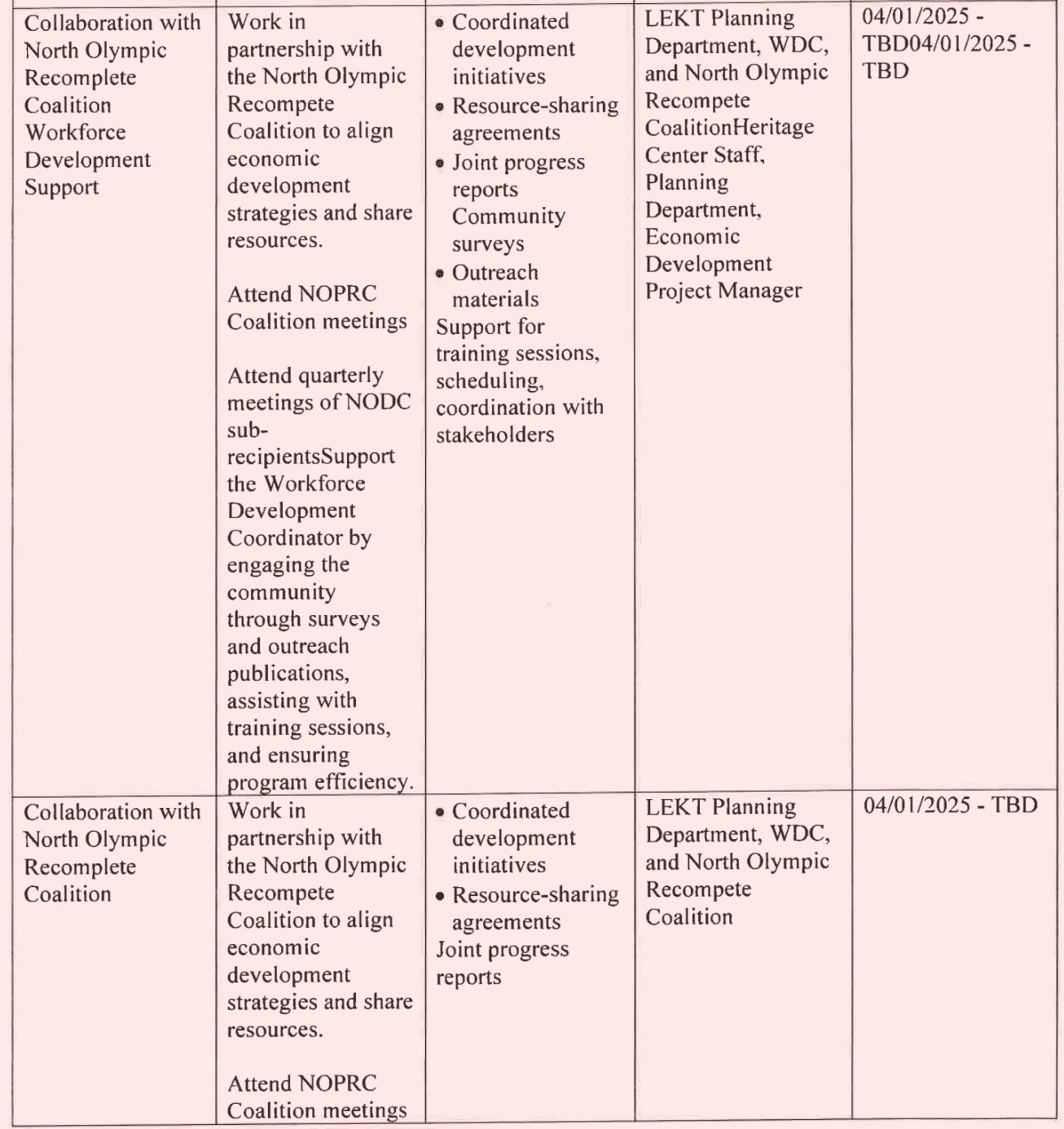
A jobs program that measures success in more grant applications is a jobs program for grant writers and that’s what Mike French said his vision was in early 2024 — grants that could be given to local tribes to train and hire grant writers. A jobs program that budgets staff time for coalition meetings is a jobs program for the coalition.
The SOW even blurs the titles. One line hires a “Workforce Development Coordinator (EDC)” — mixing the coordinator with the Economic Development Council brand.
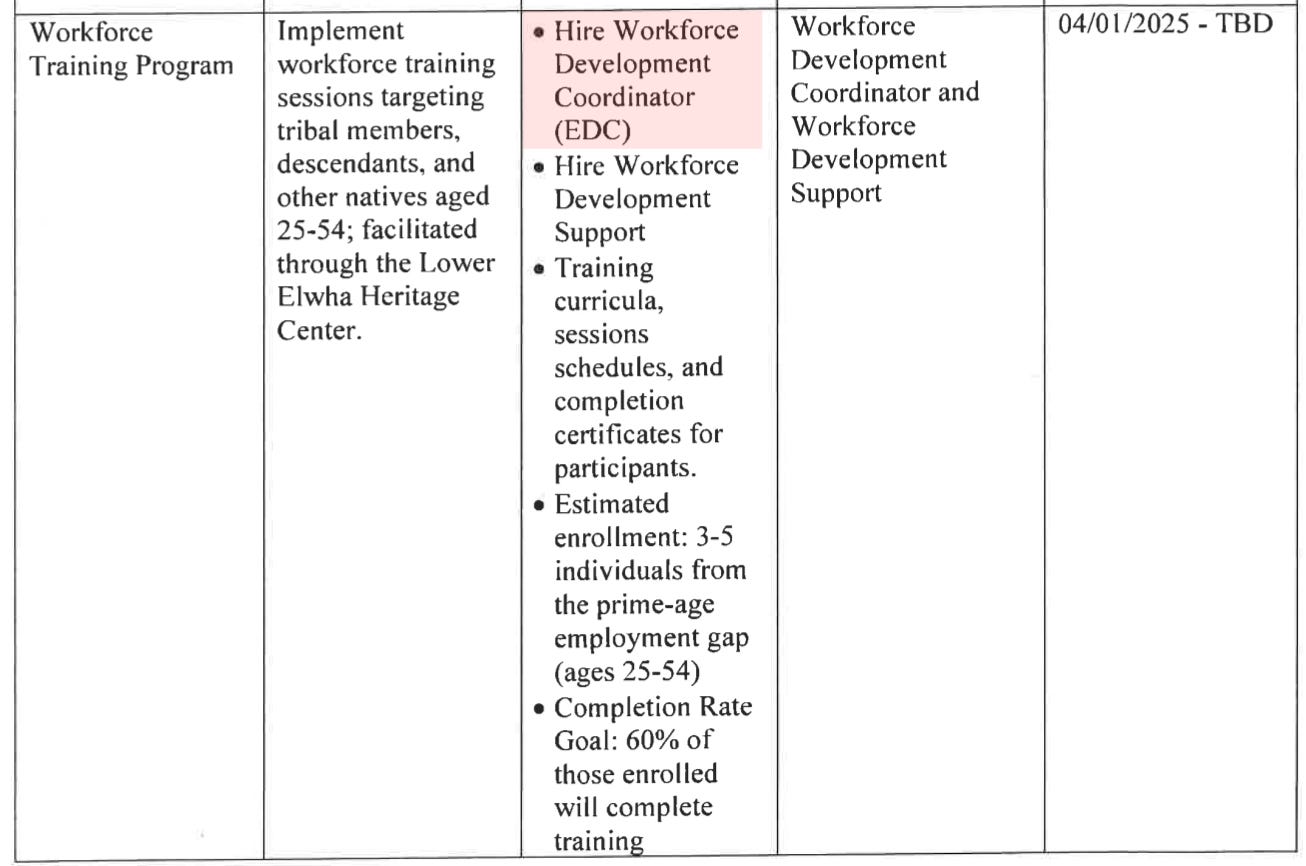
But the first row already created an EDPM and a WDC.
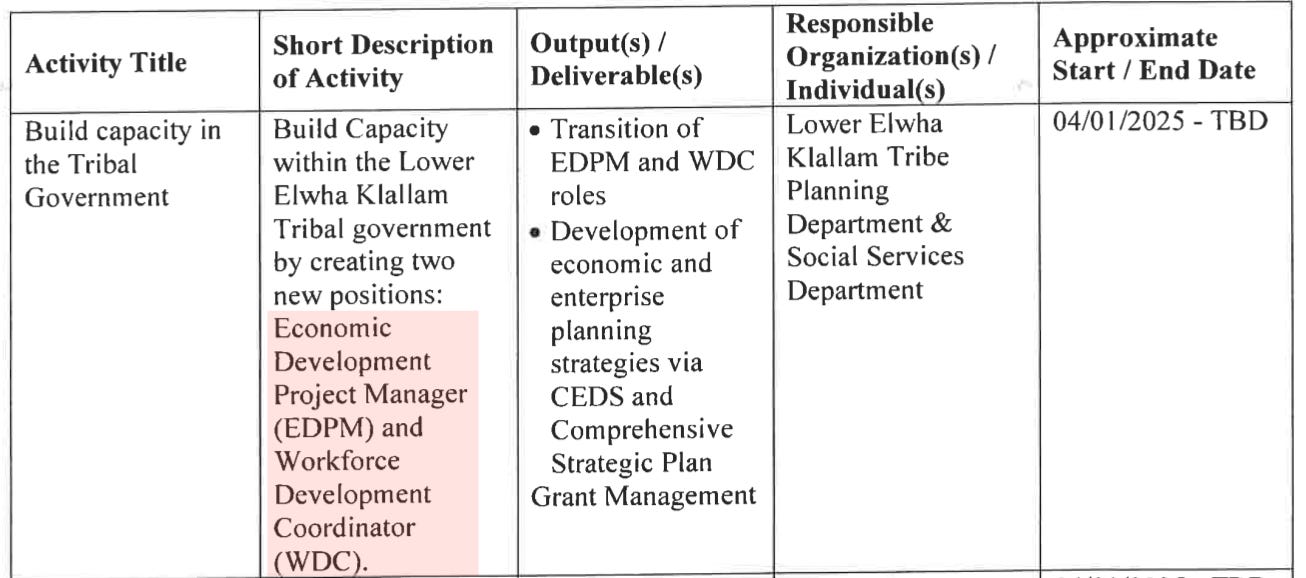
The document reads like capacity-building first, employment second, and accountability last.
The hypocrisy fits in one paragraph: taxpayers were told Recompete would pull hundreds of prime-age adults off the sidelines. This approved scope treats those same adults as a reason to expand tribal government—then concedes that the trainees and administrators together would fit on the bench seat of one pickup.
The political map is not subtle
French is not a distant observer of these tribes. The county directory lists him as Tribal Liaison for Lower Elwha Klallam, Quileute, and Makah. Those are the same governments in the Recompete west-end subawardee list. NODC’s published purpose is to send Recompete sub-grants and technical assistance to Hoh, Quileute, Makah, Lower Elwha, Jamestown, and the City of Forks. Prior reporting put NODC’s slice near $8.27 million. Coalition presentations have put Makah around $2 million and Quileute around $1.25 million. The Lower Elwha SOW is one more pipe off that same main that funnels money to District 3 voters.

District 3 is French’s seat, and it is the west end: Forks, Clallam Bay, Beaver, Joyce, Neah Bay, and La Push. He is the liaison to the tribes that live there, the chair of the grant sending them money, and the incumbent asking those same communities for another four years.
The Lower Elwha Klallam Tribe has endorsed Mike French.

That is not a coincidence sitting off to the side of the grant. French’s camp treats tribal partnership as proof of leadership. The liaison title, the Recompete chair, the subawards, and the endorsement travel together. Follow the money and you are already looking at the campaign.
The certified District 3 primary was close — Jake Seegers 3,675 (52.66%), Mike French 3,288 (47.11%). Both advance to November’s county-wide vote. Seegers still has an uphill battle. His opponent is not just an incumbent with a familiar name. French chairs a $35.6 million federal pipeline. It buys hydroseeders. It pays tribal governments and NGOs to hire coordinators, managers, and “capacity” staff. Those payrolls run three more years if the grant stays on track — and if the commissioner who sold it keeps his seat.
Call it what it looks like from the cheap seats: public money used as political sway. Recompete is federal cash, but the decisions, the liaison meetings, the subawards, and the endorsements are local. Hundreds of people on coalition, nonprofit, and government payrolls have a reason to prefer the man who keeps the faucet open. A challenger with no grant to pass around is not competing on equal ground.
You do not need a precinct spreadsheet to see the conflict. A commissioner who chairs the grant, sits as tribal liaison to the subawardees, collects the endorsement, and runs for reelection in the district that contains those reservations is asking voters to believe the money and the politics never touch.
The record, not the slogan
The Scope of Work says the first hires are inside government. The scoreboard says 21 people. The campaign says 900.
That is not a jobs miracle. That is a poor reason to keep the man who sold it.


