


In this Sundays With Seegers, County Commissioner candidate Jake Seegers shows how Clallam County’s Code Enforcement manager told the Planning Commission she wants new fees, more discretion, and the power to threaten whole groups of property owners with fines at once. She called it an “amnesty” program. Then she provided an example of how it would work: comply in three months, or face a minimum $2,000 fine—because, in her words, once people get the Hearing Examiner notice, they “usually fold.”
As Clallam County updates its Comprehensive Plan for the next 20 years, it faces two very different paths:
Enhance property rights, economic opportunity, and freedom for taxpayers…
Or,
Expand government regulation and enforcement power while eroding property rights, economic opportunity, and individual freedom.
Right now, the Planning Commission and Department of Community Development appear to be heading down the second path.
During the August 19th Planning Commission meeting, Diane Harvey, Code Enforcement Special Projects Manager, asked the Commission to consider more fees, greater discretion for her department, and new authority for the Director of the Department of Community Development (DCD) to threaten fines against entire groups of property owners at once.
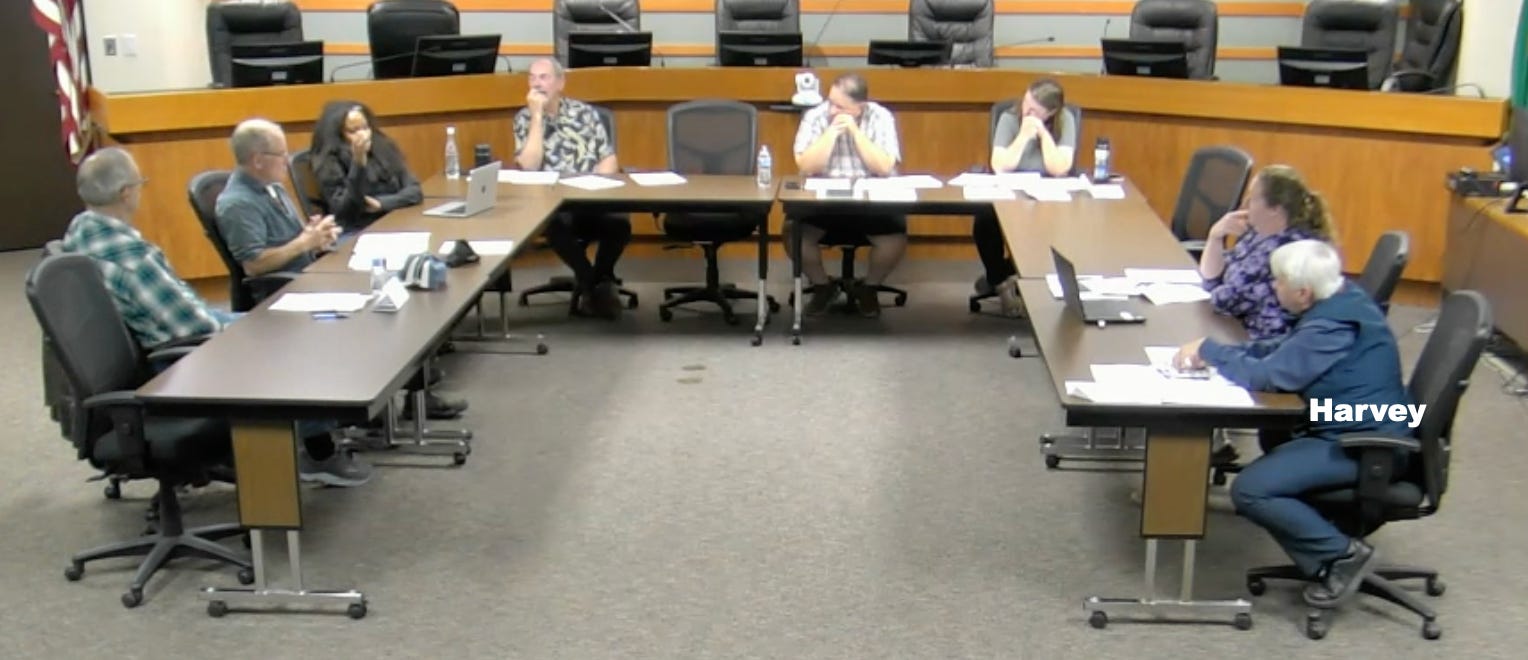
Specifically, Ms. Harvey asked for:
The ability to charge property owners up to $300 when they enter into a voluntary compliance agreement with the County—and to use those fees to help fund Code Enforcement. (10:15)
The ability to charge an alleged violator the cost of going before the Hearing Examiner. (12:30) Currently, the County pays those costs—approximately $700.
Authority for the DCD Director to send blanket letters to groups of property owners with similar alleged violations, threatening a minimum fine if they do not comply.
These would significantly expand enforcement authority because, currently, fines are imposed through the Hearing Examiner process.
Ironically, this proposal was described as an “amnesty” program. (14:15) An amnesty is a pardon, not a mass threat of fines.
More Staff. More Fees. More Power.
This request comes after a significant County investment in expanding Code Enforcement.
In 2025, Code Enforcement added two officers—one full-time and one part-time. Earlier this year, commissioners approved expanding the part-time officer's hours from 24 to 30 per week.
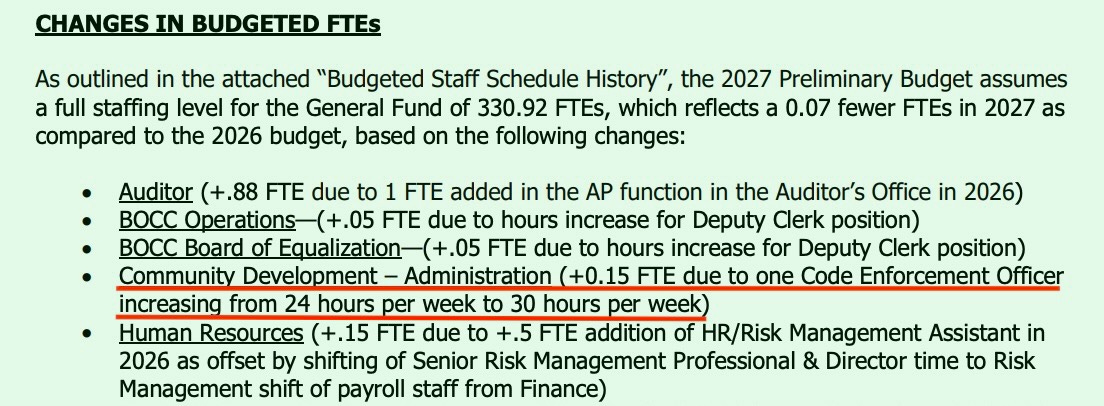
Now, Code Enforcement is asking for additional funding through fees, greater discretion, and more power to threaten property owners with fines.
Ms. Harvey offered vacation rentals as an example of how an “amnesty” program might work.
Clallam County currently requires vacation rentals to obtain a fire-life safety inspection—a County requirement that goes beyond state lodging regulations applicable to many single-family vacation rentals.
According to Ms. Harvey, most vacation rentals are not complying with that requirement.
She explained:
“Maybe we want to do that amnesty program to get people who are renting their homes to actually get the fire-life safety inspection. Because there’s probably 2,000 of this [vacation rentals] in our county.” (15:20)
Later, she described what that “amnesty” could look like:
“We would send out notices and say, ‘within the next three months, we want you to get your fire-life safety inspection. And, if you don’t we’re going to fine you a minimum of $2,000.’” (1:34:30)
But that example raises another important question.
What Happened to “Complaint-Driven”?
The Department of Community Development (DCD) and County Code Enforcement have repeatedly described enforcement as “complaint-driven,” including in the February 2025 DCD Newsletter.
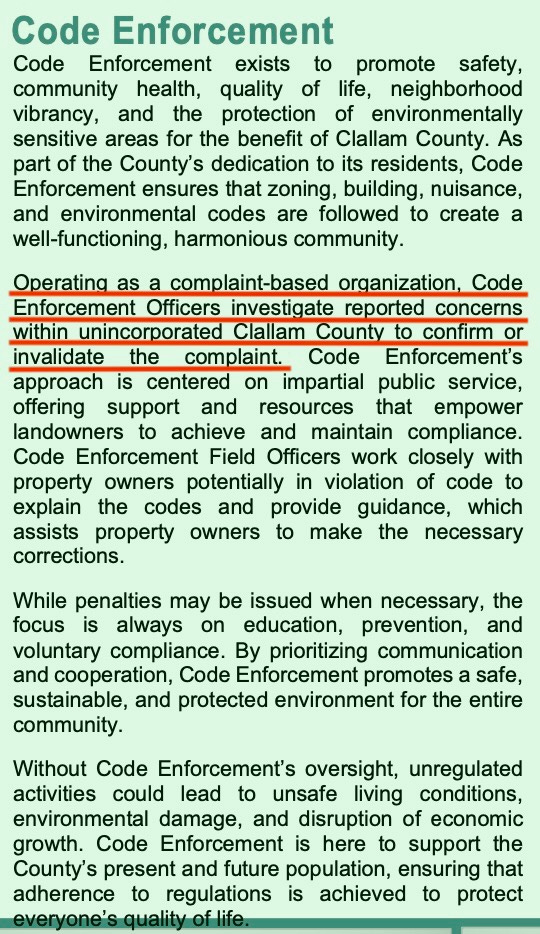
Yet the proposed vacation-rental enforcement campaign appears to proactively identify and threaten an entire class of property owners without waiting for individual complaints.
And Code Enforcement’s actions against Mossquatch Resort—a boutique glamping destination near Forks—show that proactive enforcement is not merely hypothetical.

Mossquatch had operated for years and developed strong support among customers and West End community members: five-star reviews, no known public complaints, and no reported safety incidents.
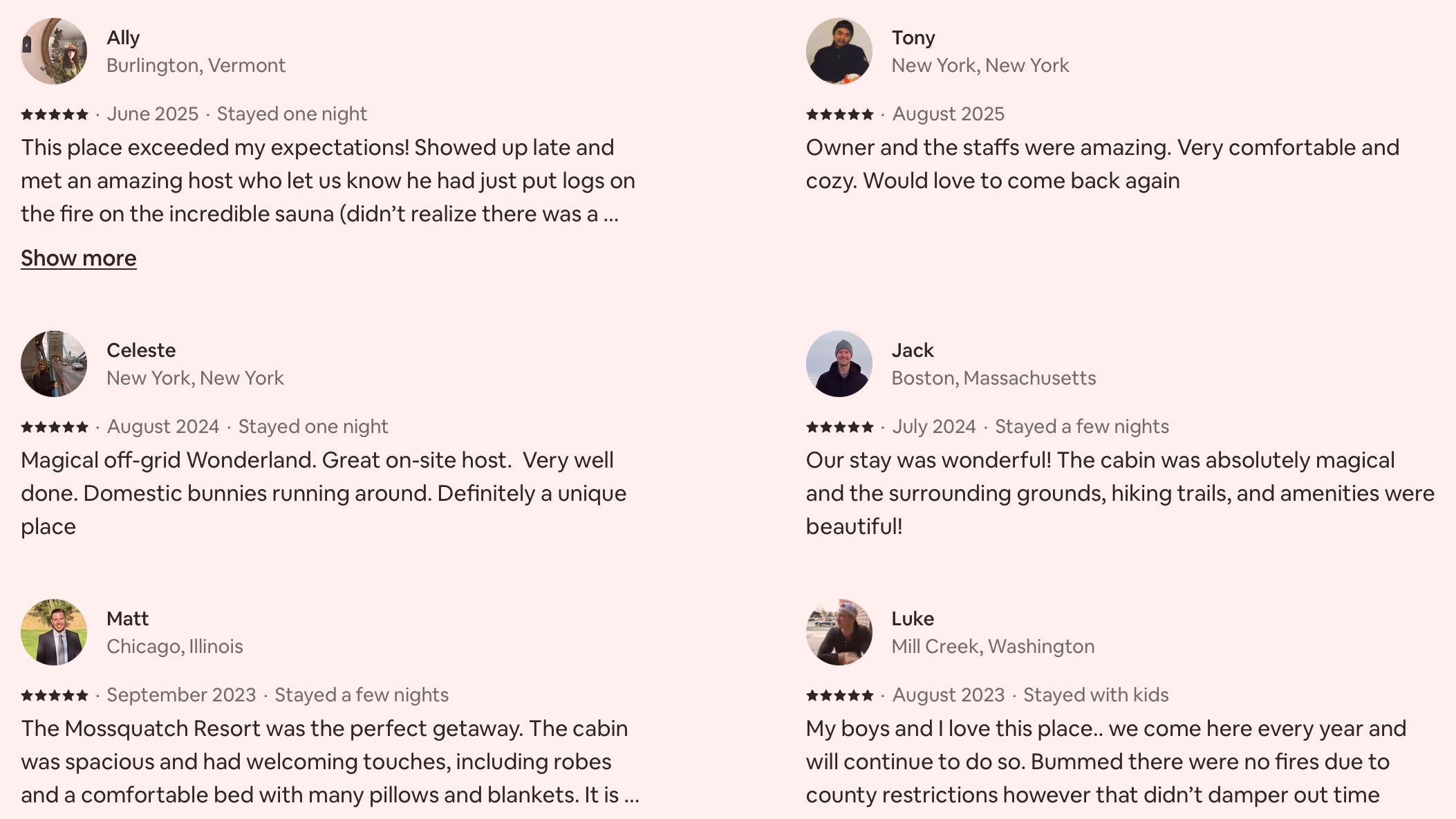
Then a taxpayer-funded county employee noticed that Mossquatch’s owner had failed to pick up a 911 address placard.
Instead of simply contacting the owner about the placard, the employee investigated the resort and discovered an issue with its Conditional Use Permit.
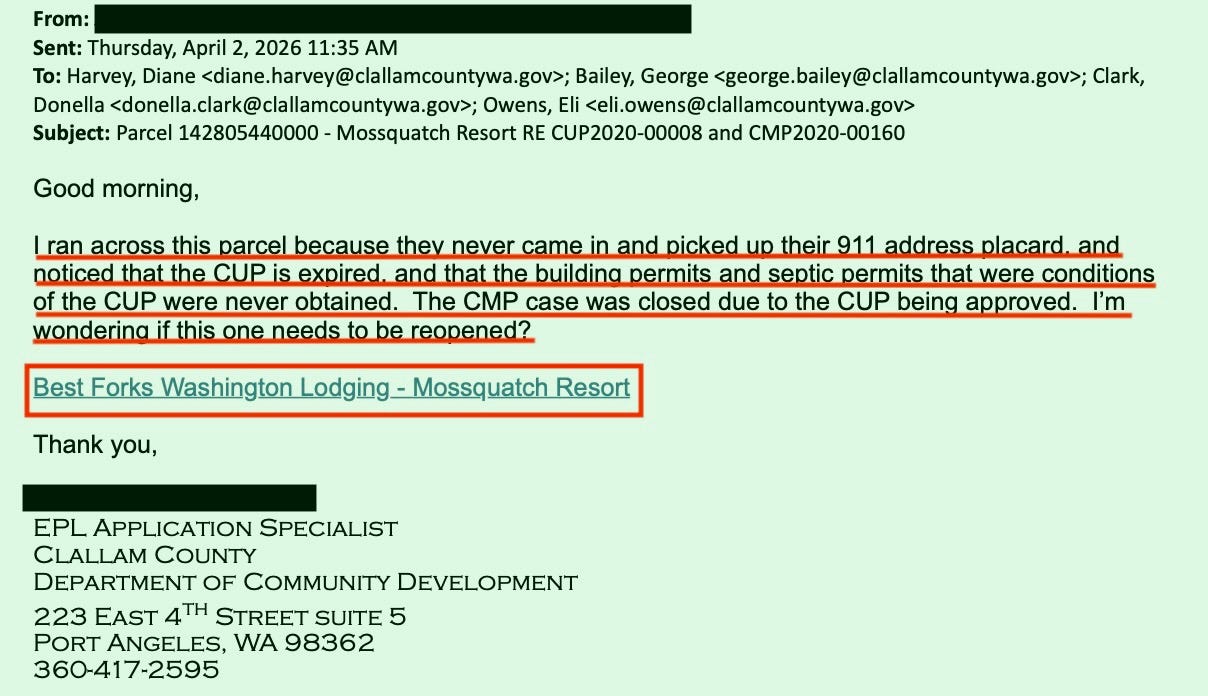
The employee forwarded the matter to Diane Harvey.
Ms. Harvey immediately requested that it be logged as a “complaint” and assigned directly to her.
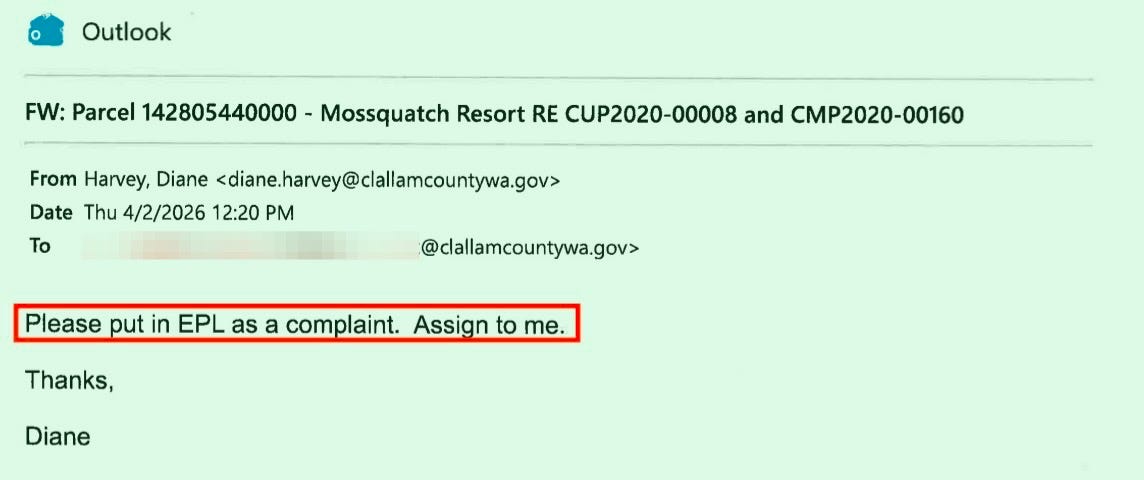
Within hours, she had also filed a complaint with the State Department of Health’s Transient Accommodations program.
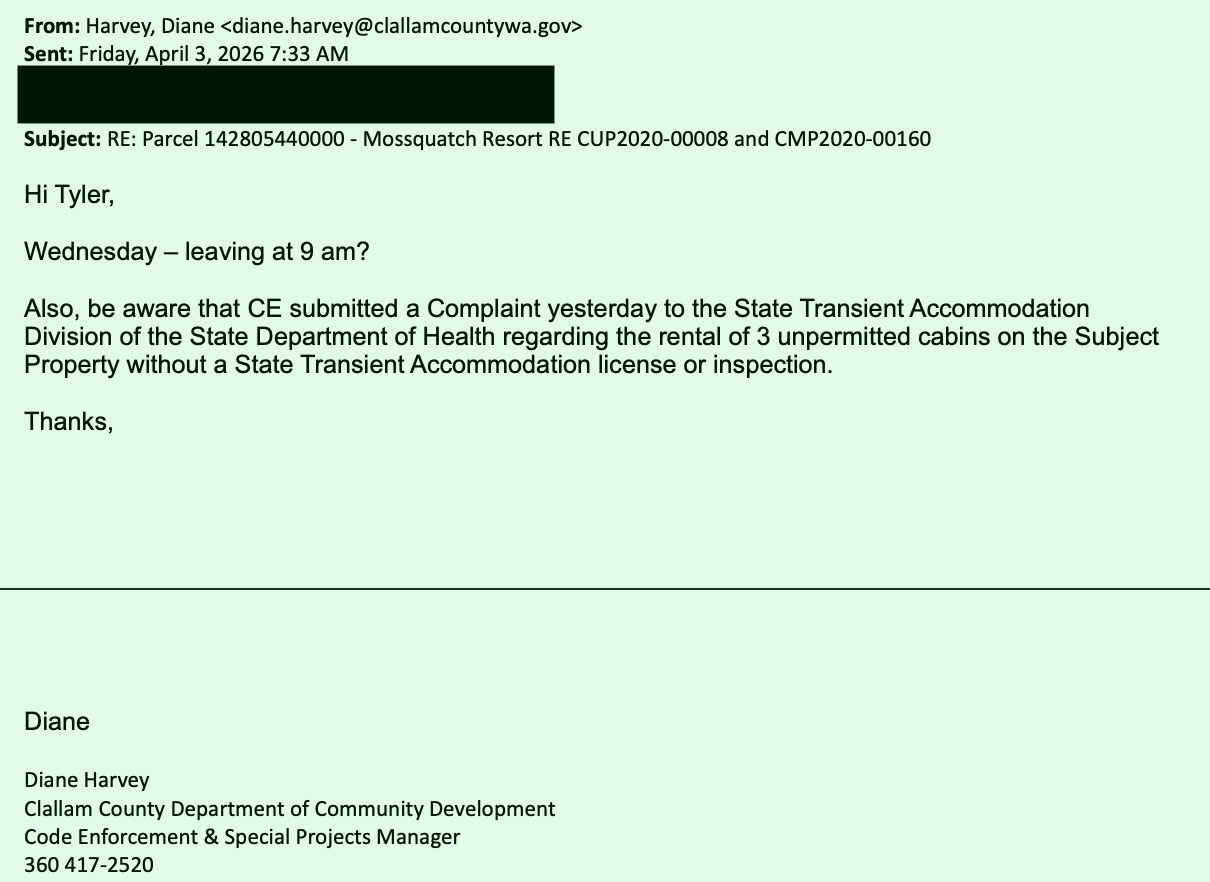
Other County departments were notified on the same day.
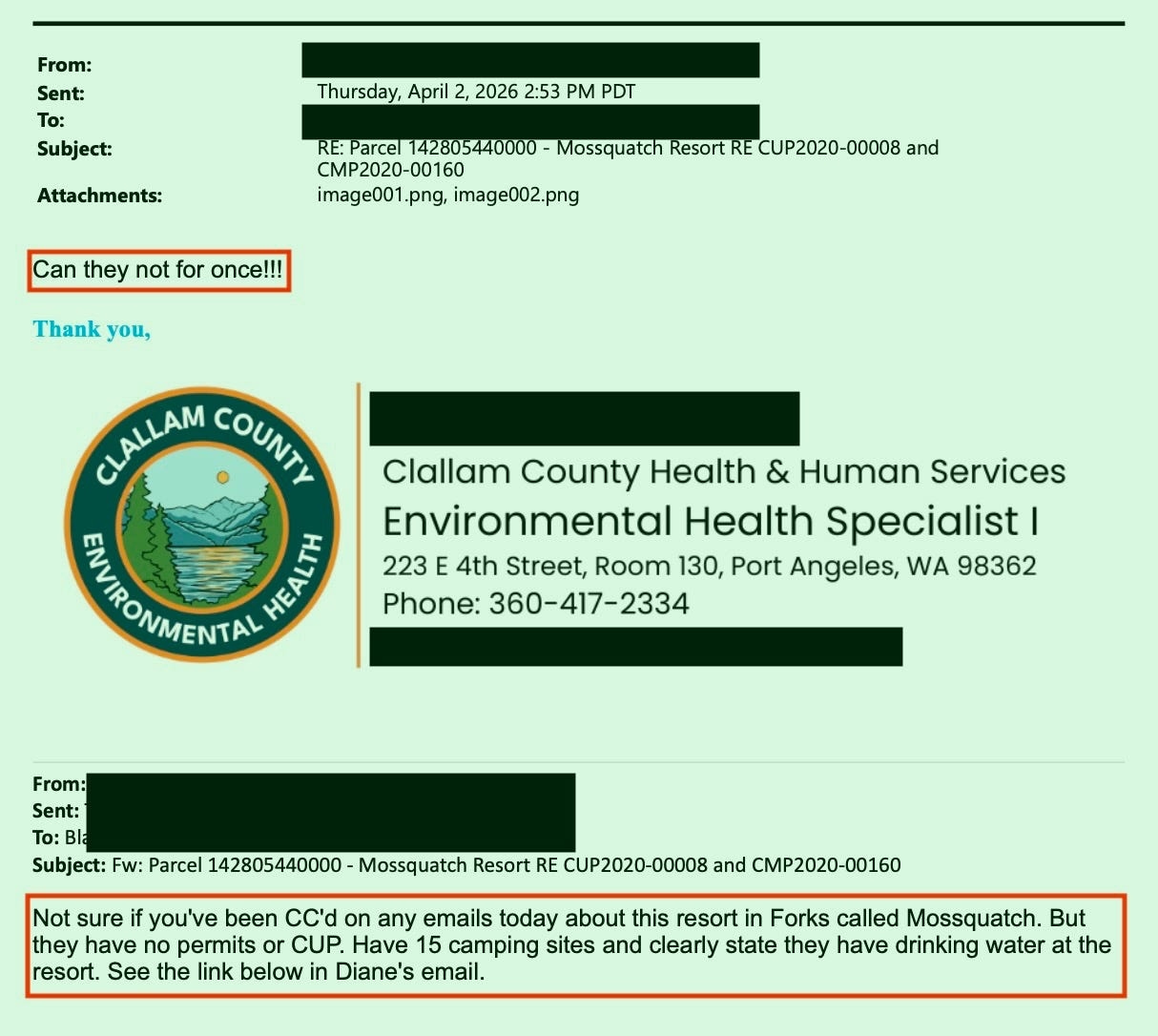
A multi-department, unannounced site visit was organized and conducted just three business days after the initial email.
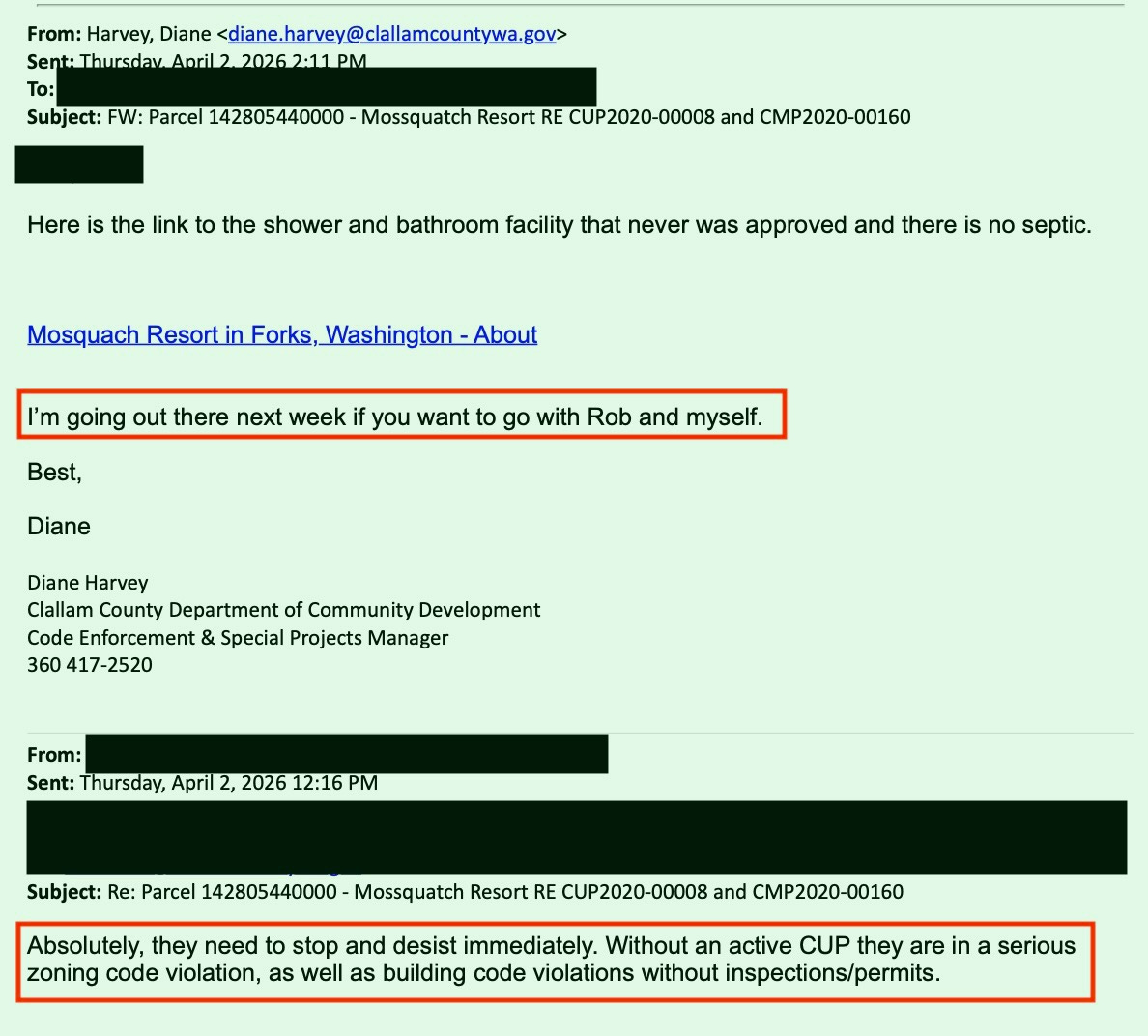
Apparently, a phone call to the business owners did not happen first.
According to Mossquatch’s owners, in an April 28, 2026 response letter:
“I am unaware of any attempts made by Clallam County…to contact myself or my family regarding the expired CUP and a potential site visit by Clallam County staff.”
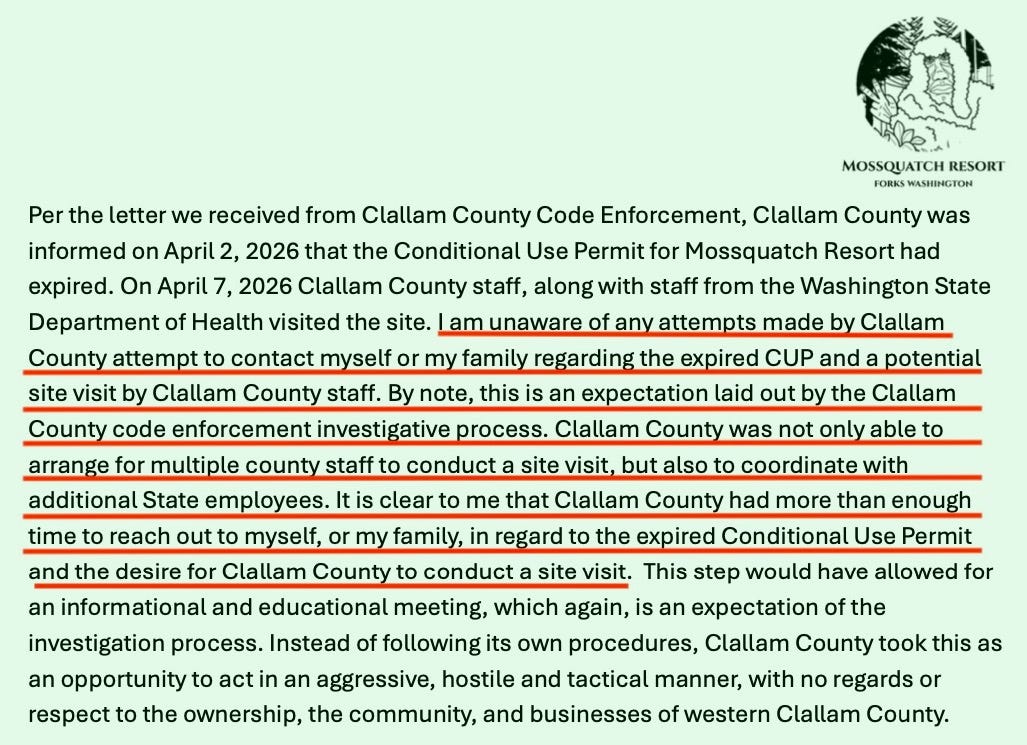
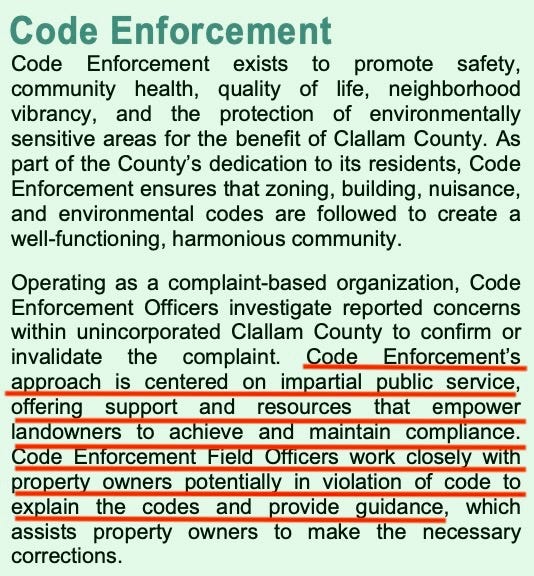
That is difficult to reconcile with Code Enforcement’s stated approach, which it describes as being “centered on impartial public service, offering support and resources that empower landowners to achieve and maintain compliance.”
The owners’ description of what followed sounds far less like supportive voluntary compliance and far more like an enforcement raid.
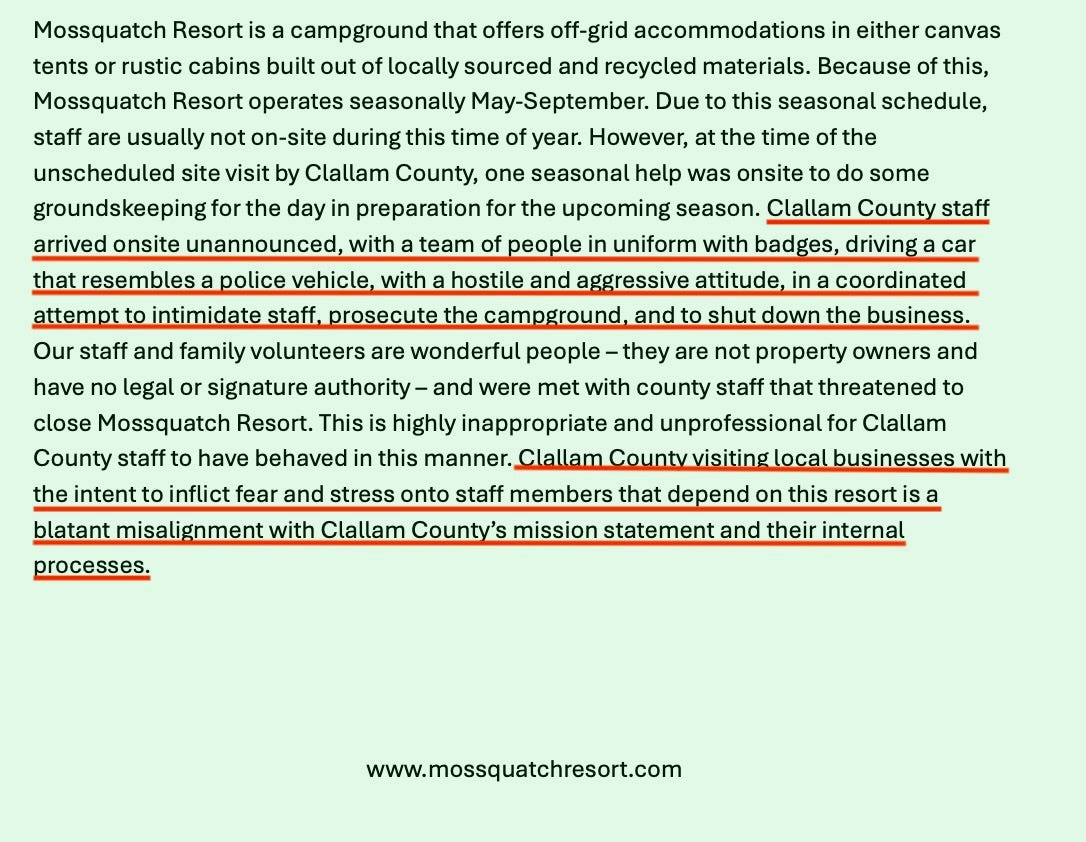
County staff ultimately compiled a roughly 400-page enforcement package, threatened substantial fines, and scheduled the matter before the Hearing Examiner.
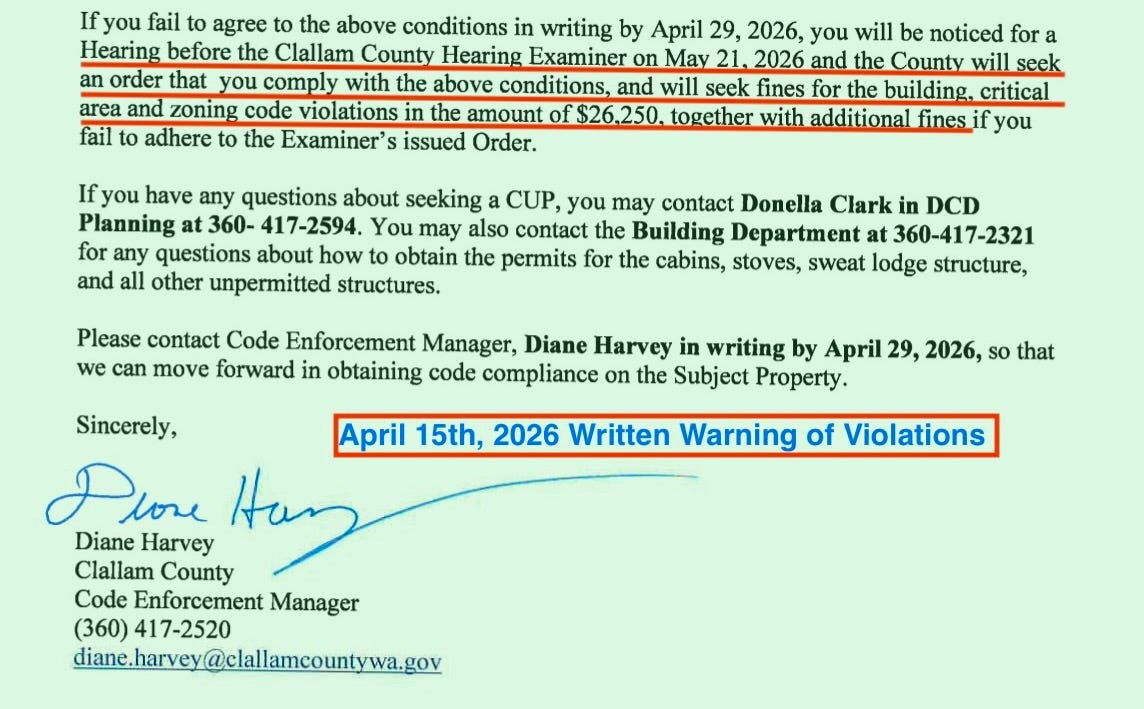
According to Ms. Harvey, that pressure is part of the enforcement process.
During a recent Planning Commission meeting, she stated that after people receive notice that they will have to appear before the Hearing Examiner, “people usually fold.”
During an August 10th Work Session, she seems to describe that strategy as very similar to the Mossquatch action:
“When you get a 460-page notice to go to a hearing examiner and they tell you you’re going to get fined $22,000 if you don’t come into compliance, that, I believe does move people.” (1:31:55)
It certainly does move people.
The more important question is whether this is how County government should treat the people it claims to represent and serve.
Who Decides What Gets Enforced?
That question matters even more because Code Enforcement has hundreds of open cases.
During the Planning Commission Meeting, a commissioner asked Ms. Harvey:
“How do we decide what takes priority? Is that your decision as the manager?”
Her answer was unequivocal:
“Yes.” (41:00)
She subsequently noted that County code also establishes enforcement priorities.
Later, she explained the discretion involved:
“I have to be honest with you. Code enforcement is not a process that you can treat everybody the same. You have all different types of people you are dealing with. They have mental health issues. We deal with hoarders. I can’t treat a hoarder the same way I treat somebody else who is just a regular person who just disregards the code.” (53:30)
County code itself recognizes substantial enforcement discretion.
Clallam County Code, as summarized on the County’s own website, provides that Title 20:
“shall not be construed as placing responsibility for code compliance or enforcement upon Clallam County in any particular case”
That is also consistent with the Washington Court of Appeals’ decision in Lange v. Clallam County. The court rejected the argument that the County Charter required DCD to investigate every alleged violation, recognizing the Director’s discretion over enforcement decisions.
That makes how that discretion is exercised extremely important.
A February 2025 DCD Newsletter states:
“Code Enforcement exists to promote safety, community health, quality of life, neighborhood vibrancy, and the protection of the environmentally sensitive areas for the benefit of Clallam County…Code Enforcement ensures that zoning, building, nuisance, and environmental codes are followed to create a well-functioning harmonious community.”
But with 349 open cases, Code Enforcement must choose where to dedicate its limited resources.
Are those choices reflecting the priorities of the people who live here—or the priorities of the department?
The same newsletter warns:
“Without Code Enforcement’s oversight, unregulated activities could lead to unsafe living conditions, environmental damage, and disruption of economic growth.”
Yet the unsolicited enforcement action against Mossquatch threatened to shut down a thriving West End business that was itself contributing to local economic growth.
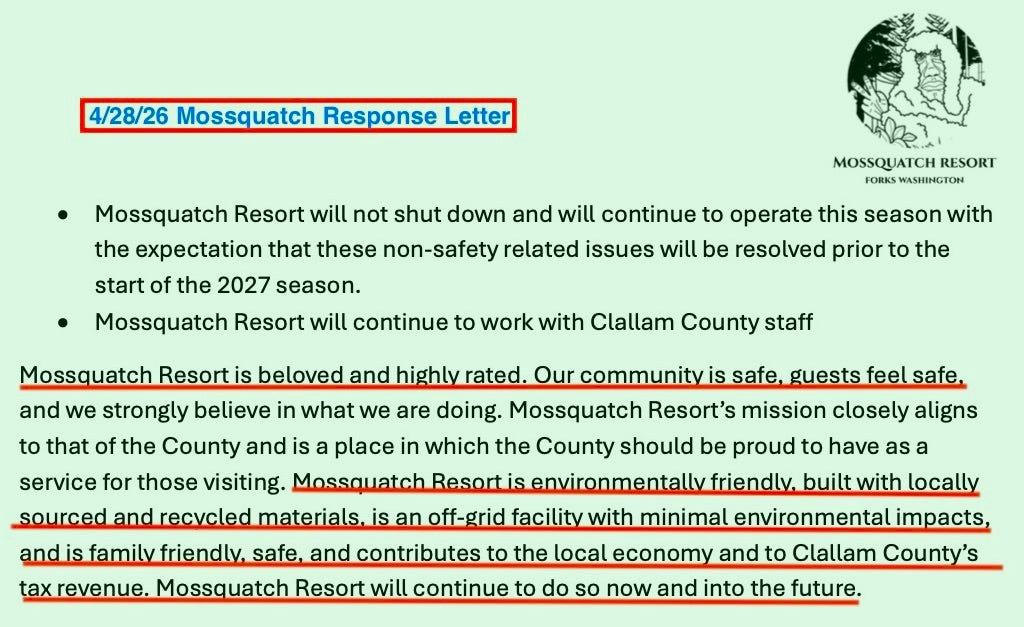
Under a voluntary compliance agreement, Mossquatch's owners had to shut down three tents and three cabins. Other areas of the property could remain open. Those six units, the owners say, support work for as many as eight people. Mossquatch also estimates that:
$2,500 of lost daily revenue (on the low end)
The county loses out on $250 daily in taxes
The water utility loses $1,200 for the season
Waste removal misses out on $3,000
The cleaners lose $350 each day ($40,000 for the season)
The local hardware store doesn’t sell $3,000 worth of propane
Costco doesn’t sell $5,000 in supplies
Local youth groups aren’t able to sell the $3,000 in donate firewood
A case that started with a 911 placard did not merely produce a 400-page file. It took a functioning West End business offline. If Code Enforcement is going to spend limited resources on a property with no public complaint and no reported safety incident, the question is not only whether a permit condition was missed. It is who else loses when the County puts that file on the top of Diane Harvey’s pile.
Consider what happened:
No customer complaint triggered the investigation.
No reported safety incident triggered it.
A County employee initiated an investigation.
Code Enforcement Manager Harvey had the matter logged as a complaint and assigned the case to herself.
Instead of first reaching out to the owners, a multi-department site visit was organized.
A roughly 400-page enforcement package was compiled.
Massive fines were threatened.
A Hearing Examiner proceeding was scheduled.
And, in Ms. Harvey’s own words, that kind of pressure causes people to “fold.”
All of this occurred at the discretion of County Code Enforcement, which chose to prioritize this case ahead of hundreds of others that remained open, despite its limited resources.
During the August Work Session, Ms. Harvey described code enforcement’s limited resources,
“I’d love to be able to clean up more, but that’s a resource, right? Resources for code enforcement time, but also resources for how much budget money we use to clean up properties. There’s a balance there on what we can do.”
Discretion Cuts Both Ways
That is what makes the issue bigger than Mossquatch.
The same enforcement discretion that allowed County resources to be rapidly mobilized against a successful West End business also allows longstanding, established threats to continue proliferating in county neighborhoods and critical areas on public land.
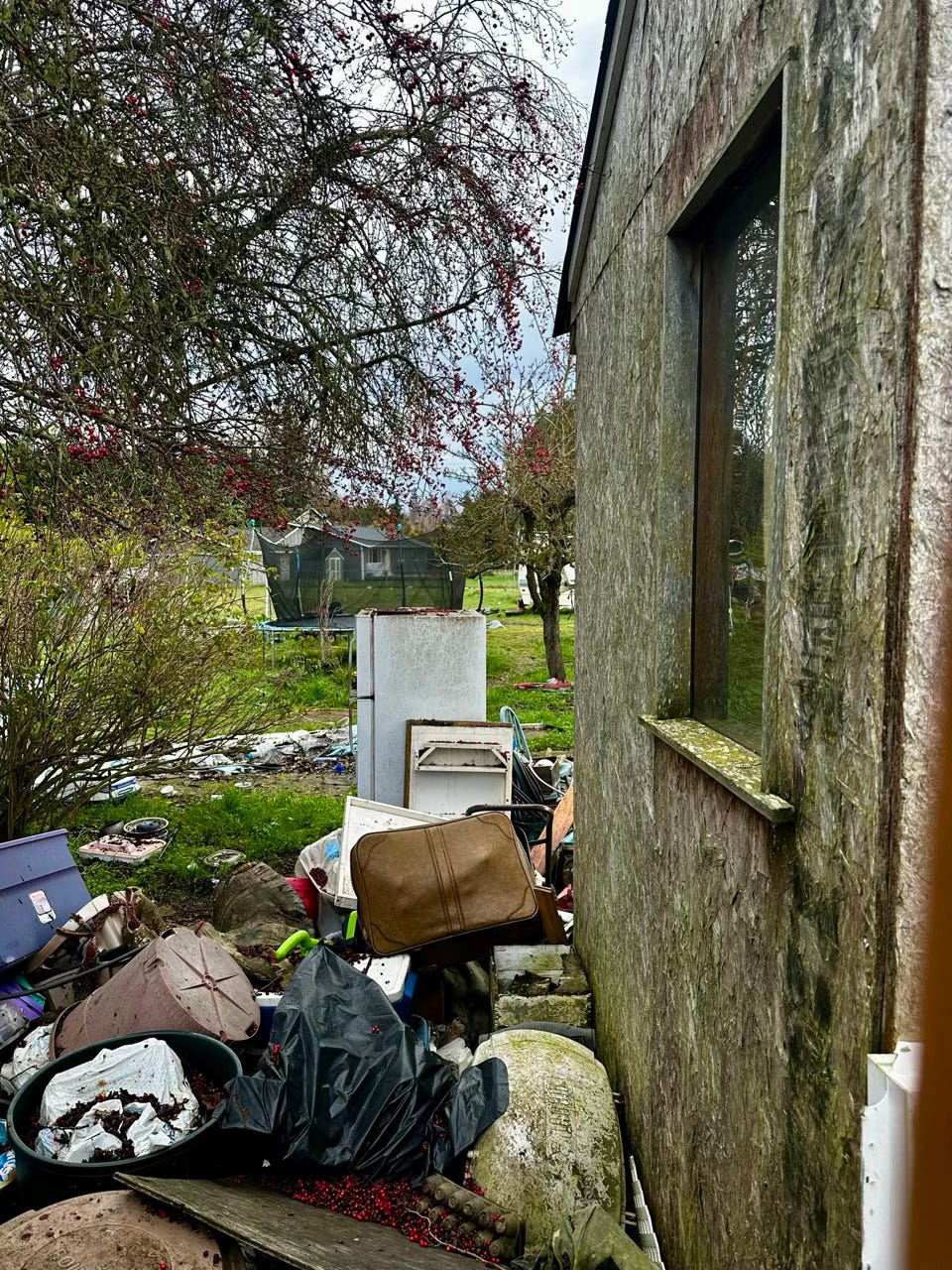
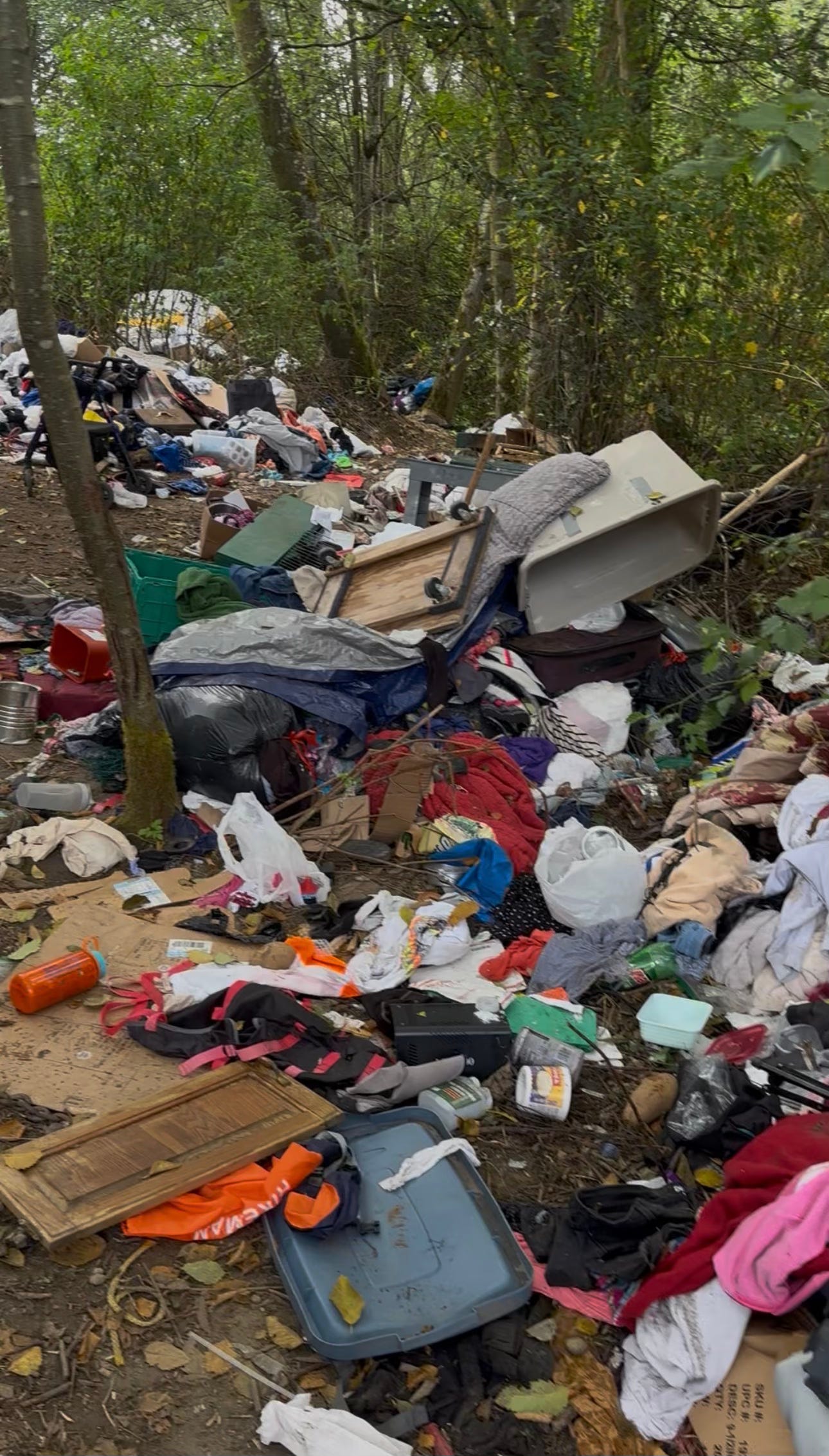
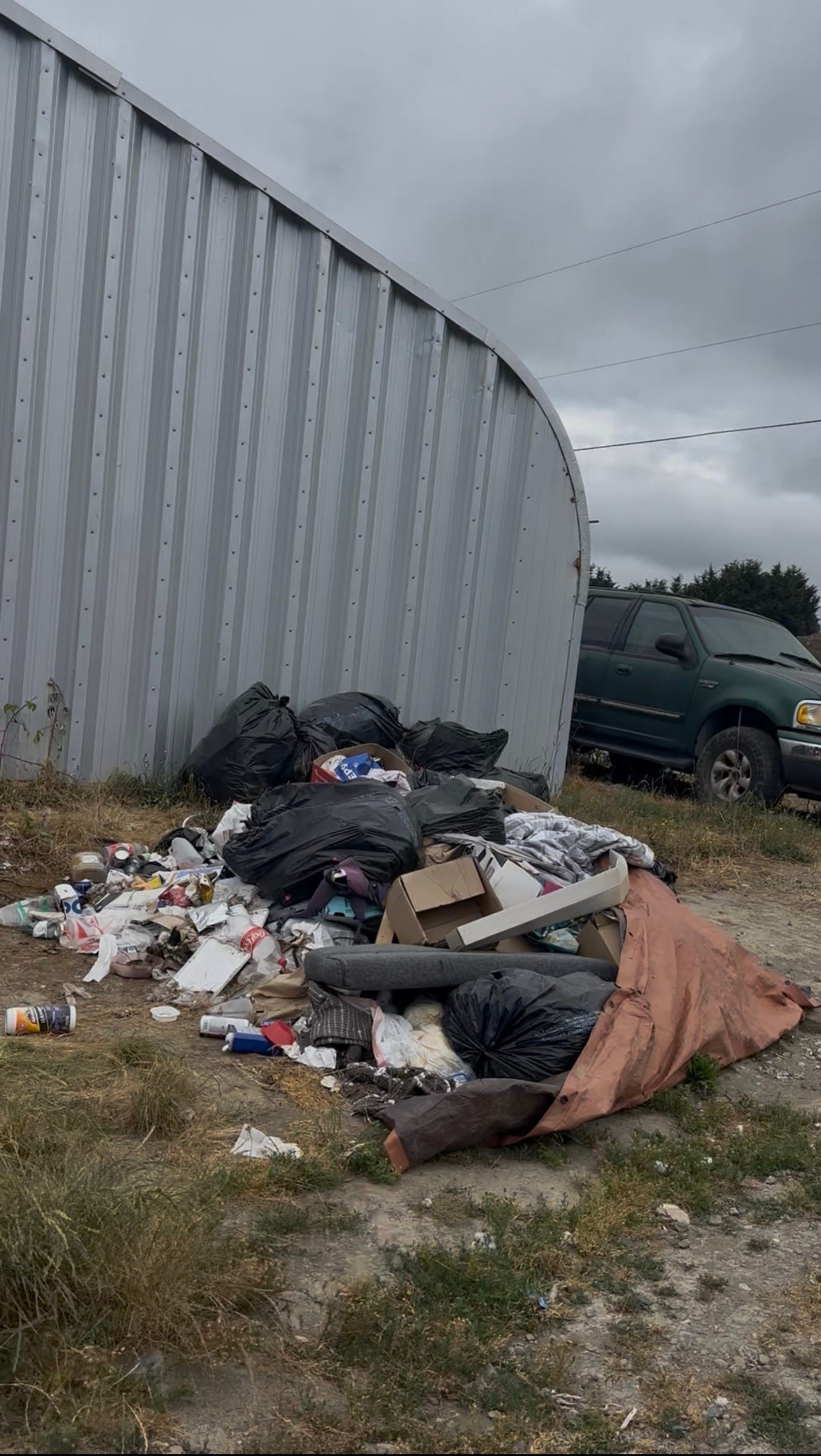
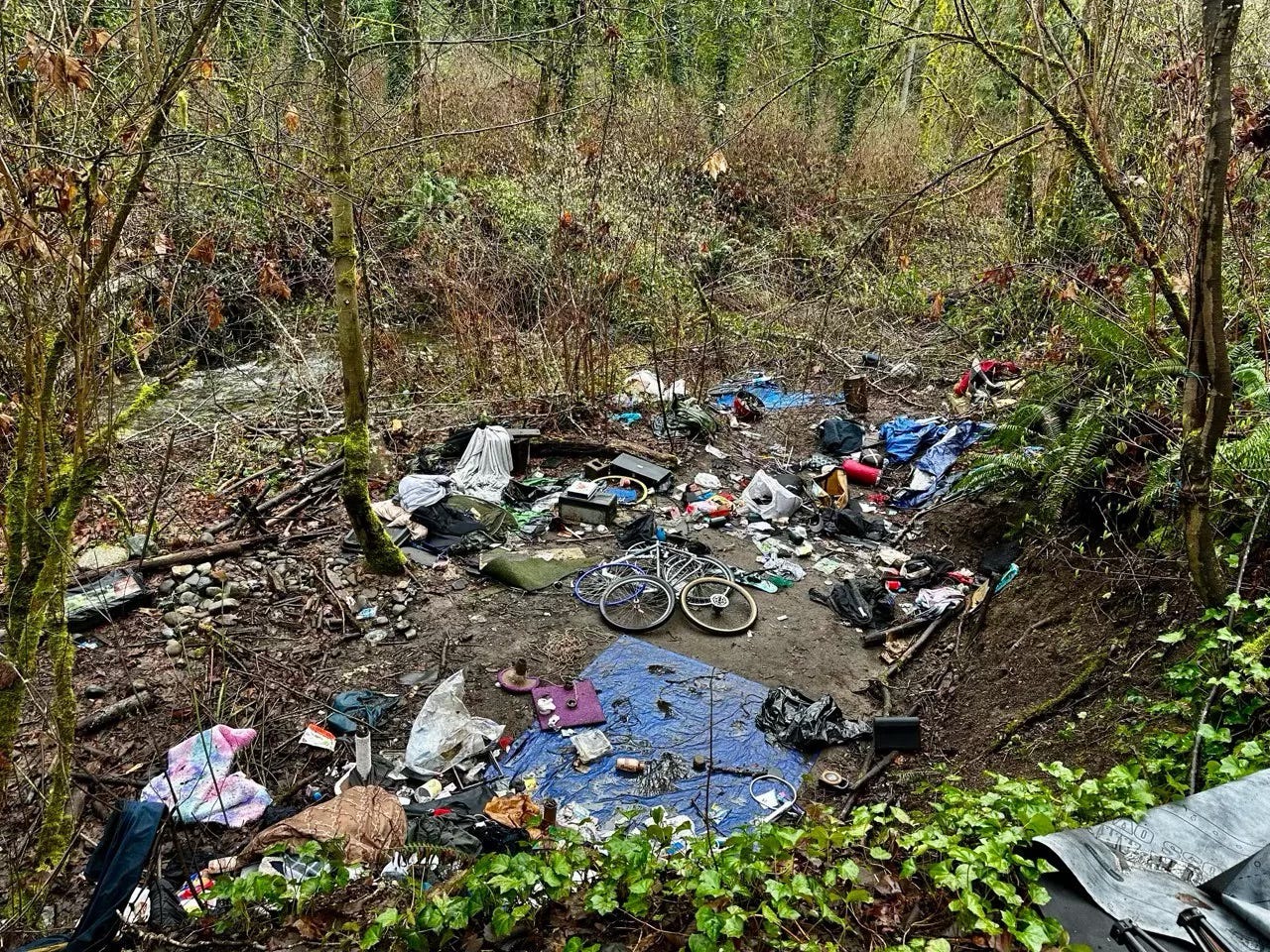
Based on Clallam County’s Charter and the county’s own 2023 Code Enforcement Memorandum of Understanding (MOU), DCD Code Enforcement does not appear to have independent authority to enforce public-health violations involving solid waste or sewage disposal—including violations occurring on City of Port Angeles property along Tumwater Creek.
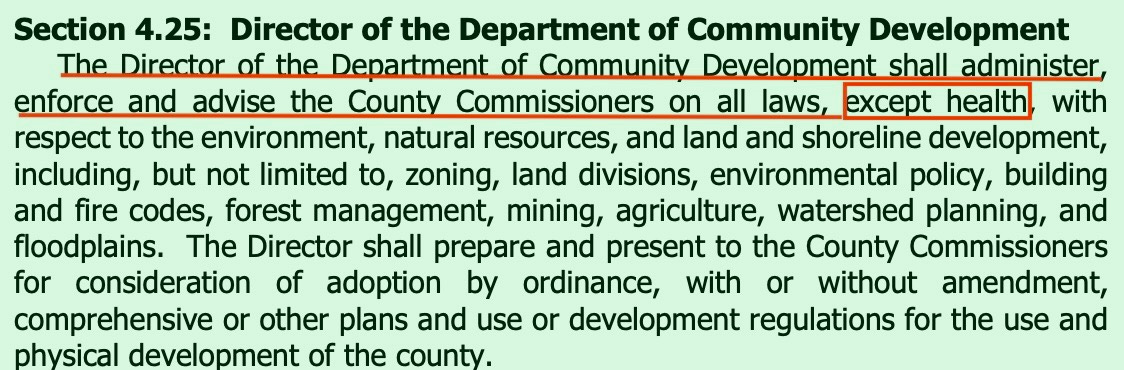
But Clallam County Health and Human Services, the Board of Health and the Health Officer do.
Under Washington law, protecting the public from health nuisances is not simply discretionary. RCW 70.05.060 requires the local Board of Health to provide for the “prevention, control and abatement of nuisances detrimental to the public health.”
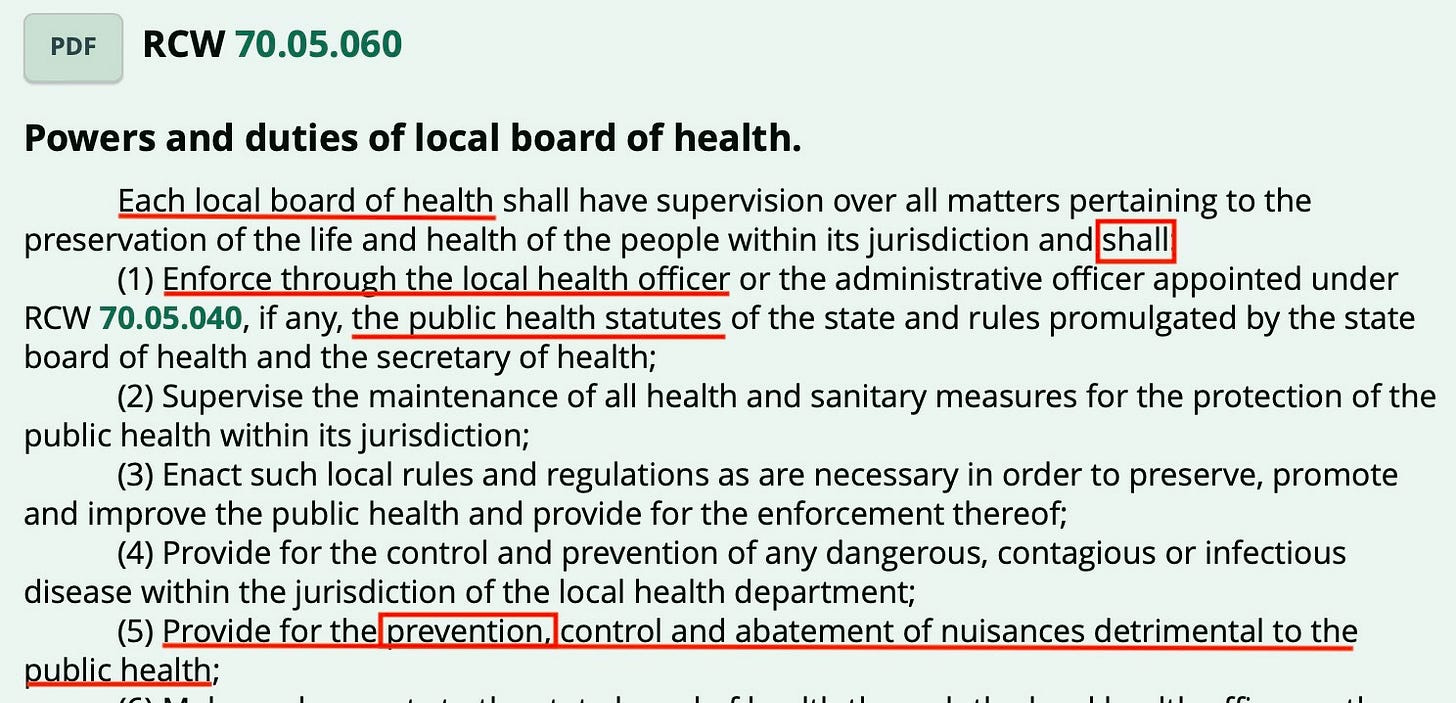
That obligation is carried out through the health officer, who under RCW 70.05.070 must enforce public health laws and take action to “prevent, control or abate nuisances.”
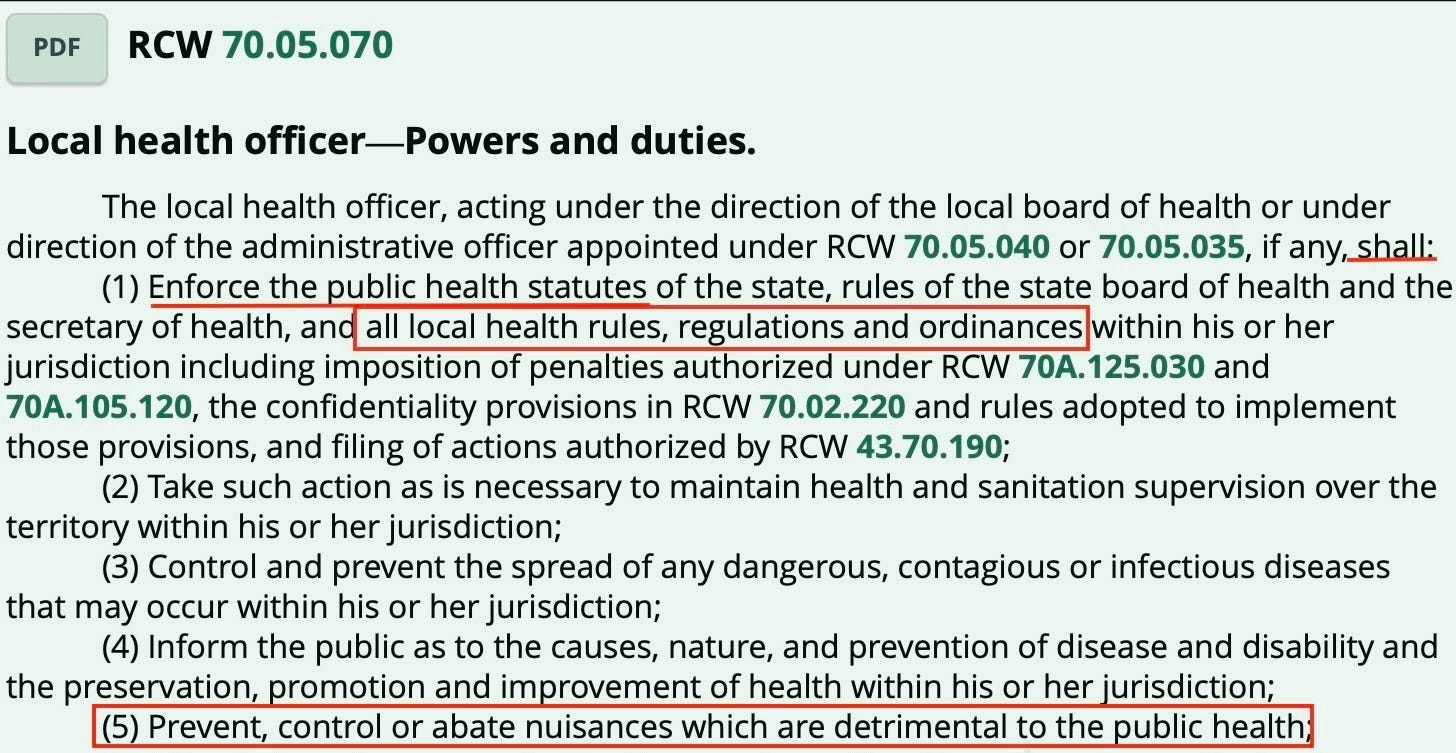
And this authority does not stop at the Port Angeles city limits. RCW 70.05.035 provides that the jurisdiction of a home-rule county’s Board of Health is “coextensive with the boundaries of the county.”
In other words: the Board of Health’s job does not end at the city line. State law gives a home-rule county board authority over the whole county, Port Angeles included.
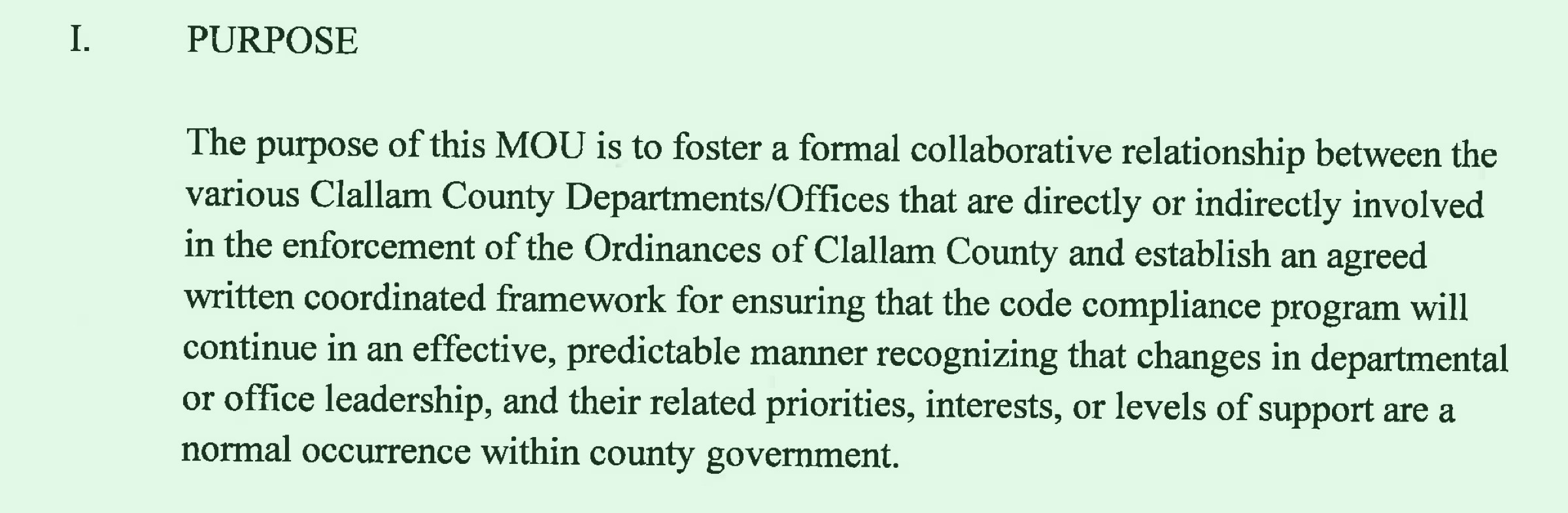
Clallam County’s own 2023 interdepartmental Code Enforcement memorandum of understanding (MOU) confirms this division of responsibility.
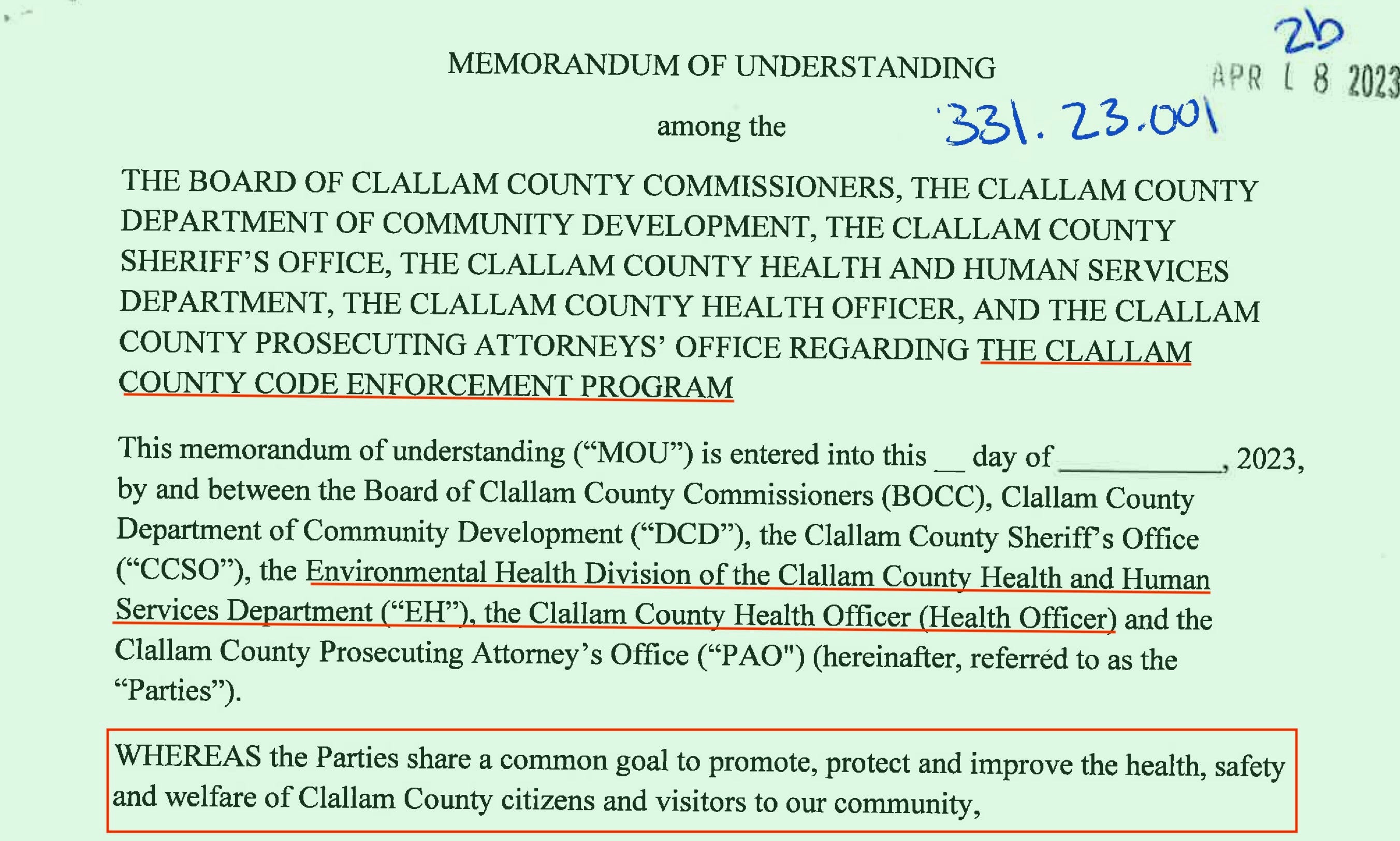
It identifies DCD as the lead enforcement agency for land use, building, shoreline, and similar regulations, while stating that Health and Human Services “shall be the lead enforcement entity concerning public health.”
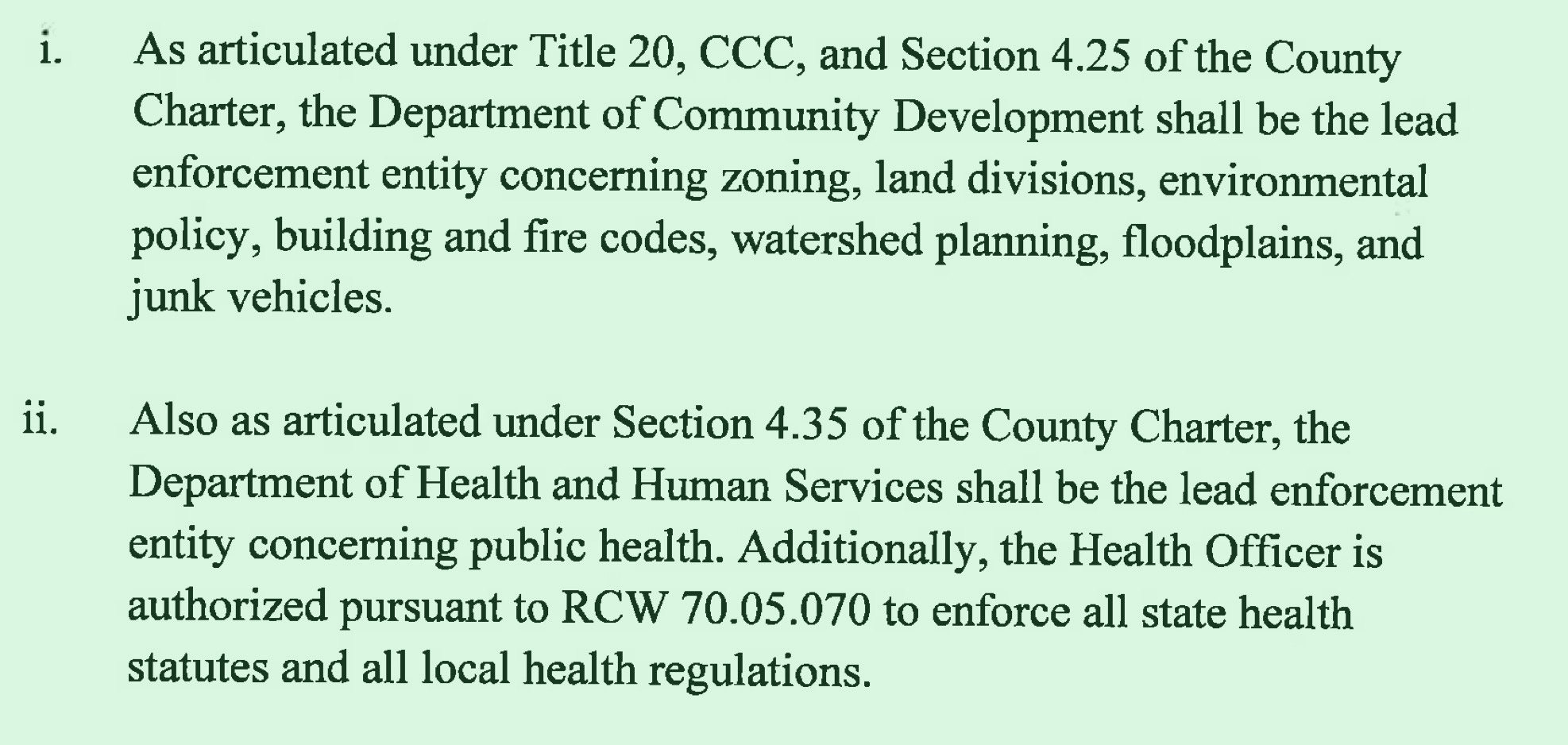
More importantly, the MOU specifically establishes a coordinated enforcement process for solid-waste violations under CCC 41.11.070 and 41.11.080. It provides that certain unresolved solid-waste violations may be referred by the HHS Director or Health Officer to the Sheriff, who can determine how best to address the violation—including referral for injunctive, declaratory, or criminal enforcement.
The MOU also requires DCD and Environmental Health to provide reciprocal investigative and evidence-gathering support and calls for ongoing coordination among DCD, Environmental Health, the Sheriff, the Health Officer, and the Prosecuting Attorney.
The commissioners are not powerless either.
Section 2.30.10 of the Clallam County Home Rule Charter gives the County Commissioners broad legislative authority to establish, abolish, combine, or divide county departments and establish their powers and responsibilities, subject to state law. RCW 36.32.120(7) separately authorizes county legislative authorities to adopt and enforce police and sanitary regulations consistent with state law.
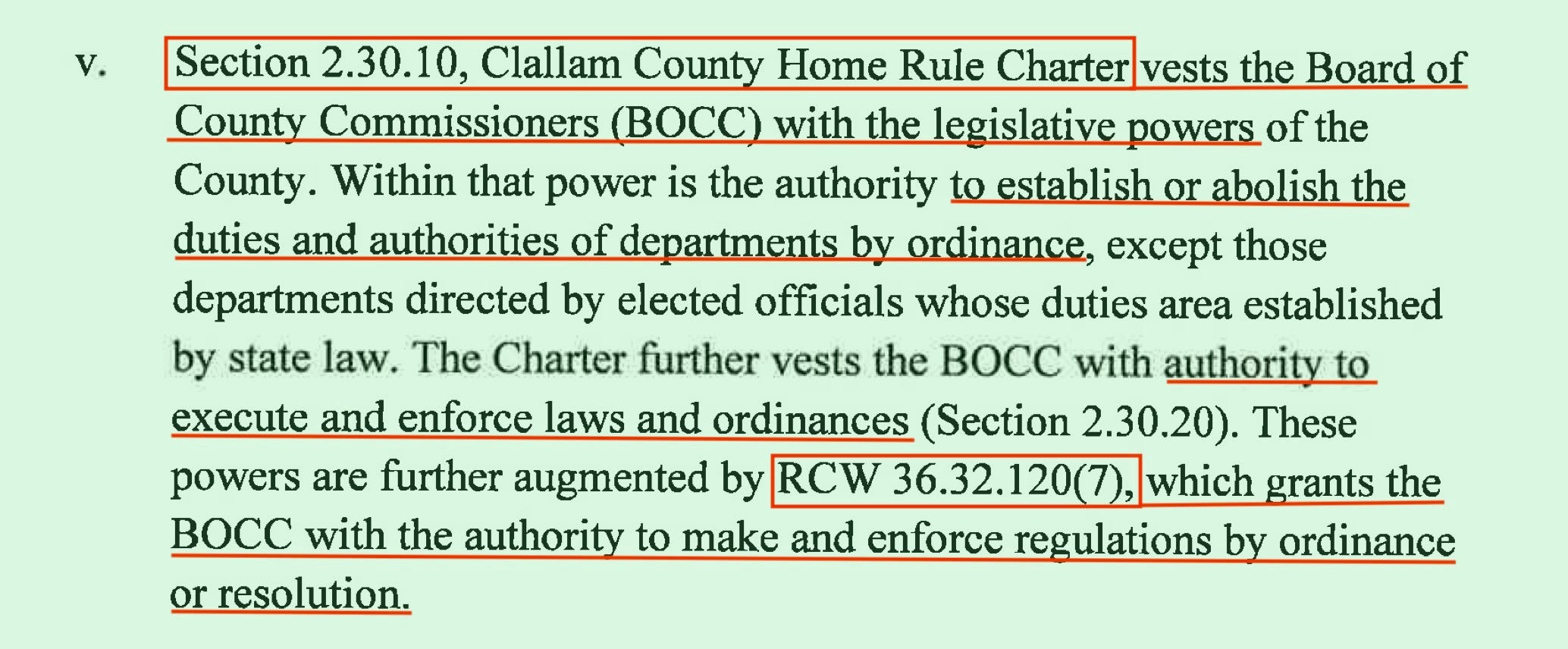
That does not necessarily mean the commissioners can transfer powers that state law specifically assigns to the Health Officer. But it does mean they have substantial authority to establish county enforcement structures, direct county departments within the limits of state law, fund enforcement, adopt additional lawful nuisance regulations, and demand coordination among county agencies.
In fact, the county’s own 2023 MOU was created for exactly that purpose: to coordinate enforcement authority across departments rather than operate in silos.
So, why aren’t these existing authorities and interdepartmental relationships being utilized to address demonstrated threats to public health, safety, and the environment—instead of expending valuable code enforcement resources pursuing businesses and property owners where there is no complaint or demonstrated community harm?
Before DCD and Code Enforcement are granted additional authority, fees, and discretion through the Comprehensive Plan process, county commissioners and residents should ask a basic question:
Is Code Enforcement currently using the authority, resources, and discretion it already possesses in the manner that best serves the public?
Why were substantial County resources dedicated to pursuing a business with no known public complaints or adverse safety outcomes while established threats to public safety, neighborhoods, and critical areas continue elsewhere?
That question becomes even more important when the proposed solution is more power.
More authority to assess costs against property owners.
More revenue generated through enforcement fees.
More discretion.
And greater authority to send mass notices threatening thousands of dollars in fines.
Clallam County’s Comprehensive Plan will help determine the relationship between local government and property owners for the next 20 years.
We can build a County government that works with property owners, protects individual rights, encourages small businesses, and reserves aggressive enforcement for circumstances where there is an actual threat to public safety, neighboring property, or the environment.
Or we can continue expanding a regulatory apparatus with the power and discretion to decide whom to pursue, when to pursue them, and how much pressure to apply.
Giving DCD and Code Enforcement more unchecked authority and discretion would move Clallam County further down the wrong path—away from property rights, economic opportunity, and fiscal responsibility at the very moment the County is again struggling to balance a budget that is millions of dollars in the red.
What can you do?
Email the Board through the Clerk at loni.gores@clallamcountywa.gov and copy the DCD Director at Bruce.Emery@clallamcountywa.gov.
Tell your elected leaders no new fees, no cost-shifting, and no mass-fine “amnesty” letters until the County shows how it already prioritizes cases; enforcement should not start with a self-assigned file and a 400-page threat; use existing health and MOU authority on real sewage and solid-waste problems first; and publish the backlog—how many cases, what priority, and who decides.
Editor’s note: This blog is published by Jeff Tozzer, the former campaign manager of Jake Seegers. Several opinion pieces appearing on this website have been authored by Jake Seegers. In keeping with normal editorial practices, op-eds written by Seegers have been edited for grammar, clarity, length, and style by Jeff Tozzer before publication, with the consent of Jake Seegers.


