


This isn’t Sundays With Seegers. It’s a Sunday about Seegers. Just over a week ago, Clallam County Commissioner candidate Jake Seegers tried to publish an opinion in the Peninsula Daily News—not as a candidate, but as a Port Angeles resident concerned about his community. He sent it from his personal email, offered solutions, and asked a question many residents are asking about the county’s harm-reduction policies: if things are working, why are the outcomes getting worse? Three days later, the paper replied that candidates for public office are not allowed to submit letters or opinion pieces. In other words, the moment Jake filed to run, he apparently lost his seat at one of the most basic tables of local democracy.
Just over a week ago, Jake Seegers sent this email to the Peninsula Daily News:
To Whom it May Concern,
My name is Jake Seegers. I live in Port Angeles.
Below is an op-ed submission for your review. Please note that I am separately submitting a shorter version as a letter to the editor. I will leave it up to PDN to determine which version is most appropriate for publishing.
Thank you in advance for your consideration.
Kind regards,
Jake Seegers
Outcomes, Not Labels
“A rose by any other name would smell as sweet.” Shakespeare’s famous line reminds us that labels do not change reality. Outcomes do.
But, whatever name is used, Clallam County’s “harm reduction” results are unmistakably putrid.
In recent weeks, Health Officer Allison Berry and Health and Human Services Deputy Director Jennifer Oppelt have defended the distribution of drug-use supplies as a way to reduce harm. They have compared handing out pipes and syringes to wearing seatbelts and installing guardrails on highways.
The analogy fails immediately. Reckless drivers who endanger themselves and others are removed from the road through license suspension or incarceration. Society does not hand them the keys to a vehicle and encourage them to keep driving.
The results of Clallam County’s harm-reduction approach are difficult to ignore. From 2018 to a 12-month peak in March 2023, overdose deaths in Clallam County rose from 8 to 51 — a 538 percent increase, according to the Deputy Coroner.
Over the same period, Washington State saw a 204 percent increase, while the national rise was 64 percent. States such as Idaho, where distribution of drug-use supplies has historically been restricted, experienced far smaller increases and continue to report significantly lower overdose death rates.
Supporters of current policy argue that drug-use supply distribution keeps people alive long enough to seek treatment. But residents are asking a simple question: if these policies are working, why are the outcomes getting worse? Despite recent declines, 2025 overdose deaths remained more than triple those reported in 2018.
Meanwhile, residents have witnessed the expansion of homelessness and open drug use firsthand, along with discarded drug-use supplies scattered across forests and waterways.Compassion does not mean abandoning accountability and expectations for our neighbors trapped in addiction. In fact, survivors of addiction frequently credit structured environments — jail and inpatient treatment — as the turning point in their lives. Sobriety began when access to drugs stopped, not when drug use became safer.
Outcomes—not labels—are what matter.
The outcomes our community seeks are clear: people graduating from addiction into sobriety and individuals moving from homelessness and dependency into stability and self-sufficiency.
Current policies embraced by city and county leadership have made Clallam County a place of least resistance for homelessness and substance abuse. That must change. Local leaders can begin by:
1. Ending outdoor living on public land by consistently enforcing existing laws.
2. Prioritizing local housing resources for individuals currently residing in Clallam County.
3. Strengthening shelter policies so services are supportive and attractive for those leaving outdoor living.
4. Expanding transitional shelter capacity rather than focusing primarily on costly permanent supportive housing.
5. Reducing the cash flow that fuels addiction through clear anti-panhandling signage and public education.
6. Redirecting funding from drug-use supplies to treatment programs with measurable results.
7. Measuring success by outcomes — tracking how many individuals move from addiction to sobriety and from homelessness to stable lives.
Clallam County residents are not asking for better messaging. They are asking for results.
Jake sent the piece not as a candidate, but as a resident of Port Angeles concerned about the future of his hometown and the community where he is raising his children. He sent it from his personal email address, not his campaign account, and offered what many readers would recognize as a straightforward civic contribution: research, questions, and proposed solutions.
Three days later, the Peninsula Daily News replied.
Thank you for your submission to Peninsula Voices.
Unfortunately, our editorial policy precludes letters or opinion pieces from candidates for public office.
John Hauck
news assistant
Jake followed up with a reasonable question.
Hi John,
Thank you for getting back to me.
Is that standard policy in the industry? Although I am currently running for office, I continue to be a private citizen as well.
Are currently elected officials also prohibited from writing for PDN during re-election campaign years, or is this a policy specific to non-elected candidates?
I appreciate your clarification, and thank you again for your time.
Kind regards,
Jake
Hauck replied shortly afterward:
I can’t speak for the rest of the industry, but it has been our editorial policy during the seven years that I have worked here.
If an incumbent is running for reelection we would not accept letters or opinion pieces from him or her.
John Hauck
news assistant
So there you have it.
A resident writes about a public policy affecting his community. He provides data, proposes solutions, and asks a question that many neighbors are already asking. But because he declared his candidacy late last year, he apparently forfeited the ability to participate in this part of the public conversation.
That raises a natural question: who is allowed to write opinions in local papers?
The contradiction becomes obvious when you look at how the same topic has been handled in local media.
A county commissioner was able to publish an article arguing that harm-reduction policies are working. Yet a private citizen—who submitted a researched opinion arguing the opposite—was told he could not publish his view at all. In other words, the public can read government officials explaining why government policy is successful, but a resident presenting data and questioning those same policies is denied space in the conversation.
For example, Clallam County Commissioner Mark Ozias was able to publish a lengthy column last year promoting the county’s harm-reduction strategy titled “County Spotlight: Clallam seeing far fewer overdose deaths.”
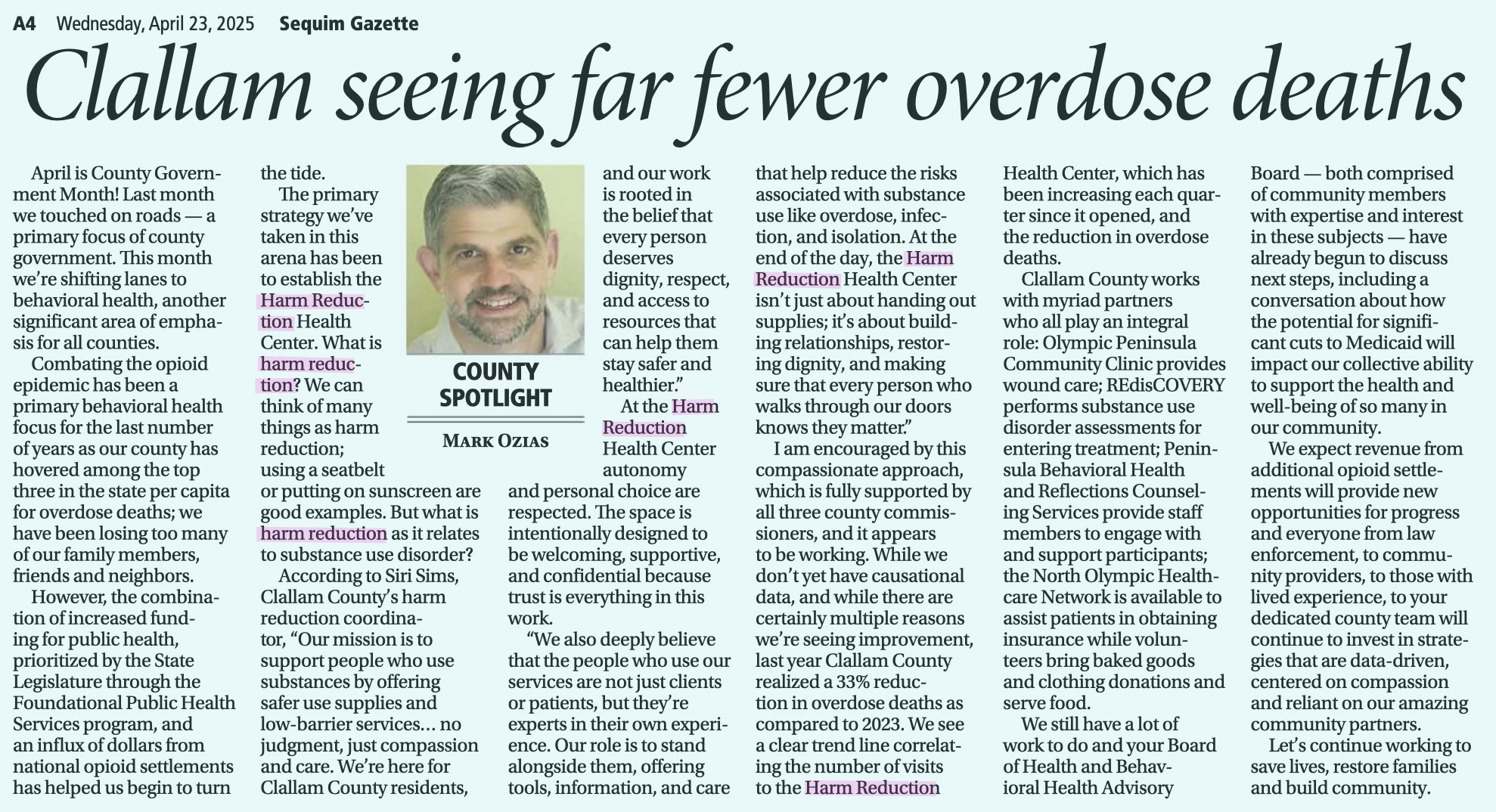
It appeared in the Sequim Gazette, which is owned by Sound Publishing—the same parent company that owns the Peninsula Daily News.
Notably, the article is not labeled as opinion, and nowhere in the piece does Ozias clearly identify himself as a county commissioner. A newcomer to Clallam County might easily read it as a straight news article written by a reporter impressed with county government’s work.
This is what happens when government officials are allowed to publish narratives about government programs in local media without clear labeling.
It’s also why the question of gatekeeping inevitably comes up.
Are dissenting voices being filtered out?
Have some outlets grown comfortable serving as a platform for those already in power while ordinary residents struggle to be heard?
Even readers have begun asking the question. A recent letter published in the Sequim Gazette put it plainly:
“Where are the letters to the editor with the other side of opinions? The Gazette needs to hear from a balance of people.”

That concern isn’t new.
When two private citizens supported the creation of a new “Water Steward” government position last year, they were granted space in the Gazette to advocate for it.
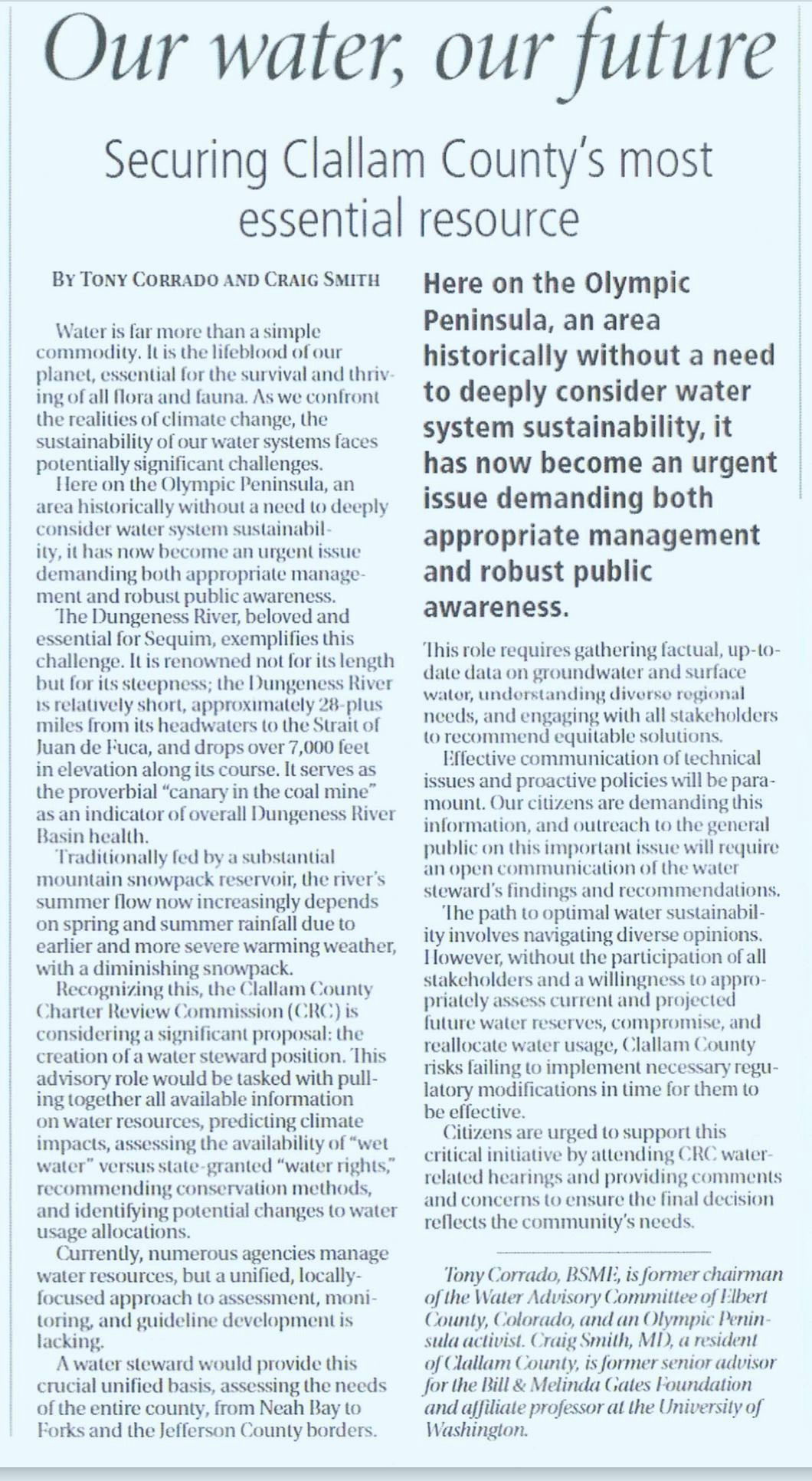
When others asked to publish opposing viewpoints, the door closed.
Meanwhile, Sound Publishing’s Olympic Peninsula Business Report—released yesterday—featured articles written by government agencies including Peninsula College, the Elwha Tribe, the PUD, the Economic Development Council, and Clallam County itself.
Commissioner Mike French contributed a piece celebrating the federal Recompete grant his team helped secure. The article describes the program as being on the “precipice of progress,” yet it does not mention that the first year connected only 31 people to employment or provide measurable outcomes.
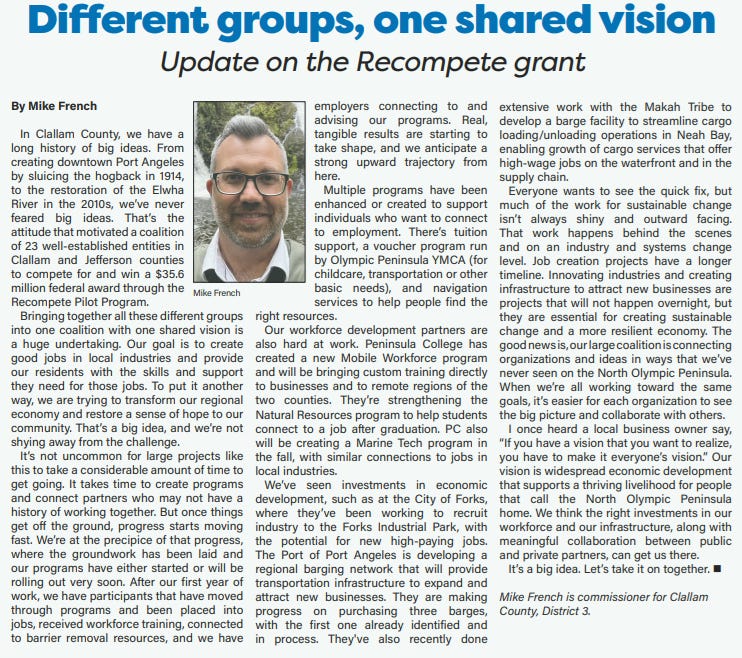
Instead, readers are told much of the work happens “behind the scenes.”
And that, increasingly, is what the local media landscape looks like.
Government writing about how successful government programs are — officials effectively narrating their own performance. Meanwhile, private citizens with research, questions, and widely shared concerns struggle to find space in the conversation.
That is why independent local voices matter more than ever.
Residents who care about the future of Clallam County are finding other places to speak and listen—to outlets like the Strait Shooter, Clallamity Jen, Clallam County Letters, the Sequim Monitor, and Clallam County Watchdog.
You can also support the work of the Olympic Herald, which has been digging into the details of what is happening inside our local courts.
But most importantly, residents can support people who are willing to step forward and challenge the status quo.
Because if local media stops representing the public conversation, the public will eventually find new places to have it.
And this year, many voters believe that voice will come through Jake Seegers, a Port Angeles resident who tried to participate in the discussion—and was told he no longer could.
Editor’s Note: CC Watchdog editor Jeff Tozzer also serves as campaign manager for Jake Seegers during his run for Clallam County Commissioner, District 3. Learn more at www.JakeSeegers.com.


